Qsarphysicochemical parameters,hansch analysis andfee Wilson
analysis
Submitted to:
VIMAL JOHN SAMUEL
Department of pharmacology
DSU
Submitted by:
Ranjeeth k
1ST year M pharm
Department of pharmacology
DSU
05-06-2020 1
contents
INTRODUCTION
PHYSICOCHEMICAL PARAMETERS
HANSCH ANALYSIS
FREE WILSON ANALYSIS
REFERENCES
05-06-2020 2
introduction
A QSAR is a mathematical relationship between a biological activity of a molecular
system and its geometric and chemical characteristics.
QSAR attempts to find consistent relationship between biological activity and
molecular properties, so that these “rules” can be used to evaluate the activity of new
compounds.
QSAR involves the derivation of mathematical formula which relates the
biological activities of a group of compounds to their measurable physicochemical
parameters. These parameters have major influence on the drug’s activity.
05-06-2020 3
Physicochemicalparamaeters
Various parameters used in QSAR studies are:
Hydrophobicity: partition coefficient, π-substitution constant
Steric Parameters: Taft’s constant, verloop steric parameter
Electronic Parameter: Hammet constant, dipole moment
05-06-2020 4
hydropobicity
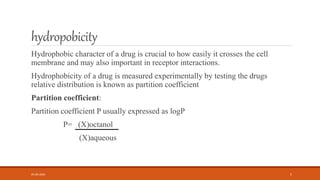
Hydrophobic character of a drug is crucial to how easily it crosses the cell
membrane and may also important in receptor interactions.
Hydrophobicity of a drug is measured experimentally by testing the drugs
relative distribution is known as partition coefficient
Partition coefficient:
Partition coefficient P usually expressed as logP
P= (X)octanol
(X)aqueous
05-06-2020 5
Contd..
π-substituent constant
The π-substituent constant defined by hansch and coworkers by the following
equation.
Partition coefficient can be calculated by knowing the contribution that various
substituent , is known as substituent hydrophobicity constant.
πx= log Px-log PH
05-06-2020 6
StericParameters
It is a measure of the bulkiness of the group it represents and it effects on the
closeness of contact between the drug and receptor site
Bulky substituent may help to orient a drug property for maximum binding and
increase activity.
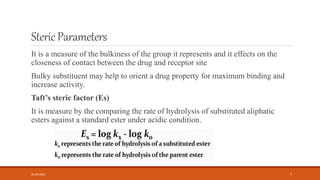
Taft’s steric factor (Es)
It is measure by the comparing the rate of hydrolysis of substituted aliphatic
esters against a standard ester under acidic condition.
05-06-2020 7
Contd..
Verloop steric parameter
• Calculated by software STERIMOL
• Gives dimensions of substituent from the standard bond angle, van der waals
radii,bond length.
05-06-2020 8
ElectronicParameter
The electronic effect of various substituent will clearly have an effect on drug
ionization and polarity.
• Have an effect on how easily drug can pass through the cell membrane or how
strongly it can interact with a binding site.
The Hammett constant (σ)
sx= log (Kx/K benzoic)
Hammett constant takes into account both resonance and inductive effects; thus,
the value depends on whether the substituent is para or meta substituted
• -ortho not measured due to steric effects
05-06-2020 9
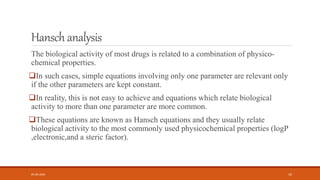
Hansch analysis
The biological activity of most drugs is related to a combination of physico-
chemical properties.
In such cases, simple equations involving only one parameter are relevant only
if the other parameters are kept constant.
In reality, this is not easy to achieve and equations which relate biological
activity to more than one parameter are more common.
These equations are known as Hansch equations and they usually relate
biological activity to the most commonly used physicochemical properties (logP
,electronic,and a steric factor).
05-06-2020 10
Contd..
If the range of hydrophobicity values is limited to a small range then the equation
will be linear .
log(1/C)= k1 log P + k2s + k3 Es +k4.
If the P values are spread over a large range then the equation will be parabolic
for the same reasons.
log (1/C) = - k1(log P)2 + k2 log P + k3 s + k4 Es +k5
05-06-2020 11
Hansch equation
•A QSAR equation relating various physicochemical properties to the biological
activity of a series of compounds
•Usually includes log P, electronic and steric factors
•Start with simple equations and elaborate as more structures are synthesised
•Typical equation for a wide range of log P is parabolic
05-06-2020 12
Contd..
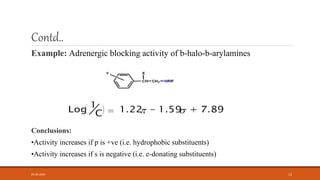
Example: Adrenergic blocking activity of b-halo-b-arylamines
Conclusions:
•Activity increases if p is +ve (i.e. hydrophobic substituents)
•Activity increases if s is negative (i.e. e-donating substituents)
05-06-2020 13
Contd..
Hansch Equation
Example : Antimalarial activity of phenanthrene aminocarbinols
05-06-2020 14
Contd..
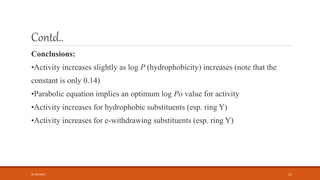
Conclusions:
•Activity increases slightly as log P (hydrophobicity) increases (note that the
constant is only 0.14)
•Parabolic equation implies an optimum log Po value for activity
•Activity increases for hydrophobic substituents (esp. ring Y)
•Activity increases for e-withdrawing substituents (esp. ring Y)
05-06-2020 15
Free-WilsonApproach
METHOD
•The biological activity of the parent structure is measured and compared
with the activity of analogues bearing different substituents
•An equation is derived relating biological activity to the presence or absence
of particular substituents
Activity = k1X1 + k2X2 +.…knXn + Z
•Xn is an indicator variable which is given the value 0 or 1 depending on whether the
substituent (n) is present or not
•The contribution of each substituent (n) to activity is determined by the value of kn
•Z is a constant representing the overall activity of the structures studied
05-06-2020 16
Contd…
Advantages
•No need for physicochemical constants or tables
•Useful for structures with unusual substituents
•Useful for quantifying the biological effects of molecular features that cannot be quantified or
tabulated by the Hansch method
Disadvantages
•A large number of analogues need to be synthesised to represent each different
substituent and each different position of a substituent
•It is difficult to rationalise why specific substituents are good or bad for activity
•The effects of different substituents may not be additive
(e.g. intramolecular interactions)
05-06-2020 17
references
Patrick L . Graham “ An introduction to medicinalchemistry ’’ 4th edition by
Oxford University, NewYork.
http://www.ccl.net/qsar/archives/0207/0029.html
QSAR: Hansch Analysis And Related Approaches, By Hugo Kubinyi, VCH
Publication.
Department of Chemistry, Pomona College, Claremont,California The
Physicochemical Approach to Drug Design and Discovery (QSAR) Drug
Development Research 1267-309 (1981)
Hansch, C.. Leo. A.: Substituent Constants for Correlation Analysis in
Chemistry and Biology, New York: Wiley-Interscience, 1979.
05-06-2020 18
Thank you
05-06-2020 19

Qsar parameters by ranjeeth k

  • 1.
    Qsarphysicochemical parameters,hansch analysisandfee Wilson analysis Submitted to: VIMAL JOHN SAMUEL Department of pharmacology DSU Submitted by: Ranjeeth k 1ST year M pharm Department of pharmacology DSU 05-06-2020 1
  • 2.
  • 3.
    introduction A QSAR isa mathematical relationship between a biological activity of a molecular system and its geometric and chemical characteristics. QSAR attempts to find consistent relationship between biological activity and molecular properties, so that these “rules” can be used to evaluate the activity of new compounds. QSAR involves the derivation of mathematical formula which relates the biological activities of a group of compounds to their measurable physicochemical parameters. These parameters have major influence on the drug’s activity. 05-06-2020 3
  • 4.
    Physicochemicalparamaeters Various parameters usedin QSAR studies are: Hydrophobicity: partition coefficient, π-substitution constant Steric Parameters: Taft’s constant, verloop steric parameter Electronic Parameter: Hammet constant, dipole moment 05-06-2020 4
  • 5.
    hydropobicity Hydrophobic character ofa drug is crucial to how easily it crosses the cell membrane and may also important in receptor interactions. Hydrophobicity of a drug is measured experimentally by testing the drugs relative distribution is known as partition coefficient Partition coefficient: Partition coefficient P usually expressed as logP P= (X)octanol (X)aqueous 05-06-2020 5
  • 6.
    Contd.. π-substituent constant The π-substituentconstant defined by hansch and coworkers by the following equation. Partition coefficient can be calculated by knowing the contribution that various substituent , is known as substituent hydrophobicity constant. πx= log Px-log PH 05-06-2020 6
  • 7.
    StericParameters It is ameasure of the bulkiness of the group it represents and it effects on the closeness of contact between the drug and receptor site Bulky substituent may help to orient a drug property for maximum binding and increase activity. Taft’s steric factor (Es) It is measure by the comparing the rate of hydrolysis of substituted aliphatic esters against a standard ester under acidic condition. 05-06-2020 7
  • 8.
    Contd.. Verloop steric parameter •Calculated by software STERIMOL • Gives dimensions of substituent from the standard bond angle, van der waals radii,bond length. 05-06-2020 8
  • 9.
    ElectronicParameter The electronic effectof various substituent will clearly have an effect on drug ionization and polarity. • Have an effect on how easily drug can pass through the cell membrane or how strongly it can interact with a binding site. The Hammett constant (σ) sx= log (Kx/K benzoic) Hammett constant takes into account both resonance and inductive effects; thus, the value depends on whether the substituent is para or meta substituted • -ortho not measured due to steric effects 05-06-2020 9
  • 10.
    Hansch analysis The biologicalactivity of most drugs is related to a combination of physico- chemical properties. In such cases, simple equations involving only one parameter are relevant only if the other parameters are kept constant. In reality, this is not easy to achieve and equations which relate biological activity to more than one parameter are more common. These equations are known as Hansch equations and they usually relate biological activity to the most commonly used physicochemical properties (logP ,electronic,and a steric factor). 05-06-2020 10
  • 11.
    Contd.. If the rangeof hydrophobicity values is limited to a small range then the equation will be linear . log(1/C)= k1 log P + k2s + k3 Es +k4. If the P values are spread over a large range then the equation will be parabolic for the same reasons. log (1/C) = - k1(log P)2 + k2 log P + k3 s + k4 Es +k5 05-06-2020 11
  • 12.
    Hansch equation •A QSARequation relating various physicochemical properties to the biological activity of a series of compounds •Usually includes log P, electronic and steric factors •Start with simple equations and elaborate as more structures are synthesised •Typical equation for a wide range of log P is parabolic 05-06-2020 12
  • 13.
    Contd.. Example: Adrenergic blockingactivity of b-halo-b-arylamines Conclusions: •Activity increases if p is +ve (i.e. hydrophobic substituents) •Activity increases if s is negative (i.e. e-donating substituents) 05-06-2020 13
  • 14.
    Contd.. Hansch Equation Example :Antimalarial activity of phenanthrene aminocarbinols 05-06-2020 14
  • 15.
    Contd.. Conclusions: •Activity increases slightlyas log P (hydrophobicity) increases (note that the constant is only 0.14) •Parabolic equation implies an optimum log Po value for activity •Activity increases for hydrophobic substituents (esp. ring Y) •Activity increases for e-withdrawing substituents (esp. ring Y) 05-06-2020 15
  • 16.
    Free-WilsonApproach METHOD •The biological activityof the parent structure is measured and compared with the activity of analogues bearing different substituents •An equation is derived relating biological activity to the presence or absence of particular substituents Activity = k1X1 + k2X2 +.…knXn + Z •Xn is an indicator variable which is given the value 0 or 1 depending on whether the substituent (n) is present or not •The contribution of each substituent (n) to activity is determined by the value of kn •Z is a constant representing the overall activity of the structures studied 05-06-2020 16
  • 17.
    Contd… Advantages •No need forphysicochemical constants or tables •Useful for structures with unusual substituents •Useful for quantifying the biological effects of molecular features that cannot be quantified or tabulated by the Hansch method Disadvantages •A large number of analogues need to be synthesised to represent each different substituent and each different position of a substituent •It is difficult to rationalise why specific substituents are good or bad for activity •The effects of different substituents may not be additive (e.g. intramolecular interactions) 05-06-2020 17
  • 18.
    references Patrick L .Graham “ An introduction to medicinalchemistry ’’ 4th edition by Oxford University, NewYork. http://www.ccl.net/qsar/archives/0207/0029.html QSAR: Hansch Analysis And Related Approaches, By Hugo Kubinyi, VCH Publication. Department of Chemistry, Pomona College, Claremont,California The Physicochemical Approach to Drug Design and Discovery (QSAR) Drug Development Research 1267-309 (1981) Hansch, C.. Leo. A.: Substituent Constants for Correlation Analysis in Chemistry and Biology, New York: Wiley-Interscience, 1979. 05-06-2020 18
  • 19.