Quantitative Structure Activity
Relationships (QSAR)
UMA BANSAL
MSC. BIOCHEMISTRY IV SEM
CONTENTS
• INTRODUCTION
• HYDROPHOBICITY OF MOLECULES
• HYDROPHOBICITY OF SUBSTITUENTS
• ELECTRONIC EFFECT
• STERIC EFFECT
• HANSCH EQUATION
• CRAIG PLOT
• ADVANTAGES
•DISADVANTAGES
•APPLICATIONS
• REFERENCES
INTRODUCTION
Drug designing....
Principles of drug designing
1. Improving the binding of drugs.
2. Increasing the selectivity.
3. Reduce side effects.
4. Easy synthesisable.
5. Arrangement functional groups
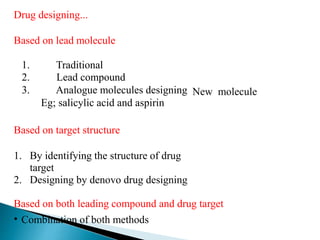
Drug designing...
Based on lead molecule
1. Traditional
2. Lead compound
3. Analogue molecules designing
Eg; salicylic acid and aspirin
New molecule
Based on target structure
1. By identifying the structure of drug
target
2. Designing by denovo drug designing
Based on both leading compound and drug target
• Combination of both methods
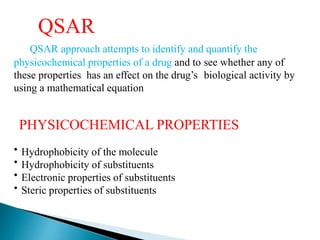
QSAR
QSAR approach attempts to identify and quantify the
physicochemical properties of a drug and to see whether any of
these properties has an effect on the drug’s biological activity by
using a mathematical equation
PHYSICOCHEMICAL PROPERTIES
•
•
•
•
Hydrophobicity of the molecule
Hydrophobicity of substituents
Electronic properties of substituents
Steric properties of substituents
A range of compounds is synthesized in order to vary one
physicochemical property and to test it affects the bioactivity.
A graph is then drawn to plot the biological activity on the
y axis versus the physicochemical feature on the x axis.
It is necessary to draw the best possible line through the
data points on the graph.
If we draw a line through a set of data points will be
scattered on either side of the line. The best line will be the
one closest to the data points.
are
To measure how close the
each point.
data points are , vertical lines
drawn from
.Log (1/C)
..
.. ...
0.78
.
3.82 Log P
HYDROPHOBICITY
Hydrophobic character of a drug is crucial to how easily it
crosses the cell membrane and may also important in receptor
interactions.
Hydrophobicity of a drug is measured experimentally by
testing the drugs relative distribution in octanol water mixture.
This relative distribution is known as partition coefficient.
Partition Coefficient P = [conc. Drug in in octanol]
[Conc.of drug in water]
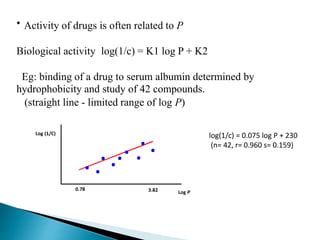
• Activity of drugs is often related to P
Biological activity log(1/c) = K1 log P + K2
Eg: binding of a drug to serum albumin determined
hydrophobicity and study of 42 compounds.
by
(straight line - limited range of log P)
.Log (1/C)
log(1/c) = 0.075 log P + 230
.. (n= 42, r= 0.960 s= 0.159)
.. ...
0.78
.
3.82 Log P
If the partition coefficient is the only
factor influencing biological activity, the
parabolic curve can expressed by the
equation
Log (1/C)
log(1/c) = -K1 (log P)2 + K2 log P + k3
Few drugs where activity is related to
log P factor alone.
Log P o
Log P
QSAR equations are only applicable
to
compounds in the same structural class
(e.g. ethers)
THE SUBSTITUENT HYDROPHOBICITY CONSTANT (π)
Partition coefficient can be calculated by knowing the
contribution that various substituents, is known as substituent
hydrophobicity constant(π)
• A measure of a substituent’s hydrophobicity relative to hydrogen
• Partition coefficient is measured experimently for a standard
compound such as benzene with or without a substituent (X).
• The hydrophobicity constant (π x) for sustituent X.
The equation is
x= logPx-logPH
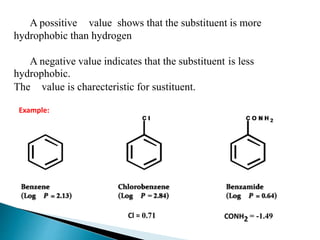
A possitive value shows that the substituent is more
hydrophobic than hydrogen
A negative value indicates that the substituent
hydrophobic.
is less
The value is charecteristic for sustituent.
Example:
= 0.71 CONH2 = -1.49Cl
THE SUBSTITUENT HYDROPHOBICITY CONSTANT (π)
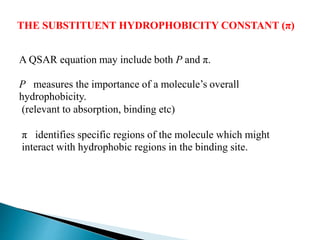
A QSAR equation may include both P and π.
P measures the importance of a molecule’s overall
hydrophobicity.
(relevant to absorption, binding etc)
π identifies specific regions of the molecule which might
interact with hydrophobic regions in the binding site.
ELECTRONIC EFFECT
The electronic effect of various sustituents will clearly have
an effect on drug ionisation and polarity.
Have an effect on how easily a drug can pass through the cell
membrane or how strongly it can interact with a binding site.
Hammet substituent constant(σ) this is a measure of electron
with-drawing or electron-donating ability of a substituents on an
aromatic ring.
σ for aromatic substituents is measured by comparing the
dissociation constants of substituted benzoic acids with
benzoic acid
+
+- HCOOH COO
-[PhCO 2]
[PhCO 2H]
=K H = Dissociation constant
σ value depends on inductive and resonance effects
σ value depends on whether the substituent is meta or para
ortho values are invalid due to steric factors
Electronic Factors R & F
• R - Quantifies a substituent’s resonance effects
• F - Quantifies a substituent’s inductive effects
The constants σ,R and F can only be used for aromatic substituents
STERIC FACTORS
The bulk, size and shape of a drug will influence how easily it can
approach and interact with binding site.
A bulky substituents may act like a shield and hinder the ideal
interaction between a drug and its binding site.
Bulky substituent may help to orient a drug properly for
maximum binding and increase activity.
Taft’s Steric Factor (Es)
• Measured by comparing the rates of hydrolysis of substituted
aliphatic esters against a standard ester under acidic conditions
Es = log kx - log ko
kx represents the rate of
hydrolysis of a substituted ester
ko represents the rate of hydrolysis of the parent ester
• Limited to substituents which interact sterically with
tetrahedral transition state for the reaction
Not by resonance or hydrogen bonding
the
•
Disadvantages
ES value measures intramolecular steric effect but drugs interact
with target binding site in intermolecular process.
Molar Refractivity (MR)
(this is a measure of a substituent’s
volume)
(n 2 - 1)
(n 2 - 2)
mol. wt.
density
MR = x
Correction factor
for polarisation
(n=index of
refraction)
Defines volume
This is perticularly significant if the substituent has π
electrons or lone pair of electrons
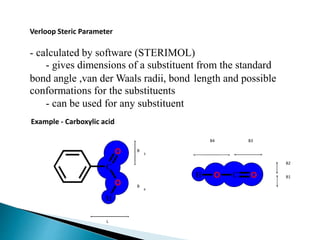
Verloop Steric Parameter
- calculated by software (STERIMOL)
- gives dimensions of a substituent from the standard
bond angle ,van der Waals radii, bond
conformations for the substituents
- can be used for any substituent
Example - Carboxylic acid
length and possible
B4 B3
O B
3
B2
C
H CO O B1
O B
4
H
L
HANSCH EQUATION
• A QSAR equation relating various physicochemical
properties to the biological activity of a series of compounds
• Usually includes log P, electronic and steric factors
• Start with simple equations and elaborate as more structures
are synthesised
• Typical equation for a wide range of log P is parabolic
- k1(logP)21CLog + k2 logP + k3 + k4 Es + k5
Craig Plot
Craig plot
properties
shows values for 2 different
for various substituents
physicochemical
.1.0
.75 . .
CF3SO2
.NO2
CN SF5
..CF3
.50CH3SO2
SO2NH2 CF3
CH CO
..
3
CONH2
O
.25
. ICO2H BrCl
.4 .8 2.01.2 1.6
..
F
. +CH3CONH
.
Et
t-Butyl
OCH3
-.5
.0
.
OH
NMe2
NH2
-.75
-1.0
-
+
. . . ..
.
-2.0 -1.6 -1.2 -.
.8 -.4
-
-.25 Me .
• Allows an easy identification of suitable substituents
a QSAR analysis which includes both relevant
properties
for
• Choose a substituent from each quadrant to ensure
orthogonality
• Choose substituents with a range of values for each
property
ADVANTAGES OF QSAR
1. Quantifying the relationship between
structure and activity provides an
understanding of the effect of structure
on activity.
2. It is also possible to make predictions
leading to synthesis of novel
analogues.
3. The results can be used to help in
understanding interaction between
functional groups in the molecules
(having greatest activity) with those of
their target.
DISADVANTAGE OF QSAR
1. False correlation may arise because of
biological data that are subject to
considerable experimental error.
2. If dataset is not large enough, many QSAR
results cannot be used to confidently predict
the, most likely compounds of best activity.
3. There are many successful applications but
one must not expect QSAR to work at all the
times.
APPLICATION OF
QSAR
1. Prediction of activity.
2. Prediction of toxicity.
3. Lead compound optimization.
REFERENCES
1. An introduction to medicinal chemistry by Graham L Patric
3rd edition pagee no:271-298
2. Foye : Principles of medicinal chemistry
3. Burgers medicinal chemistry
Qsar   UMA

Qsar UMA

  • 1.
    Quantitative Structure Activity Relationships(QSAR) UMA BANSAL MSC. BIOCHEMISTRY IV SEM
  • 2.
    CONTENTS • INTRODUCTION • HYDROPHOBICITYOF MOLECULES • HYDROPHOBICITY OF SUBSTITUENTS • ELECTRONIC EFFECT • STERIC EFFECT • HANSCH EQUATION • CRAIG PLOT • ADVANTAGES •DISADVANTAGES •APPLICATIONS • REFERENCES
  • 3.
    INTRODUCTION Drug designing.... Principles ofdrug designing 1. Improving the binding of drugs. 2. Increasing the selectivity. 3. Reduce side effects. 4. Easy synthesisable. 5. Arrangement functional groups
  • 4.
    Drug designing... Based onlead molecule 1. Traditional 2. Lead compound 3. Analogue molecules designing Eg; salicylic acid and aspirin New molecule Based on target structure 1. By identifying the structure of drug target 2. Designing by denovo drug designing Based on both leading compound and drug target • Combination of both methods
  • 5.
    QSAR QSAR approach attemptsto identify and quantify the physicochemical properties of a drug and to see whether any of these properties has an effect on the drug’s biological activity by using a mathematical equation PHYSICOCHEMICAL PROPERTIES • • • • Hydrophobicity of the molecule Hydrophobicity of substituents Electronic properties of substituents Steric properties of substituents
  • 7.
    A range ofcompounds is synthesized in order to vary one physicochemical property and to test it affects the bioactivity. A graph is then drawn to plot the biological activity on the y axis versus the physicochemical feature on the x axis. It is necessary to draw the best possible line through the data points on the graph.
  • 8.
    If we drawa line through a set of data points will be scattered on either side of the line. The best line will be the one closest to the data points. are To measure how close the each point. data points are , vertical lines drawn from .Log (1/C) .. .. ... 0.78 . 3.82 Log P
  • 9.
    HYDROPHOBICITY Hydrophobic character ofa drug is crucial to how easily it crosses the cell membrane and may also important in receptor interactions. Hydrophobicity of a drug is measured experimentally by testing the drugs relative distribution in octanol water mixture. This relative distribution is known as partition coefficient. Partition Coefficient P = [conc. Drug in in octanol] [Conc.of drug in water]
  • 10.
    • Activity ofdrugs is often related to P Biological activity log(1/c) = K1 log P + K2 Eg: binding of a drug to serum albumin determined hydrophobicity and study of 42 compounds. by (straight line - limited range of log P) .Log (1/C) log(1/c) = 0.075 log P + 230 .. (n= 42, r= 0.960 s= 0.159) .. ... 0.78 . 3.82 Log P
  • 11.
    If the partitioncoefficient is the only factor influencing biological activity, the parabolic curve can expressed by the equation Log (1/C) log(1/c) = -K1 (log P)2 + K2 log P + k3 Few drugs where activity is related to log P factor alone. Log P o Log P QSAR equations are only applicable to compounds in the same structural class (e.g. ethers)
  • 12.
    THE SUBSTITUENT HYDROPHOBICITYCONSTANT (π) Partition coefficient can be calculated by knowing the contribution that various substituents, is known as substituent hydrophobicity constant(π) • A measure of a substituent’s hydrophobicity relative to hydrogen • Partition coefficient is measured experimently for a standard compound such as benzene with or without a substituent (X). • The hydrophobicity constant (π x) for sustituent X. The equation is x= logPx-logPH
  • 13.
    A possitive valueshows that the substituent is more hydrophobic than hydrogen A negative value indicates that the substituent hydrophobic. is less The value is charecteristic for sustituent. Example: = 0.71 CONH2 = -1.49Cl
  • 14.
    THE SUBSTITUENT HYDROPHOBICITYCONSTANT (π) A QSAR equation may include both P and π. P measures the importance of a molecule’s overall hydrophobicity. (relevant to absorption, binding etc) π identifies specific regions of the molecule which might interact with hydrophobic regions in the binding site.
  • 15.
    ELECTRONIC EFFECT The electroniceffect of various sustituents will clearly have an effect on drug ionisation and polarity. Have an effect on how easily a drug can pass through the cell membrane or how strongly it can interact with a binding site. Hammet substituent constant(σ) this is a measure of electron with-drawing or electron-donating ability of a substituents on an aromatic ring.
  • 16.
    σ for aromaticsubstituents is measured by comparing the dissociation constants of substituted benzoic acids with benzoic acid + +- HCOOH COO -[PhCO 2] [PhCO 2H] =K H = Dissociation constant
  • 17.
    σ value dependson inductive and resonance effects σ value depends on whether the substituent is meta or para ortho values are invalid due to steric factors Electronic Factors R & F • R - Quantifies a substituent’s resonance effects • F - Quantifies a substituent’s inductive effects The constants σ,R and F can only be used for aromatic substituents
  • 18.
    STERIC FACTORS The bulk,size and shape of a drug will influence how easily it can approach and interact with binding site. A bulky substituents may act like a shield and hinder the ideal interaction between a drug and its binding site. Bulky substituent may help to orient a drug properly for maximum binding and increase activity.
  • 19.
    Taft’s Steric Factor(Es) • Measured by comparing the rates of hydrolysis of substituted aliphatic esters against a standard ester under acidic conditions Es = log kx - log ko kx represents the rate of hydrolysis of a substituted ester ko represents the rate of hydrolysis of the parent ester • Limited to substituents which interact sterically with tetrahedral transition state for the reaction Not by resonance or hydrogen bonding the • Disadvantages ES value measures intramolecular steric effect but drugs interact with target binding site in intermolecular process.
  • 20.
    Molar Refractivity (MR) (thisis a measure of a substituent’s volume) (n 2 - 1) (n 2 - 2) mol. wt. density MR = x Correction factor for polarisation (n=index of refraction) Defines volume This is perticularly significant if the substituent has π electrons or lone pair of electrons
  • 21.
    Verloop Steric Parameter -calculated by software (STERIMOL) - gives dimensions of a substituent from the standard bond angle ,van der Waals radii, bond conformations for the substituents - can be used for any substituent Example - Carboxylic acid length and possible B4 B3 O B 3 B2 C H CO O B1 O B 4 H L
  • 22.
    HANSCH EQUATION • AQSAR equation relating various physicochemical properties to the biological activity of a series of compounds • Usually includes log P, electronic and steric factors • Start with simple equations and elaborate as more structures are synthesised • Typical equation for a wide range of log P is parabolic - k1(logP)21CLog + k2 logP + k3 + k4 Es + k5
  • 23.
    Craig Plot Craig plot properties showsvalues for 2 different for various substituents physicochemical .1.0 .75 . . CF3SO2 .NO2 CN SF5 ..CF3 .50CH3SO2 SO2NH2 CF3 CH CO .. 3 CONH2 O .25 . ICO2H BrCl .4 .8 2.01.2 1.6 .. F . +CH3CONH . Et t-Butyl OCH3 -.5 .0 . OH NMe2 NH2 -.75 -1.0 - + . . . .. . -2.0 -1.6 -1.2 -. .8 -.4 - -.25 Me .
  • 24.
    • Allows aneasy identification of suitable substituents a QSAR analysis which includes both relevant properties for • Choose a substituent from each quadrant to ensure orthogonality • Choose substituents with a range of values for each property
  • 25.
    ADVANTAGES OF QSAR 1.Quantifying the relationship between structure and activity provides an understanding of the effect of structure on activity. 2. It is also possible to make predictions leading to synthesis of novel analogues. 3. The results can be used to help in understanding interaction between functional groups in the molecules (having greatest activity) with those of their target.
  • 26.
    DISADVANTAGE OF QSAR 1.False correlation may arise because of biological data that are subject to considerable experimental error. 2. If dataset is not large enough, many QSAR results cannot be used to confidently predict the, most likely compounds of best activity. 3. There are many successful applications but one must not expect QSAR to work at all the times.
  • 27.
    APPLICATION OF QSAR 1. Predictionof activity. 2. Prediction of toxicity. 3. Lead compound optimization.
  • 28.
    REFERENCES 1. An introductionto medicinal chemistry by Graham L Patric 3rd edition pagee no:271-298 2. Foye : Principles of medicinal chemistry 3. Burgers medicinal chemistry

Editor's Notes

  • #2 UMA BANSAL MSC. BIOCHEMISTRY IV SEM