Presented by
Mr. Bharat Kumar
17mph202
Guided by
Dr. Vivek Vyas
Assistant professor
Department of Pharmacology,
Institute of Pharmacy,
Nirma university, Ahmedabad
SAR / QSAR
Definition
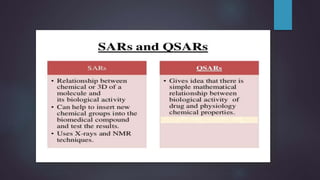
SAR (Structure activity relationship)
 The analysis of the dependence of biological effects of a chemical upon its
molecular structure.
 Molecular structure and biological activity are correlated by observing the results
of systematic structural modification on defined biological endpoints.
QSAR (Quantitative structure activity relationship)
 A QSAR is a mathematical relationship between a biological activity of a
molecular system and its geometric and chemical characteristics.
SAR / QSAR
“SAR is a qualitative not a quantitative relationship”
Structure Activity Relationship (SAR)
Aim - Identify which functional groups are important for binding and/or activity
Method
 Alter, remove or mask a functional group
 Test the analogue for activity
 Modifications may disrupt binding by electronic / steric effects
 Easiest analogues to make are those made from lead compound
 Possible modifications may depend on other groups present
 Some analogues may have to be made by a full synthesis (e.g. replacing an aromatic
ring with a cyclohexane ring)
 Allows identification of important groups involved in binding
QSAR (Quantitative structure activity relationship)
 2D analysis – In this two types
 Hansch analysis –
 Free-Wilson Analysis -
QSAR (Quantitative structure activity relationship)
 3D analysis
 Comparative Molecular Field Analysis (CoMFA) - It provide
a. Steric values
b. Electrostatic values
 Comparative Molecular Similarity Index Analysis (CoMSIA) -
It provide steric and electrostatic values and consider
1. H - bond donor
2. H - bond acceptor
3. Hydrophobic field
SAR & QSAR

SAR & QSAR

  • 1.
    Presented by Mr. BharatKumar 17mph202 Guided by Dr. Vivek Vyas Assistant professor Department of Pharmacology, Institute of Pharmacy, Nirma university, Ahmedabad SAR / QSAR
  • 2.
    Definition SAR (Structure activityrelationship)  The analysis of the dependence of biological effects of a chemical upon its molecular structure.  Molecular structure and biological activity are correlated by observing the results of systematic structural modification on defined biological endpoints. QSAR (Quantitative structure activity relationship)  A QSAR is a mathematical relationship between a biological activity of a molecular system and its geometric and chemical characteristics.
  • 4.
    SAR / QSAR “SARis a qualitative not a quantitative relationship”
  • 5.
    Structure Activity Relationship(SAR) Aim - Identify which functional groups are important for binding and/or activity Method  Alter, remove or mask a functional group  Test the analogue for activity  Modifications may disrupt binding by electronic / steric effects  Easiest analogues to make are those made from lead compound  Possible modifications may depend on other groups present  Some analogues may have to be made by a full synthesis (e.g. replacing an aromatic ring with a cyclohexane ring)  Allows identification of important groups involved in binding
  • 6.
    QSAR (Quantitative structureactivity relationship)  2D analysis – In this two types  Hansch analysis –  Free-Wilson Analysis -
  • 7.
    QSAR (Quantitative structureactivity relationship)  3D analysis  Comparative Molecular Field Analysis (CoMFA) - It provide a. Steric values b. Electrostatic values  Comparative Molecular Similarity Index Analysis (CoMSIA) - It provide steric and electrostatic values and consider 1. H - bond donor 2. H - bond acceptor 3. Hydrophobic field