Neuromuscular blocking drugs
Presented by : Komal jain.
Pharmaceutical(chemistry)
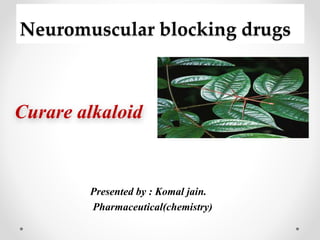
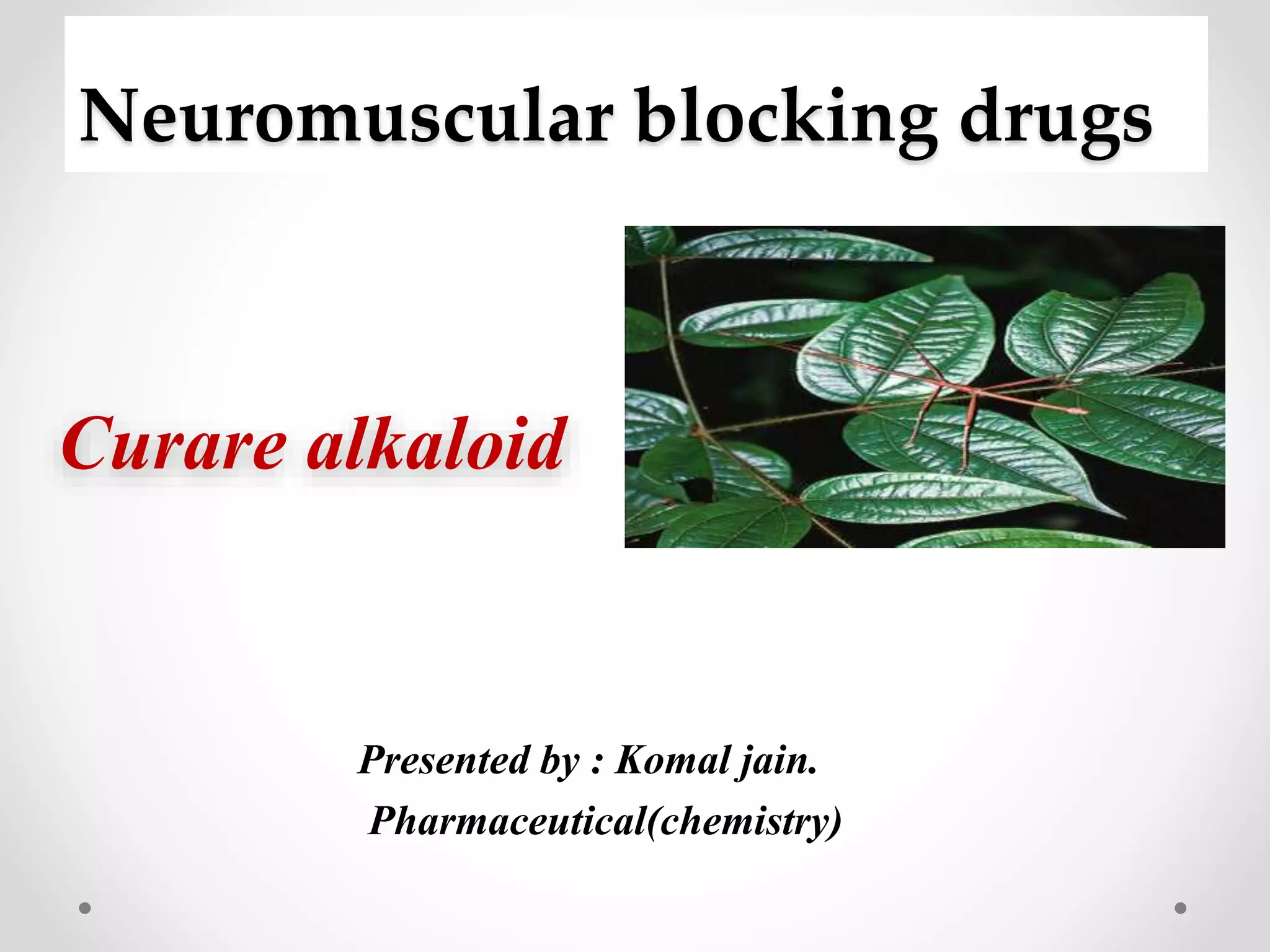
Curare alkaloid
Contents
 Introduction
 Types of neuromuscular blockers
 Curare alkaloids
 Types of curare alkaloids
 Mechanism of action
 Chemistry of curare
 Uses of curare
 Clinical features and associated disorders.
Introduction
 The neuromuscular blocking agents
are used primarily in conjunction
with general anaesthetic to provide
muscle relaxation for surgery ,while
centrally acting muscle relaxants
are used mainly for painful muscle
spasms and spastic neurological
conditions.
Types of Neuromuscular blockers
Neuromuscular blocking agents are of two types
1.Peripherally acting:
A. Non depolarizing agents
i. Long acting : d-Tubocurarine , Pancuronium ,
Pipecuronium , Doxacurium
ii. Intermediate acting : Vecuronium , Atracurium
, Rapacuronium
iii. Short acting : Mivacurium
B. Direct acting : Dantrolene sodium , Quinine
2 . Centrally acting :
• Metaxalone , Diazepam , Baclofen ,
• Tizanidine , Chlorzoxazone.
Mechanism of action
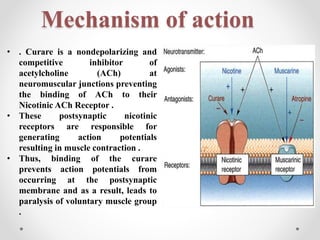
• . Curare is a nondepolarizing and
competitive inhibitor of
acetylcholine (ACh) at
neuromuscular junctions preventing
the binding of ACh to their
Nicotinic ACh Receptor .
• These postsynaptic nicotinic
receptors are responsible for
generating action potentials
resulting in muscle contraction .
• Thus, binding of the curare
prevents action potentials from
occurring at the postsynaptic
membrane and as a result, leads to
paralysis of voluntary muscle group
.
Chemistry of Curare
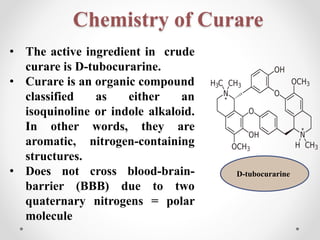
• The active ingredient in crude
curare is D-tubocurarine.
• Curare is an organic compound
classified as either an
isoquinoline or indole alkaloid.
In other words, they are
aromatic, nitrogen-containing
structures.
• Does not cross blood-brain-
barrier (BBB) due to two
quaternary nitrogens = polar
molecule
D-tubocurarine
Uses of curare
o Increased urination, reduce fever, promote
menstruation, reduce fever, and relaxation of
skeletal muscle.
o Antibacterial, anti-inflammatory, and antiseptic.
o When used for abdominal pain and treatment of
worms/parasites.
o Used as a muscle relaxant in electric shock therapy
to prevent traumatic complication.
o Curare was used in conjunction with general
anaesthetics.
Clinical features and associated disorders

Hypomagnesemia may be asymptomatic, yet when it is
symptomatic, the neurological manifestations include agitation,
tremor, myoclonus, seizures (rarely), confusion , coma, muscle
fasciculations, weakness, the presence of Chvostek's and
Trousseau's signs, tetany, and hyper‐reflexia.
 When the clinical manifestations of Mg deficiency are
determined by induction of deficiency in human , GI features
(anorexia, nausea, and vomiting), CNS features (weakness and
personality change), PNS features (positive Trousseau's and
Chvostek's signs) , tremor, and muscle fasciculations may be
observed.
curare alkaloids.pptx

curare alkaloids.pptx

  • 1.
    Neuromuscular blocking drugs Presentedby : Komal jain. Pharmaceutical(chemistry) Curare alkaloid
  • 2.
    Contents  Introduction  Typesof neuromuscular blockers  Curare alkaloids  Types of curare alkaloids  Mechanism of action  Chemistry of curare  Uses of curare  Clinical features and associated disorders.
  • 3.
    Introduction  The neuromuscularblocking agents are used primarily in conjunction with general anaesthetic to provide muscle relaxation for surgery ,while centrally acting muscle relaxants are used mainly for painful muscle spasms and spastic neurological conditions.
  • 4.
    Types of Neuromuscularblockers Neuromuscular blocking agents are of two types 1.Peripherally acting: A. Non depolarizing agents i. Long acting : d-Tubocurarine , Pancuronium , Pipecuronium , Doxacurium ii. Intermediate acting : Vecuronium , Atracurium , Rapacuronium iii. Short acting : Mivacurium B. Direct acting : Dantrolene sodium , Quinine
  • 5.
    2 . Centrallyacting : • Metaxalone , Diazepam , Baclofen , • Tizanidine , Chlorzoxazone.
  • 6.
    Mechanism of action •. Curare is a nondepolarizing and competitive inhibitor of acetylcholine (ACh) at neuromuscular junctions preventing the binding of ACh to their Nicotinic ACh Receptor . • These postsynaptic nicotinic receptors are responsible for generating action potentials resulting in muscle contraction . • Thus, binding of the curare prevents action potentials from occurring at the postsynaptic membrane and as a result, leads to paralysis of voluntary muscle group .
  • 7.
    Chemistry of Curare •The active ingredient in crude curare is D-tubocurarine. • Curare is an organic compound classified as either an isoquinoline or indole alkaloid. In other words, they are aromatic, nitrogen-containing structures. • Does not cross blood-brain- barrier (BBB) due to two quaternary nitrogens = polar molecule D-tubocurarine
  • 8.
    Uses of curare oIncreased urination, reduce fever, promote menstruation, reduce fever, and relaxation of skeletal muscle. o Antibacterial, anti-inflammatory, and antiseptic. o When used for abdominal pain and treatment of worms/parasites. o Used as a muscle relaxant in electric shock therapy to prevent traumatic complication. o Curare was used in conjunction with general anaesthetics.
  • 9.
    Clinical features andassociated disorders  Hypomagnesemia may be asymptomatic, yet when it is symptomatic, the neurological manifestations include agitation, tremor, myoclonus, seizures (rarely), confusion , coma, muscle fasciculations, weakness, the presence of Chvostek's and Trousseau's signs, tetany, and hyper‐reflexia.  When the clinical manifestations of Mg deficiency are determined by induction of deficiency in human , GI features (anorexia, nausea, and vomiting), CNS features (weakness and personality change), PNS features (positive Trousseau's and Chvostek's signs) , tremor, and muscle fasciculations may be observed.