LEAD IDENTIFICATION
Presented By
Suhas M. Patil
Roll no-MPL 12
F.Y M. Pharm
(Pharmacology)
R. C. Patel Institute of Pharmaceutical Education & Research Shirpur (M.S.)
1
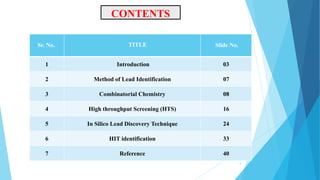
CONTENTS
1 Introduction 03
2 Method of Lead Identification 07
3 Combinatorial Chemistry 08
4 High throughput Screening (HTS) 16
5 In Silico Lead Discovery Technique 24
6 HIT identification 33
7 Reference 40
TITLESr. No. Slide No.
2
INTRODUCTION
What is lead…………..?
Once a target & a testing system has been chosen, The next is to find a lead
compound which shows the desired pharmaceutical activity
A lead compound is generally defined as a new chemical entity that could
potentially be developed into a new drug by optimizing it’s beneficial effects and
minimizing it’s side effect
3
LEAD IDENTIFICATION
A lead compound is a first foothold on the drug discovery ladder
It takes much more effort to make a lead compound into a drug candidate
DEFINITION
The identification of small molecule modulators of protein function and the
process of transforming these into high content lead series are key activities in
modern drug discovery
4
 Possible routes to identifying a lead compound are:
1. Chance observations
2. Selective optimization of side activities (SOSA approach)
3. Herbal / folk remedies
4. Screening of natural product metabolites
5. Screening of compound libraries (High-throughput)
6. “Rational” drug design
7. Natural substrate-based drug design
FINDING LEAD COMPOUND
5
STARTING IN LAB
 Without some reliable measure of potency it is impossible to conduct a systematic analysis
of possible new drugs
 Screening or assaying
 “The testing of a (series of) molecule(s) against a known biological target that correlates
with a cellular or pharmacological activity is known as screening”
(e.g. enzyme inhibition or receptor binding)
 This is now made possible / easier in modern research because macro-molecular targets
(e.g. proteins, enzymes / receptors) can be identified
 Targets are now available in large quantities using molecular biology
 Automated (High-throughput screening) technologies available
6
METHODS OF LEAD IDENTIFICATION
 Combinatorial chemistry
 High throughput screening(HTS)
 In silico lead discovery techniques
 Assay development for hit identification
7
COMBINATORIAL CHEMISTRY
 Definition:
 Combinatorial chemistry is a technique by which large numbers of different but
structurally similar molecules are produced rapidly and submitted for
pharmacological assay
 This technique uses the same reaction conditions with the same reaction vessels
to produce a large range of analogues
8
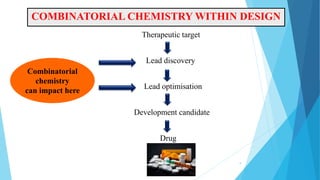
COMBINATORIAL CHEMISTRY WITHIN DESIGN
Therapeutic target
Lead discovery
Lead optimisation
Development candidate
Drug
Combinatorial
chemistry
can impact here
9
SYNTHETIC METHODOLOGIES FOR PRODUCTION OF
LIBRARIES
1. Solid Phase Techniques
2. Parallel Synthesis
i) Houghton’s Tea Bag Procedure
ii) Automated parallel synthesis
iii) Automated parallel synthesis of all 27 tripeptides from 3 amino acids
3. Mixed Combinatorial Synthesis
4. Solution phase synthesis 10
SOLID PHASE TECHNIQUE
Reactants are bound to a polymeric surface and modified whilst still attached.
Final product is released at the end of the synthesis
Requirements
 A resin bead or a functionalised surface to act as a solid support
 An anchor or linker
 A bond linking the substrate to the linker. The bond must be stable to the reaction conditions
used in the synthesis
 A means of cleaving the product from the linker at the end
 Protecting groups for functional groups not involved in the synthesis
Procedure
Beads must be able to swell in the solvent used, and remain stable most reactions occur in the
bead interior
11
Advantages:
 Specific reactants can be bound to specific beads
 Beads can be mixed and reacted in the same reaction vessel
 Products formed are distinctive for each bead and physically distinct
 Excess reagents can be used to drive reactions to completion
 Excess reagents and by products are easily removed
 Reaction intermediates are attached to bead and do not need to be isolated and purified
 Individual beads can be separated to isolate individual products
 Polymeric support can be regenerated and re-used after cleaving the product12
Aim :
PARALLEL SYNTHESIS
13
To use a standard synthetic route to produce a range of analogues,
with a different analogue in each reaction vessel, tube or well
The identity of each structure is known
Useful for producing a range of analogues for SAR or drug
Optimisation
 Each tea bag contains beads and is labelled
 Separate reactions are carried out on each tea bag
 Combine tea bags for common reactions or work up procedures
 A single product is synthesised within each tea bag
 Different products are formed in different tea bags
 Economy of effort - e.g. combining tea bags for workups
 Cheap and possible for any lab
 Manual procedure and is not suitable for producing large quantities of different products14
1: Houghton’s Tea Bag Procedure
 Automated synthesisers are available with 42, 96 or 144 reaction vessels or wells
 Use beads or pins for solid phase support
 Reactions and workups are carried out automatically
 Same synthetic route used for each vessel, but different reagents
 Different product obtained per vessel
15
2: Automated parallel synthesis
 To use a standard synthetic route to produce a large variety of different analogues
where each reaction vessel or tube contains a mixture of products
 The identities of the structures in each vessel are not known with Certainty
Useful for finding a lead compound
 Capable of synthesising large numbers of compounds quickly
 Each mixture is tested for activity as the mixture
 Inactive mixtures are stored in combinatorial libraries
 Active mixtures are studied further to identify active component
16
3: Mixed Combinatorial Synthesis
HIGH THROUGHPUT SCREENING
High Throughput Screening (HTS) is a drug discovery process widely used in
pharmaceutical industry.
It leverages automation to quickly assay the biological activity of a large number of drug
like compound
17
Biochemical assays
Target-based
Enzymes
(eg. kinases)
Receptors
(eg. Nuclear receptors)
Phenotype –based
1.Transcriptional read –outs
2.second messenger level
3.Protein interactions
4.Cell viability.
TYPES OF HTS ASSAY IN DRUG DISCOVERY
18
Cell-based assays
Assay in drug
discovery
 Cell growth tests (cell-based assays or Phenotype assays)
 Tissue response-targeted functional cell-based assay
 Enzyme test-biochemical test
 High sensitivity of assay
 High speed of assay
 Low background signal 19
Assay Technology in HTS
Advantages of HTS
DETECTION METHODS IN HTS
 Spectroscopy
 Mass spectroscopy
 Chromatography
 Calorimetry
 X-ray diffraction
 Microscopy
 Radioactive methods
20
Fluorescence Spectroscopy
Total internal reflection fluorescence
NMR
Light scattering
GC
TLC
HPLC
21
Chromatography in HTS
Spectroscopy in HTS
STEPS IN HTS
 Assay plate preparation
 The testing vessel of HTS id the microtiter a small container usually disposable and made
of plastic that features a grid of small open divots called wells
 In general modern microplates for HTS have either 384,1536 or 3456 wells
 Most of the wells contain test items depending on the nature of the experiment
22
23
Target in HTS
USES of HTS
To screen for all kind of novel biological active compounds:
1. Natural products
2. Combinatorial Libraries
3. Biological libraries
To screen Micro arrays such as:
1. DNA chips
2. RNA chips
3. Protein chips 24
IN SILICO LEAD DISCOVERY TECHNIQUE
 In silico is an expression used to mean performed on computer or via simulation
 In silico drug designing is defined as the identification of the drug target molecule by
employing bioinformatics tools
25
TYPES OF IN SILICO DRUG DESIGNING
Structure based
drug designing
In silico
drug
designing
Ligand based
drug
designing
26
LIGAND BASED DRUG DESIGN
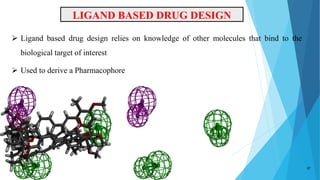
 Ligand based drug design relies on knowledge of other molecules that bind to the
biological target of interest
 Used to derive a Pharmacophore
27
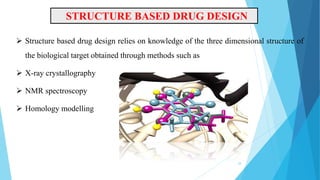
STRUCTURE BASED DRUG DESIGN
 Structure based drug design relies on knowledge of the three dimensional structure of
the biological target obtained through methods such as
 X-ray crystallography
 NMR spectroscopy
 Homology modelling
28
 Using the structure of the biological target, drugs that are predicted to bind with to the
target may be designed using
 Interactive graphics
 The intuition of a medicinal chemist
 Automated computational procedures
Selection of Disease-
 Determination the biochemical basis of the disease process
 Know the exact step in the pathway that are altered in the diseased state
 Knowledge about the regulation of the pathway is also important . Finally one would know
the three-dimensional structures of the molecules involved in the process29
TARGET SELECTION
 Biochemical pathways could become abnormal & result in disease
 Select a target at which to disrupt the biochemical process.
Categories of Targets
1. enzymes
2. receptors
3. nucleic acid
30
TARGET VALIDATION
 Performing the protein BLAST for all the genes proteins with respect to Homo
sapiens.
 Select the least matching molecule in human and again perform the BLAST.
 As the query sequence matched best, so we selected our target molecule and its
structure can be obtained from RCSB (The Research Collaboration for Structural
Bioinformatics) PDB (Protein Data Bank)
31
MOLECULAR DOCKING
 In the field of molecular modeling, docking is a method which predicts the preferred
orientation of one molecule to a second when bound to each other to form a stable complex.[1]
Knowledge of the preferred orientation in turn may be used to predict the strength of
association or binding affinity between two molecules using, for example, scoring functions.
32
PROCESS OF DOCKING
33
Assay Development for HIT identify
 A hit is a compound which has the desired activity in a compound screen and whose activity
is confirmed upon retesting.
 Lead compounds are chemical compounds that show desired biological & pharmacological
activity and may initiate the development of a new clinically relevant compound.
Hit identification
1. For Hit identification , some information about either the target protein or an active
compound is necessary.
2. If the structure of the natural substrate is known , a ligand based approach will be
accomplished.
HIT IDENTIFICATION
34
PROCESS OF HIT IDENTIFICATION
Target Validation
Compound
libraries
Target
identification
Assay development
HTS
Lead optimization
Clinical trail
35
REACTION OBSERVATION
 Fills each well of the plate with some biological entity such as a protein cell or an animal
embryo
 After some incubation time to allow the biological matter to absorb bind to
 Otherwise react with the compounds in the wells measurements are taken across all the
plates wells either manually or by machine
36
QUALITY CONTROL
Three important means of QC are
1. Good plate design
2. The selection of effective positive and negative chemical/biological controls.
3. The development of effective QC metrics to measure the degree of differentiation so
that assays with inferior data quality can be identified.
37
BIOCHEMICAL ASSAYS
 Measure function of a purified target
 Identify compounds that modulate the activity of the target protein
 Recombinant proteins, proteins isolated from crude cell lysates
 Examples: Kinase/ATPase assays , Protease assays & Protein interaction assays
38
CELL-BASED ASSAYS
 Provide a functional read –out of compound activity
 Useful for follow up of biochemical assays
 Examples: cell proliferation: MTT etc. for oncology
 Apoptosis: second messenger levels
 Motility/Migration : Bacterial viability assays
39
REFERENCES
 An introduction to Medicinal chemistry,3rd edition, Graham L.Patric
web.centre.edu/muzyka/articles/ch14slides.ppt www.authorstream.com/.../hariteja43-
1369711-2003-combinatorial-chemistry. www.slideshare.net/.../combinatorial-chemistry-
hts-and-its-applications.
 Rao, V.S. and Srinivas, K., 2011. Modern drug discovery process: an in silico
approach. Journal of bioinformatics and sequence analysis, 2(5), pp.89-94
 Web.centre.edu/muzyka/aricles/ch14slides.ppt
 www.authorstream.com/.../hariteja43-1369711-2003-combinatorial chemistry
 Gandhi, P., 2011. Clinical research methodology. Indian J Phar Edu Res, 45(2), pp.199-209
40
41

LEAD IDENTIFICATION BY SUHAS PATIL (S.K.)

  • 1.
    LEAD IDENTIFICATION Presented By SuhasM. Patil Roll no-MPL 12 F.Y M. Pharm (Pharmacology) R. C. Patel Institute of Pharmaceutical Education & Research Shirpur (M.S.) 1
  • 2.
    CONTENTS 1 Introduction 03 2Method of Lead Identification 07 3 Combinatorial Chemistry 08 4 High throughput Screening (HTS) 16 5 In Silico Lead Discovery Technique 24 6 HIT identification 33 7 Reference 40 TITLESr. No. Slide No. 2
  • 3.
    INTRODUCTION What is lead…………..? Oncea target & a testing system has been chosen, The next is to find a lead compound which shows the desired pharmaceutical activity A lead compound is generally defined as a new chemical entity that could potentially be developed into a new drug by optimizing it’s beneficial effects and minimizing it’s side effect 3
  • 4.
    LEAD IDENTIFICATION A leadcompound is a first foothold on the drug discovery ladder It takes much more effort to make a lead compound into a drug candidate DEFINITION The identification of small molecule modulators of protein function and the process of transforming these into high content lead series are key activities in modern drug discovery 4
  • 5.
     Possible routesto identifying a lead compound are: 1. Chance observations 2. Selective optimization of side activities (SOSA approach) 3. Herbal / folk remedies 4. Screening of natural product metabolites 5. Screening of compound libraries (High-throughput) 6. “Rational” drug design 7. Natural substrate-based drug design FINDING LEAD COMPOUND 5
  • 6.
    STARTING IN LAB Without some reliable measure of potency it is impossible to conduct a systematic analysis of possible new drugs  Screening or assaying  “The testing of a (series of) molecule(s) against a known biological target that correlates with a cellular or pharmacological activity is known as screening” (e.g. enzyme inhibition or receptor binding)  This is now made possible / easier in modern research because macro-molecular targets (e.g. proteins, enzymes / receptors) can be identified  Targets are now available in large quantities using molecular biology  Automated (High-throughput screening) technologies available 6
  • 7.
    METHODS OF LEADIDENTIFICATION  Combinatorial chemistry  High throughput screening(HTS)  In silico lead discovery techniques  Assay development for hit identification 7
  • 8.
    COMBINATORIAL CHEMISTRY  Definition: Combinatorial chemistry is a technique by which large numbers of different but structurally similar molecules are produced rapidly and submitted for pharmacological assay  This technique uses the same reaction conditions with the same reaction vessels to produce a large range of analogues 8
  • 9.
    COMBINATORIAL CHEMISTRY WITHINDESIGN Therapeutic target Lead discovery Lead optimisation Development candidate Drug Combinatorial chemistry can impact here 9
  • 10.
    SYNTHETIC METHODOLOGIES FORPRODUCTION OF LIBRARIES 1. Solid Phase Techniques 2. Parallel Synthesis i) Houghton’s Tea Bag Procedure ii) Automated parallel synthesis iii) Automated parallel synthesis of all 27 tripeptides from 3 amino acids 3. Mixed Combinatorial Synthesis 4. Solution phase synthesis 10
  • 11.
    SOLID PHASE TECHNIQUE Reactantsare bound to a polymeric surface and modified whilst still attached. Final product is released at the end of the synthesis Requirements  A resin bead or a functionalised surface to act as a solid support  An anchor or linker  A bond linking the substrate to the linker. The bond must be stable to the reaction conditions used in the synthesis  A means of cleaving the product from the linker at the end  Protecting groups for functional groups not involved in the synthesis Procedure Beads must be able to swell in the solvent used, and remain stable most reactions occur in the bead interior 11
  • 12.
    Advantages:  Specific reactantscan be bound to specific beads  Beads can be mixed and reacted in the same reaction vessel  Products formed are distinctive for each bead and physically distinct  Excess reagents can be used to drive reactions to completion  Excess reagents and by products are easily removed  Reaction intermediates are attached to bead and do not need to be isolated and purified  Individual beads can be separated to isolate individual products  Polymeric support can be regenerated and re-used after cleaving the product12
  • 13.
    Aim : PARALLEL SYNTHESIS 13 Touse a standard synthetic route to produce a range of analogues, with a different analogue in each reaction vessel, tube or well The identity of each structure is known Useful for producing a range of analogues for SAR or drug Optimisation
  • 14.
     Each teabag contains beads and is labelled  Separate reactions are carried out on each tea bag  Combine tea bags for common reactions or work up procedures  A single product is synthesised within each tea bag  Different products are formed in different tea bags  Economy of effort - e.g. combining tea bags for workups  Cheap and possible for any lab  Manual procedure and is not suitable for producing large quantities of different products14 1: Houghton’s Tea Bag Procedure
  • 15.
     Automated synthesisersare available with 42, 96 or 144 reaction vessels or wells  Use beads or pins for solid phase support  Reactions and workups are carried out automatically  Same synthetic route used for each vessel, but different reagents  Different product obtained per vessel 15 2: Automated parallel synthesis
  • 16.
     To usea standard synthetic route to produce a large variety of different analogues where each reaction vessel or tube contains a mixture of products  The identities of the structures in each vessel are not known with Certainty Useful for finding a lead compound  Capable of synthesising large numbers of compounds quickly  Each mixture is tested for activity as the mixture  Inactive mixtures are stored in combinatorial libraries  Active mixtures are studied further to identify active component 16 3: Mixed Combinatorial Synthesis
  • 17.
    HIGH THROUGHPUT SCREENING HighThroughput Screening (HTS) is a drug discovery process widely used in pharmaceutical industry. It leverages automation to quickly assay the biological activity of a large number of drug like compound 17
  • 18.
    Biochemical assays Target-based Enzymes (eg. kinases) Receptors (eg.Nuclear receptors) Phenotype –based 1.Transcriptional read –outs 2.second messenger level 3.Protein interactions 4.Cell viability. TYPES OF HTS ASSAY IN DRUG DISCOVERY 18 Cell-based assays Assay in drug discovery
  • 19.
     Cell growthtests (cell-based assays or Phenotype assays)  Tissue response-targeted functional cell-based assay  Enzyme test-biochemical test  High sensitivity of assay  High speed of assay  Low background signal 19 Assay Technology in HTS Advantages of HTS
  • 20.
    DETECTION METHODS INHTS  Spectroscopy  Mass spectroscopy  Chromatography  Calorimetry  X-ray diffraction  Microscopy  Radioactive methods 20
  • 21.
    Fluorescence Spectroscopy Total internalreflection fluorescence NMR Light scattering GC TLC HPLC 21 Chromatography in HTS Spectroscopy in HTS
  • 22.
    STEPS IN HTS Assay plate preparation  The testing vessel of HTS id the microtiter a small container usually disposable and made of plastic that features a grid of small open divots called wells  In general modern microplates for HTS have either 384,1536 or 3456 wells  Most of the wells contain test items depending on the nature of the experiment 22
  • 23.
  • 24.
    USES of HTS Toscreen for all kind of novel biological active compounds: 1. Natural products 2. Combinatorial Libraries 3. Biological libraries To screen Micro arrays such as: 1. DNA chips 2. RNA chips 3. Protein chips 24
  • 25.
    IN SILICO LEADDISCOVERY TECHNIQUE  In silico is an expression used to mean performed on computer or via simulation  In silico drug designing is defined as the identification of the drug target molecule by employing bioinformatics tools 25
  • 26.
    TYPES OF INSILICO DRUG DESIGNING Structure based drug designing In silico drug designing Ligand based drug designing 26
  • 27.
    LIGAND BASED DRUGDESIGN  Ligand based drug design relies on knowledge of other molecules that bind to the biological target of interest  Used to derive a Pharmacophore 27
  • 28.
    STRUCTURE BASED DRUGDESIGN  Structure based drug design relies on knowledge of the three dimensional structure of the biological target obtained through methods such as  X-ray crystallography  NMR spectroscopy  Homology modelling 28
  • 29.
     Using thestructure of the biological target, drugs that are predicted to bind with to the target may be designed using  Interactive graphics  The intuition of a medicinal chemist  Automated computational procedures Selection of Disease-  Determination the biochemical basis of the disease process  Know the exact step in the pathway that are altered in the diseased state  Knowledge about the regulation of the pathway is also important . Finally one would know the three-dimensional structures of the molecules involved in the process29
  • 30.
    TARGET SELECTION  Biochemicalpathways could become abnormal & result in disease  Select a target at which to disrupt the biochemical process. Categories of Targets 1. enzymes 2. receptors 3. nucleic acid 30
  • 31.
    TARGET VALIDATION  Performingthe protein BLAST for all the genes proteins with respect to Homo sapiens.  Select the least matching molecule in human and again perform the BLAST.  As the query sequence matched best, so we selected our target molecule and its structure can be obtained from RCSB (The Research Collaboration for Structural Bioinformatics) PDB (Protein Data Bank) 31
  • 32.
    MOLECULAR DOCKING  Inthe field of molecular modeling, docking is a method which predicts the preferred orientation of one molecule to a second when bound to each other to form a stable complex.[1] Knowledge of the preferred orientation in turn may be used to predict the strength of association or binding affinity between two molecules using, for example, scoring functions. 32
  • 33.
  • 34.
    Assay Development forHIT identify  A hit is a compound which has the desired activity in a compound screen and whose activity is confirmed upon retesting.  Lead compounds are chemical compounds that show desired biological & pharmacological activity and may initiate the development of a new clinically relevant compound. Hit identification 1. For Hit identification , some information about either the target protein or an active compound is necessary. 2. If the structure of the natural substrate is known , a ligand based approach will be accomplished. HIT IDENTIFICATION 34
  • 35.
    PROCESS OF HITIDENTIFICATION Target Validation Compound libraries Target identification Assay development HTS Lead optimization Clinical trail 35
  • 36.
    REACTION OBSERVATION  Fillseach well of the plate with some biological entity such as a protein cell or an animal embryo  After some incubation time to allow the biological matter to absorb bind to  Otherwise react with the compounds in the wells measurements are taken across all the plates wells either manually or by machine 36
  • 37.
    QUALITY CONTROL Three importantmeans of QC are 1. Good plate design 2. The selection of effective positive and negative chemical/biological controls. 3. The development of effective QC metrics to measure the degree of differentiation so that assays with inferior data quality can be identified. 37
  • 38.
    BIOCHEMICAL ASSAYS  Measurefunction of a purified target  Identify compounds that modulate the activity of the target protein  Recombinant proteins, proteins isolated from crude cell lysates  Examples: Kinase/ATPase assays , Protease assays & Protein interaction assays 38
  • 39.
    CELL-BASED ASSAYS  Providea functional read –out of compound activity  Useful for follow up of biochemical assays  Examples: cell proliferation: MTT etc. for oncology  Apoptosis: second messenger levels  Motility/Migration : Bacterial viability assays 39
  • 40.
    REFERENCES  An introductionto Medicinal chemistry,3rd edition, Graham L.Patric web.centre.edu/muzyka/articles/ch14slides.ppt www.authorstream.com/.../hariteja43- 1369711-2003-combinatorial-chemistry. www.slideshare.net/.../combinatorial-chemistry- hts-and-its-applications.  Rao, V.S. and Srinivas, K., 2011. Modern drug discovery process: an in silico approach. Journal of bioinformatics and sequence analysis, 2(5), pp.89-94  Web.centre.edu/muzyka/aricles/ch14slides.ppt  www.authorstream.com/.../hariteja43-1369711-2003-combinatorial chemistry  Gandhi, P., 2011. Clinical research methodology. Indian J Phar Edu Res, 45(2), pp.199-209 40
  • 41.