THERAPEUTIC VALUES OF PEPTIDOMIMETICS
AND
DESIGN OF PEPTIDOMIMETICS BY MANIPULATION OF
AMINOACID
Presenting by:
Mr. Purushotham K.N
Assi.Prof.Dept.Of.Ph.Chemisty
SACCP.
2021-2022
CONTENTS
1. Intoduction
2. Therapeutic values of peptidomimetics
3. Design of peptidomimetics by manipulation of the amino acid
INTRODUCTION
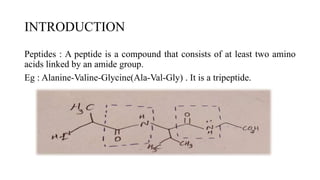
Peptides : A peptide is a compound that consists of at least two amino
acids linked by an amide group.
Eg : Alanine-Valine-Glycine(Ala-Val-Gly) . It is a tripeptide.
PEPTIDOMIMITICS
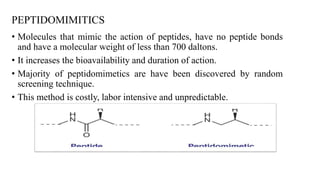
• Molecules that mimic the action of peptides, have no peptide bonds
and have a molecular weight of less than 700 daltons.
• It increases the bioavailability and duration of action.
• Majority of peptidomimetics are have been discovered by random
screening technique.
• This method is costly, labor intensive and unpredictable.
TYPES OF PEPTIDOMIMETICS
1. Type-I peptidomimetics or pseudopeptides: These are synthesized by
structure based drug design. These peptidomimetics are closely
similar to peptide backbone while retaining functional groups that
makes important contacts with binding sites of the receptors.
2. Type-II peptidomimetics or functional mimetics: These
peptidomimetics are synthesized by molecular modeling and high
throughput screening (HTS) etc. These are small non-peptide
molecule that binds to a peptide receptor.
Eg: G-protein coupled receptor antagonist.
3.Type-III peptidomimetics or topographical mimetics: These are
synthesized by structure based drug design which represents that they
possess novel templates, which appear unrelated to the original peptides
but contain the essential groups, positioned on a novel non-peptide
scaffold to serve as topographical mimetics.
4. Type-IV peptidomimetics or non-peptide mimetics: These are
synthesized by Group Replacement Assisted Binding (GRAB) technique
of drug design. These structures might share structural functional
features of type I peptidomimetics, but they bind to an enzyme form not
accessible with type I peptidomimetics for example piperidine inhibitors
THERAPEUTIC VALUES OF PEPTIDOMIMETICS
1. Antimicrobial activity
2. Anticancer activity
3. Antiviral activity
4. Immunodetection activity
5. Selectivity for DNA receptors
6. Antimalarial activity
7. Antioxidant activity
Antimicrobial activity:
Srinivas et al. developed some novel peptidomimetic antibiotics based
on the antimicrobial peptide protegrin І to combat the growing health
treat posed by resistant pathogenic microorganisms. Several rounds of
optimization gave a lead compound that was active in the nanomolar
range against Gram negative Pseudomonas species.
Anti-cancer activity:
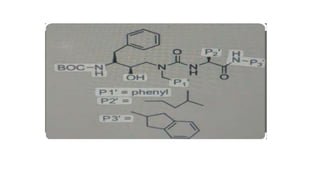
Yung-Feng et al. synthesized some novel unnatural amino acid-
substituted (Hydroxyethyl)urea peptidomimetics which inhibited
secretase, the neuronal differentiation of neuroblastoma cells and also
interfered with tumorigenesis and the malignancy of neuroblastomas.
Which shows that these peptidomimetics can be used as lead
compounds for further development of novel anticancer drugs
Antiviral activity
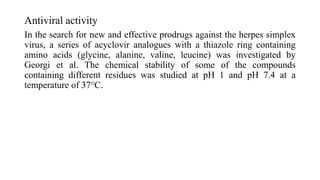
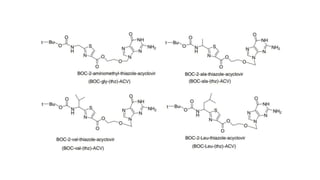
In the search for new and effective prodrugs against the herpes simplex
virus, a series of acyclovir analogues with a thiazole ring containing
amino acids (glycine, alanine, valine, leucine) was investigated by
Georgi et al. The chemical stability of some of the compounds
containing different residues was studied at pH 1 and pH 7.4 at a
temperature of 37°C.
Selectivity for DNA receptors:
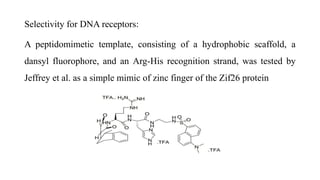
A peptidomimetic template, consisting of a hydrophobic scaffold, a
dansyl fluorophore, and an Arg-His recognition strand, was tested by
Jeffrey et al. as a simple mimic of zinc finger of the Zif26 protein
Anti-malarial activity:
Ettari et al. synthesized some novel peptidomimetics bearing a protected
aspartyl aldehyde warhead leading to the thioacylal derivatives. Both
compounds proved to possess an increased antiplasmodial activity with
respect to the parent molecule .
Anti-oxidant activity:
A series of related biocompatible imidazole-containing peptidomimetics were
synthesized in order to confer resistance to enzymatic hydrolysis and ex vivo
improvement of protective antioxidative properties related to carnosine.
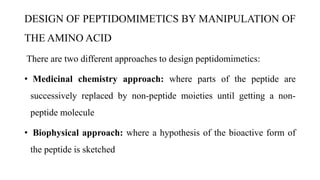
DESIGN OF PEPTIDOMIMETICS BY MANIPULATION OF
THE AMINO ACID
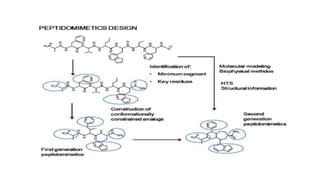
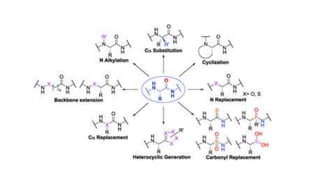
There are two different approaches to design peptidomimetics:
• Medicinal chemistry approach: where parts of the peptide are
successively replaced by non-peptide moieties until getting a non-
peptide molecule
• Biophysical approach: where a hypothesis of the bioactive form of
the peptide is sketched
• Design of peptidomimetic chemistry is connected to the development
of compounds capable of replacing one or more aminoacids in a
peptide sequence without altering the biological activity.
• Access to novel amino acids as peptide bioisosters has been persued
by
 Either modifying the atoms involved in backbone formation of a
peptide or in manipulating the side chain moiety,
 Peptidomimetic chemistry has been oriented to the development of
higher isosters, taking into account di ,tri or tetrapeptides to be
replaced by more complex molecular architectures.
REFERENCE:
1. https://www.slideshare.net/MahendraMahi28/peptidomimitics
2. https://pubs.rsc.org/en/content/articlelanding/2014/cs/c3cs60384a
3. https://badge.dimensions.ai/details/id/pub.1104166931
4. Therapeutic importance of peptidomimetics in medicinal chemistry
Rajeev Kharb 1 *, Meenakshi Rana1 , Prabodh Chander Sharma2 ,
Mohammad Shahar Yar3
THANK YOU

peptidomimetics.pptx

  • 1.
    THERAPEUTIC VALUES OFPEPTIDOMIMETICS AND DESIGN OF PEPTIDOMIMETICS BY MANIPULATION OF AMINOACID Presenting by: Mr. Purushotham K.N Assi.Prof.Dept.Of.Ph.Chemisty SACCP. 2021-2022
  • 2.
    CONTENTS 1. Intoduction 2. Therapeuticvalues of peptidomimetics 3. Design of peptidomimetics by manipulation of the amino acid
  • 3.
    INTRODUCTION Peptides : Apeptide is a compound that consists of at least two amino acids linked by an amide group. Eg : Alanine-Valine-Glycine(Ala-Val-Gly) . It is a tripeptide.
  • 4.
    PEPTIDOMIMITICS • Molecules thatmimic the action of peptides, have no peptide bonds and have a molecular weight of less than 700 daltons. • It increases the bioavailability and duration of action. • Majority of peptidomimetics are have been discovered by random screening technique. • This method is costly, labor intensive and unpredictable.
  • 5.
    TYPES OF PEPTIDOMIMETICS 1.Type-I peptidomimetics or pseudopeptides: These are synthesized by structure based drug design. These peptidomimetics are closely similar to peptide backbone while retaining functional groups that makes important contacts with binding sites of the receptors. 2. Type-II peptidomimetics or functional mimetics: These peptidomimetics are synthesized by molecular modeling and high throughput screening (HTS) etc. These are small non-peptide molecule that binds to a peptide receptor. Eg: G-protein coupled receptor antagonist.
  • 6.
    3.Type-III peptidomimetics ortopographical mimetics: These are synthesized by structure based drug design which represents that they possess novel templates, which appear unrelated to the original peptides but contain the essential groups, positioned on a novel non-peptide scaffold to serve as topographical mimetics. 4. Type-IV peptidomimetics or non-peptide mimetics: These are synthesized by Group Replacement Assisted Binding (GRAB) technique of drug design. These structures might share structural functional features of type I peptidomimetics, but they bind to an enzyme form not accessible with type I peptidomimetics for example piperidine inhibitors
  • 7.
    THERAPEUTIC VALUES OFPEPTIDOMIMETICS 1. Antimicrobial activity 2. Anticancer activity 3. Antiviral activity 4. Immunodetection activity 5. Selectivity for DNA receptors 6. Antimalarial activity 7. Antioxidant activity
  • 8.
    Antimicrobial activity: Srinivas etal. developed some novel peptidomimetic antibiotics based on the antimicrobial peptide protegrin І to combat the growing health treat posed by resistant pathogenic microorganisms. Several rounds of optimization gave a lead compound that was active in the nanomolar range against Gram negative Pseudomonas species. Anti-cancer activity: Yung-Feng et al. synthesized some novel unnatural amino acid- substituted (Hydroxyethyl)urea peptidomimetics which inhibited secretase, the neuronal differentiation of neuroblastoma cells and also interfered with tumorigenesis and the malignancy of neuroblastomas. Which shows that these peptidomimetics can be used as lead compounds for further development of novel anticancer drugs
  • 10.
    Antiviral activity In thesearch for new and effective prodrugs against the herpes simplex virus, a series of acyclovir analogues with a thiazole ring containing amino acids (glycine, alanine, valine, leucine) was investigated by Georgi et al. The chemical stability of some of the compounds containing different residues was studied at pH 1 and pH 7.4 at a temperature of 37°C.
  • 12.
    Selectivity for DNAreceptors: A peptidomimetic template, consisting of a hydrophobic scaffold, a dansyl fluorophore, and an Arg-His recognition strand, was tested by Jeffrey et al. as a simple mimic of zinc finger of the Zif26 protein
  • 13.
    Anti-malarial activity: Ettari etal. synthesized some novel peptidomimetics bearing a protected aspartyl aldehyde warhead leading to the thioacylal derivatives. Both compounds proved to possess an increased antiplasmodial activity with respect to the parent molecule . Anti-oxidant activity: A series of related biocompatible imidazole-containing peptidomimetics were synthesized in order to confer resistance to enzymatic hydrolysis and ex vivo improvement of protective antioxidative properties related to carnosine.
  • 14.
    DESIGN OF PEPTIDOMIMETICSBY MANIPULATION OF THE AMINO ACID There are two different approaches to design peptidomimetics: • Medicinal chemistry approach: where parts of the peptide are successively replaced by non-peptide moieties until getting a non- peptide molecule • Biophysical approach: where a hypothesis of the bioactive form of the peptide is sketched
  • 16.
    • Design ofpeptidomimetic chemistry is connected to the development of compounds capable of replacing one or more aminoacids in a peptide sequence without altering the biological activity. • Access to novel amino acids as peptide bioisosters has been persued by  Either modifying the atoms involved in backbone formation of a peptide or in manipulating the side chain moiety,  Peptidomimetic chemistry has been oriented to the development of higher isosters, taking into account di ,tri or tetrapeptides to be replaced by more complex molecular architectures.
  • 18.
    REFERENCE: 1. https://www.slideshare.net/MahendraMahi28/peptidomimitics 2. https://pubs.rsc.org/en/content/articlelanding/2014/cs/c3cs60384a 3.https://badge.dimensions.ai/details/id/pub.1104166931 4. Therapeutic importance of peptidomimetics in medicinal chemistry Rajeev Kharb 1 *, Meenakshi Rana1 , Prabodh Chander Sharma2 , Mohammad Shahar Yar3
  • 19.