The document discusses analog design in pharmaceutical sciences, focusing on modifying drug molecules to enhance therapeutic efficacy while minimizing adverse effects. Key strategies include bioisosteric replacement, rigid analog design, and alterations in molecular structure such as chain branching and stereoisomerism. Additionally, it categorizes analogs based on their similarities to lead compounds and explores the implications of these modifications on pharmacological properties.

![CATEGORIES OF ANALOGS
1] Analogs possessing chemical and
pharmacological similarities:
• The first class of analogs, simultaneously having
chemical and pharmacological similarities, can
be considered as “directanalogs” .
• These analogs correspond to the category of
drugs often referred to as“metoodrugs”.
• Usually,they are an advantage to the consumer
.In the case of drugs, this means that they
provide an advance in therapeutic benefit.
5](https://image.slidesharecdn.com/analogdesignmedicinalchemistry-190920144420/75/Analog-design-medicinal-chemistry-5-2048.jpg)
![CATEGORIES OF ANALOGS
2] Analogs possessing only chemical
similarities:
• The second class, made of “structural analogs,”
contains compounds originally prepared as close
and patentable analogs of a novel lead, but for
which the biological assays revealed totally
unexpected pharmacological properties.
• Observation of the new activity can be purely by
chance but can also result from a planned
systematic investigation.
6](https://image.slidesharecdn.com/analogdesignmedicinalchemistry-190920144420/75/Analog-design-medicinal-chemistry-6-2048.jpg)
![CATEGORIES OF ANALOGS
3] Compounds chemically different, but
displaying similar pharmacological
properties:
• Third class of analogs, chemical similarity is not
observed; however, they share common
biological properties.
• We propose the term “functional analogs” for
such compounds.
7](https://image.slidesharecdn.com/analogdesignmedicinalchemistry-190920144420/75/Analog-design-medicinal-chemistry-7-2048.jpg)
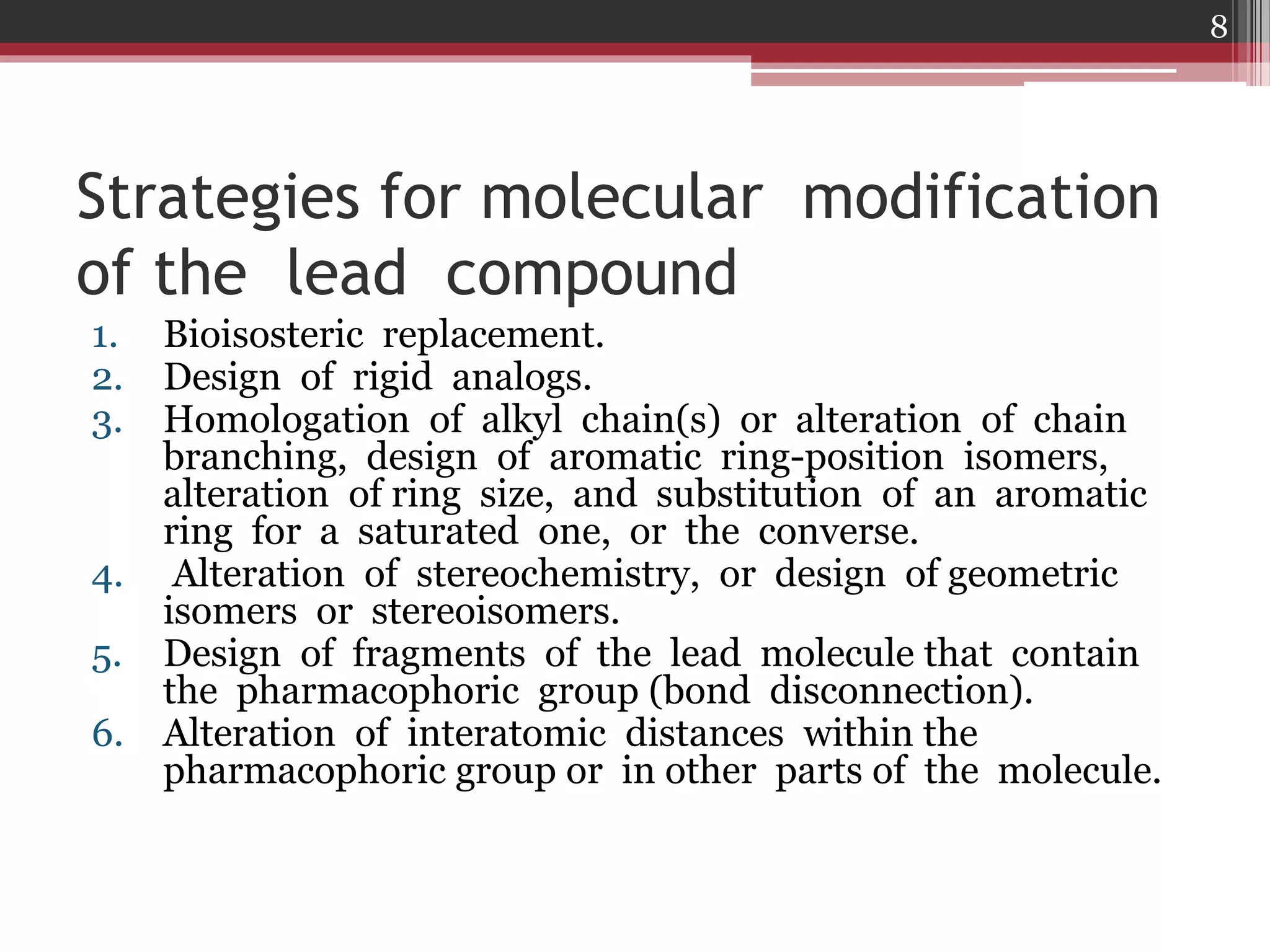
![1] BIOISOSTERIC REPLACEMENT
• Bioisosteres are groups or molecules which
have chemical and physical properties
producing broadly similar biological properties
• This definition might be modified to include
the concept that bioisosteres may produce
opposite biological effects, and these effects
are frequently a reflection of some action on
the same biological process or at the same
receptor site.
9](https://image.slidesharecdn.com/analogdesignmedicinalchemistry-190920144420/75/Analog-design-medicinal-chemistry-9-2048.jpg)
![1] BIOISOSTERIC REPLACEMENT
Utility of bioisosteres :
• Improving potency
• Enhancing selectivity
• Altering physical properties
• Reducing or redirecting metabolism
• Eliminating or modifying toxicophores
• Acquiring novel intellectual property
10](https://image.slidesharecdn.com/analogdesignmedicinalchemistry-190920144420/75/Analog-design-medicinal-chemistry-10-2048.jpg)
![1] BIOISOSTERIC REPLACEMENT
Classification:
Bioisosteres have been classified into classical
and non-classical bioisosteres.
Bioisosteres
Classical
Same stearic and
electronic properties
Non-
classical
Different stearic and
electronic properties
11](https://image.slidesharecdn.com/analogdesignmedicinalchemistry-190920144420/75/Analog-design-medicinal-chemistry-11-2048.jpg)
![1] BIOISOSTERIC REPLACEMENT
Classical Bioisoster :
• Monovalent atoms or groups.
• Divalent atoms or groups.
• Trivalent atoms or groups.
• Tetra substituted atoms.
• Ring equivalents.
12](https://image.slidesharecdn.com/analogdesignmedicinalchemistry-190920144420/75/Analog-design-medicinal-chemistry-12-2048.jpg)
![1] BIOISOSTERIC REPLACEMENT
13
Monovalent atoms or groups.
D and H
F and H
NH2 and OH
RSH and ROH
F, OH ,NH2, and CH3
CL , Br , SH ,and OH
Fig. Bioisoisteric H/F Replacement](https://image.slidesharecdn.com/analogdesignmedicinalchemistry-190920144420/75/Analog-design-medicinal-chemistry-13-2048.jpg)
![1] BIOISOSTERIC REPLACEMENT
Divalent atoms or groups.
-C=S- ,-C=O,-C=NH, -C=C-
Procainamide Procaine
14
Cardiac arrhythmia Local anesthetic](https://image.slidesharecdn.com/analogdesignmedicinalchemistry-190920144420/75/Analog-design-medicinal-chemistry-14-2048.jpg)
![1] BIOISOSTERIC REPLACEMENT
• Trivalent atoms or groups.
-CH= , -N= , -P= , –As=
Fig. Cholesterol and it’s biosteric derivative 20,25-diazacholeserol
15](https://image.slidesharecdn.com/analogdesignmedicinalchemistry-190920144420/75/Analog-design-medicinal-chemistry-15-2048.jpg)
![1] BIOISOSTERIC REPLACEMENT
• Tetra substituted atoms.
16](https://image.slidesharecdn.com/analogdesignmedicinalchemistry-190920144420/75/Analog-design-medicinal-chemistry-16-2048.jpg)
![1] BIOISOSTERIC REPLACEMENT
• Ring equivalents :
-CH=CH-,-S-(e.g.benzene,thiophene)
=CH-,=N-(e.g.benzene,pyridine)
-O-,-S-,-NH-
17](https://image.slidesharecdn.com/analogdesignmedicinalchemistry-190920144420/75/Analog-design-medicinal-chemistry-17-2048.jpg)
![1] BIOISOSTERIC REPLACEMENT
Non classical bioisosters:
• Cyclic vs Non Cyclic
• Exchangable Functional groups
18](https://image.slidesharecdn.com/analogdesignmedicinalchemistry-190920144420/75/Analog-design-medicinal-chemistry-18-2048.jpg)
![1] BIOISOSTERIC REPLACEMENT
Cyclic vs Non Cyclic
Fig. Replacement of a cyclic system with an acyclic derivative from
estradiol to trans-diethylstilbestrol.
19](https://image.slidesharecdn.com/analogdesignmedicinalchemistry-190920144420/75/Analog-design-medicinal-chemistry-19-2048.jpg)
![1] BIOISOSTERIC REPLACEMENT
Exchangable Functional groups:
i)Carbonyl group
20](https://image.slidesharecdn.com/analogdesignmedicinalchemistry-190920144420/75/Analog-design-medicinal-chemistry-20-2048.jpg)
![1] BIOISOSTERIC REPLACEMENT
21
Modafinyl Carbonyl analog Amide analog
Slight loss of activity Activity restored
Fig. Bioisosteric replacement of modafinil](https://image.slidesharecdn.com/analogdesignmedicinalchemistry-190920144420/75/Analog-design-medicinal-chemistry-21-2048.jpg)
![1] BIOISOSTERIC REPLACEMENT
ii) Catecol group:
22](https://image.slidesharecdn.com/analogdesignmedicinalchemistry-190920144420/75/Analog-design-medicinal-chemistry-22-2048.jpg)
![1] BIOISOSTERIC REPLACEMENT
iii)Thiourea group:
23
Fig. Thioamide bioisosteric replacement
Cyano imino group](https://image.slidesharecdn.com/analogdesignmedicinalchemistry-190920144420/75/Analog-design-medicinal-chemistry-23-2048.jpg)
![1] BIOISOSTERIC REPLACEMENT
iv)Carboxylic Acid :
24](https://image.slidesharecdn.com/analogdesignmedicinalchemistry-190920144420/75/Analog-design-medicinal-chemistry-24-2048.jpg)
![1] BIOISOSTERIC REPLACEMENT
v)Hydroxyl Group:
25
vi)Halogen :](https://image.slidesharecdn.com/analogdesignmedicinalchemistry-190920144420/75/Analog-design-medicinal-chemistry-25-2048.jpg)
![1] BIOISOSTERIC REPLACEMENT
vii)Pyridine :
26](https://image.slidesharecdn.com/analogdesignmedicinalchemistry-190920144420/75/Analog-design-medicinal-chemistry-26-2048.jpg)
![2] RIGID ANALOG
Imposition of some degree of molecular rigidity
on a flexible organic molecule may result in
potent, biologically active agents that show a
higher degree of specificity of pharmacologic
effect.
27](https://image.slidesharecdn.com/analogdesignmedicinalchemistry-190920144420/75/Analog-design-medicinal-chemistry-27-2048.jpg)
![2] RIGID ANALOG
Advantages:
• The key functional groups are held in one steric
disposition.
• By the rigid analog strategy, it is possible to
approximate "frozen" conformations of a
flexible lead molecule that, if an enhanced
pharmacological effect results, may assist in
defining and understanding structure activity
parameters, including the three dimensional
geometry of the pharmacophore.
28](https://image.slidesharecdn.com/analogdesignmedicinalchemistry-190920144420/75/Analog-design-medicinal-chemistry-28-2048.jpg)
![2] RIGID ANALOG
29
• Restriction of conformational freedom of the acyl moiety in 4-DAMP
(Diphenylacetoxypiperidinium ) an antimuscarinic compound displaying
higher affinity at M3, acetylcholine receptors than at atrial M2, receptors was
imposed by the structure of the spiro-compound.
• Spiro-DAMP was slightly more potent at M2, muscarinic receptors than at
M3, receptors.](https://image.slidesharecdn.com/analogdesignmedicinalchemistry-190920144420/75/Analog-design-medicinal-chemistry-29-2048.jpg)
![3] ALTERATION OF CHAIN BRANCHING
• Change in size or branching of an alkyl chain on a
bioactive molecule may have profound (and sometimes
unpredictable) effects on physical and pharmacological
properties.
• Alteration of the size and or shape of an alkyl substituent
can affect the conformational preference of a flexible
molecule and may alter the relationships of the
components of the pharmacophore, which may be reflected
in the ability of the molecule to achieve complementarity
with its receptor or with the catalytic surface of a
metabolizing enzyme.
• The alkyl group itself may represent a binding site with
the receptor (through hydrophobic interactions), and
alteration of the chain may alter its binding capacity.
30](https://image.slidesharecdn.com/analogdesignmedicinalchemistry-190920144420/75/Analog-design-medicinal-chemistry-30-2048.jpg)
![3] ALTERATION OF CHAIN BRANCHING
31
• Alteration in N-alkyl chain in norapomorphine from methyl to n-
propyl produced incremental increase in emetic response.
• n-butyl homolog demostrated a tremendous loss in potency and
activity .](https://image.slidesharecdn.com/analogdesignmedicinalchemistry-190920144420/75/Analog-design-medicinal-chemistry-31-2048.jpg)
![4] CHANGE IN RING SIZE
• In a series of spiro-tetraoxacycloalkanes,with varying
heterocyclic ring sizes, it was found that the compound where
n = 1 demonstrated marked antimalarial activity against P.
bergei and P. falciparum, and showed low toxicity.
• The analog in which n = 4 showed strong activity against P.
falciparum but it was unimpressive in the P. bergei assay.
32](https://image.slidesharecdn.com/analogdesignmedicinalchemistry-190920144420/75/Analog-design-medicinal-chemistry-32-2048.jpg)
![5] RING POSITION ISOMERS
• Positional isomers are constitutional Isomers
that have the same carbon skeleton and the
same functional group but differ from each
other in the location of the functional
groups on or in the carbon chain.
• Position isomers of substituents (even alkyl
groups) on an aromatic ring may possess
different pharmacological properties.
33](https://image.slidesharecdn.com/analogdesignmedicinalchemistry-190920144420/75/Analog-design-medicinal-chemistry-33-2048.jpg)
![5] RING POSITION ISOMERS
In a series of arylsulfonamidophenethanolamines ,
derivatives bearing the sulfonamido group meta to the
ethanolamine side chain displayed properties of a β-
adrenoceptor partial agonist, whereas 19
compounds bearing the sulfonamido group in the para
position were β-antagonists.
34](https://image.slidesharecdn.com/analogdesignmedicinalchemistry-190920144420/75/Analog-design-medicinal-chemistry-34-2048.jpg)
![6] STEREO ISOMERS
• Stereoisomers are molecules that have the
same molecular formula and differ only in
how their atoms are arranged in three-
dimensional space.
• All stereoisomers of an organic molecule will
exhibit pharmacological effects, frequently
widely different and unpredictable.
35](https://image.slidesharecdn.com/analogdesignmedicinalchemistry-190920144420/75/Analog-design-medicinal-chemistry-35-2048.jpg)
![6] STEREO ISOMERS
36
(+-)3-(3-Hydroxypheny1)-
N-n-propylpiperidine
R enantiomer: At high doses
selectively stimulated
presynaptic dopaminergic
receptor sites,
whereas at lower doses it
selectively stimulated
postsynaptic receptor sites.
S enantiomer: stimulated
presynaptic dopamine receptors
and at the same dose level, it
blocked postsynaptic dopamine
receptors.](https://image.slidesharecdn.com/analogdesignmedicinalchemistry-190920144420/75/Analog-design-medicinal-chemistry-36-2048.jpg)
![7] GEOMERTRIC ISOMERS
• Geometric isomers are molecules in which
each of two or more chemical compounds having
the same molecular formula but a different
geometric arrangement;an unsaturated
compound or ring compound in which rotation
around a carbon bond is restricted, as in cis- and
trans- configurations.
• cis- and trans-4-Aminocrotonic acid and
were prepared as congeners of Gama
aminobutyric acid (GABA).
37](https://image.slidesharecdn.com/analogdesignmedicinalchemistry-190920144420/75/Analog-design-medicinal-chemistry-37-2048.jpg)
![• The folded 2-isomer was inactive in assays
for GABA agonism, whereas the ex- tended
E-isomer was active.
• These data demonstrate biological differences
of geometric isomers.
38
7] GEOMERTRIC ISOMERS](https://image.slidesharecdn.com/analogdesignmedicinalchemistry-190920144420/75/Analog-design-medicinal-chemistry-38-2048.jpg)
![• Lead molecules present in polycyclic natural
products may be much more structurally complex
than in necessary for optimal pharmacological
effect.
• Pharmacophoric moiety may be buried within the
complex structure of the lead compound.
• This pharmacophore can be dissect out chemically.
• The result may be biologically active, simpler
molecules that may themselves be used as leads in
further analog design.
39
8] FRAGMENTS OF THE LEAD
MOLECULE](https://image.slidesharecdn.com/analogdesignmedicinalchemistry-190920144420/75/Analog-design-medicinal-chemistry-39-2048.jpg)
![• STRATEGY
A bond disconnection strategy may be employed
in which bonds in the polycyclic structure are
broken or removed to destroy one or more of the
rings.
40
8] FRAGMENTS OF THE LEAD
MOLECULE
Example :Morphine as a lead molecule for
which fragment analog design has been
used.
Morphine](https://image.slidesharecdn.com/analogdesignmedicinalchemistry-190920144420/75/Analog-design-medicinal-chemistry-40-2048.jpg)
![Fragmented Analogs:
41
8] FRAGMENTS OF THE LEAD
MOLECULE
Levophanol metazocine meperidine
methadone](https://image.slidesharecdn.com/analogdesignmedicinalchemistry-190920144420/75/Analog-design-medicinal-chemistry-41-2048.jpg)
![Alteration of distances between portions of
the pharmacophore of a molecule (or even
between other portions of the molecule) may
produce profound qualitative and/or quantitative
changes in pharmacological actions.
42
9] VARIATION IN INTERATOMIC
DISTANCES](https://image.slidesharecdn.com/analogdesignmedicinalchemistry-190920144420/75/Analog-design-medicinal-chemistry-42-2048.jpg)
![• In bis-trimethylammonium
polymethylene
Compounds showing autonomic ganglia blocking
acvtivity .
43
9] VARIATION IN INTERATOMIC
DISTANCES
n=5 or 6 maximum activity
n= 4 or 7 effect drops drastically
n= 16 0r 18 4x more potent](https://image.slidesharecdn.com/analogdesignmedicinalchemistry-190920144420/75/Analog-design-medicinal-chemistry-43-2048.jpg)


![PEPTIDOMIMETICS [M.PHARM, BSC, MSC, B.PHARM]](https://cdn.slidesharecdn.com/ss_thumbnails/53-191219102328-thumbnail.jpg?width=640&height=640&fit=bounds)


![OLIGONUCLEOTIDE THERAPY [ TECHNIQUES, APPLICATIONS]](https://cdn.slidesharecdn.com/ss_thumbnails/66-191220063512-thumbnail.jpg?width=640&height=640&fit=bounds)


![CHEMISTRY OF PEPTIDES [M.PHARM, M.SC, BSC, B.PHARM]](https://cdn.slidesharecdn.com/ss_thumbnails/45-191219080659-thumbnail.jpg?width=640&height=640&fit=bounds)


