QUANTIATIVE STRUCTURE ACTIVITY
RELATIONSHIP (QSAR)
COURSE OUTCOMES : Explain the steps involved in drug discovery process
PREPARED BY :
B.Nivedha (121011101423)
A.K.R Susmidharani (121011101433)
GUIDED BY :
Ms. P. Mala
Assistant Professor of Biotechnology
Department of Biotechnology
XBT 707 - BIOINFORMATICS
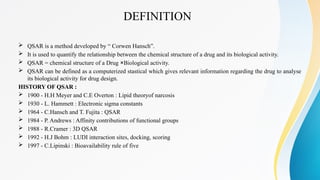
DEFINITION
 QSAR is a method developed by “ Corwen Hansch”.
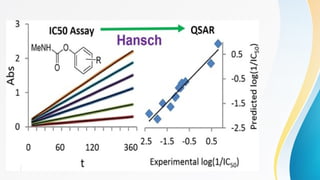
 It is used to quantify the relationship between the chemical structure of a drug and its biological activity.
 QSAR = chemical structure of a Drug ×Biological activity.
 QSAR can be defined as a computerized stastical which gives relevant information regarding the drug to analyse
its biological activity for drug design.
HISTORY OF QSAR :
 1900 - H.H Meyer and C.E Overton : Lipid theoryof narcosis
 1930 - L. Hammett : Electronic sigma constants
 1964 - C.Hansch and T. Fujita : QSAR
 1984 - P. Andrews : Affinity contributions of functional groups
 1988 - R.Cramer : 3D QSAR
 1992 - H.J Bohm : LUDI interaction sites, docking, scoring
 1997 - C.Lipinski : Bioavailability rule of five
TYPES OF QSAR MODELS
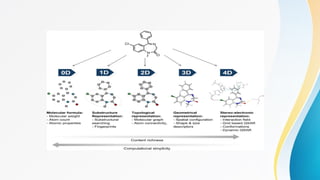
 The molecular descriptors that are used in ADMET models can be classified on the basis of level of molecular
representation required for calculating the descriptor.
One - dimensional (1D)
Two - dimensional (2D)
Three - dimensional (3D)
One - dimensional (1D):
 The 1D descriptors are the simplest type of molecular descriptors these represent information that are
calculated from the molecular formula of the molecule which includes the count and type of atoms in the
molecule and the molecular weight.
Two - dimensional (2D):
 The 2D descriptors are more complex than the 1D descriptors usually they represent molecular
information regarding the size, shape and electronic distribution in the molecule. Calculating the 2D descriptors
depends mainly on the database size and the calculation of parts of a molecule in which the data is missing could
largely result in a false result.
Three - dimensional (3D):
 The 3D descriptors that are related to the 3D conformation of the molecule such as the intramolecular hydrogen
bonding.
PHYSIOCHEMICAL PARAMETERS
Various parameters used in QSAR studies are :
HYDROPHOBICITY : Partition coefficient, π- substitution constant.
STERIC PARAMETERS : Taff’s constant, verloop steric parameter.
ELECTRONIC PARAMETER: Hammet constant, dipole moment.
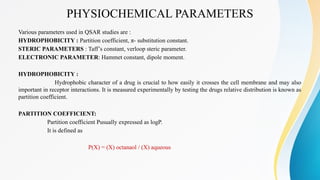
HYDROPHOBICITY :
Hydrophobic character of a drug is crucial to how easily it crosses the cell membrane and may also
important in receptor interactions. It is measured experimentally by testing the drugs relative distribution is known as
partition coefficient.
PARTITION COEFFICIENT:
Partition coefficient Pusually expressed as logP.
It is defined as
P(X) = (X) octanaol / (X) aqueous
π- SUBSTITUENT CONSTANT
 The π- substituent constant defined by hansch and co - workers by the following equation.
 Partition coefficient can be calculated by knowing the contribution that various substituent is known as
substituent hydrophobicity constant.
πx= log Px- logPH
 A positive πvalue indicates that the π substituent has a higher hydrophobicity hydrogen
 A negative πvalue indicates that the lower hydrophobicity than hydrogen and the drug favors the aqueous
phase.
 π identify specific regions of the molecule which might interact with hydrophobic regions in the binding
sites.
HAMMETT CONSTANT (σ)
 Hammett constant takes into account both resonance and inductive effects thus the value depends on whether
the substituent is Para or meta substitued
 ortho not mesured due to steric effects
 It is often denoted as σis a parameter used in physical organic chemistry to describe the electronic effects of
substituents on aromatic compounds particularly benzene rings.
log K/Ko = Pσ
 K is the equilibrium constant for the subsituted compound
 Ko is the equilibrium constant for the unsubstituted compound
 ρis the reaction constant which reflects the sensitivity of a particular reaction
 σis the Hammett constant for the substituent
STERIC SUBSTITUTION CONSTANT
 It is a measure of the bulkiness of the group it represents and it effects on the closeness of contact between
the drug and receptor site.It is much harder to quantiative.
Taft’s steric factor (Es’):
 Measured by comparing the rates of hydrolysis of substituted aliphatic esters against a standard ester
under acidic conditions.
Es= log kx - log ko
 Kx represent the rate of hydrolysis of a substituted ester
 Ko represents the rate of hydrolysis of the parent ester
Molar refractivity (MR) :
It is measure of the volume occupied by an atom or group - equation includes the MW, density (d) and
the index of refraction (n)
MR = (n2
-1)
MW/(n2
+2)d
Verloop steric parameter :
computer program uses bond angles, vander waals radii and bond lengths.
HANSCH EQUATION
 A QSAR equation relating various physiochemical properties to the biological activity of a series of
compounds.
 Start with simple equations and elaborate as more structures are synthesised.
 Usually includes logP, electronic and sterile factors.
 Typical equation for a wide range of log P is parabolic.
Log(1/C)= -K1(logP)2
+K2logP+K3σ+K4Es+K5
Example : Adrenergic blocking activity of β - halo- β- arylamines
X
Y
 Activity increases if πis +ve (i.e. hydrophobic substituents)
 Activity increases if σis negative (i.e. - donating substituents)
CH- CH2-NRR’
REFERENCES
• Gini G. QSAR Methods. Methods Mol Biol. 2016;1425:1-20. doi: 10.1007/978-1-4939-3609-0_1. PMID:
27311459.
• Gonzalez-Diaz H. Editorial: QSAR/QSPR models as enabling technologies for drug & targets discovery in:
medicinal chemistry, microbiology-parasitology, neurosciences, bioinformatics, proteomics and other biomedical
sciences. Curr Top Med Chem. 2012;12(8):799-801. doi:10.2174/156802612800166738.
• Liu S, Shi T, Yu J, Li R, Lin H, Deng K. Research on Bitter Peptides in the Field of Bioinformatics: A
Comprehensive Review. Int J Mol Sci. 2024 Sep 12;25(18):9844. doi: 10.3390/ijms25189844.
• Rosato A, Valasatava Y, Andreini C. Minimal Functional Sites in Metalloproteins and Their Usage in Structural
Bioinformatics. Int J Mol Sci. 2016 May 4;17(5):671. doi: 10.3390/ijms17050671.
• Recent advances in fragment-based QSAR and multi-dimensional QSAR methods.
• Myint KZ, Xie XQ. Recent advances in fragment-based QSAR and multi-dimensional QSAR methods. Int J Mol
Sci. 2010 Oct 8;11(10):3846-66. doi: 10.3390/ijms11103846.
THANK YOU

Quantitative Structure Activity Relationship

  • 1.
    QUANTIATIVE STRUCTURE ACTIVITY RELATIONSHIP(QSAR) COURSE OUTCOMES : Explain the steps involved in drug discovery process PREPARED BY : B.Nivedha (121011101423) A.K.R Susmidharani (121011101433) GUIDED BY : Ms. P. Mala Assistant Professor of Biotechnology Department of Biotechnology XBT 707 - BIOINFORMATICS
  • 2.
    DEFINITION  QSAR isa method developed by “ Corwen Hansch”.  It is used to quantify the relationship between the chemical structure of a drug and its biological activity.  QSAR = chemical structure of a Drug ×Biological activity.  QSAR can be defined as a computerized stastical which gives relevant information regarding the drug to analyse its biological activity for drug design. HISTORY OF QSAR :  1900 - H.H Meyer and C.E Overton : Lipid theoryof narcosis  1930 - L. Hammett : Electronic sigma constants  1964 - C.Hansch and T. Fujita : QSAR  1984 - P. Andrews : Affinity contributions of functional groups  1988 - R.Cramer : 3D QSAR  1992 - H.J Bohm : LUDI interaction sites, docking, scoring  1997 - C.Lipinski : Bioavailability rule of five
  • 3.
    TYPES OF QSARMODELS  The molecular descriptors that are used in ADMET models can be classified on the basis of level of molecular representation required for calculating the descriptor. One - dimensional (1D) Two - dimensional (2D) Three - dimensional (3D) One - dimensional (1D):  The 1D descriptors are the simplest type of molecular descriptors these represent information that are calculated from the molecular formula of the molecule which includes the count and type of atoms in the molecule and the molecular weight. Two - dimensional (2D):  The 2D descriptors are more complex than the 1D descriptors usually they represent molecular information regarding the size, shape and electronic distribution in the molecule. Calculating the 2D descriptors depends mainly on the database size and the calculation of parts of a molecule in which the data is missing could largely result in a false result. Three - dimensional (3D):  The 3D descriptors that are related to the 3D conformation of the molecule such as the intramolecular hydrogen bonding.
  • 5.
    PHYSIOCHEMICAL PARAMETERS Various parametersused in QSAR studies are : HYDROPHOBICITY : Partition coefficient, π- substitution constant. STERIC PARAMETERS : Taff’s constant, verloop steric parameter. ELECTRONIC PARAMETER: Hammet constant, dipole moment. HYDROPHOBICITY : Hydrophobic character of a drug is crucial to how easily it crosses the cell membrane and may also important in receptor interactions. It is measured experimentally by testing the drugs relative distribution is known as partition coefficient. PARTITION COEFFICIENT: Partition coefficient Pusually expressed as logP. It is defined as P(X) = (X) octanaol / (X) aqueous
  • 6.
    π- SUBSTITUENT CONSTANT The π- substituent constant defined by hansch and co - workers by the following equation.  Partition coefficient can be calculated by knowing the contribution that various substituent is known as substituent hydrophobicity constant. πx= log Px- logPH  A positive πvalue indicates that the π substituent has a higher hydrophobicity hydrogen  A negative πvalue indicates that the lower hydrophobicity than hydrogen and the drug favors the aqueous phase.  π identify specific regions of the molecule which might interact with hydrophobic regions in the binding sites.
  • 7.
    HAMMETT CONSTANT (σ) Hammett constant takes into account both resonance and inductive effects thus the value depends on whether the substituent is Para or meta substitued  ortho not mesured due to steric effects  It is often denoted as σis a parameter used in physical organic chemistry to describe the electronic effects of substituents on aromatic compounds particularly benzene rings. log K/Ko = Pσ  K is the equilibrium constant for the subsituted compound  Ko is the equilibrium constant for the unsubstituted compound  ρis the reaction constant which reflects the sensitivity of a particular reaction  σis the Hammett constant for the substituent
  • 9.
    STERIC SUBSTITUTION CONSTANT It is a measure of the bulkiness of the group it represents and it effects on the closeness of contact between the drug and receptor site.It is much harder to quantiative. Taft’s steric factor (Es’):  Measured by comparing the rates of hydrolysis of substituted aliphatic esters against a standard ester under acidic conditions. Es= log kx - log ko  Kx represent the rate of hydrolysis of a substituted ester  Ko represents the rate of hydrolysis of the parent ester Molar refractivity (MR) : It is measure of the volume occupied by an atom or group - equation includes the MW, density (d) and the index of refraction (n) MR = (n2 -1) MW/(n2 +2)d Verloop steric parameter : computer program uses bond angles, vander waals radii and bond lengths.
  • 10.
    HANSCH EQUATION  AQSAR equation relating various physiochemical properties to the biological activity of a series of compounds.  Start with simple equations and elaborate as more structures are synthesised.  Usually includes logP, electronic and sterile factors.  Typical equation for a wide range of log P is parabolic. Log(1/C)= -K1(logP)2 +K2logP+K3σ+K4Es+K5 Example : Adrenergic blocking activity of β - halo- β- arylamines X Y  Activity increases if πis +ve (i.e. hydrophobic substituents)  Activity increases if σis negative (i.e. - donating substituents) CH- CH2-NRR’
  • 12.
    REFERENCES • Gini G.QSAR Methods. Methods Mol Biol. 2016;1425:1-20. doi: 10.1007/978-1-4939-3609-0_1. PMID: 27311459. • Gonzalez-Diaz H. Editorial: QSAR/QSPR models as enabling technologies for drug & targets discovery in: medicinal chemistry, microbiology-parasitology, neurosciences, bioinformatics, proteomics and other biomedical sciences. Curr Top Med Chem. 2012;12(8):799-801. doi:10.2174/156802612800166738. • Liu S, Shi T, Yu J, Li R, Lin H, Deng K. Research on Bitter Peptides in the Field of Bioinformatics: A Comprehensive Review. Int J Mol Sci. 2024 Sep 12;25(18):9844. doi: 10.3390/ijms25189844. • Rosato A, Valasatava Y, Andreini C. Minimal Functional Sites in Metalloproteins and Their Usage in Structural Bioinformatics. Int J Mol Sci. 2016 May 4;17(5):671. doi: 10.3390/ijms17050671. • Recent advances in fragment-based QSAR and multi-dimensional QSAR methods. • Myint KZ, Xie XQ. Recent advances in fragment-based QSAR and multi-dimensional QSAR methods. Int J Mol Sci. 2010 Oct 8;11(10):3846-66. doi: 10.3390/ijms11103846.
  • 13.