
RETINOSCOPY
MS. NISHITA AFRIN
ASST. COORDINATOR, DEPARTMENT OF PUBLIC HEALTH OPHTHALMOLOGY (UNISA)
MPH IN COMMUNITY OPHTHALMOLOGY (UNISA)
B.OPTOM (ICO)
REFRACTION
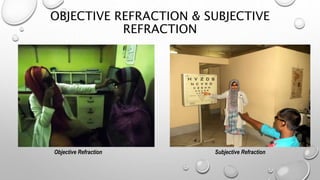
 OBJECTIVE REFRACTION
 SUBJECTIVE REFRACTION
OBJECTIVE REFRACTION & SUBJECTIVE
REFRACTION
Objective Refraction Subjective Refraction
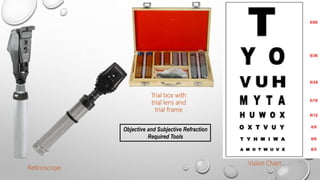
Objective and Subjective Refraction
Required Tools
Retinoscope
Trial box with
trial lens and
trial frame
Vision Chart
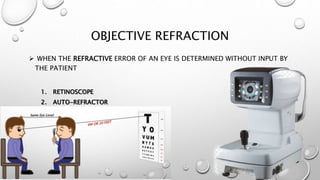
OBJECTIVE REFRACTION
 WHEN THE REFRACTIVE ERROR OF AN EYE IS DETERMINED WITHOUT INPUT BY
THE PATIENT
1. RETINOSCOPE
2. AUTO-REFRACTOR
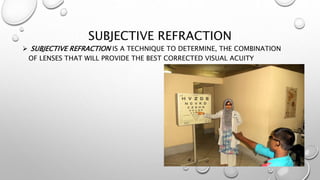
SUBJECTIVE REFRACTION
 SUBJECTIVE REFRACTION IS A TECHNIQUE TO DETERMINE, THE COMBINATION
OF LENSES THAT WILL PROVIDE THE BEST CORRECTED VISUAL ACUITY
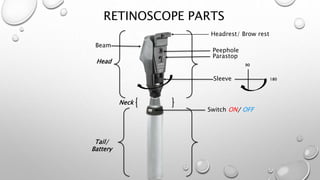
RETINOSCOPE PARTS
Headrest/ Brow rest
Peephole
Switch ON/ OFF
Parastop
Sleeve
Beam
Head
Neck
Tail/
Battery
90
180
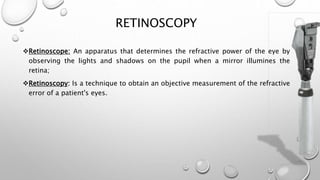
RETINOSCOPY
Retinoscope: An apparatus that determines the refractive power of the eye by
observing the lights and shadows on the pupil when a mirror illumines the
retina;
Retinoscopy: Is a technique to obtain an objective measurement of the refractive
error of a patient's eyes.
RETINOSCOPY PROCEDURE
REQUIRED TOOLS:
1. RETINOSCOPE
2. TRIAL BOX
3. TRIAL LENS
4. TARGET ACUITY (6/60)- VISUAL ACUITY CHART (TO RELAX ACCOMMODATION)
 REQUIRED ENVIRONMENT:
1. SEMI DARK ROOM
 REQUIRED POSITION:
1. PATIENT TO VISUAL ACUITY (TARGET ACUITY) CHART DISTANCE 6M OR 20 FEET OR 3
M OR 10 FEET (WITH MIRROR)
2. PATIENT’S EYE LEVEL = OBSERVER’S EYE LEVEL/ PATIENT’S SHOULDER LEVEL =
OBSERVER’S SHOULDER LEVEL
3. OBSERVER TO PATIENT DISTANCE = 50 CM (WD= +2.00 D/ 67 CM (WD=+1.50 D)
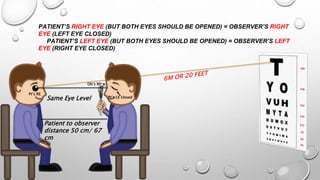
4. PATIENT’S RIGHT EYE (BUT BOTH EYES SHOULD BE OPENED) = OBSERVER’S RIGHT EYE
(LEFT EYE CLOSED)
PATIENT’S LEFT EYE (BUT BOTH EYES SHOULD BE OPENED) = OBSERVER’S LEFT EYE
(RIGHT EYE CLOSED)
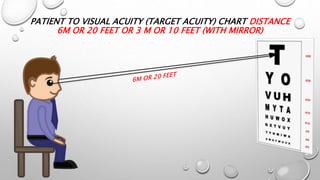
PATIENT TO VISUAL ACUITY (TARGET ACUITY) CHART DISTANCE
6M OR 20 FEET OR 3 M OR 10 FEET (WITH MIRROR)
PATIENT’S EYE LEVEL = OBSERVER’S EYE LEVEL/ PATIENT’S
OR SHOULDER LEVEL = OBSERVER’S SHOULDER LEVEL
Same Eye Level
OBSERVER TO PATIENT DISTANCE = 50 CM (WD= +2.00 D/ 67 CM
(WD=+1.50 D)
Same Eye Level
Patient to observer
distance 50 cm/ 67
cm
PATIENT’S RIGHT EYE (BUT BOTH EYES SHOULD BE OPENED) = OBSERVER’S RIGHT
EYE (LEFT EYE CLOSED)
PATIENT’S LEFT EYE (BUT BOTH EYES SHOULD BE OPENED) = OBSERVER’S LEFT
EYE (RIGHT EYE CLOSED)
Same Eye Level
Patient to observer
distance 50 cm/ 67
cm
Pt’s RE
Ob’s RE
Pt’s LE closed
RETINOSCOPIC REFLEX TYPES
 WITH MOTION
AGAINST MOTION
REFLEX TYPES
With Motion Against Motion
Retinoscopic Reflex
Retinal Reflex
Neutral or No
Motion or No
movement
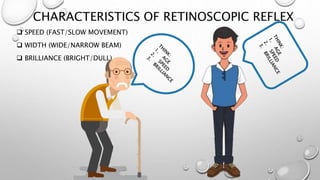
CHARACTERISTICS OF RETINOSCOPIC REFLEX
 SPEED (FAST/SLOW MOVEMENT)
 WIDTH (WIDE/NARROW BEAM)
 BRILLIANCE (BRIGHT/DULL)
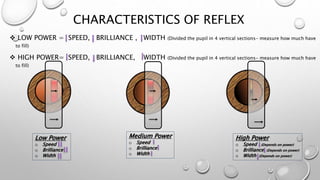
CHARACTERISTICS OF REFLEX
 LOW POWER = SPEED, BRILLIANCE , WIDTH (Divided the pupil in 4 vertical sections- measure how much have
to fill)
 HIGH POWER= SPEED, BRILLIANCE, WIDTH (Divided the pupil in 4 vertical sections- measure how much have
to fill)
Low Power
o Speed
o Brilliance
o Width
Medium Power
o Speed
o Brilliance
o Width
High Power
o Speed (Depends on power)
o Brilliance (Depends on power)
o Width (Depends on power)
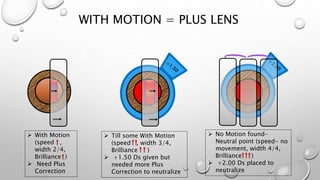
WITH MOTION = PLUS LENS
 With Motion
(speed ,
width 2/4,
Brilliance )
 Need Plus
Correction
 Till some With Motion
(speed , width 3/4,
Brilliance )
 +1.50 Ds given but
needed more Plus
Correction to neutralize
 No Motion found-
Neutral point (speed- no
movement, width 4/4,
Brilliance )
 +2.00 Ds placed to
neutralize
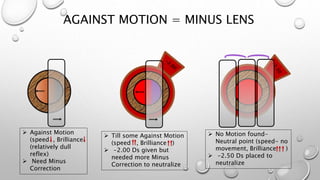
AGAINST MOTION = MINUS LENS
 Against Motion
(speed , Brilliance
(relatively dull
reflex)
 Need Minus
Correction
 Till some Against Motion
(speed , Brilliance )
 -2.00 Ds given but
needed more Minus
Correction to neutralize
 No Motion found-
Neutral point (speed- no
movement, Brilliance )
 -2.50 Ds placed to
neutralize
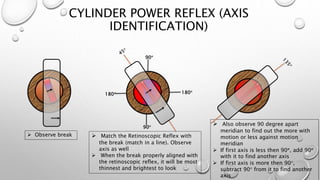
CYLINDER POWER REFLEX (AXIS
IDENTIFICATION)
 Observe break  Match the Retinoscopic Reflex with
the break (match in a line). Observe
axis as well
 When the break properly aligned with
the retinoscopic reflex, it will be most
thinnest and brightest to look
 Also observe 90 degree apart
meridian to find out the more with
motion or less against motion
meridian
 If first axis is less then 90, add 90
with it to find another axis
 If first axis is more then 90,
subtract 90 from it to find another
axis
90
180
90
180
CYLINDER POWER REFLEX CORRECTION
Sphero-cylidrical method (plus and minus lenses placed based on motion direction). First meridian must correct with
spherical lenses (either plus or minus spherical lenses depends on the motion type) and also place cylindrical lens on
another meridian over the previously corrected spherical lens (either plus or minus spherical lenses depends on the
motion type)
 1. Observe
break
 2. Match the Retinoscopic Reflex with the break (match
in a line). Observe axis as well
 When the break properly aligned with the Retinoscopic
reflex, it will be most thinnest and brightest to look
 3. Also observe 90 degree apart meridian to find out the
more with motion or less against motion meridian
 If first axis is less then 90, add 90 with it to find
another axis
 If first axis is more then 90, subtract 90 from it to find
another axis
 4. First meridian must correct with spherical
lenses (either plus or minus spherical lenses
depends on the motion type)(more with motion
preferred first)
 45 meridian corrected with +1.00 spherical
lens
 Now have to check the 90 apart axis 135
90
180
90
180
2 & 3
1 4
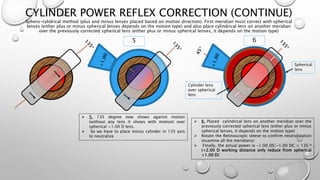
CYLINDER POWER REFLEX CORRECTION (CONTINUE)
Sphero-cylidrical method (plus and minus lenses placed based on motion direction). First meridian must correct with spherical
lenses (either plus or minus spherical lenses depends on the motion type) and also place cylindrical lens on another meridian
over the previously corrected spherical lens (either plus or minus spherical lenses, it depends on the motion type)
 6. Placed cylindrical lens on another meridian over the
previously corrected spherical lens (either plus or minus
spherical lenses, it depends on the motion type)
 Rotate the Retinoscopic sleeve to confirm neutralization
(examine all the meridians)
 Finally, the actual power is -1.00 DS/-1.00 DC × 135 
(+2.00 D working distance only reduce from spherical
+1.00 D)
6
Spherical
lens
Cylinder lens
over spherical
lens
 5. 135 degree now shows against motion
(without any lens it shows with motion) over
spherical +1.00 D lens.
 So we have to place minus cylinder in 135 axis
to neutralize
5
Retinoscopy

Retinoscopy

  • 1.
    RETINOSCOPY MS. NISHITA AFRIN ASST.COORDINATOR, DEPARTMENT OF PUBLIC HEALTH OPHTHALMOLOGY (UNISA) MPH IN COMMUNITY OPHTHALMOLOGY (UNISA) B.OPTOM (ICO)
  • 2.
  • 3.
    OBJECTIVE REFRACTION &SUBJECTIVE REFRACTION Objective Refraction Subjective Refraction
  • 4.
    Objective and SubjectiveRefraction Required Tools Retinoscope Trial box with trial lens and trial frame Vision Chart
  • 5.
    OBJECTIVE REFRACTION  WHENTHE REFRACTIVE ERROR OF AN EYE IS DETERMINED WITHOUT INPUT BY THE PATIENT 1. RETINOSCOPE 2. AUTO-REFRACTOR
  • 6.
    SUBJECTIVE REFRACTION  SUBJECTIVEREFRACTION IS A TECHNIQUE TO DETERMINE, THE COMBINATION OF LENSES THAT WILL PROVIDE THE BEST CORRECTED VISUAL ACUITY
  • 7.
    RETINOSCOPE PARTS Headrest/ Browrest Peephole Switch ON/ OFF Parastop Sleeve Beam Head Neck Tail/ Battery 90 180
  • 8.
    RETINOSCOPY Retinoscope: An apparatusthat determines the refractive power of the eye by observing the lights and shadows on the pupil when a mirror illumines the retina; Retinoscopy: Is a technique to obtain an objective measurement of the refractive error of a patient's eyes.
  • 9.
    RETINOSCOPY PROCEDURE REQUIRED TOOLS: 1.RETINOSCOPE 2. TRIAL BOX 3. TRIAL LENS 4. TARGET ACUITY (6/60)- VISUAL ACUITY CHART (TO RELAX ACCOMMODATION)  REQUIRED ENVIRONMENT: 1. SEMI DARK ROOM
  • 10.
     REQUIRED POSITION: 1.PATIENT TO VISUAL ACUITY (TARGET ACUITY) CHART DISTANCE 6M OR 20 FEET OR 3 M OR 10 FEET (WITH MIRROR) 2. PATIENT’S EYE LEVEL = OBSERVER’S EYE LEVEL/ PATIENT’S SHOULDER LEVEL = OBSERVER’S SHOULDER LEVEL 3. OBSERVER TO PATIENT DISTANCE = 50 CM (WD= +2.00 D/ 67 CM (WD=+1.50 D) 4. PATIENT’S RIGHT EYE (BUT BOTH EYES SHOULD BE OPENED) = OBSERVER’S RIGHT EYE (LEFT EYE CLOSED) PATIENT’S LEFT EYE (BUT BOTH EYES SHOULD BE OPENED) = OBSERVER’S LEFT EYE (RIGHT EYE CLOSED)
  • 11.
    PATIENT TO VISUALACUITY (TARGET ACUITY) CHART DISTANCE 6M OR 20 FEET OR 3 M OR 10 FEET (WITH MIRROR)
  • 12.
    PATIENT’S EYE LEVEL= OBSERVER’S EYE LEVEL/ PATIENT’S OR SHOULDER LEVEL = OBSERVER’S SHOULDER LEVEL Same Eye Level
  • 13.
    OBSERVER TO PATIENTDISTANCE = 50 CM (WD= +2.00 D/ 67 CM (WD=+1.50 D) Same Eye Level Patient to observer distance 50 cm/ 67 cm
  • 14.
    PATIENT’S RIGHT EYE(BUT BOTH EYES SHOULD BE OPENED) = OBSERVER’S RIGHT EYE (LEFT EYE CLOSED) PATIENT’S LEFT EYE (BUT BOTH EYES SHOULD BE OPENED) = OBSERVER’S LEFT EYE (RIGHT EYE CLOSED) Same Eye Level Patient to observer distance 50 cm/ 67 cm Pt’s RE Ob’s RE Pt’s LE closed
  • 15.
    RETINOSCOPIC REFLEX TYPES WITH MOTION AGAINST MOTION
  • 16.
    REFLEX TYPES With MotionAgainst Motion Retinoscopic Reflex Retinal Reflex Neutral or No Motion or No movement
  • 17.
    CHARACTERISTICS OF RETINOSCOPICREFLEX  SPEED (FAST/SLOW MOVEMENT)  WIDTH (WIDE/NARROW BEAM)  BRILLIANCE (BRIGHT/DULL)
  • 18.
    CHARACTERISTICS OF REFLEX LOW POWER = SPEED, BRILLIANCE , WIDTH (Divided the pupil in 4 vertical sections- measure how much have to fill)  HIGH POWER= SPEED, BRILLIANCE, WIDTH (Divided the pupil in 4 vertical sections- measure how much have to fill) Low Power o Speed o Brilliance o Width Medium Power o Speed o Brilliance o Width High Power o Speed (Depends on power) o Brilliance (Depends on power) o Width (Depends on power)
  • 19.
    WITH MOTION =PLUS LENS  With Motion (speed , width 2/4, Brilliance )  Need Plus Correction  Till some With Motion (speed , width 3/4, Brilliance )  +1.50 Ds given but needed more Plus Correction to neutralize  No Motion found- Neutral point (speed- no movement, width 4/4, Brilliance )  +2.00 Ds placed to neutralize
  • 20.
    AGAINST MOTION =MINUS LENS  Against Motion (speed , Brilliance (relatively dull reflex)  Need Minus Correction  Till some Against Motion (speed , Brilliance )  -2.00 Ds given but needed more Minus Correction to neutralize  No Motion found- Neutral point (speed- no movement, Brilliance )  -2.50 Ds placed to neutralize
  • 21.
    CYLINDER POWER REFLEX(AXIS IDENTIFICATION)  Observe break  Match the Retinoscopic Reflex with the break (match in a line). Observe axis as well  When the break properly aligned with the retinoscopic reflex, it will be most thinnest and brightest to look  Also observe 90 degree apart meridian to find out the more with motion or less against motion meridian  If first axis is less then 90, add 90 with it to find another axis  If first axis is more then 90, subtract 90 from it to find another axis 90 180 90 180
  • 22.
    CYLINDER POWER REFLEXCORRECTION Sphero-cylidrical method (plus and minus lenses placed based on motion direction). First meridian must correct with spherical lenses (either plus or minus spherical lenses depends on the motion type) and also place cylindrical lens on another meridian over the previously corrected spherical lens (either plus or minus spherical lenses depends on the motion type)  1. Observe break  2. Match the Retinoscopic Reflex with the break (match in a line). Observe axis as well  When the break properly aligned with the Retinoscopic reflex, it will be most thinnest and brightest to look  3. Also observe 90 degree apart meridian to find out the more with motion or less against motion meridian  If first axis is less then 90, add 90 with it to find another axis  If first axis is more then 90, subtract 90 from it to find another axis  4. First meridian must correct with spherical lenses (either plus or minus spherical lenses depends on the motion type)(more with motion preferred first)  45 meridian corrected with +1.00 spherical lens  Now have to check the 90 apart axis 135 90 180 90 180 2 & 3 1 4
  • 23.
    CYLINDER POWER REFLEXCORRECTION (CONTINUE) Sphero-cylidrical method (plus and minus lenses placed based on motion direction). First meridian must correct with spherical lenses (either plus or minus spherical lenses depends on the motion type) and also place cylindrical lens on another meridian over the previously corrected spherical lens (either plus or minus spherical lenses, it depends on the motion type)  6. Placed cylindrical lens on another meridian over the previously corrected spherical lens (either plus or minus spherical lenses, it depends on the motion type)  Rotate the Retinoscopic sleeve to confirm neutralization (examine all the meridians)  Finally, the actual power is -1.00 DS/-1.00 DC × 135  (+2.00 D working distance only reduce from spherical +1.00 D) 6 Spherical lens Cylinder lens over spherical lens  5. 135 degree now shows against motion (without any lens it shows with motion) over spherical +1.00 D lens.  So we have to place minus cylinder in 135 axis to neutralize 5