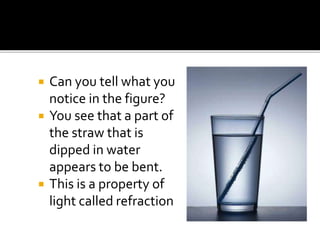
 Can you tell what you
notice in the figure?
 You see that a part of
the straw that is
dipped in water
appears to be bent.
 This is a property of
light called refraction
 When a ray of light travels from one
transparent medium to another, such as from
water to air, air to glass (and vice versa), it
undergoes a change in its direction at the
boundary between the two mediums and
bends.This phenomenon is known as
refraction.
 In air 3x10⁸ m/s
 In water 2.25x10⁸ m/s
 In glass 1.8x10⁸ m/s
 When light slows down in a medium we say it
is an optically denser medium.
 From the speed of light in different medium
we can say that water is optically denser than
air, and glass is optically denser than water.
 What happens when you roll your toy car
gently from a smooth road into a grass
lawn? At the boundary of two surfaces
wheel gets deflected from the path it
follows.
 Bending is a consequence of change in speed.
Light rays behave similarly. By bending light
rays travel faster obeying the principle of
least time, which states that out of all
available paths light rays travel the path that
requires the least time.
 A perpendicular drawn to the air glass
interface is called as normal
 The ray of light in first medium is called
incident ray and the ray after changing
direction known as refracted ray.
 The angle between incident ray and normal is
called angle of incidence(θi) and the angle
between the refracted ray(θr) and the normal
is called the angle of refraction.
 When a ray of light travels from rarer to
denser medium it bends towards the normal.
 When a ray of light travels obliquely from a
denser to rarer medium it bends away from
the normal.
 When a ray is perpendicular to the surface of
separation of two medium it goes without
any deviation.
 The incident ray, the normal to the point of
incidence, the refracted ray alllie in the same
plane;
 The ratio of sine of angle of incidence to the
sine of angle of refraction is a aconstant
known as the refractive index of the medium.
n= sin i
sinr
 The ratio of speed of light in vacuum to the
speed of light in another medium is termed
as the rtefractive index of that medium.
 n= speed of light in vacuum (c)
speed of light in the medium (v)
 The light ray AB incident on the air-glass
interface undergoes refraction and bends.
 Here light travels from rarer to denser medium
bends towards the normal and follows a path BC
inside the glass slab.
 The refracted ray BC on reaching the glass air
interface will again undergo refraction.This time
bends away from the normal and emerges out as
CD called emergent ray.
 The angle this ray makes with the normal is
known as the angle of emergence(θe).
 When the incident ray is produced further
(represented as dotted line), it is found to be
parallel to the emergent ray.This
perpendicular distance between the two rays
is called as lateral displacement.
 Thus any object placed at A will be displaced
sideways to D as a result of refraction
through the glass slab
 The light from the stars reach our earth by
travelling a great distance through space and
then through the different layers of the
atmosphere.We know that the density of the
atmosphere decreases with increasing altitude.
 Thus when light from a star travels through
different layers of the atmosphere, it bends
constantly and the star appears to change its
position slighty and varies in brightness and
colour.
 Do you know that the sun is seen a few
minutes before it actually rises above the
horizon in the morning and a few minutes
longer in the evening after it sets?
 The ray of light passing through the different
layers of the atmosphere undergoes
refraction and bends, and the viewer views
the sun at a higher position that it actually is.
This is the reason why we see the sun a few
minutes earlier than it actually rises.
Refraction

Refraction

  • 2.
     Can youtell what you notice in the figure?  You see that a part of the straw that is dipped in water appears to be bent.  This is a property of light called refraction
  • 3.
     When aray of light travels from one transparent medium to another, such as from water to air, air to glass (and vice versa), it undergoes a change in its direction at the boundary between the two mediums and bends.This phenomenon is known as refraction.
  • 4.
     In air3x108 m/s  In water 2.25x10⁸ m/s  In glass 1.8x10⁸ m/s
  • 5.
     When lightslows down in a medium we say it is an optically denser medium.  From the speed of light in different medium we can say that water is optically denser than air, and glass is optically denser than water.
  • 6.
     What happenswhen you roll your toy car gently from a smooth road into a grass lawn? At the boundary of two surfaces wheel gets deflected from the path it follows.
  • 7.
     Bending isa consequence of change in speed. Light rays behave similarly. By bending light rays travel faster obeying the principle of least time, which states that out of all available paths light rays travel the path that requires the least time.
  • 8.
     A perpendiculardrawn to the air glass interface is called as normal  The ray of light in first medium is called incident ray and the ray after changing direction known as refracted ray.  The angle between incident ray and normal is called angle of incidence(θi) and the angle between the refracted ray(θr) and the normal is called the angle of refraction.
  • 10.
     When aray of light travels from rarer to denser medium it bends towards the normal.
  • 11.
     When aray of light travels obliquely from a denser to rarer medium it bends away from the normal.
  • 12.
     When aray is perpendicular to the surface of separation of two medium it goes without any deviation.
  • 13.
     The incidentray, the normal to the point of incidence, the refracted ray alllie in the same plane;  The ratio of sine of angle of incidence to the sine of angle of refraction is a aconstant known as the refractive index of the medium. n= sin i sinr
  • 14.
     The ratioof speed of light in vacuum to the speed of light in another medium is termed as the rtefractive index of that medium.  n= speed of light in vacuum (c) speed of light in the medium (v)
  • 16.
     The lightray AB incident on the air-glass interface undergoes refraction and bends.  Here light travels from rarer to denser medium bends towards the normal and follows a path BC inside the glass slab.  The refracted ray BC on reaching the glass air interface will again undergo refraction.This time bends away from the normal and emerges out as CD called emergent ray.  The angle this ray makes with the normal is known as the angle of emergence(θe).
  • 17.
     When theincident ray is produced further (represented as dotted line), it is found to be parallel to the emergent ray.This perpendicular distance between the two rays is called as lateral displacement.  Thus any object placed at A will be displaced sideways to D as a result of refraction through the glass slab
  • 19.
     The lightfrom the stars reach our earth by travelling a great distance through space and then through the different layers of the atmosphere.We know that the density of the atmosphere decreases with increasing altitude.  Thus when light from a star travels through different layers of the atmosphere, it bends constantly and the star appears to change its position slighty and varies in brightness and colour.
  • 21.
     Do youknow that the sun is seen a few minutes before it actually rises above the horizon in the morning and a few minutes longer in the evening after it sets?  The ray of light passing through the different layers of the atmosphere undergoes refraction and bends, and the viewer views the sun at a higher position that it actually is. This is the reason why we see the sun a few minutes earlier than it actually rises.