A concave mirror is a
curved mirror that
is bended inward.
They reflect light to one focal point, therefore
they are used to focus light.
These mirrors are called “converging mirrors”
because they collect light that falls on them,
refocusing the parallel rays towards a focus.
From a distance, images appear
upside down but when brought
nearer, image become larger in size
and appears right side up.
Applications of
Concave
Mirrors
They are commonly found in the head
lights of vehicles making the light more
reflective and wider, making it possible
for the drivers to have a better view at
night.
Telescopes use a set of curved mirrors to collect
and focus light to increase the size of an
object being viewed.
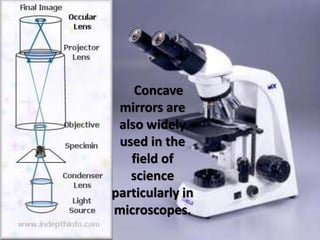
Concave
mirrors are
also widely
used in the
field of
science
particularly in
microscopes.
This type of mirrors
is also used by
dentists to have a
bigger image of
the teeth that
they are
attending to.
This is also used
in barber shops
where barbers
used it to have
an enlarged
image of the
face.
Even solar powered objects are using
concave mirrors to concentrate the
heat in a single direction.
Image
Characteristics for
Concave Mirrors
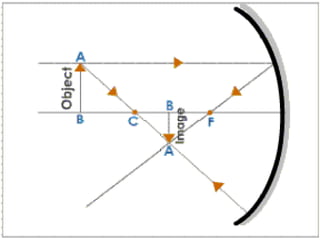
When the Object is Placed beyond C
A ray parallel to the principal axis. The ray
passing through the center of curvature
retraces its path and the ray which is parallel
to the principal axis passes through the focus
after reflection. These rays after reflection
meet at a point between C and F.
The image is
-Between C and F
-Real
-Inverted
-Diminished
When the Object is Placed at C
Here we consider the two rays, one parallel to the
principal axis and the other passing through the
focus. The ray of light which is parallel to the
principal axis passes through the focus after
reflection. The other ray passing through the
focus after reflection emerges parallel to the
axis. After reflection these rays meet at the
center of curvature to form an inverted image,
which is real and of the same size as the object.
The image is
-At C
-Real
-Inverted
-Same size as object
When the Object is between C and F:
Here we consider a ray of light which is parallel to
the principal axis and another ray passing
through the focus. The ray which is parallel to
the principal axis passes through the principal
focus and the ray which passes through the
focus after reflection emerges parallel to the
principal axis. The reflected rays meet at a point
beyond C.
The image is
-Beyond C
-Real
-Inverted
-Magnified
When the Object is at F:
Here, we consider a ray of light which is parallel to
the principal axis and another ray passing
through the center of curvature. The ray which
is parallel to the principal axis passes through
the focus and the ray which passes through the
center of curvature retraces its path. The
reflected rays are parallel to each other, and
would meet only at infinity.
The image is
-At infinity
-Real
-Inverted
-Magnified
When the Object is in front of F:
Here we consider a ray of light which is parallel to the
incident ray and another ray which is passing through
the center of curvature. The ray which is passing
through the center of curvature retraces its path and
the other ray which is parallel to the principal axis
after reflection passes through the focus. These rays
appear to meet behind the mirror when the reflected
rays are extended backwards.
The image is
-virtual
-erect
-magnified
Concave mirrors

Concave mirrors

  • 2.
    A concave mirroris a curved mirror that is bended inward.
  • 3.
    They reflect lightto one focal point, therefore they are used to focus light. These mirrors are called “converging mirrors” because they collect light that falls on them, refocusing the parallel rays towards a focus.
  • 4.
    From a distance,images appear upside down but when brought nearer, image become larger in size and appears right side up.
  • 5.
  • 6.
    They are commonlyfound in the head lights of vehicles making the light more reflective and wider, making it possible for the drivers to have a better view at night.
  • 7.
    Telescopes use aset of curved mirrors to collect and focus light to increase the size of an object being viewed.
  • 8.
    Concave mirrors are also widely usedin the field of science particularly in microscopes.
  • 9.
    This type ofmirrors is also used by dentists to have a bigger image of the teeth that they are attending to.
  • 10.
    This is alsoused in barber shops where barbers used it to have an enlarged image of the face.
  • 11.
    Even solar poweredobjects are using concave mirrors to concentrate the heat in a single direction.
  • 12.
  • 13.
    When the Objectis Placed beyond C A ray parallel to the principal axis. The ray passing through the center of curvature retraces its path and the ray which is parallel to the principal axis passes through the focus after reflection. These rays after reflection meet at a point between C and F. The image is -Between C and F -Real -Inverted -Diminished
  • 15.
    When the Objectis Placed at C Here we consider the two rays, one parallel to the principal axis and the other passing through the focus. The ray of light which is parallel to the principal axis passes through the focus after reflection. The other ray passing through the focus after reflection emerges parallel to the axis. After reflection these rays meet at the center of curvature to form an inverted image, which is real and of the same size as the object. The image is -At C -Real -Inverted -Same size as object
  • 17.
    When the Objectis between C and F: Here we consider a ray of light which is parallel to the principal axis and another ray passing through the focus. The ray which is parallel to the principal axis passes through the principal focus and the ray which passes through the focus after reflection emerges parallel to the principal axis. The reflected rays meet at a point beyond C. The image is -Beyond C -Real -Inverted -Magnified
  • 19.
    When the Objectis at F: Here, we consider a ray of light which is parallel to the principal axis and another ray passing through the center of curvature. The ray which is parallel to the principal axis passes through the focus and the ray which passes through the center of curvature retraces its path. The reflected rays are parallel to each other, and would meet only at infinity. The image is -At infinity -Real -Inverted -Magnified
  • 21.
    When the Objectis in front of F: Here we consider a ray of light which is parallel to the incident ray and another ray which is passing through the center of curvature. The ray which is passing through the center of curvature retraces its path and the other ray which is parallel to the principal axis after reflection passes through the focus. These rays appear to meet behind the mirror when the reflected rays are extended backwards. The image is -virtual -erect -magnified