LibraryServices
Referencing and
ReferencingTools
libguides.rhul.ac.uk/MediaArts
Kim Coles
k.coles@rhul.ac.uk
Department
Why reference?
“Referencing is the process of acknowledging the sources you
have used in writing your essay, assignment or piece of work. It
allows the reader to access your source documents as quickly
and easily as possible in order to verify, if necessary, the validity
of your arguments and the evidence on which they are based.”
- Palgrave Study Skills Online, http://www.palgrave.com/studentstudyskills/page/referencing-and-
avoiding-plagiarism/
2
Department
3
What is plagiarism?
 Passing off as your own a piece of work that is partly or wholly
the work of another student
 Citing and referencing sources that you have not used
 Quoting, summarising or paraphrasing material in your
assignment without citing the original source
 'Recycling' a piece of your own work that you have previously
submitted for another module or course (i.e. self-plagiarism).
Palgrave Study Skills Online, http://www.palgrave.com/studentstudyskills/page/referencing-and-
avoiding-plagiarism/
Why reference?
Department
What referencing style do you use?
Media Arts Style Guide
https://www.royalholloway.ac.uk/mediaarts/informationforcurrentstudents/home.aspx
4
 Harvard Referencing
 Emphasises Author-Date of publication
Help with Harvard
• Staffordshire University Information Services:
https://www.staffs.ac.uk/assets/harvard_referencing_examples_tcm44-
39847.pdf
• Anglia Ruskin University:
http://libweb.anglia.ac.uk/referencing/harvard.htm
Department
Examples of references
• Book with one author: Bould, Mark (2005) Film Noir. London:Wallflower
Press.
• Chapter in book: Andrew, Dudley (2004) ‘Adapting Cinema to History: A
Revolution in the Making’ in Stam, Robert and Raengo,Alessandra (eds) A
Companion to Literature and Film.Oxford: Blackwell, 189-204.
• Journal article: Andrew, Dudley (2008) ‘TheOntology of a Fetish’ Film
Quarterly 61:4, 62-66.
• Online newspaper article: Coney, James (2009) ‘Is this the start of a new
home loan war HSBC vows to lend ÂŁ1billion to homebuyers with 10%
deposits’ Daily Mail, [online] 9th April 2009.Available at:
http://www.dailymail.co.uk/news/article-1168461/Is-start-new-home-loan-
war-HSBC-vows-lend-1billion-homebuyers-10-deposits.html [Accessed on
20 April 2009].
5
Department
Citing audiovisual material
6
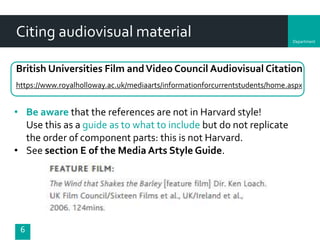
British Universities Film andVideo Council Audiovisual Citation
https://www.royalholloway.ac.uk/mediaarts/informationforcurrentstudents/home.aspx
• Be aware that the references are not in Harvard style!
Use this as a guide as to what to include but do not replicate
the order of component parts: this is not Harvard.
• See section E of the Media Arts Style Guide.
Department
In-text references
7
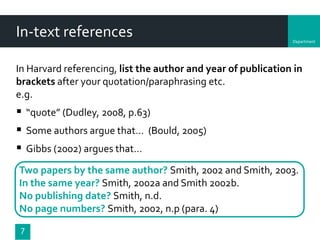
In Harvard referencing, list the author and year of publication in
brackets after your quotation/paraphrasing etc.
e.g.
 “quote” (Dudley, 2008, p.63)
 Some authors argue that… (Bould, 2005)
 Gibbs (2002) argues that…
Two papers by the same author? Smith, 2002 and Smith, 2003.
In the same year? Smith, 2002a and Smith 2002b.
No publishing date? Smith, n.d.
No page numbers? Smith, 2002, n.p (para. 4)
Department
Citing Interviews
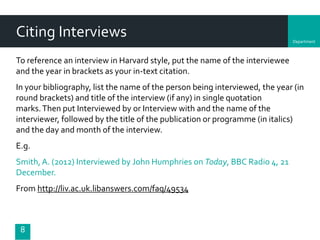
To reference an interview in Harvard style, put the name of the interviewee
and the year in brackets as your in-text citation.
In your bibliography, list the name of the person being interviewed, the year (in
round brackets) and title of the interview (if any) in single quotation
marks.Then put Interviewed by or Interview with and the name of the
interviewer, followed by the title of the publication or programme (in italics)
and the day and month of the interview.
E.g.
Smith, A. (2012) Interviewed by John Humphries on Today, BBC Radio 4, 21
December.
From http://liv.ac.uk.libanswers.com/faq/49534
8
Department
Citing foreign language material
If no translation is provided
Thurfjell,W. (1975)Vart har vüran doktor tagit vägen? Läkartidningen 72, p. 789.
or
Thurfjell,W. (1975). [Where has our doctor gone?]. Läkartidningen 72, p. 789. (In
Swedish).
Taken from: https://ilrb.cf.ac.uk/citingreferences/tutorial/faq.html#faq16
If you are reading a translation:
Alberti, L. (1974) Music through the ages.Translated from the Italian, by R.
Pierce. London:Cassell. (Originally published in 1968).
9
Department
Managing your references - RefWorks
10
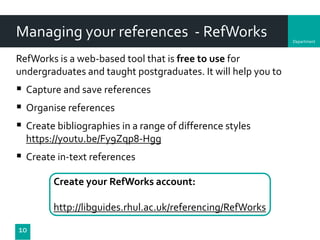
RefWorks is a web-based tool that is free to use for
undergraduates and taught postgraduates. It will help you to
 Capture and save references
 Organise references
 Create bibliographies in a range of difference styles
https://youtu.be/Fy9Zqp8-Hgg
 Create in-text references
Create your RefWorks account:
http://libguides.rhul.ac.uk/referencing/RefWorks
Department
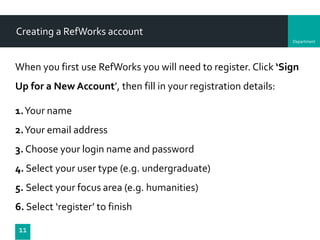
Creating a RefWorks account
When you first use RefWorks you will need to register. Click ‘Sign
Up for a New Account’, then fill in your registration details:
1.Your name
2.Your email address
3. Choose your login name and password
4. Select your user type (e.g. undergraduate)
5. Select your focus area (e.g. humanities)
6. Select ‘register’ to finish
11
Department
Questions
Referencing Drop-In help:
https://www.eventbrite.co.uk/e/dissertation-referencing-help-media-arts-tickets-18881273397
12
MarcusRamberg.Questions?CCBY-NC.Flickr.
Kim Coles
k.coles@rhul.ac.uk
01784414017
Bedford Library 2-07
Fridays 2.30 – 4pm

Referencing and Referencing Tools Media Arts

  • 1.
  • 2.
    Department Why reference? “Referencing isthe process of acknowledging the sources you have used in writing your essay, assignment or piece of work. It allows the reader to access your source documents as quickly and easily as possible in order to verify, if necessary, the validity of your arguments and the evidence on which they are based.” - Palgrave Study Skills Online, http://www.palgrave.com/studentstudyskills/page/referencing-and- avoiding-plagiarism/ 2
  • 3.
    Department 3 What is plagiarism? Passing off as your own a piece of work that is partly or wholly the work of another student  Citing and referencing sources that you have not used  Quoting, summarising or paraphrasing material in your assignment without citing the original source  'Recycling' a piece of your own work that you have previously submitted for another module or course (i.e. self-plagiarism). Palgrave Study Skills Online, http://www.palgrave.com/studentstudyskills/page/referencing-and- avoiding-plagiarism/ Why reference?
  • 4.
    Department What referencing styledo you use? Media Arts Style Guide https://www.royalholloway.ac.uk/mediaarts/informationforcurrentstudents/home.aspx 4  Harvard Referencing  Emphasises Author-Date of publication Help with Harvard • Staffordshire University Information Services: https://www.staffs.ac.uk/assets/harvard_referencing_examples_tcm44- 39847.pdf • Anglia Ruskin University: http://libweb.anglia.ac.uk/referencing/harvard.htm
  • 5.
    Department Examples of references •Book with one author: Bould, Mark (2005) Film Noir. London:Wallflower Press. • Chapter in book: Andrew, Dudley (2004) ‘Adapting Cinema to History: A Revolution in the Making’ in Stam, Robert and Raengo,Alessandra (eds) A Companion to Literature and Film.Oxford: Blackwell, 189-204. • Journal article: Andrew, Dudley (2008) ‘TheOntology of a Fetish’ Film Quarterly 61:4, 62-66. • Online newspaper article: Coney, James (2009) ‘Is this the start of a new home loan war HSBC vows to lend £1billion to homebuyers with 10% deposits’ Daily Mail, [online] 9th April 2009.Available at: http://www.dailymail.co.uk/news/article-1168461/Is-start-new-home-loan- war-HSBC-vows-lend-1billion-homebuyers-10-deposits.html [Accessed on 20 April 2009]. 5
  • 6.
    Department Citing audiovisual material 6 BritishUniversities Film andVideo Council Audiovisual Citation https://www.royalholloway.ac.uk/mediaarts/informationforcurrentstudents/home.aspx • Be aware that the references are not in Harvard style! Use this as a guide as to what to include but do not replicate the order of component parts: this is not Harvard. • See section E of the Media Arts Style Guide.
  • 7.
    Department In-text references 7 In Harvardreferencing, list the author and year of publication in brackets after your quotation/paraphrasing etc. e.g.  “quote” (Dudley, 2008, p.63)  Some authors argue that… (Bould, 2005)  Gibbs (2002) argues that… Two papers by the same author? Smith, 2002 and Smith, 2003. In the same year? Smith, 2002a and Smith 2002b. No publishing date? Smith, n.d. No page numbers? Smith, 2002, n.p (para. 4)
  • 8.
    Department Citing Interviews To referencean interview in Harvard style, put the name of the interviewee and the year in brackets as your in-text citation. In your bibliography, list the name of the person being interviewed, the year (in round brackets) and title of the interview (if any) in single quotation marks.Then put Interviewed by or Interview with and the name of the interviewer, followed by the title of the publication or programme (in italics) and the day and month of the interview. E.g. Smith, A. (2012) Interviewed by John Humphries on Today, BBC Radio 4, 21 December. From http://liv.ac.uk.libanswers.com/faq/49534 8
  • 9.
    Department Citing foreign languagematerial If no translation is provided Thurfjell,W. (1975)Vart har vüran doktor tagit vägen? Läkartidningen 72, p. 789. or Thurfjell,W. (1975). [Where has our doctor gone?]. Läkartidningen 72, p. 789. (In Swedish). Taken from: https://ilrb.cf.ac.uk/citingreferences/tutorial/faq.html#faq16 If you are reading a translation: Alberti, L. (1974) Music through the ages.Translated from the Italian, by R. Pierce. London:Cassell. (Originally published in 1968). 9
  • 10.
    Department Managing your references- RefWorks 10 RefWorks is a web-based tool that is free to use for undergraduates and taught postgraduates. It will help you to  Capture and save references  Organise references  Create bibliographies in a range of difference styles https://youtu.be/Fy9Zqp8-Hgg  Create in-text references Create your RefWorks account: http://libguides.rhul.ac.uk/referencing/RefWorks
  • 11.
    Department Creating a RefWorksaccount When you first use RefWorks you will need to register. Click ‘Sign Up for a New Account’, then fill in your registration details: 1.Your name 2.Your email address 3. Choose your login name and password 4. Select your user type (e.g. undergraduate) 5. Select your focus area (e.g. humanities) 6. Select ‘register’ to finish 11
  • 12.

Editor's Notes

  • #3 “[it] helps to demonstrate that you have read widely, and considered and analysed the writings of others. […] Most importantly, good referencing is essential to avoid any possible accusation of plagiarism.”
  • #4 Plagiarism is a term that describes the unacknowledged use of someone's work. This includes material or ideas from any (published or unpublished) sources, whether print, web-based (even if freely available) or audiovisual.”