Citing & Referencing
          WHAT?

          WHY?

          WHEN?

          HOW?


www.hw.ac.uk/library/workshops.html
WHAT ?
Citing & referencing explained
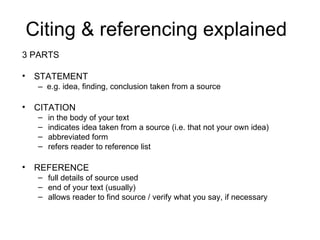
3 PARTS

•   STATEMENT
     – e.g. idea, finding, conclusion taken from a source

•   CITATION
     –   in the body of your text
     –   indicates idea taken from a source (i.e. that not your own idea)
     –   abbreviated form
     –   refers reader to reference list

•   REFERENCE
     – full details of source used
     – end of your text (usually)
     – allows reader to find source / verify what you say, if necessary
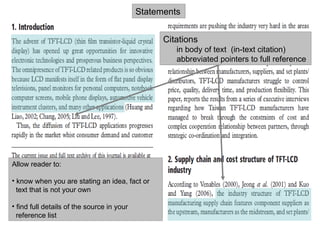
Statements


                                                  Citations
                                                     in body of text (in-text citation)
                                                     abbreviated pointers to full reference


Allow reader to:

• know when you are stating an idea, fact or
  text that is not your own

• find full details of the source in your
  reference list
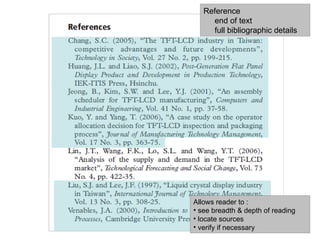
Reference
     end of text
     full bibliographic details


Allows reader to :
• see breadth & depth of reading
• locate sources
• verify if necessary
What is a citation style?
Hundreds of different styles

Author/date (e.g. Harvard)

     (Handelman and Levin, 2008)

     Handelman, G. J. & Levin, N. W. (2008) Iron and anemia in human biology: a review
     of mechanisms. Heart Failure Reviews, 13(4), 393-404.

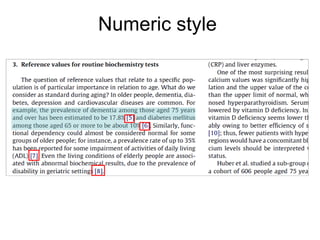
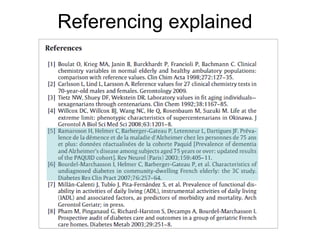
Numeric (e.g. Vancouver)

     (1) [1]

     1. Handelman G J, Levin NW. Iron and anemia in human biology: a review of mechanisms.
        Heart Failure Reviews 2008;13(4):393-404.

Journal specific e.g. British Medical Journal

     1

     1. Handelman GJ, Levin NW. Iron and anemia in human biology: a review of mechanisms.
        Heart Failure Reviews 2008;13(4):393-404.

Check with your lecturer / tutor which style to use

Use one style consistently throughout paper
Numeric style
Referencing explained
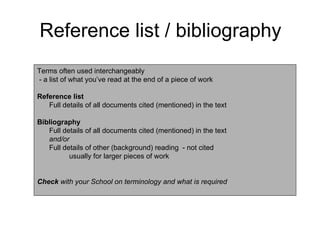
Reference list / bibliography
Terms often used interchangeably
- a list of what you’ve read at the end of a piece of work

Reference list
   Full details of all documents cited (mentioned) in the text

Bibliography
   Full details of all documents cited (mentioned) in the text
   and/or
   Full details of other (background) reading - not cited
          usually for larger pieces of work


Check with your School on terminology and what is required
WHY ?
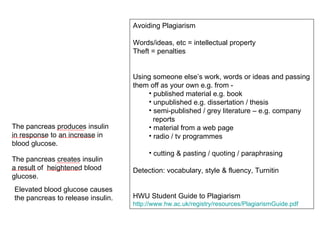
Avoiding Plagiarism

                                   Words/ideas, etc = intellectual property
                                   Theft = penalties


                                   Using someone else’s work, words or ideas and passing
                                   them off as your own e.g. from -
                                       • published material e.g. book
                                       • unpublished e.g. dissertation / thesis
                                       • semi-published / grey literature – e.g. company
                                         reports
The pancreas produces insulin          • material from a web page
in response to an increase in          • radio / tv programmes
blood glucose.
                                        • cutting & pasting / quoting / paraphrasing
The pancreas creates insulin
a result of heightened blood       Detection: vocabulary, style & fluency, Turnitin
glucose.
Elevated blood glucose causes
the pancreas to release insulin.   HWU Student Guide to Plagiarism
                                   http://www.hw.ac.uk/registry/resources/PlagiarismGuide.pdf
Found guilty of plagiarism
                                                         Copying the work of other authors in a book and articles

                                                                  “Chunks of prose, apparently written by Dr
                                                                   Persaud, were the work of other authors.”
                                                                   (Jenkins, 2008)

                                                                  “He failed to attribute the so-called ‘stolen words’”
                                                                   (Jenkins, 2008)

                                                         General Medical Council hearing-

                                                         plagiarism dishonest

                                                         brought profession into disrepute

                                                         suspended from practising medicine for 3 months


  ©Andy Butterton/PA


Jenkins, R. (2008) ‘TV psychiatrist Raj Persaud suspended for plagiarism. Raj Persaud brought profession into disrepute’ The Times, 21 June TimesOnline
[Online]. Available at: http://entertainment.timesonline.co.uk/tol/arts_and_entertainment/tv_and_radio/article4179597.ece (Accessed: 14 October 2008)
German Defence Minister
                                                          Plagiarism scandal over copy-and-past methods in PhD
                                                          thesis
                                                          Copied entire sections from other sources, without
                                                          attribution.
                                                          Admitted accidental “mistakes”
                                                          82.44% plagiarised - 891 examples of plagiarism from
                                                          over 120 different sources (Guttenplag wiki)


                                                          University of Bayreuth withdrew his doctorate
                                                          Announced his resignation (March 2011)

Karl-Theodor zu Guttenberg
©independent.co.uk


  Paterson, T. (2011) ‘German minister renounces PhD after accusations of plagiarism. ‘
  ’ The Independnet 23 Feb The Independent [Online]. Available at:
  http://www.independent.co.uk/news/world/europe/german-minister-renounces-phd-after-accusations-of-plagiarism-2222828.html (Accessed: 27 July 2011)
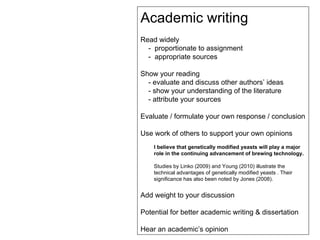
Academic writing
Read widely
  - proportionate to assignment
  - appropriate sources

Show your reading
  - evaluate and discuss other authors’ ideas
  - show your understanding of the literature
  - attribute your sources

Evaluate / formulate your own response / conclusion

Use work of others to support your own opinions
    I believe that genetically modified yeasts will play a major
    role in the continuing advancement of brewing technology.

    Studies by Linko (2009) and Young (2010) illustrate the
    technical advantages of genetically modified yeasts . Their
    significance has also been noted by Jones (2008).


Add weight to your discussion

Potential for better academic writing & dissertation

Hear an academic’s opinion
WHEN ?
QUIZ

Paul Robeson Library (n.d.) How to avoid plagiarism: An online tutorial [Online]. Available at:
http://library.camden.rutgers.edu/EducationalModule/Plagiarism/ (Accessed: 26 September, 2011)
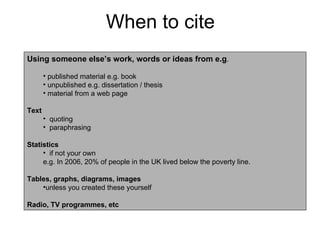
When to cite
Using someone else’s work, words or ideas from e.g.

       • published material e.g. book
       • unpublished e.g. dissertation / thesis
       • material from a web page

Text
       • quoting
       • paraphrasing

Statistics
     • if not your own
     e.g. In 2006, 20% of people in the UK lived below the poverty line.

Tables, graphs, diagrams, images
    •unless you created these yourself

Radio, TV programmes, etc
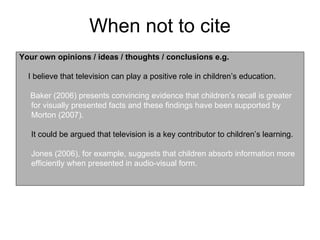
When not to cite
Your own opinions / ideas / thoughts / conclusions e.g.

  I believe that television can play a positive role in children’s education.

  Baker (2006) presents convincing evidence that children’s recall is greater
  for visually presented facts and these findings have been supported by
  Morton (2007).

   It could be argued that television is a key contributor to children’s learning.

   Jones (2006), for example, suggests that children absorb information more
   efficiently when presented in audio-visual form.
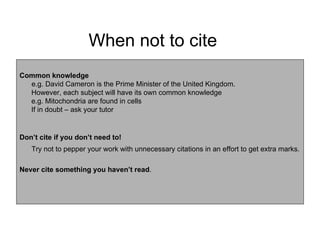
When not to cite
Common knowledge
  e.g. David Cameron is the Prime Minister of the United Kingdom.
  However, each subject will have its own common knowledge
  e.g. Mitochondria are found in cells
  If in doubt – ask your tutor


Don’t cite if you don’t need to!
   Try not to pepper your work with unnecessary citations in an effort to get extra marks.

Never cite something you haven’t read.
HOW ?
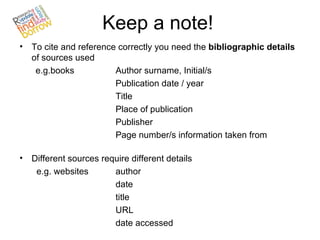
Keep a note!
• To cite and reference correctly you need the bibliographic details
  of sources used
   e.g.books           Author surname, Initial/s
                       Publication date / year
                       Title
                       Place of publication
                       Publisher
                       Page number/s information taken from

• Different sources require different details
   e.g. websites       author
                       date
                       title
                       URL
                       date accessed
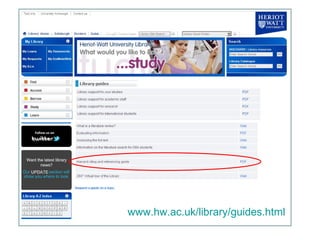
www.hw.ac.uk/library/guides.html
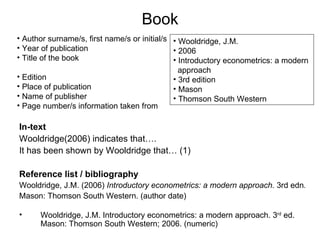
Book
• Author surname/s, first name/s or initial/s • Wooldridge, J.M.
• Year of publication                         • 2006
• Title of the book                           • Introductory econometrics: a modern
                                                approach
• Edition                                     • 3rd edition
• Place of publication                        • Mason
• Name of publisher                           • Thomson South Western
• Page number/s information taken from

In-text
Wooldridge(2006) indicates that….
It has been shown by Wooldridge that… (1)

Reference list / bibliography
Wooldridge, J.M. (2006) Introductory econometrics: a modern approach. 3rd edn.
Mason: Thomson South Western. (author date)

•     Wooldridge, J.M. Introductory econometrics: a modern approach. 3rd ed.
      Mason: Thomson South Western; 2006. (numeric)
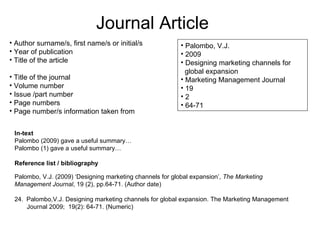
Journal Article
• Author surname/s, first name/s or initial/s              • Palombo, V.J.
• Year of publication                                      • 2009
• Title of the article                                     • Designing marketing channels for
                                                             global expansion
• Title of the journal                                     • Marketing Management Journal
• Volume number                                            • 19
• Issue /part number                                       •2
• Page numbers                                             • 64-71
• Page number/s information taken from


 In-text
 Palombo (2009) gave a useful summary…
 Palombo (1) gave a useful summary…

 Reference list / bibliography

 Palombo, V.J. (2009) ‘Designing marketing channels for global expansion’, The Marketing
 Management Journal, 19 (2), pp.64-71. (Author date)

 24. Palombo,V.J. Designing marketing channels for global expansion. The Marketing Management
     Journal 2009; 19(2): 64-71. (Numeric)
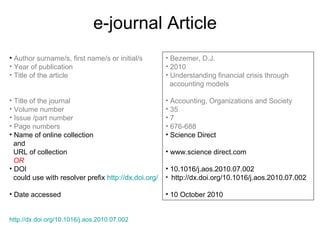
e-journal Article
• Author surname/s, first name/s or initial/s         • Bezemer, D.J.
• Year of publication                                 • 2010
• Title of the article                                • Understanding financial crisis through
                                                        accounting models

• Title of the journal                                • Accounting, Organizations and Society
• Volume number                                       • 35
• Issue /part number                                  •7
• Page numbers                                        • 676-688
• Name of online collection                           • Science Direct
  and
  URL of collection                                   • www.science direct.com
  OR
• DOI                                                 • 10.1016/j.aos.2010.07.002
  could use with resolver prefix http://dx.doi.org/   • http://dx.doi.org/10.1016/j.aos.2010.07.002

• Date accessed                                       • 10 October 2010


http://dx.doi.org/10.1016/j.aos.2010.07.002
e-journal Article
In-text
Bezemer (2010) gave a useful summary…


Reference list / bibliography

Bezember,D.J. (2010) ‘Understanding financial crisis through accounting models’, Accounting,
Organizations and Society, 35 (7), pp. 676-688, Science Direct [Online]. Available at:
http://www.sciencedirect.com (accessed: 10 October 2010). (Author date)

Bezember,D.J. (2010) ‘Understanding financial crisis through accounting models’, Accounting,
Organizations and Society, 35 (7), pp. 676-688, [Online] DOI: 10.1016/j.aos.2010.07.002
(accessed: 10 October 2010). (Author date)

Bezember,D.J. (2010) ‘Understanding financial crisis through accounting models’, Accounting,
Organizations and Society, 35 (7), pp. 676-688, [Online]. Available at:
http://dx.doi.org/10.1016/j.aos.2010.07.002 (accessed: 10 October 2010). (Author date)
e-journal Article
In-text
Bezemer(1) gave a useful summary…


Reference list / bibliography


Bezember,D.J. Understanding financial crisis through accounting models. Accounting,
Organizations and Society [internet]. 2010 [cited 2010 Oct 10]; 35 (7): 676-688. Available from:
http://www.sciencedirect.com. (Numeric)

Bezember,D.J. Understanding financial crisis through accounting models. Accounting,
Organizations and Society [internet]. 2010 [cited 2010 Oct 10]; 35 (7): 676-688. Available from:
doi: 10.1016/j.aos.2010.07.002 .(Numeric).

Bezember,D.J. Understanding financial crisis through accounting models. Accounting,
Organizations and Society [internet]. 2010 [cited 2010 Oct 10]; 35 (7): 676-688. Available from:
http://dx.doi.org/10.1016/j.aos.2010.07.002. (Numeric)
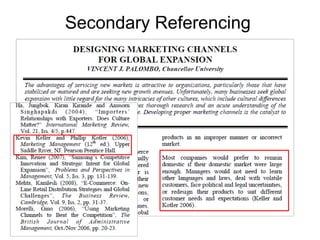
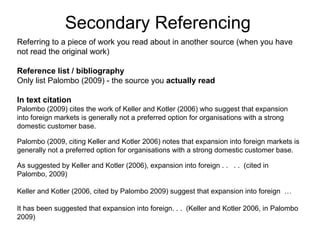
Secondary Referencing
Referring to a piece of work you read about in another source (when you have
not read the original work)

Reference list / bibliography
Only list Palombo (2009) - the source you actually read

In text citation
Palombo (2009) cites the work of Keller and Kotler (2006) who suggest that expansion
into foreign markets is generally not a preferred option for organisations with a strong
domestic customer base.

Palombo (2009, citing Keller and Kotler 2006) notes that expansion into foreign markets is
generally not a preferred option for organisations with a strong domestic customer base.

As suggested by Keller and Kotler (2006), expansion into foreign . . . . (cited in
Palombo, 2009)

Keller and Kotler (2006, cited by Palombo 2009) suggest that expansion into foreign …

It has been suggested that expansion into foreign. . . (Keller and Kotler 2006, in Palombo
2009)
TIPS & TOOLS
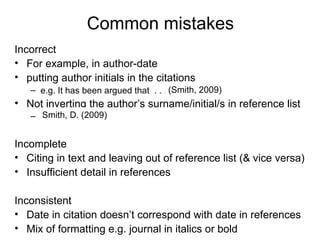
Common mistakes
Incorrect
• For example, in author-date
• putting author initials in the citations
   – e.g. It has been argued that . . . (Smith, 2009)
                                        (D. Smith, 2009)
• Not inverting the author’s surname/initial/s in reference list
     Smith, D. (2009)
   – D. Smith (2009)


Incomplete
• Citing in text and leaving out of reference list (& vice versa)
• Insufficient detail in references

Inconsistent
• Date in citation doesn’t correspond with date in references
• Mix of formatting e.g. journal in italics or bold
Note Taking
• Be systematic and thorough

• Note down all the (bibliographic) details you need to cite &
  reference correctly

   e.g. remember . . . . .
      • author initials as well as surnames
      • chapter title and author if an edited book
      • page number you get quotes / information from
      • date you accessed websites / electronic materials

• Make sure you can tie your notes to your source
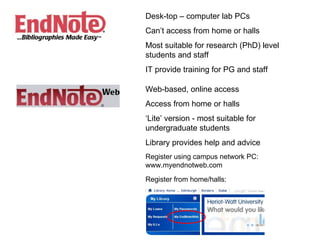
Desk-top – computer lab PCs
Can’t access from home or halls
Most suitable for research (PhD) level
students and staff
IT provide training for PG and staff

Web-based, online access
Access from home or halls
‘Lite’ version - most suitable for
undergraduate students
Library provides help and advice
Register using campus network PC:
www.myendnotweb.com

Register from home/halls:
Citing & Referencing
      WHAT?

      WHY?

      WHEN?

      HOW?
Further information
Citing & referencing
                                      www.hw.ac.uk/library/workshops.html


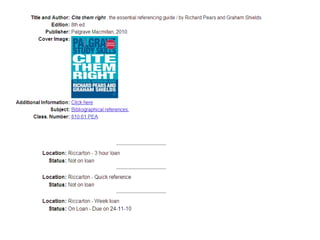
                 Cite them right: the essential referencing guide
                 Richard Pears & Graham Shields
                 (810.61 PEA) 3 hour & 1 week loan


Library Guide to Harvard Citing and Referencing
http://www.hw.ac.uk/library/guides.html

EndnoteWeb online tutorials : http://www.endnoteweb.com/training/

Enquiries: libhelp@hw.ac.uk
Further information

EndnoteWeb       (Library)

EndnoteWeb Workbook / slides
www.hw.ac.uk/library/workshops.html

Enquiries: libhelp@hw.ac.uk


Endnote (IT)

Training: www.hw.ac.uk/uics/Training/endnote.htm /

Enquiries: ithelp@hw.ac.uk
© draconisVH Flickr.com
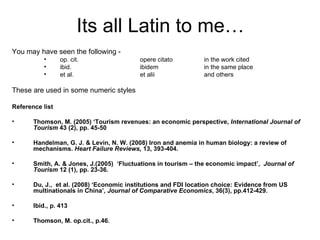
Its all Latin to me…
You may have seen the following -
           •     op. cit.                  opere citato         in the work cited
           •     ibid.                     ibidem               in the same place
           •     et al.                    et alii              and others

These are used in some numeric styles

Reference list

•      Thomson, M. (2005) ‘Tourism revenues: an economic perspective, International Journal of
       Tourism 43 (2), pp. 45-50

•      Handelman, G. J. & Levin, N. W. (2008) Iron and anemia in human biology: a review of
       mechanisms. Heart Failure Reviews, 13, 393-404.

•      Smith, A. & Jones, J.(2005) ‘Fluctuations in tourism – the economic impact’, Journal of
       Tourism 12 (1), pp. 23-36.

•      Du, J., et al. (2008) ‘Economic institutions and FDI location choice: Evidence from US
       multinationals in China’, Journal of Comparative Economics, 36(3), pp.412-429.

•      Ibid., p. 413

•      Thomson, M. op.cit., p.46.
Web-page - example
• Author/s                                 • British Red Cross
  (surname and initials or organisation)
• Year site published or last updated      • 2008
• Title of internet site                   • Open Gardens
• URL                                      • http://www.redcross.org.uk/index.asp?id=39992
• Date accessed                            • 17 June 2008

In-text

The Open Gardens scheme (British Red Cross, 2008)…
The Open Gardens scheme (1) . . .

Reference list / bibliography

British Red Cross (2008) Open Gardens. Available at:
http://www.redcross.org.uk/index.asp?id=39992 (Accessed: 17 June 2008). (Author date)

14. British Red Cross. Open Gardens [internet]. 2008 [Cited 17 June 2008] Available from:
    http://www.redcross.org.uk/index.asp?id=39992 (Numeric)
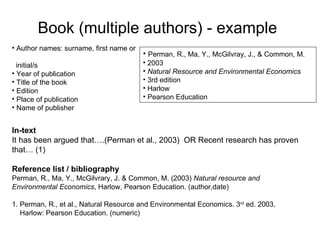
Book (multiple authors) - example
• Author names: surname, first name or
                                         • Perman, R., Ma, Y., McGilvray, J., & Common, M.
  initial/s                              • 2003
• Year of publication                    • Natural Resource and Environmental Economics
• Title of the book                      • 3rd edition
• Edition                                • Harlow
• Place of publication                   • Pearson Education
• Name of publisher


In-text
It has been argued that….(Perman et al., 2003) OR Recent research has proven
that… (1)

Reference list / bibliography
Perman, R., Ma, Y., McGilvrary, J. & Common, M. (2003) Natural resource and
Environmental Economics, Harlow, Pearson Education. (author,date)

1. Perman, R., et al., Natural Resource and Environmental Economics. 3rd ed. 2003,
   Harlow: Pearson Education. (numeric)
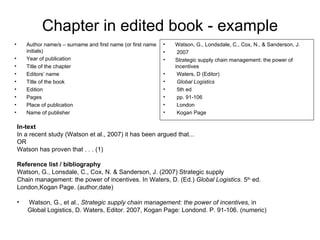
Chapter in edited book - example
•       Author name/s – surname and first name (or first name   •   Watson, G., Londsdale, C., Cox, N., & Sanderson, J.
        initials)                                               •    2007
•       Year of publication                                     •   Strategic supply chain management: the power of
•       Title of the chapter                                        incentives
•       Editors’ name                                           •    Waters, D (Editor)
•       Title of the book                                       •    Global Logistics
•       Edition                                                 •    5th ed
•       Pages                                                   •    pp. 91-106
•       Place of publication                                    •    London
•       Name of publisher                                       •    Kogan Page

    In-text
    In a recent study (Watson et al., 2007) it has been argued that...
    OR
    Watson has proven that . . . (1)

    Reference list / bibliography
    Watson, G., Lonsdale, C., Cox, N. & Sanderson, J. (2007) Strategic supply
    Chain management: the power of incentives. In Waters, D. (Ed.) Global Logistics. 5th ed.
    London,Kogan Page. (author,date)

    •   Watson, G., et al., Strategic supply chain management: the power of incentives, in
        Global Logistics, D. Waters, Editor. 2007, Kogan Page: Londond. P. 91-106. (numeric)
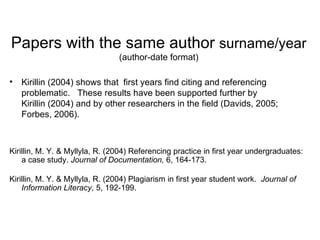
Papers with the same author surname/year
                                (author-date format)

• Kirillin (2004) shows that first years find citing and referencing
  problematic. These results have been supported further by
  Kirillin (2004) and by other researchers in the field (Davids, 2005;
  Forbes, 2006).


Kirillin, M. Y. & Myllyla, R. (2004) Referencing practice in first year undergraduates:
    a case study. Journal of Documentation, 6, 164-173.

Kirillin, M. Y. & Myllyla, R. (2004) Plagiarism in first year student work. Journal of
    Information Literacy, 5, 192-199.
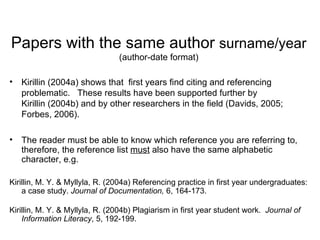
Papers with the same author surname/year
                                (author-date format)

• Kirillin (2004a) shows that first years find citing and referencing
  problematic. These results have been supported further by
  Kirillin (2004b) and by other researchers in the field (Davids, 2005;
  Forbes, 2006).

• The reader must be able to know which reference you are referring to,
  therefore, the reference list must also have the same alphabetic
  character, e.g.

Kirillin, M. Y. & Myllyla, R. (2004a) Referencing practice in first year undergraduates:
    a case study. Journal of Documentation, 6, 164-173.

Kirillin, M. Y. & Myllyla, R. (2004b) Plagiarism in first year student work. Journal of
    Information Literacy, 5, 192-199.
Newspaper article - example
    • Author name/s – surname and first name or                                                  • Old, D
      initial (if none, use title of newspaper)
    • Year of publication                                                                        • 2008
    • Title of the article                                                                       • House Price Gloom
    • Title of the newspaper                                                                     • Evening Chronicle
    • Edition (if required)                                                                      • Newcastle edition
    • Day and month                                                                              • 26th June
    • Page reference                                                                             • p 25

In-text citation
House prices fell by 2.1% last month (Old, 2008). OR
House prices fell by 2.1% last month (1).

Reference list / bibliography
Old D. (2008) ‘House price gloom’, Evening Chronicle (Newcastle edn.), 26 June, p.25. (author date)

24. Old D. House price gloom. Evening Chronicle. 2008. 26 June, p. 25.
    (numeric)

•      Online newspaper article - same as print newspaper plus [online] URL and (date accessed)
Pears, R. and Shields, G. (2008) Cite them right: The essential guide to referencing and plagiarism. Newcastle upon Tyne: Peartree Press. pp.
39

Citing and Referencing Workshop

  • 1.
    Citing & Referencing WHAT? WHY? WHEN? HOW? www.hw.ac.uk/library/workshops.html
  • 2.
  • 3.
    Citing & referencingexplained 3 PARTS • STATEMENT – e.g. idea, finding, conclusion taken from a source • CITATION – in the body of your text – indicates idea taken from a source (i.e. that not your own idea) – abbreviated form – refers reader to reference list • REFERENCE – full details of source used – end of your text (usually) – allows reader to find source / verify what you say, if necessary
  • 4.
    Statements Citations in body of text (in-text citation) abbreviated pointers to full reference Allow reader to: • know when you are stating an idea, fact or text that is not your own • find full details of the source in your reference list
  • 5.
    Reference end of text full bibliographic details Allows reader to : • see breadth & depth of reading • locate sources • verify if necessary
  • 6.
    What is acitation style? Hundreds of different styles Author/date (e.g. Harvard) (Handelman and Levin, 2008) Handelman, G. J. & Levin, N. W. (2008) Iron and anemia in human biology: a review of mechanisms. Heart Failure Reviews, 13(4), 393-404. Numeric (e.g. Vancouver) (1) [1] 1. Handelman G J, Levin NW. Iron and anemia in human biology: a review of mechanisms. Heart Failure Reviews 2008;13(4):393-404. Journal specific e.g. British Medical Journal 1 1. Handelman GJ, Levin NW. Iron and anemia in human biology: a review of mechanisms. Heart Failure Reviews 2008;13(4):393-404. Check with your lecturer / tutor which style to use Use one style consistently throughout paper
  • 7.
  • 8.
  • 9.
    Reference list /bibliography Terms often used interchangeably - a list of what you’ve read at the end of a piece of work Reference list Full details of all documents cited (mentioned) in the text Bibliography Full details of all documents cited (mentioned) in the text and/or Full details of other (background) reading - not cited usually for larger pieces of work Check with your School on terminology and what is required
  • 10.
  • 11.
    Avoiding Plagiarism Words/ideas, etc = intellectual property Theft = penalties Using someone else’s work, words or ideas and passing them off as your own e.g. from - • published material e.g. book • unpublished e.g. dissertation / thesis • semi-published / grey literature – e.g. company reports The pancreas produces insulin • material from a web page in response to an increase in • radio / tv programmes blood glucose. • cutting & pasting / quoting / paraphrasing The pancreas creates insulin a result of heightened blood Detection: vocabulary, style & fluency, Turnitin glucose. Elevated blood glucose causes the pancreas to release insulin. HWU Student Guide to Plagiarism http://www.hw.ac.uk/registry/resources/PlagiarismGuide.pdf
  • 12.
    Found guilty ofplagiarism Copying the work of other authors in a book and articles “Chunks of prose, apparently written by Dr Persaud, were the work of other authors.” (Jenkins, 2008) “He failed to attribute the so-called ‘stolen words’” (Jenkins, 2008) General Medical Council hearing- plagiarism dishonest brought profession into disrepute suspended from practising medicine for 3 months ©Andy Butterton/PA Jenkins, R. (2008) ‘TV psychiatrist Raj Persaud suspended for plagiarism. Raj Persaud brought profession into disrepute’ The Times, 21 June TimesOnline [Online]. Available at: http://entertainment.timesonline.co.uk/tol/arts_and_entertainment/tv_and_radio/article4179597.ece (Accessed: 14 October 2008)
  • 13.
    German Defence Minister Plagiarism scandal over copy-and-past methods in PhD thesis Copied entire sections from other sources, without attribution. Admitted accidental “mistakes” 82.44% plagiarised - 891 examples of plagiarism from over 120 different sources (Guttenplag wiki) University of Bayreuth withdrew his doctorate Announced his resignation (March 2011) Karl-Theodor zu Guttenberg ©independent.co.uk Paterson, T. (2011) ‘German minister renounces PhD after accusations of plagiarism. ‘ ’ The Independnet 23 Feb The Independent [Online]. Available at: http://www.independent.co.uk/news/world/europe/german-minister-renounces-phd-after-accusations-of-plagiarism-2222828.html (Accessed: 27 July 2011)
  • 14.
    Academic writing Read widely - proportionate to assignment - appropriate sources Show your reading - evaluate and discuss other authors’ ideas - show your understanding of the literature - attribute your sources Evaluate / formulate your own response / conclusion Use work of others to support your own opinions I believe that genetically modified yeasts will play a major role in the continuing advancement of brewing technology. Studies by Linko (2009) and Young (2010) illustrate the technical advantages of genetically modified yeasts . Their significance has also been noted by Jones (2008). Add weight to your discussion Potential for better academic writing & dissertation Hear an academic’s opinion
  • 15.
  • 16.
    QUIZ Paul Robeson Library(n.d.) How to avoid plagiarism: An online tutorial [Online]. Available at: http://library.camden.rutgers.edu/EducationalModule/Plagiarism/ (Accessed: 26 September, 2011)
  • 17.
    When to cite Usingsomeone else’s work, words or ideas from e.g. • published material e.g. book • unpublished e.g. dissertation / thesis • material from a web page Text • quoting • paraphrasing Statistics • if not your own e.g. In 2006, 20% of people in the UK lived below the poverty line. Tables, graphs, diagrams, images •unless you created these yourself Radio, TV programmes, etc
  • 18.
    When not tocite Your own opinions / ideas / thoughts / conclusions e.g. I believe that television can play a positive role in children’s education. Baker (2006) presents convincing evidence that children’s recall is greater for visually presented facts and these findings have been supported by Morton (2007). It could be argued that television is a key contributor to children’s learning. Jones (2006), for example, suggests that children absorb information more efficiently when presented in audio-visual form.
  • 19.
    When not tocite Common knowledge e.g. David Cameron is the Prime Minister of the United Kingdom. However, each subject will have its own common knowledge e.g. Mitochondria are found in cells If in doubt – ask your tutor Don’t cite if you don’t need to! Try not to pepper your work with unnecessary citations in an effort to get extra marks. Never cite something you haven’t read.
  • 20.
  • 21.
    Keep a note! •To cite and reference correctly you need the bibliographic details of sources used e.g.books Author surname, Initial/s Publication date / year Title Place of publication Publisher Page number/s information taken from • Different sources require different details e.g. websites author date title URL date accessed
  • 22.
  • 24.
    Book • Author surname/s,first name/s or initial/s • Wooldridge, J.M. • Year of publication • 2006 • Title of the book • Introductory econometrics: a modern approach • Edition • 3rd edition • Place of publication • Mason • Name of publisher • Thomson South Western • Page number/s information taken from In-text Wooldridge(2006) indicates that…. It has been shown by Wooldridge that… (1) Reference list / bibliography Wooldridge, J.M. (2006) Introductory econometrics: a modern approach. 3rd edn. Mason: Thomson South Western. (author date) • Wooldridge, J.M. Introductory econometrics: a modern approach. 3rd ed. Mason: Thomson South Western; 2006. (numeric)
  • 25.
    Journal Article • Authorsurname/s, first name/s or initial/s • Palombo, V.J. • Year of publication • 2009 • Title of the article • Designing marketing channels for global expansion • Title of the journal • Marketing Management Journal • Volume number • 19 • Issue /part number •2 • Page numbers • 64-71 • Page number/s information taken from In-text Palombo (2009) gave a useful summary… Palombo (1) gave a useful summary… Reference list / bibliography Palombo, V.J. (2009) ‘Designing marketing channels for global expansion’, The Marketing Management Journal, 19 (2), pp.64-71. (Author date) 24. Palombo,V.J. Designing marketing channels for global expansion. The Marketing Management Journal 2009; 19(2): 64-71. (Numeric)
  • 26.
    e-journal Article • Authorsurname/s, first name/s or initial/s • Bezemer, D.J. • Year of publication • 2010 • Title of the article • Understanding financial crisis through accounting models • Title of the journal • Accounting, Organizations and Society • Volume number • 35 • Issue /part number •7 • Page numbers • 676-688 • Name of online collection • Science Direct and URL of collection • www.science direct.com OR • DOI • 10.1016/j.aos.2010.07.002 could use with resolver prefix http://dx.doi.org/ • http://dx.doi.org/10.1016/j.aos.2010.07.002 • Date accessed • 10 October 2010 http://dx.doi.org/10.1016/j.aos.2010.07.002
  • 27.
    e-journal Article In-text Bezemer (2010)gave a useful summary… Reference list / bibliography Bezember,D.J. (2010) ‘Understanding financial crisis through accounting models’, Accounting, Organizations and Society, 35 (7), pp. 676-688, Science Direct [Online]. Available at: http://www.sciencedirect.com (accessed: 10 October 2010). (Author date) Bezember,D.J. (2010) ‘Understanding financial crisis through accounting models’, Accounting, Organizations and Society, 35 (7), pp. 676-688, [Online] DOI: 10.1016/j.aos.2010.07.002 (accessed: 10 October 2010). (Author date) Bezember,D.J. (2010) ‘Understanding financial crisis through accounting models’, Accounting, Organizations and Society, 35 (7), pp. 676-688, [Online]. Available at: http://dx.doi.org/10.1016/j.aos.2010.07.002 (accessed: 10 October 2010). (Author date)
  • 28.
    e-journal Article In-text Bezemer(1) gavea useful summary… Reference list / bibliography Bezember,D.J. Understanding financial crisis through accounting models. Accounting, Organizations and Society [internet]. 2010 [cited 2010 Oct 10]; 35 (7): 676-688. Available from: http://www.sciencedirect.com. (Numeric) Bezember,D.J. Understanding financial crisis through accounting models. Accounting, Organizations and Society [internet]. 2010 [cited 2010 Oct 10]; 35 (7): 676-688. Available from: doi: 10.1016/j.aos.2010.07.002 .(Numeric). Bezember,D.J. Understanding financial crisis through accounting models. Accounting, Organizations and Society [internet]. 2010 [cited 2010 Oct 10]; 35 (7): 676-688. Available from: http://dx.doi.org/10.1016/j.aos.2010.07.002. (Numeric)
  • 29.
  • 30.
    Secondary Referencing Referring toa piece of work you read about in another source (when you have not read the original work) Reference list / bibliography Only list Palombo (2009) - the source you actually read In text citation Palombo (2009) cites the work of Keller and Kotler (2006) who suggest that expansion into foreign markets is generally not a preferred option for organisations with a strong domestic customer base. Palombo (2009, citing Keller and Kotler 2006) notes that expansion into foreign markets is generally not a preferred option for organisations with a strong domestic customer base. As suggested by Keller and Kotler (2006), expansion into foreign . . . . (cited in Palombo, 2009) Keller and Kotler (2006, cited by Palombo 2009) suggest that expansion into foreign … It has been suggested that expansion into foreign. . . (Keller and Kotler 2006, in Palombo 2009)
  • 31.
  • 32.
    Common mistakes Incorrect • Forexample, in author-date • putting author initials in the citations – e.g. It has been argued that . . . (Smith, 2009) (D. Smith, 2009) • Not inverting the author’s surname/initial/s in reference list Smith, D. (2009) – D. Smith (2009) Incomplete • Citing in text and leaving out of reference list (& vice versa) • Insufficient detail in references Inconsistent • Date in citation doesn’t correspond with date in references • Mix of formatting e.g. journal in italics or bold
  • 33.
    Note Taking • Besystematic and thorough • Note down all the (bibliographic) details you need to cite & reference correctly e.g. remember . . . . . • author initials as well as surnames • chapter title and author if an edited book • page number you get quotes / information from • date you accessed websites / electronic materials • Make sure you can tie your notes to your source
  • 34.
    Desk-top – computerlab PCs Can’t access from home or halls Most suitable for research (PhD) level students and staff IT provide training for PG and staff Web-based, online access Access from home or halls ‘Lite’ version - most suitable for undergraduate students Library provides help and advice Register using campus network PC: www.myendnotweb.com Register from home/halls:
  • 35.
    Citing & Referencing WHAT? WHY? WHEN? HOW?
  • 36.
    Further information Citing &referencing www.hw.ac.uk/library/workshops.html Cite them right: the essential referencing guide Richard Pears & Graham Shields (810.61 PEA) 3 hour & 1 week loan Library Guide to Harvard Citing and Referencing http://www.hw.ac.uk/library/guides.html EndnoteWeb online tutorials : http://www.endnoteweb.com/training/ Enquiries: libhelp@hw.ac.uk
  • 37.
    Further information EndnoteWeb (Library) EndnoteWeb Workbook / slides www.hw.ac.uk/library/workshops.html Enquiries: libhelp@hw.ac.uk Endnote (IT) Training: www.hw.ac.uk/uics/Training/endnote.htm / Enquiries: ithelp@hw.ac.uk
  • 38.
  • 39.
    Its all Latinto me… You may have seen the following - • op. cit. opere citato in the work cited • ibid. ibidem in the same place • et al. et alii and others These are used in some numeric styles Reference list • Thomson, M. (2005) ‘Tourism revenues: an economic perspective, International Journal of Tourism 43 (2), pp. 45-50 • Handelman, G. J. & Levin, N. W. (2008) Iron and anemia in human biology: a review of mechanisms. Heart Failure Reviews, 13, 393-404. • Smith, A. & Jones, J.(2005) ‘Fluctuations in tourism – the economic impact’, Journal of Tourism 12 (1), pp. 23-36. • Du, J., et al. (2008) ‘Economic institutions and FDI location choice: Evidence from US multinationals in China’, Journal of Comparative Economics, 36(3), pp.412-429. • Ibid., p. 413 • Thomson, M. op.cit., p.46.
  • 40.
    Web-page - example •Author/s • British Red Cross (surname and initials or organisation) • Year site published or last updated • 2008 • Title of internet site • Open Gardens • URL • http://www.redcross.org.uk/index.asp?id=39992 • Date accessed • 17 June 2008 In-text The Open Gardens scheme (British Red Cross, 2008)… The Open Gardens scheme (1) . . . Reference list / bibliography British Red Cross (2008) Open Gardens. Available at: http://www.redcross.org.uk/index.asp?id=39992 (Accessed: 17 June 2008). (Author date) 14. British Red Cross. Open Gardens [internet]. 2008 [Cited 17 June 2008] Available from: http://www.redcross.org.uk/index.asp?id=39992 (Numeric)
  • 41.
    Book (multiple authors)- example • Author names: surname, first name or • Perman, R., Ma, Y., McGilvray, J., & Common, M. initial/s • 2003 • Year of publication • Natural Resource and Environmental Economics • Title of the book • 3rd edition • Edition • Harlow • Place of publication • Pearson Education • Name of publisher In-text It has been argued that….(Perman et al., 2003) OR Recent research has proven that… (1) Reference list / bibliography Perman, R., Ma, Y., McGilvrary, J. & Common, M. (2003) Natural resource and Environmental Economics, Harlow, Pearson Education. (author,date) 1. Perman, R., et al., Natural Resource and Environmental Economics. 3rd ed. 2003, Harlow: Pearson Education. (numeric)
  • 42.
    Chapter in editedbook - example • Author name/s – surname and first name (or first name • Watson, G., Londsdale, C., Cox, N., & Sanderson, J. initials) • 2007 • Year of publication • Strategic supply chain management: the power of • Title of the chapter incentives • Editors’ name • Waters, D (Editor) • Title of the book • Global Logistics • Edition • 5th ed • Pages • pp. 91-106 • Place of publication • London • Name of publisher • Kogan Page In-text In a recent study (Watson et al., 2007) it has been argued that... OR Watson has proven that . . . (1) Reference list / bibliography Watson, G., Lonsdale, C., Cox, N. & Sanderson, J. (2007) Strategic supply Chain management: the power of incentives. In Waters, D. (Ed.) Global Logistics. 5th ed. London,Kogan Page. (author,date) • Watson, G., et al., Strategic supply chain management: the power of incentives, in Global Logistics, D. Waters, Editor. 2007, Kogan Page: Londond. P. 91-106. (numeric)
  • 43.
    Papers with thesame author surname/year (author-date format) • Kirillin (2004) shows that first years find citing and referencing problematic. These results have been supported further by Kirillin (2004) and by other researchers in the field (Davids, 2005; Forbes, 2006). Kirillin, M. Y. & Myllyla, R. (2004) Referencing practice in first year undergraduates: a case study. Journal of Documentation, 6, 164-173. Kirillin, M. Y. & Myllyla, R. (2004) Plagiarism in first year student work. Journal of Information Literacy, 5, 192-199.
  • 44.
    Papers with thesame author surname/year (author-date format) • Kirillin (2004a) shows that first years find citing and referencing problematic. These results have been supported further by Kirillin (2004b) and by other researchers in the field (Davids, 2005; Forbes, 2006). • The reader must be able to know which reference you are referring to, therefore, the reference list must also have the same alphabetic character, e.g. Kirillin, M. Y. & Myllyla, R. (2004a) Referencing practice in first year undergraduates: a case study. Journal of Documentation, 6, 164-173. Kirillin, M. Y. & Myllyla, R. (2004b) Plagiarism in first year student work. Journal of Information Literacy, 5, 192-199.
  • 45.
    Newspaper article -example • Author name/s – surname and first name or • Old, D initial (if none, use title of newspaper) • Year of publication • 2008 • Title of the article • House Price Gloom • Title of the newspaper • Evening Chronicle • Edition (if required) • Newcastle edition • Day and month • 26th June • Page reference • p 25 In-text citation House prices fell by 2.1% last month (Old, 2008). OR House prices fell by 2.1% last month (1). Reference list / bibliography Old D. (2008) ‘House price gloom’, Evening Chronicle (Newcastle edn.), 26 June, p.25. (author date) 24. Old D. House price gloom. Evening Chronicle. 2008. 26 June, p. 25. (numeric) • Online newspaper article - same as print newspaper plus [online] URL and (date accessed) Pears, R. and Shields, G. (2008) Cite them right: The essential guide to referencing and plagiarism. Newcastle upon Tyne: Peartree Press. pp. 39

Editor's Notes

  • #12 ASSESSMENT CRITERIA – HAS THE STUDENT AVOIDED COPYING BLOCKS OF TEXT OR FIGURES VERBATIM FROM OTHE SOURCES MARKS WILL BE DEDUCTED FOR EXCESSIVE USE OF OTHERS’ PUBLISHED WORK, EVEN IF THE USE IS ATTRIBUTED
  • #15 ASSIGNMENT CRITERIA ASK FOR CRITICALLY EVALUATED DESCRIPTIONS OF PRIOR WORK
  • #22 PAGE NUMBERS REQUIRED – NOT JUST FOR QUOTES BUT FOR PARAPHRASES AND SUMMARIES TOO DON’T EXPECT THE READER TO HAVE TO FIND THE PAGES YOU TOOK THE INFORMATION FROM DATE ACCESSED
  • #23 IF USING SOURCES NOT COVERED BY THE SLIDES TODAY THEN TRY THE LIBRARY HARVARD GUIDE USES A SLIGHTLY DIFFERENT HARVARD STYLE TO UL BUT KEY BIBLIOGRAPHIC DETAILS SHOWN YOU CAN THEN INPUT THESE IN ENDNOTEWEB AND FORMAT IN HARVARD UL OR USE THIS GUIDE STYLE IF USED CONSISTENTLY – NO DIRECT ENDNOTEWEB FORMAT OPTION
  • #24 IF USING SOURCES NOT COVERED BY THE SLIDES TODAY THEN TRY THIS BOOK USES A SLIGHTLY DIFFERENT HARVARD STYLE TO UL BUT KEY BIBLIOGRAPHIC DETAILS SHOWN YOU CAN THEN INPUT THESE IN ENDNOTEWEB AND FORMAT IN HARVARD UL OR USE THIS BOOK IF USED CONSISTENTLY – NO DIRECT ENDNOTEWEB FORMAT OPTION
  • #26 There are more parts to remember for a journal article. You obviously need the author, and you need to take note of two titles: The article title and the journal (or source) title. If you ever wanted to know if we had the article you wanted, you would type the source title (not the article title) into the Catalogue. In addition to having the year, you also need to know the volume and issue numbers (often there are volumes are made up of several parts and there are several volumes published each year). Therefore in order to accurately reference, both to attribute the source and to allow others to follow the source, you MUST take note of the volume and issue numbers. Lastly, you should also take note of the page numbers. Again page numbers are useless unless you know which volume and issue you can find those pages in. It is common in the sciences to abbreviate the journal title – again check with your supervisor, what the preferred format is
  • #27 There are more parts to remember for a journal article. You obviously need the author, and you need to take note of two titles: The article title and the journal (or source) title. If you ever wanted to know if we had the article you wanted, you would type the source title (not the article title) into the Catalogue. In addition to having the year, you also need to know the volume and issue numbers (often there are volumes are made up of several parts and there are several volumes published each year). Therefore in order to accurately reference, both to attribute the source and to allow others to follow the source, you MUST take note of the volume and issue numbers. Lastly, you should also take note of the page numbers. Again page numbers are useless unless you know which volume and issue you can find those pages in. It is common in the sciences to abbreviate the journal title – again check with your supervisor, what the preferred format is
  • #28 There are more parts to remember for a journal article. You obviously need the author, and you need to take note of two titles: The article title and the journal (or source) title. If you ever wanted to know if we had the article you wanted, you would type the source title (not the article title) into the Catalogue. In addition to having the year, you also need to know the volume and issue numbers (often there are volumes are made up of several parts and there are several volumes published each year). Therefore in order to accurately reference, both to attribute the source and to allow others to follow the source, you MUST take note of the volume and issue numbers. Lastly, you should also take note of the page numbers. Again page numbers are useless unless you know which volume and issue you can find those pages in. It is common in the sciences to abbreviate the journal title – again check with your supervisor, what the preferred format is
  • #29 There are more parts to remember for a journal article. You obviously need the author, and you need to take note of two titles: The article title and the journal (or source) title. If you ever wanted to know if we had the article you wanted, you would type the source title (not the article title) into the Catalogue. In addition to having the year, you also need to know the volume and issue numbers (often there are volumes are made up of several parts and there are several volumes published each year). Therefore in order to accurately reference, both to attribute the source and to allow others to follow the source, you MUST take note of the volume and issue numbers. Lastly, you should also take note of the page numbers. Again page numbers are useless unless you know which volume and issue you can find those pages in. It is common in the sciences to abbreviate the journal title – again check with your supervisor, what the preferred format is
  • #30 You cannot cite something you have not read, though neither can you attribute an idea to the wrong author, therefore you should describe this in your text as wither: Using the example in the handout. Say you are reading a paper from 2007 by Chen. In this paper, Chen mentions some ideas/findings that another author (Kelly) wrote about in 1999. You would want to mention that you are aware of the work of Kelly and ideally you would find this article/book and read the original. However, if you cannot do this, then you still wish to let the reader know that you know of Kelly’s ideas. As your interpretation of Kelly’s ideas is in fact the interpretation Chen has made, you must mention this in your citation (as Chen may have misinterpreted it) Therefore… IN YOUR TEXT YOU TELL THE READER THIS BY USING IN THE TEXT (AS CITED IN . . .) IN YOUR REFERENCE LIST YOU ONLY REFERENCE THE ITEMS YOU HAVE ACTUALLY READ. SO YOU REFERENCE Chen and not Kelly
  • #31 You cannot cite something you have not read, though neither can you attribute an idea to the wrong author, therefore you should describe this in your text as wither: Using the example in the handout. Say you are reading a paper from 2007 by Chen. In this paper, Chen mentions some ideas/findings that another author (Kelly) wrote about in 1999. You would want to mention that you are aware of the work of Kelly and ideally you would find this article/book and read the original. However, if you cannot do this, then you still wish to let the reader know that you know of Kelly’s ideas. As your interpretation of Kelly’s ideas is in fact the interpretation Chen has made, you must mention this in your citation (as Chen may have misinterpreted it) Therefore… IN YOUR TEXT YOU TELL THE READER THIS BY USING IN THE TEXT (AS CITED IN . . .) IN YOUR REFERENCE LIST YOU ONLY REFERENCE THE ITEMS YOU HAVE ACTUALLY READ. SO YOU REFERENCE Chen and not Kelly
  • #42 ET AL - LATIN FOR ‘AND OTHERS’ – CAN USE “and others” INSTEAD OF USED IF MORE THAN THREE AUTHORS
  • #44 WHERE MULTIPLE PUBLICATIONS BY SAME AUTHOR FROM SAME YEAR, DIFFERENTIATE BY ADDING A LETTER – THE LETTER MUST ALSO BE USED IN THE CITATIONS
  • #45 WHERE MULTIPLE PUBLICATIONS BY SAME AUTHOR FROM SAME YEAR, DIFFERENTIATE BY ADDING A LETTER – THE LETTER MUST ALSO BE USED IN THE CITATIONS