

The document provides guidance on referencing sources using the OSCOLA (Oxford Standard for Citation of Legal Authorities) style. It discusses the importance of referencing, how to reference primary sources like cases and legislation, and secondary sources like books and articles. Footnotes and a bibliography are used to cite sources. The document also covers how to avoid plagiarism and provides examples of formatting footnotes and bibliographies according to OSCOLA guidelines.
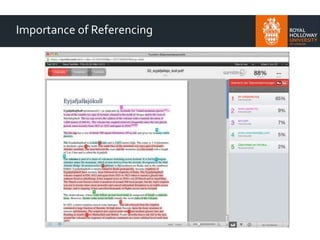
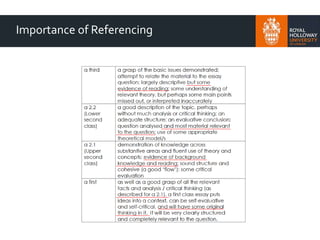
What is referencingand why do I need
to do it?
• Acknowledge when using
someone’s work
• To make clear to the reader that
this idea is not your own
• Demonstrate the breadth of
reading and individual research
• Support and improve your
argument
• An academic skill for all levels
• To allow you, your tutor and other
readers to retrieve items that you
have mentioned
• To avoid accusations of plagiarism
What is plagiarism?
•Passing off as your own a piece of work
that is partly or wholly the work of
another student
• Citing and referencing sources that you
have not used
• Quoting, summarising or paraphrasing
material in your assignment without
citing the original source
• 'Recycling' a piece of your own work that
you have previously submitted for
another module or course (i.e. self-
plagiarism).
(Palgrave Study SkillsOnline, 2018)
7.
Avoiding plagiarism
• Takeeffective notes
• Don’t leave assignments
to the last minute
• Keep a note of the
sources you have used
• Reference accurately and
correctly
Footnotes
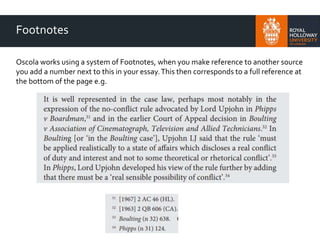
Oscola works usinga system of Footnotes, when you make reference to another source
you add a number next to this in your essay.This then corresponds to a full reference at
the bottom of the page e.g.
12.
OSCOLA – PrimarySources: Cases
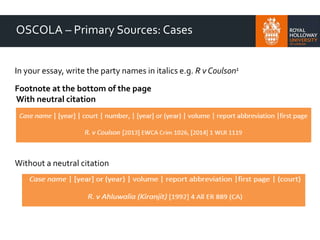
In your essay, write the party names in italics e.g. R v Coulson1
Footnote at the bottom of the page
With neutral citation
Without a neutral citation
13.
OSCOLA – PrimarySources: Cases
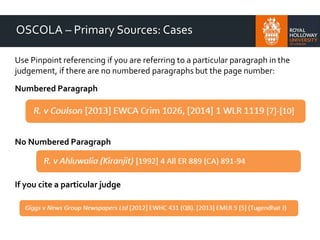
Use Pinpoint referencing if you are referring to a particular paragraph in the
judgement, if there are no numbered paragraphs but the page number:
Numbered Paragraph
No Numbered Paragraph
If you cite a particular judge
14.
OSCOLA – PrimarySources
Use [square brackets] around the year in your citation when the year
is necessary to identify the volume
Brady v Brady [1989] AC 755 (HL).
Use (round brackets) when the volumes of the law report series are
independently numbered, so that the year of publication is not
needed to find the volume. (The year being given is the year of the
judgement NOT the year of publication)
Barrett v Enfield LBC (1999) 49 BMLR 1 (HL).
15.
OSCOLA – PrimarySources: Legislation
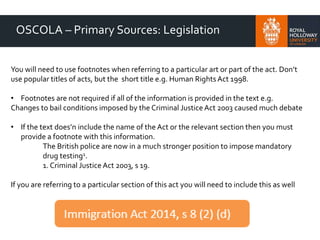
You will need to use footnotes when referring to a particular art or part of the act. Don’t
use popular titles of acts, but the short title e.g. Human RightsAct 1998.
• Footnotes are not required if all of the information is provided in the text e.g.
Changes to bail conditions imposed by the Criminal JusticeAct 2003 caused much debate
• If the text does’n include the name of the Act or the relevant section then you must
provide a footnote with this information.
The British police are now in a much stronger position to impose mandatory
drug testing1.
1. Criminal JusticeAct 2003, s 19.
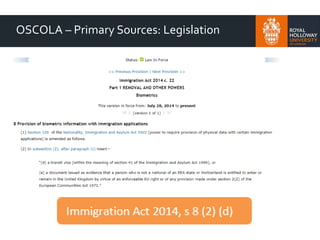
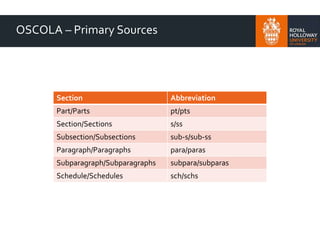
If you are referring to a particular section of this act you will need to include this as well
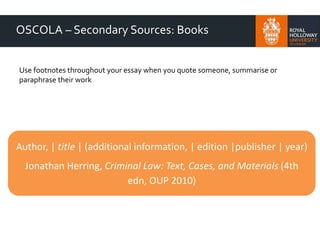
OSCOLA – SecondarySources: Books
Use footnotes throughout your essay when you quote someone, summarise or
paraphrase their work
Author, | title | (additional information, | edition |publisher | year)
Jonathan Herring, Criminal Law: Text, Cases, and Materials (4th
edn, OUP 2010)
21.
OSCOLA – SecondarySources: Journal
Articles
Use footnotes throughout your essay when you quote someone, summarise or
paraphrase their work
Cardiff Index to Legal Abbreviations
author, | ‘title’ | [year] or (year) | volume | journal name or abbreviation | first page of
article
Paul Craig, ‘Theory, “Pure Theory” and Values in Public Law’ [2005] PL 440
Or
Alison L Young, ‘In defence of Due Deference’ (2009) 72 MLR 554
22.
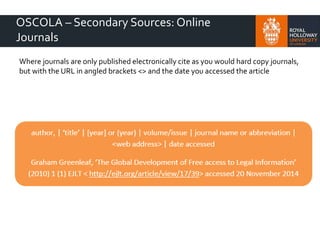
OSCOLA – SecondarySources: Online
Journals
Where journals are only published electronically cite as you would hard copy journals,
but with the URL in angled brackets <> and the date you accessed the article
23.
OSCOLA – SecondarySources
Even though you find the articles through
our online databases you reference them
as if they are hard copy articles.
Only follow the follows the rules for online
if the journal is only published online.
Footnotes
Pieces of legislationwith longer names can be referred to
in the body of your work by a shortened name, without the
need to footnote, providing that a full citation has been
given once, with the shortened version you will be using
specified in brackets at the end
15. Deregulation and Contracting Out Act 1994 (DCOA).
…
27. DCOA s2.
26.
Footnotes
There is noneed to repeat the name of the case in your footnote if you
have included this in the main body of your work – just start with the
neutral citation or law report citation, as appropriate.
Austin v Commissioner3 of Police for the Metropolis showed that being
in one place without food, shelter, or water was not a deprivation of
liberty.
3. [2009] UKHL 5, (2009)AC 564
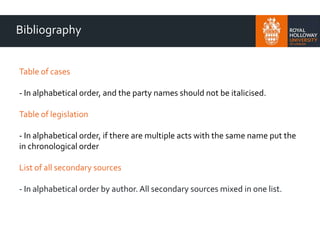
Bibliography
Table of cases
-In alphabetical order, and the party names should not be italicised.
Table of legislation
- In alphabetical order, if there are multiple acts with the same name put the
in chronological order
List of all secondary sources
- In alphabetical order by author. All secondary sources mixed in one list.
29.
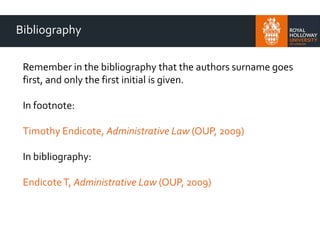
Bibliography
Remember in thebibliography that the authors surname goes
first, and only the first initial is given.
In footnote:
Timothy Endicote, Administrative Law (OUP, 2009)
In bibliography:
EndicoteT, Administrative Law (OUP, 2009)
#8 The main thing for all new students to take away is that we are here to help! There are lots of ways that you can get help so please don’t be afraid to ask, if you are unsure just ask!
Phone
Email
Social media – YOUTUBE icon
Subject guides
Helpdesk
Information consultant
Might want to follow us on social media so you can stay up to date with news. Also take a look at the subject guide for your department and have a look at what resources are available.
#13 They might not write the name of the case out in their essay but still need to put a footnote if they are referring to information from a case
Demonstrate the first example and show on Westlaw and where they can find the information
Neutral citation were introduced in 2001 and are independent from law reports, so have to include the abbreviation of the court and then the law report.
#16 Demonstrate this for immigration Act – next page
#17 Demonstrate this and where they can find the information
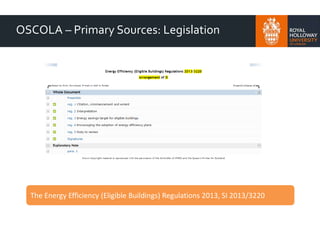
#19 SIs are numbered consecutively throughout the year, to cite them give the name, year and then the SI number preceded by a comma
#21 Demonstrate this and where they can find the information
#22 Demonstrate this and where they can find the information – show the Cardiff index and use the example of PL