Plagiarism, Citing and Referencing  Samantha Halford, Library [email_address]
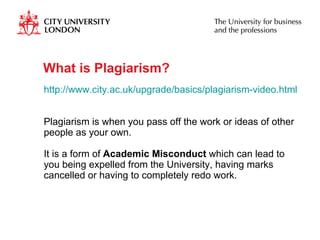
What is Plagiarism? http://www.city.ac.uk/upgrade/basics/plagiarism-video.html   Plagiarism is when you pass off the work or ideas of other people as your own. It is a form of  Academic Misconduct  which can lead to you being expelled from the University, having marks cancelled or having to completely redo work.
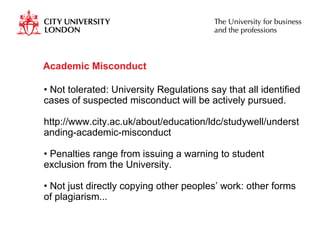
Academic Misconduct Not tolerated: University Regulations say that all identified cases of suspected misconduct will be actively pursued. http://www.city.ac.uk/about/education/ldc/studywell/understanding-academic-misconduct  Penalties range from issuing a warning to student exclusion from the University. Not just directly copying other peoples’ work: other forms of plagiarism...
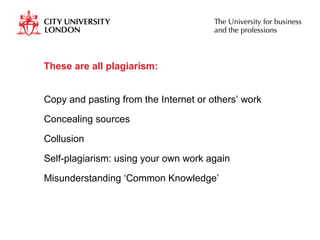
These are all plagiarism: Copy and pasting from the Internet or others’ work Concealing sources Collusion Self-plagiarism: using your own work again  Misunderstanding ‘Common Knowledge’
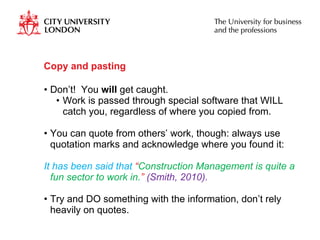
Copy and pasting  Don’t!  You  will  get caught.  Work is passed through special software that WILL catch you, regardless of where you copied from. You can quote from others’ work, though: always use quotation marks and acknowledge where you found it: It has been said that  “ Construction Management is quite a fun sector to work in. ”  (Smith, 2010). Try and DO something with the information, don’t rely heavily on quotes.
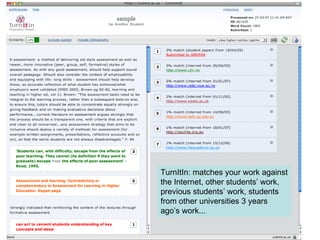
TurnItIn: matches your work against the Internet, other students’ work, previous students’ work, students from other universities 3 years ago’s work...
Concealing sources Pretending you had an idea yourself, when you really found it in your research and reading.  Often unintentional: but still counts as Academic Misconduct! Be  very careful  when you take notes so you always know which was your idea, and which the author’s. Always cite and acknowledge ideas from other people. If you use it more than once in an essay, cite each time: even if it’s the next paragraph.
Collusion Taking credit for other students’ work. Working out the answers to homework questions together.  Watch out for group work!  Always acknowledge other students’ ideas and contributions, and work individually on your assignments. It is NOT chatting with other students, then going away and doing the work on your own.
Common Knowledge If a fact is common knowledge, you do not need to cite. If it is not ‘common knowledge’, always cite! Not sure?  Ask a tutor for advice, or find a source: it is better to be on the safe side.
Self-plagiarism Re-submitting your assignments. Re-using work that you’ve already carried out. Re-using the same paragraph in two pieces of work.
Common causes of referrals/failures Lack of contact with supervisors: it’s hard for them to tell if you really did the work if you’re not discussing with them. Suspiciously good grammar/spelling in parts of your work! Your tutors know the literature well: they will recognize other peoples’ ideas. Inadequate citations/referencing.
So how do I avoid accusations of plagiarism? Take clear notes. Quote : if you use someone else’s words, put them in quotation marks (“...”) and acknowledge them properly.  Paraphrase : give your own understanding of the idea, and acknowledge them properly. Citing and Reference correctly : this is how you acknowledge other people properly! http://www.city.ac.uk/upgrade/basics/avoiding-plagiarism.html
Further tips... Consult with your tutors and supervisors if you’re in doubt. Start your work early so you’ve time to cite and reference properly. Make sure your conclusions are always your own thoughts, based on the work and research you’ve done. Read through your work carefully: is it clear where you’ve used other people’s work?  Are your own ideas obvious? Improve your writing skills:  https://intranet.city.ac.uk/students/learning-success/academic_learning_support/academic_learning_support.html
Referencing and citing Your crucial weapon against accidental plagiarism:  Cite authors within your work. Make a reference list of all the citations at the end of your work. The two most important aims:  Be consistent! Help your reader find the thing you read, so they can read it too.
Tools and guides to help you:  The Engineering Subject Guide’s Citing and Referencing Page:  http://libguides.city.ac.uk/content.php?pid=238813&sid=1970764   RefWorks (see Guide above, login using usual details): A website we pay for that helps you make your own database of references that you can automatically insert at the right point in your work. Other free referencing tools: see Guide above.
How do I find the information I need to make a reference? Front pages of books and the Library Catalogue Record. First page, header and footer, or last page of Journal Articles.  Some databases will make a reference up for you to copy and paste into your work: Yes, you can copy and paste just this once! Check it carefully: a computer is not as clever as you. Demo: Business Source Complete
So how do I do Citing & Referencing? Keep note of what information you used from which source. Find out which style your tutor wants you to use: ask them! Going to show you two common styles: Harvard (or Author/Date) Vancouver
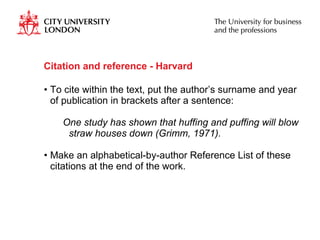
Citation and reference - Harvard To cite within the text, put the author’s surname and year of publication in brackets after a sentence:  One study has shown that huffing and puffing will blow straw houses down (Grimm, 1971). Make an alphabetical-by-author Reference List of these citations at the end of the work.
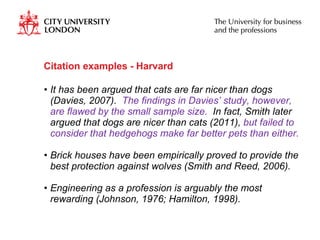
Citation examples - Harvard It has been argued that cats are far nicer than dogs (Davies, 2007).  The findings in Davies’ study, however, are flawed by the small sample size.  In fact, Smith later argued that dogs are nicer than cats (2011),  but failed to consider that hedgehogs make far better pets than either. Brick houses have been empirically proved to provide the best protection against wolves (Smith and Reed, 2006). Engineering as a profession is arguably the most rewarding (Johnson, 1976; Hamilton, 1998).
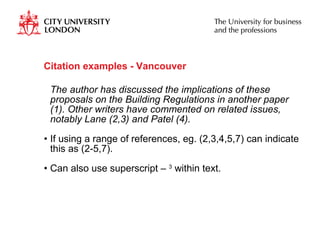
Citation examples - Vancouver The author has discussed the implications of these proposals on the Building Regulations in another paper (1). Other writers have commented on related issues, notably Lane (2,3) and Patel (4). If using a range of references, eg. (2,3,4,5,7) can indicate this as (2-5,7). Can also use superscript –  3  within text.
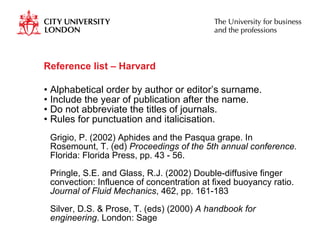
Reference list – Harvard  Alphabetical order by author or editor’s surname. Include the year of publication after the name. Do not abbreviate the titles of journals. Rules for punctuation and italicisation.  Grigio, P. (2002) Aphides and the Pasqua grape. In Rosemount, T. (ed)  Proceedings of the 5th annual conference.  Florida: Florida Press, pp. 43 - 56. Pringle, S.E. and Glass, R.J. (2002) Double-diffusive finger convection: Influence of concentration at fixed buoyancy ratio.  Journal of Fluid Mechanics , 462, pp. 161-183  Silver, D.S. & Prose, T. (eds) (2000)  A handbook for engineering . London: Sage
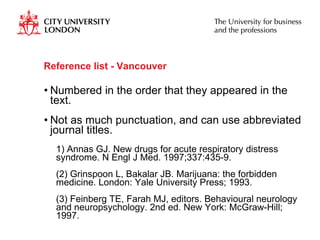
Reference list - Vancouver Numbered in the order that they appeared in the text. Not as much punctuation, and can use abbreviated journal titles. 1) Annas GJ. New drugs for acute respiratory distress syndrome. N Engl J Med. 1997;337:435-9.  (2) Grinspoon L, Bakalar JB. Marijuana: the forbidden medicine. London: Yale University Press; 1993. (3) Feinberg TE, Farah MJ, editors. Behavioural neurology and neuropsychology. 2nd ed. New York: McGraw-Hill; 1997.
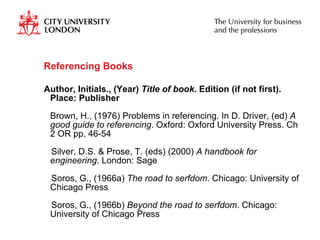
Referencing Books  Author, Initials., (Year)  Title of book . Edition (if not first). Place: Publisher Brown, H., (1976) Problems in referencing. In D. Driver, (ed)  A good guide to referencing . Oxford: Oxford University Press. Ch 2 OR pp. 46-54 Silver, D.S. & Prose, T. (eds) (2000)  A handbook for engineering . London: Sage Soros, G., (1966a)  The road to serfdom . Chicago: University of Chicago Press Soros, G., (1966b)  Beyond the road to serfdom . Chicago: University of Chicago Press
Journal articles Author, Initials., (Year) Title of article.  Full Title of Journal , Volume numbers (Issue/Part number), page numbers. Pringle, S.E. and Glass, R.J. (2002) Double-diffusive finger convection: Influence of concentration at fixed buoyancy ratio.  Journal of Fluid Mechanics , 462, pp. 161-183  Besson, O. and Stoica, P. (1999) A fast and robust algorithim for DOA estimation of a spatially dispersed source.  Digital Signal Processing. [Online] 9 (4), pp. 267-279.  Available from: Ingenta Connect [Accessed 2 October 2007].
Websites and other resources International Atomic Energy Agency (2007)  Nucleus: For nuclear knowledge and information . Available from  http://nucleus.iaea.org/NUCLEUS/nucleus/Content/index.jsp  [Accessed 2 October 2007] ALWAYS put in the date you accessed a webpage. Grigio, P. (2002) Aphides and the Pasqua grape. In Rosemount, T. (ed)  Proceedings of the 5th annual conference.  Florida: Florida Press, pp. 43 - 56.
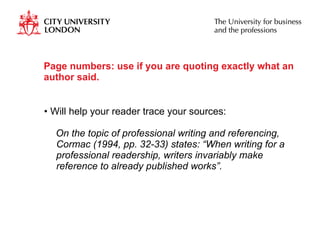
Page numbers: use if you are quoting exactly what an author said. Will help your reader trace your sources: On the topic of professional writing and referencing, Cormac (1994, pp. 32-33) states: “When writing for a professional readership, writers invariably make reference to already published works”.
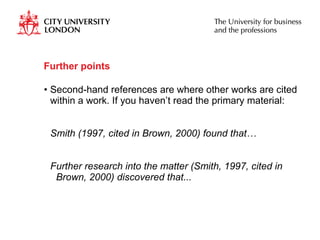
Further points Second-hand references are where other works are cited within a work. If you haven’t read the primary material: Smith (1997, cited in Brown, 2000) found that… Further research into the matter (Smith, 1997, cited in Brown, 2000) discovered that...
More further points In edited works, cite the chapter author, not the editor of the whole work. Corporate authors – use full name in first citation and abbreviation thereafter: First time:  (Institute of Civil Engineers (ICE), 2007)  Other times:  (ICE, 2007)
Referencing in the Library: search the catalogue for... Pears, R. and Shields, G. (2010)  Cite them right: the essential referencing guide . 8 th   ed. Basingstoke: Palgrave Macmillan BSI, (1989) BS 1629: Recommendations for references to published materials  BSI, (1990)  BS 5605:Recommendations for citing and referencing published material. 2nd ed.
Online guides to Citing and Referencing… City Guides:  http://www.city.ac.uk/upgrade/basics/citing-referencing.html http://www.city.ac.uk/upgrade/advanced/advanced-referencing.html   Guide to Harvard referencing http://www.bournemouth.ac.uk/library/citing_references/docs/Citing_Refs.pdf http://issuu.com/cityuniversitylibrary/docs/school_of_arts_harvard_citing_and_referencing_guid   Official guide to Vancouver referencing http://www.nlm.nih.gov/bsd/uniform_requirements.html
The End... Any Questions?  Even more places to get help: Me:  [email_address] Desks on Level 2 and Level 5 of the Library  Your tutors and lecturers Your module and programme handbooks

Slh plagiarism, referencing, citing, sept 28 2011

  • 1.
    Plagiarism, Citing andReferencing Samantha Halford, Library [email_address]
  • 2.
    What is Plagiarism?http://www.city.ac.uk/upgrade/basics/plagiarism-video.html Plagiarism is when you pass off the work or ideas of other people as your own. It is a form of Academic Misconduct which can lead to you being expelled from the University, having marks cancelled or having to completely redo work.
  • 3.
    Academic Misconduct Nottolerated: University Regulations say that all identified cases of suspected misconduct will be actively pursued. http://www.city.ac.uk/about/education/ldc/studywell/understanding-academic-misconduct Penalties range from issuing a warning to student exclusion from the University. Not just directly copying other peoples’ work: other forms of plagiarism...
  • 4.
    These are allplagiarism: Copy and pasting from the Internet or others’ work Concealing sources Collusion Self-plagiarism: using your own work again Misunderstanding ‘Common Knowledge’
  • 5.
    Copy and pasting Don’t! You will get caught. Work is passed through special software that WILL catch you, regardless of where you copied from. You can quote from others’ work, though: always use quotation marks and acknowledge where you found it: It has been said that “ Construction Management is quite a fun sector to work in. ” (Smith, 2010). Try and DO something with the information, don’t rely heavily on quotes.
  • 6.
    TurnItIn: matches yourwork against the Internet, other students’ work, previous students’ work, students from other universities 3 years ago’s work...
  • 7.
    Concealing sources Pretendingyou had an idea yourself, when you really found it in your research and reading. Often unintentional: but still counts as Academic Misconduct! Be very careful when you take notes so you always know which was your idea, and which the author’s. Always cite and acknowledge ideas from other people. If you use it more than once in an essay, cite each time: even if it’s the next paragraph.
  • 8.
    Collusion Taking creditfor other students’ work. Working out the answers to homework questions together. Watch out for group work! Always acknowledge other students’ ideas and contributions, and work individually on your assignments. It is NOT chatting with other students, then going away and doing the work on your own.
  • 9.
    Common Knowledge Ifa fact is common knowledge, you do not need to cite. If it is not ‘common knowledge’, always cite! Not sure? Ask a tutor for advice, or find a source: it is better to be on the safe side.
  • 10.
    Self-plagiarism Re-submitting yourassignments. Re-using work that you’ve already carried out. Re-using the same paragraph in two pieces of work.
  • 11.
    Common causes ofreferrals/failures Lack of contact with supervisors: it’s hard for them to tell if you really did the work if you’re not discussing with them. Suspiciously good grammar/spelling in parts of your work! Your tutors know the literature well: they will recognize other peoples’ ideas. Inadequate citations/referencing.
  • 12.
    So how doI avoid accusations of plagiarism? Take clear notes. Quote : if you use someone else’s words, put them in quotation marks (“...”) and acknowledge them properly. Paraphrase : give your own understanding of the idea, and acknowledge them properly. Citing and Reference correctly : this is how you acknowledge other people properly! http://www.city.ac.uk/upgrade/basics/avoiding-plagiarism.html
  • 13.
    Further tips... Consultwith your tutors and supervisors if you’re in doubt. Start your work early so you’ve time to cite and reference properly. Make sure your conclusions are always your own thoughts, based on the work and research you’ve done. Read through your work carefully: is it clear where you’ve used other people’s work? Are your own ideas obvious? Improve your writing skills: https://intranet.city.ac.uk/students/learning-success/academic_learning_support/academic_learning_support.html
  • 14.
    Referencing and citingYour crucial weapon against accidental plagiarism: Cite authors within your work. Make a reference list of all the citations at the end of your work. The two most important aims: Be consistent! Help your reader find the thing you read, so they can read it too.
  • 15.
    Tools and guidesto help you: The Engineering Subject Guide’s Citing and Referencing Page: http://libguides.city.ac.uk/content.php?pid=238813&sid=1970764 RefWorks (see Guide above, login using usual details): A website we pay for that helps you make your own database of references that you can automatically insert at the right point in your work. Other free referencing tools: see Guide above.
  • 16.
    How do Ifind the information I need to make a reference? Front pages of books and the Library Catalogue Record. First page, header and footer, or last page of Journal Articles. Some databases will make a reference up for you to copy and paste into your work: Yes, you can copy and paste just this once! Check it carefully: a computer is not as clever as you. Demo: Business Source Complete
  • 17.
    So how doI do Citing & Referencing? Keep note of what information you used from which source. Find out which style your tutor wants you to use: ask them! Going to show you two common styles: Harvard (or Author/Date) Vancouver
  • 18.
    Citation and reference- Harvard To cite within the text, put the author’s surname and year of publication in brackets after a sentence: One study has shown that huffing and puffing will blow straw houses down (Grimm, 1971). Make an alphabetical-by-author Reference List of these citations at the end of the work.
  • 19.
    Citation examples -Harvard It has been argued that cats are far nicer than dogs (Davies, 2007). The findings in Davies’ study, however, are flawed by the small sample size. In fact, Smith later argued that dogs are nicer than cats (2011), but failed to consider that hedgehogs make far better pets than either. Brick houses have been empirically proved to provide the best protection against wolves (Smith and Reed, 2006). Engineering as a profession is arguably the most rewarding (Johnson, 1976; Hamilton, 1998).
  • 20.
    Citation examples -Vancouver The author has discussed the implications of these proposals on the Building Regulations in another paper (1). Other writers have commented on related issues, notably Lane (2,3) and Patel (4). If using a range of references, eg. (2,3,4,5,7) can indicate this as (2-5,7). Can also use superscript – 3 within text.
  • 21.
    Reference list –Harvard Alphabetical order by author or editor’s surname. Include the year of publication after the name. Do not abbreviate the titles of journals. Rules for punctuation and italicisation. Grigio, P. (2002) Aphides and the Pasqua grape. In Rosemount, T. (ed) Proceedings of the 5th annual conference. Florida: Florida Press, pp. 43 - 56. Pringle, S.E. and Glass, R.J. (2002) Double-diffusive finger convection: Influence of concentration at fixed buoyancy ratio. Journal of Fluid Mechanics , 462, pp. 161-183 Silver, D.S. & Prose, T. (eds) (2000) A handbook for engineering . London: Sage
  • 22.
    Reference list -Vancouver Numbered in the order that they appeared in the text. Not as much punctuation, and can use abbreviated journal titles. 1) Annas GJ. New drugs for acute respiratory distress syndrome. N Engl J Med. 1997;337:435-9. (2) Grinspoon L, Bakalar JB. Marijuana: the forbidden medicine. London: Yale University Press; 1993. (3) Feinberg TE, Farah MJ, editors. Behavioural neurology and neuropsychology. 2nd ed. New York: McGraw-Hill; 1997.
  • 23.
    Referencing Books Author, Initials., (Year) Title of book . Edition (if not first). Place: Publisher Brown, H., (1976) Problems in referencing. In D. Driver, (ed) A good guide to referencing . Oxford: Oxford University Press. Ch 2 OR pp. 46-54 Silver, D.S. & Prose, T. (eds) (2000) A handbook for engineering . London: Sage Soros, G., (1966a) The road to serfdom . Chicago: University of Chicago Press Soros, G., (1966b) Beyond the road to serfdom . Chicago: University of Chicago Press
  • 24.
    Journal articles Author,Initials., (Year) Title of article. Full Title of Journal , Volume numbers (Issue/Part number), page numbers. Pringle, S.E. and Glass, R.J. (2002) Double-diffusive finger convection: Influence of concentration at fixed buoyancy ratio. Journal of Fluid Mechanics , 462, pp. 161-183 Besson, O. and Stoica, P. (1999) A fast and robust algorithim for DOA estimation of a spatially dispersed source. Digital Signal Processing. [Online] 9 (4), pp. 267-279. Available from: Ingenta Connect [Accessed 2 October 2007].
  • 25.
    Websites and otherresources International Atomic Energy Agency (2007) Nucleus: For nuclear knowledge and information . Available from http://nucleus.iaea.org/NUCLEUS/nucleus/Content/index.jsp [Accessed 2 October 2007] ALWAYS put in the date you accessed a webpage. Grigio, P. (2002) Aphides and the Pasqua grape. In Rosemount, T. (ed) Proceedings of the 5th annual conference. Florida: Florida Press, pp. 43 - 56.
  • 26.
    Page numbers: useif you are quoting exactly what an author said. Will help your reader trace your sources: On the topic of professional writing and referencing, Cormac (1994, pp. 32-33) states: “When writing for a professional readership, writers invariably make reference to already published works”.
  • 27.
    Further points Second-handreferences are where other works are cited within a work. If you haven’t read the primary material: Smith (1997, cited in Brown, 2000) found that… Further research into the matter (Smith, 1997, cited in Brown, 2000) discovered that...
  • 28.
    More further pointsIn edited works, cite the chapter author, not the editor of the whole work. Corporate authors – use full name in first citation and abbreviation thereafter: First time: (Institute of Civil Engineers (ICE), 2007) Other times: (ICE, 2007)
  • 29.
    Referencing in theLibrary: search the catalogue for... Pears, R. and Shields, G. (2010) Cite them right: the essential referencing guide . 8 th ed. Basingstoke: Palgrave Macmillan BSI, (1989) BS 1629: Recommendations for references to published materials BSI, (1990) BS 5605:Recommendations for citing and referencing published material. 2nd ed.
  • 30.
    Online guides toCiting and Referencing… City Guides: http://www.city.ac.uk/upgrade/basics/citing-referencing.html http://www.city.ac.uk/upgrade/advanced/advanced-referencing.html Guide to Harvard referencing http://www.bournemouth.ac.uk/library/citing_references/docs/Citing_Refs.pdf http://issuu.com/cityuniversitylibrary/docs/school_of_arts_harvard_citing_and_referencing_guid Official guide to Vancouver referencing http://www.nlm.nih.gov/bsd/uniform_requirements.html
  • 31.
    The End... AnyQuestions? Even more places to get help: Me: [email_address] Desks on Level 2 and Level 5 of the Library Your tutors and lecturers Your module and programme handbooks