APA Style
Seventh Edition
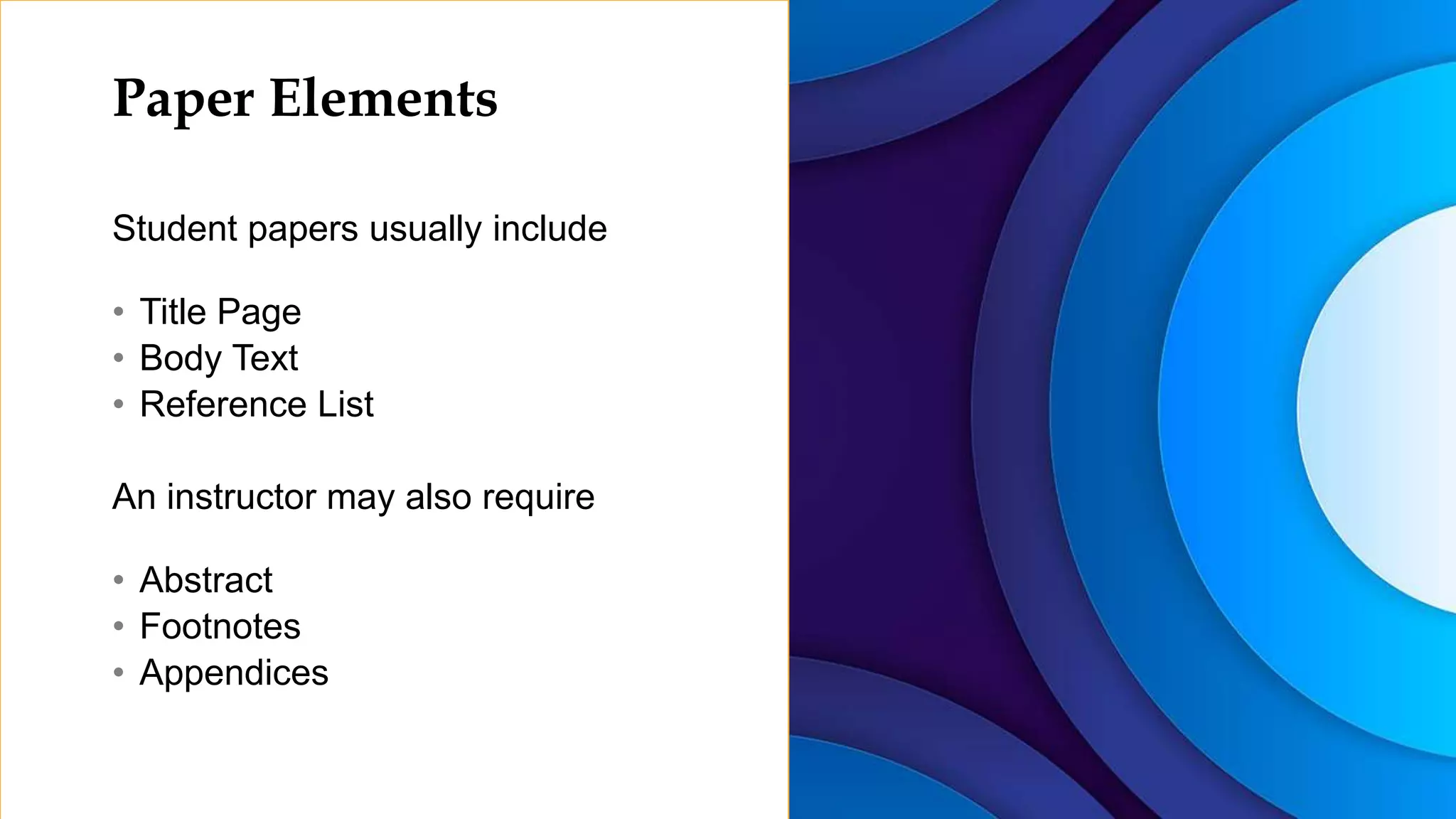
Paper Elements
Student papers usually include
• Title Page
• Body Text
• Reference List
An instructor may also require
• Abstract
• Footnotes
• Appendices
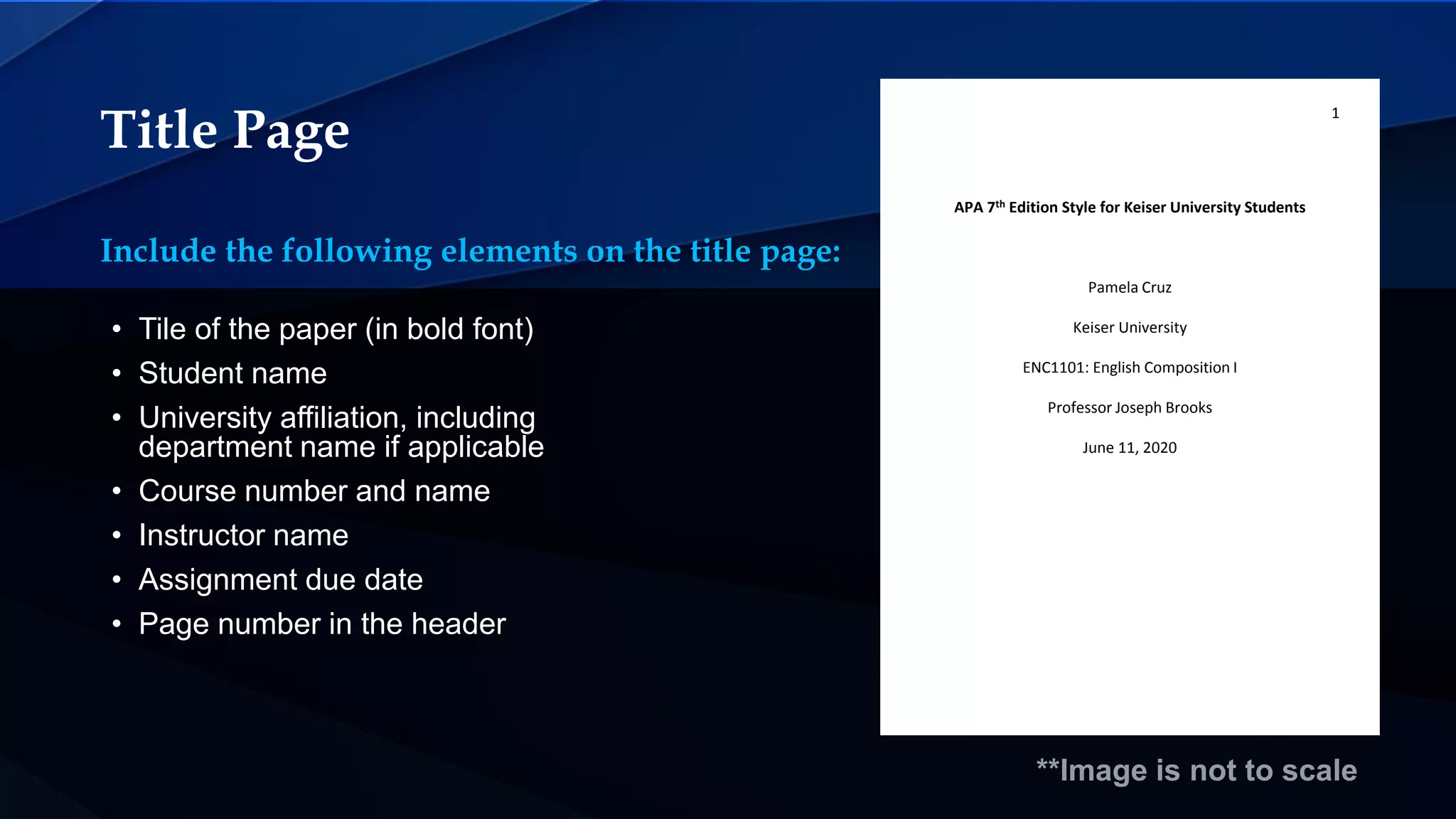
Title Page
Include the following elements on the title page:
• Tile of the paper (in bold font)
• Student name
• University affiliation, including
department name if applicable
• Course number and name
• Instructor name
• Assignment due date
• Page number in the header
1
APA 7th Edition Style for Keiser University Students
Pamela Cruz
Keiser University
ENC1101: English Composition I
Professor Joseph Brooks
June 11, 2020
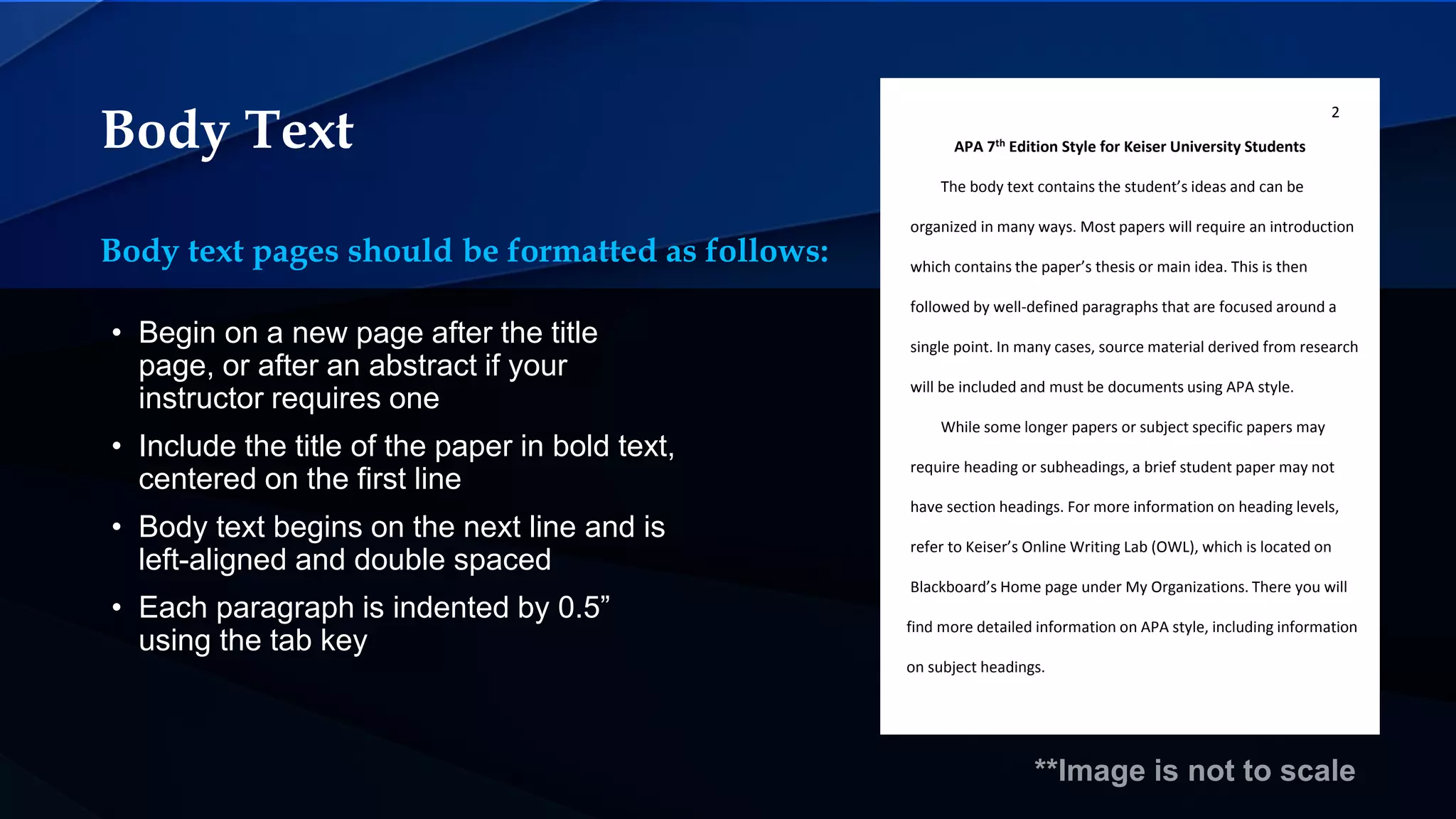
Body Text
Body text pages should be formatted as follows:
• Begin on a new page after the title
page, or after an abstract if your
instructor requires one
• Include the title of the paper in bold text,
centered on the first line
• Body text begins on the next line and is
left-aligned and double spaced
• Each paragraph is indented by 0.5”
using the tab key
2
APA 7th Edition Style for Keiser University Students
The body text contains the student’s ideas and can be
organized in many ways. Most papers will require an introduction
which contains the paper’s thesis or main idea. This is then
followed by well-defined paragraphs that are focused around a
single point. In many cases, source material derived from research
will be included and must be documents using APA style.
While some longer papers or subject specific papers may
require heading or subheadings, a brief student paper may not
have section headings. For more information on heading levels,
refer to Keiser’s Online Writing Lab (OWL), which is located on
Blackboard’s Home page under My Organizations. There you will
find more detailed information on APA style, including information
on subject headings.
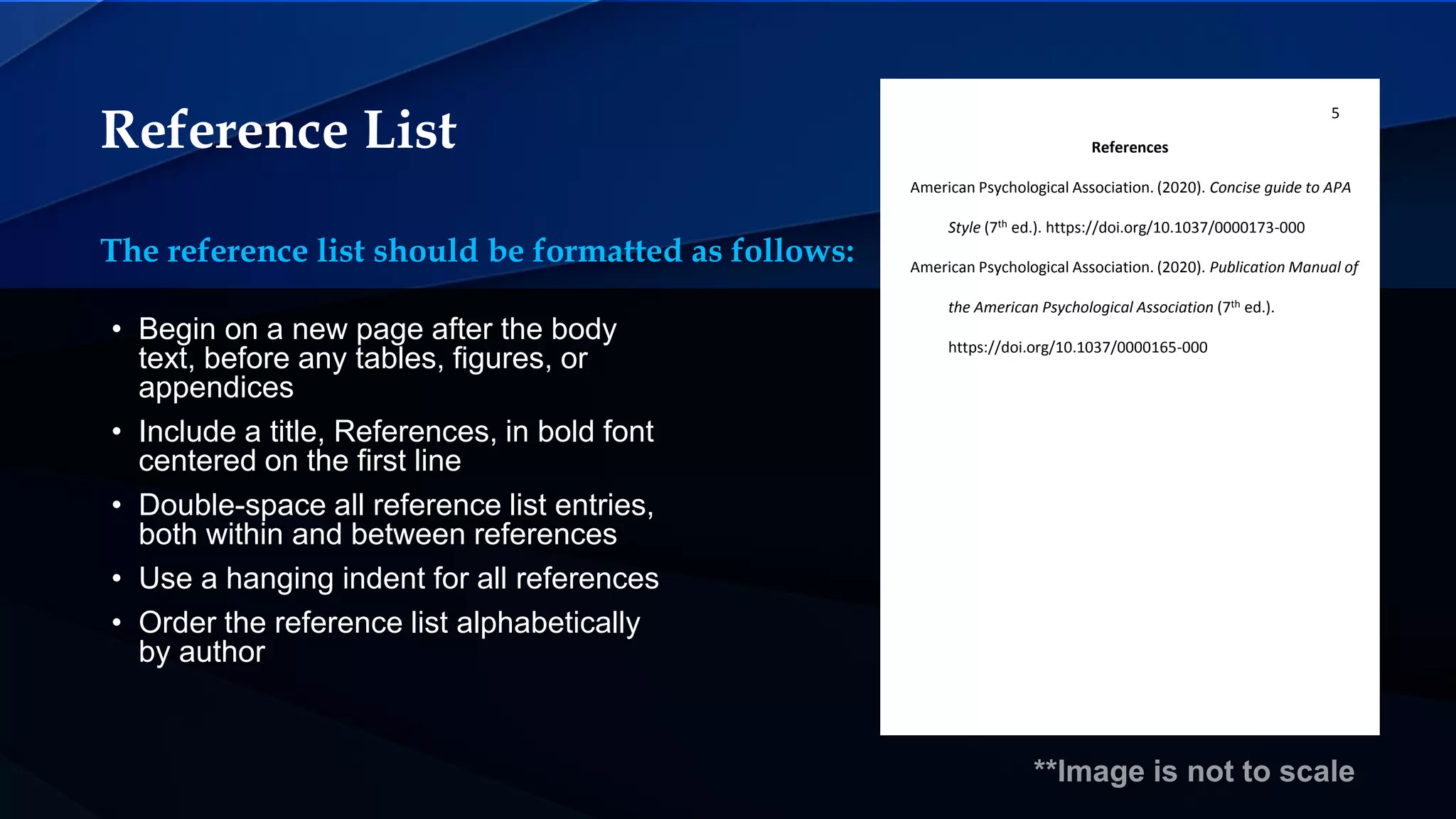
Reference List
The reference list should be formatted as follows:
• Begin on a new page after the body
text, before any tables, figures, or
appendices
• Include a title, References, in bold font
centered on the first line
• Double-space all reference list entries,
both within and between references
• Use a hanging indent for all references
• Order the reference list alphabetically
by author
5
References
American Psychological Association. (2020). Concise guide to APA
Style (7th ed.). https://doi.org/10.1037/0000173-000
American Psychological Association. (2020). Publication Manual of
the American Psychological Association (7th ed.).
https://doi.org/10.1037/0000165-000
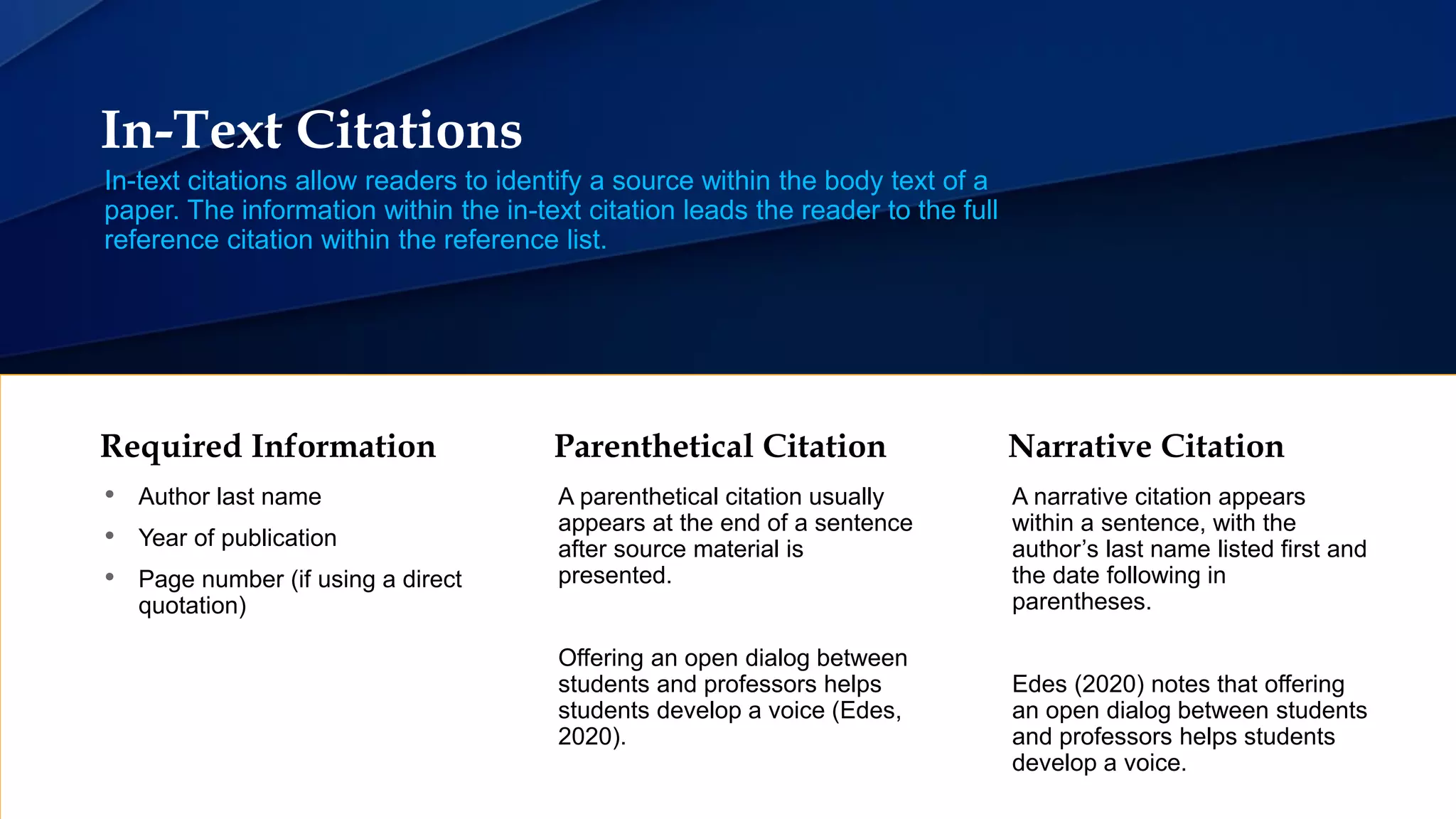
In-Text Citations
In-text citations allow readers to identify a source within the body text of a
paper. The information within the in-text citation leads the reader to the full
reference citation within the reference list.
Required Information
• Author last name
• Year of publication
• Page number (if using a direct
quotation)
Parenthetical Citation
A parenthetical citation usually
appears at the end of a sentence
after source material is
presented.
Offering an open dialog between
students and professors helps
students develop a voice (Edes,
2020).
Narrative Citation
A narrative citation appears
within a sentence, with the
author’s last name listed first and
the date following in
parentheses.
Edes (2020) notes that offering
an open dialog between students
and professors helps students
develop a voice.
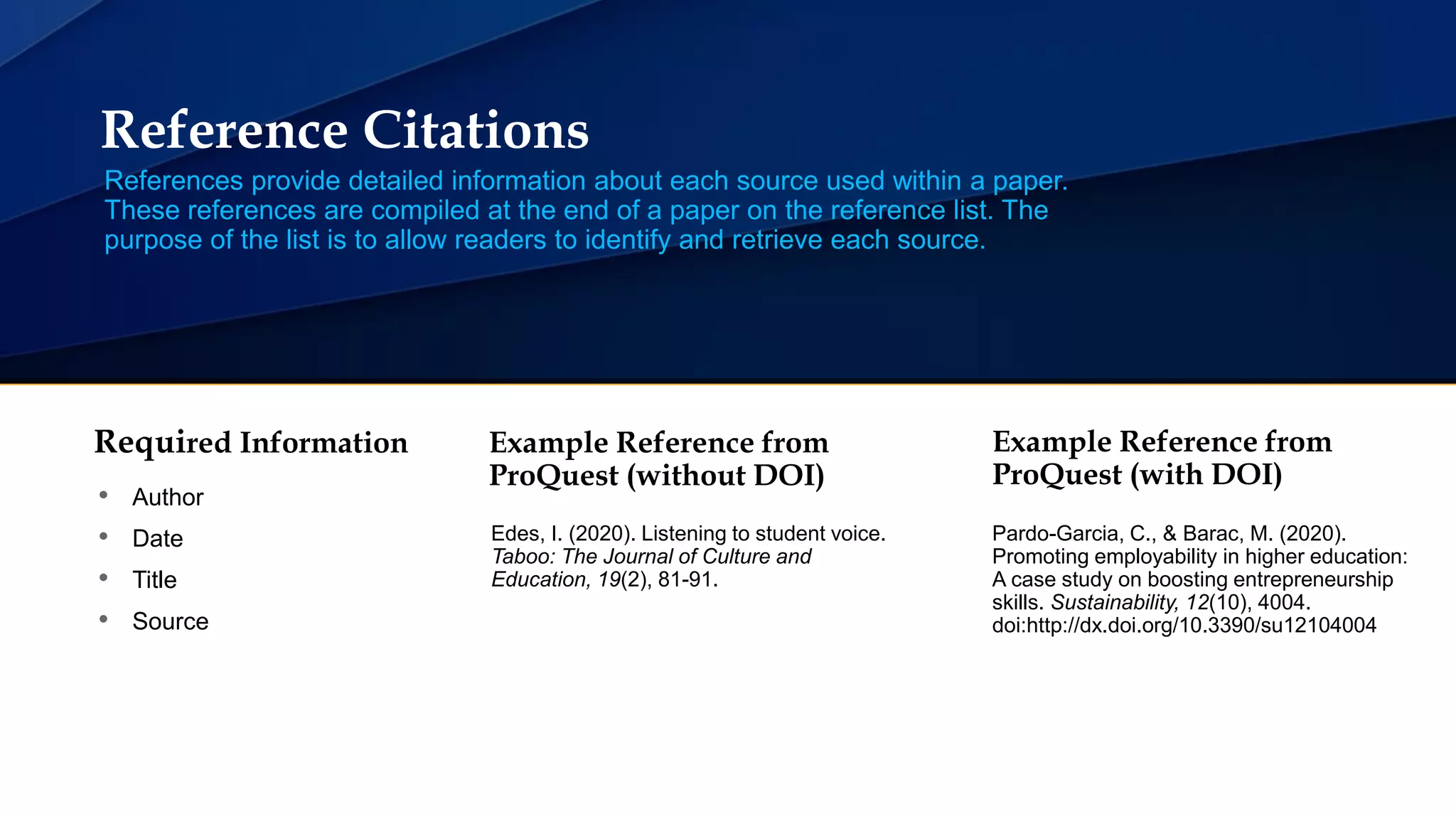
Reference Citations
References provide detailed information about each source used within a paper.
These references are compiled at the end of a paper on the reference list. The
purpose of the list is to allow readers to identify and retrieve each source.
Required Information
• Author
• Date
• Title
• Source
Example Reference from
ProQuest (without DOI)
Edes, I. (2020). Listening to student voice.
Taboo: The Journal of Culture and
Education, 19(2), 81-91.
Pardo-Garcia, C., & Barac, M. (2020).
Promoting employability in higher education:
A case study on boosting entrepreneurship
skills. Sustainability, 12(10), 4004.
doi:http://dx.doi.org/10.3390/su12104004
Example Reference from
ProQuest (with DOI)
Paraphrasing
• When paraphrasing, you restate the ideas
from a source in your own words.
• Aim to use paraphrased ideas more than
direct quotations.
• Cite the work using a parenthetical or
narrative in-text citation as well as a
reference citation
• A page number is not required in an in-text
citation when paraphrasing, but you may
include one when referencing a long work,
such as a book.
Quoting
• When quoting, you use the exact words
from a source.
• Use quotations when offering an exact
definition, a memorable line from an
author, or when the accuracy of wording is
important
• Cite the work using a parenthetical or
narrative in-text citation as well as a
reference citation
• A page number is required in an in-text
citation when offering quotations. If a page
number is not available, include a
paragraph number.

Apa style 7th edition

  • 1.
  • 2.
    Paper Elements Student papersusually include • Title Page • Body Text • Reference List An instructor may also require • Abstract • Footnotes • Appendices
  • 3.
    Title Page Include thefollowing elements on the title page: • Tile of the paper (in bold font) • Student name • University affiliation, including department name if applicable • Course number and name • Instructor name • Assignment due date • Page number in the header 1 APA 7th Edition Style for Keiser University Students Pamela Cruz Keiser University ENC1101: English Composition I Professor Joseph Brooks June 11, 2020
  • 4.
    Body Text Body textpages should be formatted as follows: • Begin on a new page after the title page, or after an abstract if your instructor requires one • Include the title of the paper in bold text, centered on the first line • Body text begins on the next line and is left-aligned and double spaced • Each paragraph is indented by 0.5” using the tab key 2 APA 7th Edition Style for Keiser University Students The body text contains the student’s ideas and can be organized in many ways. Most papers will require an introduction which contains the paper’s thesis or main idea. This is then followed by well-defined paragraphs that are focused around a single point. In many cases, source material derived from research will be included and must be documents using APA style. While some longer papers or subject specific papers may require heading or subheadings, a brief student paper may not have section headings. For more information on heading levels, refer to Keiser’s Online Writing Lab (OWL), which is located on Blackboard’s Home page under My Organizations. There you will find more detailed information on APA style, including information on subject headings.
  • 5.
    Reference List The referencelist should be formatted as follows: • Begin on a new page after the body text, before any tables, figures, or appendices • Include a title, References, in bold font centered on the first line • Double-space all reference list entries, both within and between references • Use a hanging indent for all references • Order the reference list alphabetically by author 5 References American Psychological Association. (2020). Concise guide to APA Style (7th ed.). https://doi.org/10.1037/0000173-000 American Psychological Association. (2020). Publication Manual of the American Psychological Association (7th ed.). https://doi.org/10.1037/0000165-000
  • 6.
    In-Text Citations In-text citationsallow readers to identify a source within the body text of a paper. The information within the in-text citation leads the reader to the full reference citation within the reference list. Required Information • Author last name • Year of publication • Page number (if using a direct quotation) Parenthetical Citation A parenthetical citation usually appears at the end of a sentence after source material is presented. Offering an open dialog between students and professors helps students develop a voice (Edes, 2020). Narrative Citation A narrative citation appears within a sentence, with the author’s last name listed first and the date following in parentheses. Edes (2020) notes that offering an open dialog between students and professors helps students develop a voice.
  • 7.
    Reference Citations References providedetailed information about each source used within a paper. These references are compiled at the end of a paper on the reference list. The purpose of the list is to allow readers to identify and retrieve each source. Required Information • Author • Date • Title • Source Example Reference from ProQuest (without DOI) Edes, I. (2020). Listening to student voice. Taboo: The Journal of Culture and Education, 19(2), 81-91. Pardo-Garcia, C., & Barac, M. (2020). Promoting employability in higher education: A case study on boosting entrepreneurship skills. Sustainability, 12(10), 4004. doi:http://dx.doi.org/10.3390/su12104004 Example Reference from ProQuest (with DOI)
  • 8.
    Paraphrasing • When paraphrasing,you restate the ideas from a source in your own words. • Aim to use paraphrased ideas more than direct quotations. • Cite the work using a parenthetical or narrative in-text citation as well as a reference citation • A page number is not required in an in-text citation when paraphrasing, but you may include one when referencing a long work, such as a book.
  • 9.
    Quoting • When quoting,you use the exact words from a source. • Use quotations when offering an exact definition, a memorable line from an author, or when the accuracy of wording is important • Cite the work using a parenthetical or narrative in-text citation as well as a reference citation • A page number is required in an in-text citation when offering quotations. If a page number is not available, include a paragraph number.