Referencing and finding your way
around the library
RachelWhite
Library Information Consultant for Electronic Engineering
What is referencing and why do I need
to do it?
• Acknowledge when using
someone’s work
• To make clear to the reader that
this idea is not your own
• Demonstrate the breadth of
reading, viewing and individual
research
• Support your argument
• An academic skill for all levels
• To allow you, your tutor and other
readers to retrieve items that you
have mentioned
• To avoid accusations of plagiarism
What is Plagiarism and how to avoid
it?
What is plagiarism?
• Passing off as your own a piece of work
that is partly or wholly the work of
another student
• Citing and referencing sources that you
have not used
• Quoting, summarising or paraphrasing
material in your assignment without
citing the original source
• 'Recycling' a piece of your own work that
you have previously submitted for
another module or course (i.e. self-
plagiarism).
(Palgrave Study SkillsOnline, 2018)
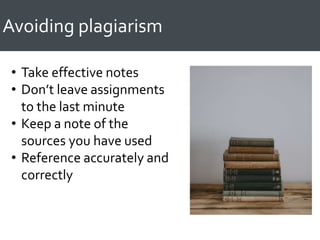
Avoiding plagiarism
• Take effective notes
• Don’t leave assignments
to the last minute
• Keep a note of the
sources you have used
• Reference accurately and
correctly
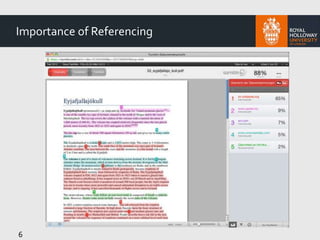
Importance of Referencing
6
Harvard Referencing
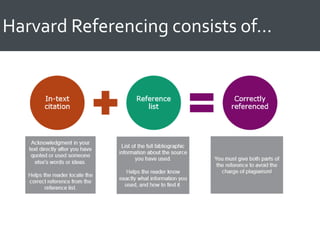
Harvard Referencing consists of…
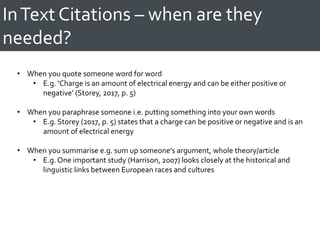
InText Citations – when are they
needed?
• When you quote someone word for word
• E.g. ‘Charge is an amount of electrical energy and can be either positive or
negative’ (Storey, 2017, p. 5)
• When you paraphrase someone i.e. putting something into your own words
• E.g. Storey (2017, p. 5) states that a charge can be positive or negative and is an
amount of electrical energy
• When you summarise e.g. sum up someone’s argument, whole theory/article
• E.g. One important study (Harrison, 2007) looks closely at the historical and
linguistic links between European races and cultures
Activity
"To Cite or Not to Cite,
That is the Question…"
Time for an interactive quiz!
• A scenario will be posted on
the screen, discuss briefly with
your neighbours whether you
need to cite or not...
• If “YES, CITE”, hold up the
green card,
• If “NO! NO CITE!”, hold up the
red card!
Quiz
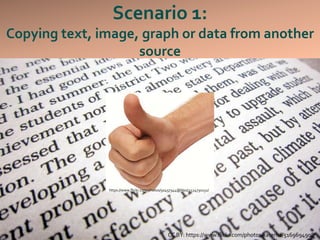
Scenario 1:
Copying text, image, graph or data from another
source
CC BY: https://www.flickr.com/photos/katerha/5169694908
https://www.flickr.com/photos/50457344@N00/2124730152/
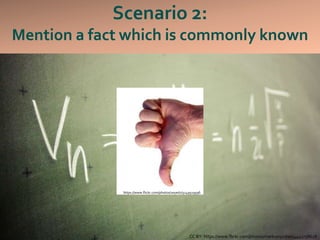
Scenario 2:
Mention a fact which is commonly known
CC BY: https://www.flickr.com/photos/markusspiske/14441758628
https://www.flickr.com/photos/1eyedz/5149519596
Scenario 3:
Discuss the ideas or research of another
person in your own words
CC BY:
https://www.flickr.com/photos/lastyearsgirl_/7765134416/
Scenario 5:
Write about something you know you’ve
read about in several different sources
CC BY: https://www.flickr.com/photos/75862793@N06/6816056519
How to reference different
resources?
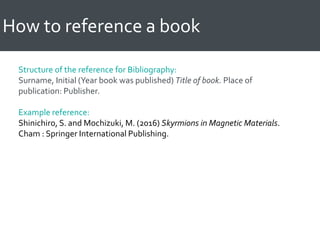
How to reference a book
Structure of the reference for Bibliography:
Surname, Initial (Year book was published) Title of book. Place of
publication: Publisher.
Example reference:
Shinichiro, S. and Mochizuki, M. (2016) Skyrmions in Magnetic Materials.
Cham : Springer International Publishing.
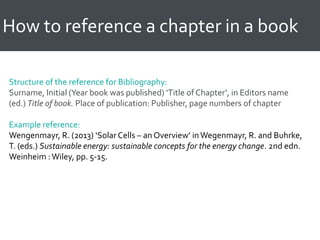
How to reference a chapter in a book
Structure of the reference for Bibliography:
Surname, Initial (Year book was published) ‘Title of Chapter’, in Editors name
(ed.) Title of book. Place of publication: Publisher, page numbers of chapter
Example reference:
Wengenmayr, R. (2013) ‘Solar Cells – an Overview’ inWegenmayr, R. and Buhrke,
T. (eds.) Sustainable energy: sustainable concepts for the energy change. 2nd edn.
Weinheim :Wiley, pp. 5-15.
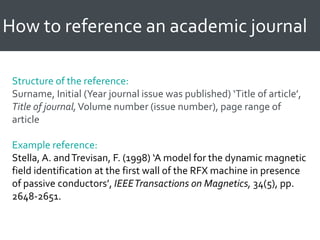
How to reference an academic journal
Structure of the reference:
Surname, Initial (Year journal issue was published) ‘Title of article’,
Title of journal,Volume number (issue number), page range of
article
Example reference:
Stella, A. andTrevisan, F. (1998) ‘A model for the dynamic magnetic
field identification at the first wall of the RFX machine in presence
of passive conductors’, IEEETransactions on Magnetics, 34(5), pp.
2648-2651.
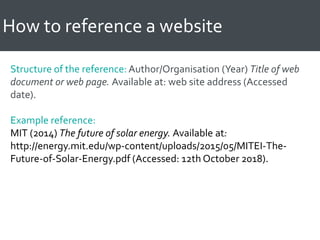
How to reference a website
Structure of the reference: Author/Organisation (Year) Title of web
document or web page. Available at: web site address (Accessed
date).
Example reference:
MIT (2014) The future of solar energy. Available at:
http://energy.mit.edu/wp-content/uploads/2015/05/MITEI-The-
Future-of-Solar-Energy.pdf (Accessed: 12th October 2018).
ActivityTime!
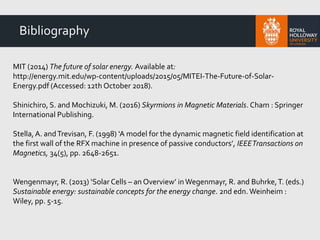
Bibliography
MIT (2014) The future of solar energy. Available at:
http://energy.mit.edu/wp-content/uploads/2015/05/MITEI-The-Future-of-Solar-
Energy.pdf (Accessed: 12th October 2018).
Shinichiro, S. and Mochizuki, M. (2016) Skyrmions in Magnetic Materials. Cham : Springer
International Publishing.
Stella,A. andTrevisan, F. (1998) ‘A model for the dynamic magnetic field identification at
the first wall of the RFX machine in presence of passive conductors’, IEEETransactions on
Magnetics, 34(5), pp. 2648-2651.
Wengenmayr, R. (2013) ‘Solar Cells – an Overview’ in Wegenmayr, R. and Buhrke,T. (eds.)
Sustainable energy: sustainable concepts for the energy change. 2nd edn. Weinheim :
Wiley, pp. 5-15.
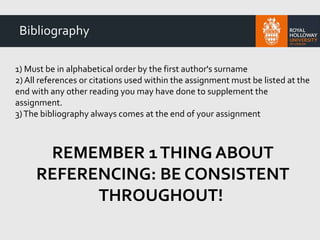
1) Must be in alphabetical order by the first author's surname
2) All references or citations used within the assignment must be listed at the
end with any other reading you may have done to supplement the
assignment.
3)The bibliography always comes at the end of your assignment
REMEMBER 1THING ABOUT
REFERENCING: BE CONSISTENT
THROUGHOUT!
Bibliography
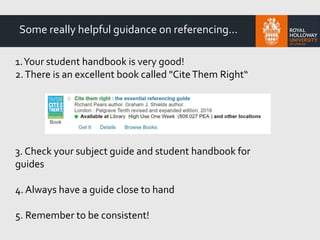
1.Your student handbook is very good!
2.There is an excellent book called "CiteThem Right“
3. Check your subject guide and student handbook for
guides
4. Always have a guide close to hand
5. Remember to be consistent!
Some really helpful guidance on referencing...
Any
questions?
2
Don't forget:
• Rachel.white@rhul.ac.uk
• http://libguides.rhul.ac.uk/
ElectronicEngineering
• 1-2-1 Sessions

Harvard Referencing

  • 1.
    Referencing and findingyour way around the library RachelWhite Library Information Consultant for Electronic Engineering
  • 2.
    What is referencingand why do I need to do it? • Acknowledge when using someone’s work • To make clear to the reader that this idea is not your own • Demonstrate the breadth of reading, viewing and individual research • Support your argument • An academic skill for all levels • To allow you, your tutor and other readers to retrieve items that you have mentioned • To avoid accusations of plagiarism
  • 3.
    What is Plagiarismand how to avoid it?
  • 4.
    What is plagiarism? •Passing off as your own a piece of work that is partly or wholly the work of another student • Citing and referencing sources that you have not used • Quoting, summarising or paraphrasing material in your assignment without citing the original source • 'Recycling' a piece of your own work that you have previously submitted for another module or course (i.e. self- plagiarism). (Palgrave Study SkillsOnline, 2018)
  • 5.
    Avoiding plagiarism • Takeeffective notes • Don’t leave assignments to the last minute • Keep a note of the sources you have used • Reference accurately and correctly
  • 6.
  • 7.
  • 8.
  • 9.
    InText Citations –when are they needed? • When you quote someone word for word • E.g. ‘Charge is an amount of electrical energy and can be either positive or negative’ (Storey, 2017, p. 5) • When you paraphrase someone i.e. putting something into your own words • E.g. Storey (2017, p. 5) states that a charge can be positive or negative and is an amount of electrical energy • When you summarise e.g. sum up someone’s argument, whole theory/article • E.g. One important study (Harrison, 2007) looks closely at the historical and linguistic links between European races and cultures
  • 10.
  • 11.
    "To Cite orNot to Cite, That is the Question…" Time for an interactive quiz! • A scenario will be posted on the screen, discuss briefly with your neighbours whether you need to cite or not... • If “YES, CITE”, hold up the green card, • If “NO! NO CITE!”, hold up the red card! Quiz
  • 12.
    Scenario 1: Copying text,image, graph or data from another source CC BY: https://www.flickr.com/photos/katerha/5169694908 https://www.flickr.com/photos/50457344@N00/2124730152/
  • 13.
    Scenario 2: Mention afact which is commonly known CC BY: https://www.flickr.com/photos/markusspiske/14441758628 https://www.flickr.com/photos/1eyedz/5149519596
  • 14.
    Scenario 3: Discuss theideas or research of another person in your own words CC BY: https://www.flickr.com/photos/lastyearsgirl_/7765134416/
  • 15.
    Scenario 5: Write aboutsomething you know you’ve read about in several different sources CC BY: https://www.flickr.com/photos/75862793@N06/6816056519
  • 16.
    How to referencedifferent resources?
  • 17.
    How to referencea book Structure of the reference for Bibliography: Surname, Initial (Year book was published) Title of book. Place of publication: Publisher. Example reference: Shinichiro, S. and Mochizuki, M. (2016) Skyrmions in Magnetic Materials. Cham : Springer International Publishing.
  • 18.
    How to referencea chapter in a book Structure of the reference for Bibliography: Surname, Initial (Year book was published) ‘Title of Chapter’, in Editors name (ed.) Title of book. Place of publication: Publisher, page numbers of chapter Example reference: Wengenmayr, R. (2013) ‘Solar Cells – an Overview’ inWegenmayr, R. and Buhrke, T. (eds.) Sustainable energy: sustainable concepts for the energy change. 2nd edn. Weinheim :Wiley, pp. 5-15.
  • 19.
    How to referencean academic journal Structure of the reference: Surname, Initial (Year journal issue was published) ‘Title of article’, Title of journal,Volume number (issue number), page range of article Example reference: Stella, A. andTrevisan, F. (1998) ‘A model for the dynamic magnetic field identification at the first wall of the RFX machine in presence of passive conductors’, IEEETransactions on Magnetics, 34(5), pp. 2648-2651.
  • 20.
    How to referencea website Structure of the reference: Author/Organisation (Year) Title of web document or web page. Available at: web site address (Accessed date). Example reference: MIT (2014) The future of solar energy. Available at: http://energy.mit.edu/wp-content/uploads/2015/05/MITEI-The- Future-of-Solar-Energy.pdf (Accessed: 12th October 2018).
  • 21.
  • 22.
    Bibliography MIT (2014) Thefuture of solar energy. Available at: http://energy.mit.edu/wp-content/uploads/2015/05/MITEI-The-Future-of-Solar- Energy.pdf (Accessed: 12th October 2018). Shinichiro, S. and Mochizuki, M. (2016) Skyrmions in Magnetic Materials. Cham : Springer International Publishing. Stella,A. andTrevisan, F. (1998) ‘A model for the dynamic magnetic field identification at the first wall of the RFX machine in presence of passive conductors’, IEEETransactions on Magnetics, 34(5), pp. 2648-2651. Wengenmayr, R. (2013) ‘Solar Cells – an Overview’ in Wegenmayr, R. and Buhrke,T. (eds.) Sustainable energy: sustainable concepts for the energy change. 2nd edn. Weinheim : Wiley, pp. 5-15.
  • 23.
    1) Must bein alphabetical order by the first author's surname 2) All references or citations used within the assignment must be listed at the end with any other reading you may have done to supplement the assignment. 3)The bibliography always comes at the end of your assignment REMEMBER 1THING ABOUT REFERENCING: BE CONSISTENT THROUGHOUT! Bibliography
  • 24.
    1.Your student handbookis very good! 2.There is an excellent book called "CiteThem Right“ 3. Check your subject guide and student handbook for guides 4. Always have a guide close to hand 5. Remember to be consistent! Some really helpful guidance on referencing...
  • 25.
  • 26.
    2 Don't forget: • Rachel.white@rhul.ac.uk •http://libguides.rhul.ac.uk/ ElectronicEngineering • 1-2-1 Sessions

Editor's Notes

  • #3 The main thing for all new students to take away is that we are here to help! There are lots of ways that you can get help so please don’t be afraid to ask, if you are unsure just ask! Phone Email Social media – YOUTUBE icon Subject guides Helpdesk Information consultant Might want to follow us on social media so you can stay up to date with news. Also take a look at the subject guide for your department and have a look at what resources are available.
  • #4 Explain that now there will be a quick quiz to see if you’ve been paying attention! Update the kahoot quiz Question about number of study spaces Questions about HUC
  • #6 The main thing for all new students to take away is that we are here to help! There are lots of ways that you can get help so please don’t be afraid to ask, if you are unsure just ask! Phone Email Social media – YOUTUBE icon Subject guides Helpdesk Information consultant Might want to follow us on social media so you can stay up to date with news. Also take a look at the subject guide for your department and have a look at what resources are available.
  • #8 Explain that now there will be a quick quiz to see if you’ve been paying attention! Update the kahoot quiz Question about number of study spaces Questions about HUC
  • #9 The main thing for all new students to take away is that we are here to help! There are lots of ways that you can get help so please don’t be afraid to ask, if you are unsure just ask! Phone Email Social media – YOUTUBE icon Subject guides Helpdesk Information consultant Might want to follow us on social media so you can stay up to date with news. Also take a look at the subject guide for your department and have a look at what resources are available.
  • #10 The main thing for all new students to take away is that we are here to help! There are lots of ways that you can get help so please don’t be afraid to ask, if you are unsure just ask! Phone Email Social media – YOUTUBE icon Subject guides Helpdesk Information consultant Might want to follow us on social media so you can stay up to date with news. Also take a look at the subject guide for your department and have a look at what resources are available.
  • #11 Explain that now there will be a quick quiz to see if you’ve been paying attention! Update the kahoot quiz Question about number of study spaces Questions about HUC
  • #13 Any verbatim use of a source, no matter how large or small the quotation, must be placed in quotation marks. The quotation must be accompanied, either within the text or in a footnote, by a precise indication of the source.
  • #14 So if you a stating a fact that is common knowledge is or is widely accepted to be FACT e.g. President Obama is the president of the United States of America, a formula etc facts may not need to be cited, whereas ideas must always be cited. Deciding which facts or pieces of information require citation and which are common knowledge, and therefore do not require citation, isn’t easy. For example, finding the same fact or piece of information in multiple sources doesn’t necessarily mean that it counts as common knowledge. Your best course of action in such a case may be to cite the most credible or authoritative of the multiple sources. BUT if you are in doubt, err on the side of caution and cite 
  • #15 So this covers paraphrasing or summarising… either way, YOU DO STILL NEED TO CITE THE SOURCE
  • #16 Excellent – I think we’ve all got to grips with when to cite or not to cite. Plagiarism occurs most commonly by NOT Referencing or citing the course correctly
  • #17 Explain that now there will be a quick quiz to see if you’ve been paying attention! Update the kahoot quiz Question about number of study spaces Questions about HUC
  • #18 The main thing for all new students to take away is that we are here to help! There are lots of ways that you can get help so please don’t be afraid to ask, if you are unsure just ask! Phone Email Social media – YOUTUBE icon Subject guides Helpdesk Information consultant Might want to follow us on social media so you can stay up to date with news. Also take a look at the subject guide for your department and have a look at what resources are available.
  • #19 The main thing for all new students to take away is that we are here to help! There are lots of ways that you can get help so please don’t be afraid to ask, if you are unsure just ask! Phone Email Social media – YOUTUBE icon Subject guides Helpdesk Information consultant Might want to follow us on social media so you can stay up to date with news. Also take a look at the subject guide for your department and have a look at what resources are available.
  • #20 The main thing for all new students to take away is that we are here to help! There are lots of ways that you can get help so please don’t be afraid to ask, if you are unsure just ask! Phone Email Social media – YOUTUBE icon Subject guides Helpdesk Information consultant Might want to follow us on social media so you can stay up to date with news. Also take a look at the subject guide for your department and have a look at what resources are available.
  • #21 The main thing for all new students to take away is that we are here to help! There are lots of ways that you can get help so please don’t be afraid to ask, if you are unsure just ask! Phone Email Social media – YOUTUBE icon Subject guides Helpdesk Information consultant Might want to follow us on social media so you can stay up to date with news. Also take a look at the subject guide for your department and have a look at what resources are available.
  • #22 HAND OUT EXERCISE – Finding books, resources, volume numbers, etc. Then get others to swap and mark each others and go through answers (collect these in at the end if no one wants them? Might prove useful?)
  • #23 You can see some common themes here: the Author goes first, then th year. Then the Title of the article in brackets. note: like with all sources of information it is ALWAYS worth thinking about whether this is a HIGH QUALITY and AUTHORITATIVE information resource. With web pages, it is always worth remembering that anyone can post anything to the web, so always evaluate the information you find here and make sure it is from a reputable source. If in doubt, don’t use it OR cross reference its information with more reputable sources of information.
  • #24 You can see some common themes here: the Author goes first, then th year. Then the Title of the article in brackets. note: like with all sources of information it is ALWAYS worth thinking about whether this is a HIGH QUALITY and AUTHORITATIVE information resource. With web pages, it is always worth remembering that anyone can post anything to the web, so always evaluate the information you find here and make sure it is from a reputable source. If in doubt, don’t use it OR cross reference its information with more reputable sources of information.
  • #25 You can see some common themes here: the Author goes first, then th year. Then the Title of the article in brackets. note: like with all sources of information it is ALWAYS worth thinking about whether this is a HIGH QUALITY and AUTHORITATIVE information resource. With web pages, it is always worth remembering that anyone can post anything to the web, so always evaluate the information you find here and make sure it is from a reputable source. If in doubt, don’t use it OR cross reference its information with more reputable sources of information.