
 Although an assignment is your own opinion, it needs to
be backed up by evidence (research, reports, case studies,
theories, etc. ).
 Referencing is how we allow the reader to know which
evidence you used, either to formulate or back up your
own opinion.
 There are many different referencing styles, in DBS School
of Business the Harvard style is used. Specifically the style
found in the “Cite them Right” series of books.
Referencing: What is it
and Why bother

 To give weight to your argument, the more evidence
supplied the better.
 Go give credit to those whose knowledge you’ve utilised
 To prove that you conducted your own secondary
research.
 To avoid committing plagiarism.
 To establish academic credibility.
 To instruct others where to find the information that you
used (reference lists are a great source of information).
The Advantages
1. Direct Quote
 When using someone else exact words, always place them
within “quotation marks”. Treat long quotes (40+ words) as
separate paragraph.
2. Paraphrase
 Instead of using a direct quote you can re-write someone
else’s idea or theory in your own words. This is called
paraphrasing. However, you must completely re-write the
original text – you cannot simply change it around a little!
3. Summarise
 If you want to give a brief synopsis of the entire content of
another work, you can briefly summarise it without going into
a lot of detail.
HOW TO CITE…
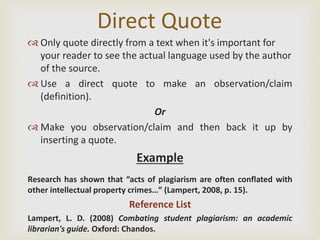
Direct Quote
 Only quote directly from a text when it's important for
your reader to see the actual language used by the author
of the source.
 Use a direct quote to make an observation/claim
(definition).
Or
 Make you observation/claim and then back it up by
inserting a quote.
Example
Research has shown that “acts of plagiarism are often conflated with
other intellectual property crimes…” (Lampert, 2008, p. 15).
Reference List
Lampert, L. D. (2008) Combating student plagiarism: an academic
librarian's guide. Oxford: Chandos.
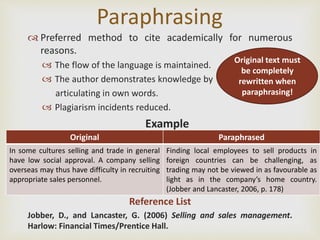
Paraphrasing
 Preferred method to cite academically for numerous
reasons.
 The flow of the language is maintained.
 The author demonstrates knowledge by
articulating in own words.
 Plagiarism incidents reduced.
Example
Reference List
Jobber, D., and Lancaster, G. (2006) Selling and sales management.
Harlow: Financial Times/Prentice Hall.
Original text must
be completely
rewritten when
paraphrasing!
Original Paraphrased
In some cultures selling and trade in general
have low social approval. A company selling
overseas may thus have difficulty in recruiting
appropriate sales personnel.
Finding local employees to sell products in
foreign countries can be challenging, as
trading may not be viewed in as favourable as
light as in the company’s home country.
(Jobber and Lancaster, 2006, p. 178)
Summarising
 Very like paraphrasing, except a complete body of work
(book/chapter) is summarised in the author’s own words.
 Normally a quick description of the main points or a brief
synopsis.
 You should include a signal or phrase to identify
who/what you are summarising.
Example
In the article “Getting Down to Business” the author outlined the
measures that the company has adopted to reinvent itself by improving
customer service and targeting business customers (Dunn, 2014).
Reference List
Dunn, G. (2014) 'Getting down to business', Airline Business, 30 (5), pp.
26-29. Business Source Complete, EBSCOhost [Online]. (Accessed: 1
February 2015).
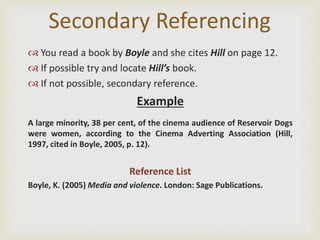
Secondary Referencing
 You read a book by Boyle and she cites Hill on page 12.
 If possible try and locate Hill’s book.
 If not possible, secondary reference.
Example
A large minority, 38 per cent, of the cinema audience of Reservoir Dogs
were women, according to the Cinema Adverting Association (Hill,
1997, cited in Boyle, 2005, p. 12).
Reference List
Boyle, K. (2005) Media and violence. London: Sage Publications.

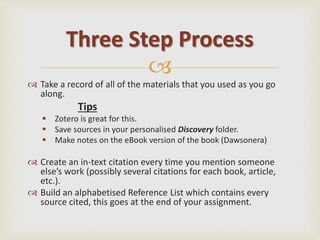
 Take a record of all of the materials that you used as you go
along.
Tips
 Zotero is great for this.
 Save sources in your personalised Discovery folder.
 Make notes on the eBook version of the book (Dawsonera)
 Create an in-text citation every time you mention someone
else’s work (possibly several citations for each book, article,
etc.).
 Build an alphabetised Reference List which contains every
source cited, this goes at the end of your assignment.
Three Step Process

 You give statistics.
 The information is unique and not known by most people.
 The reader might ask, “How do you know that?”
 You use a direct quotation from someone else.
 You use someone else’s ideas.
 You paraphrase / take info from elsewhere.
You must reference
when..

 The information is commonly known (either by the general
population, or commonly known within the particular
discipline).
 When most or all of your sources say the same thing on
that particular point.
 When it is your own original thought or opinion.
No need when…

When you’re not sure… Cite
it Anyway!
Tip
Need to cite a
fact? Credo is
great for factual
information.

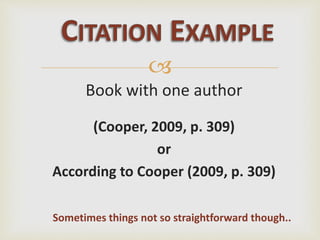
Book with one author
(Cooper, 2009, p. 309)
or
According to Cooper (2009, p. 309)
Sometimes things not so straightforward though..

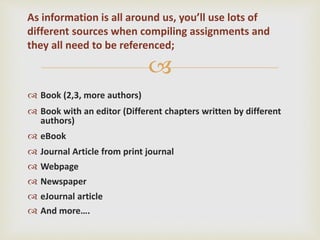
 Book (2,3, more authors)
 Book with an editor (Different chapters written by different
authors)
 eBook
 Journal Article from print journal
 Webpage
 Newspaper
 eJournal article
 And more….
As information is all around us, you’ll use lots of
different sources when compiling assignments and
they all need to be referenced;
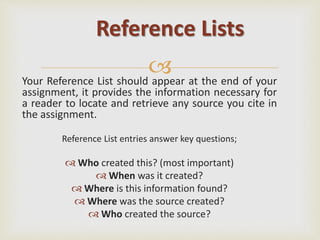
Your Reference List should appear at the end of your
assignment, it provides the information necessary for
a reader to locate and retrieve any source you cite in
the assignment.
Reference List entries answer key questions;
 Who created this? (most important)
 When was it created?
 Where is this information found?
 Where was the source created?
 Who created the source?
Reference Lists

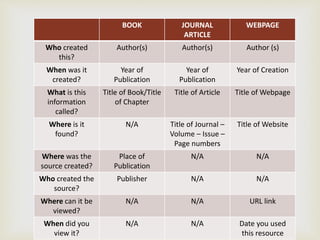
BOOK JOURNAL
ARTICLE
WEBPAGE
Who created
this?
Author(s) Author(s) Author (s)
When was it
created?
Year of
Publication
Year of
Publication
Year of Creation
What is this
information
called?
Title of Book/Title
of Chapter
Title of Article Title of Webpage
Where is it
found?
N/A Title of Journal –
Volume – Issue –
Page numbers
Title of Website
Where was the
source created?
Place of
Publication
N/A N/A
Who created the
source?
Publisher N/A N/A
Where can it be
viewed?
N/A N/A URL link
When did you
view it?
N/A N/A Date you used
this resource

 You can copy and paste reference list entries from both
Discovery and Credo (some formatting required).
 You can create book references with ISBNs via the
citethisforme website (some formatting required).
 You can download a plugin for Firefox called Zotero, this is
reference management software that both manages your
bibliographic data and creates reference lists (minimal
formatting required).
 Best news is that Zotero is officially supported by DBS and
the Library runs a workshop in it.
Some Good News

 A research tool that allows you to Collect, Organise, Cite
and Sync your data.
 Works best with Firefox as a plugin.
 Zotero standalone available also, works by installing
Zotero connectors to Chrome, Safari or Opera.
 Plugin for word processors available;
 Word
 Mac Word
 Libre Office/Open Office
Zotero

 Business students choose the Harvard “Cite them Right”
9th Edition from list of styles.
 Minimal formatting required (Done in Zotero).
 Create personal account;
 Sync content
 Access to content via Zotero website
Zotero

Referencing and zotero (business)

  • 2.
      Although anassignment is your own opinion, it needs to be backed up by evidence (research, reports, case studies, theories, etc. ).  Referencing is how we allow the reader to know which evidence you used, either to formulate or back up your own opinion.  There are many different referencing styles, in DBS School of Business the Harvard style is used. Specifically the style found in the “Cite them Right” series of books. Referencing: What is it and Why bother
  • 3.
      To giveweight to your argument, the more evidence supplied the better.  Go give credit to those whose knowledge you’ve utilised  To prove that you conducted your own secondary research.  To avoid committing plagiarism.  To establish academic credibility.  To instruct others where to find the information that you used (reference lists are a great source of information). The Advantages
  • 4.
    1. Direct Quote When using someone else exact words, always place them within “quotation marks”. Treat long quotes (40+ words) as separate paragraph. 2. Paraphrase  Instead of using a direct quote you can re-write someone else’s idea or theory in your own words. This is called paraphrasing. However, you must completely re-write the original text – you cannot simply change it around a little! 3. Summarise  If you want to give a brief synopsis of the entire content of another work, you can briefly summarise it without going into a lot of detail. HOW TO CITE…
  • 5.
    Direct Quote  Onlyquote directly from a text when it's important for your reader to see the actual language used by the author of the source.  Use a direct quote to make an observation/claim (definition). Or  Make you observation/claim and then back it up by inserting a quote. Example Research has shown that “acts of plagiarism are often conflated with other intellectual property crimes…” (Lampert, 2008, p. 15). Reference List Lampert, L. D. (2008) Combating student plagiarism: an academic librarian's guide. Oxford: Chandos.
  • 6.
    Paraphrasing  Preferred methodto cite academically for numerous reasons.  The flow of the language is maintained.  The author demonstrates knowledge by articulating in own words.  Plagiarism incidents reduced. Example Reference List Jobber, D., and Lancaster, G. (2006) Selling and sales management. Harlow: Financial Times/Prentice Hall. Original text must be completely rewritten when paraphrasing! Original Paraphrased In some cultures selling and trade in general have low social approval. A company selling overseas may thus have difficulty in recruiting appropriate sales personnel. Finding local employees to sell products in foreign countries can be challenging, as trading may not be viewed in as favourable as light as in the company’s home country. (Jobber and Lancaster, 2006, p. 178)
  • 7.
    Summarising  Very likeparaphrasing, except a complete body of work (book/chapter) is summarised in the author’s own words.  Normally a quick description of the main points or a brief synopsis.  You should include a signal or phrase to identify who/what you are summarising. Example In the article “Getting Down to Business” the author outlined the measures that the company has adopted to reinvent itself by improving customer service and targeting business customers (Dunn, 2014). Reference List Dunn, G. (2014) 'Getting down to business', Airline Business, 30 (5), pp. 26-29. Business Source Complete, EBSCOhost [Online]. (Accessed: 1 February 2015).
  • 8.
    Secondary Referencing  Youread a book by Boyle and she cites Hill on page 12.  If possible try and locate Hill’s book.  If not possible, secondary reference. Example A large minority, 38 per cent, of the cinema audience of Reservoir Dogs were women, according to the Cinema Adverting Association (Hill, 1997, cited in Boyle, 2005, p. 12). Reference List Boyle, K. (2005) Media and violence. London: Sage Publications.
  • 9.
      Take arecord of all of the materials that you used as you go along. Tips  Zotero is great for this.  Save sources in your personalised Discovery folder.  Make notes on the eBook version of the book (Dawsonera)  Create an in-text citation every time you mention someone else’s work (possibly several citations for each book, article, etc.).  Build an alphabetised Reference List which contains every source cited, this goes at the end of your assignment. Three Step Process
  • 11.
      You givestatistics.  The information is unique and not known by most people.  The reader might ask, “How do you know that?”  You use a direct quotation from someone else.  You use someone else’s ideas.  You paraphrase / take info from elsewhere. You must reference when..
  • 12.
      The informationis commonly known (either by the general population, or commonly known within the particular discipline).  When most or all of your sources say the same thing on that particular point.  When it is your own original thought or opinion. No need when…
  • 13.
     When you’re notsure… Cite it Anyway! Tip Need to cite a fact? Credo is great for factual information.
  • 14.
     Book with oneauthor (Cooper, 2009, p. 309) or According to Cooper (2009, p. 309) Sometimes things not so straightforward though..
  • 15.
      Book (2,3,more authors)  Book with an editor (Different chapters written by different authors)  eBook  Journal Article from print journal  Webpage  Newspaper  eJournal article  And more…. As information is all around us, you’ll use lots of different sources when compiling assignments and they all need to be referenced;
  • 16.
    Your Reference Listshould appear at the end of your assignment, it provides the information necessary for a reader to locate and retrieve any source you cite in the assignment. Reference List entries answer key questions;  Who created this? (most important)  When was it created?  Where is this information found?  Where was the source created?  Who created the source? Reference Lists
  • 17.
     BOOK JOURNAL ARTICLE WEBPAGE Who created this? Author(s)Author(s) Author (s) When was it created? Year of Publication Year of Publication Year of Creation What is this information called? Title of Book/Title of Chapter Title of Article Title of Webpage Where is it found? N/A Title of Journal – Volume – Issue – Page numbers Title of Website Where was the source created? Place of Publication N/A N/A Who created the source? Publisher N/A N/A Where can it be viewed? N/A N/A URL link When did you view it? N/A N/A Date you used this resource
  • 18.
      You cancopy and paste reference list entries from both Discovery and Credo (some formatting required).  You can create book references with ISBNs via the citethisforme website (some formatting required).  You can download a plugin for Firefox called Zotero, this is reference management software that both manages your bibliographic data and creates reference lists (minimal formatting required).  Best news is that Zotero is officially supported by DBS and the Library runs a workshop in it. Some Good News
  • 19.
      A researchtool that allows you to Collect, Organise, Cite and Sync your data.  Works best with Firefox as a plugin.  Zotero standalone available also, works by installing Zotero connectors to Chrome, Safari or Opera.  Plugin for word processors available;  Word  Mac Word  Libre Office/Open Office Zotero
  • 20.
      Business studentschoose the Harvard “Cite them Right” 9th Edition from list of styles.  Minimal formatting required (Done in Zotero).  Create personal account;  Sync content  Access to content via Zotero website Zotero

Editor's Notes

  • #6 According to Credo reference economics is   “The study of how individuals, households, and societies choose to use their scarce resources efficiently in order to satisfy their diverse wants. By definition, economics is a social or behavioural science because it studies human behaviour just like other social sciences, but it emphasizes the need to make wise choices in order to use scarce resources in an efficient way to satisfy diverse wants” (Sage, 2009).