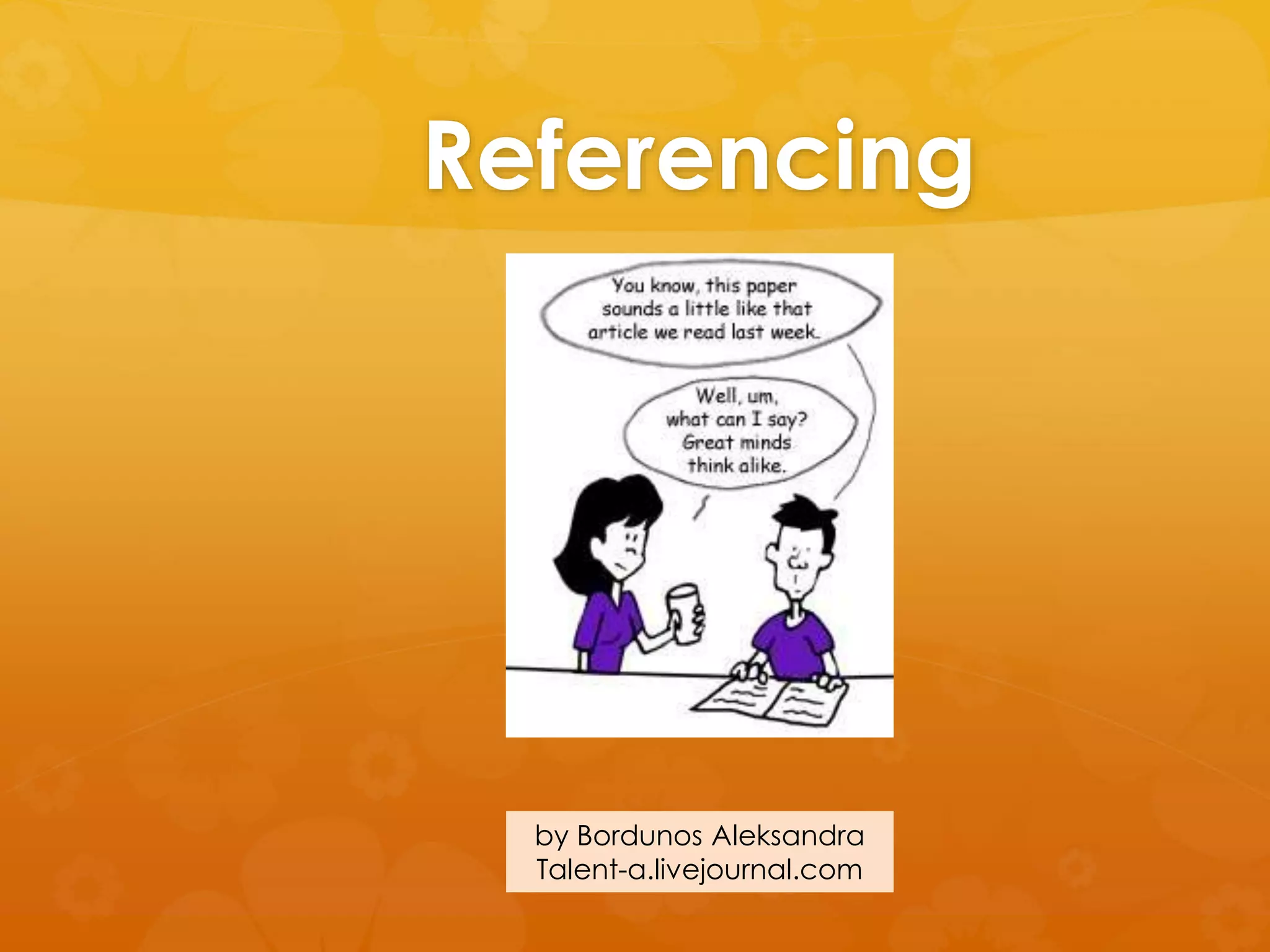



Referencing 
by Bordunos Aleksandra 
Talent-a.livejournal.com
Content 
 Citing 
 Referencing styles 
 Notes/Bibliography style 
 Author/Date style
Why 
When 
What 
Citing
3W of citing: why? 
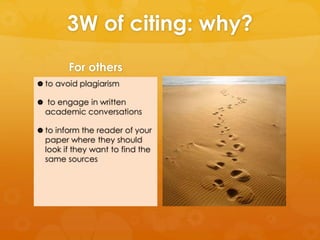
For others 
 to avoid plagiarism 
 to engage in written 
academic conversations 
 to inform the reader of your 
paper where they should 
look if they want to find the 
same sources
3W of citing: why? 
For me 
 shows the amount of 
research you've done 
 strengthens your work by 
lending outside support to 
your ideas, adds credibility 
to your work 
 emphasizes the originality of 
your own work, helping 
distinguish your ideas from 
those of your sources.
3W of citing: 
when and what? 
When to cite? 
Whenever use quotes or charts, 
pictures, etc. from an other source 
Whenever paraphrase 
Whenever use an idea that 
someone else has already 
expressed 
Whenever make specific 
reference to the work of another 
whenever someone else's work has 
been critical in developing your 
own ideas 
What to cite? 
 information about the 
author 
 the title of the work 
 the name and location of 
the company that 
published your copy of the 
source 
 the date your copy was 
published 
 the page numbers of the 
material you are borrowing
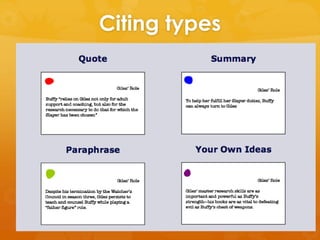
Citing types 
Quoting (direct citing) 
 Using the author's exact words. 
Paraphrasing 
 Restating the author's words or 
ideas without altering the 
meaning or providing 
interpretation. Are about the 
same length as the original. 
Summarizing 
 Condensing the author's 
words or ideas, but 
presenting the original 
information in a nutshell. 
• To support or add credibility to 
arguments 
• The original is difficult to rephrase 
• The original is so good that you want to 
preserve the language 
• BUT analyze and do well-crafted 
transitions 
• Use your own words, do not copy 
author's style 
• Do not include your 
interpretation/analysis within the 
summary - make a clear distinction 
between your thoughts and someone 
else's 
• Always include a citation 
• Use quotation marks when using exact 
words of an author 
• Include the key relevant elements of the 
original and keep it brief - you're just 
going for the original's essence
Citing types 
• To support or add credibility to 
arguments 
• The original is difficult to rephrase 
• The original is so good that you want to 
preserve the language 
• BUT analyze and do well-crafted 
• Utrsaen syiotiounr sown words, do not copy 
author's style 
• Do not include your 
interpretation/analysis within the 
summary - make a clear distinction 
between your thoughts and someone 
else's 
• Always include a citation 
• Use quotation marks when using exact 
words of an author 
• Include the key relevant elements of the 
original and keep it brief - you're just 
going for the original's essence
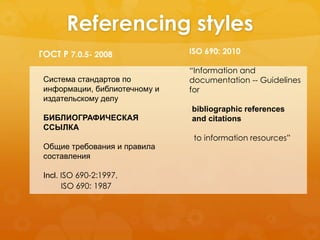
Referencing Styles
Referencing styles 
ГОСТ Р 7.0.5- 2008 
Система стандартов по 
информации, библиотечному и 
издательскому делу 
БИБЛИОГРАФИЧЕСКАЯ 
ССЫЛКА 
Общие требования и правила 
составления 
Incl. ISO 690-2:1997, 
ISO 690: 2010 
“Information and 
documentation -- Guidelines 
for 
ISO 690: 1987 
bibliographic references 
and citations 
to information resources”
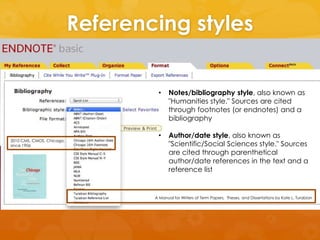
Referencing styles 
ISO 690: 1987 
• Notes/bibliography style, also known as 
"Humanities style." Sources are cited 
through footnotes (or endnotes) and a 
bibliography 
bibliographic references 
and citations 
• Author/date style, also known as 
to information resources” 2010 CMS, CMOS, Chicago, 
since 1906 
"Scientific/Social Sciences style." Sources 
are cited through parenthetical 
author/date references in the text and a 
reference list 
A Manual for Writers of Term Papers, Theses, and Dissertations by Kate L. Turabian
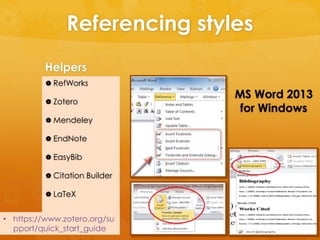
Referencing styles 
Helpers 
 RefWorks 
 Zotero 
Mendeley 
 EndNote 
 EasyBib 
 Citation Builder 
 LaTeX 
MS Word 2013 
for Windows 
• https://www.zotero.org/su 
pport/quick_start_guide
Referencing styles 
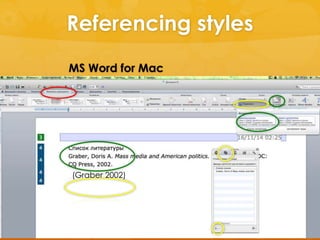
MS Word for Mac 
(Graber 2002)
Referencing styles 
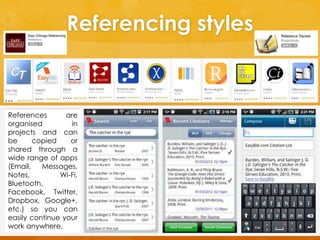
References are 
organised in 
projects and can 
be copied or 
shared through a 
wide range of apps 
(Email, Messages, 
Notes, Wi-Fi, 
Bluetooth, 
Facebook, Twitter, 
Dropbox, Google+, 
etc.) so you can 
easily continue your 
work anywhere.
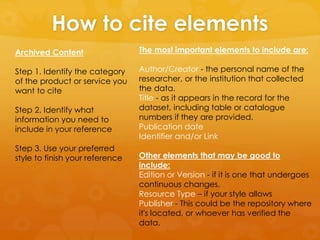
How to cite elements 
Archived Content 
Step 1. Identify the category 
of the product or service you 
want to cite 
Step 2. Identify what 
information you need to 
include in your reference 
Step 3. Use your preferred 
style to finish your reference 
The most important elements to include are: 
Author/Creator - the personal name of the 
researcher, or the institution that collected 
the data. 
Title - as it appears in the record for the 
dataset, including table or catalogue 
numbers if they are provided. 
Publication date 
Identifier and/or Link 
Other elements that may be good to 
include: 
Edition or Version - if it is one that undergoes 
continuous changes. 
Resource Type – if your style allows 
Publisher - This could be the repository where 
it's located, or whoever has verified the 
data.
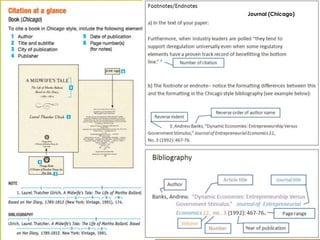
Notes/Bibliography 
style
Journal (Chicago)
Footnotes-consequence 
 Chicago style  ГОСТ Р7.0.5 2008 
The numbers in the notes are full size, not 
raised, and followed by a period. 
Citations in notes are single-spaced, but 
there is a double space between entries. 
The first line is indented. 
*"ibid." (short for 'ibidem’ "in the same place") 
Подстрочная / затекстовая 
библиографическая ссылка 
1Адорно Т.В. К логике 
социальных наук // Вопр. 
философии. — 1992. — № 
10. — С. 76—86. 
2 Вопр. философии. 1992. 
№ 10. С. 76—86. 
или 
3 Там же. С. 76-86. (или 76- 
86 с.) 
Footnote 
…дает работа библиографа 
И.М. Кауфмана1. 
… дает работа библиографа 
И.М. Кауфмана [59]. 
Subsequent notes 
Immediately following notes
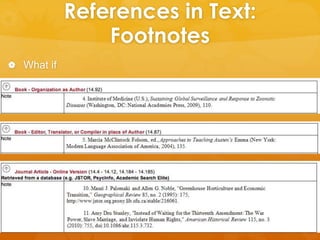
References in Text: 
Footnotes 
 What if
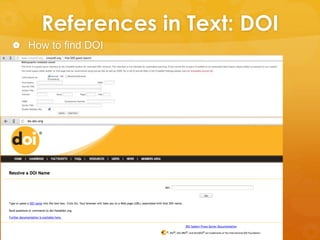
References in Text: DOI 
 How to find DOI
Author/Date 
style
References in Text: 
Text Citations 
ГОСТ Р7.0.5 2008 
Chicago style 
 Single Author (Nairn 1997), (Nairn 
1997, 73), (Kurland and Lerner, 
chap. 10, doc. 19) 
Multiple Authors (Geis and Bunn 
1997), if >4 (Barnes et al. 2010) 
 Group or Corporate Author 
(Global Environment Coordination 
1994) 
 Citations taken from secondary 
sources quoting original works 
(quoted in Rathbun 2001) 
Web-site (Google 2009) 
 E-mail (John Doe, pers. comm.) 
 [Porter, 1994], [Porter, 1994b, p. 45], 
[Иванов, 1991б, с. 45], 
 [Porter, 1994b; Иванов, 1991],[Porter, 
Yansen, 1991b; Иванов, 1991]. 
 [Гуриев и др., 2002], [Bevan et al., 
2001].
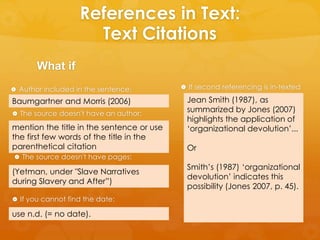
References in Text: 
Text Citations 
What if 
 Author included in the sentence: 
Baumgartner and Morris (2006) 
 The source doesn't have an author: 
mention the title in the sentence or use 
the first few words of the title in the 
parenthetical citation 
 The source doesn't have pages: 
(Yetman, under "Slave Narratives 
during Slavery and After”) 
 If you cannot find the date: 
use n.d. (= no date). 
 If second referencing is in-texted 
Jean Smith (1987), as 
summarized by Jones (2007) 
highlights the application of 
‘organizational devolution’... 
Or 
Smith’s (1987) ‘organizational 
devolution’ indicates this 
possibility (Jones 2007, p. 45).
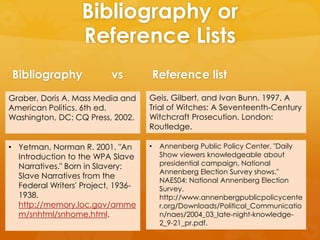
Bibliography or 
Reference Lists 
Bibliography vs Reference list 
• Annenberg Public Policy Center. "Daily 
Show viewers knowledgeable about 
presidential campaign, National 
Annenberg Election Survey shows." 
NAES04: National Annenberg Election 
Survey. 
http://www.annenbergpublicpolicycente 
r.org/Downloads/Political_Communicatio 
n/naes/2004_03_late-night-knowledge- 
2_9-21_pr.pdf. 
• Yetman, Norman R. 2001. "An 
Introduction to the WPA Slave 
Narratives." Born in Slavery: 
Slave Narratives from the 
Federal Writers' Project, 1936- 
1938. 
http://memory.loc.gov/amme 
m/snhtml/snhome.html. 
Geis, Gilbert, and Ivan Bunn. 1997. A 
Trial of Witches: A Seventeenth-Century 
Witchcraft Prosecution. London: 
Routledge. 
Graber, Doris A. Mass Media and 
American Politics. 6th ed. 
Washington, DC: CQ Press, 2002.
Bibliography or 
Reference Lists 
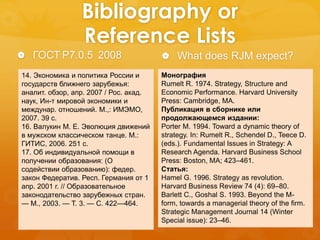
 ГОСТ Р7.0.5 2008 
Монография: 
Rumelt R. 1974. Strategy, Structure and 
Economic Performance. Harvard University 
Press: Cambridge, MA. 
Публикация в сборнике или 
продолжающемся издании: 
Porter M. 1994. Toward a dynamic theory of 
strategy. In: Rumelt R., Schendel D., Teece D. 
(eds.). Fundamental Issues in Strategy: A 
Research Agenda. Harvard Business School 
Press: Boston, MA; 423–461. 
Статья: 
Hamel G. 1996. Strategy as revolution. 
Harvard Business Review 74 (4): 69–80. 
Barlett C., Goshal S. 1993. Beyond the M-form, 
towards a managerial theory of the firm. 
Strategic Management Journal 14 (Winter 
Special issue): 23–46. 
14. Экономика и политика России и 
государств ближнего зарубежья: 
аналит. обзор, апр. 2007 / Рос. акад. 
наук, Ин-т мировой экономики и 
междунар. отношений. М.,: ИМЭМО, 
2007. 39 с. 
16. Валукин М. Е. Эволюция движений 
в мужском классическом танце. М.: 
ГИТИС, 2006. 251 с. 
17. Об индивидуальной помощи в 
получении образования: (О 
содействии образованию): федер. 
закон Федератив. Респ. Германия от 1 
апр. 2001 г. // Образовательное 
законодательство зарубежных стран. 
— М., 2003. — Т. 3. — С. 422—464. 
 What does RJM expect?
Sources used 
• https://owl.english.purdue.edu/media/pdf/20110928111055_949.pdf 
• http://web.williams.edu/ 
• http://owl.english.purdue.edu 
• http://ux.brookdalecc.edu/library/plagi 
arism/tutorial/5paraphrasing.ph… 
• http://lugin.r u/inf or ma tion/e xpla 
na tion- on- quoting.html 
• http://www.lib.sfu.ca/help/writing/c 
hicago-turabian 
• http://www.rjm.ru/avtoram/pravila/ 
• http://ru.wikisource.org/wiki/ГОСТ_Р_7.0.5—2008 
• http://bcs.bedfordstmartins.com/resdoc5e/RES5e_ch10_s1-0001.html

Referencing for academic purpose

  • 1.
    Referencing by BordunosAleksandra Talent-a.livejournal.com
  • 2.
    Content  Citing  Referencing styles  Notes/Bibliography style  Author/Date style
  • 3.
  • 4.
    3W of citing:why? For others  to avoid plagiarism  to engage in written academic conversations  to inform the reader of your paper where they should look if they want to find the same sources
  • 5.
    3W of citing:why? For me  shows the amount of research you've done  strengthens your work by lending outside support to your ideas, adds credibility to your work  emphasizes the originality of your own work, helping distinguish your ideas from those of your sources.
  • 6.
    3W of citing: when and what? When to cite? Whenever use quotes or charts, pictures, etc. from an other source Whenever paraphrase Whenever use an idea that someone else has already expressed Whenever make specific reference to the work of another whenever someone else's work has been critical in developing your own ideas What to cite?  information about the author  the title of the work  the name and location of the company that published your copy of the source  the date your copy was published  the page numbers of the material you are borrowing
  • 7.
    Citing types Quoting(direct citing)  Using the author's exact words. Paraphrasing  Restating the author's words or ideas without altering the meaning or providing interpretation. Are about the same length as the original. Summarizing  Condensing the author's words or ideas, but presenting the original information in a nutshell. • To support or add credibility to arguments • The original is difficult to rephrase • The original is so good that you want to preserve the language • BUT analyze and do well-crafted transitions • Use your own words, do not copy author's style • Do not include your interpretation/analysis within the summary - make a clear distinction between your thoughts and someone else's • Always include a citation • Use quotation marks when using exact words of an author • Include the key relevant elements of the original and keep it brief - you're just going for the original's essence
  • 8.
    Citing types •To support or add credibility to arguments • The original is difficult to rephrase • The original is so good that you want to preserve the language • BUT analyze and do well-crafted • Utrsaen syiotiounr sown words, do not copy author's style • Do not include your interpretation/analysis within the summary - make a clear distinction between your thoughts and someone else's • Always include a citation • Use quotation marks when using exact words of an author • Include the key relevant elements of the original and keep it brief - you're just going for the original's essence
  • 9.
  • 10.
    Referencing styles ГОСТР 7.0.5- 2008 Система стандартов по информации, библиотечному и издательскому делу БИБЛИОГРАФИЧЕСКАЯ ССЫЛКА Общие требования и правила составления Incl. ISO 690-2:1997, ISO 690: 2010 “Information and documentation -- Guidelines for ISO 690: 1987 bibliographic references and citations to information resources”
  • 11.
    Referencing styles ISO690: 1987 • Notes/bibliography style, also known as "Humanities style." Sources are cited through footnotes (or endnotes) and a bibliography bibliographic references and citations • Author/date style, also known as to information resources” 2010 CMS, CMOS, Chicago, since 1906 "Scientific/Social Sciences style." Sources are cited through parenthetical author/date references in the text and a reference list A Manual for Writers of Term Papers, Theses, and Dissertations by Kate L. Turabian
  • 12.
    Referencing styles Helpers  RefWorks  Zotero Mendeley  EndNote  EasyBib  Citation Builder  LaTeX MS Word 2013 for Windows • https://www.zotero.org/su pport/quick_start_guide
  • 13.
    Referencing styles MSWord for Mac (Graber 2002)
  • 14.
    Referencing styles Referencesare organised in projects and can be copied or shared through a wide range of apps (Email, Messages, Notes, Wi-Fi, Bluetooth, Facebook, Twitter, Dropbox, Google+, etc.) so you can easily continue your work anywhere.
  • 15.
    How to citeelements Archived Content Step 1. Identify the category of the product or service you want to cite Step 2. Identify what information you need to include in your reference Step 3. Use your preferred style to finish your reference The most important elements to include are: Author/Creator - the personal name of the researcher, or the institution that collected the data. Title - as it appears in the record for the dataset, including table or catalogue numbers if they are provided. Publication date Identifier and/or Link Other elements that may be good to include: Edition or Version - if it is one that undergoes continuous changes. Resource Type – if your style allows Publisher - This could be the repository where it's located, or whoever has verified the data.
  • 16.
  • 17.
  • 18.
    Footnotes-consequence  Chicagostyle  ГОСТ Р7.0.5 2008 The numbers in the notes are full size, not raised, and followed by a period. Citations in notes are single-spaced, but there is a double space between entries. The first line is indented. *"ibid." (short for 'ibidem’ "in the same place") Подстрочная / затекстовая библиографическая ссылка 1Адорно Т.В. К логике социальных наук // Вопр. философии. — 1992. — № 10. — С. 76—86. 2 Вопр. философии. 1992. № 10. С. 76—86. или 3 Там же. С. 76-86. (или 76- 86 с.) Footnote …дает работа библиографа И.М. Кауфмана1. … дает работа библиографа И.М. Кауфмана [59]. Subsequent notes Immediately following notes
  • 19.
    References in Text: Footnotes  What if
  • 20.
    References in Text:DOI  How to find DOI
  • 21.
  • 22.
    References in Text: Text Citations ГОСТ Р7.0.5 2008 Chicago style  Single Author (Nairn 1997), (Nairn 1997, 73), (Kurland and Lerner, chap. 10, doc. 19) Multiple Authors (Geis and Bunn 1997), if >4 (Barnes et al. 2010)  Group or Corporate Author (Global Environment Coordination 1994)  Citations taken from secondary sources quoting original works (quoted in Rathbun 2001) Web-site (Google 2009)  E-mail (John Doe, pers. comm.)  [Porter, 1994], [Porter, 1994b, p. 45], [Иванов, 1991б, с. 45],  [Porter, 1994b; Иванов, 1991],[Porter, Yansen, 1991b; Иванов, 1991].  [Гуриев и др., 2002], [Bevan et al., 2001].
  • 23.
    References in Text: Text Citations What if  Author included in the sentence: Baumgartner and Morris (2006)  The source doesn't have an author: mention the title in the sentence or use the first few words of the title in the parenthetical citation  The source doesn't have pages: (Yetman, under "Slave Narratives during Slavery and After”)  If you cannot find the date: use n.d. (= no date).  If second referencing is in-texted Jean Smith (1987), as summarized by Jones (2007) highlights the application of ‘organizational devolution’... Or Smith’s (1987) ‘organizational devolution’ indicates this possibility (Jones 2007, p. 45).
  • 24.
    Bibliography or ReferenceLists Bibliography vs Reference list • Annenberg Public Policy Center. "Daily Show viewers knowledgeable about presidential campaign, National Annenberg Election Survey shows." NAES04: National Annenberg Election Survey. http://www.annenbergpublicpolicycente r.org/Downloads/Political_Communicatio n/naes/2004_03_late-night-knowledge- 2_9-21_pr.pdf. • Yetman, Norman R. 2001. "An Introduction to the WPA Slave Narratives." Born in Slavery: Slave Narratives from the Federal Writers' Project, 1936- 1938. http://memory.loc.gov/amme m/snhtml/snhome.html. Geis, Gilbert, and Ivan Bunn. 1997. A Trial of Witches: A Seventeenth-Century Witchcraft Prosecution. London: Routledge. Graber, Doris A. Mass Media and American Politics. 6th ed. Washington, DC: CQ Press, 2002.
  • 25.
    Bibliography or ReferenceLists  ГОСТ Р7.0.5 2008 Монография: Rumelt R. 1974. Strategy, Structure and Economic Performance. Harvard University Press: Cambridge, MA. Публикация в сборнике или продолжающемся издании: Porter M. 1994. Toward a dynamic theory of strategy. In: Rumelt R., Schendel D., Teece D. (eds.). Fundamental Issues in Strategy: A Research Agenda. Harvard Business School Press: Boston, MA; 423–461. Статья: Hamel G. 1996. Strategy as revolution. Harvard Business Review 74 (4): 69–80. Barlett C., Goshal S. 1993. Beyond the M-form, towards a managerial theory of the firm. Strategic Management Journal 14 (Winter Special issue): 23–46. 14. Экономика и политика России и государств ближнего зарубежья: аналит. обзор, апр. 2007 / Рос. акад. наук, Ин-т мировой экономики и междунар. отношений. М.,: ИМЭМО, 2007. 39 с. 16. Валукин М. Е. Эволюция движений в мужском классическом танце. М.: ГИТИС, 2006. 251 с. 17. Об индивидуальной помощи в получении образования: (О содействии образованию): федер. закон Федератив. Респ. Германия от 1 апр. 2001 г. // Образовательное законодательство зарубежных стран. — М., 2003. — Т. 3. — С. 422—464.  What does RJM expect?
  • 26.
    Sources used •https://owl.english.purdue.edu/media/pdf/20110928111055_949.pdf • http://web.williams.edu/ • http://owl.english.purdue.edu • http://ux.brookdalecc.edu/library/plagi arism/tutorial/5paraphrasing.ph… • http://lugin.r u/inf or ma tion/e xpla na tion- on- quoting.html • http://www.lib.sfu.ca/help/writing/c hicago-turabian • http://www.rjm.ru/avtoram/pravila/ • http://ru.wikisource.org/wiki/ГОСТ_Р_7.0.5—2008 • http://bcs.bedfordstmartins.com/resdoc5e/RES5e_ch10_s1-0001.html

Editor's Notes

  • #5 Think of citations as footprints leading the reader through some of the steps you took to reach your conclusions.
  • #8  Quoting is good, but stringing a bunch of quotes together without analysis and well-crafted transitions is bad. Also, random quotes will just look like you are trying to make the page requirements of the assignment. Always include a citation and use "quotation marks" to signal that you are using someone else's words when you quote.
  • #9  Quoting is good, but stringing a bunch of quotes together without analysis and well-crafted transitions is bad. Also, random quotes will just look like you are trying to make the page requirements of the assignment. Always include a citation and use "quotation marks" to signal that you are using someone else's words when you quote. Richardson argues, refers to, explains, hypothesizes, compares, concludes; As Littlewood and Sherwin demonstrated, proved, ... etc.
  • #11 Разница между reference list and bibliography list?
  • #12 Разница между reference list and bibliography list?
  • #19 Найдите отличия
  • #23 What is the difference between russian and chicago style? Secondary source citation Is generally to be avoided as researchers are expected to examine the works they cite. If the original work is not available, the original and secondary source must be cited. The original author and date would be used in the running text and as the beginning of the reference list entry. The text citation would include the words “quoted in.”
  • #24 What is the difference between russian and chicago style? Secondary source citation Is generally to be avoided as researchers are expected to examine the works they cite. If the original work is not available, the original and secondary source must be cited. The original author and date would be used in the running text and as the beginning of the reference list entry. The text citation would include the words “quoted in.”
  • #25 Разница?
  • #26 Найдите отличия