Introduction to Harvard
Referencing
October 2018
RachelWhite
What is referencing and why do I need
to do it?
• Acknowledge when using
someone’s work
• To make clear to the reader that
this idea is not your own
• Demonstrate the breadth of
reading and individual research
• Support and improve your
argument
• An academic skill for all levels
• To allow you, your tutor and other
readers to retrieve items that you
have mentioned
• To avoid accusations of plagiarism
What is Plagiarism and how to avoid
it?
What is plagiarism?
• Passing off as your own a piece of work
that is partly or wholly the work of
another student
• Citing and referencing sources that you
have not used
• Quoting, summarising or paraphrasing
material in your assignment without
citing the original source
• 'Recycling' a piece of your own work that
you have previously submitted for
another module or course (i.e. self-
plagiarism).
(Palgrave Study SkillsOnline, 2018)
Avoiding plagiarism
• Take effective notes
• Don’t leave assignments
to the last minute
• Keep a note of the
sources you have used
• Reference accurately and
correctly
Harvard Referencing
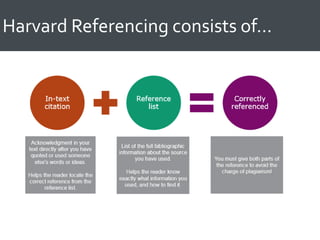
Harvard Referencing consists of…
InText Citations – when are they
needed?
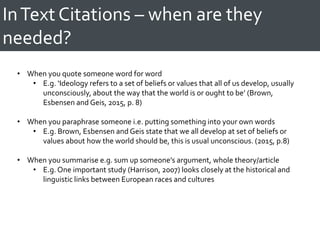
• When you quote someone word for word
• E.g. ‘Ideology refers to a set of beliefs or values that all of us develop, usually
unconsciously, about the way that the world is or ought to be’ (Brown,
Esbensen and Geis, 2015, p. 8)
• When you paraphrase someone i.e. putting something into your own words
• E.g. Brown, Esbensen and Geis state that we all develop at set of beliefs or
values about how the world should be, this is usual unconscious. (2015, p.8)
• When you summarise e.g. sum up someone’s argument, whole theory/article
• E.g. One important study (Harrison, 2007) looks closely at the historical and
linguistic links between European races and cultures
Common Knowledge and when to cite
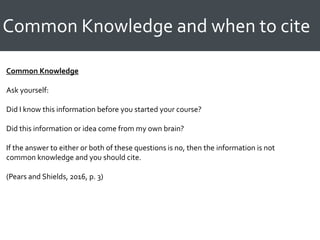
Common Knowledge
Ask yourself:
Did I know this information before you started your course?
Did this information or idea come from my own brain?
If the answer to either or both of these questions is no, then the information is not
common knowledge and you should cite.
(Pears and Shields, 2016, p. 3)
Common Knowledge and when to cite
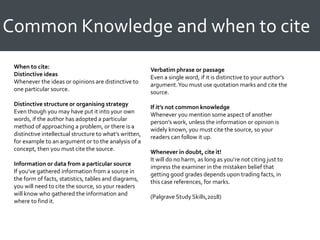
When to cite:
Distinctive ideas
Whenever the ideas or opinions are distinctive to
one particular source.
Distinctive structure or organising strategy
Even though you may have put it into your own
words, if the author has adopted a particular
method of approaching a problem, or there is a
distinctive intellectual structure to what’s written,
for example to an argument or to the analysis of a
concept, then you must cite the source.
Information or data from a particular source
If you’ve gathered information from a source in
the form of facts, statistics, tables and diagrams,
you will need to cite the source, so your readers
will know who gathered the information and
where to find it.
Verbatim phrase or passage
Even a single word, if it is distinctive to your author’s
argument.You must use quotation marks and cite the
source.
If it’s not common knowledge
Whenever you mention some aspect of another
person’s work, unless the information or opinion is
widely known, you must cite the source, so your
readers can follow it up.
Whenever in doubt, cite it!
It will do no harm, as long as you’re not citing just to
impress the examiner in the mistaken belief that
getting good grades depends upon trading facts, in
this case references, for marks.
(Palgrave Study Skills,2018)
How to reference different
resources?
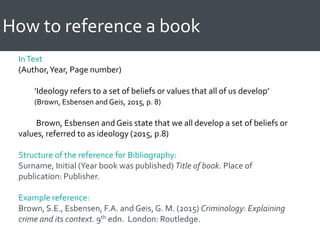
How to reference a book
InText
(Author,Year, Page number)
‘Ideology refers to a set of beliefs or values that all of us develop’
(Brown, Esbensen and Geis, 2015, p. 8)
Brown, Esbensen and Geis state that we all develop a set of beliefs or
values, referred to as ideology (2015, p.8)
Structure of the reference for Bibliography:
Surname, Initial (Year book was published) Title of book. Place of
publication: Publisher.
Example reference:
Brown, S.E., Esbensen, F.A. and Geis,G. M. (2015) Criminology: Explaining
crime and its context. 9th edn. London: Routledge.
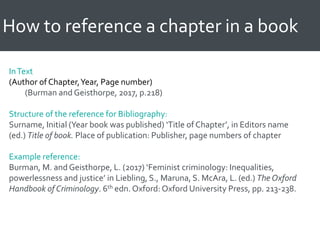
How to reference a chapter in a book
InText
(Author of Chapter,Year, Page number)
(Burman and Geisthorpe, 2017, p.218)
Structure of the reference for Bibliography:
Surname, Initial (Year book was published) ‘Title of Chapter’, in Editors name
(ed.) Title of book. Place of publication: Publisher, page numbers of chapter
Example reference:
Burman, M. and Geisthorpe, L. (2017) ‘Feminist criminology: Inequalities,
powerlessness and justice’ in Liebling, S., Maruna, S. McAra, L. (ed.) The Oxford
Handbook of Criminology. 6th edn. Oxford: Oxford University Press, pp. 213-238.
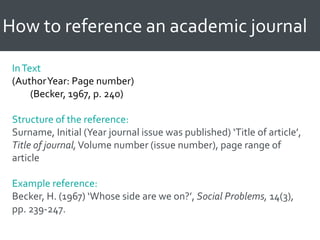
How to reference an academic journal
InText
(AuthorYear: Page number)
(Becker, 1967, p. 240)
Structure of the reference:
Surname, Initial (Year journal issue was published) ‘Title of article’,
Title of journal,Volume number (issue number), page range of
article
Example reference:
Becker, H. (1967) ‘Whose side are we on?’, Social Problems, 14(3),
pp. 239-247.
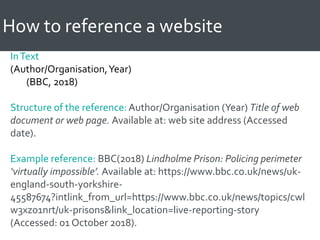
How to reference a website
InText
(Author/Organisation,Year)
(BBC, 2018)
Structure of the reference: Author/Organisation (Year) Title of web
document or web page. Available at: web site address (Accessed
date).
Example reference: BBC(2018) Lindholme Prison: Policing perimeter
‘virtually impossible’. Available at: https://www.bbc.co.uk/news/uk-
england-south-yorkshire-
45587674?intlink_from_url=https://www.bbc.co.uk/news/topics/cwl
w3xz01nrt/uk-prisons&link_location=live-reporting-story
(Accessed: 01 October 2018).
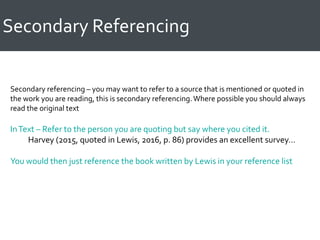
Secondary Referencing
Secondary referencing – you may want to refer to a source that is mentioned or quoted in
the work you are reading, this is secondary referencing.Where possible you should always
read the original text
InText – Refer to the person you are quoting but say where you cited it.
Harvey (2015, quoted in Lewis, 2016, p. 86) provides an excellent survey…
You would then just reference the book written by Lewis in your reference list
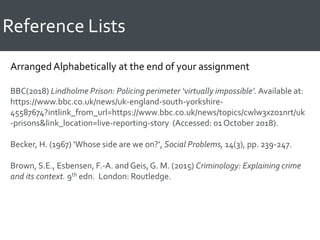
Reference Lists
Arranged Alphabetically at the end of your assignment
BBC(2018) Lindholme Prison: Policing perimeter ‘virtually impossible’. Available at:
https://www.bbc.co.uk/news/uk-england-south-yorkshire-
45587674?intlink_from_url=https://www.bbc.co.uk/news/topics/cwlw3xz01nrt/uk
-prisons&link_location=live-reporting-story (Accessed: 01 October 2018).
Becker, H. (1967) ‘Whose side are we on?’, Social Problems, 14(3), pp. 239-247.
Brown, S.E., Esbensen, F.-A. and Geis,G. M. (2015) Criminology: Explaining crime
and its context. 9th edn. London: Routledge.
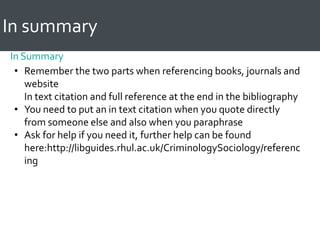
In summary
In Summary
• Remember the two parts when referencing books, journals and
website
In text citation and full reference at the end in the bibliography
• You need to put an in text citation when you quote directly
from someone else and also when you paraphrase
• Ask for help if you need it, further help can be found
here:http://libguides.rhul.ac.uk/CriminologySociology/referenc
ing
Referencing
1-1s
Any
questions?
Reference Lists
Palgrave Study Skills Online (2018) Referencing and avoiding
plagiarism. Available at:
https://www.macmillanihe.com/studentstudyskills/page/Referenci
ng-and-Avoiding-Plagiarism (Accessed: 14 September 2018).
Pears, R. and Shields, G. (2016) Cite them right. 10th edn. London:
Palgrave Macmillan.

Harvard referencing - Criminology

  • 1.
  • 2.
    What is referencingand why do I need to do it? • Acknowledge when using someone’s work • To make clear to the reader that this idea is not your own • Demonstrate the breadth of reading and individual research • Support and improve your argument • An academic skill for all levels • To allow you, your tutor and other readers to retrieve items that you have mentioned • To avoid accusations of plagiarism
  • 3.
    What is Plagiarismand how to avoid it?
  • 4.
    What is plagiarism? •Passing off as your own a piece of work that is partly or wholly the work of another student • Citing and referencing sources that you have not used • Quoting, summarising or paraphrasing material in your assignment without citing the original source • 'Recycling' a piece of your own work that you have previously submitted for another module or course (i.e. self- plagiarism). (Palgrave Study SkillsOnline, 2018)
  • 5.
    Avoiding plagiarism • Takeeffective notes • Don’t leave assignments to the last minute • Keep a note of the sources you have used • Reference accurately and correctly
  • 6.
  • 7.
  • 8.
    InText Citations –when are they needed? • When you quote someone word for word • E.g. ‘Ideology refers to a set of beliefs or values that all of us develop, usually unconsciously, about the way that the world is or ought to be’ (Brown, Esbensen and Geis, 2015, p. 8) • When you paraphrase someone i.e. putting something into your own words • E.g. Brown, Esbensen and Geis state that we all develop at set of beliefs or values about how the world should be, this is usual unconscious. (2015, p.8) • When you summarise e.g. sum up someone’s argument, whole theory/article • E.g. One important study (Harrison, 2007) looks closely at the historical and linguistic links between European races and cultures
  • 9.
    Common Knowledge andwhen to cite Common Knowledge Ask yourself: Did I know this information before you started your course? Did this information or idea come from my own brain? If the answer to either or both of these questions is no, then the information is not common knowledge and you should cite. (Pears and Shields, 2016, p. 3)
  • 10.
    Common Knowledge andwhen to cite When to cite: Distinctive ideas Whenever the ideas or opinions are distinctive to one particular source. Distinctive structure or organising strategy Even though you may have put it into your own words, if the author has adopted a particular method of approaching a problem, or there is a distinctive intellectual structure to what’s written, for example to an argument or to the analysis of a concept, then you must cite the source. Information or data from a particular source If you’ve gathered information from a source in the form of facts, statistics, tables and diagrams, you will need to cite the source, so your readers will know who gathered the information and where to find it. Verbatim phrase or passage Even a single word, if it is distinctive to your author’s argument.You must use quotation marks and cite the source. If it’s not common knowledge Whenever you mention some aspect of another person’s work, unless the information or opinion is widely known, you must cite the source, so your readers can follow it up. Whenever in doubt, cite it! It will do no harm, as long as you’re not citing just to impress the examiner in the mistaken belief that getting good grades depends upon trading facts, in this case references, for marks. (Palgrave Study Skills,2018)
  • 11.
    How to referencedifferent resources?
  • 12.
    How to referencea book InText (Author,Year, Page number) ‘Ideology refers to a set of beliefs or values that all of us develop’ (Brown, Esbensen and Geis, 2015, p. 8) Brown, Esbensen and Geis state that we all develop a set of beliefs or values, referred to as ideology (2015, p.8) Structure of the reference for Bibliography: Surname, Initial (Year book was published) Title of book. Place of publication: Publisher. Example reference: Brown, S.E., Esbensen, F.A. and Geis,G. M. (2015) Criminology: Explaining crime and its context. 9th edn. London: Routledge.
  • 13.
    How to referencea chapter in a book InText (Author of Chapter,Year, Page number) (Burman and Geisthorpe, 2017, p.218) Structure of the reference for Bibliography: Surname, Initial (Year book was published) ‘Title of Chapter’, in Editors name (ed.) Title of book. Place of publication: Publisher, page numbers of chapter Example reference: Burman, M. and Geisthorpe, L. (2017) ‘Feminist criminology: Inequalities, powerlessness and justice’ in Liebling, S., Maruna, S. McAra, L. (ed.) The Oxford Handbook of Criminology. 6th edn. Oxford: Oxford University Press, pp. 213-238.
  • 14.
    How to referencean academic journal InText (AuthorYear: Page number) (Becker, 1967, p. 240) Structure of the reference: Surname, Initial (Year journal issue was published) ‘Title of article’, Title of journal,Volume number (issue number), page range of article Example reference: Becker, H. (1967) ‘Whose side are we on?’, Social Problems, 14(3), pp. 239-247.
  • 15.
    How to referencea website InText (Author/Organisation,Year) (BBC, 2018) Structure of the reference: Author/Organisation (Year) Title of web document or web page. Available at: web site address (Accessed date). Example reference: BBC(2018) Lindholme Prison: Policing perimeter ‘virtually impossible’. Available at: https://www.bbc.co.uk/news/uk- england-south-yorkshire- 45587674?intlink_from_url=https://www.bbc.co.uk/news/topics/cwl w3xz01nrt/uk-prisons&link_location=live-reporting-story (Accessed: 01 October 2018).
  • 16.
    Secondary Referencing Secondary referencing– you may want to refer to a source that is mentioned or quoted in the work you are reading, this is secondary referencing.Where possible you should always read the original text InText – Refer to the person you are quoting but say where you cited it. Harvey (2015, quoted in Lewis, 2016, p. 86) provides an excellent survey… You would then just reference the book written by Lewis in your reference list
  • 17.
    Reference Lists Arranged Alphabeticallyat the end of your assignment BBC(2018) Lindholme Prison: Policing perimeter ‘virtually impossible’. Available at: https://www.bbc.co.uk/news/uk-england-south-yorkshire- 45587674?intlink_from_url=https://www.bbc.co.uk/news/topics/cwlw3xz01nrt/uk -prisons&link_location=live-reporting-story (Accessed: 01 October 2018). Becker, H. (1967) ‘Whose side are we on?’, Social Problems, 14(3), pp. 239-247. Brown, S.E., Esbensen, F.-A. and Geis,G. M. (2015) Criminology: Explaining crime and its context. 9th edn. London: Routledge.
  • 18.
    In summary In Summary •Remember the two parts when referencing books, journals and website In text citation and full reference at the end in the bibliography • You need to put an in text citation when you quote directly from someone else and also when you paraphrase • Ask for help if you need it, further help can be found here:http://libguides.rhul.ac.uk/CriminologySociology/referenc ing
  • 19.
  • 20.
  • 21.
    Reference Lists Palgrave StudySkills Online (2018) Referencing and avoiding plagiarism. Available at: https://www.macmillanihe.com/studentstudyskills/page/Referenci ng-and-Avoiding-Plagiarism (Accessed: 14 September 2018). Pears, R. and Shields, G. (2016) Cite them right. 10th edn. London: Palgrave Macmillan.

Editor's Notes

  • #3 The main thing for all new students to take away is that we are here to help! There are lots of ways that you can get help so please don’t be afraid to ask, if you are unsure just ask! Phone Email Social media – YOUTUBE icon Subject guides Helpdesk Information consultant Might want to follow us on social media so you can stay up to date with news. Also take a look at the subject guide for your department and have a look at what resources are available.
  • #4 Explain that now there will be a quick quiz to see if you’ve been paying attention! Update the kahoot quiz Question about number of study spaces Questions about HUC
  • #6 The main thing for all new students to take away is that we are here to help! There are lots of ways that you can get help so please don’t be afraid to ask, if you are unsure just ask! Phone Email Social media – YOUTUBE icon Subject guides Helpdesk Information consultant Might want to follow us on social media so you can stay up to date with news. Also take a look at the subject guide for your department and have a look at what resources are available.
  • #7 Explain that now there will be a quick quiz to see if you’ve been paying attention! Update the kahoot quiz Question about number of study spaces Questions about HUC
  • #8 The main thing for all new students to take away is that we are here to help! There are lots of ways that you can get help so please don’t be afraid to ask, if you are unsure just ask! Phone Email Social media – YOUTUBE icon Subject guides Helpdesk Information consultant Might want to follow us on social media so you can stay up to date with news. Also take a look at the subject guide for your department and have a look at what resources are available.
  • #9 The main thing for all new students to take away is that we are here to help! There are lots of ways that you can get help so please don’t be afraid to ask, if you are unsure just ask! Phone Email Social media – YOUTUBE icon Subject guides Helpdesk Information consultant Might want to follow us on social media so you can stay up to date with news. Also take a look at the subject guide for your department and have a look at what resources are available.
  • #10 The main thing for all new students to take away is that we are here to help! There are lots of ways that you can get help so please don’t be afraid to ask, if you are unsure just ask! Phone Email Social media – YOUTUBE icon Subject guides Helpdesk Information consultant Might want to follow us on social media so you can stay up to date with news. Also take a look at the subject guide for your department and have a look at what resources are available.
  • #11 The main thing for all new students to take away is that we are here to help! There are lots of ways that you can get help so please don’t be afraid to ask, if you are unsure just ask! Phone Email Social media – YOUTUBE icon Subject guides Helpdesk Information consultant Might want to follow us on social media so you can stay up to date with news. Also take a look at the subject guide for your department and have a look at what resources are available.
  • #12 Explain that now there will be a quick quiz to see if you’ve been paying attention! Update the kahoot quiz Question about number of study spaces Questions about HUC
  • #13 The main thing for all new students to take away is that we are here to help! There are lots of ways that you can get help so please don’t be afraid to ask, if you are unsure just ask! Phone Email Social media – YOUTUBE icon Subject guides Helpdesk Information consultant Might want to follow us on social media so you can stay up to date with news. Also take a look at the subject guide for your department and have a look at what resources are available.
  • #14 The main thing for all new students to take away is that we are here to help! There are lots of ways that you can get help so please don’t be afraid to ask, if you are unsure just ask! Phone Email Social media – YOUTUBE icon Subject guides Helpdesk Information consultant Might want to follow us on social media so you can stay up to date with news. Also take a look at the subject guide for your department and have a look at what resources are available.
  • #15 The main thing for all new students to take away is that we are here to help! There are lots of ways that you can get help so please don’t be afraid to ask, if you are unsure just ask! Phone Email Social media – YOUTUBE icon Subject guides Helpdesk Information consultant Might want to follow us on social media so you can stay up to date with news. Also take a look at the subject guide for your department and have a look at what resources are available.
  • #16 The main thing for all new students to take away is that we are here to help! There are lots of ways that you can get help so please don’t be afraid to ask, if you are unsure just ask! Phone Email Social media – YOUTUBE icon Subject guides Helpdesk Information consultant Might want to follow us on social media so you can stay up to date with news. Also take a look at the subject guide for your department and have a look at what resources are available.
  • #17 The main thing for all new students to take away is that we are here to help! There are lots of ways that you can get help so please don’t be afraid to ask, if you are unsure just ask! Phone Email Social media – YOUTUBE icon Subject guides Helpdesk Information consultant Might want to follow us on social media so you can stay up to date with news. Also take a look at the subject guide for your department and have a look at what resources are available.
  • #18 The main thing for all new students to take away is that we are here to help! There are lots of ways that you can get help so please don’t be afraid to ask, if you are unsure just ask! Phone Email Social media – YOUTUBE icon Subject guides Helpdesk Information consultant Might want to follow us on social media so you can stay up to date with news. Also take a look at the subject guide for your department and have a look at what resources are available.
  • #19 The main thing for all new students to take away is that we are here to help! There are lots of ways that you can get help so please don’t be afraid to ask, if you are unsure just ask! Phone Email Social media – YOUTUBE icon Subject guides Helpdesk Information consultant Might want to follow us on social media so you can stay up to date with news. Also take a look at the subject guide for your department and have a look at what resources are available.
  • #22 The main thing for all new students to take away is that we are here to help! There are lots of ways that you can get help so please don’t be afraid to ask, if you are unsure just ask! Phone Email Social media – YOUTUBE icon Subject guides Helpdesk Information consultant Might want to follow us on social media so you can stay up to date with news. Also take a look at the subject guide for your department and have a look at what resources are available.