Dance 
Finding articles & 
Referencing
Aims of the session 
• Referencing – how to do it, hands on 
practice 
• Review of where to find online journal 
articles
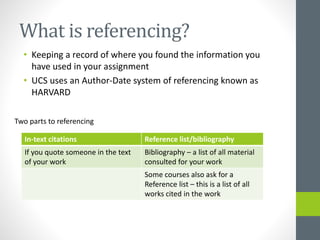
What is referencing? 
• Keeping a record of where you found the information you 
have used in your assignment 
• UCS uses an Author-Date system of referencing known as 
HARVARD 
In-text citations Reference list/bibliography 
If you quote someone in the text 
of your work 
Bibliography – a list of all material 
consulted for your work 
Some courses also ask for a 
Reference list – this is a list of all 
works cited in the work 
Two parts to referencing
Why do I need to reference? 
• Keep track of your ideas – where you found information, the 
person marking you work will want to see where you have got 
your resources from 
• Proper referencing validates your own work by showing where 
your evidence has come from 
• Gives credit to the work of others - spreads knowledge – 
others can find out more 
What is plagarism? 
• Presenting someone else’s work as your own 
• Using another person’s work without properly crediting them 
• Quoting someone else without citing the original in your source 
• Making small changes to someone else’s work and pretending it is your 
own
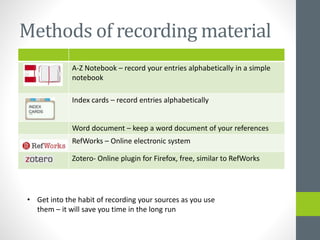
Methods of recording material 
A-Z Notebook – record your entries alphabetically in a simple 
notebook 
Index cards – record entries alphabetically 
Word document – keep a word document of your references 
RefWorks – Online electronic system 
Zotero- Online plugin for Firefox, free, similar to RefWorks 
• Get into the habit of recording your sources as you use 
them – it will save you time in the long run
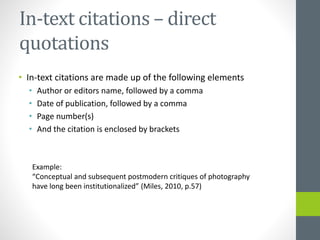
In-text citations – direct 
quotations 
• In-text citations are made up of the following elements 
• Author or editors name, followed by a comma 
• Date of publication, followed by a comma 
• Page number(s) 
• And the citation is enclosed by brackets 
Example: 
“Conceptual and subsequent postmodern critiques of photography 
have long been institutionalized” (Miles, 2010, p.57)
Summarising or paraphrasing 
someone else 
• You need to acknowledge the source of the original source 
• Include the authors name in your text, 
• Bracket the year of publication 
• Include the page number that you are referring to 
Example 
• In a recent article Miles (2010, P. 57) describes documentary 
photography as....
Main reference list -what do I 
need to record 
• Each reference is made up of a number of elements 
• The elements will vary depending on the type of material you 
are referencing – for example, print or electronic. 
• The elements are recorded in a specific order 
Common elements include 
Author 
Year of publication 
Title of the book 
Place of Publication 
Publisher
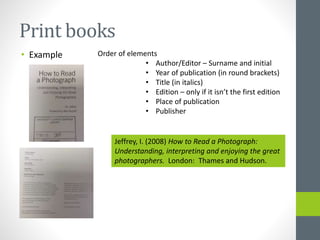
Print books 
• Example Order of elements 
• Author/Editor – Surname and initial 
• Year of publication (in round brackets) 
• Title (in italics) 
• Edition – only if it isn’t the first edition 
• Place of publication 
• Publisher 
Jeffrey, I. (2008) How to Read a Photograph: 
Understanding, interpreting and enjoying the great 
photographers. London: Thames and Hudson.
Reference Example – book 
• Davies, C. (2011) Thinking about 
Architecture: An Introduction to 
Architectural Theory. London: 
Laurence King.
Print books -more than two 
authors 
• All the authors must be mentioned 
• Use And between authors 
• Full-stop after the initial(s) 
Example 
George, J. M. and Jones, G. R. (2002) Organizational behaviour. 3rd ed. 
Harlow: Pearson Education. 
Edited Books 
If the book has an editor instead of an author then (ed.) or (eds.) would 
be placed after the editor(s) name 
e.g. Smith, T. (ed.) 
If more than one editor, Bryant, S. and May, J. (eds.)
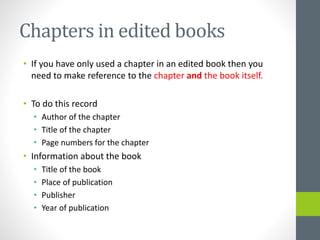
Chapters in edited books 
• If you have only used a chapter in an edited book then you 
need to make reference to the chapter and the book itself. 
• To do this record 
• Author of the chapter 
• Title of the chapter 
• Page numbers for the chapter 
• Information about the book 
• Title of the book 
• Place of publication 
• Publisher 
• Year of publication
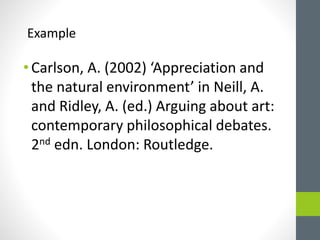
Example 
• Carlson, A. (2002) ‘Appreciation and 
the natural environment’ in Neill, A. 
and Ridley, A. (ed.) Arguing about art: 
contemporary philosophical debates. 
2nd edn. London: Routledge.
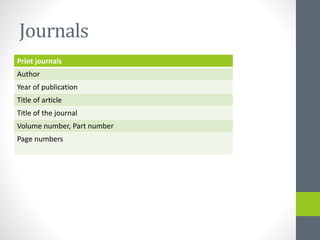
Journals 
Print journals 
Author 
Year of publication 
Title of article 
Title of the journal 
Volume number, Part number 
Page numbers
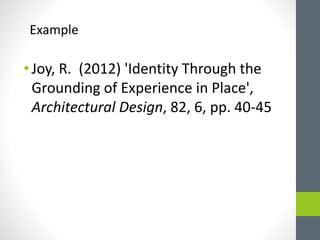
Example 
• Joy, R. (2012) 'Identity Through the 
Grounding of Experience in Place', 
Architectural Design, 82, 6, pp. 40-45
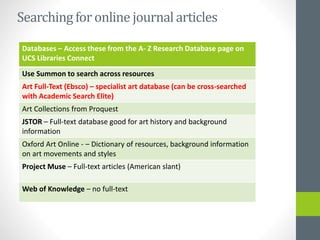
Searching for online journal articles 
Databases – Access these from the A- Z Research Database page on 
UCS Libraries Connect 
Use Summon to search across resources 
Art Full-Text (Ebsco) – specialist art database (can be cross-searched 
with Academic Search Elite) 
Art Collections from Proquest 
JSTOR – Full-text database good for art history and background 
information 
Oxford Art Online - – Dictionary of resources, background information 
on art movements and styles 
Project Muse – Full-text articles (American slant) 
Web of Knowledge – no full-text
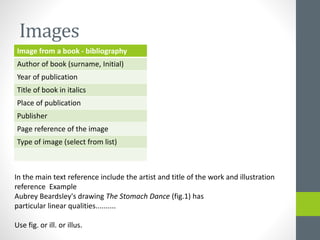
Images 
Image from a book - bibliography 
Author of book (surname, Initial) 
Year of publication 
Title of book in italics 
Place of publication 
Publisher 
Page reference of the image 
Type of image (select from list) 
In the main text reference include the artist and title of the work and illustration 
reference Example 
Aubrey Beardsley's drawing The Stomach Dance (fig.1) has 
particular linear qualities.......... 
Use fig. or ill. or illus.
Images 
Artist/photographer 
Year of production (if available) 
Title of image in italics 
Medium in square brackets 
Institution or collection that houses the work, followed by the city 
Or if seen online 
Available at – URL 
(Accessed: date) 
Example: Parker, C. (1991) Cold Dark Matter: An Exploded View [Wood, metal, 
plastic, ceramic, paper, textile and wire] Available at: 
http://www.tate.org.uk/art/artworks/parker-cold-dark-matter-an-exploded-view- 
t06949 (Accessed 18th March 2013)
DVD 
Commercial DVDs 
The title of the film (in italics) 
Year of distribution (in round brackets) 
Directed by 
[DVD] 
Place of distribution, distribution company 
Example: The Titfield Thunderbolt (1952) Directed by Charles Chrichton 
[DVD] Ealing: Ealing Studios.
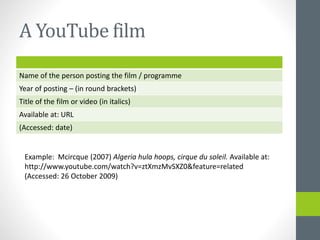
A YouTube film 
Name of the person posting the film / programme 
Year of posting – (in round brackets) 
Title of the film or video (in italics) 
Available at: URL 
(Accessed: date) 
Example: Mcircque (2007) Algeria hula hoops, cirque du soleil. Available at: 
http://www.youtube.com/watch?v=ztXmzMvSXZ0&feature=related 
(Accessed: 26 October 2009)
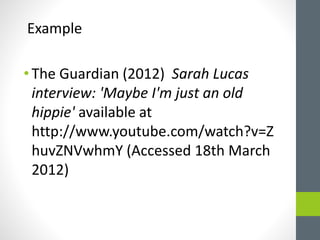
Example 
• The Guardian (2012) Sarah Lucas 
interview: 'Maybe I'm just an old 
hippie' available at 
http://www.youtube.com/watch?v=Z 
huvZNVwhmY (Accessed 18th March 
2012)

Dance referencing slides

  • 1.
  • 2.
    Aims of thesession • Referencing – how to do it, hands on practice • Review of where to find online journal articles
  • 3.
    What is referencing? • Keeping a record of where you found the information you have used in your assignment • UCS uses an Author-Date system of referencing known as HARVARD In-text citations Reference list/bibliography If you quote someone in the text of your work Bibliography – a list of all material consulted for your work Some courses also ask for a Reference list – this is a list of all works cited in the work Two parts to referencing
  • 4.
    Why do Ineed to reference? • Keep track of your ideas – where you found information, the person marking you work will want to see where you have got your resources from • Proper referencing validates your own work by showing where your evidence has come from • Gives credit to the work of others - spreads knowledge – others can find out more What is plagarism? • Presenting someone else’s work as your own • Using another person’s work without properly crediting them • Quoting someone else without citing the original in your source • Making small changes to someone else’s work and pretending it is your own
  • 5.
    Methods of recordingmaterial A-Z Notebook – record your entries alphabetically in a simple notebook Index cards – record entries alphabetically Word document – keep a word document of your references RefWorks – Online electronic system Zotero- Online plugin for Firefox, free, similar to RefWorks • Get into the habit of recording your sources as you use them – it will save you time in the long run
  • 6.
    In-text citations –direct quotations • In-text citations are made up of the following elements • Author or editors name, followed by a comma • Date of publication, followed by a comma • Page number(s) • And the citation is enclosed by brackets Example: “Conceptual and subsequent postmodern critiques of photography have long been institutionalized” (Miles, 2010, p.57)
  • 7.
    Summarising or paraphrasing someone else • You need to acknowledge the source of the original source • Include the authors name in your text, • Bracket the year of publication • Include the page number that you are referring to Example • In a recent article Miles (2010, P. 57) describes documentary photography as....
  • 8.
    Main reference list-what do I need to record • Each reference is made up of a number of elements • The elements will vary depending on the type of material you are referencing – for example, print or electronic. • The elements are recorded in a specific order Common elements include Author Year of publication Title of the book Place of Publication Publisher
  • 9.
    Print books •Example Order of elements • Author/Editor – Surname and initial • Year of publication (in round brackets) • Title (in italics) • Edition – only if it isn’t the first edition • Place of publication • Publisher Jeffrey, I. (2008) How to Read a Photograph: Understanding, interpreting and enjoying the great photographers. London: Thames and Hudson.
  • 10.
    Reference Example –book • Davies, C. (2011) Thinking about Architecture: An Introduction to Architectural Theory. London: Laurence King.
  • 11.
    Print books -morethan two authors • All the authors must be mentioned • Use And between authors • Full-stop after the initial(s) Example George, J. M. and Jones, G. R. (2002) Organizational behaviour. 3rd ed. Harlow: Pearson Education. Edited Books If the book has an editor instead of an author then (ed.) or (eds.) would be placed after the editor(s) name e.g. Smith, T. (ed.) If more than one editor, Bryant, S. and May, J. (eds.)
  • 12.
    Chapters in editedbooks • If you have only used a chapter in an edited book then you need to make reference to the chapter and the book itself. • To do this record • Author of the chapter • Title of the chapter • Page numbers for the chapter • Information about the book • Title of the book • Place of publication • Publisher • Year of publication
  • 13.
    Example • Carlson,A. (2002) ‘Appreciation and the natural environment’ in Neill, A. and Ridley, A. (ed.) Arguing about art: contemporary philosophical debates. 2nd edn. London: Routledge.
  • 14.
    Journals Print journals Author Year of publication Title of article Title of the journal Volume number, Part number Page numbers
  • 15.
    Example • Joy,R. (2012) 'Identity Through the Grounding of Experience in Place', Architectural Design, 82, 6, pp. 40-45
  • 16.
    Searching for onlinejournal articles Databases – Access these from the A- Z Research Database page on UCS Libraries Connect Use Summon to search across resources Art Full-Text (Ebsco) – specialist art database (can be cross-searched with Academic Search Elite) Art Collections from Proquest JSTOR – Full-text database good for art history and background information Oxford Art Online - – Dictionary of resources, background information on art movements and styles Project Muse – Full-text articles (American slant) Web of Knowledge – no full-text
  • 17.
    Images Image froma book - bibliography Author of book (surname, Initial) Year of publication Title of book in italics Place of publication Publisher Page reference of the image Type of image (select from list) In the main text reference include the artist and title of the work and illustration reference Example Aubrey Beardsley's drawing The Stomach Dance (fig.1) has particular linear qualities.......... Use fig. or ill. or illus.
  • 18.
    Images Artist/photographer Yearof production (if available) Title of image in italics Medium in square brackets Institution or collection that houses the work, followed by the city Or if seen online Available at – URL (Accessed: date) Example: Parker, C. (1991) Cold Dark Matter: An Exploded View [Wood, metal, plastic, ceramic, paper, textile and wire] Available at: http://www.tate.org.uk/art/artworks/parker-cold-dark-matter-an-exploded-view- t06949 (Accessed 18th March 2013)
  • 19.
    DVD Commercial DVDs The title of the film (in italics) Year of distribution (in round brackets) Directed by [DVD] Place of distribution, distribution company Example: The Titfield Thunderbolt (1952) Directed by Charles Chrichton [DVD] Ealing: Ealing Studios.
  • 20.
    A YouTube film Name of the person posting the film / programme Year of posting – (in round brackets) Title of the film or video (in italics) Available at: URL (Accessed: date) Example: Mcircque (2007) Algeria hula hoops, cirque du soleil. Available at: http://www.youtube.com/watch?v=ztXmzMvSXZ0&feature=related (Accessed: 26 October 2009)
  • 21.
    Example • TheGuardian (2012) Sarah Lucas interview: 'Maybe I'm just an old hippie' available at http://www.youtube.com/watch?v=Z huvZNVwhmY (Accessed 18th March 2012)