

Citing References
 in Your Research
 (APA Style)


Prof. Dr. Khalid Mahmood
Department of Library & Information Science
University of the Punjab
Lahore, PAKISTAN


                                              1
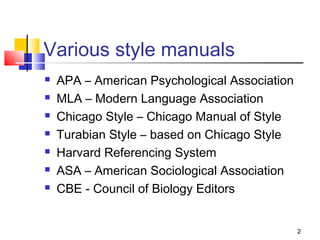
Various style manuals
   APA – American Psychological Association
   MLA – Modern Language Association
   Chicago Style – Chicago Manual of Style
   Turabian Style – based on Chicago Style
   Harvard Referencing System
   ASA – American Sociological Association
   CBE - Council of Biology Editors


                                               2
APA style
   American Psychological
    Association
   In 1929, published
    instructions for authors
    on how to prepare
    manuscripts for APA
    journals
   Later used for theses,
    term papers, etc.
   Latest edition 6th in 2009
   Widely used in social
    sciences

                                 3
Citing references – Outline
   Identifying and formatting citing
    elements
   Citing in text
   Preparing reference list / bibliography


                                              4
Citing Elements


                  5
Citing elements
   Author or authoring body
   Date of publication
   Title of the work
   Edition
   Publisher
   Place of publication
   Title of the source
   Location information within the source
   URL or DOI
   Nonroutine information

                                             6
Author
   Surname and initials
     Kernis, M. H.
   Hyphenated first name
     Sun, C.-R.
   Editor’s name
     Robinson, D. N. (Ed.)
   No author
     Entry under title
   Delete Prof., Dr., Maj., Retd., etc.

                                           7
Authoring body or group
   Full name
     National Institute of Health
   Subordinate body
     University of the Punjab, Institute of
    Business Administration
   Government agencies
     Pakistan, Ministry of Finance

                                              8
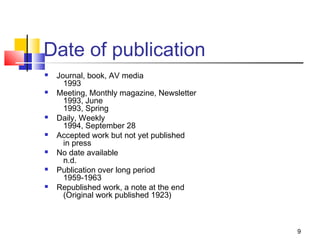
Date of publication
   Journal, book, AV media
      1993
   Meeting, Monthly magazine, Newsletter
      1993, June
      1993, Spring
   Daily, Weekly
      1994, September 28
   Accepted work but not yet published
      in press
   No date available
      n.d.
   Publication over long period
      1959-1963
   Republished work, a note at the end
      (Original work published 1923)


                                            9
Title of the work
   Title of book
   Title of book chapter
   Title of journal article
   Title of encyclopedia article
   Subtitle with colon


                                    10
Edition
   Edition you used
   Edition in Arabic numeral
     2nd ed.
     Rev. ed.
     4th rev. ed.


                                11
Publisher
   Publisher name for non periodicals
   In a brief form
   Omit superfluous terms, such as Publishers,
    Publications, Co., Inc.
      Sage
      Wiley
      McGraw-Hill
      Prentice Hall
      Ferozsons
   Use only word “Author” when author and
    publisher is the same
                                             12
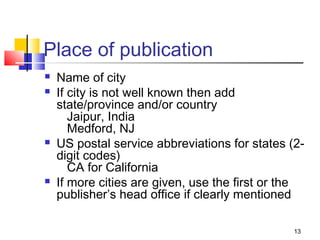
Place of publication
   Name of city
   If city is not well known then add
    state/province and/or country
       Jaipur, India
       Medford, NJ
   US postal service abbreviations for states (2-
    digit codes)
       CA for California
   If more cities are given, use the first or the
    publisher’s head office if clearly mentioned

                                                13
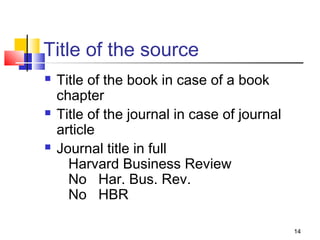
Title of the source
   Title of the book in case of a book
    chapter
   Title of the journal in case of journal
    article
   Journal title in full
      Harvard Business Review
      No Har. Bus. Rev.
      No HBR

                                              14
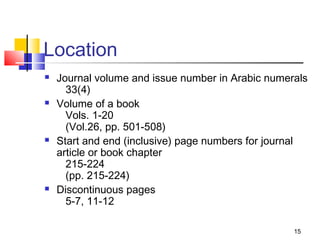
Location
   Journal volume and issue number in Arabic numerals
      33(4)
   Volume of a book
      Vols. 1-20
      (Vol.26, pp. 501-508)
   Start and end (inclusive) page numbers for journal
    article or book chapter
      215-224
      (pp. 215-224)
   Discontinuous pages
      5-7, 11-12

                                                   15
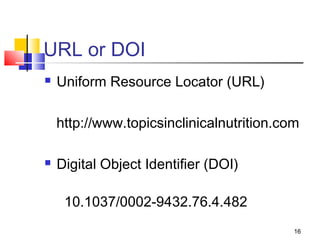
URL or DOI
   Uniform Resource Locator (URL)

    http://www.topicsinclinicalnutrition.com

   Digital Object Identifier (DOI)

     10.1037/0002-9432.76.4.482
                                           16
Nonroutine information
   Give nonroutine but important
    information in square brackets

    [Letter to the editor]
    [Special issue]
    [Brochure]
    [Abstract]


                                     17
Citing in text


                 18
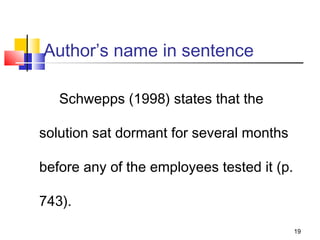
Author’s name in sentence

   Schwepps (1998) states that the

solution sat dormant for several months

before any of the employees tested it (p.

743).
                                            19
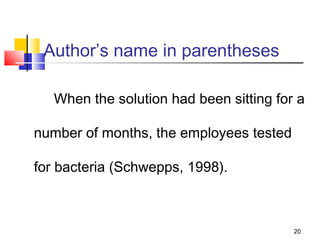
Author’s name in parentheses

   When the solution had been sitting for a

number of months, the employees tested

for bacteria (Schwepps, 1998).


                                         20
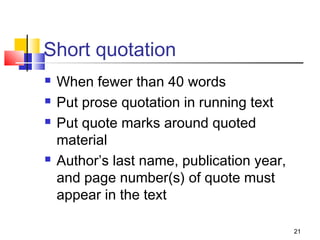
Short quotation
   When fewer than 40 words
   Put prose quotation in running text
   Put quote marks around quoted
    material
   Author’s last name, publication year,
    and page number(s) of quote must
    appear in the text

                                            21
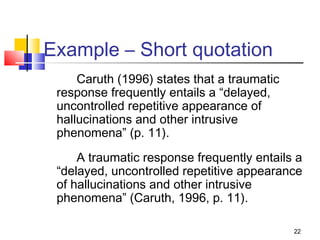
Example – Short quotation
     Caruth (1996) states that a traumatic
 response frequently entails a “delayed,
 uncontrolled repetitive appearance of
 hallucinations and other intrusive
 phenomena” (p. 11).
     A traumatic response frequently entails a
 “delayed, uncontrolled repetitive appearance
 of hallucinations and other intrusive
 phenomena” (Caruth, 1996, p. 11).

                                             22
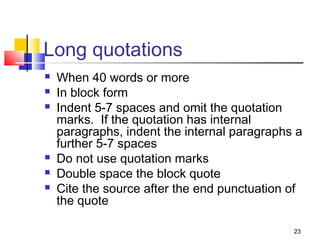
Long quotations
   When 40 words or more
   In block form
   Indent 5-7 spaces and omit the quotation
    marks. If the quotation has internal
    paragraphs, indent the internal paragraphs a
    further 5-7 spaces
   Do not use quotation marks
   Double space the block quote
   Cite the source after the end punctuation of
    the quote

                                              23
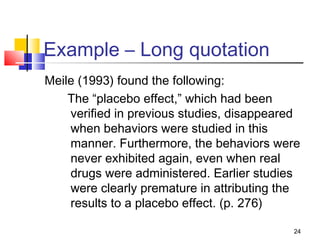
Example – Long quotation
Meile (1993) found the following:
    The “placebo effect,” which had been
    verified in previous studies, disappeared
    when behaviors were studied in this
    manner. Furthermore, the behaviors were
    never exhibited again, even when real
    drugs were administered. Earlier studies
    were clearly premature in attributing the
    results to a placebo effect. (p. 276)

                                           24
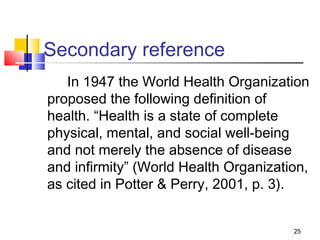
Secondary reference
   In 1947 the World Health Organization
proposed the following definition of
health. “Health is a state of complete
physical, mental, and social well-being
and not merely the absence of disease
and infirmity” (World Health Organization,
as cited in Potter & Perry, 2001, p. 3).


                                       25
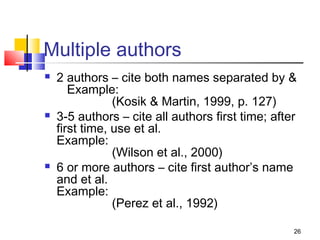
Multiple authors
   2 authors – cite both names separated by &
       Example:
                (Kosik & Martin, 1999, p. 127)
   3-5 authors – cite all authors first time; after
    first time, use et al.
    Example:
                (Wilson et al., 2000)
   6 or more authors – cite first author’s name
    and et al.
    Example:
                (Perez et al., 1992)

                                                   26
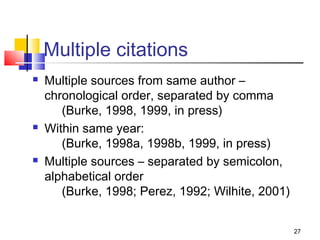
Multiple citations
   Multiple sources from same author –
    chronological order, separated by comma
       (Burke, 1998, 1999, in press)
   Within same year:
       (Burke, 1998a, 1998b, 1999, in press)
   Multiple sources – separated by semicolon,
    alphabetical order
       (Burke, 1998; Perez, 1992; Wilhite, 2001)


                                                   27
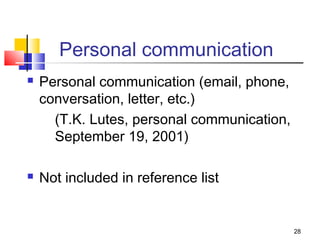
Personal communication
   Personal communication (email, phone,
    conversation, letter, etc.)
      (T.K. Lutes, personal communication,
      September 19, 2001)

   Not included in reference list


                                             28
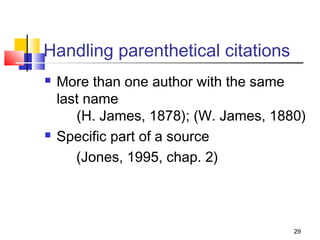
Handling parenthetical citations
   More than one author with the same
    last name
       (H. James, 1878); (W. James, 1880)
   Specific part of a source
       (Jones, 1995, chap. 2)


                                       29
Handling parenthetical citations
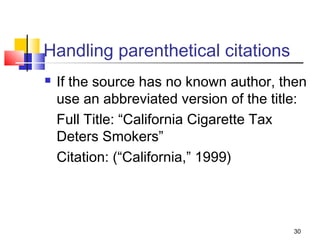
   If the source has no known author, then
    use an abbreviated version of the title:
    Full Title: “California Cigarette Tax
    Deters Smokers”
    Citation: (“California,” 1999)


                                         30
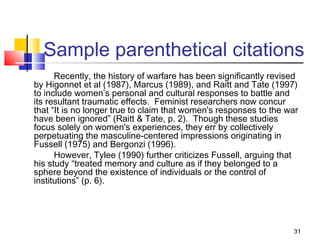
Sample parenthetical citations
      Recently, the history of warfare has been significantly revised
by Higonnet et al (1987), Marcus (1989), and Raitt and Tate (1997)
to include women’s personal and cultural responses to battle and
its resultant traumatic effects. Feminist researchers now concur
that “It is no longer true to claim that women's responses to the war
have been ignored” (Raitt & Tate, p. 2). Though these studies
focus solely on women's experiences, they err by collectively
perpetuating the masculine-centered impressions originating in
Fussell (1975) and Bergonzi (1996).
      However, Tylee (1990) further criticizes Fussell, arguing that
his study “treated memory and culture as if they belonged to a
sphere beyond the existence of individuals or the control of
institutions” (p. 6).


                                                                   31
Reference List / Bibliography


                                32
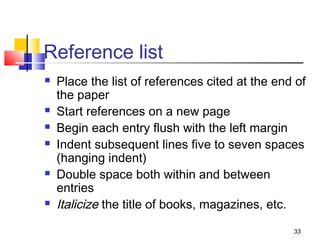
Reference list
   Place the list of references cited at the end of
    the paper
   Start references on a new page
   Begin each entry flush with the left margin
   Indent subsequent lines five to seven spaces
    (hanging indent)
   Double space both within and between
    entries
   Italicize the title of books, magazines, etc.
                                                 33
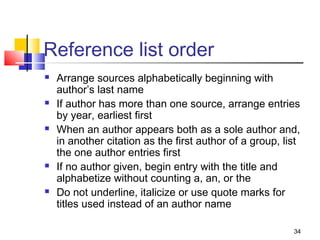
Reference list order
   Arrange sources alphabetically beginning with
    author’s last name
   If author has more than one source, arrange entries
    by year, earliest first
   When an author appears both as a sole author and,
    in another citation as the first author of a group, list
    the one author entries first
   If no author given, begin entry with the title and
    alphabetize without counting a, an, or the
   Do not underline, italicize or use quote marks for
    titles used instead of an author name

                                                          34
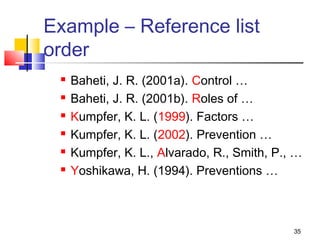
Example – Reference list
order
    Baheti, J. R. (2001a). Control …
    Baheti, J. R. (2001b). Roles of …
    Kumpfer, K. L. (1999). Factors …
    Kumpfer, K. L. (2002). Prevention …
    Kumpfer, K. L., Alvarado, R., Smith, P., …
    Yoshikawa, H. (1994). Preventions …


                                             35
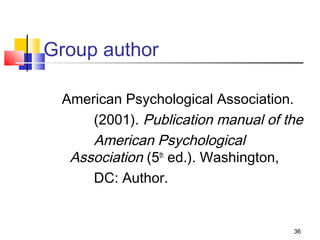
Group author

 American Psychological Association.
     (2001). Publication manual of the
     American Psychological
  Association (5th ed.). Washington,
     DC: Author.


                                    36
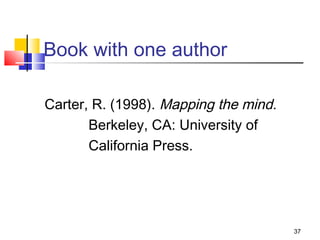
Book with one author

Carter, R. (1998). Mapping the mind.
       Berkeley, CA: University of
       California Press.


                                       37
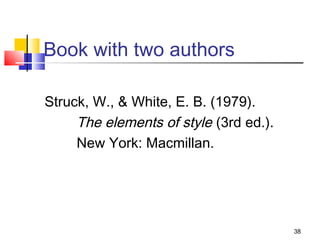
Book with two authors

Struck, W., & White, E. B. (1979).
     The elements of style (3rd ed.).
     New York: Macmillan.


                                        38
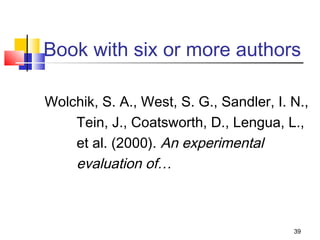
Book with six or more authors

Wolchik, S. A., West, S. G., Sandler, I. N.,
    Tein, J., Coatsworth, D., Lengua, L.,
    et al. (2000). An experimental
    evaluation of…


                                         39
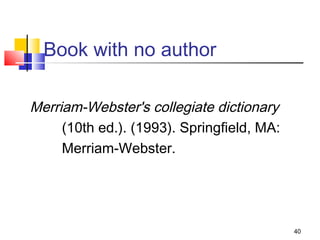
Book with no author

Merriam-Webster's collegiate dictionary
     (10th ed.). (1993). Springfield, MA:
     Merriam-Webster.


                                            40
Book with editors

Allison, M. T., & Schneider, I. E. (Eds.).
      (2000). Diversity and the recreation
      profession: Organizational
      perspectives. State College, PA:
      Venture.

                                             41
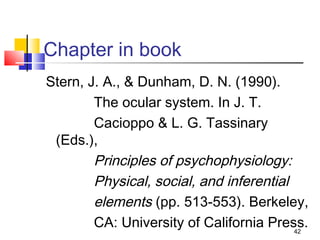
Chapter in book
Stern, J. A., & Dunham, D. N. (1990).
        The ocular system. In J. T.
        Cacioppo & L. G. Tassinary
 (Eds.),
        Principles of psychophysiology:
        Physical, social, and inferential
        elements (pp. 513-553). Berkeley,
        CA: University of California Press.
                                          42
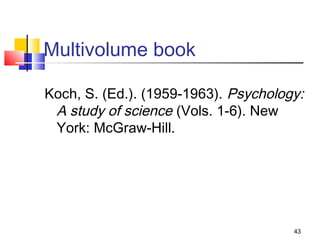
Multivolume book

Koch, S. (Ed.). (1959-1963). Psychology:
 A study of science (Vols. 1-6). New
 York: McGraw-Hill.


                                      43
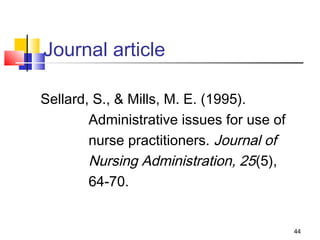
Journal article

Sellard, S., & Mills, M. E. (1995).
        Administrative issues for use of
        nurse practitioners. Journal of
        Nursing Administration, 25(5),
        64-70.


                                           44
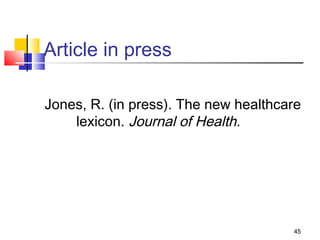
Article in press

Jones, R. (in press). The new healthcare
    lexicon. Journal of Health.


                                      45
Abstract
Misumi, J., & Fumita, M. (1982). Effects
    of PM organizational development in
    supermarket organization.
 Japanese
    Journal of Experimental Social
    Psychology, 21, 93-111. [Abstract]
    Psychological Abstracts, 1982, 68,
    Abstract No. 11474                   46
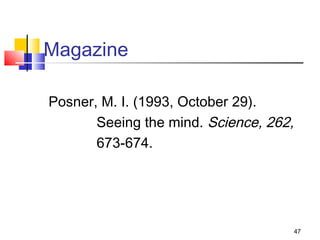
Magazine

Posner, M. I. (1993, October 29).
       Seeing the mind. Science, 262,
       673-674.


                                        47
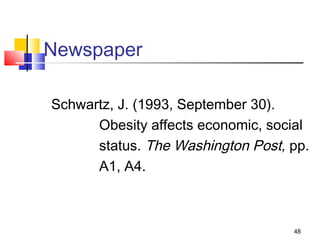
Newspaper

Schwartz, J. (1993, September 30).
      Obesity affects economic, social
      status. The Washington Post, pp.
      A1, A4.


                                   48
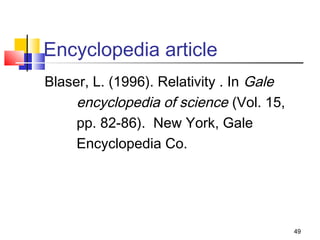
Encyclopedia article
Blaser, L. (1996). Relativity . In Gale
     encyclopedia of science (Vol. 15,
     pp. 82-86). New York, Gale
     Encyclopedia Co.


                                          49
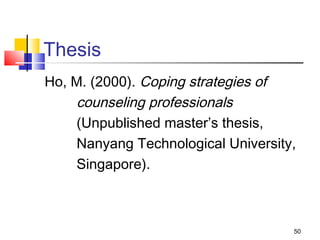
Thesis
Ho, M. (2000). Coping strategies of
    counseling professionals
    (Unpublished master’s thesis,
    Nanyang Technological University,
    Singapore).


                                    50
Videotape

National Institute on Mental Health. (1980).
     Drug abuse [videotape]. Bethesda:
     Author.


                                           51
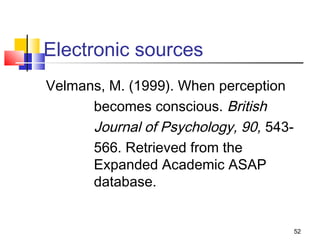
Electronic sources
Velmans, M. (1999). When perception
      becomes conscious. British
      Journal of Psychology, 90, 543-
      566. Retrieved from the
      Expanded Academic ASAP
      database.


                                        52
Web page

Green, C. (2000, April 16). History &
 philosophy of psychology web
 resources. Retrieved from
 http://www.yorku.ca/dept.htm


                                        53
Article with DOI
Stultz, J. (2006). Integrating exposure
  therapy and analytic therapy in trauma
  treatment. American Journal of
  Orthopsychiatry, 76(4), 482–488.
  doi:10.1037/0002-9432.76.4.482


                                       54
Preprint version of article

Philippsen, C., Hahn, M., Schwabe, L., Richter,
  S., Drewe, J., & Schachinger, H. (2007).
  Cardiovascular reactivity to mental stress is
  not affected by alpha2-adrenoreceptor
  activation or inhibition. Psychopharmacology,
  190(2), 181–188. Advance online publication.
  doi:10.1007/s00213-006-0597-7


                                            55
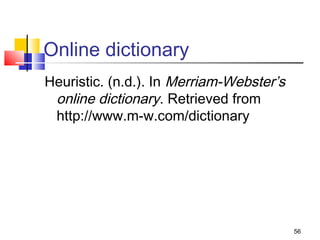
Online dictionary
Heuristic. (n.d.). In Merriam-Webster’s
 online dictionary. Retrieved from
 http://www.m-w.com/dictionary


                                          56
Presentation slides
Columbia University, Teachers College,
 Institute for Learning Technologies.
 (2000). Smart cities: New York:
 Electronic education for the new
 millennium [PowerPoint slides].
 Retrieved from
 http://www.ilt.columbia.edu/
 publications/index.html
                                     57
Press release
American Psychological Association.
 (2006, April 30). Internet use involves
 both pros and cons for children and
 adolescents [Press release]. Retrieved
 from http://www.apa.org/releases/
 youthwww0406.html


                                      58
Message posted to an electronic
mailing list
Smith, S. (2006, January 5). Re: Disputed
 estimates of IQ [Msg 670]. Message
 posted to ForensicNetwork electronic
 mailing list, archived at
 http://tech.groups.yahoo.com/group/For
 ensicNetwork/message/670


                                      59
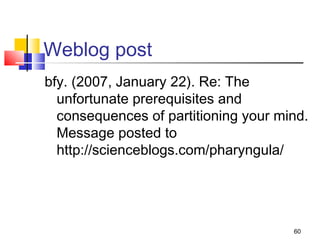
Weblog post
bfy. (2007, January 22). Re: The
  unfortunate prerequisites and
  consequences of partitioning your mind.
  Message posted to
  http://scienceblogs.com/pharyngula/


                                      60
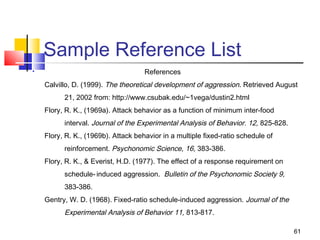
Sample Reference List

                                     References
    Calvillo, D. (1999). The theoretical development of aggression. Retrieved August
          21, 2002 from: http://www.csubak.edu/~1vega/dustin2.html
    Flory, R. K., (1969a). Attack behavior as a function of minimum inter-food
          interval. Journal of the Experimental Analysis of Behavior. 12, 825-828.
    Flory, R. K., (1969b). Attack behavior in a multiple fixed-ratio schedule of
          reinforcement. Psychonomic Science, 16, 383-386.
    Flory, R. K., & Everist, H.D. (1977). The effect of a response requirement on
          schedule- induced aggression. Bulletin of the Psychonomic Society 9,
          383-386.
    Gentry, W. D. (1968). Fixed-ratio schedule-induced aggression. Journal of the
          Experimental Analysis of Behavior 11, 813-817.

                                                                                     61
For More Information

     APA Manual Website:
      www.apastyle.org


                           62

7 citing sources-khalid

  • 1.
    Citing References inYour Research (APA Style) Prof. Dr. Khalid Mahmood Department of Library & Information Science University of the Punjab Lahore, PAKISTAN 1
  • 2.
    Various style manuals  APA – American Psychological Association  MLA – Modern Language Association  Chicago Style – Chicago Manual of Style  Turabian Style – based on Chicago Style  Harvard Referencing System  ASA – American Sociological Association  CBE - Council of Biology Editors 2
  • 3.
    APA style  American Psychological Association  In 1929, published instructions for authors on how to prepare manuscripts for APA journals  Later used for theses, term papers, etc.  Latest edition 6th in 2009  Widely used in social sciences 3
  • 4.
    Citing references –Outline  Identifying and formatting citing elements  Citing in text  Preparing reference list / bibliography 4
  • 5.
  • 6.
    Citing elements  Author or authoring body  Date of publication  Title of the work  Edition  Publisher  Place of publication  Title of the source  Location information within the source  URL or DOI  Nonroutine information 6
  • 7.
    Author  Surname and initials Kernis, M. H.  Hyphenated first name Sun, C.-R.  Editor’s name Robinson, D. N. (Ed.)  No author Entry under title  Delete Prof., Dr., Maj., Retd., etc. 7
  • 8.
    Authoring body orgroup  Full name National Institute of Health  Subordinate body University of the Punjab, Institute of Business Administration  Government agencies Pakistan, Ministry of Finance 8
  • 9.
    Date of publication  Journal, book, AV media 1993  Meeting, Monthly magazine, Newsletter 1993, June 1993, Spring  Daily, Weekly 1994, September 28  Accepted work but not yet published in press  No date available n.d.  Publication over long period 1959-1963  Republished work, a note at the end (Original work published 1923) 9
  • 10.
    Title of thework  Title of book  Title of book chapter  Title of journal article  Title of encyclopedia article  Subtitle with colon 10
  • 11.
    Edition  Edition you used  Edition in Arabic numeral 2nd ed. Rev. ed. 4th rev. ed. 11
  • 12.
    Publisher  Publisher name for non periodicals  In a brief form  Omit superfluous terms, such as Publishers, Publications, Co., Inc. Sage Wiley McGraw-Hill Prentice Hall Ferozsons  Use only word “Author” when author and publisher is the same 12
  • 13.
    Place of publication  Name of city  If city is not well known then add state/province and/or country Jaipur, India Medford, NJ  US postal service abbreviations for states (2- digit codes) CA for California  If more cities are given, use the first or the publisher’s head office if clearly mentioned 13
  • 14.
    Title of thesource  Title of the book in case of a book chapter  Title of the journal in case of journal article  Journal title in full Harvard Business Review No Har. Bus. Rev. No HBR 14
  • 15.
    Location  Journal volume and issue number in Arabic numerals 33(4)  Volume of a book Vols. 1-20 (Vol.26, pp. 501-508)  Start and end (inclusive) page numbers for journal article or book chapter 215-224 (pp. 215-224)  Discontinuous pages 5-7, 11-12 15
  • 16.
    URL or DOI  Uniform Resource Locator (URL) http://www.topicsinclinicalnutrition.com  Digital Object Identifier (DOI) 10.1037/0002-9432.76.4.482 16
  • 17.
    Nonroutine information  Give nonroutine but important information in square brackets [Letter to the editor] [Special issue] [Brochure] [Abstract] 17
  • 18.
  • 19.
    Author’s name insentence Schwepps (1998) states that the solution sat dormant for several months before any of the employees tested it (p. 743). 19
  • 20.
    Author’s name inparentheses When the solution had been sitting for a number of months, the employees tested for bacteria (Schwepps, 1998). 20
  • 21.
    Short quotation  When fewer than 40 words  Put prose quotation in running text  Put quote marks around quoted material  Author’s last name, publication year, and page number(s) of quote must appear in the text 21
  • 22.
    Example – Shortquotation Caruth (1996) states that a traumatic response frequently entails a “delayed, uncontrolled repetitive appearance of hallucinations and other intrusive phenomena” (p. 11). A traumatic response frequently entails a “delayed, uncontrolled repetitive appearance of hallucinations and other intrusive phenomena” (Caruth, 1996, p. 11). 22
  • 23.
    Long quotations  When 40 words or more  In block form  Indent 5-7 spaces and omit the quotation marks. If the quotation has internal paragraphs, indent the internal paragraphs a further 5-7 spaces  Do not use quotation marks  Double space the block quote  Cite the source after the end punctuation of the quote 23
  • 24.
    Example – Longquotation Meile (1993) found the following: The “placebo effect,” which had been verified in previous studies, disappeared when behaviors were studied in this manner. Furthermore, the behaviors were never exhibited again, even when real drugs were administered. Earlier studies were clearly premature in attributing the results to a placebo effect. (p. 276) 24
  • 25.
    Secondary reference In 1947 the World Health Organization proposed the following definition of health. “Health is a state of complete physical, mental, and social well-being and not merely the absence of disease and infirmity” (World Health Organization, as cited in Potter & Perry, 2001, p. 3). 25
  • 26.
    Multiple authors  2 authors – cite both names separated by & Example: (Kosik & Martin, 1999, p. 127)  3-5 authors – cite all authors first time; after first time, use et al. Example: (Wilson et al., 2000)  6 or more authors – cite first author’s name and et al. Example: (Perez et al., 1992) 26
  • 27.
    Multiple citations  Multiple sources from same author – chronological order, separated by comma (Burke, 1998, 1999, in press)  Within same year: (Burke, 1998a, 1998b, 1999, in press)  Multiple sources – separated by semicolon, alphabetical order (Burke, 1998; Perez, 1992; Wilhite, 2001) 27
  • 28.
    Personal communication  Personal communication (email, phone, conversation, letter, etc.) (T.K. Lutes, personal communication, September 19, 2001)  Not included in reference list 28
  • 29.
    Handling parenthetical citations  More than one author with the same last name (H. James, 1878); (W. James, 1880)  Specific part of a source (Jones, 1995, chap. 2) 29
  • 30.
    Handling parenthetical citations  If the source has no known author, then use an abbreviated version of the title: Full Title: “California Cigarette Tax Deters Smokers” Citation: (“California,” 1999) 30
  • 31.
    Sample parenthetical citations Recently, the history of warfare has been significantly revised by Higonnet et al (1987), Marcus (1989), and Raitt and Tate (1997) to include women’s personal and cultural responses to battle and its resultant traumatic effects. Feminist researchers now concur that “It is no longer true to claim that women's responses to the war have been ignored” (Raitt & Tate, p. 2). Though these studies focus solely on women's experiences, they err by collectively perpetuating the masculine-centered impressions originating in Fussell (1975) and Bergonzi (1996). However, Tylee (1990) further criticizes Fussell, arguing that his study “treated memory and culture as if they belonged to a sphere beyond the existence of individuals or the control of institutions” (p. 6). 31
  • 32.
    Reference List /Bibliography 32
  • 33.
    Reference list  Place the list of references cited at the end of the paper  Start references on a new page  Begin each entry flush with the left margin  Indent subsequent lines five to seven spaces (hanging indent)  Double space both within and between entries  Italicize the title of books, magazines, etc. 33
  • 34.
    Reference list order  Arrange sources alphabetically beginning with author’s last name  If author has more than one source, arrange entries by year, earliest first  When an author appears both as a sole author and, in another citation as the first author of a group, list the one author entries first  If no author given, begin entry with the title and alphabetize without counting a, an, or the  Do not underline, italicize or use quote marks for titles used instead of an author name 34
  • 35.
    Example – Referencelist order  Baheti, J. R. (2001a). Control …  Baheti, J. R. (2001b). Roles of …  Kumpfer, K. L. (1999). Factors …  Kumpfer, K. L. (2002). Prevention …  Kumpfer, K. L., Alvarado, R., Smith, P., …  Yoshikawa, H. (1994). Preventions … 35
  • 36.
    Group author AmericanPsychological Association. (2001). Publication manual of the American Psychological Association (5th ed.). Washington, DC: Author. 36
  • 37.
    Book with oneauthor Carter, R. (1998). Mapping the mind. Berkeley, CA: University of California Press. 37
  • 38.
    Book with twoauthors Struck, W., & White, E. B. (1979). The elements of style (3rd ed.). New York: Macmillan. 38
  • 39.
    Book with sixor more authors Wolchik, S. A., West, S. G., Sandler, I. N., Tein, J., Coatsworth, D., Lengua, L., et al. (2000). An experimental evaluation of… 39
  • 40.
    Book with noauthor Merriam-Webster's collegiate dictionary (10th ed.). (1993). Springfield, MA: Merriam-Webster. 40
  • 41.
    Book with editors Allison,M. T., & Schneider, I. E. (Eds.). (2000). Diversity and the recreation profession: Organizational perspectives. State College, PA: Venture. 41
  • 42.
    Chapter in book Stern,J. A., & Dunham, D. N. (1990). The ocular system. In J. T. Cacioppo & L. G. Tassinary (Eds.), Principles of psychophysiology: Physical, social, and inferential elements (pp. 513-553). Berkeley, CA: University of California Press. 42
  • 43.
    Multivolume book Koch, S.(Ed.). (1959-1963). Psychology: A study of science (Vols. 1-6). New York: McGraw-Hill. 43
  • 44.
    Journal article Sellard, S.,& Mills, M. E. (1995). Administrative issues for use of nurse practitioners. Journal of Nursing Administration, 25(5), 64-70. 44
  • 45.
    Article in press Jones,R. (in press). The new healthcare lexicon. Journal of Health. 45
  • 46.
    Abstract Misumi, J., &Fumita, M. (1982). Effects of PM organizational development in supermarket organization. Japanese Journal of Experimental Social Psychology, 21, 93-111. [Abstract] Psychological Abstracts, 1982, 68, Abstract No. 11474 46
  • 47.
    Magazine Posner, M. I.(1993, October 29). Seeing the mind. Science, 262, 673-674. 47
  • 48.
    Newspaper Schwartz, J. (1993,September 30). Obesity affects economic, social status. The Washington Post, pp. A1, A4. 48
  • 49.
    Encyclopedia article Blaser, L.(1996). Relativity . In Gale encyclopedia of science (Vol. 15, pp. 82-86). New York, Gale Encyclopedia Co. 49
  • 50.
    Thesis Ho, M. (2000).Coping strategies of counseling professionals (Unpublished master’s thesis, Nanyang Technological University, Singapore). 50
  • 51.
    Videotape National Institute onMental Health. (1980). Drug abuse [videotape]. Bethesda: Author. 51
  • 52.
    Electronic sources Velmans, M.(1999). When perception becomes conscious. British Journal of Psychology, 90, 543- 566. Retrieved from the Expanded Academic ASAP database. 52
  • 53.
    Web page Green, C.(2000, April 16). History & philosophy of psychology web resources. Retrieved from http://www.yorku.ca/dept.htm 53
  • 54.
    Article with DOI Stultz,J. (2006). Integrating exposure therapy and analytic therapy in trauma treatment. American Journal of Orthopsychiatry, 76(4), 482–488. doi:10.1037/0002-9432.76.4.482 54
  • 55.
    Preprint version ofarticle Philippsen, C., Hahn, M., Schwabe, L., Richter, S., Drewe, J., & Schachinger, H. (2007). Cardiovascular reactivity to mental stress is not affected by alpha2-adrenoreceptor activation or inhibition. Psychopharmacology, 190(2), 181–188. Advance online publication. doi:10.1007/s00213-006-0597-7 55
  • 56.
    Online dictionary Heuristic. (n.d.).In Merriam-Webster’s online dictionary. Retrieved from http://www.m-w.com/dictionary 56
  • 57.
    Presentation slides Columbia University,Teachers College, Institute for Learning Technologies. (2000). Smart cities: New York: Electronic education for the new millennium [PowerPoint slides]. Retrieved from http://www.ilt.columbia.edu/ publications/index.html 57
  • 58.
    Press release American PsychologicalAssociation. (2006, April 30). Internet use involves both pros and cons for children and adolescents [Press release]. Retrieved from http://www.apa.org/releases/ youthwww0406.html 58
  • 59.
    Message posted toan electronic mailing list Smith, S. (2006, January 5). Re: Disputed estimates of IQ [Msg 670]. Message posted to ForensicNetwork electronic mailing list, archived at http://tech.groups.yahoo.com/group/For ensicNetwork/message/670 59
  • 60.
    Weblog post bfy. (2007,January 22). Re: The unfortunate prerequisites and consequences of partitioning your mind. Message posted to http://scienceblogs.com/pharyngula/ 60
  • 61.
    Sample Reference List  References Calvillo, D. (1999). The theoretical development of aggression. Retrieved August 21, 2002 from: http://www.csubak.edu/~1vega/dustin2.html Flory, R. K., (1969a). Attack behavior as a function of minimum inter-food interval. Journal of the Experimental Analysis of Behavior. 12, 825-828. Flory, R. K., (1969b). Attack behavior in a multiple fixed-ratio schedule of reinforcement. Psychonomic Science, 16, 383-386. Flory, R. K., & Everist, H.D. (1977). The effect of a response requirement on schedule- induced aggression. Bulletin of the Psychonomic Society 9, 383-386. Gentry, W. D. (1968). Fixed-ratio schedule-induced aggression. Journal of the Experimental Analysis of Behavior 11, 813-817. 61
  • 62.
    For More Information APA Manual Website: www.apastyle.org 62