Using the Library
Dance
November 2018
RachelWhite
Aims of the Session
• Talk about key research skills that will help you find
resources for your assignments
• Library resources refreshers
• Google Scholar
• Other ways to access resources
• Referencing refresher
Introduction to the Library
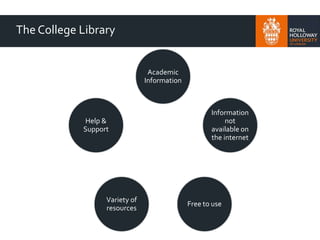
The College Library
Academic
Information
Information
not
available on
the internet
Free to use
Variety of
resources
Help &
Support
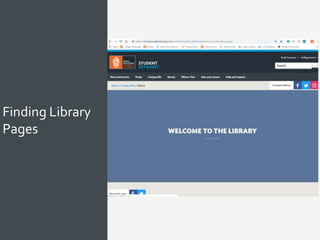
Finding Library
Pages
Research Skills
How to find good information
1. What exactly is the topic you are searching for?
2. What are the main concepts or keywords for your topic?
3. Are there are alternative terms for these concept?
Lego bicycle by Do-Hyun Kim CC BY-ND. Flickr.
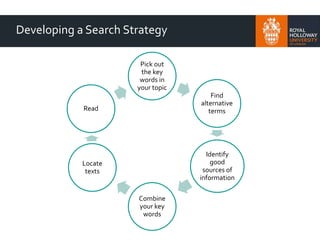
Developing a Search Strategy
Pick out
the key
words in
your topic
Find
alternative
terms
Identify
good
sources of
information
Combine
your key
words
Locate
texts
Read
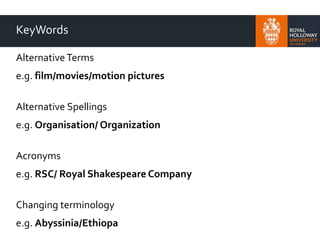
KeyWords
Alternative Terms
e.g. film/movies/motion pictures
Alternative Spellings
e.g. Organisation/ Organization
Acronyms
e.g. RSC/ Royal Shakespeare Company
Changing terminology
e.g. Abyssinia/Ethiopa
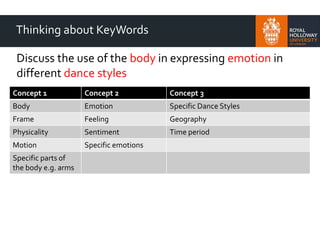
Thinking about KeyWords
Discuss the use of the body in expressing emotion in
different dance styles
Concept 1 Concept 2 Concept 3
Body Emotion Specific Dance Styles
Frame Feeling Geography
Physicality Sentiment Time period
Motion Specific emotions
Specific parts of
the body e.g. arms
SearchTips
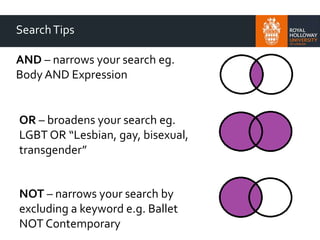
AND – narrows your search eg.
Body AND Expression
OR – broadens your search eg.
LGBT OR “Lesbian, gay, bisexual,
transgender”
NOT – narrows your search by
excluding a keyword e.g. Ballet
NOT Contemporary
SearchTips
• * truncation allows you to search for work endings eg.
femin* will search for femine, feminist, feminism
• ? Wildcards allow you search for letter alternatives
within a word eg.Wom?n
• “” phrase searches allow you to search for words in a
certain order eg. “Contemporary Dance”
Library Resources – A Refresher
Identify Resources
Books/ebooks JournalArticles Newspaper Articles
Reports Reference Material eResources
Library Refresher
Evaluating
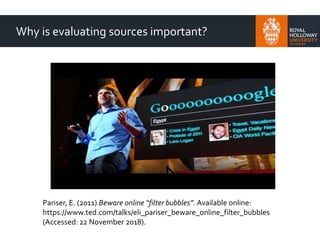
Why is evaluating sources important?
 Vast amounts of information
available
 Making sure you are using
appropriate sources in your work
 An important academic skill to
develop
 Important for the wider wide e.g.
fake news, filter bubbles
BBC, 2017
Why is evaluating sources important?
Pariser, E. (2011) Beware online “filter bubbles”. Available online:
https://www.ted.com/talks/eli_pariser_beware_online_filter_bubbles
(Accessed: 22 November 2018).
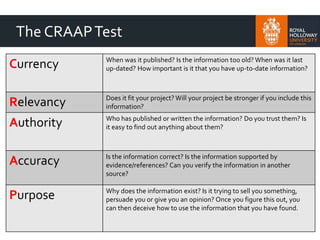
The CRAAPTest
Currency When was it published? Is the information too old? When was it last
up-dated? How important is it that you have up-to-date information?
Relevancy Does it fit your project? Will your project be stronger if you include this
information?
Authority Who has published or written the information? Do you trust them? Is
it easy to find out anything about them?
Accuracy Is the information correct? Is the information supported by
evidence/references? Can you verify the information in another
source?
Purpose Why does the information exist? Is it trying to sell you something,
persuade you or give you an opinion? Once you figure this out, you
can then deceive how to use the information that you have found.
Further Afield
Further afield
• Senate House
• Inter library loan requests
• More Books
• Sconul and other libraries
• If in doubt contact me,
Rachel.white@rhul.ac.uk
Referencing
Referencing Refresher
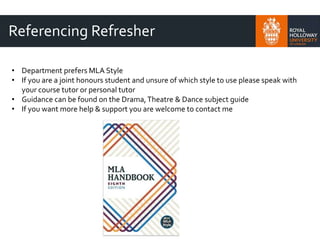
• Department prefers MLA Style
• If you are a joint honours student and unsure of which style to use please speak with
your course tutor or personal tutor
• Guidance can be found on the Drama,Theatre & Dance subject guide
• If you want more help & support you are welcome to contact me
Any
questions?
Don't forget:
• Rachel.white@rhul.ac.uk
• http://libguides.rhul.ac.uk/
• 1-2-1 Sessions

Using the Library - A Refresher

  • 1.
  • 2.
    Aims of theSession • Talk about key research skills that will help you find resources for your assignments • Library resources refreshers • Google Scholar • Other ways to access resources • Referencing refresher
  • 3.
  • 4.
    The College Library Academic Information Information not availableon the internet Free to use Variety of resources Help & Support
  • 5.
  • 6.
  • 7.
    How to findgood information 1. What exactly is the topic you are searching for? 2. What are the main concepts or keywords for your topic? 3. Are there are alternative terms for these concept? Lego bicycle by Do-Hyun Kim CC BY-ND. Flickr.
  • 8.
    Developing a SearchStrategy Pick out the key words in your topic Find alternative terms Identify good sources of information Combine your key words Locate texts Read
  • 9.
    KeyWords Alternative Terms e.g. film/movies/motionpictures Alternative Spellings e.g. Organisation/ Organization Acronyms e.g. RSC/ Royal Shakespeare Company Changing terminology e.g. Abyssinia/Ethiopa
  • 10.
    Thinking about KeyWords Discussthe use of the body in expressing emotion in different dance styles Concept 1 Concept 2 Concept 3 Body Emotion Specific Dance Styles Frame Feeling Geography Physicality Sentiment Time period Motion Specific emotions Specific parts of the body e.g. arms
  • 11.
    SearchTips AND – narrowsyour search eg. Body AND Expression OR – broadens your search eg. LGBT OR “Lesbian, gay, bisexual, transgender” NOT – narrows your search by excluding a keyword e.g. Ballet NOT Contemporary
  • 12.
    SearchTips • * truncationallows you to search for work endings eg. femin* will search for femine, feminist, feminism • ? Wildcards allow you search for letter alternatives within a word eg.Wom?n • “” phrase searches allow you to search for words in a certain order eg. “Contemporary Dance”
  • 13.
  • 14.
    Identify Resources Books/ebooks JournalArticlesNewspaper Articles Reports Reference Material eResources
  • 15.
  • 16.
  • 17.
    Why is evaluatingsources important?  Vast amounts of information available  Making sure you are using appropriate sources in your work  An important academic skill to develop  Important for the wider wide e.g. fake news, filter bubbles BBC, 2017
  • 18.
    Why is evaluatingsources important? Pariser, E. (2011) Beware online “filter bubbles”. Available online: https://www.ted.com/talks/eli_pariser_beware_online_filter_bubbles (Accessed: 22 November 2018).
  • 19.
    The CRAAPTest Currency Whenwas it published? Is the information too old? When was it last up-dated? How important is it that you have up-to-date information? Relevancy Does it fit your project? Will your project be stronger if you include this information? Authority Who has published or written the information? Do you trust them? Is it easy to find out anything about them? Accuracy Is the information correct? Is the information supported by evidence/references? Can you verify the information in another source? Purpose Why does the information exist? Is it trying to sell you something, persuade you or give you an opinion? Once you figure this out, you can then deceive how to use the information that you have found.
  • 20.
  • 21.
    Further afield • SenateHouse • Inter library loan requests • More Books • Sconul and other libraries • If in doubt contact me, Rachel.white@rhul.ac.uk
  • 22.
  • 23.
    Referencing Refresher • Departmentprefers MLA Style • If you are a joint honours student and unsure of which style to use please speak with your course tutor or personal tutor • Guidance can be found on the Drama,Theatre & Dance subject guide • If you want more help & support you are welcome to contact me
  • 24.
  • 25.
    Don't forget: • Rachel.white@rhul.ac.uk •http://libguides.rhul.ac.uk/ • 1-2-1 Sessions

Editor's Notes

  • #6 Explain changes for returners
  • #9 So you will all be thinking about your proposed dissertation and the research questions you want to answer. Before you start thinking about the searching for resources to use in your dissertation you should spend some time thinking about your search strategy Searching for resources, the clue is in the title. It can take a while to “search” for resources so important to spend some time thinking about this, planning it and reading materials. The more you can read on your area the better you will understand it. Pick out keywords Important to think about the keywords in your dissertation topic, what are the main concepts that are jumping out at you. These will form the basis of the search terms that you will use to find resources Alternative terms Are there alternative ways of saying the keywords? Important to have a bank of keywords to use. You may search say library search with a set of keywords, and then use the same on google scholar but you might not return the same number of hits. Each database has its own type of vocabulary and some keywords might return more hits than others. Trial and error 3. Good sources of information? a. Where are you going to look for resources? Google Scholar? Library Resources? Books? Articles? Films? Images? 4. Combine your keywords a. You can combine your keywords with connecting words to return more relevant searches. You can use them to broaden the number of results, or narrow them down. More in this in a second 5. Locate texts. a. Start looking for texts. Can use things like citation searching more of this in a second. Good tip is to read the abstract to see if useful before spending time reading the whole article. 6. Read a. Spend time reading resources, will give you a better understanding of the resources available. Important to evaluate material, think about who has written it and why, is this information still accurate, has it been written because of a specific agenda. More help about this can be found on the subject guide
  • #16 Adair, C. and Burt, R. (2017) British Dance: Black Routes. New York and London: Routledge Indonesia Dance
  • #25 Marlon atkins Claire Velazquez Hleb voukau