The document outlines the importance of citing sources in academic and professional work to avoid plagiarism and to validate the information presented. It provides detailed guidelines on gathering citation information for different types of sources, including books, articles, and websites, as well as proper formatting for in-text citations and bibliographies. Additionally, it references various citation styles such as MLA, APA, Turabian, and Chicago manual of style.
Purpose for citing
Thepurpose for citing is to let readers know that a
specific piece of information you're providing has a
source/author, other than your own observation or
reasoning. In many cases, the strength and credibility of
your work depends on the validity of your sources, the
quality of the sources (especially peer reviewed journals),
and your ability to represent those sources clearly
without plagiarizing. Even if you fail to cite a source, or
cite improperly, without meaning to do so, the
consequences can be just as dire as if you did it on
purpose, especially in academic and professional settings.
3.
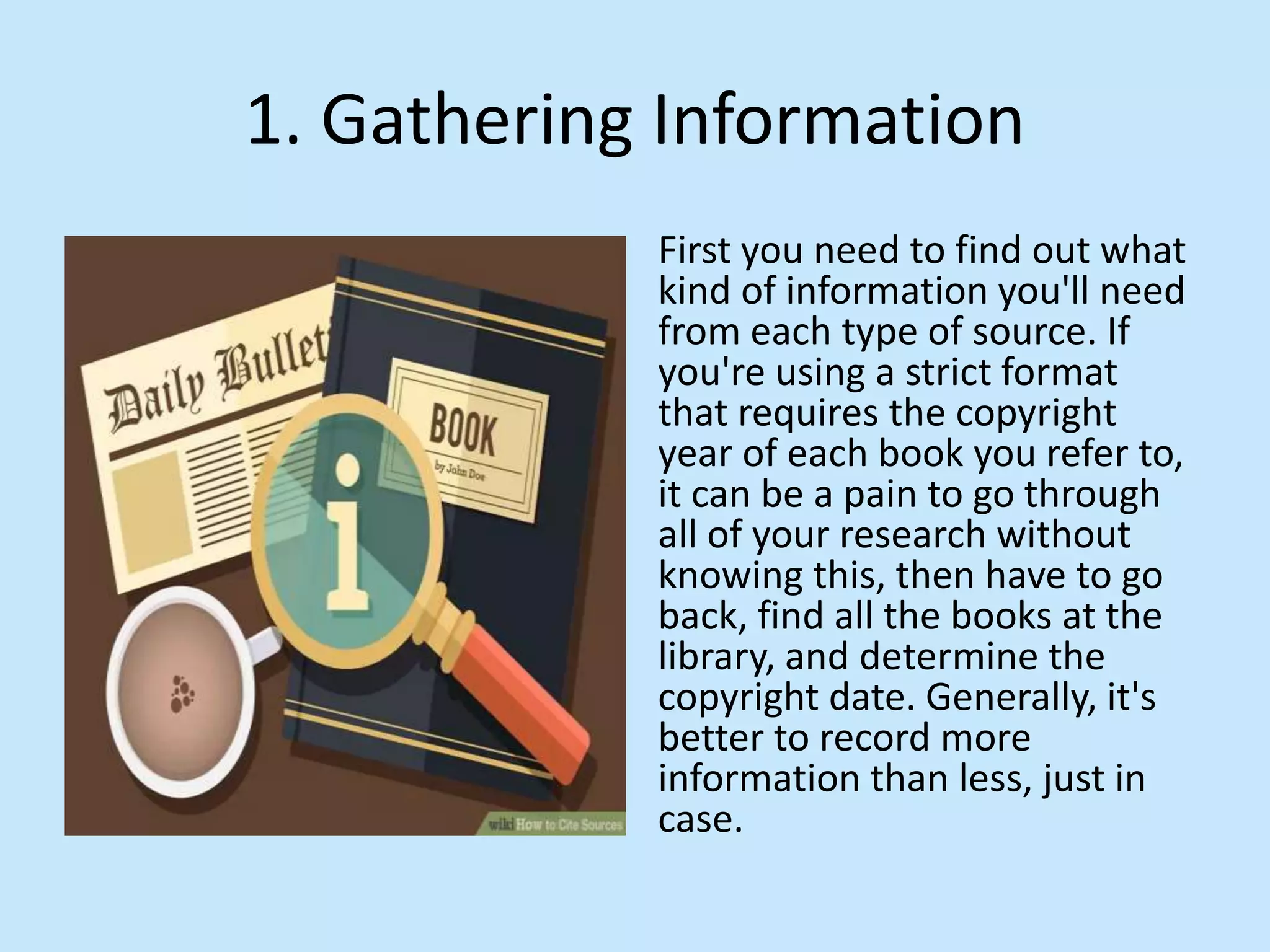
1. Gathering Information
Firstyou need to find out what
kind of information you'll need
from each type of source. If
you're using a strict format
that requires the copyright
year of each book you refer to,
it can be a pain to go through
all of your research without
knowing this, then have to go
back, find all the books at the
library, and determine the
copyright date. Generally, it's
better to record more
information than less, just in
case.
4.
Books
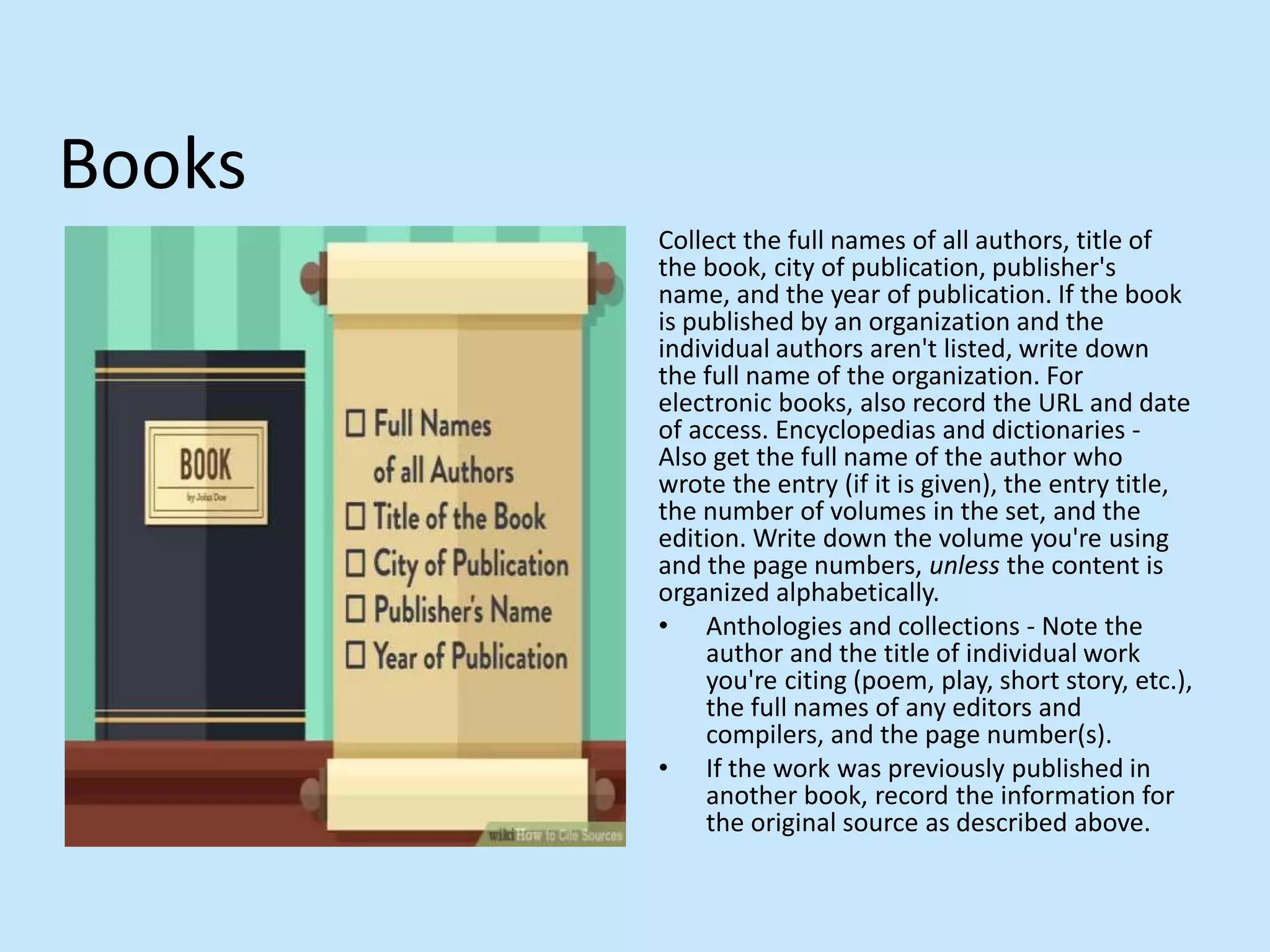
Collect the fullnames of all authors, title of
the book, city of publication, publisher's
name, and the year of publication. If the book
is published by an organization and the
individual authors aren't listed, write down
the full name of the organization. For
electronic books, also record the URL and date
of access. Encyclopedias and dictionaries -
Also get the full name of the author who
wrote the entry (if it is given), the entry title,
the number of volumes in the set, and the
edition. Write down the volume you're using
and the page numbers, unless the content is
organized alphabetically.
• Anthologies and collections - Note the
author and the title of individual work
you're citing (poem, play, short story, etc.),
the full names of any editors and
compilers, and the page number(s).
• If the work was previously published in
another book, record the information for
the original source as described above.
5.
Journal articles.
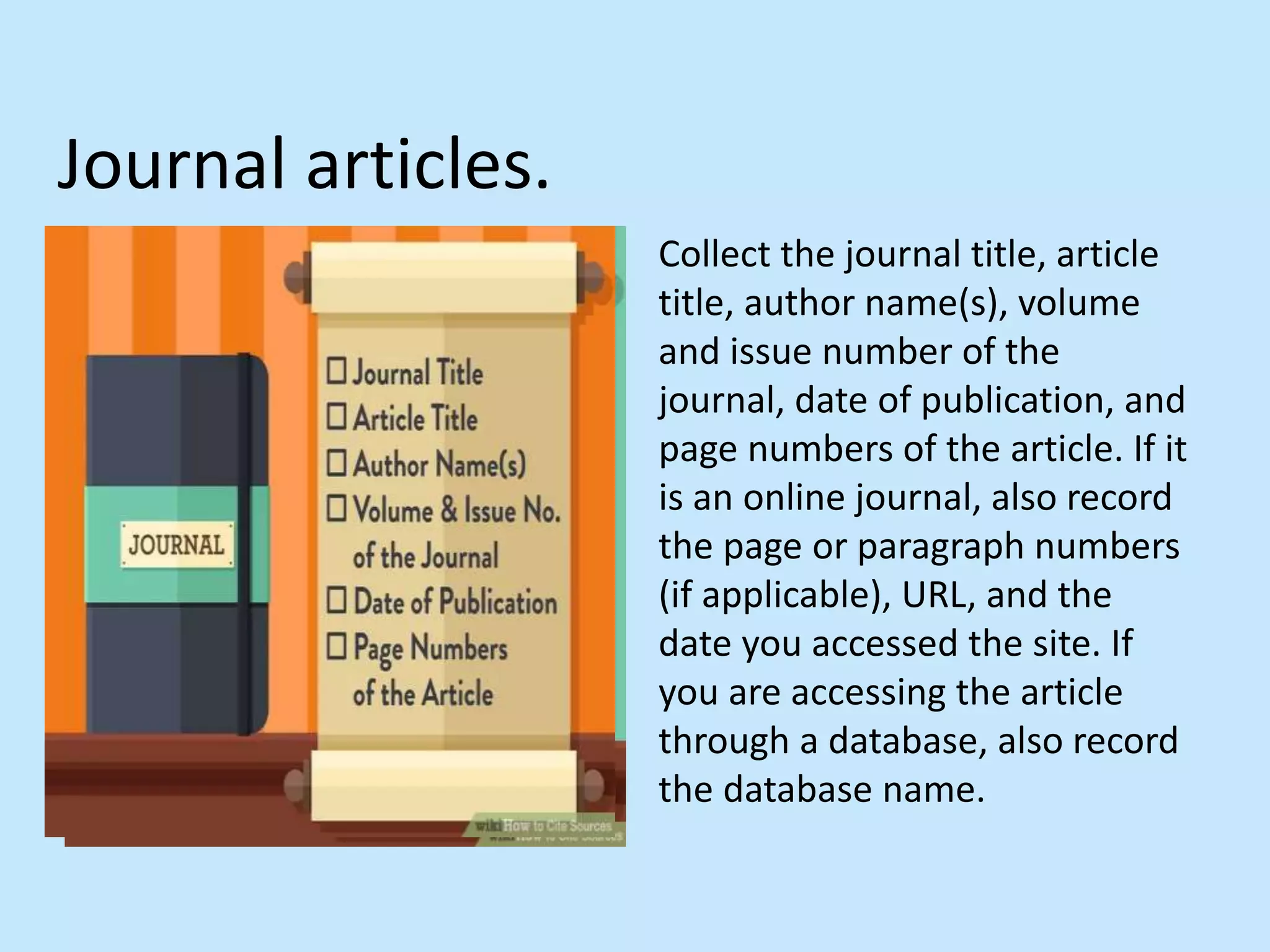
Collect thejournal title, article
title, author name(s), volume
and issue number of the
journal, date of publication, and
page numbers of the article. If it
is an online journal, also record
the page or paragraph numbers
(if applicable), URL, and the
date you accessed the site. If
you are accessing the article
through a database, also record
the database name.
6.
Magazine articles.
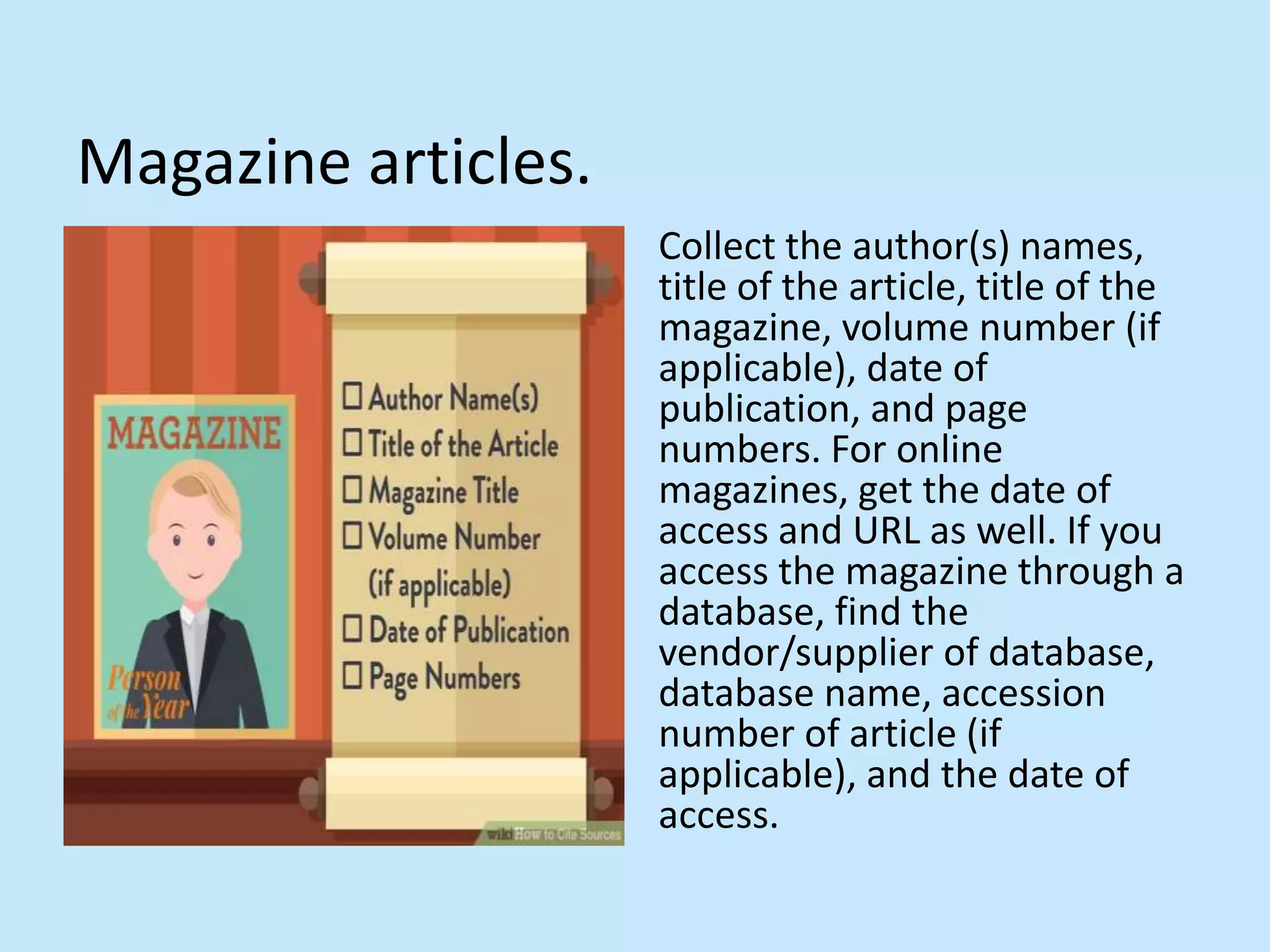
Collect theauthor(s) names,
title of the article, title of the
magazine, volume number (if
applicable), date of
publication, and page
numbers. For online
magazines, get the date of
access and URL as well. If you
access the magazine through a
database, find the
vendor/supplier of database,
database name, accession
number of article (if
applicable), and the date of
access.
7.
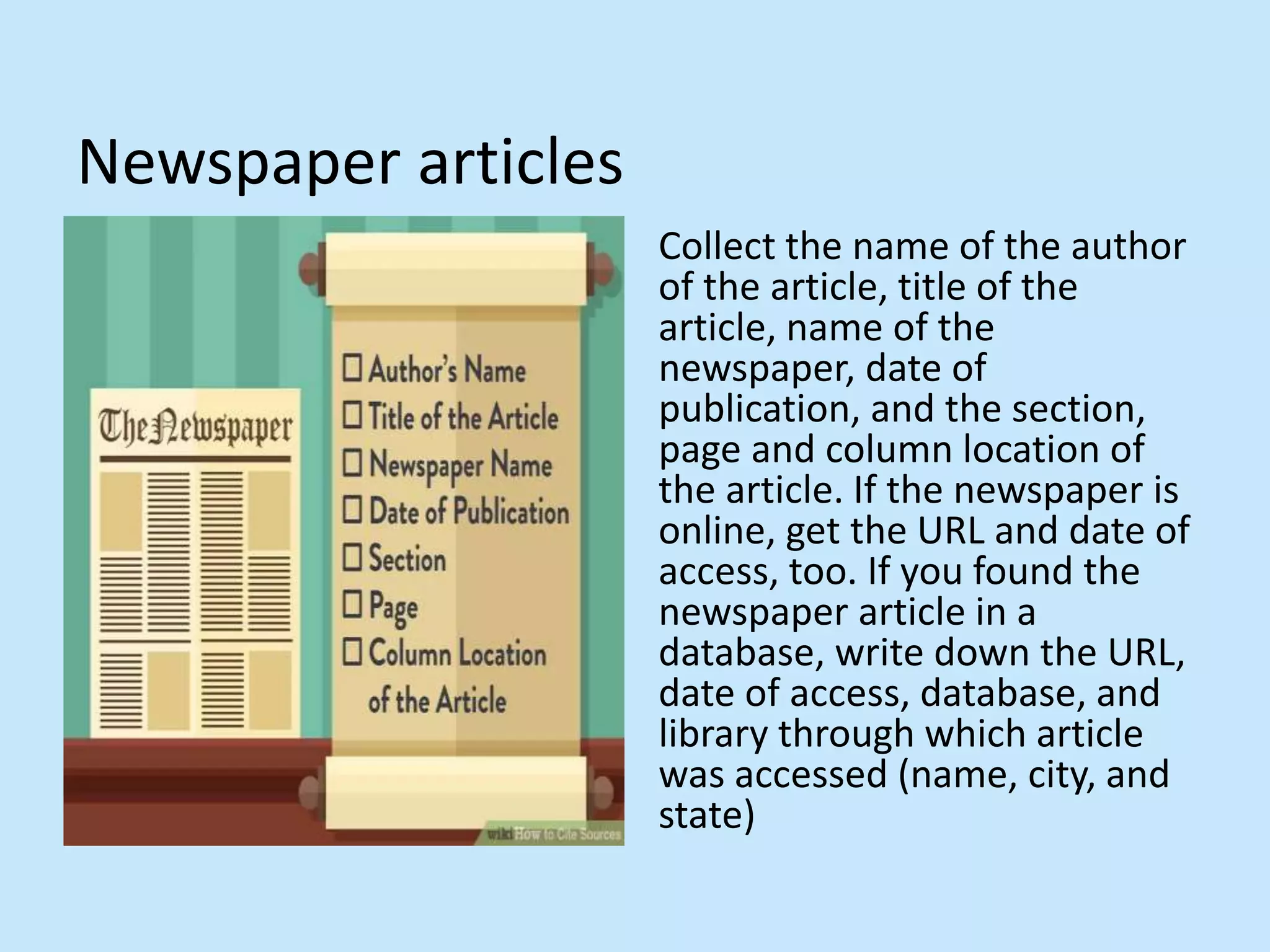
Newspaper articles
Collect thename of the author
of the article, title of the
article, name of the
newspaper, date of
publication, and the section,
page and column location of
the article. If the newspaper is
online, get the URL and date of
access, too. If you found the
newspaper article in a
database, write down the URL,
date of access, database, and
library through which article
was accessed (name, city, and
state)
8.
Websites.
Get the author'sname (if
given), title of work, group
responsible for the site (if
applicable), date site was last
updated, date of access, and
URL. If you have trouble
finding everything except the
last two items, you might want
to reconsider the validity of
this source. For postings, also
get the title of posting, post
number (if numbered), date of
posting, URL the post was
made to, and URL of message
archives
9.
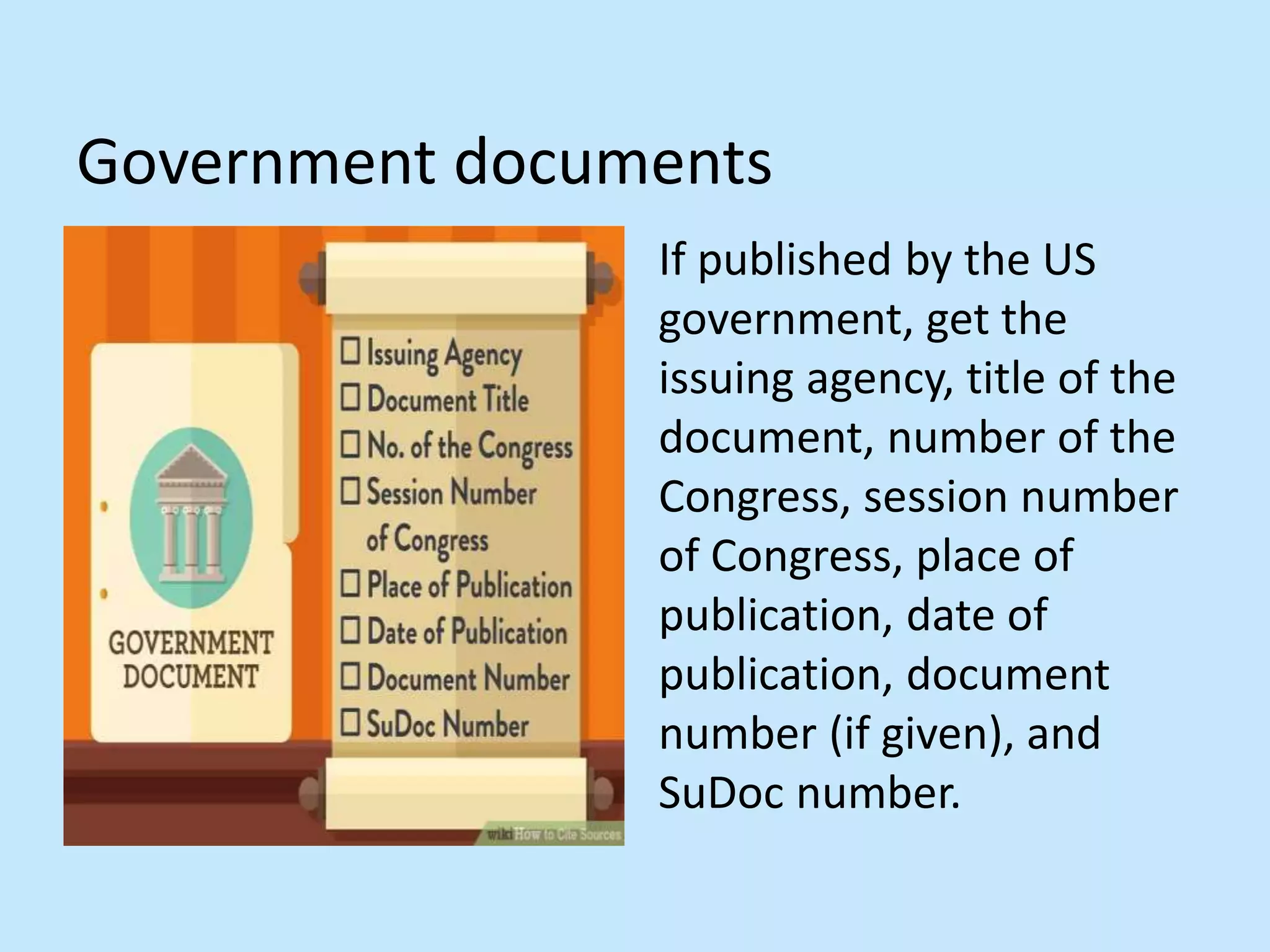
Government documents
If publishedby the US
government, get the
issuing agency, title of the
document, number of the
Congress, session number
of Congress, place of
publication, date of
publication, document
number (if given), and
SuDoc number.
10.
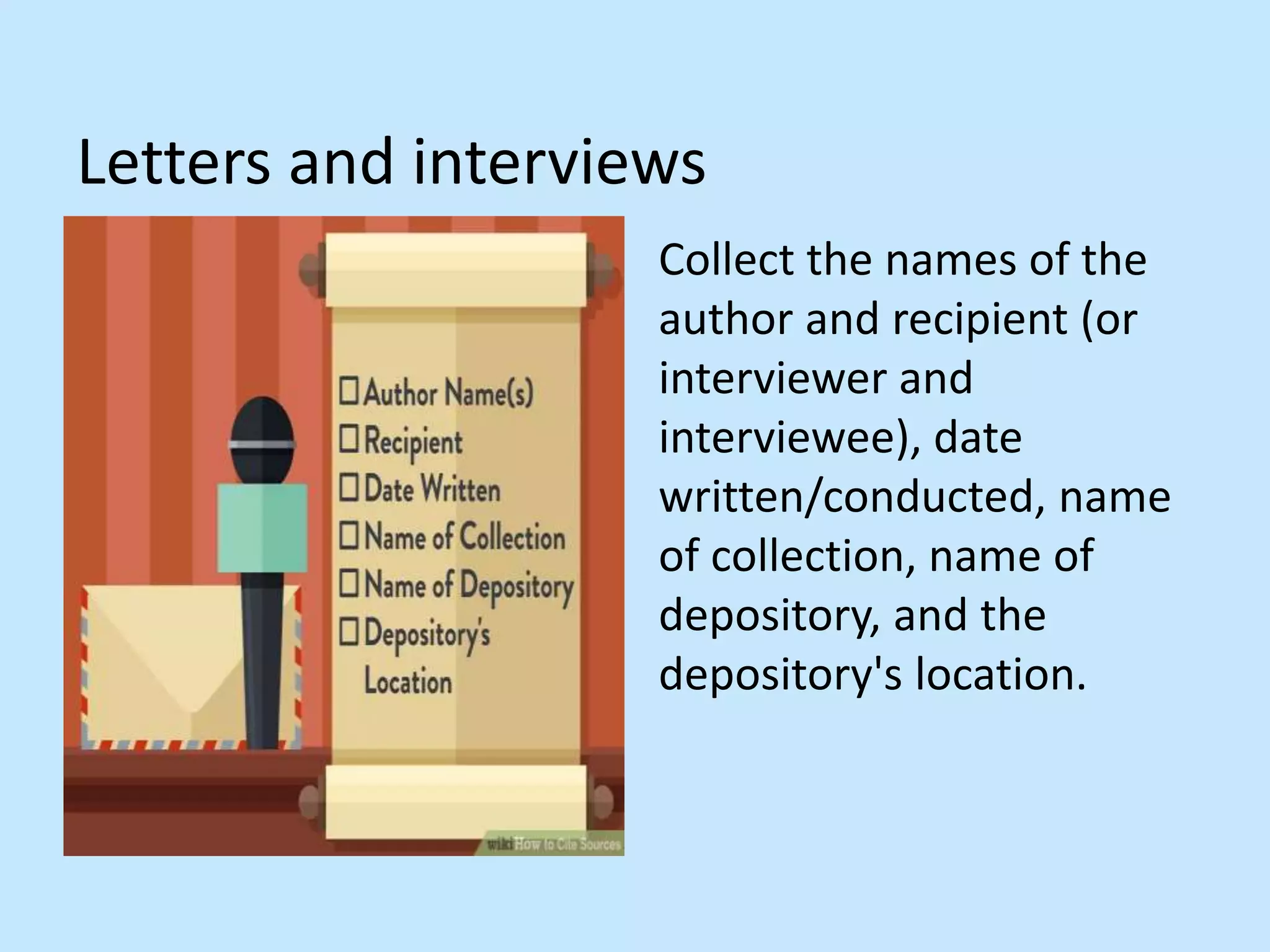
Letters and interviews
Collectthe names of the
author and recipient (or
interviewer and
interviewee), date
written/conducted, name
of collection, name of
depository, and the
depository's location.
11.
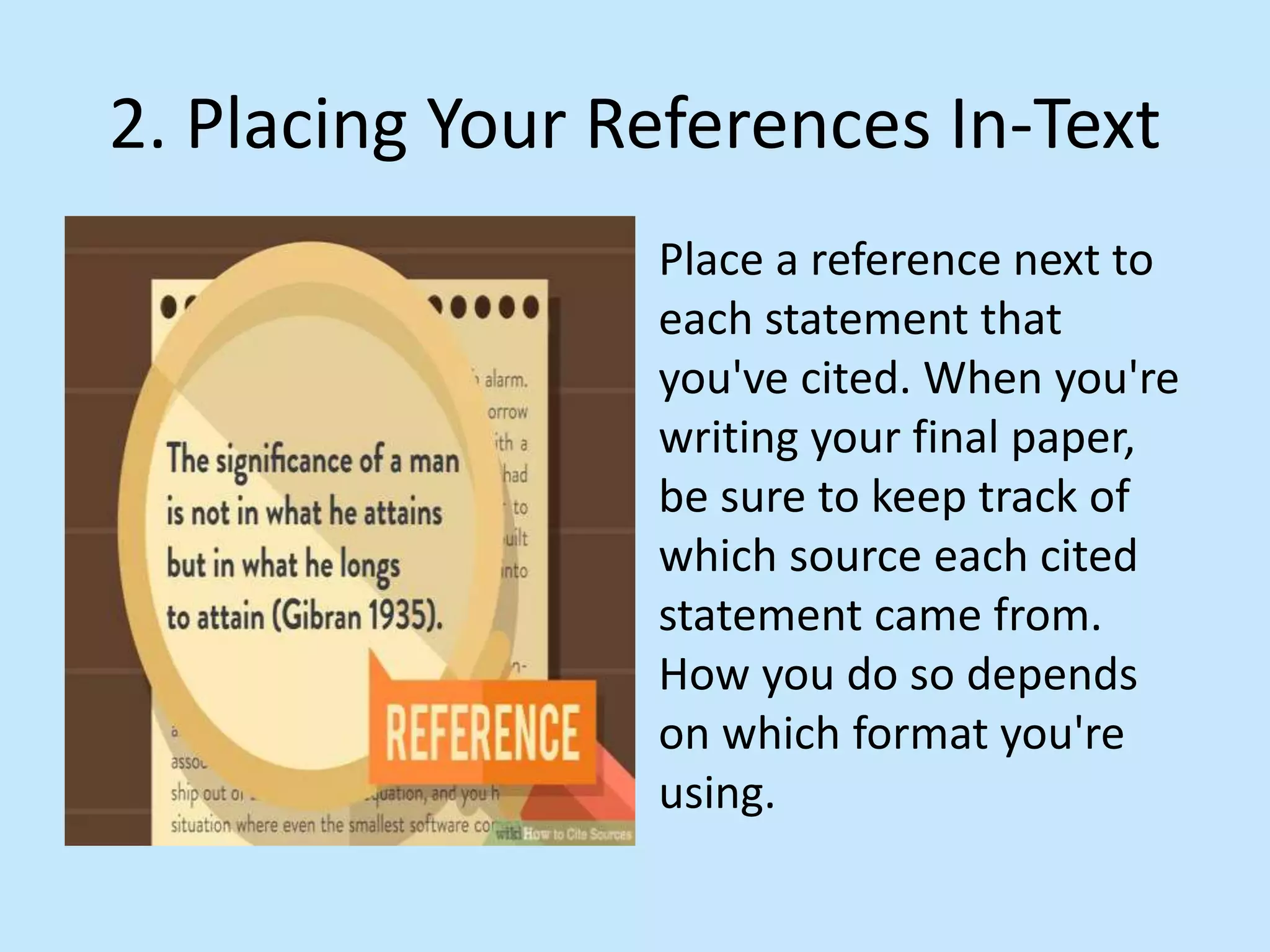
2. Placing YourReferences In-Text
Place a reference next to
each statement that
you've cited. When you're
writing your final paper,
be sure to keep track of
which source each cited
statement came from.
How you do so depends
on which format you're
using.
12.
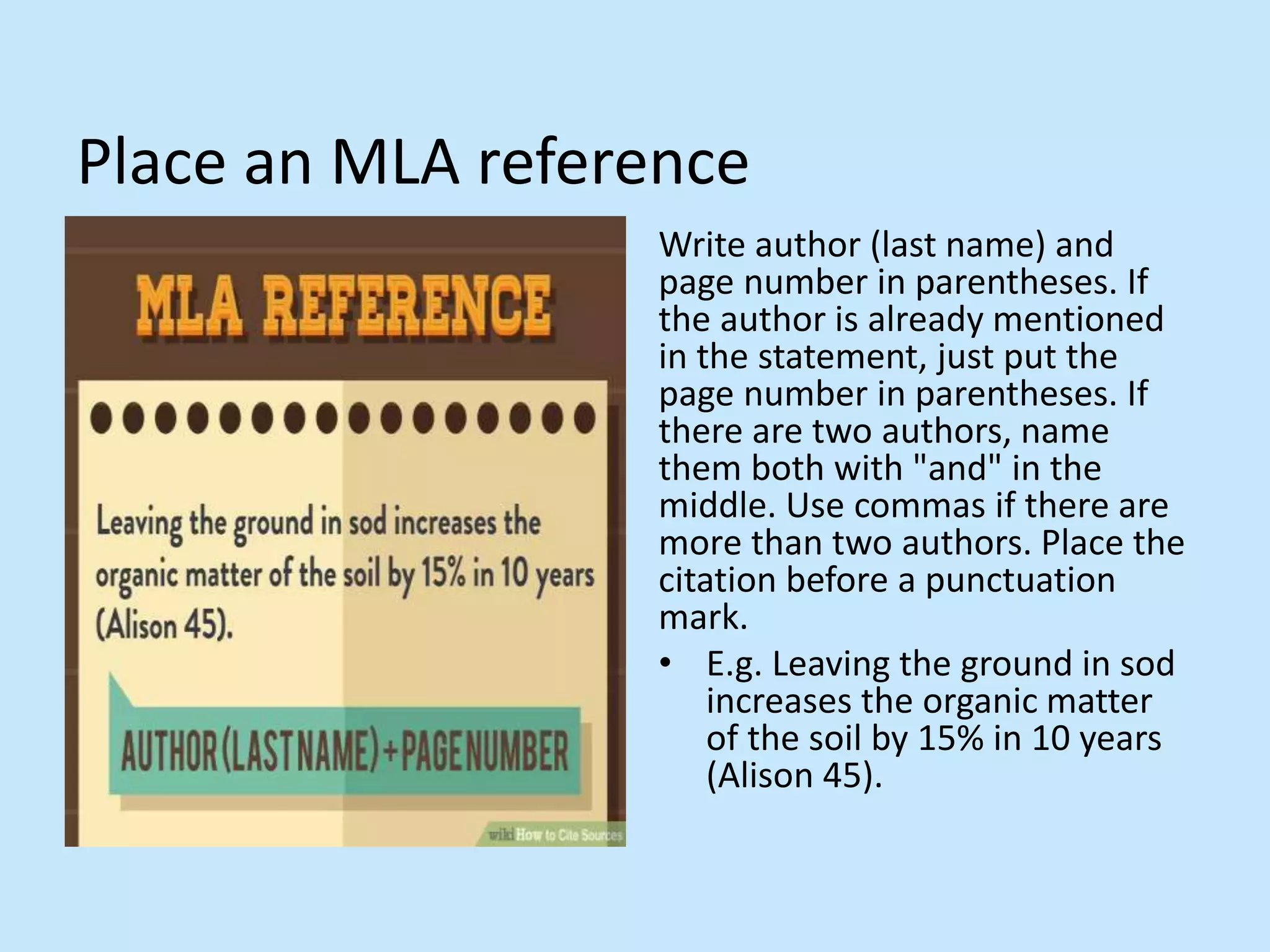
Place an MLAreference
Write author (last name) and
page number in parentheses. If
the author is already mentioned
in the statement, just put the
page number in parentheses. If
there are two authors, name
them both with "and" in the
middle. Use commas if there are
more than two authors. Place the
citation before a punctuation
mark.
• E.g. Leaving the ground in sod
increases the organic matter
of the soil by 15% in 10 years
(Alison 45).
13.
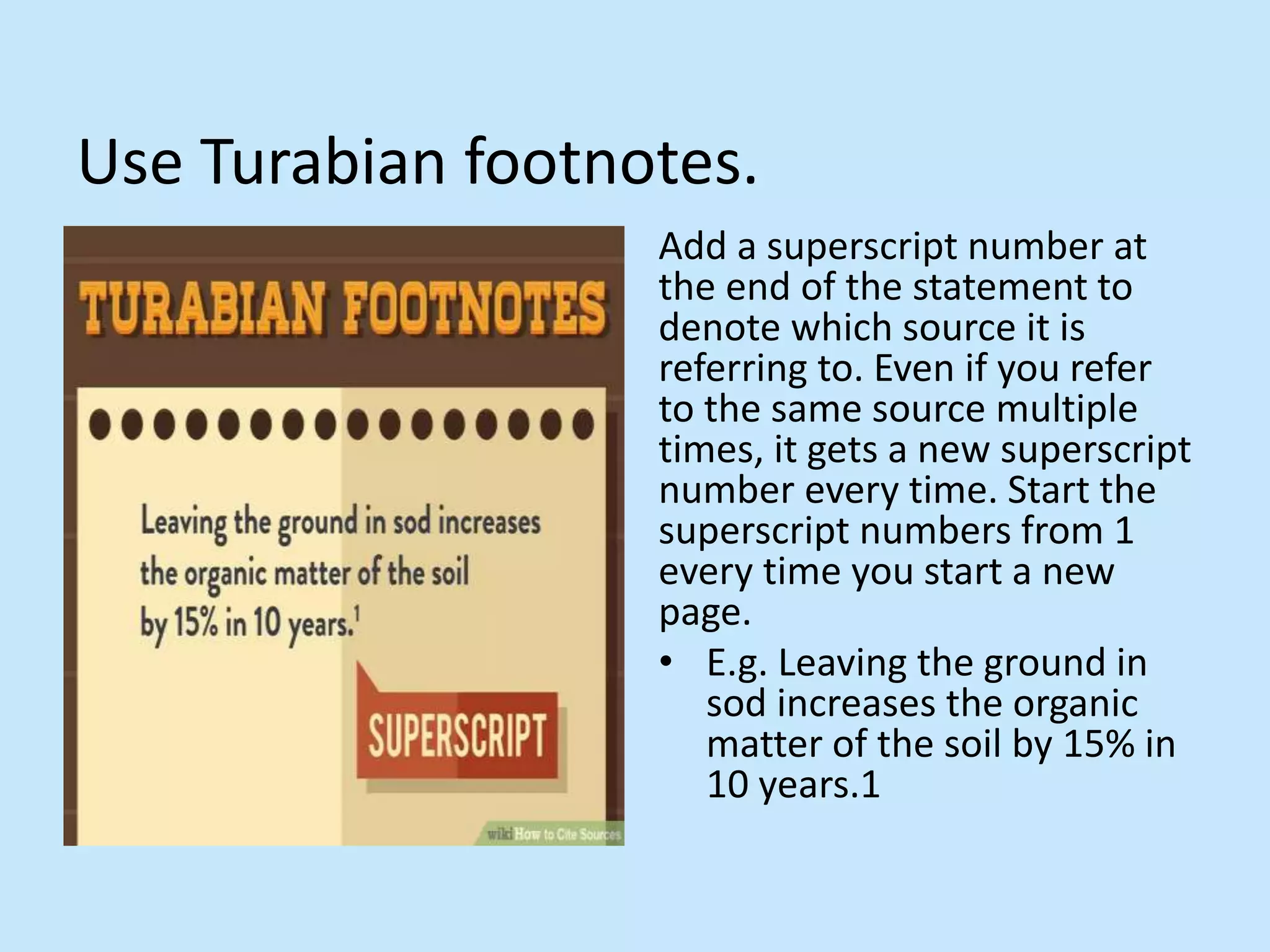
Use Turabian footnotes.
Adda superscript number at
the end of the statement to
denote which source it is
referring to. Even if you refer
to the same source multiple
times, it gets a new superscript
number every time. Start the
superscript numbers from 1
every time you start a new
page.
• E.g. Leaving the ground in
sod increases the organic
matter of the soil by 15% in
10 years.1
14.
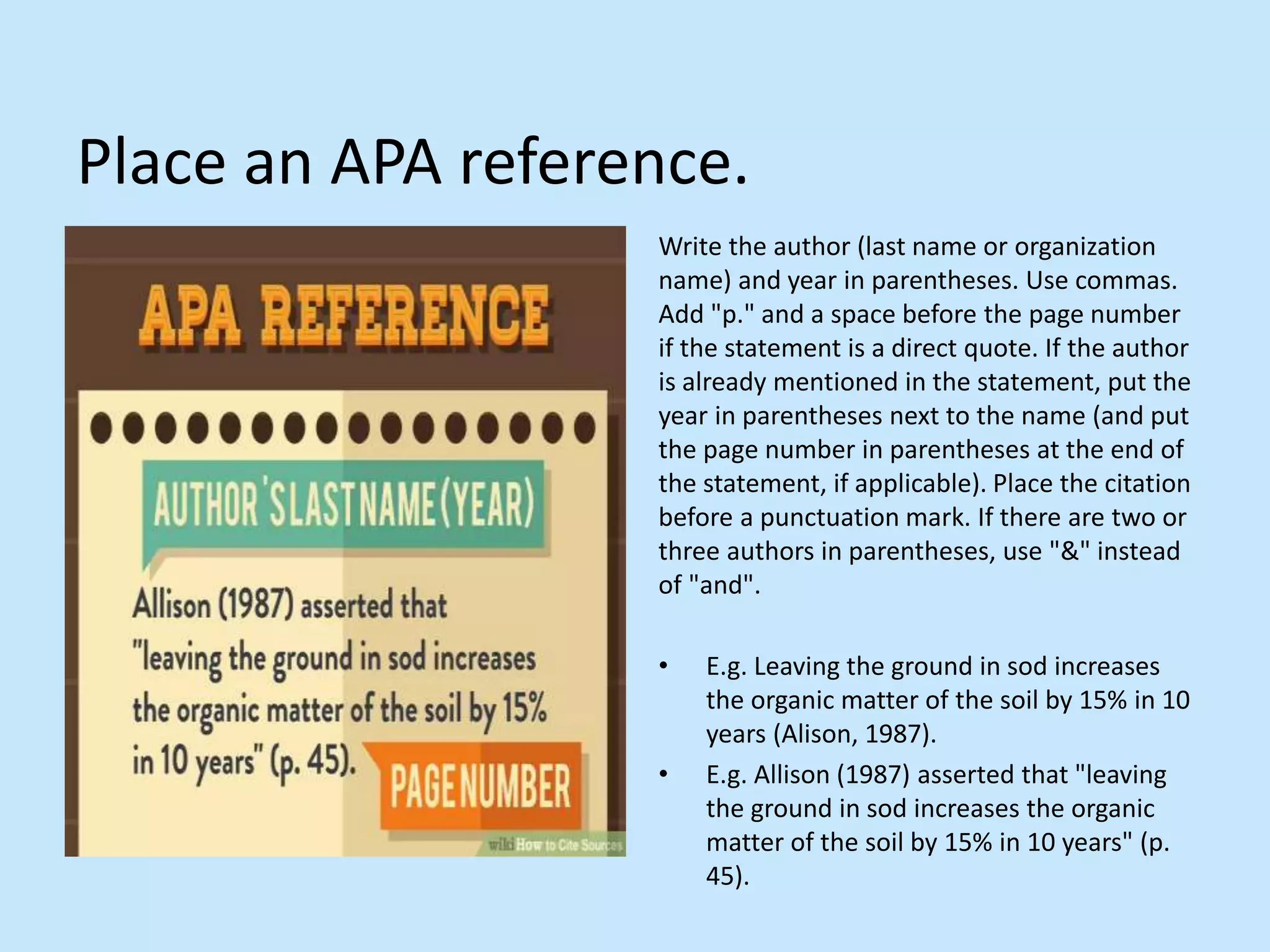
Place an APAreference.
Write the author (last name or organization
name) and year in parentheses. Use commas.
Add "p." and a space before the page number
if the statement is a direct quote. If the author
is already mentioned in the statement, put the
year in parentheses next to the name (and put
the page number in parentheses at the end of
the statement, if applicable). Place the citation
before a punctuation mark. If there are two or
three authors in parentheses, use "&" instead
of "and".
• E.g. Leaving the ground in sod increases
the organic matter of the soil by 15% in 10
years (Alison, 1987).
• E.g. Allison (1987) asserted that "leaving
the ground in sod increases the organic
matter of the soil by 15% in 10 years" (p.
45).
15.
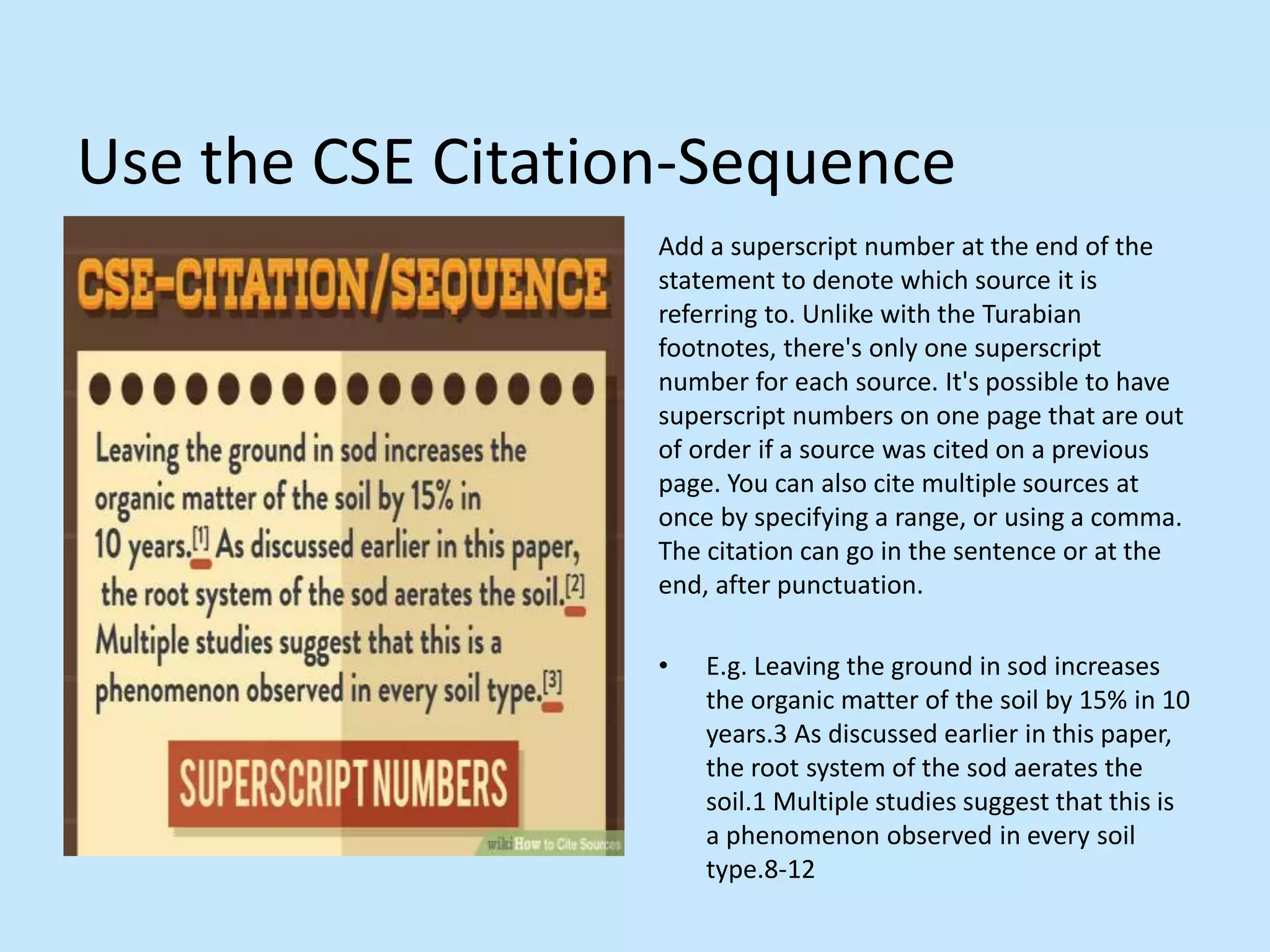
Use the CSECitation-Sequence
Add a superscript number at the end of the
statement to denote which source it is
referring to. Unlike with the Turabian
footnotes, there's only one superscript
number for each source. It's possible to have
superscript numbers on one page that are out
of order if a source was cited on a previous
page. You can also cite multiple sources at
once by specifying a range, or using a comma.
The citation can go in the sentence or at the
end, after punctuation.
• E.g. Leaving the ground in sod increases
the organic matter of the soil by 15% in 10
years.3 As discussed earlier in this paper,
the root system of the sod aerates the
soil.1 Multiple studies suggest that this is
a phenomenon observed in every soil
type.8-12
16.
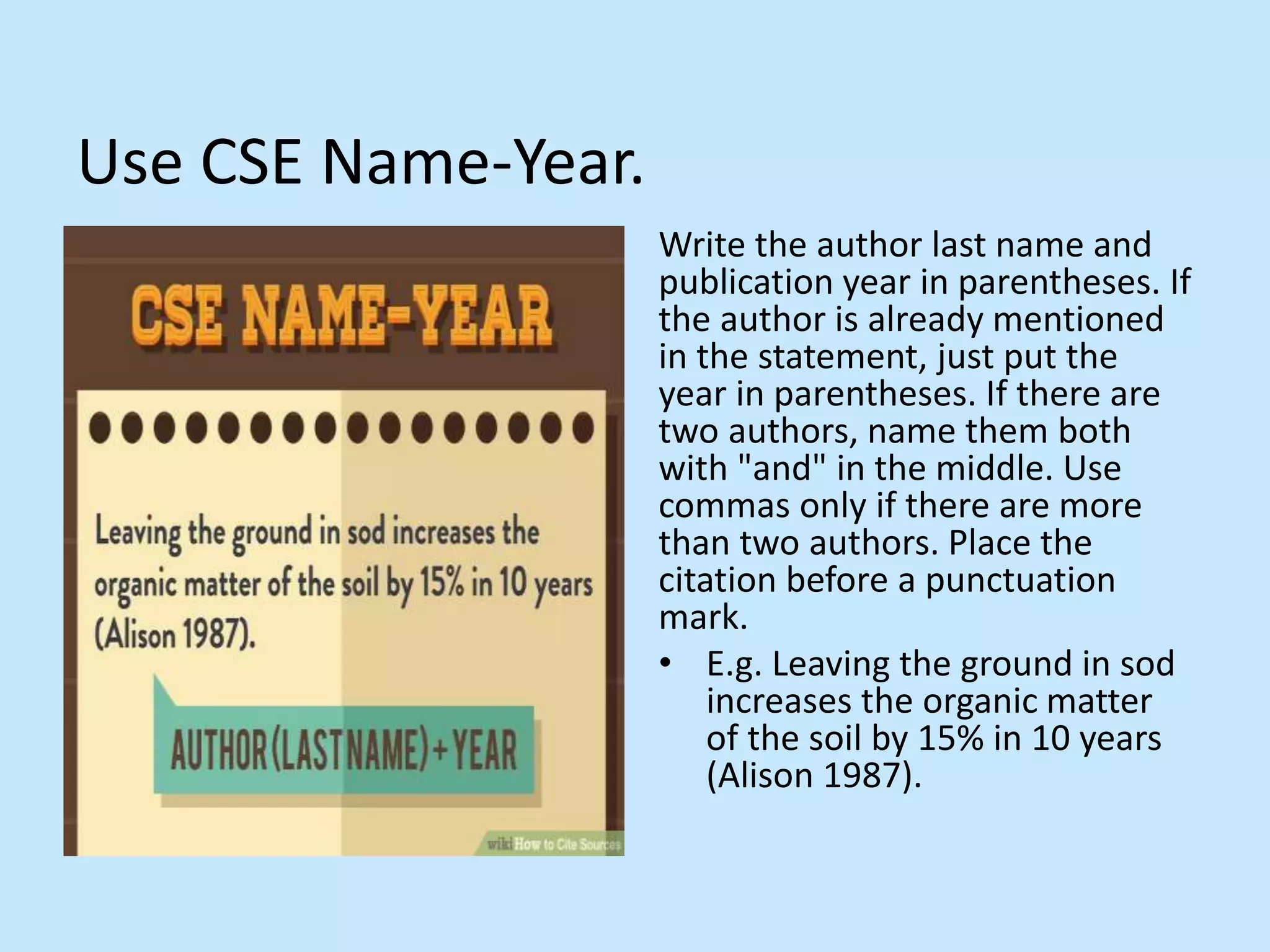
Use CSE Name-Year.
Writethe author last name and
publication year in parentheses. If
the author is already mentioned
in the statement, just put the
year in parentheses. If there are
two authors, name them both
with "and" in the middle. Use
commas only if there are more
than two authors. Place the
citation before a punctuation
mark.
• E.g. Leaving the ground in sod
increases the organic matter
of the soil by 15% in 10 years
(Alison 1987).
17.
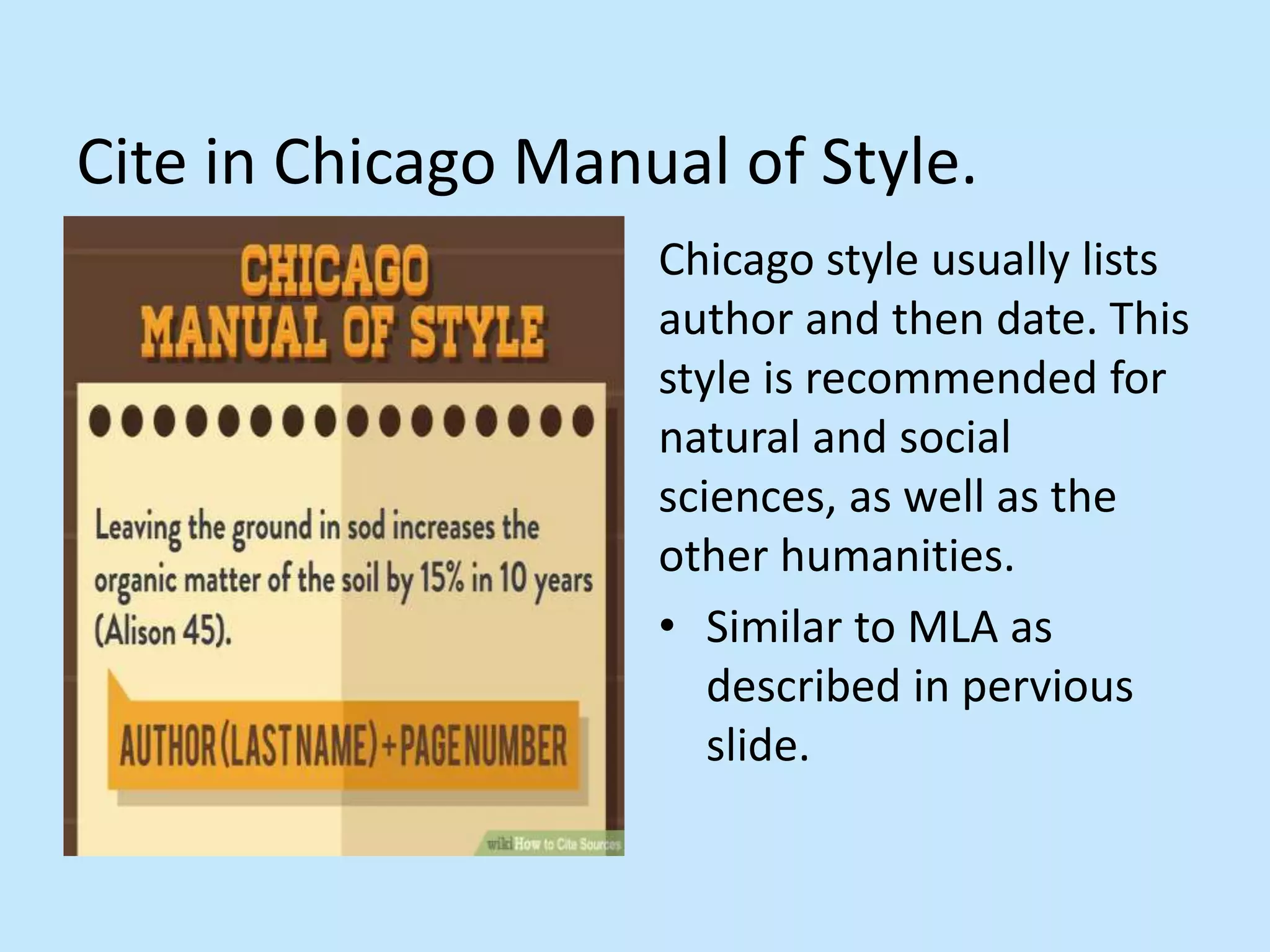
Cite in ChicagoManual of Style.
Chicago style usually lists
author and then date. This
style is recommended for
natural and social
sciences, as well as the
other humanities.
• Similar to MLA as
described in pervious
slide.
18.
Legal/Blue Book formatfor citations in
legal documents.
Depending on the type of work, may use in-
line citations or footnotes/endnotes. The
general format follows the form of case name
or author and article name, followed by a
comma, then [Volume Number] Authority
Name [Page number of start of case/article or
section number of statute], followed by the
date in parenthesis.
• For example, Marbury v. Madison, 5 U.S.
137 (1803) (a case named Marbury v.
Madison, found in the fifth volume of the
reports of the U.S. Supreme Court,
starting at page 137), 12 U.S.C. §3401 et
seq. (a statute beginning at section 3401
of the 12th volume of the United States
Code) and Warren and Brandeis, The Right
to Privacy, 4 Harvard L.R. 193 (1890) (a
journal article from the fourth volume of
the Harvard Law Review).
19.
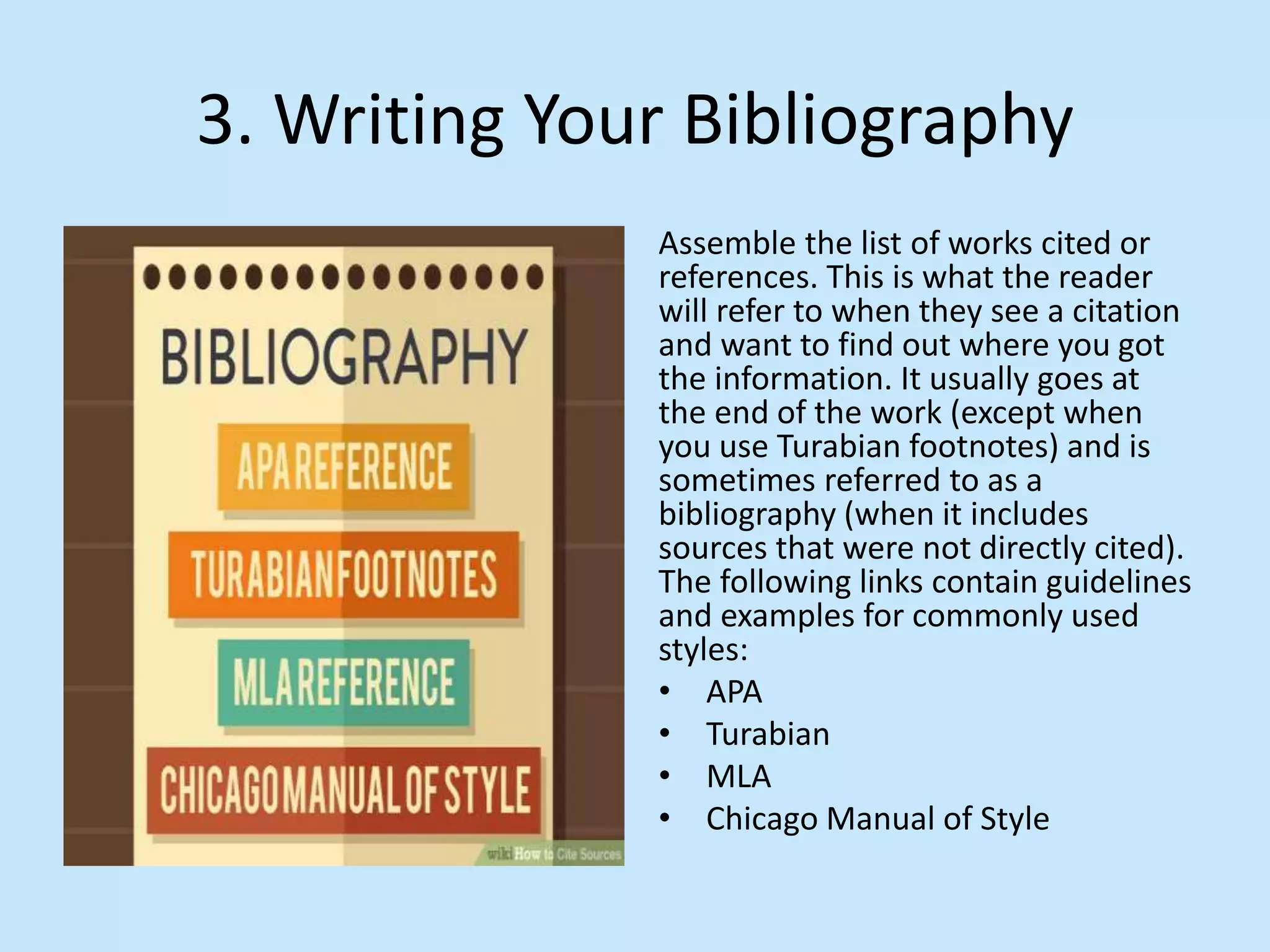
3. Writing YourBibliography
Assemble the list of works cited or
references. This is what the reader
will refer to when they see a citation
and want to find out where you got
the information. It usually goes at
the end of the work (except when
you use Turabian footnotes) and is
sometimes referred to as a
bibliography (when it includes
sources that were not directly cited).
The following links contain guidelines
and examples for commonly used
styles:
• APA
• Turabian
• MLA
• Chicago Manual of Style
20.
Don't forget toput your sources in order!
For most formats, you will need to put your
sources in alphabetical order.
21.
Make sure toinclude all of your sources in
your bibliography. You do not want to be
accused of plagiarism.

![Legal/Blue Book format for citations in
legal documents.
Depending on the type of work, may use in-
line citations or footnotes/endnotes. The
general format follows the form of case name
or author and article name, followed by a
comma, then [Volume Number] Authority
Name [Page number of start of case/article or
section number of statute], followed by the
date in parenthesis.
• For example, Marbury v. Madison, 5 U.S.
137 (1803) (a case named Marbury v.
Madison, found in the fifth volume of the
reports of the U.S. Supreme Court,
starting at page 137), 12 U.S.C. §3401 et
seq. (a statute beginning at section 3401
of the 12th volume of the United States
Code) and Warren and Brandeis, The Right
to Privacy, 4 Harvard L.R. 193 (1890) (a
journal article from the fourth volume of
the Harvard Law Review).](https://image.slidesharecdn.com/howtocitesources-160623141159/75/How-to-cite-sources-18-2048.jpg)