Recent Advances
in Mammography
DR.SUHAS B
RESIDENT (MD RADIO-DIAGNOSIS)
Brief History
Concept of using x-ray to visualize breast tissue was first putforth by Dr.Albert Salomon, a
German surgeon in 1913
In 1950’s Jacob Gershon began to advocate widespread use of x-rays for screening
purpose.
In December 2005 RSNA brings digital mammography to USA
Introduction
 Mammography is the gold standard for detecting breast lesions.
 However, modern mammography has only existed since about 1970, when the first
dedicated mammography imaging systems became widely available.
 There has been tremendous advancement in the technology so that today’s examination
differs markedly even from those of the early 1980s.
 Modern x-ray mammography uses dedicated systems (that is, a machine used only for
breast x-rays) to produce x-rays that are high in quality but low in radiation dose.
 Modern mammography systems are tightly monitored by the Mammography Quality
Standard Act (MQSA)
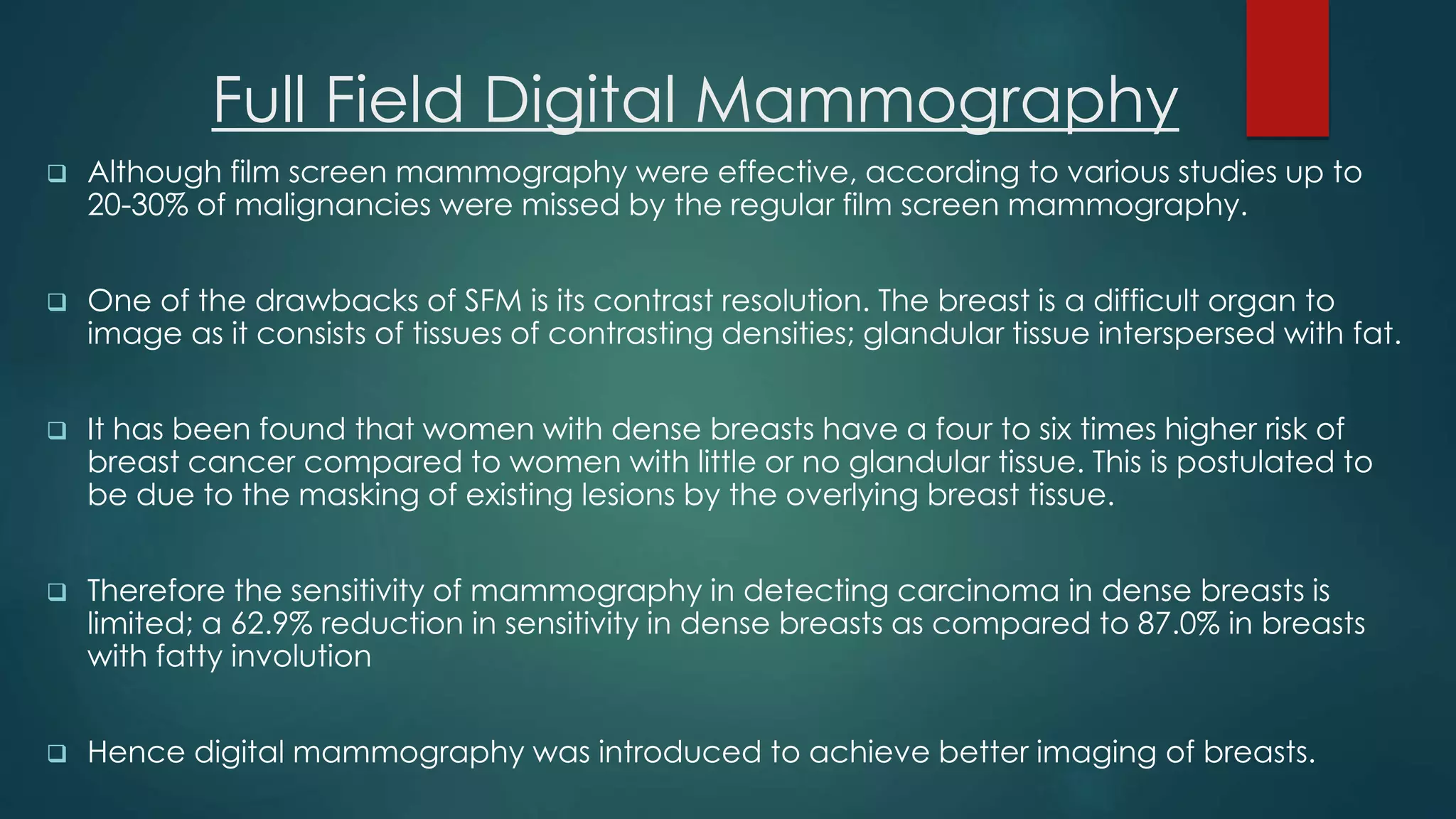
Equipment
Automatic Exposure Control
Magnification View
 Magnifies the image by 1.5x to 2.0x
 Increased effective resolution
 Small focal spot size used (lower mA and
longer exposure times)
 Dose increased
 Reduction of scatter
Full Field Digital Mammography
 Although film screen mammography were effective, according to various studies up to
20-30% of malignancies were missed by the regular film screen mammography.
 One of the drawbacks of SFM is its contrast resolution. The breast is a difficult organ to
image as it consists of tissues of contrasting densities; glandular tissue interspersed with fat.
 It has been found that women with dense breasts have a four to six times higher risk of
breast cancer compared to women with little or no glandular tissue. This is postulated to
be due to the masking of existing lesions by the overlying breast tissue.
 Therefore the sensitivity of mammography in detecting carcinoma in dense breasts is
limited; a 62.9% reduction in sensitivity in dense breasts as compared to 87.0% in breasts
with fatty involution
 Hence digital mammography was introduced to achieve better imaging of breasts.
Full Field Digital Mammography
Types of Digitalization
Full Field Digital Mammography (contd.)
 It works like a DR system wherein the x-rays are directly converted into photons directly
or through a scintillator (indirectly) and an electronic signal detector converts this
light/photons into digitized form (binary system) to be read through an external device
(CCD or Flat-panel)
 When comparing DM to SFM, it was found that the overall diagnostic accuracy of both
technologies in detecting breast cancer detection was similar
 FFDM has a better signal to noise ratio than FSM.
 Preferably uses W/Rh combination.
 Near instantaneous image acquisition helps in cost cutting and time management.
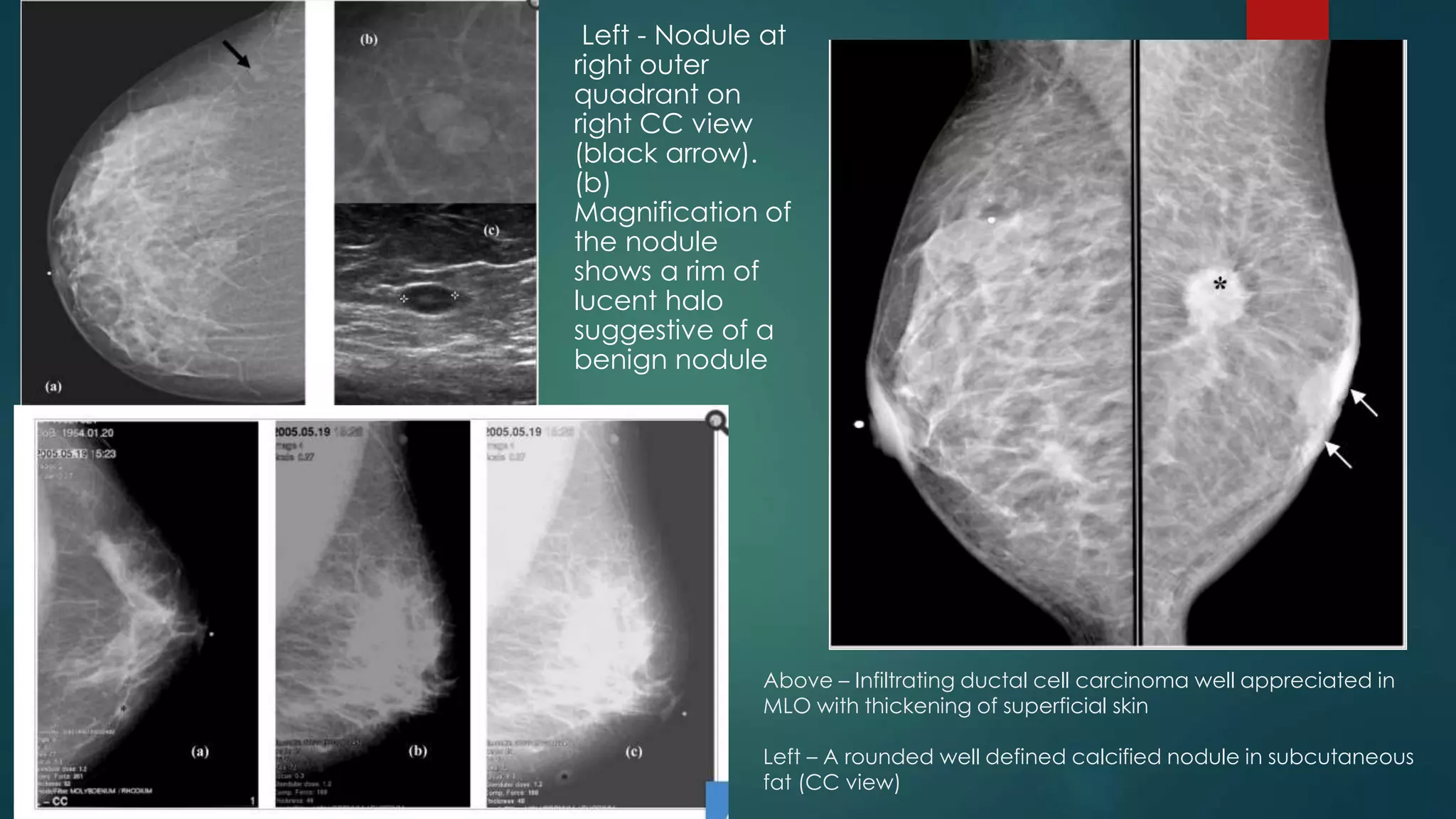
Above – Infiltrating ductal cell carcinoma well appreciated in
MLO with thickening of superficial skin
Left – A rounded well defined calcified nodule in subcutaneous
fat (CC view)
Left - Nodule at
right outer
quadrant on
right CC view
(black arrow).
(b)
Magnification of
the nodule
shows a rim of
lucent halo
suggestive of a
benign nodule
Full Field Digital Mammography (contd.)
 DM is able to capture areas of contrasting densities and display these regions without
compromising the contrast resolution very much.
 SFM boasts a high spatial resolution of approximately 16 linepairs per mm which enables
detection of fine structures such as microcalcification.
 The spatial resolution of DM, however, is limited by pixel size. Despite this limitation, it has
been found that the detection of microcalcifications on DM is equal to, if not better than,
that of SFM.
 This is due to the increased contrast resolution of DM which enhances its ability to visualise
small high-contrast structures such as microcalcification
 There is a 45% reduction in the time taken to perform examinations and process images
using DM when compared to SFM.
Above image shows very minute calcifications in an inverted digital
image which are otherwise definitely missed and not even seen in SFM
Advantages
 Higher contrast resolution
 Ability to manipulate to improve image quality and visibility
 Reduced false positives and increased PPV
 Fewer repeat exams for poor exposure. Hence high repeatability index.
 Faster patient throughput
 Eliminates processing issues
 Simplifies storage and retrieval of images
 Avails possibilities for remote assessing of the images
 Significantly better image acquisition than SFM in women under 50 years, in pre and peri-
menopausal women and in denser breasts.
 Able to do stereotactic biopsy
 Availability of CAD
Disadvantages
Expensive (>300,000$ per QALY gained)
Less accurate in patients with fatty breasts
Stereotactic or
Mammography guided
biopsy of suspicious mass
using an automated vacuum
powered device.
Contrast Enhanced Digital Mammography
CEDM is a recent development of digital mammography using the intra-venous injection of
an iodinated contrast agent in conjunction with a mammography examination.
Contrast-enhanced mammography is based on the principle that rapidly growing tumors
require increased blood supply to support growth.
The contrast agent preferentially accumulates in such areas, and contrast-enhanced
mammography offers a method of imaging contrast distribution in breast tissue.
This technique can increase mammographic lesion conspicuity
Contrast Enhanced Digital Mammography
Two techniques have been developed to perform CEDM examinations –
1. Temporal Subtraction :
 Technique with acquisition of high-energy images before and after contrast medium
injection.
 The temporal subtraction technique offers the possibility to analyze the kinetic curve of
enhancement of breast lesions.
 A finite number of sequential images are obtained at a high energy, above the K-edge
of Iodine, and with an intravenous non-ionic Iodine contrast agent.
 The main disadvantages of this technique are that only a single breast can be imaged,
patients have to maintain a particular position (usually MLO) for a prolonged period
 Motion artifacts are more as breast is under compression when contrast arrives in the
blood stream
Contrast Enhanced Digital Mammography
2. Dual Energy CEDM
 This is a technique based on dual-energy acquisitions, where two images are acquired using
distinct low-energy (standard mammography kV and filtration) and high-energy (higher kV with
strong filtration) X-ray spectra.
 The differences between X-ray attenuation of iodine and breast tissues at these two energy levels
are exploited to suppress the background breast tissue.
 Dual-energy CEDM depicts areas in the breast associated with increased vascularity
 2 min after the start of contrast injection that images are acquired.
 Absence of compression during contrast injection also ensures non-occlusion of small tumor
feeders and, hence, adequate uptake by even small lesions.
 The procedure takes approximately 10 min and could be followed by either a stereotactic or an
USG-guided biopsy in the same sitting.
 The dual energy technique do not provide information about the kinetic of tumor enhancement
but allows the acquisition of multiples views of the same breast or bilateral examination and is less
sensitive to patient motion than temporal CEDM
Post contrast images show an enhancing
lesion proved to be malignant on biopsy
Post-contrast images show an enhancing
lesion infero-medial quadrant - DCC
Breast Tomosynthesis
 Also known as 3D mammography.
 Its an extension of digital mammography
 Breast tomosynthesis is a new tool that is based on the acquisition of three-dimensional
digital image data, could help solve the problem of interpreting mammographic
features produced by tissue overlap.
 In breast tomosynthesis, a moving x-ray source and a digital detector are used.
Breast Tomosynthesis (contd.)
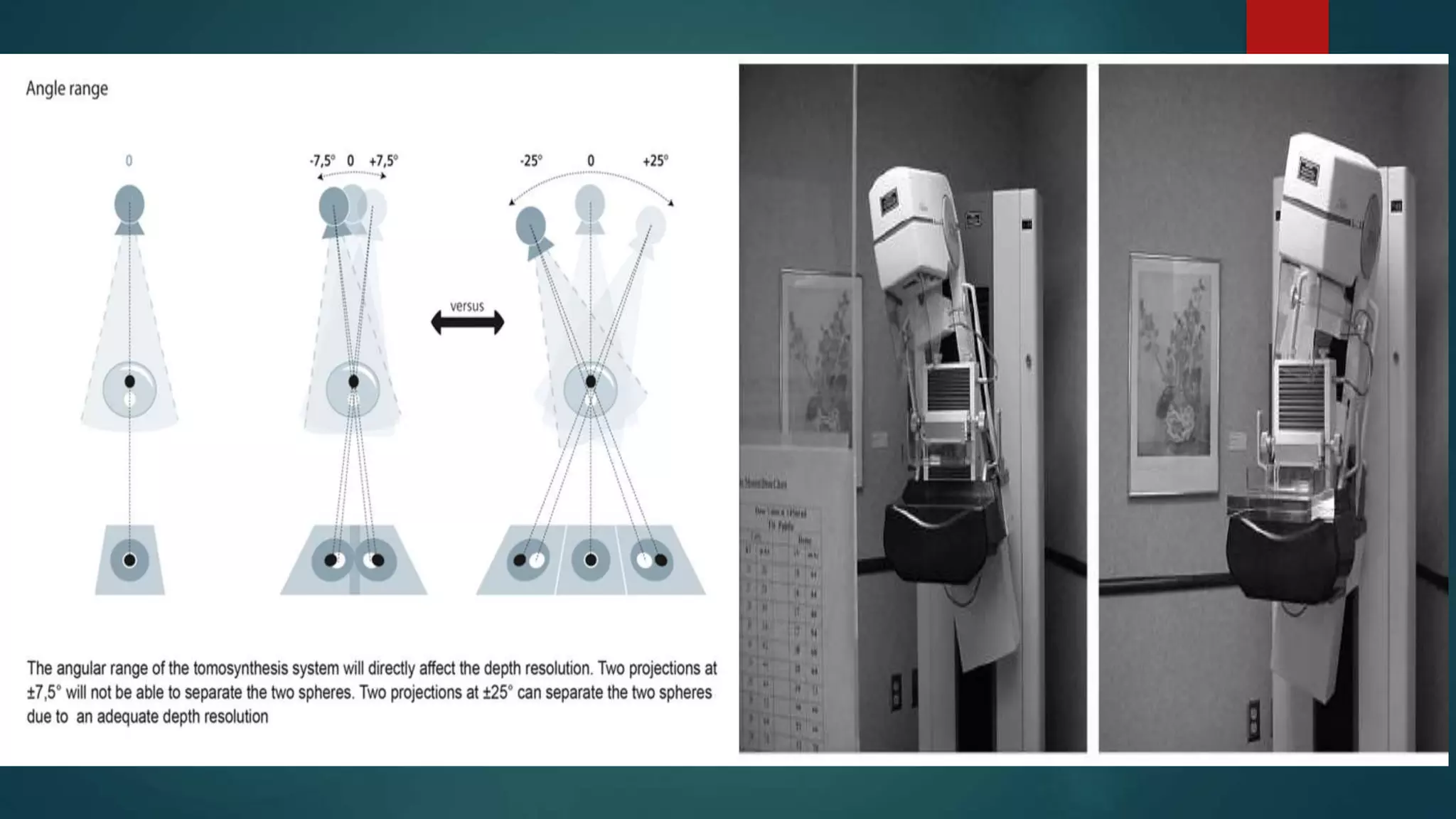
 The x-ray tube in a breast tomosynthesis system moves along an arc during exposure.
 An arc like linear motion is suitable for imaging of breast tissue because most normal
anatomic structures in the breast are oriented from the chest wall to the nipple.
 A wider angular range allows a thinner reconstructed section thickness of the in-focus
plane because objects in the different planes are less blurred on images acquired at a
smaller angle.
Normal lactiferous ducts are more prominently depicted on
the breast tomosynthesis image (arrows in a) than on the
digital mammogram (b).
Normal glandular tissues are more clearly depicted on the
breast tomosynthesis image (arrows in a) than on the digital
mammogram (b).
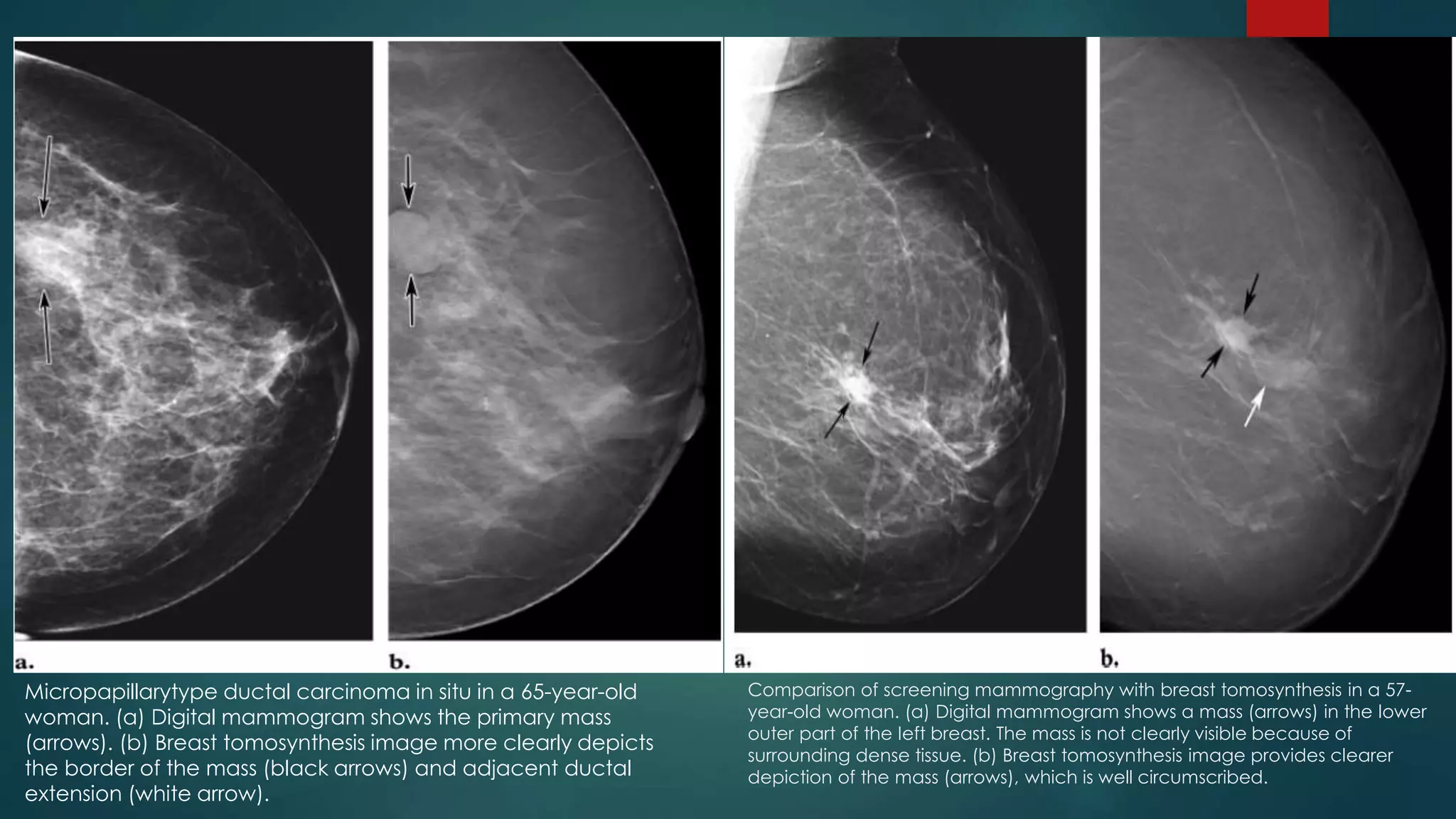
Comparison of screening mammography with breast tomosynthesis in a 57-
year-old woman. (a) Digital mammogram shows a mass (arrows) in the lower
outer part of the left breast. The mass is not clearly visible because of
surrounding dense tissue. (b) Breast tomosynthesis image provides clearer
depiction of the mass (arrows), which is well circumscribed.
Micropapillarytype ductal carcinoma in situ in a 65-year-old
woman. (a) Digital mammogram shows the primary mass
(arrows). (b) Breast tomosynthesis image more clearly depicts
the border of the mass (black arrows) and adjacent ductal
extension (white arrow).
Advantages
 Since it is an extension of digital tomography, it has the same advantages as that of
FFDM.
 Better depiction of the smallest calcifications
 The total radiation exposure to the patient from a two-view tomosynthesis acquisition is
similar to or less than that from conventional mammography.
 Better delineation of the lesion border results in a more definitive interpretation.
 Breast tomosynthesis requires less compression than does 2D mammography.
Disadvantages
 Special training of technologists is needed for positioning
 Motion artifacts are more likely to occur because of the slightly longer exposure time
 Large calcifications cause significant artifacts.
 Reconstructed images lengthens interpretation time for radiologists
Computerized Tomography Laser Mammography
 Is an optical tomographic technique for breast imaging.
 This medical imaging technique uses laser energy in the near infrared region of the spectrum, to detect
angiogenesis in the breast tissue
 It is optical molecular imaging for hemoglobin both oxygenated and deoxygenated.
 The technology uses laser in the same way computed tomography uses X-Rays, these beams travel
through tissue and suffer attenuation.
 A laser detector measures the intensity drop and the data is collected as the laser detector moves
across the breast creating a tomography image.
 CTLM is able to recognize malignant tumour from benign lesion
 CTLM images show hemoglobin distribution in a tissue and can detect areas of Angiogenesis
surrounding malignant tumors, that stimulate this angiogenesis to obtain nutrients for growth.
Computerized Tomography Laser Mammography
Scintimammography
 Scintimammography, also known as nuclear medicine breast imaging, is an examination that may be
used to investigate a breast abnormality that has been discovered on mammography.
 Scintimammography is also known as Breast Specific Gamma Imaging (BSGI) or Molecular Breast Imaging
(MBI).
 Done in those who had abnormal mammograms, or for those who have dense breast tissue, post-
operative scar tissue or breast implants.
 Patient receives an injection of a small amount of a radioactive substance called technetium 99
sestamibi, which is taken up by cancer cells, and a gamma camera is used to take pictures of the breasts.
 Also called a Miraluma test (when with sestamibi)[3] and sestamibi breast imaging.
 The procedure is less accurate in evaluating abnormalities smaller than one centimeter.
 Patient is exposed to slightly more radiation than mammography but has higher sensitivity and PPV than
conventional mammography.
Pre-therapy (early image A, delayed image B) and post-
therapy (early image C, delayed image D) 99mTC-sestamibi
studies of a patient who showed no response to chemotherapy
at pathologic examination. Pretherapy studies show evidence
of high 99mTC-sestamibi washout rate, predicting high MDR
expression. Image C confirms negative response to
chemotherapy; image D shows evident decrease in tracer
uptake.
Scintimammgraphy. Breast carcinoma in right and left side (black arrows) and
lymphonodal metastase (red arrow).
Optical Mammography
 Diffuse optical imaging is a set of non-invasive imaging modalities that use near-infrared light, which can
be an alternative, if not replacement, to those existing modalities.
 Such 3D maps of hemodynamic parameters serve as indicators of malignant tumors, as it is known that
tumor position is strongly correlated with total hemoglobin concentration via angiogenesis.
 Optical mammography uses near infrared light to scan breast tissue, then applies an algorithm to
interpret the image and information. The technique can measure differences in water and fats.
 The tool creates real-time images of metabolic changes, allowing the differentiation between oxygen-
rich and oxygen-poor tissue and varying levels of hemoglobin through differences in light absorption.
 Optical mammography is comparatively more comfortable with much less breast compression
compared to conventional mammography.
 There is a high acceptance of the technology from patients, mostly because of the lack of breast
compression and the lack of ionizing radiation and it has very high repeatability index.
Optical Mammography
Computer Aided Detection
Introduction
 Mammography has a low positive predictive value of 35% in detection of malignancies.
 But, due to the high number of mammograms to be read, the accuracy rate tends to decrease
 Double reading of mammograms has been proven to increase the accuracy, but at high cost
 CAD can assist the medical staff to achieve high efficiency and effectiveness
 Hence computer aided detection or CAD was developed to assist the radiologists, thereby reducing the
false positive rate.
 It is a two level reporting system.
 Helps to reduce interpretative or subjective errors.
Computer Aided Detection (contd.)
Functions
CAD is designed to detect , classify the clustered micro calcification and nodules.
Image segmentation : detection , extraction of clustered micro calcified nodules
from back ground breast tissue.
Extracted micro calcification nodules are categorized as benign or malignant (image
classification)
Computer Aided Detection (contd.)
Basic Components of the System
Mammogram Normalization
Mammogram Registration
Mammogram Subtraction
Feature Extraction
- Morphological Closing
- Morphological Opening
- Size Test
- Border Test
ROC/FROC Analysis
Computer Aided Detection (contd.)
Proposed Method
 The proposed method will assist the physician by providing a second opinion on
reading the mammogram, by pointing out area(s) that are different between the
right and left breasts
 If the two readings are similar, no more work is to be done
 If they are different, the radiologist will take a second look to make the final
diagnosis
Computer Aided Detection (contd.)
Data Used
The dataset used is the Mammographic Image Analysis Society (MIAS) MINIMIAS database
containing Medio-Lateral Oblique (MLO) views for each breast for 161 patients for a total of
322 images. Each image is 1024 pixels X 1024 pixels.
Normalization
The images were corrected/normalized to avoid differences in brightness between the
right and left mammograms.
Computer Aided Detection (contd.)
 Retrospective studies have shown the ability of CAD to mark cancers with a high degree
of accuracy, especially when microcalcifications are present.
 One study estimated that as many as 25% of cancers could have been detected an
average of 14 months sooner using CAD. In another retrospective review, the sensitivity of
CAD was 75% for masses and 99% for microcalcifications.
Positron Emission Mammography
 Positron emission mammography (PEM) has been approved by the US Food and Drug
Administration and introduced into clinical use as a diagnostic adjunct to
mammography and breast ultrasonography.
 PEM has higher resolution and a more localized field of view than positron emission
tomography–computed tomography and can be performed on patients to stage a
newly diagnosed malignancy.
 PEM uses a pair of dedicated gamma radiation detectors placed above and below the
breast and mild breast compression to detect coincident gamma rays after
administration of fluorine-18 fluorodeoxyglucose (18F-FDG)
 The principle behind this technology is that cancer cells demonstrate increased
utilization of glucose. Through use of isotope fluorine-18 attached to the delivery
compound deoxyglucose to produce the radiopharmaceutical 18F-FDG, this utilization
of glucose can be visualized.
Positron Emission Mammography
When is PEM advised?
 It is done after mammography or USG in following cases:
 Presence of mass lesions which are conspicuous
 Dense breasts where mammography and USG couldn’t delineate the lesion properly
 In breasts with diffuse calcifications
 In deformed breasts (post-op/post-RT)
 In lesions which couldn’t be classified according to BIRADS
 When MRI of breasts are contra-indicated
Positron Emission Mammography
Advantages
 Better delineation of lesion
 High positive predictive value for malignancies
 Reduced workload
 Helpful for pre-op assessment
 Has good pathological correlation
 Effective in follow up or in planning for RT
Disadvantages
 Higher radiation exposure
 Not recommended for screening purposes
 Low repeatability index
Automated Breast Ultrasound
 Also known as Automated 3D US Breast Volume Scanning (ABVS)
 Cross-correlation between multiplanar reconstructions
 Optimizes assessment and correlation with mammography and MRI
 Disconnection of image acquisition and assessment: suitable for double reading, screening and CAD
 Facilitates preoperative surgical planning: Lesion distance to nipple and skin; Indication and lesion
position.
 Doubles cancer detection from 3.6 to 7.2 per 1,000 compared with mammography alone in dense
breasts and triples detected invasive cancers < 10 mm
 US detects early-stage cancers in women with mammography-negative dense breasts
 Can be combined with MRI or mammography to reproduce fusion images.
Drawbacks and Limitations of ABUS
 Depth & focus are fixed
 Lymph node stations not reliably evaluable
 Doppler and elastography not possible
 Imaging artefacts
- Suboptimal contact (skin folds)
- Transducer movement (breathing)
- Skip artefact (superficially located tumors)
Breast MRI
 Also known as MR Mammography/MRM.
 It is a valuable tool to diagnose additional cancer in the same breast in up to one third of patients and
is recommended as a supplemental screening tool to mammography in women considered to be at
high risk for developing breast cancer.
 MRI is more sensitive an accurate than mammography and ultrasound in detection of invasive lobular
cancer, which occurs at a higher rate in women with a history of hormone replacement therapy.
 Dedicated bilateral breast surface coil (simultaneous examination of both breasts)
 Preoperative MRI more accurate in assessing tumor extent and multi-focality (incl. DCIS)
 MRI lowest FN rate in detecting ILC, highest accuracy in measuring the size
 MRM could detect extensive intraductal component (EIC): sensitivity 71%, specificity 85%, accuracy 76%
Fischer Scoring
Indications
 Malignancy (detection, prognosis, treatment monitoring)
 Axillary lymphadenopathy
 Screening of high-risk women
 Distinguishing of scar and recurrence
 Implant complications
 Biopsy of the malignant/benign lesion can be done at the same sitting.
 Further evaluating hard-to-assess abnormalities seen on mammography
 Evaluating lumpectomy sites in the years following breast cancer treatment
 Evaluating breast implants
Pitfalls
 MRI typically costs more and takes more time to perform than other imaging modalities.
 MRI persistently underestimate minimal residual disease
Electrical Impedance Scanning (EIS)
 T-scan (also called electrical impedance scanning or EIS) was approved by the U.S. Food and Drug
Administration (FDA) to be used as an adjunct tool to mammography in helping to detect breast
cancer.
 The T-scan measures low level bioelectric currents to produce real-time images of the electrical
impedance properties of the breast. The resulting impedance images of the breast tissue can be used
to help determine if the region of interest is normal tissue or a cancerous tumor.
 The T-scan works by creating an image "map" of the breast using a small electrical current.
 One-volt of continuous electricity (approximately the same as holding a flashlight battery by its ends) is
transmitted into the body, either through an electrode patch attached to the arm or a hand-held
cylinder.
 The electric current travels through the breast where it is then measured at skin level by a
probe placed on the breast.
 T-scan impedance imaging of the breast does not use radiation such as x-rays or
radionuclides, does not require compression of the breast, and does not require an injection
or biopsy sampling of the breast tissue via needle or surgical incision.
Conclusion
 Mammography still remains the basic breast imaging examination
 Digital mammography provides better visualization in dense breast
 DBT is an exciting prospect which will definitely improve the diagnosis
 MR Mammography is recommended in women with Lifetime risk of higher than 20%
 Tremendous advances are taking place in this field.
 We are heading towards non-radiating mammography which supplements and
compliments to regular mammography
 Technological advances in breast imaging, such as DBT, ultrasound and mri have
gained extensive acceptance, and have shown significant potential benefits in breast
cancer detection enhancing the diagnostic accuracy.
 Various attempts will be made in future to have mammography completely free of
radiation without compromising the information and image quality.
Refernces :
 Diekmann F., Bick U: "Tomosynthesis and contrast-enhanced digital mammography:
recent advances in digital mammography"; European Radiology; v.17:3086-3092
 Brem, R. et al : "Detection of Occult Foci of Breast Cancer Using Breast-Speci#c Gamma
Imaging in Women with One Mammographic or Clinically Suspicious Breast Lesion";
Acad Radiol; 17:735-743
 Dean, J. : "Using Automated Breast Ultrasound to Reduce or Eliminate Interval Cancers" in
www.diagnosticimaging.com
 Gennaro G. et al : "Digital breast tomosynthesis versus digital mammography: a clinical
performance study"; European Radiology; v.20:1545-1553.
 Weigert et al : "Results of a Multicenter Patient Registry to Determine the Clinical Impact
of Breast-Specific Gamma Imaging, a Molecular Breast Imaging Technique"; AJR:198.
 Potente, G. et al : "Practical application of contrast-enhanced magnetic resonance
mammography [CE-MRM] by an algorithm combining morphological and
enhancement patterns"; Computerized Medical Imaging and Graphics 33; 83-90.

Recent advances in Mammography

  • 1.
    Recent Advances in Mammography DR.SUHASB RESIDENT (MD RADIO-DIAGNOSIS)
  • 2.
    Brief History Concept ofusing x-ray to visualize breast tissue was first putforth by Dr.Albert Salomon, a German surgeon in 1913 In 1950’s Jacob Gershon began to advocate widespread use of x-rays for screening purpose. In December 2005 RSNA brings digital mammography to USA
  • 3.
    Introduction  Mammography isthe gold standard for detecting breast lesions.  However, modern mammography has only existed since about 1970, when the first dedicated mammography imaging systems became widely available.  There has been tremendous advancement in the technology so that today’s examination differs markedly even from those of the early 1980s.  Modern x-ray mammography uses dedicated systems (that is, a machine used only for breast x-rays) to produce x-rays that are high in quality but low in radiation dose.  Modern mammography systems are tightly monitored by the Mammography Quality Standard Act (MQSA)
  • 4.
  • 9.
  • 10.
    Magnification View  Magnifiesthe image by 1.5x to 2.0x  Increased effective resolution  Small focal spot size used (lower mA and longer exposure times)  Dose increased  Reduction of scatter
  • 11.
    Full Field DigitalMammography  Although film screen mammography were effective, according to various studies up to 20-30% of malignancies were missed by the regular film screen mammography.  One of the drawbacks of SFM is its contrast resolution. The breast is a difficult organ to image as it consists of tissues of contrasting densities; glandular tissue interspersed with fat.  It has been found that women with dense breasts have a four to six times higher risk of breast cancer compared to women with little or no glandular tissue. This is postulated to be due to the masking of existing lesions by the overlying breast tissue.  Therefore the sensitivity of mammography in detecting carcinoma in dense breasts is limited; a 62.9% reduction in sensitivity in dense breasts as compared to 87.0% in breasts with fatty involution  Hence digital mammography was introduced to achieve better imaging of breasts.
  • 12.
    Full Field DigitalMammography
  • 14.
  • 16.
    Full Field DigitalMammography (contd.)  It works like a DR system wherein the x-rays are directly converted into photons directly or through a scintillator (indirectly) and an electronic signal detector converts this light/photons into digitized form (binary system) to be read through an external device (CCD or Flat-panel)  When comparing DM to SFM, it was found that the overall diagnostic accuracy of both technologies in detecting breast cancer detection was similar  FFDM has a better signal to noise ratio than FSM.  Preferably uses W/Rh combination.  Near instantaneous image acquisition helps in cost cutting and time management.
  • 18.
    Above – Infiltratingductal cell carcinoma well appreciated in MLO with thickening of superficial skin Left – A rounded well defined calcified nodule in subcutaneous fat (CC view) Left - Nodule at right outer quadrant on right CC view (black arrow). (b) Magnification of the nodule shows a rim of lucent halo suggestive of a benign nodule
  • 19.
    Full Field DigitalMammography (contd.)  DM is able to capture areas of contrasting densities and display these regions without compromising the contrast resolution very much.  SFM boasts a high spatial resolution of approximately 16 linepairs per mm which enables detection of fine structures such as microcalcification.  The spatial resolution of DM, however, is limited by pixel size. Despite this limitation, it has been found that the detection of microcalcifications on DM is equal to, if not better than, that of SFM.  This is due to the increased contrast resolution of DM which enhances its ability to visualise small high-contrast structures such as microcalcification  There is a 45% reduction in the time taken to perform examinations and process images using DM when compared to SFM.
  • 20.
    Above image showsvery minute calcifications in an inverted digital image which are otherwise definitely missed and not even seen in SFM
  • 21.
    Advantages  Higher contrastresolution  Ability to manipulate to improve image quality and visibility  Reduced false positives and increased PPV  Fewer repeat exams for poor exposure. Hence high repeatability index.  Faster patient throughput  Eliminates processing issues  Simplifies storage and retrieval of images  Avails possibilities for remote assessing of the images  Significantly better image acquisition than SFM in women under 50 years, in pre and peri- menopausal women and in denser breasts.  Able to do stereotactic biopsy  Availability of CAD Disadvantages Expensive (>300,000$ per QALY gained) Less accurate in patients with fatty breasts
  • 22.
    Stereotactic or Mammography guided biopsyof suspicious mass using an automated vacuum powered device.
  • 23.
    Contrast Enhanced DigitalMammography CEDM is a recent development of digital mammography using the intra-venous injection of an iodinated contrast agent in conjunction with a mammography examination. Contrast-enhanced mammography is based on the principle that rapidly growing tumors require increased blood supply to support growth. The contrast agent preferentially accumulates in such areas, and contrast-enhanced mammography offers a method of imaging contrast distribution in breast tissue. This technique can increase mammographic lesion conspicuity
  • 24.
    Contrast Enhanced DigitalMammography Two techniques have been developed to perform CEDM examinations – 1. Temporal Subtraction :  Technique with acquisition of high-energy images before and after contrast medium injection.  The temporal subtraction technique offers the possibility to analyze the kinetic curve of enhancement of breast lesions.  A finite number of sequential images are obtained at a high energy, above the K-edge of Iodine, and with an intravenous non-ionic Iodine contrast agent.  The main disadvantages of this technique are that only a single breast can be imaged, patients have to maintain a particular position (usually MLO) for a prolonged period  Motion artifacts are more as breast is under compression when contrast arrives in the blood stream
  • 25.
    Contrast Enhanced DigitalMammography 2. Dual Energy CEDM  This is a technique based on dual-energy acquisitions, where two images are acquired using distinct low-energy (standard mammography kV and filtration) and high-energy (higher kV with strong filtration) X-ray spectra.  The differences between X-ray attenuation of iodine and breast tissues at these two energy levels are exploited to suppress the background breast tissue.  Dual-energy CEDM depicts areas in the breast associated with increased vascularity  2 min after the start of contrast injection that images are acquired.  Absence of compression during contrast injection also ensures non-occlusion of small tumor feeders and, hence, adequate uptake by even small lesions.  The procedure takes approximately 10 min and could be followed by either a stereotactic or an USG-guided biopsy in the same sitting.  The dual energy technique do not provide information about the kinetic of tumor enhancement but allows the acquisition of multiples views of the same breast or bilateral examination and is less sensitive to patient motion than temporal CEDM
  • 26.
    Post contrast imagesshow an enhancing lesion proved to be malignant on biopsy Post-contrast images show an enhancing lesion infero-medial quadrant - DCC
  • 28.
    Breast Tomosynthesis  Alsoknown as 3D mammography.  Its an extension of digital mammography  Breast tomosynthesis is a new tool that is based on the acquisition of three-dimensional digital image data, could help solve the problem of interpreting mammographic features produced by tissue overlap.  In breast tomosynthesis, a moving x-ray source and a digital detector are used.
  • 29.
    Breast Tomosynthesis (contd.) The x-ray tube in a breast tomosynthesis system moves along an arc during exposure.  An arc like linear motion is suitable for imaging of breast tissue because most normal anatomic structures in the breast are oriented from the chest wall to the nipple.  A wider angular range allows a thinner reconstructed section thickness of the in-focus plane because objects in the different planes are less blurred on images acquired at a smaller angle.
  • 32.
    Normal lactiferous ductsare more prominently depicted on the breast tomosynthesis image (arrows in a) than on the digital mammogram (b). Normal glandular tissues are more clearly depicted on the breast tomosynthesis image (arrows in a) than on the digital mammogram (b).
  • 33.
    Comparison of screeningmammography with breast tomosynthesis in a 57- year-old woman. (a) Digital mammogram shows a mass (arrows) in the lower outer part of the left breast. The mass is not clearly visible because of surrounding dense tissue. (b) Breast tomosynthesis image provides clearer depiction of the mass (arrows), which is well circumscribed. Micropapillarytype ductal carcinoma in situ in a 65-year-old woman. (a) Digital mammogram shows the primary mass (arrows). (b) Breast tomosynthesis image more clearly depicts the border of the mass (black arrows) and adjacent ductal extension (white arrow).
  • 34.
    Advantages  Since itis an extension of digital tomography, it has the same advantages as that of FFDM.  Better depiction of the smallest calcifications  The total radiation exposure to the patient from a two-view tomosynthesis acquisition is similar to or less than that from conventional mammography.  Better delineation of the lesion border results in a more definitive interpretation.  Breast tomosynthesis requires less compression than does 2D mammography. Disadvantages  Special training of technologists is needed for positioning  Motion artifacts are more likely to occur because of the slightly longer exposure time  Large calcifications cause significant artifacts.  Reconstructed images lengthens interpretation time for radiologists
  • 35.
    Computerized Tomography LaserMammography  Is an optical tomographic technique for breast imaging.  This medical imaging technique uses laser energy in the near infrared region of the spectrum, to detect angiogenesis in the breast tissue  It is optical molecular imaging for hemoglobin both oxygenated and deoxygenated.  The technology uses laser in the same way computed tomography uses X-Rays, these beams travel through tissue and suffer attenuation.  A laser detector measures the intensity drop and the data is collected as the laser detector moves across the breast creating a tomography image.  CTLM is able to recognize malignant tumour from benign lesion  CTLM images show hemoglobin distribution in a tissue and can detect areas of Angiogenesis surrounding malignant tumors, that stimulate this angiogenesis to obtain nutrients for growth.
  • 36.
  • 38.
    Scintimammography  Scintimammography, alsoknown as nuclear medicine breast imaging, is an examination that may be used to investigate a breast abnormality that has been discovered on mammography.  Scintimammography is also known as Breast Specific Gamma Imaging (BSGI) or Molecular Breast Imaging (MBI).  Done in those who had abnormal mammograms, or for those who have dense breast tissue, post- operative scar tissue or breast implants.  Patient receives an injection of a small amount of a radioactive substance called technetium 99 sestamibi, which is taken up by cancer cells, and a gamma camera is used to take pictures of the breasts.  Also called a Miraluma test (when with sestamibi)[3] and sestamibi breast imaging.  The procedure is less accurate in evaluating abnormalities smaller than one centimeter.  Patient is exposed to slightly more radiation than mammography but has higher sensitivity and PPV than conventional mammography.
  • 39.
    Pre-therapy (early imageA, delayed image B) and post- therapy (early image C, delayed image D) 99mTC-sestamibi studies of a patient who showed no response to chemotherapy at pathologic examination. Pretherapy studies show evidence of high 99mTC-sestamibi washout rate, predicting high MDR expression. Image C confirms negative response to chemotherapy; image D shows evident decrease in tracer uptake.
  • 40.
    Scintimammgraphy. Breast carcinomain right and left side (black arrows) and lymphonodal metastase (red arrow).
  • 41.
    Optical Mammography  Diffuseoptical imaging is a set of non-invasive imaging modalities that use near-infrared light, which can be an alternative, if not replacement, to those existing modalities.  Such 3D maps of hemodynamic parameters serve as indicators of malignant tumors, as it is known that tumor position is strongly correlated with total hemoglobin concentration via angiogenesis.  Optical mammography uses near infrared light to scan breast tissue, then applies an algorithm to interpret the image and information. The technique can measure differences in water and fats.  The tool creates real-time images of metabolic changes, allowing the differentiation between oxygen- rich and oxygen-poor tissue and varying levels of hemoglobin through differences in light absorption.  Optical mammography is comparatively more comfortable with much less breast compression compared to conventional mammography.  There is a high acceptance of the technology from patients, mostly because of the lack of breast compression and the lack of ionizing radiation and it has very high repeatability index.
  • 42.
  • 44.
    Computer Aided Detection Introduction Mammography has a low positive predictive value of 35% in detection of malignancies.  But, due to the high number of mammograms to be read, the accuracy rate tends to decrease  Double reading of mammograms has been proven to increase the accuracy, but at high cost  CAD can assist the medical staff to achieve high efficiency and effectiveness  Hence computer aided detection or CAD was developed to assist the radiologists, thereby reducing the false positive rate.  It is a two level reporting system.  Helps to reduce interpretative or subjective errors.
  • 45.
    Computer Aided Detection(contd.) Functions CAD is designed to detect , classify the clustered micro calcification and nodules. Image segmentation : detection , extraction of clustered micro calcified nodules from back ground breast tissue. Extracted micro calcification nodules are categorized as benign or malignant (image classification)
  • 46.
    Computer Aided Detection(contd.) Basic Components of the System Mammogram Normalization Mammogram Registration Mammogram Subtraction Feature Extraction - Morphological Closing - Morphological Opening - Size Test - Border Test ROC/FROC Analysis
  • 47.
    Computer Aided Detection(contd.) Proposed Method  The proposed method will assist the physician by providing a second opinion on reading the mammogram, by pointing out area(s) that are different between the right and left breasts  If the two readings are similar, no more work is to be done  If they are different, the radiologist will take a second look to make the final diagnosis
  • 48.
    Computer Aided Detection(contd.) Data Used The dataset used is the Mammographic Image Analysis Society (MIAS) MINIMIAS database containing Medio-Lateral Oblique (MLO) views for each breast for 161 patients for a total of 322 images. Each image is 1024 pixels X 1024 pixels. Normalization The images were corrected/normalized to avoid differences in brightness between the right and left mammograms.
  • 50.
    Computer Aided Detection(contd.)  Retrospective studies have shown the ability of CAD to mark cancers with a high degree of accuracy, especially when microcalcifications are present.  One study estimated that as many as 25% of cancers could have been detected an average of 14 months sooner using CAD. In another retrospective review, the sensitivity of CAD was 75% for masses and 99% for microcalcifications.
  • 51.
    Positron Emission Mammography Positron emission mammography (PEM) has been approved by the US Food and Drug Administration and introduced into clinical use as a diagnostic adjunct to mammography and breast ultrasonography.  PEM has higher resolution and a more localized field of view than positron emission tomography–computed tomography and can be performed on patients to stage a newly diagnosed malignancy.  PEM uses a pair of dedicated gamma radiation detectors placed above and below the breast and mild breast compression to detect coincident gamma rays after administration of fluorine-18 fluorodeoxyglucose (18F-FDG)  The principle behind this technology is that cancer cells demonstrate increased utilization of glucose. Through use of isotope fluorine-18 attached to the delivery compound deoxyglucose to produce the radiopharmaceutical 18F-FDG, this utilization of glucose can be visualized.
  • 52.
    Positron Emission Mammography Whenis PEM advised?  It is done after mammography or USG in following cases:  Presence of mass lesions which are conspicuous  Dense breasts where mammography and USG couldn’t delineate the lesion properly  In breasts with diffuse calcifications  In deformed breasts (post-op/post-RT)  In lesions which couldn’t be classified according to BIRADS  When MRI of breasts are contra-indicated
  • 55.
    Positron Emission Mammography Advantages Better delineation of lesion  High positive predictive value for malignancies  Reduced workload  Helpful for pre-op assessment  Has good pathological correlation  Effective in follow up or in planning for RT Disadvantages  Higher radiation exposure  Not recommended for screening purposes  Low repeatability index
  • 56.
    Automated Breast Ultrasound Also known as Automated 3D US Breast Volume Scanning (ABVS)  Cross-correlation between multiplanar reconstructions  Optimizes assessment and correlation with mammography and MRI  Disconnection of image acquisition and assessment: suitable for double reading, screening and CAD  Facilitates preoperative surgical planning: Lesion distance to nipple and skin; Indication and lesion position.  Doubles cancer detection from 3.6 to 7.2 per 1,000 compared with mammography alone in dense breasts and triples detected invasive cancers < 10 mm  US detects early-stage cancers in women with mammography-negative dense breasts  Can be combined with MRI or mammography to reproduce fusion images.
  • 59.
    Drawbacks and Limitationsof ABUS  Depth & focus are fixed  Lymph node stations not reliably evaluable  Doppler and elastography not possible  Imaging artefacts - Suboptimal contact (skin folds) - Transducer movement (breathing) - Skip artefact (superficially located tumors)
  • 60.
    Breast MRI  Alsoknown as MR Mammography/MRM.  It is a valuable tool to diagnose additional cancer in the same breast in up to one third of patients and is recommended as a supplemental screening tool to mammography in women considered to be at high risk for developing breast cancer.  MRI is more sensitive an accurate than mammography and ultrasound in detection of invasive lobular cancer, which occurs at a higher rate in women with a history of hormone replacement therapy.  Dedicated bilateral breast surface coil (simultaneous examination of both breasts)  Preoperative MRI more accurate in assessing tumor extent and multi-focality (incl. DCIS)  MRI lowest FN rate in detecting ILC, highest accuracy in measuring the size  MRM could detect extensive intraductal component (EIC): sensitivity 71%, specificity 85%, accuracy 76%
  • 63.
  • 64.
    Indications  Malignancy (detection,prognosis, treatment monitoring)  Axillary lymphadenopathy  Screening of high-risk women  Distinguishing of scar and recurrence  Implant complications  Biopsy of the malignant/benign lesion can be done at the same sitting.  Further evaluating hard-to-assess abnormalities seen on mammography  Evaluating lumpectomy sites in the years following breast cancer treatment  Evaluating breast implants Pitfalls  MRI typically costs more and takes more time to perform than other imaging modalities.  MRI persistently underestimate minimal residual disease
  • 66.
    Electrical Impedance Scanning(EIS)  T-scan (also called electrical impedance scanning or EIS) was approved by the U.S. Food and Drug Administration (FDA) to be used as an adjunct tool to mammography in helping to detect breast cancer.  The T-scan measures low level bioelectric currents to produce real-time images of the electrical impedance properties of the breast. The resulting impedance images of the breast tissue can be used to help determine if the region of interest is normal tissue or a cancerous tumor.  The T-scan works by creating an image "map" of the breast using a small electrical current.  One-volt of continuous electricity (approximately the same as holding a flashlight battery by its ends) is transmitted into the body, either through an electrode patch attached to the arm or a hand-held cylinder.  The electric current travels through the breast where it is then measured at skin level by a probe placed on the breast.  T-scan impedance imaging of the breast does not use radiation such as x-rays or radionuclides, does not require compression of the breast, and does not require an injection or biopsy sampling of the breast tissue via needle or surgical incision.
  • 68.
    Conclusion  Mammography stillremains the basic breast imaging examination  Digital mammography provides better visualization in dense breast  DBT is an exciting prospect which will definitely improve the diagnosis  MR Mammography is recommended in women with Lifetime risk of higher than 20%  Tremendous advances are taking place in this field.  We are heading towards non-radiating mammography which supplements and compliments to regular mammography  Technological advances in breast imaging, such as DBT, ultrasound and mri have gained extensive acceptance, and have shown significant potential benefits in breast cancer detection enhancing the diagnostic accuracy.  Various attempts will be made in future to have mammography completely free of radiation without compromising the information and image quality.
  • 69.
    Refernces :  DiekmannF., Bick U: "Tomosynthesis and contrast-enhanced digital mammography: recent advances in digital mammography"; European Radiology; v.17:3086-3092  Brem, R. et al : "Detection of Occult Foci of Breast Cancer Using Breast-Speci#c Gamma Imaging in Women with One Mammographic or Clinically Suspicious Breast Lesion"; Acad Radiol; 17:735-743  Dean, J. : "Using Automated Breast Ultrasound to Reduce or Eliminate Interval Cancers" in www.diagnosticimaging.com  Gennaro G. et al : "Digital breast tomosynthesis versus digital mammography: a clinical performance study"; European Radiology; v.20:1545-1553.  Weigert et al : "Results of a Multicenter Patient Registry to Determine the Clinical Impact of Breast-Specific Gamma Imaging, a Molecular Breast Imaging Technique"; AJR:198.  Potente, G. et al : "Practical application of contrast-enhanced magnetic resonance mammography [CE-MRM] by an algorithm combining morphological and enhancement patterns"; Computerized Medical Imaging and Graphics 33; 83-90.