Mammography Physics
Jerry Allison, Ph.D.
Department of Radiology and Imaging
Medical College of Georgia
Augusta University
Augusta, GA
Educational Objectives
Our educational objectives are to understand:
1. Why pay special attention to mammography physics?
2. Radiation Risk/Benefit Issues
3. Physical principles of mammography
4. Physical principles of full field digital mammography
(FFDM): 2D
5. Technical Details of Digital Breast Tomosynthesis
(DBT): 3D
Why pay special attention
to mammography physics?
• Approximately 1 of 8 women will
develop breast cancer over a lifetime.
• 10-30% of women who have breast
cancer have negative mammograms.
• ~80% of masses biopsied are not
malignant (fibroadenomas, small
papillomas, proliferating dysplasia).
Radiation Risk/Benefit Issues
• Radiation is a carcinogen (ionizing radiation, x-
radiation, radiation: National Toxicology Program 2004)
• "No woman has been shown to have developed breast
cancer as a result of mammography, not even from
multiple studies performed over many years with doses
higher than the current dose (~250 mRad)... However
the possibility of such risk has been raised because of
excessive incidence of breast cancer in women exposed
to much higher doses (100-2000 Rad: Japanese A-bomb
survivors, TB patients having chest fluoro and
postpartum mastitis patients treated w/radiation
therapy).” ©1992 RSNA
• Radiation treatment of Hodgkin lymphoma associated
with radiation induced breast cancer
©NCRP 2006 (Report 149)
Risk/Benefit
©1992 RSNA
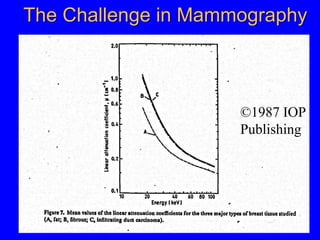
©1987 IOP
Publishing
The Challenge in Mammography
• X-ray spectral distribution is determined by:
– kV
– target/filter combination
– Mo/Mo, Mo/Rh, Rh/Rh for GE
– Mo/Mo, Mo/Rh, W/Rh for Siemens
– Mo/Mo, Mo/Rh or W/Rh, W/Ag for Hologic
– W/Rh, W/Ag, W/Al for Hologic DBT Tomo
– W/Rh for Giotto
– W/Rh for Fuji Saphire HD
– W/Rh, W/Ag for Planmed
– W/Al for Philips
X-ray Spectra in Mammography
X-ray spectra are variable
Compression (Redistribution?)
©1994 Williams & Wilkins
Scatter
Geometric blurring
Superposition
Increases the proportion of
the X-ray beam that is used
to image a breast
Motion
Beam hardening
Dose
Scattered Radiation Control
• Linear Grids
– Grid ratio (height of lamina/distance between
laminae): 4:1 or 5:1 w/ 30-40 lines/cm.
– Conventional grids are 8:1 to 12:1 (up to 43
lines/cm).
– Breast dose is increased by grids (Bucky Factor:
x2 to x3) w/40% improvement in contrast.
– Laminae are focused to the focal spot to prevent
grid cut off.
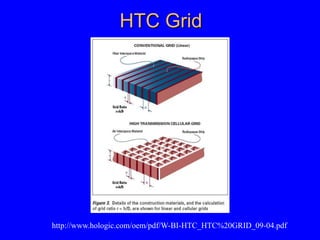
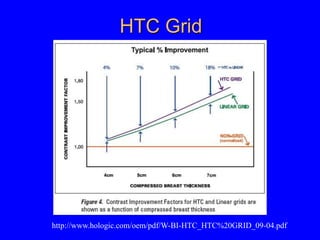
• High Transmission Cellular (HTC) Grids
– Focused
– Increased 2D absorption of scattered radiation
– Increase contrast
– Must move the grid a very precise distance
during exposure regardless of exposure duration
– Essentially same grid ratio and dose as
conventional linear grids
Scattered Radiation Control
HTC Grid
http://www.hologic.com/oem/pdf/W-BI-HTC_HTC%20GRID_09-04.pdf
HTC Grid
http://www.hologic.com/oem/pdf/W-BI-HTC_HTC%20GRID_09-04.pdf
Magnification Mammography
• Magnification factor: x1.5 – x2.0
• Increases the size of the projected
anatomical structures compared
with the noise of the image
• Valuable for visualization of
calcifications and spiculations.
©1994 Williams & Wilkins
Magnification
• Spot compression paddles
http://www.americanmammographics.com/mammopads.htm
Magnification
• Reduction of effective image noise (less
quantum noise, more photons per object
area)
• Air gap between breast and image
receptor reduces scattered radiation
without attenuating primary photons or
increasing radiation dose (no grid!)
• Small focal spot: 0.1 - 0.15mm (low
mA, long exposure times)
• Increased dose (x2-x3)
©1994 Williams & Wilkins
Focal Spot and MTF
Dose Limits
 FDA Dose limit for screening
mammograms
– 3 mGy (w/grid)
 Mean glandular dose
 Single view
 4.5cm compressed breast
 Average composition
Physical Principles of Full Field
Digital Mammography (FFDM): 2D
• FFDM Technologies
– Direct detectors
– Indirect detectors
– Computed radiography (CR)
– Slit scanning technology
Certification statistics
August 6, 2018
http://www.fda.gov/Radiation-
EmittingProducts/MammographyQualityStandardsActandProgram/FacilityScorec
ard/ucm113858.htm
• Total certified facilities / Total accredited units
• 8,688 / 19,242
• Certified facilities with FFDM units /
Accredited FFDM units
• 8,622 / 12,817
• Certified facilities with DBT units /
Accredited DBT units
• 4,526 / 6,341
“INDIRECT” Detectors (GE)
• Scintillating phosphor (CsI columns) on an array of amorphous silicon
photodiodes using thin-film transistor (TFT) flat panel technology (GE)
– ~100 micron pixels, ~5 lp/mm
“DIRECT” Detectors (Siemens, Hologic, Giotto, Planmed, Fuji)
• Amorphous selenium (direct conversion)
• (TFT) flat panel technology
• ~70-85 micron pixels , ~7 lp/mm
• Direct optical switching technology (Fuji Aspire HD))
• ~50 micron pixels , ~10 lp/mm
Computed radiography (Fuji, Carestream, Agfa, Konica, iCRco)
– ~50 micron pixels, ~10 lp/mm
– ~100 micron pixels, ~5 lp/mm
Slit scanning technology (Philips)
– ~50 micron pixels, ~10 lp/mm
FFDM Technologies
Does pixel size matter?
• As pixel size decreases:
– Spatial resolution improves
– Noise increases
– Signal-to-noise decreases
• Yet another set of imaging tradeoffs
Independent (“Indirect”) Conversion:
CsI Converter + aSi Substrate Sensor
Matrix
Blocking
Layer
CsI
X-Ray Photons
Light
Photodiode Photodiode
Electrons
Read Out Electronics
X-ray
Digital
Data
2,600+
Volts
Electrode
Dielectric
Digital
Data
Electrons
X-Ray Photons
Selenium
K-edge
Fluoresence
Electrons
Read Out Electronics
X-ray
Electrode
Capacitor
Dependent (“Direct”) Conversion:
aSe Converter + aSi Substrate Sensor
Matrix
Detector Technology Overview
Courtesy: Jill Spear, GE Women’s Healthcare
Fuji CR Digital Mammography
• Deleted (obsolete)
Slit Scanning Technology
• Philips MicroDose
• 650 installed worldwide (June 2015)
• 35 installed USA (June 2015)
Slit Scanning Technology
• Slit Scanning
Technology
(multi-slit)
http://incenter.medical.philips.com/doclib/enc/fetch/2000/4504/577242/577260/593280/593
431/8477093/Photon_Counting_White_Paper.pdf%3fnodeid%3d8477094%26vernum%3d1
• X-ray generates electron-hole pairs
creating a short electrical signal
Philips MicroDose
• Multi-slit scanning (~ 26 slits)
• Pre & post collimation
• Photon counting
• 50 micron pixels
• Silicon strip detectors (tapered toward
focal spot)
• Mean glandular dose ~50% of other FFDM
approaches
Philips Micro Dose
• 3-15 sec exposures
• Can sort photon events into high energy
and low energy (spectral imaging) for
quantitative breast density measurements
Breast Dose in FFDM
• Systems display breast dose with image
– Mean Glandular Dose < 3 mGy
– Dose recorded in DICOM image header
 Entrance skin exposure and/or mean glandular dose
 Vendors use different dose calculation algorithms
• Dance
• Wu & Barnes
• U.S. Method
• As of the 3.4.2 software upgrade, Hologic “follows
the latest EUREF adopted method if the system is set
up to use EUREF dose calculation”
http://www.fda.gov/Radiation-
EmittingProducts/MammographyQualityStandardsActandProgram/FacilityCertificationandInspectio
n/ucm114148.htm
• FDAApproved DBT Units
• Hologic Selenia Dimensions Digital Breast
Tomosynthesis (DBT) System on 2/11/11
• GE SenoClaire Digital Breast Tomosynthesis
(DBT) System on 8/26/14
• Siemens Mammomat Inspiration with
Tomosynthesis Option (DBT) System on 4/21/15
• Fujifilm ASPIRE Cristalle on 1/10/17
• GE Senpgraphe Pristina on 3/3/2017
Technical Details of Digital Breast
Tomosynthesis (DBT)
Breast tomosynthesis
Hologic Selenia Dimensions
http://www.hologic.com/data/WP-00007_Tomo_08-08.pdf
Cone Beam Breast CT
 University of Rochester
 300 views
 10 seconds
http://www.hologic.com/data/WP-00007_Tomo_08-08.pdf
Breast tomosynthesis
©www.hologic.com/data/W-BI-001_EmergTech_08-06.pdf
Breast tomosynthesis
http://www.hologic.com/data/WP-00007_Tomo_08-08.pdf
DQE in Breast Tomosynthesis
• Mean glandular dose (MGD) for tomosynthesis
is expected to be the same as for projection
mammography (< 300 mRad)
• Since breast tomosynthesis requires several
exposures (e.g.15), low exposure DQE
performance of digital detectors used in breast
tomosynthesis is important
• A grid might not be used in breast
tomosynthesis, which reduces dose (x2 – x3)
Characteristics: DBT Breast Tomo
• Tiling of very large breasts (more than one view to
cover very large breasts) may not work since tissue
outside of FOV can cause artifacts
Characteristics: Hologic DBT Breast Tomo
Modes/ views:
• 2D: one conventional FFDM image
• 3D Tomo: 15 views used to reconstruct
tomographic slices
• Combo: acquisition of both 2D and 3D tomo (still
< 3 mGy)
• Synthetic view: reconstruction of a pseudo
projection mammogram from a stack of
tomographic images
Characteristics: Hologic DBT Breast Tomo
• Data acquisition (tomo)
– 15 discrete views (exposures)
– Limited arc (± 7.5 degrees)
– 4 sec
• Anode
– Tungsten
Characteristics: Hologic DBT Breast Tomo
• Filters
– Rh: for 2D only
– Ag: for 2D only (thick/dense breasts)
– Al: for 3D tomo only
• Density control
– None
• No grid during tomo
• No MAGnification in tomo
Characteristics: Hologic DBT Breast Tomo
• Pixel binning
– In 3D tomo mode, pixels are “binned” into groups
of 2x2 pixels (140 micron pitch)
• Reconstruction
– 1 mm thick
– Number of tomo images: (compressed breast
thickness/ 1mm => 40 – 80)
• Interpretation
– 1mm tomographic slices
– 15 individual projection views (good for motion
detection)
– May also have a conventional 2D view and/or
synthetic view
Hologic DBT MGD
• 2D: 1.2 mGy
• 3D Tomo: 1.45 mGy
• Combo*: 2.65 mGy
*Combo: 2D and 3D tomo of the same
breast view (e.g. MLO)
Characteristics: DBT Breast Tomo
DBT System
General
Electric
Essential
Hologic
Selenia
Dimensions
Siemens
Mammomat
Inspiration
Type of geometry Full-field Full-field Full-field
Detector type
Energy
integrating
Energy
integrating
Energy
integrating
Detector material CsI-Si a-Se a-Se
Detector element size
(μm) 100 70 85
Focal plane pixel size 100 95-117 85
X-ray tube motion
Step-and
shoot Continuous Continuous
Target Mo/Rh W W
Filter
Mo: 30μm
Rh: 25 μm Al: 700 μm Rh: 50 μm
Angular range 25 15 50
Number of projection
images 9 15 25
Source to detector
distance (mm) 660 700 655
Distance between
detector and centre of
rotation (mm) 40 0 47
Reconstruction
algoorithm Iterative
Filtered back
projection? Analytic
Grid used for tomo yes no
no (scatter
correction
software)
Detector binning for
tomo no yes ?
References
– ©NCRP 2006
NCRP Report 149, “A Guide to Mammography and Other
Breast Imaging Procedures” National Council on Radiation
Protection and Measurements, 2004
– ©1994 Williams & Wilkins
Bushberg, JT, Seibert, JA, Leidholdt, EM Jr., Boone, JM, ”The
Essential Physics of Medical Imaging” Williams & Wilkins,
Baltimore, Maryland, 1994
– ©1993 RSNA
Haus, AG, Yaffe, MJ, Eds., “Syllabus: A Categorical Course
in Physics Technical Aspects of Breast Imaging”, 2nd
Edition, RSNA, 1993
– ©1992 RSNA
Haus, AG, Yaffe, MJ, Eds., “Syllabus: A Categorical Course
in Physics Technical Aspects of Breast Imaging”, RSNA,
1992
– ©1987 IOP Publishing
Johns, PC, Yaffe, MJ, “X-Ray characterisation 675-695
of normal and neoplastic breast tissues”, Phys Med Biol, 1987,
32,

mammophysics.ppt

  • 1.
    Mammography Physics Jerry Allison,Ph.D. Department of Radiology and Imaging Medical College of Georgia Augusta University Augusta, GA
  • 2.
    Educational Objectives Our educationalobjectives are to understand: 1. Why pay special attention to mammography physics? 2. Radiation Risk/Benefit Issues 3. Physical principles of mammography 4. Physical principles of full field digital mammography (FFDM): 2D 5. Technical Details of Digital Breast Tomosynthesis (DBT): 3D
  • 3.
    Why pay specialattention to mammography physics? • Approximately 1 of 8 women will develop breast cancer over a lifetime. • 10-30% of women who have breast cancer have negative mammograms. • ~80% of masses biopsied are not malignant (fibroadenomas, small papillomas, proliferating dysplasia).
  • 4.
    Radiation Risk/Benefit Issues •Radiation is a carcinogen (ionizing radiation, x- radiation, radiation: National Toxicology Program 2004) • "No woman has been shown to have developed breast cancer as a result of mammography, not even from multiple studies performed over many years with doses higher than the current dose (~250 mRad)... However the possibility of such risk has been raised because of excessive incidence of breast cancer in women exposed to much higher doses (100-2000 Rad: Japanese A-bomb survivors, TB patients having chest fluoro and postpartum mastitis patients treated w/radiation therapy).” ©1992 RSNA • Radiation treatment of Hodgkin lymphoma associated with radiation induced breast cancer
  • 5.
    ©NCRP 2006 (Report149) Risk/Benefit
  • 6.
  • 7.
  • 8.
    • X-ray spectraldistribution is determined by: – kV – target/filter combination – Mo/Mo, Mo/Rh, Rh/Rh for GE – Mo/Mo, Mo/Rh, W/Rh for Siemens – Mo/Mo, Mo/Rh or W/Rh, W/Ag for Hologic – W/Rh, W/Ag, W/Al for Hologic DBT Tomo – W/Rh for Giotto – W/Rh for Fuji Saphire HD – W/Rh, W/Ag for Planmed – W/Al for Philips X-ray Spectra in Mammography
  • 9.
  • 10.
    Compression (Redistribution?) ©1994 Williams& Wilkins Scatter Geometric blurring Superposition Increases the proportion of the X-ray beam that is used to image a breast Motion Beam hardening Dose
  • 11.
    Scattered Radiation Control •Linear Grids – Grid ratio (height of lamina/distance between laminae): 4:1 or 5:1 w/ 30-40 lines/cm. – Conventional grids are 8:1 to 12:1 (up to 43 lines/cm). – Breast dose is increased by grids (Bucky Factor: x2 to x3) w/40% improvement in contrast. – Laminae are focused to the focal spot to prevent grid cut off.
  • 12.
    • High TransmissionCellular (HTC) Grids – Focused – Increased 2D absorption of scattered radiation – Increase contrast – Must move the grid a very precise distance during exposure regardless of exposure duration – Essentially same grid ratio and dose as conventional linear grids Scattered Radiation Control
  • 13.
  • 14.
  • 15.
    Magnification Mammography • Magnificationfactor: x1.5 – x2.0 • Increases the size of the projected anatomical structures compared with the noise of the image • Valuable for visualization of calcifications and spiculations.
  • 16.
  • 17.
    Magnification • Spot compressionpaddles http://www.americanmammographics.com/mammopads.htm
  • 18.
    Magnification • Reduction ofeffective image noise (less quantum noise, more photons per object area) • Air gap between breast and image receptor reduces scattered radiation without attenuating primary photons or increasing radiation dose (no grid!) • Small focal spot: 0.1 - 0.15mm (low mA, long exposure times) • Increased dose (x2-x3)
  • 19.
    ©1994 Williams &Wilkins Focal Spot and MTF
  • 20.
    Dose Limits  FDADose limit for screening mammograms – 3 mGy (w/grid)  Mean glandular dose  Single view  4.5cm compressed breast  Average composition
  • 21.
    Physical Principles ofFull Field Digital Mammography (FFDM): 2D • FFDM Technologies – Direct detectors – Indirect detectors – Computed radiography (CR) – Slit scanning technology
  • 22.
    Certification statistics August 6,2018 http://www.fda.gov/Radiation- EmittingProducts/MammographyQualityStandardsActandProgram/FacilityScorec ard/ucm113858.htm • Total certified facilities / Total accredited units • 8,688 / 19,242 • Certified facilities with FFDM units / Accredited FFDM units • 8,622 / 12,817 • Certified facilities with DBT units / Accredited DBT units • 4,526 / 6,341
  • 23.
    “INDIRECT” Detectors (GE) •Scintillating phosphor (CsI columns) on an array of amorphous silicon photodiodes using thin-film transistor (TFT) flat panel technology (GE) – ~100 micron pixels, ~5 lp/mm “DIRECT” Detectors (Siemens, Hologic, Giotto, Planmed, Fuji) • Amorphous selenium (direct conversion) • (TFT) flat panel technology • ~70-85 micron pixels , ~7 lp/mm • Direct optical switching technology (Fuji Aspire HD)) • ~50 micron pixels , ~10 lp/mm Computed radiography (Fuji, Carestream, Agfa, Konica, iCRco) – ~50 micron pixels, ~10 lp/mm – ~100 micron pixels, ~5 lp/mm Slit scanning technology (Philips) – ~50 micron pixels, ~10 lp/mm FFDM Technologies
  • 24.
    Does pixel sizematter? • As pixel size decreases: – Spatial resolution improves – Noise increases – Signal-to-noise decreases • Yet another set of imaging tradeoffs
  • 25.
    Independent (“Indirect”) Conversion: CsIConverter + aSi Substrate Sensor Matrix Blocking Layer CsI X-Ray Photons Light Photodiode Photodiode Electrons Read Out Electronics X-ray Digital Data 2,600+ Volts Electrode Dielectric Digital Data Electrons X-Ray Photons Selenium K-edge Fluoresence Electrons Read Out Electronics X-ray Electrode Capacitor Dependent (“Direct”) Conversion: aSe Converter + aSi Substrate Sensor Matrix Detector Technology Overview Courtesy: Jill Spear, GE Women’s Healthcare
  • 26.
    Fuji CR DigitalMammography • Deleted (obsolete)
  • 27.
    Slit Scanning Technology •Philips MicroDose • 650 installed worldwide (June 2015) • 35 installed USA (June 2015)
  • 28.
    Slit Scanning Technology •Slit Scanning Technology (multi-slit) http://incenter.medical.philips.com/doclib/enc/fetch/2000/4504/577242/577260/593280/593 431/8477093/Photon_Counting_White_Paper.pdf%3fnodeid%3d8477094%26vernum%3d1 • X-ray generates electron-hole pairs creating a short electrical signal
  • 29.
    Philips MicroDose • Multi-slitscanning (~ 26 slits) • Pre & post collimation • Photon counting • 50 micron pixels • Silicon strip detectors (tapered toward focal spot) • Mean glandular dose ~50% of other FFDM approaches
  • 30.
    Philips Micro Dose •3-15 sec exposures • Can sort photon events into high energy and low energy (spectral imaging) for quantitative breast density measurements
  • 31.
    Breast Dose inFFDM • Systems display breast dose with image – Mean Glandular Dose < 3 mGy – Dose recorded in DICOM image header  Entrance skin exposure and/or mean glandular dose  Vendors use different dose calculation algorithms • Dance • Wu & Barnes • U.S. Method • As of the 3.4.2 software upgrade, Hologic “follows the latest EUREF adopted method if the system is set up to use EUREF dose calculation”
  • 32.
    http://www.fda.gov/Radiation- EmittingProducts/MammographyQualityStandardsActandProgram/FacilityCertificationandInspectio n/ucm114148.htm • FDAApproved DBTUnits • Hologic Selenia Dimensions Digital Breast Tomosynthesis (DBT) System on 2/11/11 • GE SenoClaire Digital Breast Tomosynthesis (DBT) System on 8/26/14 • Siemens Mammomat Inspiration with Tomosynthesis Option (DBT) System on 4/21/15 • Fujifilm ASPIRE Cristalle on 1/10/17 • GE Senpgraphe Pristina on 3/3/2017 Technical Details of Digital Breast Tomosynthesis (DBT)
  • 33.
    Breast tomosynthesis Hologic SeleniaDimensions http://www.hologic.com/data/WP-00007_Tomo_08-08.pdf
  • 34.
    Cone Beam BreastCT  University of Rochester  300 views  10 seconds http://www.hologic.com/data/WP-00007_Tomo_08-08.pdf
  • 35.
  • 36.
  • 37.
    DQE in BreastTomosynthesis • Mean glandular dose (MGD) for tomosynthesis is expected to be the same as for projection mammography (< 300 mRad) • Since breast tomosynthesis requires several exposures (e.g.15), low exposure DQE performance of digital detectors used in breast tomosynthesis is important • A grid might not be used in breast tomosynthesis, which reduces dose (x2 – x3)
  • 38.
    Characteristics: DBT BreastTomo • Tiling of very large breasts (more than one view to cover very large breasts) may not work since tissue outside of FOV can cause artifacts
  • 39.
    Characteristics: Hologic DBTBreast Tomo Modes/ views: • 2D: one conventional FFDM image • 3D Tomo: 15 views used to reconstruct tomographic slices • Combo: acquisition of both 2D and 3D tomo (still < 3 mGy) • Synthetic view: reconstruction of a pseudo projection mammogram from a stack of tomographic images
  • 40.
    Characteristics: Hologic DBTBreast Tomo • Data acquisition (tomo) – 15 discrete views (exposures) – Limited arc (± 7.5 degrees) – 4 sec • Anode – Tungsten
  • 41.
    Characteristics: Hologic DBTBreast Tomo • Filters – Rh: for 2D only – Ag: for 2D only (thick/dense breasts) – Al: for 3D tomo only • Density control – None • No grid during tomo • No MAGnification in tomo
  • 42.
    Characteristics: Hologic DBTBreast Tomo • Pixel binning – In 3D tomo mode, pixels are “binned” into groups of 2x2 pixels (140 micron pitch) • Reconstruction – 1 mm thick – Number of tomo images: (compressed breast thickness/ 1mm => 40 – 80) • Interpretation – 1mm tomographic slices – 15 individual projection views (good for motion detection) – May also have a conventional 2D view and/or synthetic view
  • 43.
    Hologic DBT MGD •2D: 1.2 mGy • 3D Tomo: 1.45 mGy • Combo*: 2.65 mGy *Combo: 2D and 3D tomo of the same breast view (e.g. MLO)
  • 44.
    Characteristics: DBT BreastTomo DBT System General Electric Essential Hologic Selenia Dimensions Siemens Mammomat Inspiration Type of geometry Full-field Full-field Full-field Detector type Energy integrating Energy integrating Energy integrating Detector material CsI-Si a-Se a-Se Detector element size (μm) 100 70 85 Focal plane pixel size 100 95-117 85 X-ray tube motion Step-and shoot Continuous Continuous Target Mo/Rh W W Filter Mo: 30μm Rh: 25 μm Al: 700 μm Rh: 50 μm Angular range 25 15 50 Number of projection images 9 15 25 Source to detector distance (mm) 660 700 655 Distance between detector and centre of rotation (mm) 40 0 47 Reconstruction algoorithm Iterative Filtered back projection? Analytic Grid used for tomo yes no no (scatter correction software) Detector binning for tomo no yes ?
  • 45.
    References – ©NCRP 2006 NCRPReport 149, “A Guide to Mammography and Other Breast Imaging Procedures” National Council on Radiation Protection and Measurements, 2004 – ©1994 Williams & Wilkins Bushberg, JT, Seibert, JA, Leidholdt, EM Jr., Boone, JM, ”The Essential Physics of Medical Imaging” Williams & Wilkins, Baltimore, Maryland, 1994 – ©1993 RSNA Haus, AG, Yaffe, MJ, Eds., “Syllabus: A Categorical Course in Physics Technical Aspects of Breast Imaging”, 2nd Edition, RSNA, 1993 – ©1992 RSNA Haus, AG, Yaffe, MJ, Eds., “Syllabus: A Categorical Course in Physics Technical Aspects of Breast Imaging”, RSNA, 1992 – ©1987 IOP Publishing Johns, PC, Yaffe, MJ, “X-Ray characterisation 675-695 of normal and neoplastic breast tissues”, Phys Med Biol, 1987, 32,