Portable ct scanner and
mobile ct scanner
Dr anil
INTRODUCTION
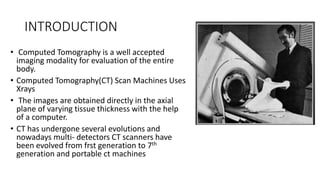
• Computed Tomography is a well accepted
imaging modality for evaluation of the entire
body.
• Computed Tomography(CT) Scan Machines Uses
Xrays
• The images are obtained directly in the axial
plane of varying tissue thickness with the help
of a computer.
• CT has undergone several evolutions and
nowadays multi- detectors CT scanners have
been evolved from frst generation to 7th
generation and portable ct machines
Advancement in ct
• Mobile ct unit
• Portable ct
• A mobile or portable CT is, technologically, the same as a
fixed CT.
• they have similar image quality nwhen compared to a fixed
CT machine.
• Portable CT scanners are designed to be moved from room-
to-room
• "mobile" CT machines are the same as what would be in a
fixed location. Mobile CT scanners are "fixed" inside a trailer
that is equipped with proper shielding.
Mobile CT scanner unit
• Mobile CT scanners are "fixed" inside a trailer that is equipped
with proper shielding.
• The trailer provides heating and air conditioning, which allows it
to operate in many different weather conditions.
• Mobile units typically withstand in external conditions of -20°F
to 110°F, relying on air-conditioning, heating, and humidification
units to maintain proper environmental conditions inside the
trailer.
• Maintenance of a mobile CT is a key factor due to the stresses
in moving the system in a trailer of torque, vibration, shock,
vertical and lateral movement.
Mobile ct unit
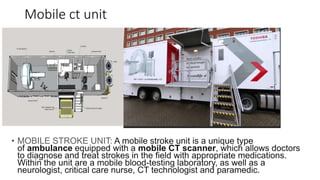
• MOBILE STROKE UNIT: A mobile stroke unit is a unique type
of ambulance equipped with a mobile CT scanner, which allows doctors
to diagnose and treat strokes in the field with appropriate medications.
Within the unit are a mobile blood-testing laboratory, as well as a
neurologist, critical care nurse, CT technologist and paramedic.
Mobile CT Advantages
•Shared costs and services between multiple
sites(hospitals/branches)
•Less travel for patients
•Decreased preinstallation costs
•Increased revenue and ability to justify the purchase by receiving
revenue from multiple clinics or hospitals
•Ability to alter locations based on patient volume. Flexible fixed
schedule and/or on-demand
•Dramatically shorter installation time with fewer logistics issues.
•Lower initial investment
MOBILE CT MACHINE
• Mobile CT Disadvantages
• More frequent maintenance
• Not advantageous for sites that may need emergency scans
because it's possible the unit will be at a different location
• Transportation costs: Driver's salary, fuel (including generator
fuel), mileage, and insurance, which are not associated with a
fixed site
• Increased downtime for site travel and more frequent
maintenance and quality assurance checks
• Limited interior space and increased claustrophobia incidents
types
• Head ct scanner
• Full body ct scanner
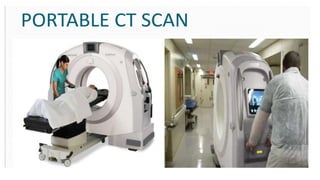
portable ct scanner
• Principle : Mdct
• significantly smaller than a traditional scanner
• Motorised trolley
• Gantry size : small for head ct , large for full body ct scanner
• Detachable table and gantry for full body scanner
• Limited gantry movement(disadv)
• Detector type varies with company
• Self shielded detector system.
• Image quality similar to conventional ct
• Point of care imaging
• Reduced overall scanning time by reducing transport time
• Reduced manpower
• Cost effective
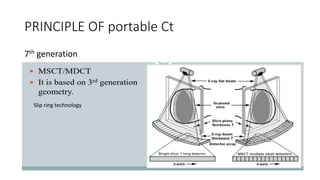
PRINCIPLE OF portable Ct
7th generation
Slip ring technology
MULTISLICE/MULTIDETECTOR CT
• In MDCT, a two-dimensional array of detector elements replaces the
linear array of detector elements used in typical conventional and
helical CT scanners.
• The twodimensional detector array permits CT scanners to acquire
multiple slices or sections simultaneously and greatly increase the
speed of CT image acquisition.
Advantage of MDCT
• The latest breakthrough in CT technology.
• The primary difference between single-slice CT (SSCT) and MDCT
hardware is in the design of the detector arrays.
• Faster Gantry rotation(sub second).
• Fast Data Acquisition System.
• High Speed image reconstruction system.
• Multiple reconstruction technique
Indication / area of research of portable ct
• reduces complications associated with patient transports to the
radiology department
• Performing CT scans of the head at the patient's bedside helps
physicians to reach fast treatment decision
• Portable CT improves patient care by providing fast scanning with early
diagnosis and timely proper management in Neurosurgical patients,
particularly of severe head injury
• The portable CT is strongly recommended for any high volume
neurosurgery department
• Portable CT Increases Chance of Stroke Survival and Recovery if used in
emergency department.
• This setup is currently being evaluated for use in a more extensive
range of procedural applications, including a promising role in image-
guided surgery of the head and neck
• image guidance of brachytherapy; external beam radition therapy;
and applications in spinal, orthopedic, thoracic, and abdominal
surgeries.
• The use of this technology for interventional radiologic procedures,
including neurointerventional ones in an ICU
Available potable CT scanners
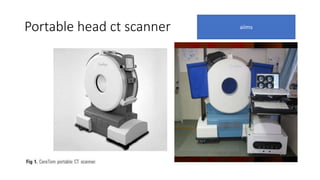
Portable head ct scanner aiims
CereTom
• The is significantly smaller than a traditional scanner
• with a height of 153 cm, a length of 134 cm, and a width of 73 cm.
• This machine weighs 800 lb (362.87 kg) and requires a single technician for its
transport.
• Typical scanning parameters are 120 kV, 7 mA, and a scanning time of 2 seconds.
• Reconstructed section thicknesses are 1.25 mm in CT angiography, 5 mm for
head scans, and 10 mm for perfusion imaging.
• can be used to perform CT scanning with and without contrast, CT angiography,
CT perfusion, and CT fluoroscopy.
• It has potential application in several small-room environments, including clinics,
critical care departments, departments of surgery, and emergency departments.
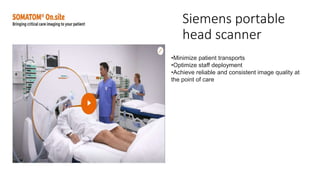
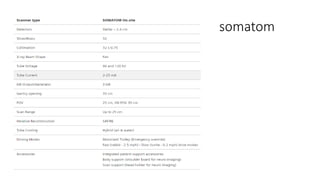
Siemens portable
head scanner
•Minimize patient transports
•Optimize staff deployment
•Achieve reliable and consistent image quality at
the point of care
somatom
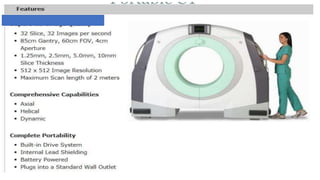
PORTABLE full body CT SCAN
• As the world’s first portable, full-body, 32-slice CT (computed tomography)
scanner, BodyTom is a multi-departmental imaging solution capable of
transforming any room in the hospital into an advanced imaging suite. ]
• The system boasts an 85cm gantry and 60cm field of view, the largest field
of view available in a portable CT scanner.
• The battery-powered BodyTom with an internal drive system can easily be
transported from room to room and is compatible with PACS, planning
systems, surgical and robotic navigation systems
• Uniquely designed to accommodate patients of all sizes, BodyTom
provides point-of-care CT imaging wherever highquality CT images are
needed, including the operating room, intensive care unit, radiation
oncology suites, and the emergency department
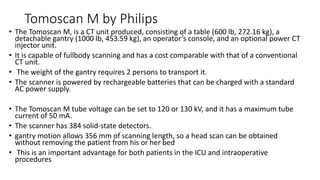
Tomoscan M by Philips
• The Tomoscan M, is a CT unit produced, consisting of a table (600 lb, 272.16 kg), a
detachable gantry (1000 lb, 453.59 kg), an operator’s console, and an optional power CT
injector unit.
• It is capable of fullbody scanning and has a cost comparable with that of a conventional
CT unit.
• The weight of the gantry requires 2 persons to transport it.
• The scanner is powered by rechargeable batteries that can be charged with a standard
AC power supply.
• The Tomoscan M tube voltage can be set to 120 or 130 kV, and it has a maximum tube
current of 50 mA.
• The scanner has 384 solid-state detectors.
• gantry motion allows 356 mm of scanning length, so a head scan can be obtained
without removing the patient from his or her bed
• This is an important advantage for both patients in the ICU and intraoperative
procedures
Portable Abdominal CT : Tomoscan M (Philips
Medical Systems)
:
Radiation concerns
• Icu settings where patients are in close proximity, increasing the
radiation dose might be prohibitive due to concerns about the
radiation exposure of staff and other patients.
• the quality of images acquired with a level of radiation comparable to
that of standard scanners was reduced
• Inbuilt radiation protection
• Detachable lead shielding for gantry
• Use of personal radiation safety equipments.
Portable ct summary
• Mdct
• significantly smaller than a traditional scanner
• Two types : head ct and full body scanner
• Gantry size small for head ct , large for full body ct scanner
• Detachable table and gantry for full body scanner
• Limited gantry movement
• Detector type varies with company
• Image quality similar to conventional ct
• Self shielded detector system
• Point of care imaging
• Reduced overall scanning time by reducing transport time
• Reduced manpower
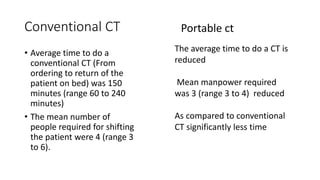
Conventional CT
• Average time to do a
conventional CT (From
ordering to return of the
patient on bed) was 150
minutes (range 60 to 240
minutes)
• The mean number of
people required for shifting
the patient were 4 (range 3
to 6).
Portable ct
The average time to do a CT is
reduced
Mean manpower required
was 3 (range 3 to 4) reduced
As compared to conventional
CT significantly less time
• thankyou
Ref,
• RSNA Press Release Portable CT Increases Chance of Stroke Survival
and Recovery
• Portable Abdominal CT: Analysis of Quality and Clinical Impact
• Review of Portable CT with Assessment of a Dedicated Head CT
Scanner
• Technical assessment of a mobile CT scanner for image‐ guided
brachytherapy

Portable ct mobile ct

  • 1.
    Portable ct scannerand mobile ct scanner Dr anil
  • 2.
    INTRODUCTION • Computed Tomographyis a well accepted imaging modality for evaluation of the entire body. • Computed Tomography(CT) Scan Machines Uses Xrays • The images are obtained directly in the axial plane of varying tissue thickness with the help of a computer. • CT has undergone several evolutions and nowadays multi- detectors CT scanners have been evolved from frst generation to 7th generation and portable ct machines
  • 4.
    Advancement in ct •Mobile ct unit • Portable ct
  • 5.
    • A mobileor portable CT is, technologically, the same as a fixed CT. • they have similar image quality nwhen compared to a fixed CT machine. • Portable CT scanners are designed to be moved from room- to-room • "mobile" CT machines are the same as what would be in a fixed location. Mobile CT scanners are "fixed" inside a trailer that is equipped with proper shielding.
  • 6.
    Mobile CT scannerunit • Mobile CT scanners are "fixed" inside a trailer that is equipped with proper shielding. • The trailer provides heating and air conditioning, which allows it to operate in many different weather conditions. • Mobile units typically withstand in external conditions of -20°F to 110°F, relying on air-conditioning, heating, and humidification units to maintain proper environmental conditions inside the trailer. • Maintenance of a mobile CT is a key factor due to the stresses in moving the system in a trailer of torque, vibration, shock, vertical and lateral movement.
  • 7.
    Mobile ct unit •MOBILE STROKE UNIT: A mobile stroke unit is a unique type of ambulance equipped with a mobile CT scanner, which allows doctors to diagnose and treat strokes in the field with appropriate medications. Within the unit are a mobile blood-testing laboratory, as well as a neurologist, critical care nurse, CT technologist and paramedic.
  • 8.
    Mobile CT Advantages •Sharedcosts and services between multiple sites(hospitals/branches) •Less travel for patients •Decreased preinstallation costs •Increased revenue and ability to justify the purchase by receiving revenue from multiple clinics or hospitals •Ability to alter locations based on patient volume. Flexible fixed schedule and/or on-demand •Dramatically shorter installation time with fewer logistics issues. •Lower initial investment
  • 9.
    MOBILE CT MACHINE •Mobile CT Disadvantages • More frequent maintenance • Not advantageous for sites that may need emergency scans because it's possible the unit will be at a different location • Transportation costs: Driver's salary, fuel (including generator fuel), mileage, and insurance, which are not associated with a fixed site • Increased downtime for site travel and more frequent maintenance and quality assurance checks • Limited interior space and increased claustrophobia incidents
  • 11.
    types • Head ctscanner • Full body ct scanner
  • 12.
    portable ct scanner •Principle : Mdct • significantly smaller than a traditional scanner • Motorised trolley • Gantry size : small for head ct , large for full body ct scanner • Detachable table and gantry for full body scanner • Limited gantry movement(disadv) • Detector type varies with company • Self shielded detector system. • Image quality similar to conventional ct • Point of care imaging • Reduced overall scanning time by reducing transport time • Reduced manpower • Cost effective
  • 13.
    PRINCIPLE OF portableCt 7th generation Slip ring technology
  • 14.
    MULTISLICE/MULTIDETECTOR CT • InMDCT, a two-dimensional array of detector elements replaces the linear array of detector elements used in typical conventional and helical CT scanners. • The twodimensional detector array permits CT scanners to acquire multiple slices or sections simultaneously and greatly increase the speed of CT image acquisition.
  • 15.
    Advantage of MDCT •The latest breakthrough in CT technology. • The primary difference between single-slice CT (SSCT) and MDCT hardware is in the design of the detector arrays. • Faster Gantry rotation(sub second). • Fast Data Acquisition System. • High Speed image reconstruction system. • Multiple reconstruction technique
  • 16.
    Indication / areaof research of portable ct • reduces complications associated with patient transports to the radiology department • Performing CT scans of the head at the patient's bedside helps physicians to reach fast treatment decision • Portable CT improves patient care by providing fast scanning with early diagnosis and timely proper management in Neurosurgical patients, particularly of severe head injury • The portable CT is strongly recommended for any high volume neurosurgery department • Portable CT Increases Chance of Stroke Survival and Recovery if used in emergency department.
  • 17.
    • This setupis currently being evaluated for use in a more extensive range of procedural applications, including a promising role in image- guided surgery of the head and neck • image guidance of brachytherapy; external beam radition therapy; and applications in spinal, orthopedic, thoracic, and abdominal surgeries. • The use of this technology for interventional radiologic procedures, including neurointerventional ones in an ICU
  • 18.
  • 19.
    Portable head ctscanner aiims
  • 20.
    CereTom • The issignificantly smaller than a traditional scanner • with a height of 153 cm, a length of 134 cm, and a width of 73 cm. • This machine weighs 800 lb (362.87 kg) and requires a single technician for its transport. • Typical scanning parameters are 120 kV, 7 mA, and a scanning time of 2 seconds. • Reconstructed section thicknesses are 1.25 mm in CT angiography, 5 mm for head scans, and 10 mm for perfusion imaging. • can be used to perform CT scanning with and without contrast, CT angiography, CT perfusion, and CT fluoroscopy. • It has potential application in several small-room environments, including clinics, critical care departments, departments of surgery, and emergency departments.
  • 22.
    Siemens portable head scanner •Minimizepatient transports •Optimize staff deployment •Achieve reliable and consistent image quality at the point of care
  • 24.
  • 25.
    PORTABLE full bodyCT SCAN • As the world’s first portable, full-body, 32-slice CT (computed tomography) scanner, BodyTom is a multi-departmental imaging solution capable of transforming any room in the hospital into an advanced imaging suite. ] • The system boasts an 85cm gantry and 60cm field of view, the largest field of view available in a portable CT scanner. • The battery-powered BodyTom with an internal drive system can easily be transported from room to room and is compatible with PACS, planning systems, surgical and robotic navigation systems • Uniquely designed to accommodate patients of all sizes, BodyTom provides point-of-care CT imaging wherever highquality CT images are needed, including the operating room, intensive care unit, radiation oncology suites, and the emergency department
  • 27.
    Tomoscan M byPhilips • The Tomoscan M, is a CT unit produced, consisting of a table (600 lb, 272.16 kg), a detachable gantry (1000 lb, 453.59 kg), an operator’s console, and an optional power CT injector unit. • It is capable of fullbody scanning and has a cost comparable with that of a conventional CT unit. • The weight of the gantry requires 2 persons to transport it. • The scanner is powered by rechargeable batteries that can be charged with a standard AC power supply. • The Tomoscan M tube voltage can be set to 120 or 130 kV, and it has a maximum tube current of 50 mA. • The scanner has 384 solid-state detectors. • gantry motion allows 356 mm of scanning length, so a head scan can be obtained without removing the patient from his or her bed • This is an important advantage for both patients in the ICU and intraoperative procedures
  • 28.
    Portable Abdominal CT: Tomoscan M (Philips Medical Systems) :
  • 29.
    Radiation concerns • Icusettings where patients are in close proximity, increasing the radiation dose might be prohibitive due to concerns about the radiation exposure of staff and other patients. • the quality of images acquired with a level of radiation comparable to that of standard scanners was reduced • Inbuilt radiation protection • Detachable lead shielding for gantry • Use of personal radiation safety equipments.
  • 30.
    Portable ct summary •Mdct • significantly smaller than a traditional scanner • Two types : head ct and full body scanner • Gantry size small for head ct , large for full body ct scanner • Detachable table and gantry for full body scanner • Limited gantry movement • Detector type varies with company • Image quality similar to conventional ct • Self shielded detector system • Point of care imaging • Reduced overall scanning time by reducing transport time • Reduced manpower
  • 31.
    Conventional CT • Averagetime to do a conventional CT (From ordering to return of the patient on bed) was 150 minutes (range 60 to 240 minutes) • The mean number of people required for shifting the patient were 4 (range 3 to 6). Portable ct The average time to do a CT is reduced Mean manpower required was 3 (range 3 to 4) reduced As compared to conventional CT significantly less time
  • 32.
  • 33.
    Ref, • RSNA PressRelease Portable CT Increases Chance of Stroke Survival and Recovery • Portable Abdominal CT: Analysis of Quality and Clinical Impact • Review of Portable CT with Assessment of a Dedicated Head CT Scanner • Technical assessment of a mobile CT scanner for image‐ guided brachytherapy