MAMMOGRAPHY
DR. BRIBIN BRIGHT
MAMMOGRAPHY - INDICATIONS
 Screening of asymptomatic women.
 Screening of high risk women.
 Follow up of patients after mastectomy of same and opposite breast / same breast with implant
 Investigations of benign breast diseases with eczematous skin,nipple discharge , skin thickening .
 Investigation of a breast lump.
 Investigation of occult primary with secondaries .
 Male breast evaluation .
TYPE OF MAMMOGRAPHIC EXAMINATION
 Diagnostic mammography
Is performed on patients with symptoms or elevated risk factors.
Two or three views of each breast may be required.
 Screening mammography
Is performed on asymptomatic women with the use of a two view protocol,
usually medial lateral oblique and cranio caudal , to detect on unsuspected cancer
MAMMOGRAPHY - BASICS
 Uses low-energy x-rays (40kVp) for dectecting breast pathologies.
 Higher kV - Poor Contrast
Lower kV - Good Contrast
 Tissues within breast have very small difference in attenuation property - Lacks contrast
 <40kVp - Good photoelectric effect - brings out contrast between the tissues within the breasts.
 Better contrast
Better detailing of structures
INSTRUMENTATIONS
 HIGH FREQUENCY X-RAY GENERATOR
 X-RAYTUBE
 ANODE
 CATHODE
 BEAM PORT
 K-EDGE FILTERS
 COMPRESSION PADDLE
 SPOT COMPRESSION
 PARALLEL LINEAR GRID
 IMAGE RECEPTOR
 AEC (AUTOMATIC EXPOSURE CONTROL)
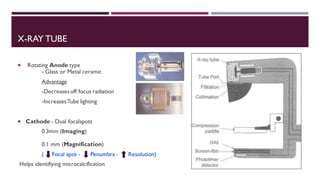
X-RAY TUBE
 Rotating Anode type
- Glass or Metal ceramic
Advantage
-Decreases off focus radiation
-IncreasesTube lighting
 Cathode - Dual focalspots
0.3mm (Imaging)
0.1 mm (Magnification)
( Focal spot - Penumbra - Resolution)
Helps identifiying microcalcification
ANODE (TARGET)
Usually-Tungsten (xray /Floro/ CT/ cathlab)
 MOLYBDENUM -17.5 & 19.6 keV
 RHODIUM -20.2 & 22.7 keV
 CHARACTERISTIC RADIATION
Characteristic x-ray Characteristic x-rays are produced after ionization of a k- shell electron.When an outer-shell
electron fills the vacancy in the k shell, an x-ray is emitted.
In mammography,17.5- 19.5kev characteristic x-ray is produced with Mo and 23kev is produced with Rh
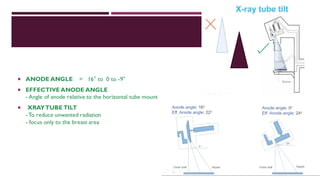
 ANODE ANGLE = 16° to 0 to -9°
 EFFECTIVE ANODE ANGLE
- Angle of anode relative to the horizontal tube mount
 XRAYTUBE TILT
-To reduce unwanted radiation
- focus only to the breast area
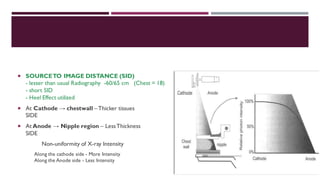
 SOURCETO IMAGE DISTANCE (SID)
- lesser than usual Radiography -60/65 cm (Chest = 18)
- short SID
- Heel Effect utilized
 At Cathode → chestwall – Thicker tissues
SIDE
 At Anode → Nipple region – LessThickness
SIDE
Non-uniformity of X-ray Intensity
Along the cathode side - More Intensity
Along the Anode side - Less Intensity
PARTS OF MAMMOGRAPHY EQUIPMENT
 Beam port - 1 mm Beryllium
Since metal/ Glass is used in XRAYTUBE
metal will absorb the low energy photons from xray tube
 K-edge filters - Cuts unwanted Low energy photons (RADIATION)
/ High energy photons (SCATTER – Reduces contrast)
(0.03mm Mo / 0.025mm Rh)
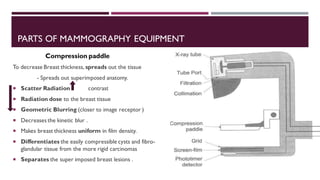
PARTS OF MAMMOGRAPHY EQUIPMENT
To decrease Breast thickness, spreads out the tissue
- Spreads out superimposed anatomy.
 Scatter Radiation - contrast
 Radiation dose to the breast tissue
 Geometric Blurring (closer to image receptor )
 Decreases the kinetic blur .
 Makes breast thickness uniform in film density.
 Differentiates the easily compressible cysts and fibro-
glandular tissue from the more rigid carcinomas
 Separates the super imposed breast lesions .
Compression paddle
PARTS OF MAMMOGRAPHY EQUIPMENT
 GRIDS
 Stationary grids or grids placed in between the screen and the film are no longer used as the thin grid lines
compromised on the quality of the image .
 Covered tiny details such as microcalcifications
 Hence oscillating grids are used o Grid ratio of 4 :1 or 5 : 1
 The grid lines are eliminated by the motion of the grid .
 Grids improve the image quality and cause a significant reduction
PARTS OF MAMMOGRAPHY EQUIPMENT
 Spot.compression - for imaging particular region
 Parallel Linear grid - (4:1 to 5:1) low grade ratio grids used
to increase the Contrast
 Image Receptor
Screen film
CR Cassette
Flat panel detector - (Digital Mammography)
 AEC -Automatic Exposure Control
KeV selected → MAS automatically chosen.
FLAT PANEL DETECTORS - INDIRECT
Indirect Amorphous silicon technology
 Xray scintillator (Gradoliniun Sulphate / Csl)
Produces light flashes when Xray beam falls over it.
 Silicon Photodiode array (Photo detector)
Made of Amorphous silicon
Converts light photons from the scintillator into electrical signal
 TFT-electronic switch
- Reads electrical signal
- Gives positional information
-This data is sent to AEC (Analogue to Digital Converter)
 AEC
Converts it into digital signal and are finally sent to Computer for processing
 Disadvantage - LIGHT SCATTER
Scattering of light within the phosphors leading to unsharpness
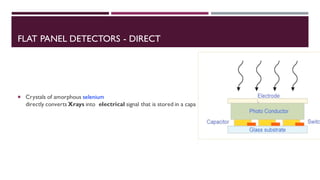
FLAT PANEL DETECTORS - DIRECT
 Crystals of amorphous selenium
directly converts Xrays into electrical signal that is stored in a capacitor (ready to be read)
MAGNIFICATION TECHNIQUE
 To increase the visibility of finer details like microcalcification
Increase O ID - object to Image Distance
Breast is kept over a raised platform
No need for grid as there is presence of air gap
SCREEN FILM MAMMOGRAPHY
 Old method
 The image is created directly on a film-Non modifiable
 Less sensitive for women with dense breasts
 Screen film cassette used
Single emulsion film
Single screen
Terbium activated Gadolinium oxysulphide
Screen emits green light
Film will be sensitive to greenlight (ORTHOCHROMATIC FILM)
COMPUTER RADIOGRAPHY (CR) MAMMOGRAPHY
 A/K/A Filmless radiography
Electronic radiography
Digital storage phosphor imaging
 Xray images are acquired in digital format
 Photostimulable phosphor plates used
 Imaging plate has high sensitivity to xrays
 COMPONENTS
 storage phosphor cassette
 Storage phosphor reader
 Bar code scanner
 Workstation
Photostimuliable Phosphor (PSP) Cassette
PSP Receptor materials
. BaFBr : Eu2+
. BaF (Br1): Eu 2+
.Ba SrFBr:Eu 2+
DIGITAL MAMMOGRAPHY
 Also called full-field digital mammography (FFDM)
-in which the x-ray film is replaced by electronics that convert x-rays into mammographic pictures of the breast.
Display Monitor - HIGH RESOLUTION (5 MP)
 Direct Digital Mammography
- Flat panel detector with amorphous selenium array
 Indirect Digital Mammography
-Flat panel scintillator with amorphous silicon diode array
DIGITAL MAMMOGRAPHY
 ADVANTAGE
Better contrast,more details.Better delineation of parenchyma & subcutaneous tissue
Better noise level reduction
Tolerance to over/under exposure (Avoids Repetition?
Post-processing techniques for better diagnosis
Radiation dose is decreased- Mean glandular dose in mammography
Screen Film (2-3m bGy)
Digital (20-30% reduction)
Image can be seen quickly and stored digitally(less storage space )
LIMITATIONS OF 2D MAMMOGRAPHY
 20% of cancers will be missed
 10% recalled for additional workup
 75-80% of biopsies result in benign lesions
 sensitivity decreases with increased breast density
 2D mammograms,take images only from the front and side, this may create images with
overlapping breast tissue
ADVANCES IN DIGITAL MAMMOGRAPHY
 Computer -Aided Diagnosis
- uses software to detect area of clinical significance and highlight them for better output image
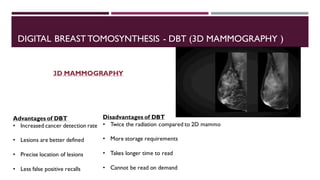
 Digital BreastTomosynthesis (DBT)
XrayTube rotates /moves in a 50-55° arc around the breast,
capturing several (11-25) low dose projections of the breast at different angles.
Then reconstructed to 3D Projection images (1 mm slices)
3D MAMMOGRAPHY
DIGITAL BREAST TOMOSYNTHESIS - DBT (3D MAMMOGRAPHY )
Disadvantages of DBT
• Twice the radiation compared to 2D mammo
• More storage requirements
• Takes longer time to read
• Cannot be read on demand
Advantages of DBT
• Increased cancer detection rate
• Lesions are better defined
• Precise location of lesions
• Less false positive recalls
3D MAMMOGRAPHY
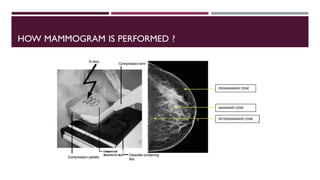
HOW MAMMOGRAM IS PERFORMED ?
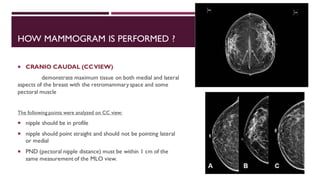
 CRANIO CAUDAL (CCVIEW)
demonstrate maximum tissue on both medial and lateral
aspects of the breast with the retromammaryspace and some
pectoral muscle
The following points were analyzed on CC view:
 nipple should be in profile
 nipple should point straight and should not be pointing lateral
or medial
 PND (pectoral nipple distance) must be within 1 cm of the
same measurement of the MLO view.
HOW MAMMOGRAM IS PERFORMED ?
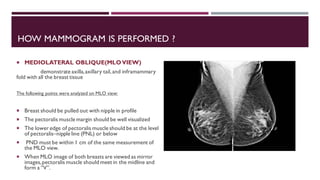
 MEDIOLATERAL OBLIQUE(MLOVIEW)
demonstrate axilla,axillary tail,and inframammary
fold with all the breast tissue
The following points were analyzed on MLO view:
 Breast should be pulled out with nipple in profile
 The pectoralis muscle margin should be well visualized
 The lower edge of pectoralis muscle should be at the level
of pectoralis–nipple line (PNL) or below
 PND must be within 1 cm of the same measurement of
the MLO view.
 When MLO image of both breasts are viewed as mirror
images,pectoralis muscle should meet in the midline and
form a “V”.
OTHER VIEWS
 Latero-medial (LO) - from the outside towards the center
 Medio-lateral (ML) - from the center towards the outside
 Spot compression - compression on only a small area,to get more detail
 Cleavage view - both breast compressed,to see tissue near the center of
the chest
 Magnification -to see borders of structures and calcifications
REPORTING A MAMMOGRAM
 Breast Imaging Reporting and Data System (BI-RADS)
RISKASSESSMENT AND QUALITYASSURANCETOOL developed byAmerican college of radiology (ACR)
that provides a widely accepted lexicon and reporting schema for imaging of the breast.
All mammographic, ultrasound and breast MRI findings and reports should closely adhere to the BI-RADS lexicon
and assessment categories.
THANKYOU

Mammography

  • 1.
  • 2.
    MAMMOGRAPHY - INDICATIONS Screening of asymptomatic women.  Screening of high risk women.  Follow up of patients after mastectomy of same and opposite breast / same breast with implant  Investigations of benign breast diseases with eczematous skin,nipple discharge , skin thickening .  Investigation of a breast lump.  Investigation of occult primary with secondaries .  Male breast evaluation .
  • 3.
    TYPE OF MAMMOGRAPHICEXAMINATION  Diagnostic mammography Is performed on patients with symptoms or elevated risk factors. Two or three views of each breast may be required.  Screening mammography Is performed on asymptomatic women with the use of a two view protocol, usually medial lateral oblique and cranio caudal , to detect on unsuspected cancer
  • 4.
    MAMMOGRAPHY - BASICS Uses low-energy x-rays (40kVp) for dectecting breast pathologies.  Higher kV - Poor Contrast Lower kV - Good Contrast  Tissues within breast have very small difference in attenuation property - Lacks contrast  <40kVp - Good photoelectric effect - brings out contrast between the tissues within the breasts.  Better contrast Better detailing of structures
  • 5.
    INSTRUMENTATIONS  HIGH FREQUENCYX-RAY GENERATOR  X-RAYTUBE  ANODE  CATHODE  BEAM PORT  K-EDGE FILTERS  COMPRESSION PADDLE  SPOT COMPRESSION  PARALLEL LINEAR GRID  IMAGE RECEPTOR  AEC (AUTOMATIC EXPOSURE CONTROL)
  • 6.
    X-RAY TUBE  RotatingAnode type - Glass or Metal ceramic Advantage -Decreases off focus radiation -IncreasesTube lighting  Cathode - Dual focalspots 0.3mm (Imaging) 0.1 mm (Magnification) ( Focal spot - Penumbra - Resolution) Helps identifiying microcalcification
  • 7.
    ANODE (TARGET) Usually-Tungsten (xray/Floro/ CT/ cathlab)  MOLYBDENUM -17.5 & 19.6 keV  RHODIUM -20.2 & 22.7 keV  CHARACTERISTIC RADIATION Characteristic x-ray Characteristic x-rays are produced after ionization of a k- shell electron.When an outer-shell electron fills the vacancy in the k shell, an x-ray is emitted. In mammography,17.5- 19.5kev characteristic x-ray is produced with Mo and 23kev is produced with Rh
  • 9.
     ANODE ANGLE= 16° to 0 to -9°  EFFECTIVE ANODE ANGLE - Angle of anode relative to the horizontal tube mount  XRAYTUBE TILT -To reduce unwanted radiation - focus only to the breast area
  • 10.
     SOURCETO IMAGEDISTANCE (SID) - lesser than usual Radiography -60/65 cm (Chest = 18) - short SID - Heel Effect utilized  At Cathode → chestwall – Thicker tissues SIDE  At Anode → Nipple region – LessThickness SIDE Non-uniformity of X-ray Intensity Along the cathode side - More Intensity Along the Anode side - Less Intensity
  • 11.
    PARTS OF MAMMOGRAPHYEQUIPMENT  Beam port - 1 mm Beryllium Since metal/ Glass is used in XRAYTUBE metal will absorb the low energy photons from xray tube  K-edge filters - Cuts unwanted Low energy photons (RADIATION) / High energy photons (SCATTER – Reduces contrast) (0.03mm Mo / 0.025mm Rh)
  • 12.
    PARTS OF MAMMOGRAPHYEQUIPMENT To decrease Breast thickness, spreads out the tissue - Spreads out superimposed anatomy.  Scatter Radiation - contrast  Radiation dose to the breast tissue  Geometric Blurring (closer to image receptor )  Decreases the kinetic blur .  Makes breast thickness uniform in film density.  Differentiates the easily compressible cysts and fibro- glandular tissue from the more rigid carcinomas  Separates the super imposed breast lesions . Compression paddle
  • 13.
    PARTS OF MAMMOGRAPHYEQUIPMENT  GRIDS  Stationary grids or grids placed in between the screen and the film are no longer used as the thin grid lines compromised on the quality of the image .  Covered tiny details such as microcalcifications  Hence oscillating grids are used o Grid ratio of 4 :1 or 5 : 1  The grid lines are eliminated by the motion of the grid .  Grids improve the image quality and cause a significant reduction
  • 14.
    PARTS OF MAMMOGRAPHYEQUIPMENT  Spot.compression - for imaging particular region  Parallel Linear grid - (4:1 to 5:1) low grade ratio grids used to increase the Contrast  Image Receptor Screen film CR Cassette Flat panel detector - (Digital Mammography)  AEC -Automatic Exposure Control KeV selected → MAS automatically chosen.
  • 15.
    FLAT PANEL DETECTORS- INDIRECT Indirect Amorphous silicon technology  Xray scintillator (Gradoliniun Sulphate / Csl) Produces light flashes when Xray beam falls over it.  Silicon Photodiode array (Photo detector) Made of Amorphous silicon Converts light photons from the scintillator into electrical signal  TFT-electronic switch - Reads electrical signal - Gives positional information -This data is sent to AEC (Analogue to Digital Converter)  AEC Converts it into digital signal and are finally sent to Computer for processing  Disadvantage - LIGHT SCATTER Scattering of light within the phosphors leading to unsharpness
  • 16.
    FLAT PANEL DETECTORS- DIRECT  Crystals of amorphous selenium directly converts Xrays into electrical signal that is stored in a capacitor (ready to be read)
  • 17.
    MAGNIFICATION TECHNIQUE  Toincrease the visibility of finer details like microcalcification Increase O ID - object to Image Distance Breast is kept over a raised platform No need for grid as there is presence of air gap
  • 18.
    SCREEN FILM MAMMOGRAPHY Old method  The image is created directly on a film-Non modifiable  Less sensitive for women with dense breasts  Screen film cassette used Single emulsion film Single screen Terbium activated Gadolinium oxysulphide Screen emits green light Film will be sensitive to greenlight (ORTHOCHROMATIC FILM)
  • 19.
    COMPUTER RADIOGRAPHY (CR)MAMMOGRAPHY  A/K/A Filmless radiography Electronic radiography Digital storage phosphor imaging  Xray images are acquired in digital format  Photostimulable phosphor plates used  Imaging plate has high sensitivity to xrays  COMPONENTS  storage phosphor cassette  Storage phosphor reader  Bar code scanner  Workstation Photostimuliable Phosphor (PSP) Cassette PSP Receptor materials . BaFBr : Eu2+ . BaF (Br1): Eu 2+ .Ba SrFBr:Eu 2+
  • 20.
    DIGITAL MAMMOGRAPHY  Alsocalled full-field digital mammography (FFDM) -in which the x-ray film is replaced by electronics that convert x-rays into mammographic pictures of the breast. Display Monitor - HIGH RESOLUTION (5 MP)  Direct Digital Mammography - Flat panel detector with amorphous selenium array  Indirect Digital Mammography -Flat panel scintillator with amorphous silicon diode array
  • 21.
    DIGITAL MAMMOGRAPHY  ADVANTAGE Bettercontrast,more details.Better delineation of parenchyma & subcutaneous tissue Better noise level reduction Tolerance to over/under exposure (Avoids Repetition? Post-processing techniques for better diagnosis Radiation dose is decreased- Mean glandular dose in mammography Screen Film (2-3m bGy) Digital (20-30% reduction) Image can be seen quickly and stored digitally(less storage space )
  • 22.
    LIMITATIONS OF 2DMAMMOGRAPHY  20% of cancers will be missed  10% recalled for additional workup  75-80% of biopsies result in benign lesions  sensitivity decreases with increased breast density  2D mammograms,take images only from the front and side, this may create images with overlapping breast tissue
  • 23.
    ADVANCES IN DIGITALMAMMOGRAPHY  Computer -Aided Diagnosis - uses software to detect area of clinical significance and highlight them for better output image  Digital BreastTomosynthesis (DBT) XrayTube rotates /moves in a 50-55° arc around the breast, capturing several (11-25) low dose projections of the breast at different angles. Then reconstructed to 3D Projection images (1 mm slices) 3D MAMMOGRAPHY
  • 24.
    DIGITAL BREAST TOMOSYNTHESIS- DBT (3D MAMMOGRAPHY ) Disadvantages of DBT • Twice the radiation compared to 2D mammo • More storage requirements • Takes longer time to read • Cannot be read on demand Advantages of DBT • Increased cancer detection rate • Lesions are better defined • Precise location of lesions • Less false positive recalls 3D MAMMOGRAPHY
  • 25.
    HOW MAMMOGRAM ISPERFORMED ?
  • 26.
    HOW MAMMOGRAM ISPERFORMED ?  CRANIO CAUDAL (CCVIEW) demonstrate maximum tissue on both medial and lateral aspects of the breast with the retromammaryspace and some pectoral muscle The following points were analyzed on CC view:  nipple should be in profile  nipple should point straight and should not be pointing lateral or medial  PND (pectoral nipple distance) must be within 1 cm of the same measurement of the MLO view.
  • 27.
    HOW MAMMOGRAM ISPERFORMED ?  MEDIOLATERAL OBLIQUE(MLOVIEW) demonstrate axilla,axillary tail,and inframammary fold with all the breast tissue The following points were analyzed on MLO view:  Breast should be pulled out with nipple in profile  The pectoralis muscle margin should be well visualized  The lower edge of pectoralis muscle should be at the level of pectoralis–nipple line (PNL) or below  PND must be within 1 cm of the same measurement of the MLO view.  When MLO image of both breasts are viewed as mirror images,pectoralis muscle should meet in the midline and form a “V”.
  • 28.
    OTHER VIEWS  Latero-medial(LO) - from the outside towards the center  Medio-lateral (ML) - from the center towards the outside  Spot compression - compression on only a small area,to get more detail  Cleavage view - both breast compressed,to see tissue near the center of the chest  Magnification -to see borders of structures and calcifications
  • 30.
    REPORTING A MAMMOGRAM Breast Imaging Reporting and Data System (BI-RADS) RISKASSESSMENT AND QUALITYASSURANCETOOL developed byAmerican college of radiology (ACR) that provides a widely accepted lexicon and reporting schema for imaging of the breast. All mammographic, ultrasound and breast MRI findings and reports should closely adhere to the BI-RADS lexicon and assessment categories.
  • 33.