MAMMOGRAPHY AND
RECENT ADVANCES
BY DR AVINASH DAHATRE
RADIOLOGY DEPARTMENT
BREAST ANATOMY
INTRODUCTION
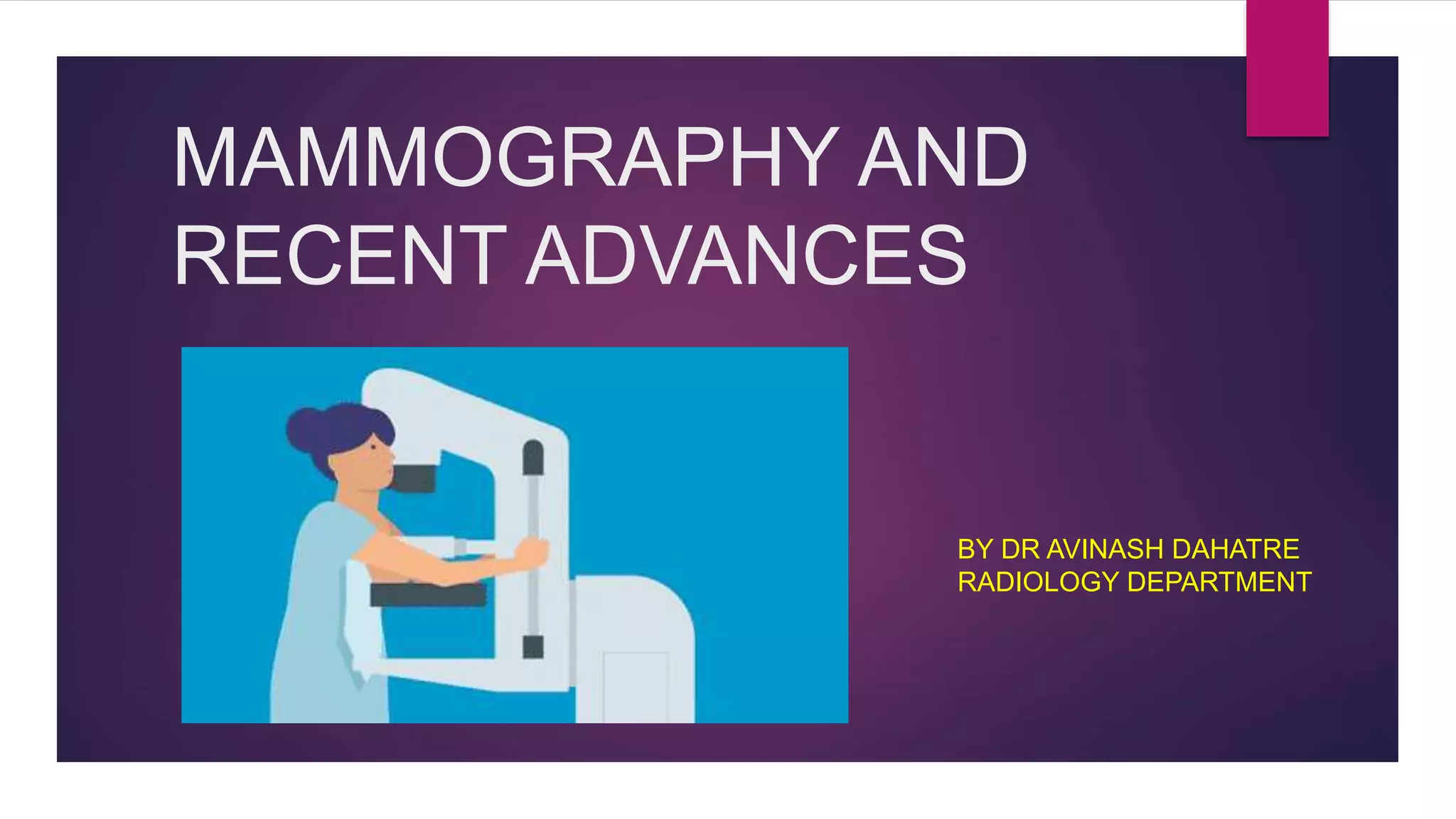
 Mammography is the first line of investigation for imaging breast and early
detection of cancer.
 It is special x ray of breast with compression in order to recognise any
abnormality.
 Mammography consist of High resolution and low radiation dose.
 Sensitivity of Mammography ranges from 83 to 95% however it decreases in
patient with radiographically dense and glandular breast.
 MRI and USG is adjunctive diagnostic technique for detecting breast pathology.
PHYSICS
MAMMOGRAPHY EQUIPMENTS
 Cathode (filament) – Small filament only.
 Anode – Molybdenum or rhodium.
 Focal spot – 0.1 to 0.3mm
 Kv – 30kv
 Window – Berylium
 Filter – Molybdenum or Rhodium filter of 0.03mm thickness.
 Grids- Must be used
-Oscillating type is used.
- Grid ratio 5:1.
Exposure control:- automatic exposure control device
AUTOMATIC EXPOSURE CONTROL
 AEC system employs phototimers to measure the X ray intensity and quality.
 It is kept closer to image receptor to minimize object to image distance.
 It improves spatial resolution.
COMPRESSION PEEDLE
 Decreases thickness of breast and reduces scatter radiation and improves
contrast.
 Compression closer to image receptor or film reduces geometric blur.
 Makes breast thickness uniform in film density.
 Decreases easily compressible cyst and fibro-glandular tissue from more rigid
carcinoma.
 Reduces radiation dose to breast tissue.
 Compression device is parallel to receptor surface.
 Radioleucent plate is flat and parallel to support table
SCREEN FILM SYSTEM
 FILM – one side emulsion coating .
- used with one intensifying screen only.
-slow speed film.
- high contrast film
- fine grained
- film with antihalation layer.
- film with non curling back.
 Gadolinium Oxisulfide activated with terbium is used as screen phosphor.
FEATURES NECESSARY FOR
PRODUCING HIGH QUALITY IMAGES:-
 TUBE CURRENT – As high as possible.
keep exposure for short time.
 Molybdenum and Rhenium Anode –
Required to produce low energy X rays.
To achieve high tissue contrast.
 High spatial resolution for identifying microcalcification.
 Small focal spot 0.3mm for routine and 0.1mm for magnification mammography.
INDICATIONS for MAMMOGRAPHY:-
 Screening mammo-
a. -asymptomatic women of age above 40yrs
b. -asymptomatic women of age 35yr and above who have high risk of
developing breast cancer.eg,
1) Women with 1or more relatives diagnosed with breast
cancer.
2) Women with histological factors found at previous surgery i.e,
Atypical ductal hyperplasia.
Diagnostic mammo
 Symptomatic women aged above 35yrs with breast lump or clinical e/o breast
cancer.
 Screening call back.
 Recommended for short interval follow-up.
 Surveillance of breast following local excision of breast cancer.
 Breast lump in male.
 Evaluation of breast lump in women following augmentation mammoplasty.
CONTRAINDICATIONS:-
 Not performed in pregnant and lactating mother.
 Generally avoided in women of age below 30yrs.
TIMING AN PREPARATION
 Week after the menstrual period.
 Avoid deodorant, antiperspirant, powder, lotion.
MAMMOGRAPHIC PROJECTIONS
 MEDIO LATERAL OBLIQUE.
 CRANIO CAUDAL VIEW.
MEDIO LATERAL OBLIQUE (MLO)
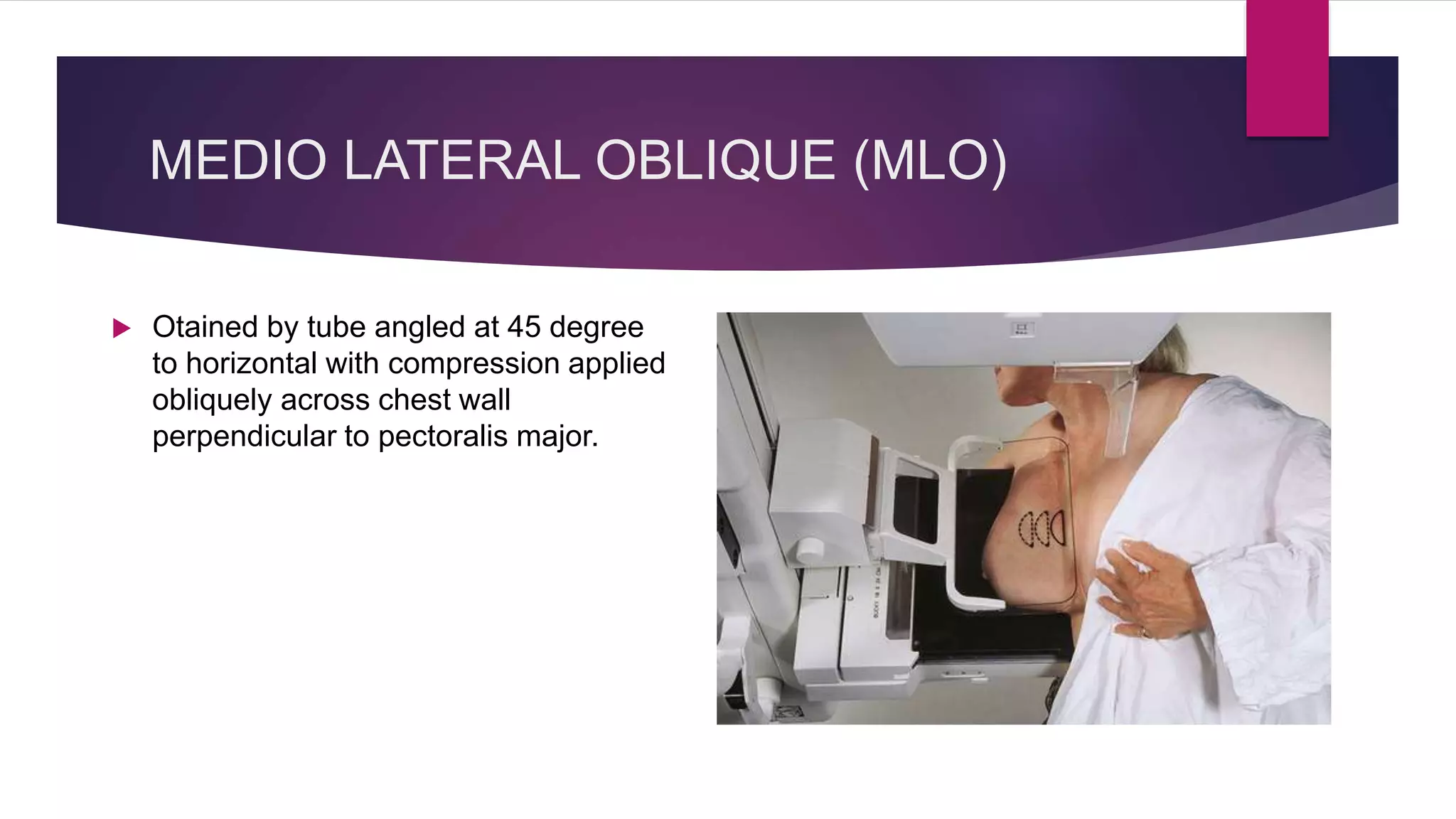
 Otained by tube angled at 45 degree
to horizontal with compression applied
obliquely across chest wall
perpendicular to pectoralis major.
CRITERIA FOR MLO VIEW:-
 Nipple should be seen in profile.
 Pectoralis muscle should extend
inferior to posterior nipple line.
 There should be no skin fold
superimposed on breast.
 ADVANTAGE:-
More breast tissue is demonstrated than in
any view
CRANIO CAUDAL VIEW:-
 Positioned by pulling breast up and
forward away from chest wall with
compression applied.
Criteria for CC view:-
 Nipple should be demonstrated in profile.
 Posterior nipple line drawn from the
pectoralis muscle and should be within
1cm of its length on MLO projection.
 ADVANTAGE:-
Demonstrate medial and lateral portion of
breast.
SUPPLIMENTARY VIEWS:-
 ROLLED VIEW:-
Rolling breast tissue with compression.
May separate fibroglandular element into their
individual component.
 MAGNIFICATION VIEW:-
Obtained by increasing object film distance
producing air gap and using fine focal spot
0.1mm.
Use- for microcalcification analysis.
CLEOPATRA / AXILLARY TAIL VIEW
 Position- semireclined posture
 To confirm location of lesion in axillary tail of spense.
SPOT COMPRESSION VIEW:-
Obtained by use of small compression paddle
with or without magnification.
Helpful in analysing asymmetric soft tissue
shadow either of normal glandular tissue or
underlying lesion.
CLEVAGE / VALLEY view
 Used to project the tissue that are close to sternum.
EXTENDED CRANIO CAUDAL VIEW:-
 EXTENDED CRANIO CAUDAL VIEW:-
Performed by rotating patient body (rotated
medially for observing lateral part and lateral
rotation for medial part) to display lateral and
medial breast tissue.
ACR BIRADS CATEGORIES OF
BREAST DENSITY:-
1. Breast tissue entirely fatty
2. Scatter fibroglandular tissue
3. Heterogenously dense parenchyma
4. Extremely dense breast
 < 25% dense glandular tissue
 25 to 50% dense glandular tissue
 50 to 75%dense glandular tissue
 >75% of dense glandular tissue
ACR BIRAD SCORE FOR
MALIGNANCY:-
RECENT ADVANCES
DIGITAL MAMMOGRAPHY
 IT INCLUDES:-
1. COMPUTED AIDED DETECTION AND
DIAGNOSIS
2. DIGITAL BREAST TOMOSYNTHESIS
3. STEREO MAMMOGRAPHY
4. CONTRAST ENHANCED DIGITAL
MAMMOGRAPHY
5. DUAL ENERGY SUBSTRACTION
MAMMOGRAPHY
COMPUTER AIDED DETECTION AND
DIAGNOSIS
 DETECTION:- Software that highlight abnormal area to be reviewed by radiologist
directly on image.
 DIAGNOSIS:Gives additional information about size of lesion and various lesion
matrix.
DIGITAL BREAST TOMOSYNTHESIS
 It provides sectional image which help to distinguish glandular breast tissue from
true lesion.
 Multiple projections are acquired at different depth by digital detector from a
mammographic x ray tube which moves in a small arc.eg, If ARC movement is 45
degree and exposure is taken at every 3degree then 15films will be taken.
 each slice may be as thin as 0.5mm.
 ARC angle range 11 to 60degree.
TOMOSYNTHESIS
ADVANTAGES
 Better depiction of smallest calcification.
 More definitive interpretation.
 Require less compression than 2D
mammography.
DISADVANTAGES
 Special training of technologist needed for
positioning.
 Motion artefact more likely to occur
because of longer exposure time.
 Large calcification cause significant
artefact.
STEREO MAMMOGRAPHY
 3D feature of lesion are studied by getting binary images which are separated by
few degrees.
CONTRAST ENHANCE DIGITAL
MAMMOGRAPHY
 Gives functional information about malignant neovascularity which is directly
linked to high quality anatomic image.
TECHNIQUES:-
1. Pre-contrast image obtained.
2. IV contrast injected and images are taken.
CONTRAST ENHANCE DIGITAL
MAMMOGRAPHY
DUAL ENERGY SUBSTRACTION
MAMMOGRAPHY
 In this two images are acquired using low energy (i.e, standard Kv
and filtration) and high energy (High Kv and strong filtration).
 Calcification are better appreciated in dual energy.
 Most imp parameter is malignancy.
 A high kv of 45 to 50 is used.
DUAL ENERGY SUBSTRACTION
MAMMOGRAPHY
LOW
ENERGY
HIGH ENERGY SUBSTRACTIO
N
OPTICAL MAMMOGRAPHY
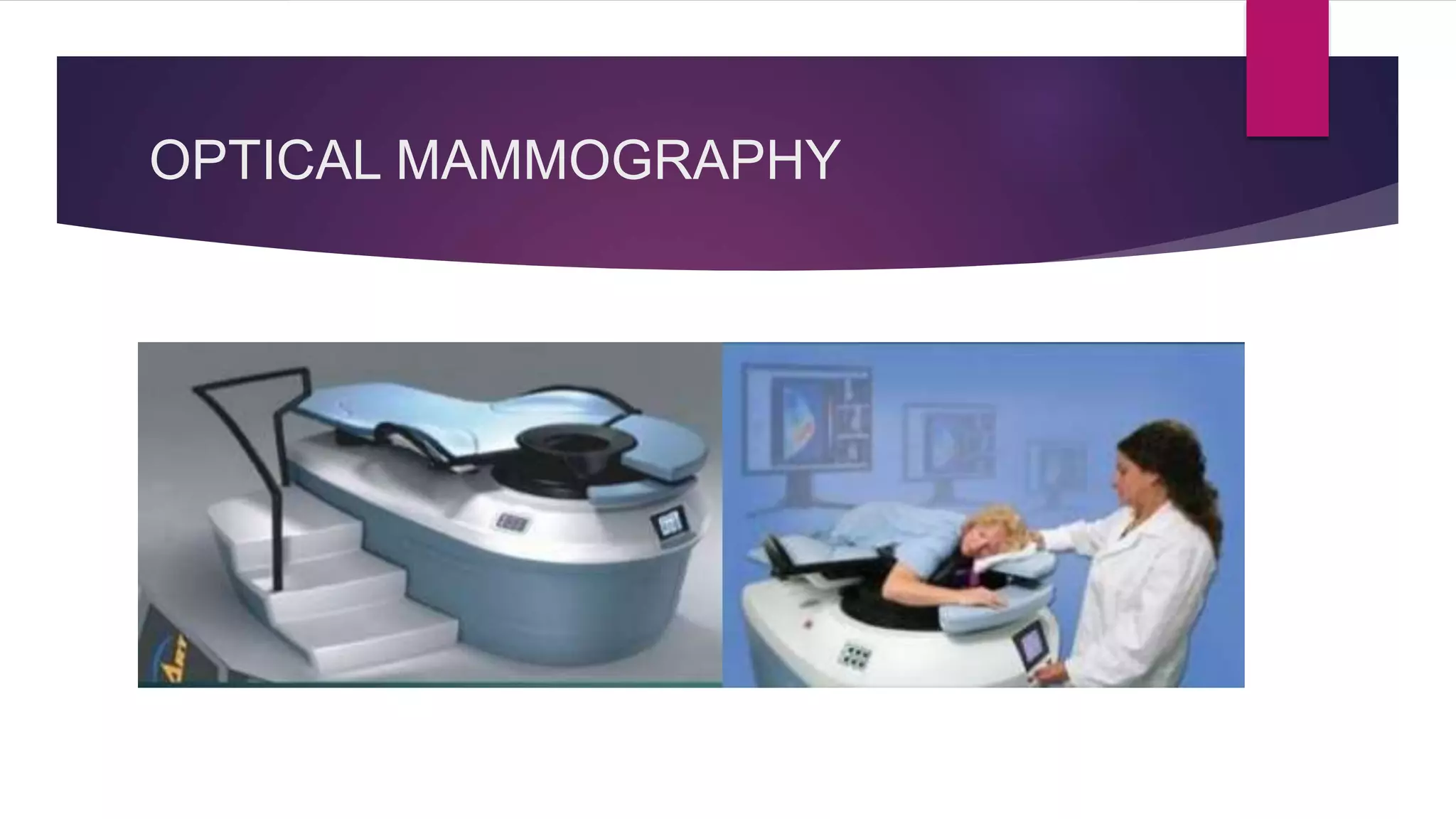
 It uses infrared light to scan breast tissues.
 It applies algorith to interpret image and information.
 The technique can measure differences in water and fat.
 It is comparatively more comfortable with much less breast compression.
OPTICAL MAMMOGRAPHY
ULTRASONOGRAPHY OF BREAST:-
 INDICATIONS:-
• Evaluation of young <30yr age group or pregnant or lactating women.
• Evaluate palpable lump with negative mammographic finding.
• Helps in guiding biopsy.
• Screening of high density breast.
• Differentiate between cystic and solid lesion.
• Evaluate breast implant for rupture.
SCANNING TECHNIQUE
HORIZONTAL
pattern
VERTICAL
pattern
RADIAL
pattern
Mammography and recent advances dr avinash

Mammography and recent advances dr avinash

  • 1.
    MAMMOGRAPHY AND RECENT ADVANCES BYDR AVINASH DAHATRE RADIOLOGY DEPARTMENT
  • 2.
  • 3.
    INTRODUCTION  Mammography isthe first line of investigation for imaging breast and early detection of cancer.  It is special x ray of breast with compression in order to recognise any abnormality.  Mammography consist of High resolution and low radiation dose.  Sensitivity of Mammography ranges from 83 to 95% however it decreases in patient with radiographically dense and glandular breast.  MRI and USG is adjunctive diagnostic technique for detecting breast pathology.
  • 4.
  • 5.
    MAMMOGRAPHY EQUIPMENTS  Cathode(filament) – Small filament only.  Anode – Molybdenum or rhodium.  Focal spot – 0.1 to 0.3mm  Kv – 30kv  Window – Berylium  Filter – Molybdenum or Rhodium filter of 0.03mm thickness.  Grids- Must be used -Oscillating type is used. - Grid ratio 5:1. Exposure control:- automatic exposure control device
  • 6.
    AUTOMATIC EXPOSURE CONTROL AEC system employs phototimers to measure the X ray intensity and quality.  It is kept closer to image receptor to minimize object to image distance.  It improves spatial resolution.
  • 10.
    COMPRESSION PEEDLE  Decreasesthickness of breast and reduces scatter radiation and improves contrast.  Compression closer to image receptor or film reduces geometric blur.  Makes breast thickness uniform in film density.  Decreases easily compressible cyst and fibro-glandular tissue from more rigid carcinoma.  Reduces radiation dose to breast tissue.  Compression device is parallel to receptor surface.  Radioleucent plate is flat and parallel to support table
  • 12.
    SCREEN FILM SYSTEM FILM – one side emulsion coating . - used with one intensifying screen only. -slow speed film. - high contrast film - fine grained - film with antihalation layer. - film with non curling back.  Gadolinium Oxisulfide activated with terbium is used as screen phosphor.
  • 14.
    FEATURES NECESSARY FOR PRODUCINGHIGH QUALITY IMAGES:-  TUBE CURRENT – As high as possible. keep exposure for short time.  Molybdenum and Rhenium Anode – Required to produce low energy X rays. To achieve high tissue contrast.  High spatial resolution for identifying microcalcification.  Small focal spot 0.3mm for routine and 0.1mm for magnification mammography.
  • 15.
    INDICATIONS for MAMMOGRAPHY:- Screening mammo- a. -asymptomatic women of age above 40yrs b. -asymptomatic women of age 35yr and above who have high risk of developing breast cancer.eg, 1) Women with 1or more relatives diagnosed with breast cancer. 2) Women with histological factors found at previous surgery i.e, Atypical ductal hyperplasia.
  • 16.
    Diagnostic mammo  Symptomaticwomen aged above 35yrs with breast lump or clinical e/o breast cancer.  Screening call back.  Recommended for short interval follow-up.  Surveillance of breast following local excision of breast cancer.  Breast lump in male.  Evaluation of breast lump in women following augmentation mammoplasty.
  • 17.
    CONTRAINDICATIONS:-  Not performedin pregnant and lactating mother.  Generally avoided in women of age below 30yrs.
  • 18.
    TIMING AN PREPARATION Week after the menstrual period.  Avoid deodorant, antiperspirant, powder, lotion.
  • 19.
    MAMMOGRAPHIC PROJECTIONS  MEDIOLATERAL OBLIQUE.  CRANIO CAUDAL VIEW.
  • 20.
    MEDIO LATERAL OBLIQUE(MLO)  Otained by tube angled at 45 degree to horizontal with compression applied obliquely across chest wall perpendicular to pectoralis major.
  • 21.
    CRITERIA FOR MLOVIEW:-  Nipple should be seen in profile.  Pectoralis muscle should extend inferior to posterior nipple line.  There should be no skin fold superimposed on breast.  ADVANTAGE:- More breast tissue is demonstrated than in any view
  • 22.
    CRANIO CAUDAL VIEW:- Positioned by pulling breast up and forward away from chest wall with compression applied.
  • 23.
    Criteria for CCview:-  Nipple should be demonstrated in profile.  Posterior nipple line drawn from the pectoralis muscle and should be within 1cm of its length on MLO projection.  ADVANTAGE:- Demonstrate medial and lateral portion of breast.
  • 24.
    SUPPLIMENTARY VIEWS:-  ROLLEDVIEW:- Rolling breast tissue with compression. May separate fibroglandular element into their individual component.  MAGNIFICATION VIEW:- Obtained by increasing object film distance producing air gap and using fine focal spot 0.1mm. Use- for microcalcification analysis.
  • 25.
    CLEOPATRA / AXILLARYTAIL VIEW  Position- semireclined posture  To confirm location of lesion in axillary tail of spense.
  • 26.
    SPOT COMPRESSION VIEW:- Obtainedby use of small compression paddle with or without magnification. Helpful in analysing asymmetric soft tissue shadow either of normal glandular tissue or underlying lesion.
  • 27.
    CLEVAGE / VALLEYview  Used to project the tissue that are close to sternum.
  • 28.
    EXTENDED CRANIO CAUDALVIEW:-  EXTENDED CRANIO CAUDAL VIEW:- Performed by rotating patient body (rotated medially for observing lateral part and lateral rotation for medial part) to display lateral and medial breast tissue.
  • 29.
    ACR BIRADS CATEGORIESOF BREAST DENSITY:- 1. Breast tissue entirely fatty 2. Scatter fibroglandular tissue 3. Heterogenously dense parenchyma 4. Extremely dense breast  < 25% dense glandular tissue  25 to 50% dense glandular tissue  50 to 75%dense glandular tissue  >75% of dense glandular tissue
  • 31.
    ACR BIRAD SCOREFOR MALIGNANCY:-
  • 32.
  • 33.
    DIGITAL MAMMOGRAPHY  ITINCLUDES:- 1. COMPUTED AIDED DETECTION AND DIAGNOSIS 2. DIGITAL BREAST TOMOSYNTHESIS 3. STEREO MAMMOGRAPHY 4. CONTRAST ENHANCED DIGITAL MAMMOGRAPHY 5. DUAL ENERGY SUBSTRACTION MAMMOGRAPHY
  • 34.
    COMPUTER AIDED DETECTIONAND DIAGNOSIS  DETECTION:- Software that highlight abnormal area to be reviewed by radiologist directly on image.  DIAGNOSIS:Gives additional information about size of lesion and various lesion matrix.
  • 35.
    DIGITAL BREAST TOMOSYNTHESIS It provides sectional image which help to distinguish glandular breast tissue from true lesion.  Multiple projections are acquired at different depth by digital detector from a mammographic x ray tube which moves in a small arc.eg, If ARC movement is 45 degree and exposure is taken at every 3degree then 15films will be taken.  each slice may be as thin as 0.5mm.  ARC angle range 11 to 60degree.
  • 37.
    TOMOSYNTHESIS ADVANTAGES  Better depictionof smallest calcification.  More definitive interpretation.  Require less compression than 2D mammography. DISADVANTAGES  Special training of technologist needed for positioning.  Motion artefact more likely to occur because of longer exposure time.  Large calcification cause significant artefact.
  • 38.
    STEREO MAMMOGRAPHY  3Dfeature of lesion are studied by getting binary images which are separated by few degrees.
  • 39.
    CONTRAST ENHANCE DIGITAL MAMMOGRAPHY Gives functional information about malignant neovascularity which is directly linked to high quality anatomic image. TECHNIQUES:- 1. Pre-contrast image obtained. 2. IV contrast injected and images are taken.
  • 40.
  • 41.
    DUAL ENERGY SUBSTRACTION MAMMOGRAPHY In this two images are acquired using low energy (i.e, standard Kv and filtration) and high energy (High Kv and strong filtration).  Calcification are better appreciated in dual energy.  Most imp parameter is malignancy.  A high kv of 45 to 50 is used.
  • 42.
  • 43.
    OPTICAL MAMMOGRAPHY  Ituses infrared light to scan breast tissues.  It applies algorith to interpret image and information.  The technique can measure differences in water and fat.  It is comparatively more comfortable with much less breast compression.
  • 44.
  • 45.
    ULTRASONOGRAPHY OF BREAST:- INDICATIONS:- • Evaluation of young <30yr age group or pregnant or lactating women. • Evaluate palpable lump with negative mammographic finding. • Helps in guiding biopsy. • Screening of high density breast. • Differentiate between cystic and solid lesion. • Evaluate breast implant for rupture.
  • 46.