CORONARY CT
Dr. Suhas Basavaiah
Resident (MD Radio-diagnosis)
Coronary Anatomy
 The coronary arteries are the blood vessels that supply
blood to the heart muscle itself.
 There are numerous collaterals but they are not always
sufficient to maintain adequate myocardial blood supply
in case of occlusion of a coronary artery.
 The right heart has a more favorable ratio of muscle
fibers to capillaries, which is why it is more susceptible to
toxic damage, while the left heart is more likely to suffer
ischemic damage.
 The two coronary arteries arising from the right and left
aortic sinus are the first branches of the ascending aorta.
Coronary artery
Coronary artery is a vasa
vasorum that supplies the heart.
Coronary comes from the
latin ”Coronarius” meaning
“Crown”.
3
Coronary artery
 The coronary artery arises just
superior to the aortic valve and
supply the heart
 The aortic valve has three cusps –
 left coronary (LC),
 right coronary (RC)
 posterior non-coronary (NC) cusps.
4
Right coronary artery
 Originates from right
coronary sinus of Valsalva
 Courses through the right
AV groove between the
right atrium and right
ventricle to the inferior part
of the septum
5
The right coronary artery. Course of the right coronary
artery (RCA) on a series of axial images acquired
from top to bottom (A-F). (A-C) The aorta gives rise
to the proximal segment (1), which courses in an
anterolateral direction. (D) The middle segment of
the RCA takes a nearly vertical downward course
(2). (E) The RCA then turns to the left and continues
to the posterior aspect of the heart (segment 3)
along a nearly horizontal course on the
diaphragmatic surface of the heart. (F) At the crux of
the heart—the junction of the septa and walls of the
four heart chambers—the RCA branches into the
posterior descending artery and right posterolateral
branch (4). Ao, aorta; RV, right ventricle; LV, left
ventricle; LA, left atrium.
Branches of RCA
7
Right coronary artery
Conus artery
Sinu nodal artery
Marginal artery
Post. Descending IV artery
AV nodal artery-
Conus branch
SINU NODAL BRANCH
AV Nodal Branch
 Conus branch – 1st branch supplies the RVOT
 Sinus node artery – 2nd branch - SA node.(in 40%
they originate from LCA)
 Acute marginal arteries-Arise at acute angle and
runs along the margin of the right ventricle above
the diaphragm.
 Branch to AV node
 Posterior descending artery : Supply lower part of
the ventricular septum & adjacent ventricular walls.
Arises from RCA in 85% of case.
8
Right coronary anatomy
AO
LA
RCA
CONUS BR
RCA
SAN
1 2
3 4
RCA
AM
9
RCA
AM
AM
10
Area of distribution
RT CORONARY ARTERY----
1)Right atrium
2)Ventricles
i) greater part of rt. Ventricle except the area adjoining the
anterior IV groove.
ii) a small part of the lt ventricle adjoining posterior IV
groove.
3)Posterior part of the IV septum
4)Whole of the conducting system of the heart, except part
of the left br of AV bundle 11
Left coronary artery
 Arises from left coronary
cusps
 Travels between RVOT
anteriorly and left atrium
posteriorly.
 Almost immediately
bifurcate into left anterior
descending and left
circumflex artery.
 Length – 10-15mm
12
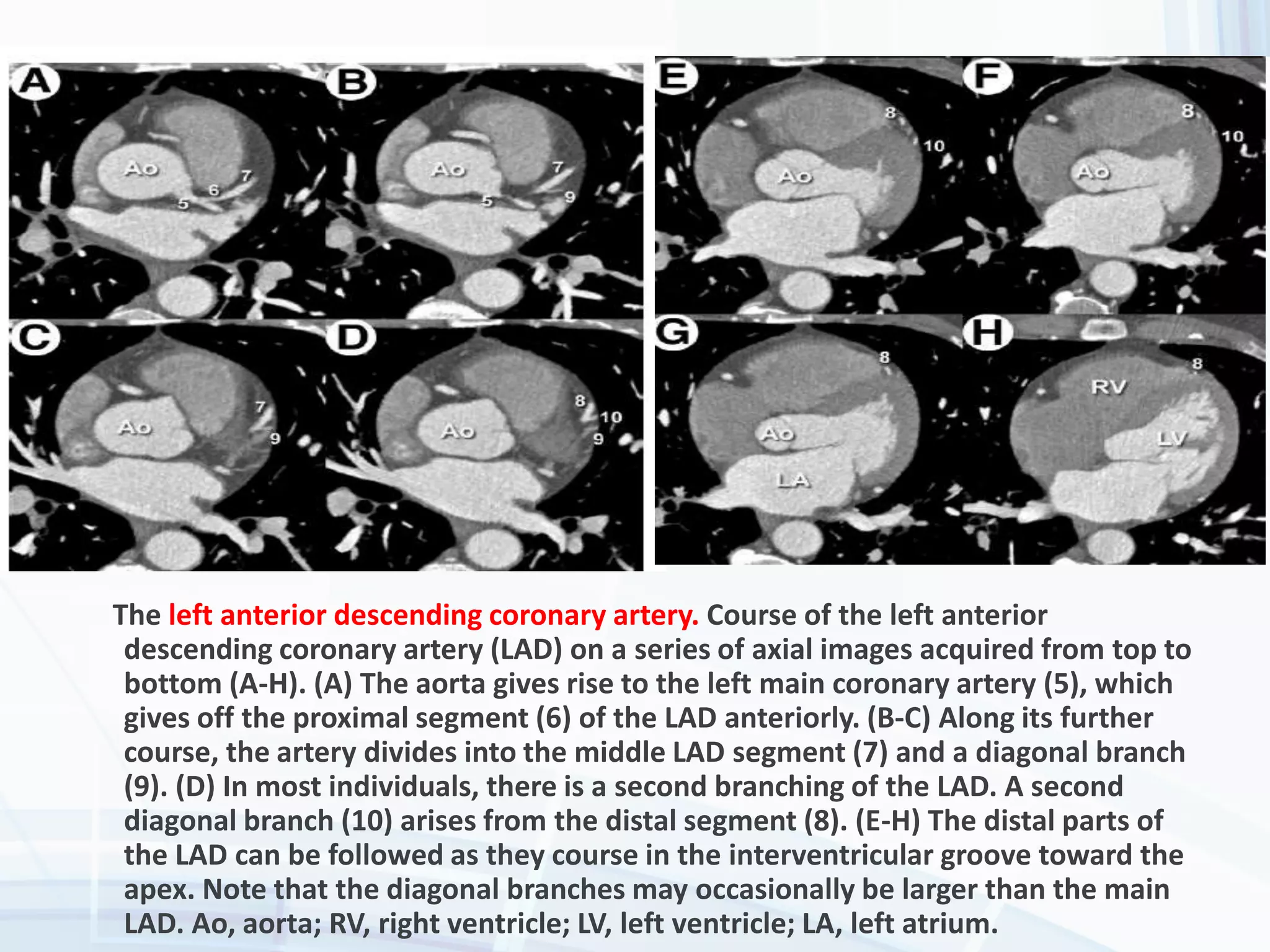
The left anterior descending coronary artery. Course of the left anterior
descending coronary artery (LAD) on a series of axial images acquired from top to
bottom (A-H). (A) The aorta gives rise to the left main coronary artery (5), which
gives off the proximal segment (6) of the LAD anteriorly. (B-C) Along its further
course, the artery divides into the middle LAD segment (7) and a diagonal branch
(9). (D) In most individuals, there is a second branching of the LAD. A second
diagonal branch (10) arises from the distal segment (8). (E-H) The distal parts of
the LAD can be followed as they course in the interventricular groove toward the
apex. Note that the diagonal branches may occasionally be larger than the main
LAD. Ao, aorta; RV, right ventricle; LV, left ventricle; LA, left atrium.
The left circumflex coronary artery. Course of the left circumflex coronary artery (LCX) on a series of
axial images acquired from top to bottom (A-H). (A) The aorta gives rise to the left main coronary
artery (5), which gives of the proximal segment (11) of the LCX posteriorly. (B-D) Along its further
course, the artery divides into the middle segment of the LCX (13) and a marginal branch (12). (E-
H) The middle segment (13) then gives off a second marginal branch (14). The circumflex branch
turns around the left border and continues on the diaphragmatic surface (distal segment, 15).
Ao, aorta; LA, left atrium; arrow, segment 12
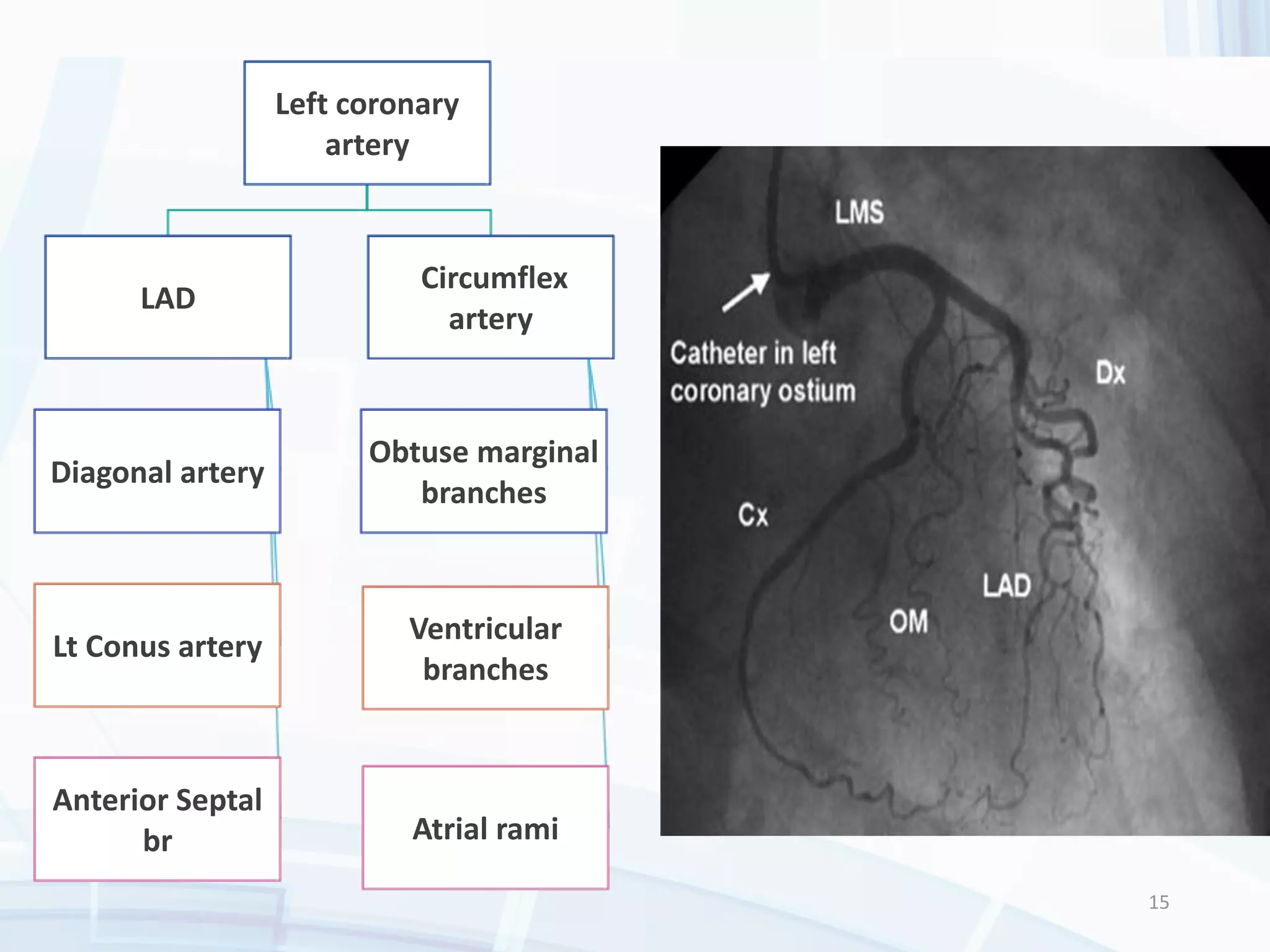
Left coronary
artery
LAD
Diagonal artery
Lt Conus artery
Anterior Septal
br
Circumflex
artery
Obtuse marginal
branches
Ventricular
branches
Atrial rami
15
LEFT CORONARY ARTERY 16
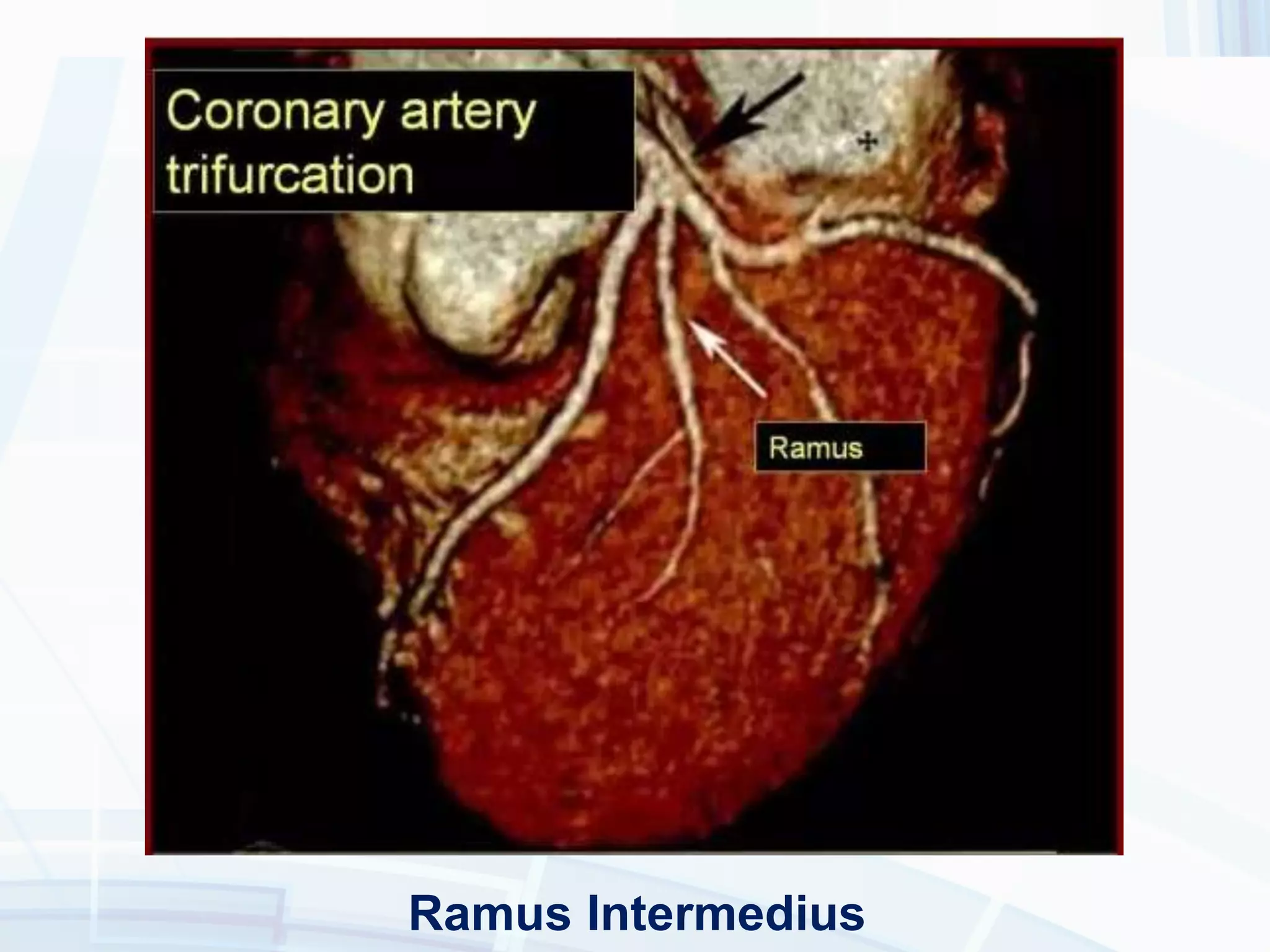
Ramus Intermedius
Area of Distribution
1) Left atrium.
2) Ventricles
i) Greater part of the left ventricle, except the area
adjoining the posterior IV groove.
ii) A small part of the right ventricle adjoining the
anterior IV groove.
3) Anterior part of the IV septum.
4) A part of the left br. Of the AV bundle.
18
DOMINANCE
 Determined by the arrangement that which artery
reaches the crux & supply posterior descending artery
 The right coronary artery is dominant in 85% cases.
 8% cases - - circumflex br of the left coronary artery
 7% both rt & lt coronary artery supply posterior
IVseptum & inferior surface of the left ventricle-here it is
balanced dominance. 19
Coronary artery dominence
CORONARY ARTERY ANOMALIES
 The diagnosis of coronary artery anomalies has
previously required invasive coronary angiography;
however, in up to 50% of patients, the coronary artery
anomalies may be incorrectly classified during invasive
angiography.
 This misclassification may result from the difficulty in
delineating the precise vessel path within a complex 3D
geometry using a relatively restricted two-dimensional
view.
 Coronary CTA has been shown to accurately depict the
anomalous vessel origin, its subsequent course, and the
relationship to the great vessels.
 Two studies comparing CCTA and invasive coronary
angiography found that invasive angiography was able
to detect 80% of the anomalous origins but only 53% of
the anomalous coronary courses and resulted in a
precise anatomic diagnosis in only 55% of patients.
 In a multicenter coronary artery CT registry, CCTA was
able to unequivocally demonstrate the origin and the
course of the anomalous artery in all patients with
equivocal findings on invasive coronary angiography.
Shi H, Aschoff AJ, Brambs HJ, et al.
Multislice CT imaging of anomalous
coronary arteries. Eur Radiol.
2004;14(12):2172-2181.
Schmitt R, Froehner S, Brunn J, et al.
Congenital anomalies of the coronary
arteries: imaging with contrast-
enhanced, multidetector computed
tomography. Eur Radiol.
2005;15(6):1110-1121
Datta J, White CS, Gilkeson RC,
et al. Anomalous coronary
arteries in adults: depiction at
multi-detector row CT
angiography. Radiology.
2005;235(3):812-818.
Evaluation of coronary anomaly. A. Three-dimensional (3D) rendering image showing an
anomalous left circumflex arising from the right coronary sinus and coursing between the
aorta and the left atrium. B. 3D rendering image showing a coronary aneurysm involving
the LM, the proximal LAD, and a diagonal branch. LAD, left anterior descending
(coronary artery); LM, left main.
ATHEROSCLEROSIS
24
Fatty streaks composed of lipid-laden macrophages (foam cells))
Plaque :- Soft necrotic core of lipid with surrounding chronic inflammatory cells
covered by fibrous cap.
Fatty streaky progress to plaque
Progressively enlarge
causing critical
stenosis
Ulcerates or ruptures
leading to thrombosis
and critical ischemia
Pressure atrophy of
the media causing
aneurysmal dilatation
25
Coronary pathology in acute coronary syndrome. The evolution of coronary
lesions follows a progression from (1) initial plaque formation, (2) plaque
growth, (3) plaque vulnerability and rupture, and (4) thrombosis.
26
CORONARY CT
ANGIOGRAPHY
27
AVAILABLE TECHNOLOGY
 Currently, two competing CT technologies are used-
1. Electron-beam CT and
2. Mechanical multi–detector row CT
Electron beam CT :
 Used specifically for cardiac imaging d/t high temporal resolution
 Uses a rapidly rotating electron beam, which is reflected onto a
stationary tungsten target
 Imaging done in sequential mode, where single transverse
sections are sequentially acquired.
 However, due to higher cost and limited availability, MDCT is
most commonly used. 28
CT CORONARY ANGIOGRAPHY
 Coronary computed tomography angiography
(CCTA) is an effective noninvasive method to image
the coronary arteries
 MDCT has multiple detector rows are placed
opposite the x-ray tube which shortens the
examination time and improves the temporal
resolution
 The new generation 64 detector MDCT system has
allowed higher isotropic resolution, with visual clarity
of up to fifth- order coronary arterial branches.
29
Which ? MDCT is optimum
 4/8-slice –For detection CAD sensitivity: 86% and
ruled out in 64 of 80 patients (specificity: 81%).
 16 slice MDCT -sensitivity: 96% ,specificity: 83
 64 slice CT -sensitivity: 97% ,specificity: 92%
30
 High-quality source images are the most important
prerequisite for the diagnostic assessment of coronary
CTA.
 Image quality depends on:
1. Heart rate – Image quality improves with heart rate
less than 65.
2. Proper coronary CTA scan and post processing
protocol.
3. The synchronization of raw image data with
electrocardiography (ECG) information
4. Breath Holding : 45 sec (4 detector) to 9 sec (64
detector) 31
INDICATION
 Screening high risk patients
 Evaluation of chest pain
 Post procedural study
 Post CABG
 Post stent
 Dilated Cardiomyopathy
 Non-cardiac surgery evaluation
32
CONTRAINDICATIONS
 Absolute contraindication :
1. Hypersensitivity to iodinated contrast agent
2. Pregnancy
 Relative contraindication
 Irregular rhythm
 Renal insufficiency (sr. creatinine > 1.5 mg/ml)
 Hyperthyroidism
 Inability to hold breath for 10 sec
 History of allergy to other medication
 Metallic interference (e,g: pacemaker, defibrillator wires) 33
PATIENT PREPARATION
 Avoid caffeine and smoking 12 hours prior to the
procedure to avoid cardiac stimulation.
 B- blocker : Oral or I.V B-blocker is used in patient with
heart rate greater than 60 bpm
 oral 50- 100 mg metaprolol administered 45 min to 1
hr before procedure.
 or I.V Metaprolol 5 to 20 mg at the time of procedure
 Sublingual Nitrates or Nitroglycerine: given
immediately before the procedure to dilated the
coronary arteries.
34
Patient Positioning and
Preparation for Scanning
 Patients are positioned on the CT examination table
in the supine position
 ECG leads are attached to obtain an adequate ECG
tracing.
 Intravenous access via a large intravenous line (18
gauge cannula) is necessary to ensure easy injection
of the viscous contrast agent at a flow rate of 5 mL/s
 Training of patients with repeated breath holds
35
ECG gating protocols
 For ECG synchronized scanning of the cardiac
region, two different approaches are taken
1. Prospective ECG gating
2. Retrospective ECG gating
36
PROSPECTIVE ECG GATING
 Scan acquisition is triggered by
the ECG signal at the prospected
mid-diastolic phase of the
cardiac cycle.
 Between 40% and 80% of the R-
R interval
 Benefits: Smaller patient
radiation dose
37
A diagram showing the division of the cardiac cycle into 10%
intervals. The two ovals cover the two regions of the cardiac cycle
where the motions are the most still. The light blue oval covers the
mid- to end-systolic phase, and the red oval covers the mid- to end-
diastolic phase.
Hurst’s The Heart
RETROSPECTIVE ECG GATED
SCANNING
 Heart region is scanned continuously
 Contiguous data of cardiac region are acquired
 Patient’s ECG is recorded at the same time
 Scan data with least cardiac motions , usually the
diastolic phase , are selected later for image
reconstruction
Advantage:
•Entire volume is acquired continuously and gapless
•Image may be reconstructed with overlap
Disadvantage:
• Higher patient radiation exposure
39
Diagram showing effect of ECG
dose modulation.
In Fig 1- continuous scanning
throughout the cardiac cycle with
full tube current , resulting in high
radiation dose.
In Fig 2- ECG dose modulation is
turned on and full tube current is
applied only during 40-80% of
cardiac cycle, where cardiac
motion is least.
In Fig 3- To further decrease
radiation, a single phase of cardiac
cycle is selected for scanning
during which full tube current is
applied.
ECG controlled dose modulation
40
Image acquisition and
reconstruction
 The acquisition of the dataset for coronary CTA
consists of 3 steps :
1. Topogram
2. Contrast medium protocol : to ensure
homogeneous contrast enhancement of the
entire coronary artery tree
3. Coronary CTA scan
41
TOPOGRAM
42
• Native coronary arteries
# Begin above carina
# Tortuous aorta or
prominent upper left
heart border – begin scan
1-2cm higher
• Bypass Grafts
 Veins: top of arch
 LIMA: above clavicles
SCAN START POSITION
SCAN ENDING POSITION
Image acquisition end 2 cm below the diaphragm
Contrast Medium Protocol
 Optimal coronary artery opacification depends
on :
1. The iodine medium concentration – (300-400
mg iodine/ ml is used)
2. The volume and rate of contrast
administration
3. Timing of the contrast medium delivery.
43
Volume and rate of contrast
administration
Using 64 detector MDCT technology:
 80ml of contrast agent is injected at 6 ml/sec
f/b 40ml saline solution at 4ml/sec
Using 16 detector MDCT technology:
 100- 120 ml of contrast agent @ 4 to 5 ml per
sec. 44
 Delivery of contrast medium s/b timed to ensure that the scan
of cardiac region will occur at the peak of opacification of the
coronary tree.
 It can be assessed by two techniques-
1. Automated contrast bolus tracker technique- the ROI is
placed on ascending aorta. When ct value of ROI is greater
than predetermined threshold of 100- 150 HU, the scan
begins.
2. Test bolus scan – here a small bolus of contrast is injected to
determine contrast transit time. The time from the start of the
injection to the peak contrast enhancement in the ascending
aorta determines the scan delay after the initiation of contrast
material administration. 45
 After contrast administration, CT is obtained in
single breath-hold
 Scan volume covers the entire heart from the
proximal ascending aorta (approximately 1–2 cm
below the carina) to the diaphragmatic surface of
the heart
46
Scanning protocol
47
Post processing protocol
 The axial source images obtained are utilized for
multiplanar reconstructions in at least 2 planes
 Commonly used techniques are :
 Maximum intensity projection (MIP),
 Volume rendering (VR),
 Multiplanar reconstruction (MPR) or
 Curved planar reconstruction (CPR)
48
3D Reconstructions
 The CT angiography dataset can be used to
generate a 3D display of the entire heart, which can
be rotated to view the heart from different
perspectives.
 Such 3D reconstructions primarily serve to provide
an overview of the anatomic situation or to present
the findings to patients or clinicians and should not
be used for primary interpretation of the CT data.
TREE VR
3D/ VR
Maximum Intensity Projection
 Maximum intensity projection is a visualization
method for three-dimensional data that extracts
voxels of the highest intensity for two-dimensional
display in a defined plane.
 This technique is well suited to generate
angiography-like images of vessels in any plane.
Curved multiplanar
reconstruction (MPR) image
"Ribbon" multiplanar reconstruction
(MPR)
Maximum intensity projection (MIP)3D Volume-rendering 54
Multiplaner reconstructions
CORONARY CT ANGIOGRAPHY OF
NON-CALCIFIED PLAQUE
CORONARY CT ANGIOGRAPHY OF
CALCIFIED PLAQUES
A significant stenosis
of
LAD is confirmed on
coronary angiography
Extensive calcified plaques are
noticed in the proximal and
middle segments of left anterior
descending (LAD) on curved
multiplanar reformatted
Extensive calcified
plaques are
noticed in volume
rendering images
CORONARY CT ANGIOGRAPHY
OF MIXED PLAQUES
Coronary CT angiography of mixed plaques. Mixed plaques are observed in
the proximal segment of the left anterior descending (LAD) artery with > 50%
stenosis (a, arrow). Coronary angiography confirms the significant stenosis of
the LAD (b, arrow).
RADIATION DOSE
Ranges between 12-16 mSv depending on CT scanner and
type of ECG gating used.
 ECG-controlled dose modulation systems allows reduction of
radiation exposure by upto 50%
 Lower the KVP to 100 causes significant dose reduction.
 A prospective gate window of 20% over diastole in patients
with HR of 60, can reduce total dose by 80%.
59
Coronary artery assessment
 The best evaluated coronary artery is the LAD as it
runs along the axis of the scan and is not
significantly affected by cardiac movements
 The LAD is well visualized in 76-96% of cases
 The left CX artery may be affected by cardiac motion
artifacts and can be assessed in 52-95% of cases
 RCA is most affected by cardiac movement
 Proximal coronary segments are better visualized
than distal ones.
60
GRADING
 0 Normal: Absence of plaque and no luminal
stenosis
 1 Minimal: Plaque with <25% stenosis
 2 Mild: 23%-49% stenosis
 3 Moderate: 50%-69% stenosis
 4 Severe: 70%-99% stenosis
 5 Occluded
Raff GL, Abidov A, Achenbach S, et al: SCCT guidelines for the
interpretation and reporting of coronary computed tomographic
angiography. J Cardiovasc Comput Tomogr 3:122, 2009.
CCTA, adequate interpretation & reporting
Society of Cardiovascular Computed Tomography
(SCCT)
Underlying principles of interpreting
Raff GL, et al SCCT guidelines for the interpretation and reporting
of coronary computed tomographic angiography. J Cardiovasc
Comput Tomogr. 2009 Mar-Apr;3(2):122-36. Epub 2009 Jan 29.
CCTA, adequate interpretation & reporting
Society of Cardiovascular Computed Tomography
(SCCT)
Stenosis Grading
Raff GL, et al SCCT guidelines for the interpretation and reporting of coronary computed tomographic angiography. J Cardiovasc Comput
Tomogr. 2009 Mar-Apr;3(2):122-36. Epub 2009 Jan 29.
CCTA, adequate interpretation & reporting
Society of Cardiovascular Computed Tomography
(SCCT)
Structured reporting
Raff GL, et al SCCT guidelines for the interpretation and reporting of coronary computed tomographic angiography. J Cardiovasc Comput
Tomogr. 2009 Mar-Apr;3(2):122-36. Epub 2009 Jan 29.
CCTA, adequate interpretation & reporting
Society of Cardiovascular Computed Tomography
(SCCT)
Structured reporting
Raff GL, et al SCCT guidelines for the interpretation and reporting of coronary computed tomographic angiography. J Cardiovasc Comput
Tomogr. 2009 Mar-Apr;3(2):122-36. Epub 2009 Jan 29.
BYPASS GRAFT IMAGING
 1. Graft location : MDCT can accurately characterize
the origin, course, and touchdown of prior bypass grafts
 2. Graft patency : Patency of both arterial and venous
bypass grafts can be assessed.
 Recent studies have suggested that the sensitivities and
specificities of MDCT for detecting stenosis or occlusion
of bypass grafts, when compared with invasive
angiography, approaching 100%.
 Before reoperative CABG, cardiac CT is considered an
appropriate indication, defining the relationship of sternal
wires to cardiac and graft structures for the purpose of
planning surgical reentry techniques.
 High-risk findings on cardiac CT include cardiac
structures adjacent to or adherent to the sternum and
coronary bypass grafts that extend into the midline.
 CT images also guide the surgical team on optimal
locations for aortic crossclamping, to avoid regions with
extensive CAC or atheroma .
 Occasionally, artifacts related to metallic clips can
interfere with assessment of the distal anastomosis of an
arterial graft (internal mammary or radial artery graft).
Maluenda G, et al: Perioperative outcomes in reoperative cardiac surgery
guided by cardiac multidetector computed tomographic angiography. Am
Heart J 159:301, 2010.
Cardiac CT provides high accuracy for evaluation of coronary bypass
grafts owing to their large size, often limited extent of calcified
atherosclerosis, and limited mobility, as shown in the oblique multiplanar
reformat (A) and three-dimensional volume-rendered reformat (B).
High-risk substernal reoperative anatomy in a patient with previous
coronary bypass surgery including a coronary bypass graft (arrow)
immediately beneath the sternum, shown in axial (A) and sagittal (B)
views. The right ventricle is immediately adjacent and adherent to the
sternal wire (C, arrow).
Three-dimensional rendering image shows the adhesion of the mid-portion
of the left internal mammary artery graft to the sternum.
Fuster V, Walsh RA Hurst’s The Heart
Noncontrast CT showing extensive aortic calcification (“porcelain aorta”).
A, In the coronal plane, calcification extends from the aortic sinotubular
junction to the aortic arch. B, C, Cross-sectional images (at levels
indicated by arrows extending from A) from the upper (B) and lower (C)
ascending aorta show the circumferential nature of the calcification
STENT PATENCY
 Image artifact from metallic stents limits the application
in patients with prior coronary stent procedures.
 Small stents are difficult to evaluate .
 However, 90% accuracy can be obtained in stents 3 mm
or greater in diameter with the use of sharp kernel and
wide display window.
 Quantitative assessment of within-stent contrast density
may assist in the diagnosis.
 A contrast density ratio of 0.81 between the stent
(proximal, mid-, and distal portions) and the aorta
showed a sensitivity of 90.9% and a specificity of 95.2%
in-stent stenosis for stents down to 2.5 mm in size.
CORONARY CT ANGIOGRAPHY OF A
PATENT STENT
A patent coronary stent is noticed in the proximal left anterior descending (LAD)
artery on a curved multiplana reformatted (MPR) image with clear demonstration of
the intrastent lumen without in-stent restenosis.
Stent imaging with cardiac CT. A, A large stent with uniform contrast attenuation in the lumen, indicating
patency. B, A small stent in the left anterior descending artery with another stent in the proximal diagonal
branch. Three reconstruction/display settings are shown: a medium-soft kernel, a sharp kernel, and sharp
kernel reconstruction displayed with a wide window width. Visualization of in-stent restenosis in the
diagonal branch is optimized with the third approach (i.e., sharp kernel, wide window display width).
CORONARY CT ANGIOGRAPHY OF IN-
STENT RESTENOSIS
An in-stent restenosis is present at the distal part of the right coronary
artery (RCA) stent which is demonstrated as the low-attenuating area on
longitudinally straightened (a), curved multiplana reformatted (b) and
cross-sectional images (c).
ADVANTAGES OF MDCT
 Non invasive procedure without any hospital stay.
 MDCT CA can precisely identify total occlusion,
indicate cause and extent.
 Morphology of the occluded segment and the time
the artery was occluded
 In acute obstruction, low density intraluminal defect
caused by thrombosis with an increase in luminal
area and diameter are seen.
 In chronic cases , the obstruction shows calcified or
mixed plaques with the artery lumen with normal or
slightly narrowed lumen
76
 Predictors of failure to open an occluded artery
include
1.occlusion length greater than 15mm
2.Presence of severe calcification in the
compromised segment.
 Vessel distal to the completely obstructed segment
is visualized , not possible with catheter angio.
77
78
Limitations of CT coronary angio
 Rapid (>80 bpm) and irregular heart rate.
 High calcium scores (>800-1000)
 Presence of stents
 Contrast requirements
 small vessels (<1.5 mm) and collaterals
 Obese and uncooperative patients
 Radiation exposure
TRIPLE RULE OUT(TRO) CTA
 Triple rule-out (TRO) CTA can evaluate the coronary
arteries, pulmonary arteries, aorta, and intrathoracic
structures in selected patients presenting with acute
chest pain of unclear etiology.
 The new 64-slice MDCT scanners can provide high-
quality TRO CTA studies by tailoring the injection of
iodinated contrast to provide simultaneous high levels of
arterial enhancement in the coronary arteries and aorta
(>300 HU) and in the pulmonary arteries (>200 HU).
Halpern EJ. Triple-rule-out CT angiography for evaluation of acute chest pain
and possible acute coronary syndrome. Radiology. 2009;252(2):332-345
 Radiation exposure is minimized by limiting the imaging
window to include from the aortic arch down through the
heart, rather than encompassing the entire chest.
 In addition, the same imaging parameters, such as
prospective gating and current modulation, used in
CCTA are incorporated into the TRO CTA to limit ionizing
radiation doses to between 5 and 9 mSv.
 When used in the emergency department on
appropriately selected patients, TRO CTA can eliminate
the need for further diagnostic testing in >75% of
patients.
Calcium scoring
 Coronary calcium screening is intended to detect
calcified atherosclerotic plaque burden as a
surrogate marker for coronary atherosclerosis.
 Based on the principle that–
Obstructive atherosclerotic plaques are calcified –
so called “Hard Plaque”
Calcium is not present within the wall of a normal
coronary artery 83
INDICATION
 Women over the age of 55 and men over the age
of 45 should consider the coronary calcium scan, if
they have coronary artery disease risk factors:
---- Family history of heart disease
---- High cholesterol level (hypercholesteremia)
---- High blood pressure
---- Smoking, Obesity
---- Diabetes
---- High-stress lifestyle
84
Minimum requirement for calcium
scoring
85
HOW THE PROCEDURE IS DONE
Preparation:
# No special preparation is necessary
# Avoid caffeine and smoking four hours before the exam.
# Heart rate > 90/min → β- blocker
Protocol :
# No contrast used
# 2.5 mm to 3 mm slice thickness
# Prospective ECG –gated acquisition for calcium scoring.
86
 The threshold for calcification is set at an
attenuation value of ≥ 130 HU, for an area of >
1mm2 along the course of the coronary arteries.
 For MDCT the threshold value for calcification is
90 HU ( because of high signal to noise ratio )
 Automated measurement of the lesion area in
mm2 and maximum CT No. (HU) of each lesions
are recorded. 87
 Density score of the lesions are determined as
The total as well as individual coronary artery
calcium score is calculated using special
software at the workstation
88
Methods
 Quantitative calcium scores are calculated according to
the method described by Agatston et al .
Calcium score= density score x volume
 CAC scores are typically reported for each major
coronary artery (left main, left anterior descending,
circumflex, right coronary artery) separately
 The total score is achieved by adding up each of the
scores for all the slices 89
WHAT DOES THE CALCIUM SCORE
REPRESENT
 Detection of any degree of coronary calcium on
CT indicates that CAD is present
 It provides a quantitative estimation of plaque
burden. Higher the score the larger the plaque
burden & higher the subsequent cardiac events.
 Score of zero indicates unlikely chance of CAD,
does not eliminate the possibility.
90
CALCIUM SCORING GUIDELINES
CALCIUM
SCORES
IMPLICATION RISK OF CORONARY ARTERY
DISEASE
0 No identifiable plaque Very low, less than 5%
1 – 10 Minimal identifiable plaque Very unlikely, less than 10%
11 – 100 Definite, at least mild
atherosclerotic plaque
Mild or minimal coronary
narrowing likely
101 - 400 Definite, at least moderate
plaque
Mild coronary artery disease
highly likely, significant
narrowing possible
401 or higher Extensive atherosclerotic
plaque
High likelihood of at least one
significant coronary narrowing
91
The CAC score can be classified into five groups:
1) zero, no coronary calcification;
2) 100, mild coronary calcification;
3) > 100 to 399, moderate calcification;
4) >400 to 999, severe calcification;
5) > 1000, extensive calcification.
CORONARY CALCIUM SCORING
Advantages of Coronary calcium
scoring
 Gives an idea of whether CAD is present, despite
a lack of symptoms or is likely to develop in next
few years develop in next few years.
 Non invasive and less time consuming.
 No contrast required needed.
 The examination can suggests the presence of
CAD even when the coronary arteries are <50%
narrowed.
94
LIMITATIONS
 Not all calcium deposits mean there is a
blockade and not all blocked arteries contain
calcium.
 The earliest form of CAD soft plaque, cannot be
detected by cardiac CT.
 A high heart rate interferes with the test.
 Men <35 yrs and women <40 yrs are not likely
to benefit from cardiac CT for calcium scoring
unless there is risk factors such as diabetes or a
strong family history of heart disease. 95
SUMMARY AND CONCLUSION
 Coronary CT angiography represents the most
rapidly developed imaging modality in cardiac
imaging.
 Demonstrates high diagnostic accuracy.
 Utilization of coronary CT angiography must be
defined in terms of whether it leads to the
greatest benefit and whether the radiation risk
may be greater than the benefit expected from
the CT examinations.
Thank You

Coronary CT

  • 1.
    CORONARY CT Dr. SuhasBasavaiah Resident (MD Radio-diagnosis)
  • 2.
    Coronary Anatomy  Thecoronary arteries are the blood vessels that supply blood to the heart muscle itself.  There are numerous collaterals but they are not always sufficient to maintain adequate myocardial blood supply in case of occlusion of a coronary artery.  The right heart has a more favorable ratio of muscle fibers to capillaries, which is why it is more susceptible to toxic damage, while the left heart is more likely to suffer ischemic damage.  The two coronary arteries arising from the right and left aortic sinus are the first branches of the ascending aorta.
  • 3.
    Coronary artery Coronary arteryis a vasa vasorum that supplies the heart. Coronary comes from the latin ”Coronarius” meaning “Crown”. 3
  • 4.
    Coronary artery  Thecoronary artery arises just superior to the aortic valve and supply the heart  The aortic valve has three cusps –  left coronary (LC),  right coronary (RC)  posterior non-coronary (NC) cusps. 4
  • 5.
    Right coronary artery Originates from right coronary sinus of Valsalva  Courses through the right AV groove between the right atrium and right ventricle to the inferior part of the septum 5
  • 6.
    The right coronaryartery. Course of the right coronary artery (RCA) on a series of axial images acquired from top to bottom (A-F). (A-C) The aorta gives rise to the proximal segment (1), which courses in an anterolateral direction. (D) The middle segment of the RCA takes a nearly vertical downward course (2). (E) The RCA then turns to the left and continues to the posterior aspect of the heart (segment 3) along a nearly horizontal course on the diaphragmatic surface of the heart. (F) At the crux of the heart—the junction of the septa and walls of the four heart chambers—the RCA branches into the posterior descending artery and right posterolateral branch (4). Ao, aorta; RV, right ventricle; LV, left ventricle; LA, left atrium.
  • 7.
    Branches of RCA 7 Rightcoronary artery Conus artery Sinu nodal artery Marginal artery Post. Descending IV artery AV nodal artery- Conus branch SINU NODAL BRANCH AV Nodal Branch
  • 8.
     Conus branch– 1st branch supplies the RVOT  Sinus node artery – 2nd branch - SA node.(in 40% they originate from LCA)  Acute marginal arteries-Arise at acute angle and runs along the margin of the right ventricle above the diaphragm.  Branch to AV node  Posterior descending artery : Supply lower part of the ventricular septum & adjacent ventricular walls. Arises from RCA in 85% of case. 8
  • 9.
    Right coronary anatomy AO LA RCA CONUSBR RCA SAN 1 2 3 4 RCA AM 9
  • 10.
  • 11.
    Area of distribution RTCORONARY ARTERY---- 1)Right atrium 2)Ventricles i) greater part of rt. Ventricle except the area adjoining the anterior IV groove. ii) a small part of the lt ventricle adjoining posterior IV groove. 3)Posterior part of the IV septum 4)Whole of the conducting system of the heart, except part of the left br of AV bundle 11
  • 12.
    Left coronary artery Arises from left coronary cusps  Travels between RVOT anteriorly and left atrium posteriorly.  Almost immediately bifurcate into left anterior descending and left circumflex artery.  Length – 10-15mm 12
  • 13.
    The left anteriordescending coronary artery. Course of the left anterior descending coronary artery (LAD) on a series of axial images acquired from top to bottom (A-H). (A) The aorta gives rise to the left main coronary artery (5), which gives off the proximal segment (6) of the LAD anteriorly. (B-C) Along its further course, the artery divides into the middle LAD segment (7) and a diagonal branch (9). (D) In most individuals, there is a second branching of the LAD. A second diagonal branch (10) arises from the distal segment (8). (E-H) The distal parts of the LAD can be followed as they course in the interventricular groove toward the apex. Note that the diagonal branches may occasionally be larger than the main LAD. Ao, aorta; RV, right ventricle; LV, left ventricle; LA, left atrium.
  • 14.
    The left circumflexcoronary artery. Course of the left circumflex coronary artery (LCX) on a series of axial images acquired from top to bottom (A-H). (A) The aorta gives rise to the left main coronary artery (5), which gives of the proximal segment (11) of the LCX posteriorly. (B-D) Along its further course, the artery divides into the middle segment of the LCX (13) and a marginal branch (12). (E- H) The middle segment (13) then gives off a second marginal branch (14). The circumflex branch turns around the left border and continues on the diaphragmatic surface (distal segment, 15). Ao, aorta; LA, left atrium; arrow, segment 12
  • 15.
    Left coronary artery LAD Diagonal artery LtConus artery Anterior Septal br Circumflex artery Obtuse marginal branches Ventricular branches Atrial rami 15
  • 16.
  • 17.
  • 18.
    Area of Distribution 1)Left atrium. 2) Ventricles i) Greater part of the left ventricle, except the area adjoining the posterior IV groove. ii) A small part of the right ventricle adjoining the anterior IV groove. 3) Anterior part of the IV septum. 4) A part of the left br. Of the AV bundle. 18
  • 19.
    DOMINANCE  Determined bythe arrangement that which artery reaches the crux & supply posterior descending artery  The right coronary artery is dominant in 85% cases.  8% cases - - circumflex br of the left coronary artery  7% both rt & lt coronary artery supply posterior IVseptum & inferior surface of the left ventricle-here it is balanced dominance. 19
  • 20.
  • 21.
    CORONARY ARTERY ANOMALIES The diagnosis of coronary artery anomalies has previously required invasive coronary angiography; however, in up to 50% of patients, the coronary artery anomalies may be incorrectly classified during invasive angiography.  This misclassification may result from the difficulty in delineating the precise vessel path within a complex 3D geometry using a relatively restricted two-dimensional view.  Coronary CTA has been shown to accurately depict the anomalous vessel origin, its subsequent course, and the relationship to the great vessels.
  • 22.
     Two studiescomparing CCTA and invasive coronary angiography found that invasive angiography was able to detect 80% of the anomalous origins but only 53% of the anomalous coronary courses and resulted in a precise anatomic diagnosis in only 55% of patients.  In a multicenter coronary artery CT registry, CCTA was able to unequivocally demonstrate the origin and the course of the anomalous artery in all patients with equivocal findings on invasive coronary angiography. Shi H, Aschoff AJ, Brambs HJ, et al. Multislice CT imaging of anomalous coronary arteries. Eur Radiol. 2004;14(12):2172-2181. Schmitt R, Froehner S, Brunn J, et al. Congenital anomalies of the coronary arteries: imaging with contrast- enhanced, multidetector computed tomography. Eur Radiol. 2005;15(6):1110-1121 Datta J, White CS, Gilkeson RC, et al. Anomalous coronary arteries in adults: depiction at multi-detector row CT angiography. Radiology. 2005;235(3):812-818.
  • 23.
    Evaluation of coronaryanomaly. A. Three-dimensional (3D) rendering image showing an anomalous left circumflex arising from the right coronary sinus and coursing between the aorta and the left atrium. B. 3D rendering image showing a coronary aneurysm involving the LM, the proximal LAD, and a diagonal branch. LAD, left anterior descending (coronary artery); LM, left main.
  • 24.
  • 25.
    Fatty streaks composedof lipid-laden macrophages (foam cells)) Plaque :- Soft necrotic core of lipid with surrounding chronic inflammatory cells covered by fibrous cap. Fatty streaky progress to plaque Progressively enlarge causing critical stenosis Ulcerates or ruptures leading to thrombosis and critical ischemia Pressure atrophy of the media causing aneurysmal dilatation 25
  • 26.
    Coronary pathology inacute coronary syndrome. The evolution of coronary lesions follows a progression from (1) initial plaque formation, (2) plaque growth, (3) plaque vulnerability and rupture, and (4) thrombosis. 26
  • 27.
  • 28.
    AVAILABLE TECHNOLOGY  Currently,two competing CT technologies are used- 1. Electron-beam CT and 2. Mechanical multi–detector row CT Electron beam CT :  Used specifically for cardiac imaging d/t high temporal resolution  Uses a rapidly rotating electron beam, which is reflected onto a stationary tungsten target  Imaging done in sequential mode, where single transverse sections are sequentially acquired.  However, due to higher cost and limited availability, MDCT is most commonly used. 28
  • 29.
    CT CORONARY ANGIOGRAPHY Coronary computed tomography angiography (CCTA) is an effective noninvasive method to image the coronary arteries  MDCT has multiple detector rows are placed opposite the x-ray tube which shortens the examination time and improves the temporal resolution  The new generation 64 detector MDCT system has allowed higher isotropic resolution, with visual clarity of up to fifth- order coronary arterial branches. 29
  • 30.
    Which ? MDCTis optimum  4/8-slice –For detection CAD sensitivity: 86% and ruled out in 64 of 80 patients (specificity: 81%).  16 slice MDCT -sensitivity: 96% ,specificity: 83  64 slice CT -sensitivity: 97% ,specificity: 92% 30
  • 31.
     High-quality sourceimages are the most important prerequisite for the diagnostic assessment of coronary CTA.  Image quality depends on: 1. Heart rate – Image quality improves with heart rate less than 65. 2. Proper coronary CTA scan and post processing protocol. 3. The synchronization of raw image data with electrocardiography (ECG) information 4. Breath Holding : 45 sec (4 detector) to 9 sec (64 detector) 31
  • 32.
    INDICATION  Screening highrisk patients  Evaluation of chest pain  Post procedural study  Post CABG  Post stent  Dilated Cardiomyopathy  Non-cardiac surgery evaluation 32
  • 33.
    CONTRAINDICATIONS  Absolute contraindication: 1. Hypersensitivity to iodinated contrast agent 2. Pregnancy  Relative contraindication  Irregular rhythm  Renal insufficiency (sr. creatinine > 1.5 mg/ml)  Hyperthyroidism  Inability to hold breath for 10 sec  History of allergy to other medication  Metallic interference (e,g: pacemaker, defibrillator wires) 33
  • 34.
    PATIENT PREPARATION  Avoidcaffeine and smoking 12 hours prior to the procedure to avoid cardiac stimulation.  B- blocker : Oral or I.V B-blocker is used in patient with heart rate greater than 60 bpm  oral 50- 100 mg metaprolol administered 45 min to 1 hr before procedure.  or I.V Metaprolol 5 to 20 mg at the time of procedure  Sublingual Nitrates or Nitroglycerine: given immediately before the procedure to dilated the coronary arteries. 34
  • 35.
    Patient Positioning and Preparationfor Scanning  Patients are positioned on the CT examination table in the supine position  ECG leads are attached to obtain an adequate ECG tracing.  Intravenous access via a large intravenous line (18 gauge cannula) is necessary to ensure easy injection of the viscous contrast agent at a flow rate of 5 mL/s  Training of patients with repeated breath holds 35
  • 36.
    ECG gating protocols For ECG synchronized scanning of the cardiac region, two different approaches are taken 1. Prospective ECG gating 2. Retrospective ECG gating 36
  • 37.
    PROSPECTIVE ECG GATING Scan acquisition is triggered by the ECG signal at the prospected mid-diastolic phase of the cardiac cycle.  Between 40% and 80% of the R- R interval  Benefits: Smaller patient radiation dose 37
  • 38.
    A diagram showingthe division of the cardiac cycle into 10% intervals. The two ovals cover the two regions of the cardiac cycle where the motions are the most still. The light blue oval covers the mid- to end-systolic phase, and the red oval covers the mid- to end- diastolic phase. Hurst’s The Heart
  • 39.
    RETROSPECTIVE ECG GATED SCANNING Heart region is scanned continuously  Contiguous data of cardiac region are acquired  Patient’s ECG is recorded at the same time  Scan data with least cardiac motions , usually the diastolic phase , are selected later for image reconstruction Advantage: •Entire volume is acquired continuously and gapless •Image may be reconstructed with overlap Disadvantage: • Higher patient radiation exposure 39
  • 40.
    Diagram showing effectof ECG dose modulation. In Fig 1- continuous scanning throughout the cardiac cycle with full tube current , resulting in high radiation dose. In Fig 2- ECG dose modulation is turned on and full tube current is applied only during 40-80% of cardiac cycle, where cardiac motion is least. In Fig 3- To further decrease radiation, a single phase of cardiac cycle is selected for scanning during which full tube current is applied. ECG controlled dose modulation 40
  • 41.
    Image acquisition and reconstruction The acquisition of the dataset for coronary CTA consists of 3 steps : 1. Topogram 2. Contrast medium protocol : to ensure homogeneous contrast enhancement of the entire coronary artery tree 3. Coronary CTA scan 41
  • 42.
    TOPOGRAM 42 • Native coronaryarteries # Begin above carina # Tortuous aorta or prominent upper left heart border – begin scan 1-2cm higher • Bypass Grafts  Veins: top of arch  LIMA: above clavicles SCAN START POSITION SCAN ENDING POSITION Image acquisition end 2 cm below the diaphragm
  • 43.
    Contrast Medium Protocol Optimal coronary artery opacification depends on : 1. The iodine medium concentration – (300-400 mg iodine/ ml is used) 2. The volume and rate of contrast administration 3. Timing of the contrast medium delivery. 43
  • 44.
    Volume and rateof contrast administration Using 64 detector MDCT technology:  80ml of contrast agent is injected at 6 ml/sec f/b 40ml saline solution at 4ml/sec Using 16 detector MDCT technology:  100- 120 ml of contrast agent @ 4 to 5 ml per sec. 44
  • 45.
     Delivery ofcontrast medium s/b timed to ensure that the scan of cardiac region will occur at the peak of opacification of the coronary tree.  It can be assessed by two techniques- 1. Automated contrast bolus tracker technique- the ROI is placed on ascending aorta. When ct value of ROI is greater than predetermined threshold of 100- 150 HU, the scan begins. 2. Test bolus scan – here a small bolus of contrast is injected to determine contrast transit time. The time from the start of the injection to the peak contrast enhancement in the ascending aorta determines the scan delay after the initiation of contrast material administration. 45
  • 46.
     After contrastadministration, CT is obtained in single breath-hold  Scan volume covers the entire heart from the proximal ascending aorta (approximately 1–2 cm below the carina) to the diaphragmatic surface of the heart 46
  • 47.
  • 48.
    Post processing protocol The axial source images obtained are utilized for multiplanar reconstructions in at least 2 planes  Commonly used techniques are :  Maximum intensity projection (MIP),  Volume rendering (VR),  Multiplanar reconstruction (MPR) or  Curved planar reconstruction (CPR) 48
  • 49.
    3D Reconstructions  TheCT angiography dataset can be used to generate a 3D display of the entire heart, which can be rotated to view the heart from different perspectives.  Such 3D reconstructions primarily serve to provide an overview of the anatomic situation or to present the findings to patients or clinicians and should not be used for primary interpretation of the CT data.
  • 50.
  • 51.
  • 53.
    Maximum Intensity Projection Maximum intensity projection is a visualization method for three-dimensional data that extracts voxels of the highest intensity for two-dimensional display in a defined plane.  This technique is well suited to generate angiography-like images of vessels in any plane.
  • 54.
    Curved multiplanar reconstruction (MPR)image "Ribbon" multiplanar reconstruction (MPR) Maximum intensity projection (MIP)3D Volume-rendering 54
  • 55.
  • 56.
    CORONARY CT ANGIOGRAPHYOF NON-CALCIFIED PLAQUE
  • 57.
    CORONARY CT ANGIOGRAPHYOF CALCIFIED PLAQUES A significant stenosis of LAD is confirmed on coronary angiography Extensive calcified plaques are noticed in the proximal and middle segments of left anterior descending (LAD) on curved multiplanar reformatted Extensive calcified plaques are noticed in volume rendering images
  • 58.
    CORONARY CT ANGIOGRAPHY OFMIXED PLAQUES Coronary CT angiography of mixed plaques. Mixed plaques are observed in the proximal segment of the left anterior descending (LAD) artery with > 50% stenosis (a, arrow). Coronary angiography confirms the significant stenosis of the LAD (b, arrow).
  • 59.
    RADIATION DOSE Ranges between12-16 mSv depending on CT scanner and type of ECG gating used.  ECG-controlled dose modulation systems allows reduction of radiation exposure by upto 50%  Lower the KVP to 100 causes significant dose reduction.  A prospective gate window of 20% over diastole in patients with HR of 60, can reduce total dose by 80%. 59
  • 60.
    Coronary artery assessment The best evaluated coronary artery is the LAD as it runs along the axis of the scan and is not significantly affected by cardiac movements  The LAD is well visualized in 76-96% of cases  The left CX artery may be affected by cardiac motion artifacts and can be assessed in 52-95% of cases  RCA is most affected by cardiac movement  Proximal coronary segments are better visualized than distal ones. 60
  • 61.
    GRADING  0 Normal:Absence of plaque and no luminal stenosis  1 Minimal: Plaque with <25% stenosis  2 Mild: 23%-49% stenosis  3 Moderate: 50%-69% stenosis  4 Severe: 70%-99% stenosis  5 Occluded Raff GL, Abidov A, Achenbach S, et al: SCCT guidelines for the interpretation and reporting of coronary computed tomographic angiography. J Cardiovasc Comput Tomogr 3:122, 2009.
  • 62.
    CCTA, adequate interpretation& reporting Society of Cardiovascular Computed Tomography (SCCT) Underlying principles of interpreting Raff GL, et al SCCT guidelines for the interpretation and reporting of coronary computed tomographic angiography. J Cardiovasc Comput Tomogr. 2009 Mar-Apr;3(2):122-36. Epub 2009 Jan 29.
  • 63.
    CCTA, adequate interpretation& reporting Society of Cardiovascular Computed Tomography (SCCT) Stenosis Grading Raff GL, et al SCCT guidelines for the interpretation and reporting of coronary computed tomographic angiography. J Cardiovasc Comput Tomogr. 2009 Mar-Apr;3(2):122-36. Epub 2009 Jan 29.
  • 64.
    CCTA, adequate interpretation& reporting Society of Cardiovascular Computed Tomography (SCCT) Structured reporting Raff GL, et al SCCT guidelines for the interpretation and reporting of coronary computed tomographic angiography. J Cardiovasc Comput Tomogr. 2009 Mar-Apr;3(2):122-36. Epub 2009 Jan 29.
  • 65.
    CCTA, adequate interpretation& reporting Society of Cardiovascular Computed Tomography (SCCT) Structured reporting Raff GL, et al SCCT guidelines for the interpretation and reporting of coronary computed tomographic angiography. J Cardiovasc Comput Tomogr. 2009 Mar-Apr;3(2):122-36. Epub 2009 Jan 29.
  • 66.
    BYPASS GRAFT IMAGING 1. Graft location : MDCT can accurately characterize the origin, course, and touchdown of prior bypass grafts  2. Graft patency : Patency of both arterial and venous bypass grafts can be assessed.  Recent studies have suggested that the sensitivities and specificities of MDCT for detecting stenosis or occlusion of bypass grafts, when compared with invasive angiography, approaching 100%.  Before reoperative CABG, cardiac CT is considered an appropriate indication, defining the relationship of sternal wires to cardiac and graft structures for the purpose of planning surgical reentry techniques.
  • 67.
     High-risk findingson cardiac CT include cardiac structures adjacent to or adherent to the sternum and coronary bypass grafts that extend into the midline.  CT images also guide the surgical team on optimal locations for aortic crossclamping, to avoid regions with extensive CAC or atheroma .  Occasionally, artifacts related to metallic clips can interfere with assessment of the distal anastomosis of an arterial graft (internal mammary or radial artery graft). Maluenda G, et al: Perioperative outcomes in reoperative cardiac surgery guided by cardiac multidetector computed tomographic angiography. Am Heart J 159:301, 2010.
  • 68.
    Cardiac CT provideshigh accuracy for evaluation of coronary bypass grafts owing to their large size, often limited extent of calcified atherosclerosis, and limited mobility, as shown in the oblique multiplanar reformat (A) and three-dimensional volume-rendered reformat (B).
  • 69.
    High-risk substernal reoperativeanatomy in a patient with previous coronary bypass surgery including a coronary bypass graft (arrow) immediately beneath the sternum, shown in axial (A) and sagittal (B) views. The right ventricle is immediately adjacent and adherent to the sternal wire (C, arrow).
  • 70.
    Three-dimensional rendering imageshows the adhesion of the mid-portion of the left internal mammary artery graft to the sternum. Fuster V, Walsh RA Hurst’s The Heart
  • 71.
    Noncontrast CT showingextensive aortic calcification (“porcelain aorta”). A, In the coronal plane, calcification extends from the aortic sinotubular junction to the aortic arch. B, C, Cross-sectional images (at levels indicated by arrows extending from A) from the upper (B) and lower (C) ascending aorta show the circumferential nature of the calcification
  • 72.
    STENT PATENCY  Imageartifact from metallic stents limits the application in patients with prior coronary stent procedures.  Small stents are difficult to evaluate .  However, 90% accuracy can be obtained in stents 3 mm or greater in diameter with the use of sharp kernel and wide display window.  Quantitative assessment of within-stent contrast density may assist in the diagnosis.  A contrast density ratio of 0.81 between the stent (proximal, mid-, and distal portions) and the aorta showed a sensitivity of 90.9% and a specificity of 95.2% in-stent stenosis for stents down to 2.5 mm in size.
  • 73.
    CORONARY CT ANGIOGRAPHYOF A PATENT STENT A patent coronary stent is noticed in the proximal left anterior descending (LAD) artery on a curved multiplana reformatted (MPR) image with clear demonstration of the intrastent lumen without in-stent restenosis.
  • 74.
    Stent imaging withcardiac CT. A, A large stent with uniform contrast attenuation in the lumen, indicating patency. B, A small stent in the left anterior descending artery with another stent in the proximal diagonal branch. Three reconstruction/display settings are shown: a medium-soft kernel, a sharp kernel, and sharp kernel reconstruction displayed with a wide window width. Visualization of in-stent restenosis in the diagonal branch is optimized with the third approach (i.e., sharp kernel, wide window display width).
  • 75.
    CORONARY CT ANGIOGRAPHYOF IN- STENT RESTENOSIS An in-stent restenosis is present at the distal part of the right coronary artery (RCA) stent which is demonstrated as the low-attenuating area on longitudinally straightened (a), curved multiplana reformatted (b) and cross-sectional images (c).
  • 76.
    ADVANTAGES OF MDCT Non invasive procedure without any hospital stay.  MDCT CA can precisely identify total occlusion, indicate cause and extent.  Morphology of the occluded segment and the time the artery was occluded  In acute obstruction, low density intraluminal defect caused by thrombosis with an increase in luminal area and diameter are seen.  In chronic cases , the obstruction shows calcified or mixed plaques with the artery lumen with normal or slightly narrowed lumen 76
  • 77.
     Predictors offailure to open an occluded artery include 1.occlusion length greater than 15mm 2.Presence of severe calcification in the compromised segment.  Vessel distal to the completely obstructed segment is visualized , not possible with catheter angio. 77
  • 78.
  • 79.
    Limitations of CTcoronary angio  Rapid (>80 bpm) and irregular heart rate.  High calcium scores (>800-1000)  Presence of stents  Contrast requirements  small vessels (<1.5 mm) and collaterals  Obese and uncooperative patients  Radiation exposure
  • 80.
    TRIPLE RULE OUT(TRO)CTA  Triple rule-out (TRO) CTA can evaluate the coronary arteries, pulmonary arteries, aorta, and intrathoracic structures in selected patients presenting with acute chest pain of unclear etiology.  The new 64-slice MDCT scanners can provide high- quality TRO CTA studies by tailoring the injection of iodinated contrast to provide simultaneous high levels of arterial enhancement in the coronary arteries and aorta (>300 HU) and in the pulmonary arteries (>200 HU). Halpern EJ. Triple-rule-out CT angiography for evaluation of acute chest pain and possible acute coronary syndrome. Radiology. 2009;252(2):332-345
  • 81.
     Radiation exposureis minimized by limiting the imaging window to include from the aortic arch down through the heart, rather than encompassing the entire chest.  In addition, the same imaging parameters, such as prospective gating and current modulation, used in CCTA are incorporated into the TRO CTA to limit ionizing radiation doses to between 5 and 9 mSv.  When used in the emergency department on appropriately selected patients, TRO CTA can eliminate the need for further diagnostic testing in >75% of patients.
  • 83.
    Calcium scoring  Coronarycalcium screening is intended to detect calcified atherosclerotic plaque burden as a surrogate marker for coronary atherosclerosis.  Based on the principle that– Obstructive atherosclerotic plaques are calcified – so called “Hard Plaque” Calcium is not present within the wall of a normal coronary artery 83
  • 84.
    INDICATION  Women overthe age of 55 and men over the age of 45 should consider the coronary calcium scan, if they have coronary artery disease risk factors: ---- Family history of heart disease ---- High cholesterol level (hypercholesteremia) ---- High blood pressure ---- Smoking, Obesity ---- Diabetes ---- High-stress lifestyle 84
  • 85.
    Minimum requirement forcalcium scoring 85
  • 86.
    HOW THE PROCEDUREIS DONE Preparation: # No special preparation is necessary # Avoid caffeine and smoking four hours before the exam. # Heart rate > 90/min → β- blocker Protocol : # No contrast used # 2.5 mm to 3 mm slice thickness # Prospective ECG –gated acquisition for calcium scoring. 86
  • 87.
     The thresholdfor calcification is set at an attenuation value of ≥ 130 HU, for an area of > 1mm2 along the course of the coronary arteries.  For MDCT the threshold value for calcification is 90 HU ( because of high signal to noise ratio )  Automated measurement of the lesion area in mm2 and maximum CT No. (HU) of each lesions are recorded. 87
  • 88.
     Density scoreof the lesions are determined as The total as well as individual coronary artery calcium score is calculated using special software at the workstation 88
  • 89.
    Methods  Quantitative calciumscores are calculated according to the method described by Agatston et al . Calcium score= density score x volume  CAC scores are typically reported for each major coronary artery (left main, left anterior descending, circumflex, right coronary artery) separately  The total score is achieved by adding up each of the scores for all the slices 89
  • 90.
    WHAT DOES THECALCIUM SCORE REPRESENT  Detection of any degree of coronary calcium on CT indicates that CAD is present  It provides a quantitative estimation of plaque burden. Higher the score the larger the plaque burden & higher the subsequent cardiac events.  Score of zero indicates unlikely chance of CAD, does not eliminate the possibility. 90
  • 91.
    CALCIUM SCORING GUIDELINES CALCIUM SCORES IMPLICATIONRISK OF CORONARY ARTERY DISEASE 0 No identifiable plaque Very low, less than 5% 1 – 10 Minimal identifiable plaque Very unlikely, less than 10% 11 – 100 Definite, at least mild atherosclerotic plaque Mild or minimal coronary narrowing likely 101 - 400 Definite, at least moderate plaque Mild coronary artery disease highly likely, significant narrowing possible 401 or higher Extensive atherosclerotic plaque High likelihood of at least one significant coronary narrowing 91
  • 92.
    The CAC scorecan be classified into five groups: 1) zero, no coronary calcification; 2) 100, mild coronary calcification; 3) > 100 to 399, moderate calcification; 4) >400 to 999, severe calcification; 5) > 1000, extensive calcification.
  • 93.
  • 94.
    Advantages of Coronarycalcium scoring  Gives an idea of whether CAD is present, despite a lack of symptoms or is likely to develop in next few years develop in next few years.  Non invasive and less time consuming.  No contrast required needed.  The examination can suggests the presence of CAD even when the coronary arteries are <50% narrowed. 94
  • 95.
    LIMITATIONS  Not allcalcium deposits mean there is a blockade and not all blocked arteries contain calcium.  The earliest form of CAD soft plaque, cannot be detected by cardiac CT.  A high heart rate interferes with the test.  Men <35 yrs and women <40 yrs are not likely to benefit from cardiac CT for calcium scoring unless there is risk factors such as diabetes or a strong family history of heart disease. 95
  • 96.
    SUMMARY AND CONCLUSION Coronary CT angiography represents the most rapidly developed imaging modality in cardiac imaging.  Demonstrates high diagnostic accuracy.  Utilization of coronary CT angiography must be defined in terms of whether it leads to the greatest benefit and whether the radiation risk may be greater than the benefit expected from the CT examinations.
  • 97.

Editor's Notes

  • #13 The venous drainage of the heart is carried out by 3 types of vessels— Coronary sinus– Larger vein draining 75% of total coronary flow. It drains from left side of heart. Anterior coronary veins – drains from right side of heart Thebesian veins- drians blood from myocardium into concerned chambers of heart.
  • #16 37% OF PATIENTS HAVE TRIFURCATION OF LEFT coronary artery, with an intermediate or ramus medianus artery arising between the LAD and circumflex coronary artery.
  • #20 Whichever artery crosses the crux of the heart and gives off the posterior descending branches is considered to be the dominant coronary artery.
  • #25 Atherosclerosis is an ongoing process, which starts from 1st decade and continues thereafter.
  • #26 A plaque is a raised focal lesion within the intima. It comprises a soft necrotic core (predominantly lipids, foam cells and debris) surrounded by chronic inflammatory cells, smooth muscle cells and neovascularisation, and covered by a fibrous cap. Plaques often undergo calcification.
  • #29 Instead of x ray photon beam, rapidly rotating electron beams are used and reflected onto a stationary beam.
  • #35 It is well established that heart rate is the predictor of image quality. And a low heart rate (<60 bpm) substantially improves image quality and accuracy for stenosis detection.
  • #38 Scan is initiated by the patient’s ECG signal at a phase when cardiac motion is minimal while the patient table is stationary
  • #46 The bolus tracking technique uses a series of dynamic low-dose axial scans (every 2 s) at the level of the carina to track the bolus of contrast material and to monitor the contrast enhancement at the level of the ascending aorta. The coronary CTA imaging sequence is initiated when the contrast enhancement reaches a predefined value, usually 100 Hounsfield units.