International Research Journal of Engineering and Technology (IRJET) e-ISSN: 2395 -0056
Volume: 04 Issue: 03 | Mar -2017 www.irjet.net p-ISSN: 2395-0072
© 2017, IRJET | Impact Factor value: 5.181 | ISO 9001:2008 Certified Journal | Page 743
Real-Time Bus Tracking System
Dhruv Patel1, Rahul Seth2, Vikas Mishra3
123 Department of Computer Engineering, Universal College of Engineering, Kaman Bhiwandi Road, Survey No. 146
(Part), Village Kaman, Taluka Vasai, District Palghar, Mumbai - 401202
Professor. Rucha Pathari4
4 Professor, Dept. of Computer Engineering, Universal College of Engineering, Kaman Bhiwandi Road, Survey No.
146 (Part), Village Kaman, Taluka Vasai, District Palghar, Mumbai - 401202
---------------------------------------------------------------------***---------------------------------------------------------------------
Abstract - Unusual and unexpected conditions on theroads
affect the smooth operation of the bus system and the
movement of vehicles. Also, everyday problems such as traffic
congestion, unexpected delays, randomness in passenger
demand, irregular vehicle dispatching times take placeand as
a result of which the schedule of the passengers are affected
and they inevitably have to wait for the arrival of their
respective bus. This passenger inconvenience can be avoided
by introducing a system which provides real-timeinformation
about the location and estimated time of arrival of the buses.
This project focuses on the implementation of a Real-Time bus
Tracking System (RTBTS), by installing GPS (Global
Positioning System)-module devices on college buses which
will transmit the current location on the GPS Receiver. Now
the GPS Receiver will be interfaced with a computer and an
interface driver will auto save data in a dot text (.txt) file
which will continue to do so until the GPS module is connected
to a bus. From here the application willretrievedataandstore
it in web server from where the system will display real-time
information of the bus. The real-time bus tracking system is a
standalone system designed to display the real-time
location(s) of the buses provided by the college.
Key Words: Passenger inconvenience, real-time
information, Real-Time Bus Tracking System (RTBTS),
GPS module, web server.
1. INTRODUCTION
The movement of college buses is affected by different
uncertain conditions as the day progresses such as traffic
congestion, unexpected delays, and randomness in
passenger demand, irregular vehicle-dispatching times and
many more incidents. Many students and staff members are
often late for college because they decide to wait for the bus
instead of using an alternate transportation. To reduce this
confusion and inconvenience, a message will be shown on
the web that will providethe real-timeinformationabout the
bus showing its arrival time which could reduce the anxiety
of passengers waiting for the bus. With the advent of GPS
and the omnipresent cellular network, real-time vehicle
tracking for better transport management has become
possible. These technologies can be applied to transport
systems especially buses, which are not able to adhere to
predefined timetables due to reasons like traffic jams,
breakdowns etc. The increased waiting time and the
uncertainty in bus arrival make public transport system
unattractive and impractical for passengers to manage their
daily transportation. The real-time bus trackingsystemuses
GPS (Global PositioningSystem)technologytofetchdata and
displays the data using a software allowinga usertomonitor
a particular bus on a particular route. Whenthisinformation
is presented to the passenger by wireless media or online
web media, they can manage their time efficiently and reach
the bus stop just before the bus arrives, or take an alternate
means of transport if the bus is delayed. They can even plan
their journeys long before they actually initiate them. The
real-time tracking of the bus can be done by our proposed
system and this information is then given to a remote user
who wants to know the real-time bus information. The
system provides web-based application, which gives the
real-time location of a bus on user interface screen to the
remote user. This will make the college transport system
smooth and passenger friendly.
2. LITERATURE SURVEY
Paper 1:”Real Time Bus Position and Time Monitoring
System” IJSTE-International Journal of Science
Technology Engineering, Volume1,Issue10,April2015.
Many passengers are usually late to work, students are late
for classes as a result of they decide to anticipate the bus
rather than simply merely using another alternate
transportation. A variable message shown ontheweb which
will be real time info regarding the bus showing the time of
arrival at a particular bus stop might scale back the anxiety
of passengers expecting the bus. With the advent of GPS and
International Research Journal of Engineering and Technology (IRJET) e-ISSN: 2395 -0056
Volume: 04 Issue: 03 | Mar -2017 www.irjet.net p-ISSN: 2395-0072
© 2017, IRJET | Impact Factor value: 5.181 | ISO 9001:2008 Certified Journal | Page 744
also the ubiquitous cellular network, real time vehicle
tracking for higher transport management has become
attainable. These technologies can be applied to conveyance
systems particularly buses, which are not ready to adhereto
predefined timetables owing to reasons like traffic jams,
breakdowns etc. The increased waiting time and the
uncertainty in bus arrival build conveyance system
unattractive for passengers. The real-time bus position and
time observance system uses GPS technology alongside
totally different application to fetch knowledge and with
code that displays the information online on with different
buses on a special route to the user. When this info is
conferred to the traveler by wired or wireless media or
online internet media, they can use theirtimewith efficiency
and reach the stop simply before the bus arrives, or take
alternate means of transport if the bus is delayed. They can
even arrange their journeys long before they really
undertake them. This will build the general public transport
system competitive and passenger- friendly. The use of
personal vehicles is reduced whenadditional individualsuse
transit vehicles, which in turn reduces traffic and pollution.
Paper 2: M. B. M. Kamel, ”Real-timeGPS/GPRS based
vehicle tracking system,” International Journal Of
Engineering And Computer Science, Aug. 2015” The
Real Time Bus Monitoring and Passenger Information
bus tracking device will serve as a viable notification
system that will effectively assist pedestrians in making
the decision of whether to wait for the bus or walk. This
device is a standalone system designed to display the
real-time location(s) of the buses in Mumbai city. The
system will consist of a transmitter module installed on
the buses, receiver boards installed on the bus stops,
LED embedded map of the BEST bus transportation
routes at the centralized controller. It will also have
passenger information system software installed at the
bus stops, which will provide a user the relevant
information regarding all the bus numbers going for his
source to destination along with the route details and
the cost. Assembly of these modules will enable the
tracking device to obtain GPS data from the bus
locations, which will then transfer it to the centralized
control unit and depict it by activating LEDs in the
approximate geographic positions of the buses on the
route map. It will also transmit its bus numbers and
route names continuously as soon as the bus comes
within the range of the receiver at the bus stop. In
addition, the device will be portable and sustainable; it
will not require an external power source, which will
eliminate long-term energy costs.
Paper 3:”Real Time Availability System” International
Journal of Advanced Research in Computer Engineering
Technology (IJARCET) Volume 4 Issue 3, March 2015,
This Paper is a survey to implement a method that makes
transport much convenient for individuals who commute
daily using the public bus transport of the city, for effective
time management and making it trouble-free,notjustforthe
commuters but the Transport Department to create an
efficient public transport system. There are applications
available in the market today which specifies the route and
the timings, predict arrival times of different buses But the
survey presented here aimstobuildanapplicationthattakes
it to the next step by making information about the vacant
seats and the current location of any bus in Real-Time,
accessible to the daily commuters with a novel and
economical wireless system. These methodologies offer
incremental improvements in bus system to meet the
capacity requirements of different size cities and presents a
review of strategies which can be employed to satisfy public
transport demands of different city sizes. Their aim is to
build a flexible, comfortable, easily availableandreliable bus
service which may encourage shift from private vehicles to
public transport.
3. OVERVIEW OF THE PROPOSED SYSTEM
3.1 Problem Statement
To design a web based application for the users who want
real time information about the estimated time of arrival
(ETA) buses in the college. Use of centralized servertoshare
the calculated ETA to bus passenger throughanyconvenient
way.
3.2 Architecture of Proposed System
The system is operated by GPS which is attached to the
bus. Firstly it receives the satellite signals and then the
position coordinates with latitude and longitude are
determined. This system uses Automatic Vehicle
Location (AVL). By using AVL the geographic location of
a vehicle can be determined and this data can be
transmitted to a remotely placed server.Withthehelpof
GPS and transmission mechanism, the location is
determined. The data may be received by satellite or a
terrestrial radio cellular connection from the bus to a
radio receiver. After receiving the location the tracking
information can be transmitted using any wireless
communications systems. This system uses GSM to
transmit the info. Generally, a remoteusercanaccessthe
data on a bus based on user’s supply and destination.
The proposed system provides the precise location of
International Research Journal of Engineering and Technology (IRJET) e-ISSN: 2395 -0056
Volume: 04 Issue: 03 | Mar -2017 www.irjet.net p-ISSN: 2395-0072
© 2017, IRJET | Impact Factor value: 5.181 | ISO 9001:2008 Certified Journal | Page 745
the bus. Bus pursuit technology is advantageous for
tracking and monitoring a bus.
The proposed system consists of three vital modules:-
1. Bus Unit
2. Central Control Unit
3. Client-Side Application
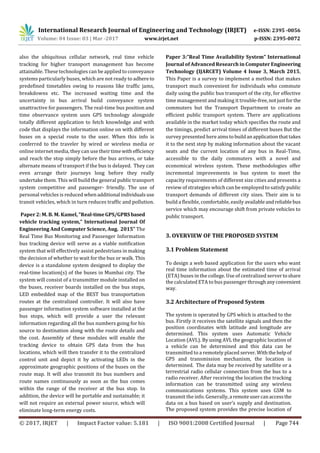
In bus unit, a bus has GPS device attached to itthatsends
its coordinates i.e. longitude and altitude after every
fixed interval of time to the main server. To use GPS
there are no subscription fees or setup charges. To
calculate the position, GPS receiver is capable of
receiving signals fromatleastthreesatellites.Depending
on the kind of application the GPS transceivers may be a
data Loggers, data Pullers or Data Pushers. This device
receives the GPS information and sends the data at
regular intervals to the server. On receiving, the server
analyses the data. To receive signals in the appropriate
place, the GPS antenna is connected to the right jack and
fixes the antennas. One slot is allocated for SIM card and
it receives the signals from theGSMtowersto respondto
the users. The positive and negative wire isconnectedto
12V or 24V vehicle power system. Then to receive the
signals from the satellite the tracker device is turned on.
Now the device is capable of receiving the latitude and
longitude values of the location of the bus. At any point
of time, the GPS receiver gives the location values. Now
the bus unit has the coordinates with a timestamp which
is then compared with the previous coordinates and if
there is any distinction then thecoordinatesareupdated
and sent to a server over GPRS network (internet).
Fig -1: Architecture of proposed system.
The location details are stored on a server in the format
such as ID, longitude, latitude, timestamp, etc. To
identify every bus among the varied buses here ID is
taken. Each bus has given one distinctive identification
number. The server is the most significant module
during this system which acts as a central repository of
the system. In this system, the whole information is
stored and maintained by the server. The server is the
intermediate between bus module and user module.
These databases consist of real-time information
regarding bus it includes bus routes, actual
arrival/departure time and real time location of thebus.
The user side module is nothing but an interactive web-
based application that services the various function of
the system to remote users. The user side module takes
two inputs i.e. one is the source that indicates wherever
the remote user is now and second is the destination
user wants to travel. When a user sends a request the
appliance fires a query to the server for accessing the
data stored within the server database and provides the
list of obtainable buses in keeping with remote users
supply and destination. Now it’s user’s task to choose or
select explicit bus range to understand the real time
location of the bus or other information. After choosing
an explicit bus number the application shows the real-
time location of that bus on the user screen. This
application gives support and interacts with varied
clients to offer service to user’s requests. The system
facilitates the real-time pursuit of the bus.
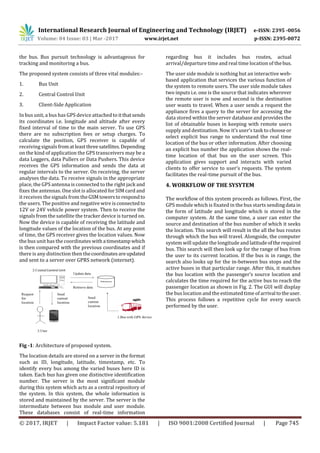
4. WORKFLOW OF THE SYSYTEM
The workflow of this system proceeds as follows. First, the
GPS module which is fixated in the bus starts sendingdata in
the form of latitude and longitude which is stored in the
computer system. At the same time, a user can enter the
source and destination of the bus number of which it seeks
the location. This search will result in the all the bus routes
through which the bus will travel. Alongside, the computer
system will update the longitude and latitudeofthe required
bus. This search will then look up for the range of bus from
the user to its current location. If the bus is in range, the
search also looks up for the in-between bus stops and the
active buses in that particular range. After this, it matches
the bus location with the passenger’s source location and
calculates the time required for the active bus to reach the
passenger location as shown in Fig. 2. The GUI will display
the bus location and the estimated time of arrival totheuser.
This process follows a repetitive cycle for every search
performed by the user.
International Research Journal of Engineering and Technology (IRJET) e-ISSN: 2395 -0056
Volume: 04 Issue: 03 | Mar -2017 www.irjet.net p-ISSN: 2395-0072
© 2017, IRJET | Impact Factor value: 5.181 | ISO 9001:2008 Certified Journal | Page 746
Fig -2: Workflow diagram
5. CONCLUSION
With the implementation of the project,a completetrack can
be kept of the buses of the college. The display at the
passenger’s end acts as a time saver. Due to this, an ideal
system of bus transport is established by us for college
purposes. By implementingoursystem,a passengercanplan
their journey more efficientlybeforetimeasthewaitingtime
at the bus stops is reduced. This system also throws a light
on the frequency of the buses on the same route. The main
features of this systems are the efficient usage of time, real-
time information on the availability of buses, traffic
acknowledgment, and commuter satisfaction. A general
question arises in mind that is if the bus is stuck in a traffic
or it broke down somewhere in the middle how our system
will inform the traveler. The answer to this problem is that
when a user will query the central server, the server will
show the same location and ETA of the bus as previous so by
this method, it is self-explanatory that the bus must havegot
stuck in a traffic or there mightbeanunknownproblemwith
it. Thus in this system, we have shown that transit
information collected in real time can be shown on the
server for tracking and monitoring. Internet-enabled mobile
phones can receive real-time transit information and will
help the passenger to monitor their time more effectively
and precisely.
6. ACKNOWLEDGEMENT
It gives us great pleasure in presenting this project
report titled “Real-Time Bus Tracking System” and we
have a tendency to want to precise our huge feeling to
those who provided valuable information and support
within the completion of this project. Their guidance
and motivation has helped in creatingthisprojecta nice
success. Thus, we specific deep sense of feeling and
satisfaction. We are indebted to our inspiring HOD
professor Kanchan Dabre and Project Guide Prof.
Vishakha Shelke, Project Co-Guide Prof. Rucha Pathari
who has extended all valuable steerage, help and
constant encouragement through numerous tough
stages for the development of the project. We specific
our sincere feeling to our respected Principle Dr.
J.B.Patil for encouragement andfacilitiesprovidedtous.
Last but not the least we'd prefer to convey all direct
and indirect identities of the college with whom we
have a tendency to took the strides for this successful
project.
REFERENCES
[1] Dr. Saylee Gharge, Manal Chhaya, Gaurav Chheda, Jitesh
Deshpande, “Real time bus monitoring system using
GPS,” AnInternational JournalofEngineeringScienceand
Technology,Vol.2,Issue3,June2012.
[2] M. B. M. Kamel, ”Real-time GPS/GPRS based vehicle
tracking system,” International Journal Of Engineering
And Computer Science, Aug. 2015
[3] ”Real time vehicle monitoring and tracking system for
school bus via Beagle bone,”
International Journal of Science and Research (IJSR),
vol. 5, no. 5, pp. 918–921, May 2015.
[4] Abid Khan, Ravi Mishra, “GPS-GSM based tracking
system,” International Journal ofEngineeringTrendsand
Technology, Vol. 3, Issue 2, pp: 161-164, 2012.

Real-Time Bus Tracking System

  • 1.
    International Research Journalof Engineering and Technology (IRJET) e-ISSN: 2395 -0056 Volume: 04 Issue: 03 | Mar -2017 www.irjet.net p-ISSN: 2395-0072 © 2017, IRJET | Impact Factor value: 5.181 | ISO 9001:2008 Certified Journal | Page 743 Real-Time Bus Tracking System Dhruv Patel1, Rahul Seth2, Vikas Mishra3 123 Department of Computer Engineering, Universal College of Engineering, Kaman Bhiwandi Road, Survey No. 146 (Part), Village Kaman, Taluka Vasai, District Palghar, Mumbai - 401202 Professor. Rucha Pathari4 4 Professor, Dept. of Computer Engineering, Universal College of Engineering, Kaman Bhiwandi Road, Survey No. 146 (Part), Village Kaman, Taluka Vasai, District Palghar, Mumbai - 401202 ---------------------------------------------------------------------***--------------------------------------------------------------------- Abstract - Unusual and unexpected conditions on theroads affect the smooth operation of the bus system and the movement of vehicles. Also, everyday problems such as traffic congestion, unexpected delays, randomness in passenger demand, irregular vehicle dispatching times take placeand as a result of which the schedule of the passengers are affected and they inevitably have to wait for the arrival of their respective bus. This passenger inconvenience can be avoided by introducing a system which provides real-timeinformation about the location and estimated time of arrival of the buses. This project focuses on the implementation of a Real-Time bus Tracking System (RTBTS), by installing GPS (Global Positioning System)-module devices on college buses which will transmit the current location on the GPS Receiver. Now the GPS Receiver will be interfaced with a computer and an interface driver will auto save data in a dot text (.txt) file which will continue to do so until the GPS module is connected to a bus. From here the application willretrievedataandstore it in web server from where the system will display real-time information of the bus. The real-time bus tracking system is a standalone system designed to display the real-time location(s) of the buses provided by the college. Key Words: Passenger inconvenience, real-time information, Real-Time Bus Tracking System (RTBTS), GPS module, web server. 1. INTRODUCTION The movement of college buses is affected by different uncertain conditions as the day progresses such as traffic congestion, unexpected delays, and randomness in passenger demand, irregular vehicle-dispatching times and many more incidents. Many students and staff members are often late for college because they decide to wait for the bus instead of using an alternate transportation. To reduce this confusion and inconvenience, a message will be shown on the web that will providethe real-timeinformationabout the bus showing its arrival time which could reduce the anxiety of passengers waiting for the bus. With the advent of GPS and the omnipresent cellular network, real-time vehicle tracking for better transport management has become possible. These technologies can be applied to transport systems especially buses, which are not able to adhere to predefined timetables due to reasons like traffic jams, breakdowns etc. The increased waiting time and the uncertainty in bus arrival make public transport system unattractive and impractical for passengers to manage their daily transportation. The real-time bus trackingsystemuses GPS (Global PositioningSystem)technologytofetchdata and displays the data using a software allowinga usertomonitor a particular bus on a particular route. Whenthisinformation is presented to the passenger by wireless media or online web media, they can manage their time efficiently and reach the bus stop just before the bus arrives, or take an alternate means of transport if the bus is delayed. They can even plan their journeys long before they actually initiate them. The real-time tracking of the bus can be done by our proposed system and this information is then given to a remote user who wants to know the real-time bus information. The system provides web-based application, which gives the real-time location of a bus on user interface screen to the remote user. This will make the college transport system smooth and passenger friendly. 2. LITERATURE SURVEY Paper 1:”Real Time Bus Position and Time Monitoring System” IJSTE-International Journal of Science Technology Engineering, Volume1,Issue10,April2015. Many passengers are usually late to work, students are late for classes as a result of they decide to anticipate the bus rather than simply merely using another alternate transportation. A variable message shown ontheweb which will be real time info regarding the bus showing the time of arrival at a particular bus stop might scale back the anxiety of passengers expecting the bus. With the advent of GPS and
  • 2.
    International Research Journalof Engineering and Technology (IRJET) e-ISSN: 2395 -0056 Volume: 04 Issue: 03 | Mar -2017 www.irjet.net p-ISSN: 2395-0072 © 2017, IRJET | Impact Factor value: 5.181 | ISO 9001:2008 Certified Journal | Page 744 also the ubiquitous cellular network, real time vehicle tracking for higher transport management has become attainable. These technologies can be applied to conveyance systems particularly buses, which are not ready to adhereto predefined timetables owing to reasons like traffic jams, breakdowns etc. The increased waiting time and the uncertainty in bus arrival build conveyance system unattractive for passengers. The real-time bus position and time observance system uses GPS technology alongside totally different application to fetch knowledge and with code that displays the information online on with different buses on a special route to the user. When this info is conferred to the traveler by wired or wireless media or online internet media, they can use theirtimewith efficiency and reach the stop simply before the bus arrives, or take alternate means of transport if the bus is delayed. They can even arrange their journeys long before they really undertake them. This will build the general public transport system competitive and passenger- friendly. The use of personal vehicles is reduced whenadditional individualsuse transit vehicles, which in turn reduces traffic and pollution. Paper 2: M. B. M. Kamel, ”Real-timeGPS/GPRS based vehicle tracking system,” International Journal Of Engineering And Computer Science, Aug. 2015” The Real Time Bus Monitoring and Passenger Information bus tracking device will serve as a viable notification system that will effectively assist pedestrians in making the decision of whether to wait for the bus or walk. This device is a standalone system designed to display the real-time location(s) of the buses in Mumbai city. The system will consist of a transmitter module installed on the buses, receiver boards installed on the bus stops, LED embedded map of the BEST bus transportation routes at the centralized controller. It will also have passenger information system software installed at the bus stops, which will provide a user the relevant information regarding all the bus numbers going for his source to destination along with the route details and the cost. Assembly of these modules will enable the tracking device to obtain GPS data from the bus locations, which will then transfer it to the centralized control unit and depict it by activating LEDs in the approximate geographic positions of the buses on the route map. It will also transmit its bus numbers and route names continuously as soon as the bus comes within the range of the receiver at the bus stop. In addition, the device will be portable and sustainable; it will not require an external power source, which will eliminate long-term energy costs. Paper 3:”Real Time Availability System” International Journal of Advanced Research in Computer Engineering Technology (IJARCET) Volume 4 Issue 3, March 2015, This Paper is a survey to implement a method that makes transport much convenient for individuals who commute daily using the public bus transport of the city, for effective time management and making it trouble-free,notjustforthe commuters but the Transport Department to create an efficient public transport system. There are applications available in the market today which specifies the route and the timings, predict arrival times of different buses But the survey presented here aimstobuildanapplicationthattakes it to the next step by making information about the vacant seats and the current location of any bus in Real-Time, accessible to the daily commuters with a novel and economical wireless system. These methodologies offer incremental improvements in bus system to meet the capacity requirements of different size cities and presents a review of strategies which can be employed to satisfy public transport demands of different city sizes. Their aim is to build a flexible, comfortable, easily availableandreliable bus service which may encourage shift from private vehicles to public transport. 3. OVERVIEW OF THE PROPOSED SYSTEM 3.1 Problem Statement To design a web based application for the users who want real time information about the estimated time of arrival (ETA) buses in the college. Use of centralized servertoshare the calculated ETA to bus passenger throughanyconvenient way. 3.2 Architecture of Proposed System The system is operated by GPS which is attached to the bus. Firstly it receives the satellite signals and then the position coordinates with latitude and longitude are determined. This system uses Automatic Vehicle Location (AVL). By using AVL the geographic location of a vehicle can be determined and this data can be transmitted to a remotely placed server.Withthehelpof GPS and transmission mechanism, the location is determined. The data may be received by satellite or a terrestrial radio cellular connection from the bus to a radio receiver. After receiving the location the tracking information can be transmitted using any wireless communications systems. This system uses GSM to transmit the info. Generally, a remoteusercanaccessthe data on a bus based on user’s supply and destination. The proposed system provides the precise location of
  • 3.
    International Research Journalof Engineering and Technology (IRJET) e-ISSN: 2395 -0056 Volume: 04 Issue: 03 | Mar -2017 www.irjet.net p-ISSN: 2395-0072 © 2017, IRJET | Impact Factor value: 5.181 | ISO 9001:2008 Certified Journal | Page 745 the bus. Bus pursuit technology is advantageous for tracking and monitoring a bus. The proposed system consists of three vital modules:- 1. Bus Unit 2. Central Control Unit 3. Client-Side Application In bus unit, a bus has GPS device attached to itthatsends its coordinates i.e. longitude and altitude after every fixed interval of time to the main server. To use GPS there are no subscription fees or setup charges. To calculate the position, GPS receiver is capable of receiving signals fromatleastthreesatellites.Depending on the kind of application the GPS transceivers may be a data Loggers, data Pullers or Data Pushers. This device receives the GPS information and sends the data at regular intervals to the server. On receiving, the server analyses the data. To receive signals in the appropriate place, the GPS antenna is connected to the right jack and fixes the antennas. One slot is allocated for SIM card and it receives the signals from theGSMtowersto respondto the users. The positive and negative wire isconnectedto 12V or 24V vehicle power system. Then to receive the signals from the satellite the tracker device is turned on. Now the device is capable of receiving the latitude and longitude values of the location of the bus. At any point of time, the GPS receiver gives the location values. Now the bus unit has the coordinates with a timestamp which is then compared with the previous coordinates and if there is any distinction then thecoordinatesareupdated and sent to a server over GPRS network (internet). Fig -1: Architecture of proposed system. The location details are stored on a server in the format such as ID, longitude, latitude, timestamp, etc. To identify every bus among the varied buses here ID is taken. Each bus has given one distinctive identification number. The server is the most significant module during this system which acts as a central repository of the system. In this system, the whole information is stored and maintained by the server. The server is the intermediate between bus module and user module. These databases consist of real-time information regarding bus it includes bus routes, actual arrival/departure time and real time location of thebus. The user side module is nothing but an interactive web- based application that services the various function of the system to remote users. The user side module takes two inputs i.e. one is the source that indicates wherever the remote user is now and second is the destination user wants to travel. When a user sends a request the appliance fires a query to the server for accessing the data stored within the server database and provides the list of obtainable buses in keeping with remote users supply and destination. Now it’s user’s task to choose or select explicit bus range to understand the real time location of the bus or other information. After choosing an explicit bus number the application shows the real- time location of that bus on the user screen. This application gives support and interacts with varied clients to offer service to user’s requests. The system facilitates the real-time pursuit of the bus. 4. WORKFLOW OF THE SYSYTEM The workflow of this system proceeds as follows. First, the GPS module which is fixated in the bus starts sendingdata in the form of latitude and longitude which is stored in the computer system. At the same time, a user can enter the source and destination of the bus number of which it seeks the location. This search will result in the all the bus routes through which the bus will travel. Alongside, the computer system will update the longitude and latitudeofthe required bus. This search will then look up for the range of bus from the user to its current location. If the bus is in range, the search also looks up for the in-between bus stops and the active buses in that particular range. After this, it matches the bus location with the passenger’s source location and calculates the time required for the active bus to reach the passenger location as shown in Fig. 2. The GUI will display the bus location and the estimated time of arrival totheuser. This process follows a repetitive cycle for every search performed by the user.
  • 4.
    International Research Journalof Engineering and Technology (IRJET) e-ISSN: 2395 -0056 Volume: 04 Issue: 03 | Mar -2017 www.irjet.net p-ISSN: 2395-0072 © 2017, IRJET | Impact Factor value: 5.181 | ISO 9001:2008 Certified Journal | Page 746 Fig -2: Workflow diagram 5. CONCLUSION With the implementation of the project,a completetrack can be kept of the buses of the college. The display at the passenger’s end acts as a time saver. Due to this, an ideal system of bus transport is established by us for college purposes. By implementingoursystem,a passengercanplan their journey more efficientlybeforetimeasthewaitingtime at the bus stops is reduced. This system also throws a light on the frequency of the buses on the same route. The main features of this systems are the efficient usage of time, real- time information on the availability of buses, traffic acknowledgment, and commuter satisfaction. A general question arises in mind that is if the bus is stuck in a traffic or it broke down somewhere in the middle how our system will inform the traveler. The answer to this problem is that when a user will query the central server, the server will show the same location and ETA of the bus as previous so by this method, it is self-explanatory that the bus must havegot stuck in a traffic or there mightbeanunknownproblemwith it. Thus in this system, we have shown that transit information collected in real time can be shown on the server for tracking and monitoring. Internet-enabled mobile phones can receive real-time transit information and will help the passenger to monitor their time more effectively and precisely. 6. ACKNOWLEDGEMENT It gives us great pleasure in presenting this project report titled “Real-Time Bus Tracking System” and we have a tendency to want to precise our huge feeling to those who provided valuable information and support within the completion of this project. Their guidance and motivation has helped in creatingthisprojecta nice success. Thus, we specific deep sense of feeling and satisfaction. We are indebted to our inspiring HOD professor Kanchan Dabre and Project Guide Prof. Vishakha Shelke, Project Co-Guide Prof. Rucha Pathari who has extended all valuable steerage, help and constant encouragement through numerous tough stages for the development of the project. We specific our sincere feeling to our respected Principle Dr. J.B.Patil for encouragement andfacilitiesprovidedtous. Last but not the least we'd prefer to convey all direct and indirect identities of the college with whom we have a tendency to took the strides for this successful project. REFERENCES [1] Dr. Saylee Gharge, Manal Chhaya, Gaurav Chheda, Jitesh Deshpande, “Real time bus monitoring system using GPS,” AnInternational JournalofEngineeringScienceand Technology,Vol.2,Issue3,June2012. [2] M. B. M. Kamel, ”Real-time GPS/GPRS based vehicle tracking system,” International Journal Of Engineering And Computer Science, Aug. 2015 [3] ”Real time vehicle monitoring and tracking system for school bus via Beagle bone,” International Journal of Science and Research (IJSR), vol. 5, no. 5, pp. 918–921, May 2015. [4] Abid Khan, Ravi Mishra, “GPS-GSM based tracking system,” International Journal ofEngineeringTrendsand Technology, Vol. 3, Issue 2, pp: 161-164, 2012.