International Research Journal of Engineering and Technology (IRJET) e-ISSN: 2395-0056
Volume: 06 Issue: 12 | Dec 2019 www.irjet.net p-ISSN: 2395-0072
© 2019, IRJET | Impact Factor value: 7.34 | ISO 9001:2008 Certified Journal | Page 931
SMART BUS TRACKING SYSTEM
Deepika Godse1, Ambika Rayaji2, Pallavi Pawar3, Prof. Sneha Ramteke4
1,2,3B.E. Student, Dept. of Computer Engineering, APCOER, Savitribai Phule Pune University, Pune, Maharashtra, India
4Professor (Internal Guide), Dept. of Computer Engineering, APCOER, Savitribai Phule Pune University, Pune,
Maharashtra, India
------------------------------------------------------------------------***-----------------------------------------------------------------------
ABSTRACT - The reliability of public transport is very
important today. Peoples who use public buses can waste a
lot of time waiting for the particular bus at bus stop. In the
daily operation of the bus system, the movement of buses
affected by unknown circumstances is the arrival of buses
arriving at bus stop at irregular times of transportation or
deployment from the bus depot. If people traveling by bus
get the exact bus location and the approximate arrival time
based on the normal traffic conditions and also if the counts
of passengers in bus then it will increase the trustworthiness
in the public transport. This paper proposes a system to
track public bus using GPS (Global Positioning System), tell
the count of number of passengers in bus and the estimated
time arrival to the user. The location of Bus can be tracked
by public using Android Application by the user. The Android
application will also contain the details of all the bus like
Bus number, Bus routes, Bus Stops, Bus timings or the
frequency of particular bus.
Key Words: Internet of things (IoT), IR sensors, GPS,
GPRS, public transport, bus tracking, Android
1. INTRODUCTION
Nowadays, due to increase of population in cities there is a
need to make the city smart. In the Smart City includes
major changes in city life like development of roads, public
transportation, and electricity in houses, streets,
commercial places, and water supply. The current public
transportation like city bus transportation should be
upgraded. The city bus at the movement is not traceable
for public but only for the bus authorities. The people have
to wait for bus at bus stops for long period of time or till
the bus comes without having knowledge of when the bus
will arrive. The Timetable provided at bus stop has the
information like bus number, and where the bus is going
from the specific stop and the frequency of bus. If some
passengers wait for long time it may have happens that,
the bus fails during an ongoing journey. So, at the present
in PMPML the conductor calls the depot and informs them
about the failure of bus and in this case conductor wait for
the bus which is coming towards their direction of
destination and then the passengers from the failed bus
are then deported in the coming bus after verification of
ticket which is lengthy process and also due to unexpected
delays in traffic jams the bus arrival time cannot be
predicted. So, for this reason we are going to develop a
smart bus by using embedded system to which the
passenger’s waiting time reduced for bus and will provide
him/her with all necessary details regarding the
arrival/departure time of the bus, its exact location and
when the bus is nearer to the particular bus stop. We are
going to track the bus using GPS to get the exact
location/place of the bus. We have installed a Arduino UNO
as a microcontroller in the bus which is connected with
GPS with wires and it is also connected with IR sensors on
both IN and OUT doors with Bluetooth. The Arduino UNO
is also connected with the app of conductor, which is
android based. The whole set of bus or the embedded
system is connected to the cloud server i.e. Admin
Application. Moreover, there is an Android Application for
public or Bus user, which will help to track bus and get the
exact location of bus, the vacant seats in Bus and will also
contain a small database of bus’s timetable. The Timetable
will contain Bus Number, Names of Bus stops that will
help to search source and destination and give the
information about which bus to catch. The application will
also tell the estimated arrival time (ETA) of the particular
bus to the user and calculating it by using Euclidean
formula. Estimated arrival time (ETA) is calculated when
user is standing on bus stop and the nearest bus coming
towards the bus stops at which user is standing. Further,
we are going to set a frequency for buses so that some
trips might be saved. It will be done by using K-means
clustering Algorithm. This paper presents a system for
public transportation, which is successful in producing an
intended or desired solution or result for specified
purpose.
2. NEED OF THE NEW GENERATION SMART BUS
TRACKING SYSTEM
Main objective of new generation smart bus (for tracking)
systems is to get real time location (coordinates) of the bus
and count the number of passenger in the bus so that
passengers can make better travel decisions and also to
make user friendly system to track location and get the
density of passengers in the bus. Main effects of such a bus
tracking system are reduced waiting time, reduced
uncertainty time, increased willingness to pay, and
customer satisfaction.
International Research Journal of Engineering and Technology (IRJET) e-ISSN: 2395-0056
Volume: 06 Issue: 12 | Dec 2019 www.irjet.net p-ISSN: 2395-0072
© 2019, IRJET | Impact Factor value: 7.34 | ISO 9001:2008 Certified Journal | Page 932
3. EXISTING SYSTEM
The public transportation is the main source of
transportation for the people. It saves the utilization of fuel
and is also inexpensive. Many offices commuters’ school
going students, university students use public
transportation as the main source for going to their
specific destination. Currently, at right now the public
transport buses are tracked using GPRS i.e. General packet
radio service device. It is wireless data service built on
existing GSM network. GPRS device works by allowing data
to be stored in Packets, this data is then transmitted in an
efficient manner across the mobile networks. A GPRS
device has the capability to allow users to have mobile
Communication and also have the internet connections,
GPRS device track the location by fetching the relevant
information from nearby GSM cell station. The reason
public transport should use GPRS device is that it is a two-
way communication between dispatcher and driver and
the ability to track location information and vital vehicles
statistics. The timetable declared by PMPML is on the
official website or the poster, which is stickled on the Bus
stop. The Website contains all the information of PMPML
buses, which are traveling across the whole city. However,
the poster on Bus stops contains information of buses,
which are going to pass by the specific bus stop.
Sometimes the timetable changes according to the
requirement of people without giving any prior notice to
the citizens. The posters, which are stickled on bus stops,
remain same all the time or maybe throughout the year.
Only the timetable, which is on the website, is updated. So,
many times it so happens that people follow time table
which is stickled on bus stops which leads in increasing
waiting time. The frequencies of Buss’, which are set, are
based on the requirement of the people for that particular
route. The Survey is conducted manually by getting
information about crowd or traffic from the bus
conductors, drivers, and the ticket checker. At present, the
frequency is high in morning from 7am to 11am and in
evening from 5pm to 9pm and there is low frequency in
early morning, afternoon and in night after 9pm. And in
case of Bus failure the conductor have to calls the depot
manager and tells them to send an alternative bus and till
the alternative bus comes the conductor helps passengers
to get into the bus which is coming towards that direction
or have to wait till the alternative bus will come.
4. PROPOSED SYSTEM
This paper proposes a system for tracking the city bus
using advance techniques, which are capable to deliver
results and the information in a rapid and efficient way.
We propose the bus tracking system on Android
Application as everyone is uses a smart phone in day-to-
day life. It proposes the advance and latest techniques for
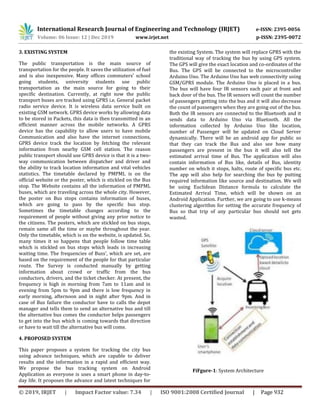
the existing System. The system will replace GPRS with the
traditional way of tracking the bus by using GPS system.
The GPS will give the exact location and co-ordinates of the
Bus. The GPS will be connected to the microcontroller
Arduino Uno. The Arduino Uno has web connectivity using
GSM/GPRS module. The Arduino Uno is placed in a bus.
The bus will have four IR sensors each pair at front and
back door of the bus. The IR sensors will count the number
of passengers getting into the bus and it will also decrease
the count of passengers when they are going out of the bus.
Both the IR sensors are connected to the Bluetooth and it
sends data to Arduino Uno via Bluetooth. All the
information collected by Arduino Uno like location,
number of Passenger will be updated on Cloud Server
dynamically. There will be an android app for public so
that they can track the Bus and also see how many
passengers are present in the bus it will also tell the
estimated arrival time of Bus. The application will also
contain information of Bus like, details of Bus, identity
number on which it stops, halts, route of specific bus etc.
The app will also help for searching the bus by putting
required information like source and destination. We will
be using Euclidean Distance formula to calculate the
Estimated Arrival Time, which will be shown on an
Android Application. Further, we are going to use k-means
clustering algorithm for setting the accurate frequency of
Bus so that trip of any particular bus should not gets
wasted.
FiFgure-1: System Architecture
International Research Journal of Engineering and Technology (IRJET) e-ISSN: 2395-0056
Volume: 06 Issue: 12 | Dec 2019 www.irjet.net p-ISSN: 2395-0072
© 2019, IRJET | Impact Factor value: 7.34 | ISO 9001:2008 Certified Journal | Page 933
4.1 K-means clustering Algorithm
K-means clustering is vector quantization method that is
popular for cluster analysis in the field of Data mining.
Medians are used rather than mean because this
minimizes the norms. We will be surveying around 10-15
routes in different timings like in Morning, Afternoon and
Evening. From this survey, we will come to know how
many people travel in a particular Route in given time
and also the frequencies of bus. Therefore, we will be
applying k-means clustering algorithm to form three
clusters. The first cluster will consist of data where the
maximum crowds i.e. in this cluster we will have those
entries where people travel the most in a particular route
at a particular time period. The second cluster will consist
of data where crowd at this time the bus will be partially
filled of less than the half of its capacity. The Third cluster
will consist of data where the crowd is moderate, It is not
over crowded neither is it empty. Here the number of
people traveling in a bus at a particular time is
manageable and there is no inconvenience caused to
anyone. By using the data from above clusters, we will be
able to assign an appropriate set of frequency for bus in
specific time. This will also help to prevent the loss of trip
when demand for bus is low and also help to increase the
frequency when demand is high. This will restore the
faith of citizens in public transportation.
4.2 Euclidean Formula
This formula will help us to calculate the estimated arrival
time of the bus. It will be calculated by using longitude and
latitude of bus and the passenger who is standing on the
bus stop. We will take latitude as x-axis and longitude as y-
axis. Therefore, here x2 will be latitude of the bus, x1 will
be latitude of Passenger standing on bus stop. Similarly, y2
will be longitude of bus; y1 will be longitude of Passenger
standing on bus stop. Applying the formula and after
square rooting we will get the answer which will be
estimated arrival time of the bus. Estimated Arrival time
(EAT) is calculated for the bus only which is coming
towards the bus stop on which the passenger is standing
by considering approximate time for signals on route and
moderate traffic.
5. SYSTEM ARCHITECTURE
Application starts with instantiating Location Manager.
This is needed to track user location. Detailed description
regarding Location Manager is provided in this section to
the user. Next, GUI and user interaction handling sets up
all necessary selections. In order to provide a detailed view
concerning system mechanism, project can be grouped in
three segments. These are Location Manager, Fragments
and sync Task & Services. The Broadcast receiver in the
GPS module work in tandem to establish connection &
report location, the fragments in the activity class manage
all the methods in listing peers. To search for a bus, client
has to enter the bus number or source and destination in
the search bar of the application. Then the map is displays
the current location of the bus. An alert is sent as soon as
bus reaches nearest stop. When the application is
launched, the home Activity fetches the routes (Location)
and bus No. from the server and binds it for the client to
select it. When the client selects a bus, corresponding stops
are fetched from the server and binded in the application
for the client to select it. If the client selects “Track Bus”
then the location details of the bus from that route is
fetched. If the client clicks on “Show Map” then the location
of the particular bus on the map will be displayed to
users/clients.
5.1 SYSTEM DESIGN
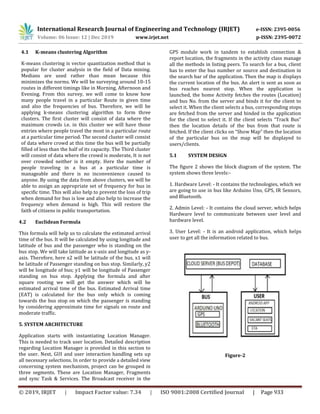
The figure 2 shows the block diagram of the system. The
system shows three levels:-
1. Hardware Level: - It contains the technologies, which we
are going to use in bus like Arduino Uno, GPS, IR Sensors,
and Bluetooth.
2. Admin Level: - It contains the cloud server, which helps
Hardware level to communicate between user level and
hardware level.
3. User Level: - It is an android application, which helps
user to get all the information related to bus.
Figure-2
International Research Journal of Engineering and Technology (IRJET) e-ISSN: 2395-0056
Volume: 06 Issue: 12 | Dec 2019 www.irjet.net p-ISSN: 2395-0072
© 2019, IRJET | Impact Factor value: 7.34 | ISO 9001:2008 Certified Journal | Page 934
5.2. THE TECHNIQUES & TECHNOLOGIES USED ARE
BRIEFLY EXPLAINED BELOW
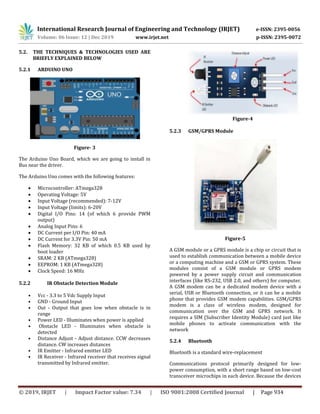
5.2.1 ARDUINO UNO
Figure- 3
The Arduino Uno Board, which we are going to install in
Bus near the driver.
The Arduino Uno comes with the following features:
 Microcontroller: ATmega328
 Operating Voltage: 5V
 Input Voltage (recommended): 7-12V
 Input Voltage (limits): 6-20V
 Digital I/O Pins: 14 (of which 6 provide PWM
output)
 Analog Input Pins: 6
 DC Current per I/O Pin: 40 mA
 DC Current for 3.3V Pin: 50 mA
 Flash Memory: 32 KB of which 0.5 KB used by
boot loader
 SRAM: 2 KB (ATmega328)
 EEPROM: 1 KB (ATmega328)
 Clock Speed: 16 MHz
5.2.2 IR Obstacle Detection Module
• Vcc - 3.3 to 5 Vdc Supply Input
• GND - Ground Input
• Out - Output that goes low when obstacle is in
range
• Power LED - Illuminates when power is applied
• Obstacle LED - Illuminates when obstacle is
detected
• Distance Adjust - Adjust distance. CCW decreases
distance. CW increases distances
• IR Emitter - Infrared emitter LED
• IR Receiver - Infrared receiver that receives signal
transmitted by Infrared emitter.
Figure-4
5.2.3 GSM/GPRS Module
Figure-5
A GSM module or a GPRS module is a chip or circuit that is
used to establish communication between a mobile device
or a computing machine and a GSM or GPRS system. These
modules consist of a GSM module or GPRS modem
powered by a power supply circuit and communication
interfaces (like RS-232, USB 2.0, and others) for computer.
A GSM modem can be a dedicated modem device with a
serial, USB or Bluetooth connection, or it can be a mobile
phone that provides GSM modem capabilities. GSM/GPRS
modem is a class of wireless modem, designed for
communication over the GSM and GPRS network. It
requires a SIM (Subscriber Identity Module) card just like
mobile phones to activate communication with the
network
5.2.4 Bluetooth
Bluetooth is a standard wire-replacement
Communications protocol primarily designed for low-
power consumption, with a short range based on low-cost
transceiver microchips in each device. Because the devices
International Research Journal of Engineering and Technology (IRJET) e-ISSN: 2395-0056
Volume: 06 Issue: 12 | Dec 2019 www.irjet.net p-ISSN: 2395-0072
© 2019, IRJET | Impact Factor value: 7.34 | ISO 9001:2008 Certified Journal | Page 935
use a radio (broadcast) communications system, they do
not have to be in visual line of sight of each other.
Figure-6
6. METHODOLOGY
6.1 Location Information
The Location information is fetched from the online
database, which receives the data regarding the location
from the Arduino UNO module in the bus. This helps in
maintaining the uniqueness of the particular bus while
displaying its location in the map.
6.2 Maps
The application is developed using android API, which has
a very simple User Interface to use it. Google maps API is
the core component used in it, which is very easy to use
and explore maps with simple gestures such as pinch to
zoom tap to point etc.
6.3 Bus / Route Information
The Routes of all the Buses are recorded by Bus In-charge.
So, the management can login the website and
update/modify the bus details and details regarding its
routes dynamically so that passengers will have right
information about a particular bus. Now, the request made
by the client for the bus information will be fetched from
the database and delivered to client through server.
7. CONCLUSION
This Project has been implemented on Android platform.
The requirements and specifications have been listed
above. This project is implemented using Android and the
data-mining domain. Thus in this system, we have shown
that transit information collected in real time can be
shown on the server for tracking and monitoring. Through
the Internet-enabled mobile phones, the users can receive
real-time transit information and will help the passenger
to monitor their time more effectively and precisely. Using
the GPS system, the android application will automatically
display the maps and routes to the different locations, also
track the bus location using client-server technology, and
forward it to the client device. It uses basic measurements
of distance between two locations and provides necessary
details of each and every route for people to easily pick up
buses or any other conveyance possible on the specified
route. Specific location details of the particular bus are
provided to the user along with bus number so that the
person can identify the bus correctly. Due to this the
records can be easily manipulated on the device itself and
the server burden gets reduced.
8. REFERENCES
[1] Dr D Durga Bhavani , S C V S L S Ravi Kiran,
“Implementation of Smart Bus Tracking System Using
Wi-Fi”, www.ijirset.com , Vol. 6, Issue 7, July 2017 .
[2] Dhruv Patel, Rahul Seth, Vikas Mishra, “ Real-Time
Bus Tracking System”, www.irjet.net , Volume: 04
Issue: 03 | Mar -2017
[3] Shekhar Shinde, Vijaykumar Nagalwar, Nikhil Shinde,
B.V.Pawar,” Design of E-City Bus Tracking System”,
Vol. 4, Issue 4, April 2014
[4] Manish Chandwani, Bhoomika Batheja, Lokesh
Jeswani, Praveen Devnani, Prof. Richard Joseph, “Real
Time Bus Tracking System”, www.iosrjen.org, Volume
14, PP 24-28
[5] B.Caulfield and M.O‟Mahony, “An examination of the
public transport information requirements of users,”
IEEE Trans.Intell.Transp. Syst., vol. 8, no. 1, pp. 21–30,
Mar. 2007.
[6] K.Rehrl,S.Bruntsch,andH.-J.Mentz,“Assisting
multimodal travelers: Design and prototypical
implementation of a personal travel companion,” IEEE
Trans. on Intelligent Transportation Systems, vol. 8,
no. 1, pp. 31–42, Mar2007.
[7] Swati Chandorkar, Sneha Nude, Sanjana Sinha,
PoojaBorkar “Implementation of real time bus
monitoring and passenger information system,”
International Journal of Scientific and Research
Publications, Vol. 3, Issue 5, May 2013. Swati
Chandorkar, Sneha Nude, Sanjana Sinha, PoojaBorkar
“Implementation of real time bus monitoring and
International Research Journal of Engineering and Technology (IRJET) e-ISSN: 2395-0056
Volume: 06 Issue: 12 | Dec 2019 www.irjet.net p-ISSN: 2395-0072
© 2019, IRJET | Impact Factor value: 7.34 | ISO 9001:2008 Certified Journal | Page 936
passenger information system,” International Journal
of Scientific and Research Publications, Vol. 3, Issue 5,
May 2013.
[8] Madhu Manikya Kumar, K. Rajesekhar, K. Pavani,
“Design of punctually enhanced bus transportation
system using GSM and Zigbee” International Journal of
Research in Computer and Communication
Technology, Vol.2, Issue 12, December 2013.
[9] Ms. Madhuri. Patil- M.Tech(CSE), Department
CSE,MLRIT, Hyderabad & Mr. N. Aravind Kumar-
Assistant Professor,Department of CSE,
MLRIT,Hyderabad“Design of punctually enhanced bus
transportation system using GSM and Zigbee,”
International Research Journal of Computer Science
(IRJCS) ISSN: 2393-9842 Issue 6, Volume 2 (June
2015).
[10] https://en.wikipedia.org/wiki/Kmeans_Clustering
[11] https://en.wikipedia.org/wiki/Kmeans_Clustering
[12] https://wiki.eprolabs.com/index.php?title=IR_Ob
stacle_Sensor
[13] https://en.wikipedia.org/wiki/Bluetooth

IRJET- Smart Bus Tracking System

  • 1.
    International Research Journalof Engineering and Technology (IRJET) e-ISSN: 2395-0056 Volume: 06 Issue: 12 | Dec 2019 www.irjet.net p-ISSN: 2395-0072 © 2019, IRJET | Impact Factor value: 7.34 | ISO 9001:2008 Certified Journal | Page 931 SMART BUS TRACKING SYSTEM Deepika Godse1, Ambika Rayaji2, Pallavi Pawar3, Prof. Sneha Ramteke4 1,2,3B.E. Student, Dept. of Computer Engineering, APCOER, Savitribai Phule Pune University, Pune, Maharashtra, India 4Professor (Internal Guide), Dept. of Computer Engineering, APCOER, Savitribai Phule Pune University, Pune, Maharashtra, India ------------------------------------------------------------------------***----------------------------------------------------------------------- ABSTRACT - The reliability of public transport is very important today. Peoples who use public buses can waste a lot of time waiting for the particular bus at bus stop. In the daily operation of the bus system, the movement of buses affected by unknown circumstances is the arrival of buses arriving at bus stop at irregular times of transportation or deployment from the bus depot. If people traveling by bus get the exact bus location and the approximate arrival time based on the normal traffic conditions and also if the counts of passengers in bus then it will increase the trustworthiness in the public transport. This paper proposes a system to track public bus using GPS (Global Positioning System), tell the count of number of passengers in bus and the estimated time arrival to the user. The location of Bus can be tracked by public using Android Application by the user. The Android application will also contain the details of all the bus like Bus number, Bus routes, Bus Stops, Bus timings or the frequency of particular bus. Key Words: Internet of things (IoT), IR sensors, GPS, GPRS, public transport, bus tracking, Android 1. INTRODUCTION Nowadays, due to increase of population in cities there is a need to make the city smart. In the Smart City includes major changes in city life like development of roads, public transportation, and electricity in houses, streets, commercial places, and water supply. The current public transportation like city bus transportation should be upgraded. The city bus at the movement is not traceable for public but only for the bus authorities. The people have to wait for bus at bus stops for long period of time or till the bus comes without having knowledge of when the bus will arrive. The Timetable provided at bus stop has the information like bus number, and where the bus is going from the specific stop and the frequency of bus. If some passengers wait for long time it may have happens that, the bus fails during an ongoing journey. So, at the present in PMPML the conductor calls the depot and informs them about the failure of bus and in this case conductor wait for the bus which is coming towards their direction of destination and then the passengers from the failed bus are then deported in the coming bus after verification of ticket which is lengthy process and also due to unexpected delays in traffic jams the bus arrival time cannot be predicted. So, for this reason we are going to develop a smart bus by using embedded system to which the passenger’s waiting time reduced for bus and will provide him/her with all necessary details regarding the arrival/departure time of the bus, its exact location and when the bus is nearer to the particular bus stop. We are going to track the bus using GPS to get the exact location/place of the bus. We have installed a Arduino UNO as a microcontroller in the bus which is connected with GPS with wires and it is also connected with IR sensors on both IN and OUT doors with Bluetooth. The Arduino UNO is also connected with the app of conductor, which is android based. The whole set of bus or the embedded system is connected to the cloud server i.e. Admin Application. Moreover, there is an Android Application for public or Bus user, which will help to track bus and get the exact location of bus, the vacant seats in Bus and will also contain a small database of bus’s timetable. The Timetable will contain Bus Number, Names of Bus stops that will help to search source and destination and give the information about which bus to catch. The application will also tell the estimated arrival time (ETA) of the particular bus to the user and calculating it by using Euclidean formula. Estimated arrival time (ETA) is calculated when user is standing on bus stop and the nearest bus coming towards the bus stops at which user is standing. Further, we are going to set a frequency for buses so that some trips might be saved. It will be done by using K-means clustering Algorithm. This paper presents a system for public transportation, which is successful in producing an intended or desired solution or result for specified purpose. 2. NEED OF THE NEW GENERATION SMART BUS TRACKING SYSTEM Main objective of new generation smart bus (for tracking) systems is to get real time location (coordinates) of the bus and count the number of passenger in the bus so that passengers can make better travel decisions and also to make user friendly system to track location and get the density of passengers in the bus. Main effects of such a bus tracking system are reduced waiting time, reduced uncertainty time, increased willingness to pay, and customer satisfaction.
  • 2.
    International Research Journalof Engineering and Technology (IRJET) e-ISSN: 2395-0056 Volume: 06 Issue: 12 | Dec 2019 www.irjet.net p-ISSN: 2395-0072 © 2019, IRJET | Impact Factor value: 7.34 | ISO 9001:2008 Certified Journal | Page 932 3. EXISTING SYSTEM The public transportation is the main source of transportation for the people. It saves the utilization of fuel and is also inexpensive. Many offices commuters’ school going students, university students use public transportation as the main source for going to their specific destination. Currently, at right now the public transport buses are tracked using GPRS i.e. General packet radio service device. It is wireless data service built on existing GSM network. GPRS device works by allowing data to be stored in Packets, this data is then transmitted in an efficient manner across the mobile networks. A GPRS device has the capability to allow users to have mobile Communication and also have the internet connections, GPRS device track the location by fetching the relevant information from nearby GSM cell station. The reason public transport should use GPRS device is that it is a two- way communication between dispatcher and driver and the ability to track location information and vital vehicles statistics. The timetable declared by PMPML is on the official website or the poster, which is stickled on the Bus stop. The Website contains all the information of PMPML buses, which are traveling across the whole city. However, the poster on Bus stops contains information of buses, which are going to pass by the specific bus stop. Sometimes the timetable changes according to the requirement of people without giving any prior notice to the citizens. The posters, which are stickled on bus stops, remain same all the time or maybe throughout the year. Only the timetable, which is on the website, is updated. So, many times it so happens that people follow time table which is stickled on bus stops which leads in increasing waiting time. The frequencies of Buss’, which are set, are based on the requirement of the people for that particular route. The Survey is conducted manually by getting information about crowd or traffic from the bus conductors, drivers, and the ticket checker. At present, the frequency is high in morning from 7am to 11am and in evening from 5pm to 9pm and there is low frequency in early morning, afternoon and in night after 9pm. And in case of Bus failure the conductor have to calls the depot manager and tells them to send an alternative bus and till the alternative bus comes the conductor helps passengers to get into the bus which is coming towards that direction or have to wait till the alternative bus will come. 4. PROPOSED SYSTEM This paper proposes a system for tracking the city bus using advance techniques, which are capable to deliver results and the information in a rapid and efficient way. We propose the bus tracking system on Android Application as everyone is uses a smart phone in day-to- day life. It proposes the advance and latest techniques for the existing System. The system will replace GPRS with the traditional way of tracking the bus by using GPS system. The GPS will give the exact location and co-ordinates of the Bus. The GPS will be connected to the microcontroller Arduino Uno. The Arduino Uno has web connectivity using GSM/GPRS module. The Arduino Uno is placed in a bus. The bus will have four IR sensors each pair at front and back door of the bus. The IR sensors will count the number of passengers getting into the bus and it will also decrease the count of passengers when they are going out of the bus. Both the IR sensors are connected to the Bluetooth and it sends data to Arduino Uno via Bluetooth. All the information collected by Arduino Uno like location, number of Passenger will be updated on Cloud Server dynamically. There will be an android app for public so that they can track the Bus and also see how many passengers are present in the bus it will also tell the estimated arrival time of Bus. The application will also contain information of Bus like, details of Bus, identity number on which it stops, halts, route of specific bus etc. The app will also help for searching the bus by putting required information like source and destination. We will be using Euclidean Distance formula to calculate the Estimated Arrival Time, which will be shown on an Android Application. Further, we are going to use k-means clustering algorithm for setting the accurate frequency of Bus so that trip of any particular bus should not gets wasted. FiFgure-1: System Architecture
  • 3.
    International Research Journalof Engineering and Technology (IRJET) e-ISSN: 2395-0056 Volume: 06 Issue: 12 | Dec 2019 www.irjet.net p-ISSN: 2395-0072 © 2019, IRJET | Impact Factor value: 7.34 | ISO 9001:2008 Certified Journal | Page 933 4.1 K-means clustering Algorithm K-means clustering is vector quantization method that is popular for cluster analysis in the field of Data mining. Medians are used rather than mean because this minimizes the norms. We will be surveying around 10-15 routes in different timings like in Morning, Afternoon and Evening. From this survey, we will come to know how many people travel in a particular Route in given time and also the frequencies of bus. Therefore, we will be applying k-means clustering algorithm to form three clusters. The first cluster will consist of data where the maximum crowds i.e. in this cluster we will have those entries where people travel the most in a particular route at a particular time period. The second cluster will consist of data where crowd at this time the bus will be partially filled of less than the half of its capacity. The Third cluster will consist of data where the crowd is moderate, It is not over crowded neither is it empty. Here the number of people traveling in a bus at a particular time is manageable and there is no inconvenience caused to anyone. By using the data from above clusters, we will be able to assign an appropriate set of frequency for bus in specific time. This will also help to prevent the loss of trip when demand for bus is low and also help to increase the frequency when demand is high. This will restore the faith of citizens in public transportation. 4.2 Euclidean Formula This formula will help us to calculate the estimated arrival time of the bus. It will be calculated by using longitude and latitude of bus and the passenger who is standing on the bus stop. We will take latitude as x-axis and longitude as y- axis. Therefore, here x2 will be latitude of the bus, x1 will be latitude of Passenger standing on bus stop. Similarly, y2 will be longitude of bus; y1 will be longitude of Passenger standing on bus stop. Applying the formula and after square rooting we will get the answer which will be estimated arrival time of the bus. Estimated Arrival time (EAT) is calculated for the bus only which is coming towards the bus stop on which the passenger is standing by considering approximate time for signals on route and moderate traffic. 5. SYSTEM ARCHITECTURE Application starts with instantiating Location Manager. This is needed to track user location. Detailed description regarding Location Manager is provided in this section to the user. Next, GUI and user interaction handling sets up all necessary selections. In order to provide a detailed view concerning system mechanism, project can be grouped in three segments. These are Location Manager, Fragments and sync Task & Services. The Broadcast receiver in the GPS module work in tandem to establish connection & report location, the fragments in the activity class manage all the methods in listing peers. To search for a bus, client has to enter the bus number or source and destination in the search bar of the application. Then the map is displays the current location of the bus. An alert is sent as soon as bus reaches nearest stop. When the application is launched, the home Activity fetches the routes (Location) and bus No. from the server and binds it for the client to select it. When the client selects a bus, corresponding stops are fetched from the server and binded in the application for the client to select it. If the client selects “Track Bus” then the location details of the bus from that route is fetched. If the client clicks on “Show Map” then the location of the particular bus on the map will be displayed to users/clients. 5.1 SYSTEM DESIGN The figure 2 shows the block diagram of the system. The system shows three levels:- 1. Hardware Level: - It contains the technologies, which we are going to use in bus like Arduino Uno, GPS, IR Sensors, and Bluetooth. 2. Admin Level: - It contains the cloud server, which helps Hardware level to communicate between user level and hardware level. 3. User Level: - It is an android application, which helps user to get all the information related to bus. Figure-2
  • 4.
    International Research Journalof Engineering and Technology (IRJET) e-ISSN: 2395-0056 Volume: 06 Issue: 12 | Dec 2019 www.irjet.net p-ISSN: 2395-0072 © 2019, IRJET | Impact Factor value: 7.34 | ISO 9001:2008 Certified Journal | Page 934 5.2. THE TECHNIQUES & TECHNOLOGIES USED ARE BRIEFLY EXPLAINED BELOW 5.2.1 ARDUINO UNO Figure- 3 The Arduino Uno Board, which we are going to install in Bus near the driver. The Arduino Uno comes with the following features:  Microcontroller: ATmega328  Operating Voltage: 5V  Input Voltage (recommended): 7-12V  Input Voltage (limits): 6-20V  Digital I/O Pins: 14 (of which 6 provide PWM output)  Analog Input Pins: 6  DC Current per I/O Pin: 40 mA  DC Current for 3.3V Pin: 50 mA  Flash Memory: 32 KB of which 0.5 KB used by boot loader  SRAM: 2 KB (ATmega328)  EEPROM: 1 KB (ATmega328)  Clock Speed: 16 MHz 5.2.2 IR Obstacle Detection Module • Vcc - 3.3 to 5 Vdc Supply Input • GND - Ground Input • Out - Output that goes low when obstacle is in range • Power LED - Illuminates when power is applied • Obstacle LED - Illuminates when obstacle is detected • Distance Adjust - Adjust distance. CCW decreases distance. CW increases distances • IR Emitter - Infrared emitter LED • IR Receiver - Infrared receiver that receives signal transmitted by Infrared emitter. Figure-4 5.2.3 GSM/GPRS Module Figure-5 A GSM module or a GPRS module is a chip or circuit that is used to establish communication between a mobile device or a computing machine and a GSM or GPRS system. These modules consist of a GSM module or GPRS modem powered by a power supply circuit and communication interfaces (like RS-232, USB 2.0, and others) for computer. A GSM modem can be a dedicated modem device with a serial, USB or Bluetooth connection, or it can be a mobile phone that provides GSM modem capabilities. GSM/GPRS modem is a class of wireless modem, designed for communication over the GSM and GPRS network. It requires a SIM (Subscriber Identity Module) card just like mobile phones to activate communication with the network 5.2.4 Bluetooth Bluetooth is a standard wire-replacement Communications protocol primarily designed for low- power consumption, with a short range based on low-cost transceiver microchips in each device. Because the devices
  • 5.
    International Research Journalof Engineering and Technology (IRJET) e-ISSN: 2395-0056 Volume: 06 Issue: 12 | Dec 2019 www.irjet.net p-ISSN: 2395-0072 © 2019, IRJET | Impact Factor value: 7.34 | ISO 9001:2008 Certified Journal | Page 935 use a radio (broadcast) communications system, they do not have to be in visual line of sight of each other. Figure-6 6. METHODOLOGY 6.1 Location Information The Location information is fetched from the online database, which receives the data regarding the location from the Arduino UNO module in the bus. This helps in maintaining the uniqueness of the particular bus while displaying its location in the map. 6.2 Maps The application is developed using android API, which has a very simple User Interface to use it. Google maps API is the core component used in it, which is very easy to use and explore maps with simple gestures such as pinch to zoom tap to point etc. 6.3 Bus / Route Information The Routes of all the Buses are recorded by Bus In-charge. So, the management can login the website and update/modify the bus details and details regarding its routes dynamically so that passengers will have right information about a particular bus. Now, the request made by the client for the bus information will be fetched from the database and delivered to client through server. 7. CONCLUSION This Project has been implemented on Android platform. The requirements and specifications have been listed above. This project is implemented using Android and the data-mining domain. Thus in this system, we have shown that transit information collected in real time can be shown on the server for tracking and monitoring. Through the Internet-enabled mobile phones, the users can receive real-time transit information and will help the passenger to monitor their time more effectively and precisely. Using the GPS system, the android application will automatically display the maps and routes to the different locations, also track the bus location using client-server technology, and forward it to the client device. It uses basic measurements of distance between two locations and provides necessary details of each and every route for people to easily pick up buses or any other conveyance possible on the specified route. Specific location details of the particular bus are provided to the user along with bus number so that the person can identify the bus correctly. Due to this the records can be easily manipulated on the device itself and the server burden gets reduced. 8. REFERENCES [1] Dr D Durga Bhavani , S C V S L S Ravi Kiran, “Implementation of Smart Bus Tracking System Using Wi-Fi”, www.ijirset.com , Vol. 6, Issue 7, July 2017 . [2] Dhruv Patel, Rahul Seth, Vikas Mishra, “ Real-Time Bus Tracking System”, www.irjet.net , Volume: 04 Issue: 03 | Mar -2017 [3] Shekhar Shinde, Vijaykumar Nagalwar, Nikhil Shinde, B.V.Pawar,” Design of E-City Bus Tracking System”, Vol. 4, Issue 4, April 2014 [4] Manish Chandwani, Bhoomika Batheja, Lokesh Jeswani, Praveen Devnani, Prof. Richard Joseph, “Real Time Bus Tracking System”, www.iosrjen.org, Volume 14, PP 24-28 [5] B.Caulfield and M.O‟Mahony, “An examination of the public transport information requirements of users,” IEEE Trans.Intell.Transp. Syst., vol. 8, no. 1, pp. 21–30, Mar. 2007. [6] K.Rehrl,S.Bruntsch,andH.-J.Mentz,“Assisting multimodal travelers: Design and prototypical implementation of a personal travel companion,” IEEE Trans. on Intelligent Transportation Systems, vol. 8, no. 1, pp. 31–42, Mar2007. [7] Swati Chandorkar, Sneha Nude, Sanjana Sinha, PoojaBorkar “Implementation of real time bus monitoring and passenger information system,” International Journal of Scientific and Research Publications, Vol. 3, Issue 5, May 2013. Swati Chandorkar, Sneha Nude, Sanjana Sinha, PoojaBorkar “Implementation of real time bus monitoring and
  • 6.
    International Research Journalof Engineering and Technology (IRJET) e-ISSN: 2395-0056 Volume: 06 Issue: 12 | Dec 2019 www.irjet.net p-ISSN: 2395-0072 © 2019, IRJET | Impact Factor value: 7.34 | ISO 9001:2008 Certified Journal | Page 936 passenger information system,” International Journal of Scientific and Research Publications, Vol. 3, Issue 5, May 2013. [8] Madhu Manikya Kumar, K. Rajesekhar, K. Pavani, “Design of punctually enhanced bus transportation system using GSM and Zigbee” International Journal of Research in Computer and Communication Technology, Vol.2, Issue 12, December 2013. [9] Ms. Madhuri. Patil- M.Tech(CSE), Department CSE,MLRIT, Hyderabad & Mr. N. Aravind Kumar- Assistant Professor,Department of CSE, MLRIT,Hyderabad“Design of punctually enhanced bus transportation system using GSM and Zigbee,” International Research Journal of Computer Science (IRJCS) ISSN: 2393-9842 Issue 6, Volume 2 (June 2015). [10] https://en.wikipedia.org/wiki/Kmeans_Clustering [11] https://en.wikipedia.org/wiki/Kmeans_Clustering [12] https://wiki.eprolabs.com/index.php?title=IR_Ob stacle_Sensor [13] https://en.wikipedia.org/wiki/Bluetooth