GPS AND GSM BASED VEHICLE THEFT
CONTROL SYSTEM
Guided by
Mr. P.L.Paikrao
Assistant Professor,
Presented By
Ankush D. Jamthikar
B.Tech ,Final Year,
Department of Electronics and Telecommunication
CONTENTS
 Introduction
 Literature Review
 System Requirements
 Global Positioning System
 How GPS Works
 Global System for Mobile
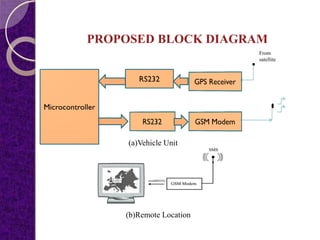
 Proposed Block Diagram
 Application
 Conclusion
 Future Scope
 References
INTRODUCTION
 The goal of our project is to design a useful and fully functional
real-world product that is used to track the vehicle's location and
improve the security level
 Combination of two Technologies: GPS and GSM
 Exact position of the vehicle is tracked by GPS
 Position of the vehicle in terms of latitude and longitude is access
by GSM modem located at remote location and displayed on
Google Earth
LITERATURE REVIEW
 Vehicle tracking systems can now also be found in consumers vehicles as
a theft prevention and retrieval device. Police can follow the signal
emitted by the tracking system to locate a stolen vehicle
 Most of the papers show two separate methodologies like GPS and GSM
for detecting vehicle theft. In some cases both of them are implemented as
a combine unit but there are some issues related to providing exact visual
location
 Based on the current requirements, besides integrating both the
technologies, in our project we are providing a complete unit that monitor
and locate the vehicle, thereby ensuring complete security to the vehicle.
SYSTEM REQUIRMENTS
 AERON GPS Module
 SIM 300 GSM Module
 AT89C51 Microcontroller
 Serial Communication Unit(RS232)
 On board devices
 Web support for displaying location
GLOBAL POSITIONING SYSTEM
• GPS is a satellite-based navigation system made up of a network of 24 satellites
• Developed by the U.S. Department of Defence for military applications
• The first GPS satellite was launched in 1978.A full constellation of 24 satellites was
achieved in 1994.
• Each satellite is built to last about 10 years. Replacements are constantly being built
and launched into orbit.
• The satellites transmit signals that can be detected by GPS receivers located in your
vehicles and used to determine their location with great accuracy
HOW GPS WORKS
 GPS satellites circle the earth twice a day in a very precise orbit and transmit
signal information to earth
 GPS receivers take this information and calculates the user's exact location.
 A GPS receiver must be locked on to the signal of at least three satellites to
calculate a 2D position (latitude and longitude) and track movement
 GPS Receivers commonly used in most Vehicle tracking systems can only
receive data from GPS Satellites. They cannot communicate back with GPS or
any other satellite
 A system based on GPS can only calculate its location but cannot send it to
central control room. In order to do this they normally use GSM networks
GLOBAL SYSTEM FOR MOBILE
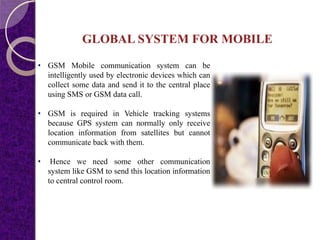
• GSM Mobile communication system can be
intelligently used by electronic devices which can
collect some data and send it to the central place
using SMS or GSM data call.
• GSM is required in Vehicle tracking systems
because GPS system can normally only receive
location information from satellites but cannot
communicate back with them.
• Hence we need some other communication
system like GSM to send this location information
to central control room.
PROPOSED BLOCK DIAGRAM
From
satellite
(a)Vehicle Unit
(b)Remote Location
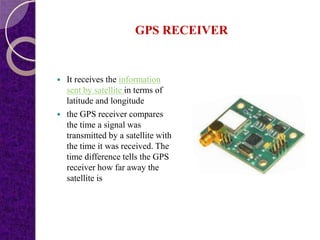
GPS RECEIVER
 It receives the information
sent by satellite in terms of
latitude and longitude
 the GPS receiver compares
the time a signal was
transmitted by a satellite with
the time it was received. The
time difference tells the GPS
receiver how far away the
satellite is
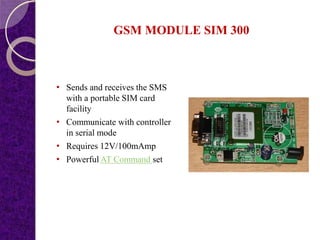
GSM MODULE SIM 300
• Sends and receives the SMS
with a portable SIM card
facility
• Communicate with controller
in serial mode
• Requires 12V/100mAmp
• Powerful AT Command set
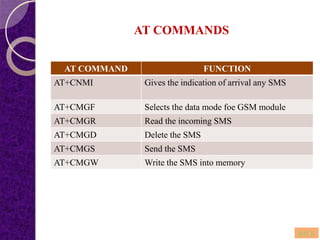
AT COMMANDS
AT COMMAND FUNCTION
AT+CNMI Gives the indication of arrival any SMS
AT+CMGF Selects the data mode foe GSM module
AT+CMGR Read the incoming SMS
AT+CMGD Delete the SMS
AT+CMGS Send the SMS
AT+CMGW Write the SMS into memory
BACK
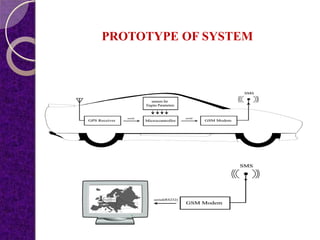
PROTOTYPE OF SYSTEM
APPLICATION
 Accident Detection System
 ATM cash monitoring Vehicle
 Bus Transport Monitoring
 Security Applications
CONCLUSION
 A real-time automobile tracking system via Google Earth is presented.
 The system included two main components: a transmitting embedded
module to interface in-vehicle GPS and GSM devices in order determine
and send automobile location and status information via SMS.
 The second stationary module is a receiving module to collect and process
the transmitted information to a compatible format with Google Earth to
remotely monitor the automobile location and status online.
 The transmitted location of the vehicle has been accurately tracking. The
accuracy of estimated vehicle coordinates has been enhanced.
FUTURE SCOPE
 Besides using GSM, it is possible to implement the system using GPRS
technique.
 At the receiver end instead of using GSM module the information can be
possible to receive on internet
 An additional setting could be implemented to interface the system to the
car’s alarm to alert the owner on his cell phone if the alarm is set off.
 The automobile’s airbag system can also be wired to this system to report
severe accidents to immediately alert the police and ambulance service
with the location of the accident.
REFERENCES
 Abid khan and Ravi Mishra , “GPS – GSM Based Tracking System”
International Journal of Engineering Trends and Technology-
Volume3Issue2- 2012
 Sagar Shah, Mihir Shah and Amit Sheth, “Real Time Vehicle Tracking and
ControllingSystem” Electronics Department, Sardar Patel Institute of
Technology University of Mumbai
 ARN SGPS, Aeron Systems Pvt. Ltd., www.aeronsystems.com
THANK YOU
!!!
QURIES ARE
INVITED
?
What's the signal?
 GPS satellites transmit two low power radio signals, designated L1 and L2.
Civilian GPS uses the L1 frequency of 1575.42 MHz in the UHF band.
 A GPS signal contains three different bits of information - a pseudorandom code,
ephemeris data and almanac data.
 The pseudorandom code is simply an I.D. code that identifies which satellite is
transmitting information.
 Ephemeris data, which is constantly transmitted by each satellite, contains
important information about the status of the satellite (healthy or unhealthy),
current date and time. This part of the signal is essential for determining a position.
 The almanac data tells the GPS receiver where each GPS satellite should be at any
time throughout the day. Each satellite transmits almanac data showing the orbital
information for that satellite and for every other satellite in the system.
back
back

Vehicle Theft control system

  • 1.
    GPS AND GSMBASED VEHICLE THEFT CONTROL SYSTEM Guided by Mr. P.L.Paikrao Assistant Professor, Presented By Ankush D. Jamthikar B.Tech ,Final Year, Department of Electronics and Telecommunication
  • 2.
    CONTENTS  Introduction  LiteratureReview  System Requirements  Global Positioning System  How GPS Works  Global System for Mobile  Proposed Block Diagram  Application  Conclusion  Future Scope  References
  • 3.
    INTRODUCTION  The goalof our project is to design a useful and fully functional real-world product that is used to track the vehicle's location and improve the security level  Combination of two Technologies: GPS and GSM  Exact position of the vehicle is tracked by GPS  Position of the vehicle in terms of latitude and longitude is access by GSM modem located at remote location and displayed on Google Earth
  • 4.
    LITERATURE REVIEW  Vehicletracking systems can now also be found in consumers vehicles as a theft prevention and retrieval device. Police can follow the signal emitted by the tracking system to locate a stolen vehicle  Most of the papers show two separate methodologies like GPS and GSM for detecting vehicle theft. In some cases both of them are implemented as a combine unit but there are some issues related to providing exact visual location  Based on the current requirements, besides integrating both the technologies, in our project we are providing a complete unit that monitor and locate the vehicle, thereby ensuring complete security to the vehicle.
  • 5.
    SYSTEM REQUIRMENTS  AERONGPS Module  SIM 300 GSM Module  AT89C51 Microcontroller  Serial Communication Unit(RS232)  On board devices  Web support for displaying location
  • 6.
    GLOBAL POSITIONING SYSTEM •GPS is a satellite-based navigation system made up of a network of 24 satellites • Developed by the U.S. Department of Defence for military applications • The first GPS satellite was launched in 1978.A full constellation of 24 satellites was achieved in 1994. • Each satellite is built to last about 10 years. Replacements are constantly being built and launched into orbit. • The satellites transmit signals that can be detected by GPS receivers located in your vehicles and used to determine their location with great accuracy
  • 7.
    HOW GPS WORKS GPS satellites circle the earth twice a day in a very precise orbit and transmit signal information to earth  GPS receivers take this information and calculates the user's exact location.  A GPS receiver must be locked on to the signal of at least three satellites to calculate a 2D position (latitude and longitude) and track movement  GPS Receivers commonly used in most Vehicle tracking systems can only receive data from GPS Satellites. They cannot communicate back with GPS or any other satellite  A system based on GPS can only calculate its location but cannot send it to central control room. In order to do this they normally use GSM networks
  • 8.
    GLOBAL SYSTEM FORMOBILE • GSM Mobile communication system can be intelligently used by electronic devices which can collect some data and send it to the central place using SMS or GSM data call. • GSM is required in Vehicle tracking systems because GPS system can normally only receive location information from satellites but cannot communicate back with them. • Hence we need some other communication system like GSM to send this location information to central control room.
  • 9.
  • 10.
    GPS RECEIVER  Itreceives the information sent by satellite in terms of latitude and longitude  the GPS receiver compares the time a signal was transmitted by a satellite with the time it was received. The time difference tells the GPS receiver how far away the satellite is
  • 11.
    GSM MODULE SIM300 • Sends and receives the SMS with a portable SIM card facility • Communicate with controller in serial mode • Requires 12V/100mAmp • Powerful AT Command set
  • 12.
    AT COMMANDS AT COMMANDFUNCTION AT+CNMI Gives the indication of arrival any SMS AT+CMGF Selects the data mode foe GSM module AT+CMGR Read the incoming SMS AT+CMGD Delete the SMS AT+CMGS Send the SMS AT+CMGW Write the SMS into memory BACK
  • 13.
  • 14.
    APPLICATION  Accident DetectionSystem  ATM cash monitoring Vehicle  Bus Transport Monitoring  Security Applications
  • 15.
    CONCLUSION  A real-timeautomobile tracking system via Google Earth is presented.  The system included two main components: a transmitting embedded module to interface in-vehicle GPS and GSM devices in order determine and send automobile location and status information via SMS.  The second stationary module is a receiving module to collect and process the transmitted information to a compatible format with Google Earth to remotely monitor the automobile location and status online.  The transmitted location of the vehicle has been accurately tracking. The accuracy of estimated vehicle coordinates has been enhanced.
  • 16.
    FUTURE SCOPE  Besidesusing GSM, it is possible to implement the system using GPRS technique.  At the receiver end instead of using GSM module the information can be possible to receive on internet  An additional setting could be implemented to interface the system to the car’s alarm to alert the owner on his cell phone if the alarm is set off.  The automobile’s airbag system can also be wired to this system to report severe accidents to immediately alert the police and ambulance service with the location of the accident.
  • 17.
    REFERENCES  Abid khanand Ravi Mishra , “GPS – GSM Based Tracking System” International Journal of Engineering Trends and Technology- Volume3Issue2- 2012  Sagar Shah, Mihir Shah and Amit Sheth, “Real Time Vehicle Tracking and ControllingSystem” Electronics Department, Sardar Patel Institute of Technology University of Mumbai  ARN SGPS, Aeron Systems Pvt. Ltd., www.aeronsystems.com
  • 18.
  • 19.
  • 21.
    What's the signal? GPS satellites transmit two low power radio signals, designated L1 and L2. Civilian GPS uses the L1 frequency of 1575.42 MHz in the UHF band.  A GPS signal contains three different bits of information - a pseudorandom code, ephemeris data and almanac data.  The pseudorandom code is simply an I.D. code that identifies which satellite is transmitting information.  Ephemeris data, which is constantly transmitted by each satellite, contains important information about the status of the satellite (healthy or unhealthy), current date and time. This part of the signal is essential for determining a position.  The almanac data tells the GPS receiver where each GPS satellite should be at any time throughout the day. Each satellite transmits almanac data showing the orbital information for that satellite and for every other satellite in the system. back back