RAID
 Redundant Array of Independent Disks
 Multiple secondary disks are connected
together to increase the performance, data
redundancy or both.
RAID
 Need:
 To increase the performance
 Increased reliability
 To give greater throughput
 Data are restored
RAID – Level 0
RAID – Level 0
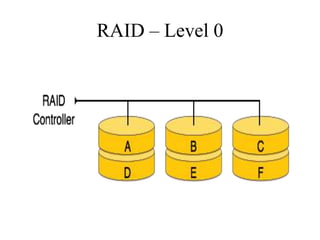
 Data is broken down into blocks and these blocks are
stored across all the disks.
 Thus striped array of disks is implemented.
 There is no duplication of data in this level so once a
block is lost then there is no way recover it.
 It has good performance.
RAID – Level 1
RAID – Level 1
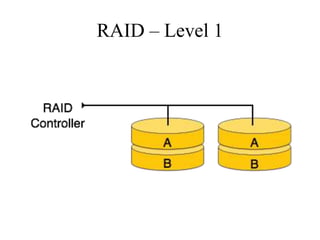
 uses mirroring techniques
 All data in the drive is duplicated to another
drive.
 It provides 100% redundancy in case of a
failure.
 Advantage: Fault Tolerance
RAID – Level 2
RAID – Level 2
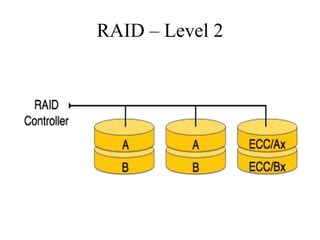
 Use of mirroring as well as stores Error Correcting
codes for its data striped on different disks.
 Each data bit in a word is recorded on a separate disk
and ECC codes of the data words are stored on a
different set disks.
 Due to its complex structure and high cost, RAID 2 is
not commercially available.
RAID – Level 3
RAID – Level 3
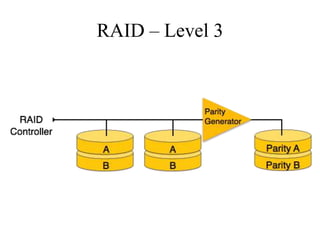
 It consists of byte level stripping with dedicated
parity. In this level, the parity information is
stored for each disk section and written to
dedicated parity drive.
 Parity is a technique that checks whether data has
been lost or written over when it is moved from
one place in storage to another.
RAID – Level 3
 In the case of disk failure, the parity disk is
accessed and data is reconstructed from the
remaining devices.
 Once the failed disk is replaced, the missing
data can be restored on the new disk.
RAID – Level 4
RAID – Level 4
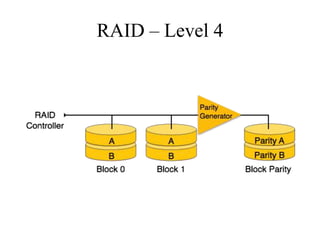
 It consists of block level stripping with a
parity disk.
RAID – Level 5
RAID – Level 5
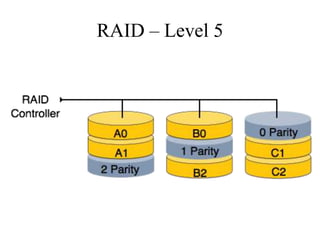
 RAID 5 writes whole data blocks onto
different disks, but the parity bits generated for
data block stripe are distributed among all the
data disks rather than storing them on a
different dedicated disk.
RAID – Level 6
RAID – Level 6
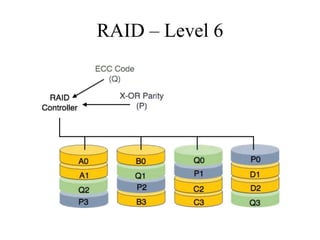
 RAID 6 is a extension of Level 5.
 In this level, two independent parities are generated
and stored in distributed fashion among multiple disks.
 Two parities provide additional fault tolerance.
 This level requires at least four disk drives to
implement RAID.
 The factors to be taken into account in
choosing a RAID level are:
 Performance requirements in terms of number of
I/O operation.
 Performance when a disk has failed.
 Performance during rebuild.

DBMS - RAID

  • 1.
    RAID  Redundant Arrayof Independent Disks  Multiple secondary disks are connected together to increase the performance, data redundancy or both.
  • 2.
    RAID  Need:  Toincrease the performance  Increased reliability  To give greater throughput  Data are restored
  • 3.
  • 4.
    RAID – Level0  Data is broken down into blocks and these blocks are stored across all the disks.  Thus striped array of disks is implemented.  There is no duplication of data in this level so once a block is lost then there is no way recover it.  It has good performance.
  • 5.
  • 6.
    RAID – Level1  uses mirroring techniques  All data in the drive is duplicated to another drive.  It provides 100% redundancy in case of a failure.  Advantage: Fault Tolerance
  • 7.
  • 8.
    RAID – Level2  Use of mirroring as well as stores Error Correcting codes for its data striped on different disks.  Each data bit in a word is recorded on a separate disk and ECC codes of the data words are stored on a different set disks.  Due to its complex structure and high cost, RAID 2 is not commercially available.
  • 9.
  • 10.
    RAID – Level3  It consists of byte level stripping with dedicated parity. In this level, the parity information is stored for each disk section and written to dedicated parity drive.  Parity is a technique that checks whether data has been lost or written over when it is moved from one place in storage to another.
  • 11.
    RAID – Level3  In the case of disk failure, the parity disk is accessed and data is reconstructed from the remaining devices.  Once the failed disk is replaced, the missing data can be restored on the new disk.
  • 12.
  • 13.
    RAID – Level4  It consists of block level stripping with a parity disk.
  • 14.
  • 15.
    RAID – Level5  RAID 5 writes whole data blocks onto different disks, but the parity bits generated for data block stripe are distributed among all the data disks rather than storing them on a different dedicated disk.
  • 16.
  • 17.
    RAID – Level6  RAID 6 is a extension of Level 5.  In this level, two independent parities are generated and stored in distributed fashion among multiple disks.  Two parities provide additional fault tolerance.  This level requires at least four disk drives to implement RAID.
  • 18.
     The factorsto be taken into account in choosing a RAID level are:  Performance requirements in terms of number of I/O operation.  Performance when a disk has failed.  Performance during rebuild.