RAID
Redundant Arrays Of
Independent Disks
Group : 3
Miss Munni Unmul Habbiba (dc2013MCA00)
Keyilamswabe (dc2013MCA00)
Bikash dhal (dc2013MCA0028)
Introduction :
Solution: RAID
 Technology that employs the simultaneous use of two or more
hard disk drives to achieve greater levels of performance &
reliability.
 Several physical disks are set up to use RAID technology, they are said
to be in a RAID array.
 This array distributes data across several disks, but the array is seen by
the computer user and operating system as one single disk.
Different Levels of
RAID
 RAID Level 0
 RAID Level 1
 RAID Level 2
 RAID Level 3
 RAID Level 4
 RAID Level 5
 RAID Level 6
Figure : RAID Level 0 (Striping)
RAID Level 0
 Requires a minimum of 2 drives to implement.
 The first byte of the file is sent to the first drive, then the
second to second drive and so on.
 Striping is the segmentation of logically sequential data, such
as a single file, so that segments can be assigned to multiple
physical devices
RAID Level 0
 Advantages:
 I/o performance is greatly improved by spreading the i/o load
across many channels & drives.
 Best performance is achieved when data is striped across
multiple controllers with only one drive per controller.
 Disadvantages:
 It is not a “True” RAID because it is NOT fault-tolerant. The
failure of just one drive will result in all data in an array being
lost.
Figure : RAID Level 1 (Mirroring)
RAID Level 1
Data duplicated, also the controller card
Requires only two drives to implement
 Duplicate copies of data, so if a disk fails, data is still available
and applications keep running.
Advantages
Better than single disk
Simple to Implement
Disadvantage - high check disk overhead.
Figure : RAID Level 2
RAID Level 2
Uses Bit-level striping with Hamming codes of ECC.
Disks are synchronized and striped in very small stripes, often
in single bytes/words.
Hamming codes error correction is calculated across
corresponding bits on disks, and is stored on multiple parity
disks.
Advantages
Good read and write performance
Disadvantages:
High overhead for check disks
Not used in modern systems
RAID Level 3
RAID Level 3
Uses dedicated parity disk.
Requires a minimum of 3 drives to implement.
Every write requires updation in parity data .
Advantages
improved performance and fault tolerance.
Disadvantages:
 One minor benefit is the dedicated parity disk allows
the parity drive to fail and operation will continue
without parity or performance penalty.
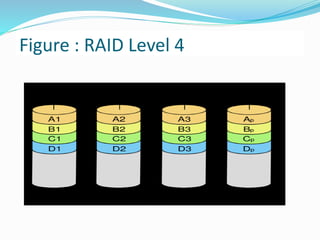
Figure : RAID Level 4
RAID Level 4
Uses Block-level striping with dedicated parity
Requires minimum of 3 drives to implement
Each disk operates independently which allows I/O requests to
be performed in parallel.
Advantages
Read Performance is very good because of the blocks.
Lowest overhead of check disks.
Disadvantages
Quite complex controller design
Not commonly used
Figure : RAID Level 5
RAID Level 5
Uses Block-level striping with distributed parity
Requires a minimum of 3 drives to implement
Advantages
Read performance very good.
Lowest overhead of check disks.
Disadvantages
Most complex controller design.
Difficult to rebuild in the event of a disk failure.
Figure : RAID Level 6
RAID Level 6
 Raid Level 6 uses Block-level striping with dual distributed
parity.
Advantages:
Continues to operate with up to two failed drives.
Disadvantages
Most complex controller design.
Difficult to rebuild in the event of multiple disk failure.
THANK YOU

Raid

  • 1.
    RAID Redundant Arrays Of IndependentDisks Group : 3 Miss Munni Unmul Habbiba (dc2013MCA00) Keyilamswabe (dc2013MCA00) Bikash dhal (dc2013MCA0028)
  • 2.
  • 3.
    Solution: RAID  Technologythat employs the simultaneous use of two or more hard disk drives to achieve greater levels of performance & reliability.  Several physical disks are set up to use RAID technology, they are said to be in a RAID array.  This array distributes data across several disks, but the array is seen by the computer user and operating system as one single disk.
  • 4.
    Different Levels of RAID RAID Level 0  RAID Level 1  RAID Level 2  RAID Level 3  RAID Level 4  RAID Level 5  RAID Level 6
  • 5.
    Figure : RAIDLevel 0 (Striping)
  • 6.
    RAID Level 0 Requires a minimum of 2 drives to implement.  The first byte of the file is sent to the first drive, then the second to second drive and so on.  Striping is the segmentation of logically sequential data, such as a single file, so that segments can be assigned to multiple physical devices
  • 7.
    RAID Level 0 Advantages:  I/o performance is greatly improved by spreading the i/o load across many channels & drives.  Best performance is achieved when data is striped across multiple controllers with only one drive per controller.  Disadvantages:  It is not a “True” RAID because it is NOT fault-tolerant. The failure of just one drive will result in all data in an array being lost.
  • 8.
    Figure : RAIDLevel 1 (Mirroring)
  • 9.
    RAID Level 1 Dataduplicated, also the controller card Requires only two drives to implement  Duplicate copies of data, so if a disk fails, data is still available and applications keep running. Advantages Better than single disk Simple to Implement Disadvantage - high check disk overhead.
  • 10.
  • 11.
    RAID Level 2 UsesBit-level striping with Hamming codes of ECC. Disks are synchronized and striped in very small stripes, often in single bytes/words. Hamming codes error correction is calculated across corresponding bits on disks, and is stored on multiple parity disks. Advantages Good read and write performance Disadvantages: High overhead for check disks Not used in modern systems
  • 12.
  • 13.
    RAID Level 3 Usesdedicated parity disk. Requires a minimum of 3 drives to implement. Every write requires updation in parity data . Advantages improved performance and fault tolerance. Disadvantages:  One minor benefit is the dedicated parity disk allows the parity drive to fail and operation will continue without parity or performance penalty.
  • 14.
  • 15.
    RAID Level 4 UsesBlock-level striping with dedicated parity Requires minimum of 3 drives to implement Each disk operates independently which allows I/O requests to be performed in parallel. Advantages Read Performance is very good because of the blocks. Lowest overhead of check disks. Disadvantages Quite complex controller design Not commonly used
  • 16.
  • 17.
    RAID Level 5 UsesBlock-level striping with distributed parity Requires a minimum of 3 drives to implement Advantages Read performance very good. Lowest overhead of check disks. Disadvantages Most complex controller design. Difficult to rebuild in the event of a disk failure.
  • 18.
  • 19.
    RAID Level 6 Raid Level 6 uses Block-level striping with dual distributed parity. Advantages: Continues to operate with up to two failed drives. Disadvantages Most complex controller design. Difficult to rebuild in the event of multiple disk failure.
  • 20.