Impact of Intel® Optane™
Technology on HPC
Andrey Kudryavtsev
HPC Storage Architect
Intel Corporation
2
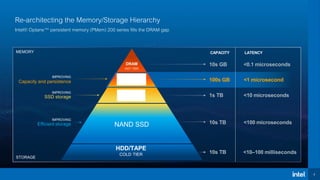
Re-architecting the Memory/Storage Hierarchy
Intel® Optane™ persistent memory (PMem) 200 series fills the DRAM gap
10s GB <0.1 microseconds
1s TB <10 microseconds
10s TB <100 microseconds
10s TB <10–100 milliseconds
DRAM
HOT TIER
HDD/TAPE
COLD TIER
100s GB <1 microsecond
MEMORY
STORAGE
CAPACITY LATENCY
IMPROVING
Capacity and persistence
IMPROVING
SSD storage
IMPROVING
Efficient storage NAND SSD
3
Accelerate Insight and Innovation
Intel® Optane™ persistent memory (PMem) 200 series fills the DRAM gap
3 Supports for more than 1.2x more VMs than the previous generation. Based on testing by Intel as of April 27, 2020 (Baseline) and March 31, 2020 (New). For details, see Endnotes slides.
High performance. High capacity. Hardware-enhanced security.
Lower overall total cost of ownership (TCO).3 Do more
with each server—increase CPU utilization, in-memory
database capacity, throughput, virtual machine (VM) density,
and services for users on a consolidated footprint.
Protect data automatically. Help secure all data at
rest in persistent memory with application-transparent
AES-256 encryption, which enhances security without
code changes.
Extract more from larger datasets. Expand your memory
pool in persistent memory and support near-real-time data
analysis; deliver deep insights, improve operations, or
create new revenue streams.
4
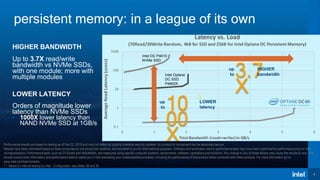
persistent memory: in a league of its own
HIGHER BANDWIDTH
Up to 3.7X read/write
bandwidth vs NVMe SSDs,
with one module; more with
multiple modules
LOWER LATENCY
Orders of magnitude lower
latency than NVMe SSDs
• 1000X lower latency than
NAND NVMe SSD at 1GB/s
Performance results are based on testing as of Feb 22, 2019 and may not reflect all publicly available security updates. No product or component can be absolutely secure.
Results have been estimated based on tests conducted on pre-production systems, and provided to you for informational purposes. Software and workloads used in performance tests may have been optimized for performance only on Intel
microprocessors. Performance tests, such as SYSmark and MobileMark, are measured using specific computer systems, components, software, operations and functions. Any change to any of those factors may cause the results to vary. You
should consult other information and performance tests to assist you in fully evaluating your contemplated purchases, including the performance of that product when combined with other products. For more information go to
www.intel.com/benchmarks.
2, 3 Based on internal testing by Intel . Configuration: see slides 38 and 39.
3.7
X
HIGHER
bandwidth
up
to
10
00
X
LOWER
latency
up
to
Intel DC P4610
NVMe SSD
Intel Optane
DC SSD
P4800X
5
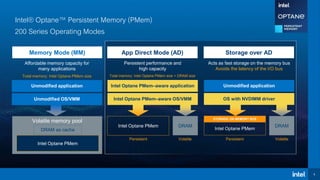
Intel® Optane™ Persistent Memory (PMem)
200 Series Operating Modes
Memory Mode (MM)
Intel Optane PMem–aware OS/VMM
Intel Optane PMem–aware application
Intel Optane PMem DRAM
Persistent performance and
high capacity
Unmodified OS/VMM
Unmodified application
Volatile memory pool
Affordable memory capacity for
many applications
DRAM as cache
Intel Optane PMem
Total memory: Intel Optane PMem size Total memory: Intel Optane PMem size + DRAM size
App Direct Mode (AD) Storage over AD
OS with NVDIMM driver
Unmodified application
Intel Optane PMem
DRAM
Acts as fast storage on the memory bus
Avoids the latency of the I/O bus
STORAGE ON MEMORY BUS
Persistent VolatilePersistent Volatile
6
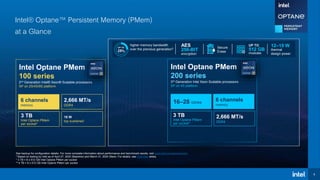
Intel® Optane™ Persistent Memory (PMem)
at a Glance
See backup for configuration details. For more complete information about performance and benchmark results, visit www.intel.com/benchmarks.
3 Based on testing by Intel as of April 27, 2020 (Baseline) and March 31, 2020 (New). For details, see Endnotes slides.
* 3 TB = 6 x 512 GB Intel Optane PMem per socket
** 4 TB = 8 x 512 GB Intel Optane PMem per socket
Intel Optane PMem
100 series
2nd Generation Intel® Xeon® Scalable processors
SP on 2S/4S/8S platform
6 channels
memory
2,666 MT/s
DDR4
3 TB
Intel Optane PMem
per socket*
18 W
top sustained
Intel Optane PMem
200 series
3rd Generation Intel Xeon Scalable processors
SP on 4S platform
2,666 MT/s
DDR4
3 TB
Intel Optane PMem
per socket*
25%
UP TO
higher memory bandwidth
over the previous generation3
256-BIT
AES
encryption
Secure
Erase
512 GB
UP TO
modules
12–15 W
thermal
design power
16–28 cores
6 channels
memory
7
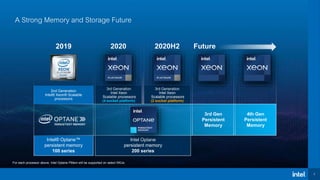
A Strong Memory and Storage Future
For each processor above, Intel Optane PMem will be supported on select SKUs.
3rd Generation
Intel Xeon
Scalable processors
(2 socket platform)
Intel Optane
persistent memory
200 series
Intel® Optane™
persistent memory
100 series
2nd Generation
Intel® Xeon® Scalable
processors
3rd Generation
Intel Xeon
Scalable processors
(4 socket platform)
3rd Gen
Persistent
Memory​
4th Gen
Persistent
Memory​
Future2019 2020 2020H2
8
Intel Optane SSD
Intel 3D NAND SSD
accelerati
ng
caching Tiering
Intel
Optane
SSD
Intel 3D NAND SSD
intelligent data placement
storage
compute
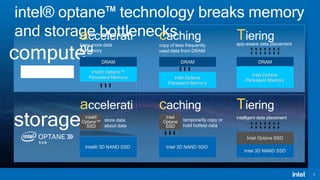
intel® optane™ technology breaks memory
and storage bottlenecks
store data
about data
temporarily copy or
hold hottest data
Intel Optane
Persistent Memory
DRAM
Intel Optane
Persistent Memory
DRAM
caching Tiering
copy of less frequently
used data from DRAM
app-aware data placement
accelerati
ngkeep more data
in memory
Intel® Optane™
Persistent Memory
DRAM
Intel®
Optane™
SSD
Intel® 3D NAND SSD
Intel CorporationCloud & Enterprise Solutions Group 9
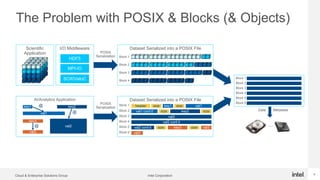
The Problem with POSIX & Blocks (& Objects)
…
Data Metadata
Scientific
Application
I/O Middleware
HDF5
MPI-IO
SCR/VeloC
Dataset Serialized into a POSIX File
Block 1
Block 2
Block 3
Block 4
Dataset Serialized into a POSIX File
Block 1 header size key1 size val1
val1 cont’d size sizekey2
val2
val2 cont’d
val2 cont’d size size val3key3
val3
Block 2
Block 3
Block 4
Block 5
Block 6
AI/Analytics Application
key1
val1
key2
val2
key3
val3
@
@
@
POSIX
Serialization
POSIX
Serialization
Block 1
Block 2
Block 3
Block 4
Block 5
Block 6
Intel CorporationCloud & Enterprise Solutions Group 10
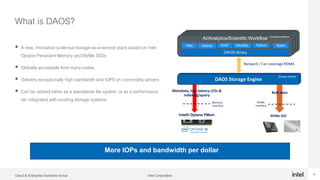
What is DAOS?
 A new, innovative scale-out storage-as-a-service stack based on Intel
Optane Persistent Memory and NVMe SSDs
 Globally accessible from many nodes
 Delivers exceptionally high bandwidth and IOPS on commodity servers
 Can be utilized either as a standalone file system, or as a performance
tier integrated with existing storage systems
10
More IOPs and bandwidth per dollar
Network / Can Leverage RDMA
DAOS Storage Engine
Intel® Optane PMem
NVMe
Interface
Metadata, low-latency I/Os &
indexing/query
Bulk data
NVMe SSD
Memory
Interface
Storage Instance
AI/Analytics/Scientific Workflow
DAOS library
Files KVoF Spark…
Compute Instance
Objects (No)SQL Python
Intel CorporationCloud & Enterprise Solutions Group 11
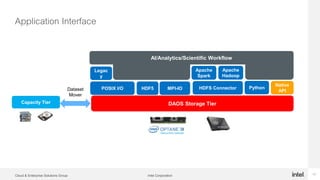
Application Interface
Dataset
Mover
Capacity Tier DAOS Storage Tier
POSIX I/O
AI/Analytics/Scientific Workflow
HDF5 MPI-IO Python
Native
API
Legac
y
Apache
Spark
Apache
Hadoop
HDFS Connector
Intel CorporationCloud & Enterprise Solutions Group 12
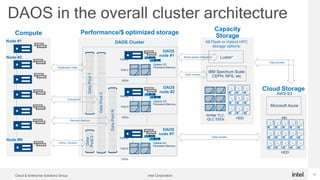
DAOS in the overall cluster architecture
DAOS
node #1
Optane DC
Persistent Memory
P4510/
P4610
SSDs
Optane DC
Persistent Memory
P4510/
P4610
SSDs
Optane DC
Persistent Memory
P4510/
P4610
SSDs
DAOS
node #2
DAOS
node #Y
DataPool1
Data
Pool2
Application data
Checkpoint
Performance/$ optimized storage
Capacity
Storage
All Flash or Hybrid HPC
storage options:
Lustre*
IBM Spectrum Scale
CEPH, NFS, etc
HDD
NVMe TLC,
QLC SSDs
DataPool3
DataPoolN
DAOS Cluster
Compute
Node #1
Node #2
Node #N
Remote memory
Temp / Scratch
Data movers
Name space integration
Data proxies
Cloud Storage
HDD
AWS S3
Microsoft Azure
etc
Data proxies
Intel CorporationCloud & Enterprise Solutions Group 13
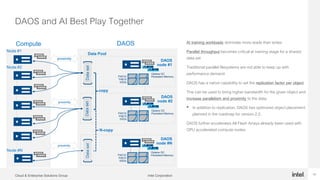
DAOS and AI Best Play Together
13
Compute AI training workloads dominate more reads than writes
Parallel throughput becomes critical at training stage for a shared
data set
Traditional parallel filesystems are not able to keep up with
performance demand
DAOS has a native capability to set the replication factor per object
This can be used to bring higher bandwidth for the given object and
increase parallelism and proximity to the data.
• In addition to replication, DAOS has optimized object placement
planned in the roadmap for version 2.2.
DAOS further accelerates All Flash Arrays already been used with
GPU accelerated compute nodes.
proximity
DAOS
node #1
Optane DC
Persistent MemoryP4510/
P4610
SSDs
Optane DC
Persistent MemoryP4510/
P4610
SSDs
Optane DC
Persistent MemoryP4510/
P4610
SSDs
DAOS
node #2
DAOS
node #N
Node #1
Node #2
Node #N
Data Pool
DatasetDatasetDataset
copy
N-copy
proximity
proximity
DAOS
Intel CorporationCloud & Enterprise Solutions Group 14
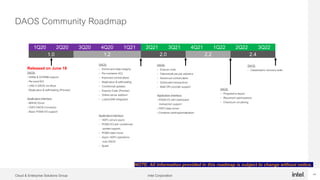
DAOS Community Roadmap
1Q20 2Q20 3Q20 4Q20 1Q21 2Q21 3Q21 4Q21 1Q22 2Q22 3Q22
1.0 1.2 2.0 2.2 2.4
Released on June 18
DAOS:
- NVMe & DCPMM support
- Per-pool ACL
- UNS in DAOS via dfuse
- Replication & self-healing (Preview)
Application Interface:
- MPI-IODriver
- HDF5 DAOS Connector
- Basic POSIX I/O support
DAOS:
- End-to-end data integrity
- Per-container ACL
- Improved control plane
- Replication & self-healing
- Conditional updates
- Erasure Code (Preview)
- Online server addition
- Lustre/UNS integration
Application Interface:
- HDF5 vol w/o async
- POSIX I/O with conditional
update support
- POSIX data mover
- Async HDF5 operations
over DAOS
- Spark
DAOS:
- Erasure code
- Telemetry& per-job statistics
- Advanced control plane
- Distributedtransactions
- Multi OFI provider support
Application Interface:
- POSIX I/O with distributed
transaction support
- HDF5 data mover
- Container parking/serialization
DAOS:
- Progressivelayout
- Placement optimizations
- Checksum scrubbing
DAOS:
- Catastrophic recovery tools
NOTE: All information provided in this roadmap is subject to change without notice.
Intel CorporationCloud & Enterprise Solutions Group 15
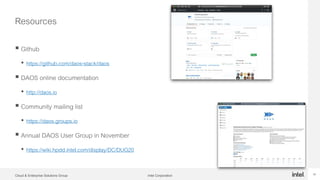
Resources
 Github
• https://github.com/daos-stack/daos
 DAOS online documentation
• http://daos.io
 Community mailing list
• https://daos.groups.io
 Annual DAOS User Group in November
• https://wiki.hpdd.intel.com/display/DC/DUG20

Impact of Intel Optane Technology on HPC

  • 1.
    Impact of Intel®Optane™ Technology on HPC Andrey Kudryavtsev HPC Storage Architect Intel Corporation
  • 2.
    2 Re-architecting the Memory/StorageHierarchy Intel® Optane™ persistent memory (PMem) 200 series fills the DRAM gap 10s GB <0.1 microseconds 1s TB <10 microseconds 10s TB <100 microseconds 10s TB <10–100 milliseconds DRAM HOT TIER HDD/TAPE COLD TIER 100s GB <1 microsecond MEMORY STORAGE CAPACITY LATENCY IMPROVING Capacity and persistence IMPROVING SSD storage IMPROVING Efficient storage NAND SSD
  • 3.
    3 Accelerate Insight andInnovation Intel® Optane™ persistent memory (PMem) 200 series fills the DRAM gap 3 Supports for more than 1.2x more VMs than the previous generation. Based on testing by Intel as of April 27, 2020 (Baseline) and March 31, 2020 (New). For details, see Endnotes slides. High performance. High capacity. Hardware-enhanced security. Lower overall total cost of ownership (TCO).3 Do more with each server—increase CPU utilization, in-memory database capacity, throughput, virtual machine (VM) density, and services for users on a consolidated footprint. Protect data automatically. Help secure all data at rest in persistent memory with application-transparent AES-256 encryption, which enhances security without code changes. Extract more from larger datasets. Expand your memory pool in persistent memory and support near-real-time data analysis; deliver deep insights, improve operations, or create new revenue streams.
  • 4.
    4 persistent memory: ina league of its own HIGHER BANDWIDTH Up to 3.7X read/write bandwidth vs NVMe SSDs, with one module; more with multiple modules LOWER LATENCY Orders of magnitude lower latency than NVMe SSDs • 1000X lower latency than NAND NVMe SSD at 1GB/s Performance results are based on testing as of Feb 22, 2019 and may not reflect all publicly available security updates. No product or component can be absolutely secure. Results have been estimated based on tests conducted on pre-production systems, and provided to you for informational purposes. Software and workloads used in performance tests may have been optimized for performance only on Intel microprocessors. Performance tests, such as SYSmark and MobileMark, are measured using specific computer systems, components, software, operations and functions. Any change to any of those factors may cause the results to vary. You should consult other information and performance tests to assist you in fully evaluating your contemplated purchases, including the performance of that product when combined with other products. For more information go to www.intel.com/benchmarks. 2, 3 Based on internal testing by Intel . Configuration: see slides 38 and 39. 3.7 X HIGHER bandwidth up to 10 00 X LOWER latency up to Intel DC P4610 NVMe SSD Intel Optane DC SSD P4800X
  • 5.
    5 Intel® Optane™ PersistentMemory (PMem) 200 Series Operating Modes Memory Mode (MM) Intel Optane PMem–aware OS/VMM Intel Optane PMem–aware application Intel Optane PMem DRAM Persistent performance and high capacity Unmodified OS/VMM Unmodified application Volatile memory pool Affordable memory capacity for many applications DRAM as cache Intel Optane PMem Total memory: Intel Optane PMem size Total memory: Intel Optane PMem size + DRAM size App Direct Mode (AD) Storage over AD OS with NVDIMM driver Unmodified application Intel Optane PMem DRAM Acts as fast storage on the memory bus Avoids the latency of the I/O bus STORAGE ON MEMORY BUS Persistent VolatilePersistent Volatile
  • 6.
    6 Intel® Optane™ PersistentMemory (PMem) at a Glance See backup for configuration details. For more complete information about performance and benchmark results, visit www.intel.com/benchmarks. 3 Based on testing by Intel as of April 27, 2020 (Baseline) and March 31, 2020 (New). For details, see Endnotes slides. * 3 TB = 6 x 512 GB Intel Optane PMem per socket ** 4 TB = 8 x 512 GB Intel Optane PMem per socket Intel Optane PMem 100 series 2nd Generation Intel® Xeon® Scalable processors SP on 2S/4S/8S platform 6 channels memory 2,666 MT/s DDR4 3 TB Intel Optane PMem per socket* 18 W top sustained Intel Optane PMem 200 series 3rd Generation Intel Xeon Scalable processors SP on 4S platform 2,666 MT/s DDR4 3 TB Intel Optane PMem per socket* 25% UP TO higher memory bandwidth over the previous generation3 256-BIT AES encryption Secure Erase 512 GB UP TO modules 12–15 W thermal design power 16–28 cores 6 channels memory
  • 7.
    7 A Strong Memoryand Storage Future For each processor above, Intel Optane PMem will be supported on select SKUs. 3rd Generation Intel Xeon Scalable processors (2 socket platform) Intel Optane persistent memory 200 series Intel® Optane™ persistent memory 100 series 2nd Generation Intel® Xeon® Scalable processors 3rd Generation Intel Xeon Scalable processors (4 socket platform) 3rd Gen Persistent Memory​ 4th Gen Persistent Memory​ Future2019 2020 2020H2
  • 8.
    8 Intel Optane SSD Intel3D NAND SSD accelerati ng caching Tiering Intel Optane SSD Intel 3D NAND SSD intelligent data placement storage compute intel® optane™ technology breaks memory and storage bottlenecks store data about data temporarily copy or hold hottest data Intel Optane Persistent Memory DRAM Intel Optane Persistent Memory DRAM caching Tiering copy of less frequently used data from DRAM app-aware data placement accelerati ngkeep more data in memory Intel® Optane™ Persistent Memory DRAM Intel® Optane™ SSD Intel® 3D NAND SSD
  • 9.
    Intel CorporationCloud &Enterprise Solutions Group 9 The Problem with POSIX & Blocks (& Objects) … Data Metadata Scientific Application I/O Middleware HDF5 MPI-IO SCR/VeloC Dataset Serialized into a POSIX File Block 1 Block 2 Block 3 Block 4 Dataset Serialized into a POSIX File Block 1 header size key1 size val1 val1 cont’d size sizekey2 val2 val2 cont’d val2 cont’d size size val3key3 val3 Block 2 Block 3 Block 4 Block 5 Block 6 AI/Analytics Application key1 val1 key2 val2 key3 val3 @ @ @ POSIX Serialization POSIX Serialization Block 1 Block 2 Block 3 Block 4 Block 5 Block 6
  • 10.
    Intel CorporationCloud &Enterprise Solutions Group 10 What is DAOS?  A new, innovative scale-out storage-as-a-service stack based on Intel Optane Persistent Memory and NVMe SSDs  Globally accessible from many nodes  Delivers exceptionally high bandwidth and IOPS on commodity servers  Can be utilized either as a standalone file system, or as a performance tier integrated with existing storage systems 10 More IOPs and bandwidth per dollar Network / Can Leverage RDMA DAOS Storage Engine Intel® Optane PMem NVMe Interface Metadata, low-latency I/Os & indexing/query Bulk data NVMe SSD Memory Interface Storage Instance AI/Analytics/Scientific Workflow DAOS library Files KVoF Spark… Compute Instance Objects (No)SQL Python
  • 11.
    Intel CorporationCloud &Enterprise Solutions Group 11 Application Interface Dataset Mover Capacity Tier DAOS Storage Tier POSIX I/O AI/Analytics/Scientific Workflow HDF5 MPI-IO Python Native API Legac y Apache Spark Apache Hadoop HDFS Connector
  • 12.
    Intel CorporationCloud &Enterprise Solutions Group 12 DAOS in the overall cluster architecture DAOS node #1 Optane DC Persistent Memory P4510/ P4610 SSDs Optane DC Persistent Memory P4510/ P4610 SSDs Optane DC Persistent Memory P4510/ P4610 SSDs DAOS node #2 DAOS node #Y DataPool1 Data Pool2 Application data Checkpoint Performance/$ optimized storage Capacity Storage All Flash or Hybrid HPC storage options: Lustre* IBM Spectrum Scale CEPH, NFS, etc HDD NVMe TLC, QLC SSDs DataPool3 DataPoolN DAOS Cluster Compute Node #1 Node #2 Node #N Remote memory Temp / Scratch Data movers Name space integration Data proxies Cloud Storage HDD AWS S3 Microsoft Azure etc Data proxies
  • 13.
    Intel CorporationCloud &Enterprise Solutions Group 13 DAOS and AI Best Play Together 13 Compute AI training workloads dominate more reads than writes Parallel throughput becomes critical at training stage for a shared data set Traditional parallel filesystems are not able to keep up with performance demand DAOS has a native capability to set the replication factor per object This can be used to bring higher bandwidth for the given object and increase parallelism and proximity to the data. • In addition to replication, DAOS has optimized object placement planned in the roadmap for version 2.2. DAOS further accelerates All Flash Arrays already been used with GPU accelerated compute nodes. proximity DAOS node #1 Optane DC Persistent MemoryP4510/ P4610 SSDs Optane DC Persistent MemoryP4510/ P4610 SSDs Optane DC Persistent MemoryP4510/ P4610 SSDs DAOS node #2 DAOS node #N Node #1 Node #2 Node #N Data Pool DatasetDatasetDataset copy N-copy proximity proximity DAOS
  • 14.
    Intel CorporationCloud &Enterprise Solutions Group 14 DAOS Community Roadmap 1Q20 2Q20 3Q20 4Q20 1Q21 2Q21 3Q21 4Q21 1Q22 2Q22 3Q22 1.0 1.2 2.0 2.2 2.4 Released on June 18 DAOS: - NVMe & DCPMM support - Per-pool ACL - UNS in DAOS via dfuse - Replication & self-healing (Preview) Application Interface: - MPI-IODriver - HDF5 DAOS Connector - Basic POSIX I/O support DAOS: - End-to-end data integrity - Per-container ACL - Improved control plane - Replication & self-healing - Conditional updates - Erasure Code (Preview) - Online server addition - Lustre/UNS integration Application Interface: - HDF5 vol w/o async - POSIX I/O with conditional update support - POSIX data mover - Async HDF5 operations over DAOS - Spark DAOS: - Erasure code - Telemetry& per-job statistics - Advanced control plane - Distributedtransactions - Multi OFI provider support Application Interface: - POSIX I/O with distributed transaction support - HDF5 data mover - Container parking/serialization DAOS: - Progressivelayout - Placement optimizations - Checksum scrubbing DAOS: - Catastrophic recovery tools NOTE: All information provided in this roadmap is subject to change without notice.
  • 15.
    Intel CorporationCloud &Enterprise Solutions Group 15 Resources  Github • https://github.com/daos-stack/daos  DAOS online documentation • http://daos.io  Community mailing list • https://daos.groups.io  Annual DAOS User Group in November • https://wiki.hpdd.intel.com/display/DC/DUG20