Satellite and Their Specification


RADARSAT Satellites and Their Specification


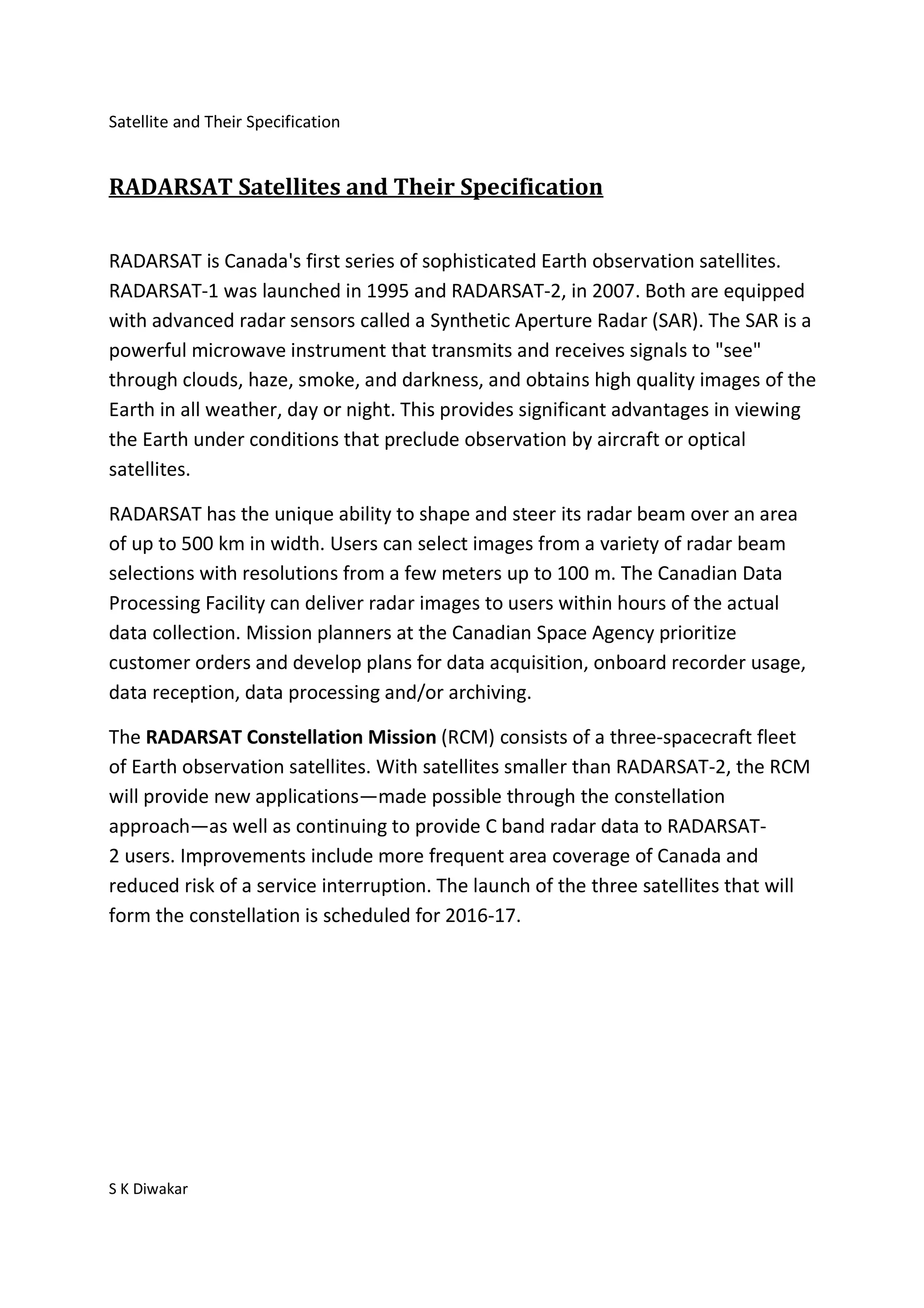
RADARSAT is Canada's first series of sophisticated Earth observation satellites.
RADARSAT-1 was launched in 1995 and RADARSAT-2, in 2007. Both are equipped
with advanced radar sensors called a Synthetic Aperture Radar (SAR). The SAR is a
powerful microwave instrument that transmits and receives signals to "see"
through clouds, haze, smoke, and darkness, and obtains high quality images of the
Earth in all weather, day or night. This provides significant advantages in viewing
the Earth under conditions that preclude observation by aircraft or optical
satellites.

RADARSAT has the unique ability to shape and steer its radar beam over an area
of up to 500 km in width. Users can select images from a variety of radar beam
selections with resolutions from a few meters up to 100 m. The Canadian Data
Processing Facility can deliver radar images to users within hours of the actual
data collection. Mission planners at the Canadian Space Agency prioritize
customer orders and develop plans for data acquisition, onboard recorder usage,
data reception, data processing and/or archiving.

The RADARSAT Constellation Mission (RCM) consists of a three-spacecraft fleet
of Earth observation satellites. With satellites smaller than RADARSAT-2, the RCM
will provide new applications—made possible through the constellation
approach—as well as continuing to provide C band radar data to RADARSAT-
2 users. Improvements include more frequent area coverage of Canada and
reduced risk of a service interruption. The launch of the three satellites that will
form the constellation is scheduled for 2016-17.


S K Diwakar
Satellite and Their Specification


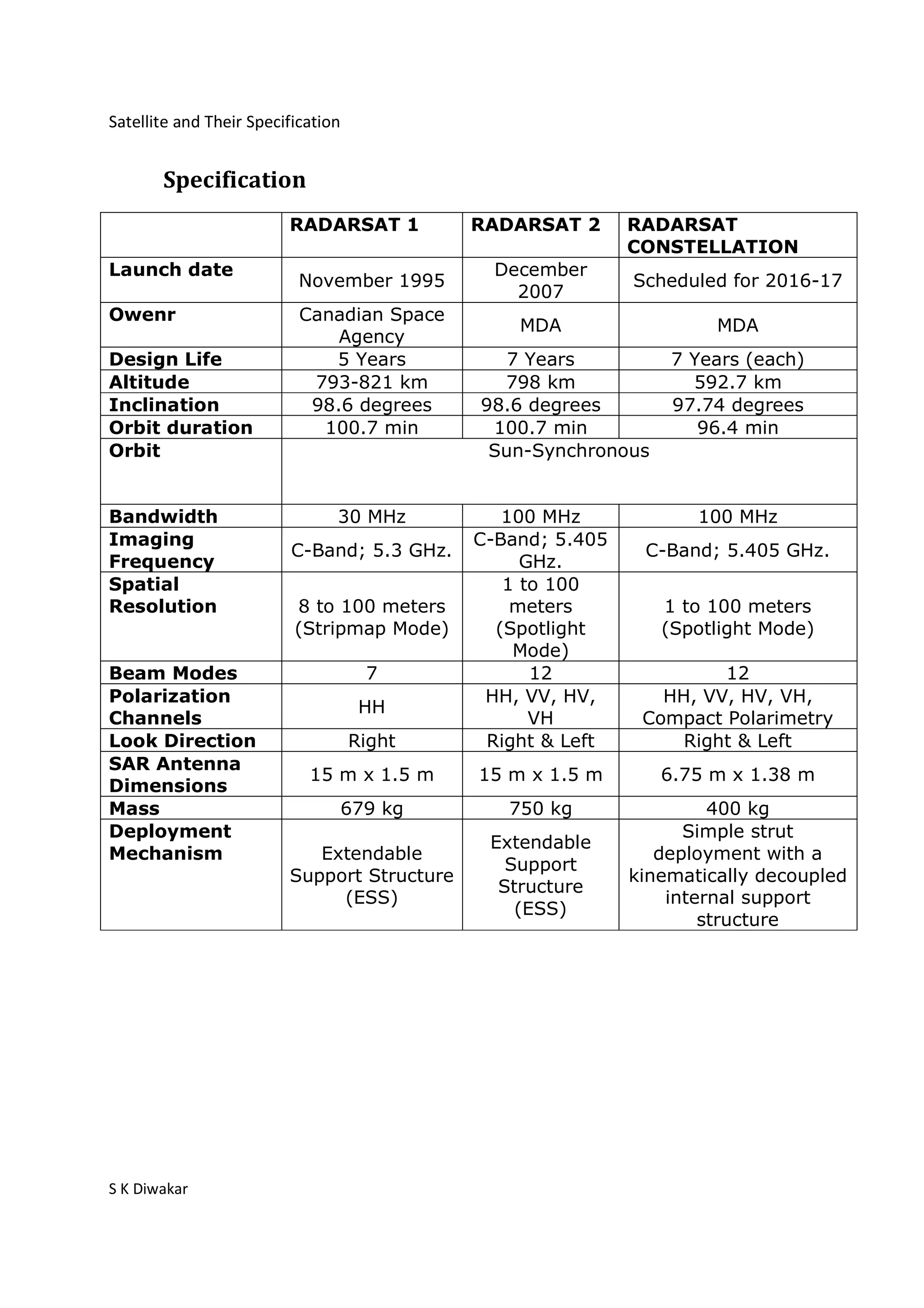
       Specification
                         RADARSAT 1          RADARSAT 2      RADARSAT
                                                             CONSTELLATION
Launch date                                    December
                           November 1995                     Scheduled for 2016-17
                                                 2007
Owenr                      Canadian Space
                                                 MDA                  MDA
                               Agency
Design Life                   5 Years           7 Years          7 Years (each)
Altitude                    793-821 km         798 km              592.7 km
Inclination                 98.6 degrees     98.6 degrees        97.74 degrees
Orbit duration               100.7 min        100.7 min             96.4 min
Orbit                                         Sun-Synchronous


Bandwidth                       30 MHz          100 MHz             100 MHz
Imaging                                      C-Band; 5.405
                         C-Band; 5.3 GHz.                     C-Band; 5.405 GHz.
Frequency                                         GHz.
Spatial                                         1 to 100
Resolution                8 to 100 meters        meters         1 to 100 meters
                          (Stripmap Mode)      (Spotlight       (Spotlight Mode)
                                                 Mode)
Beam Modes                            7            12                 12
Polarization                                  HH, VV, HV,       HH, VV, HV, VH,
                                     HH
Channels                                           VH         Compact Polarimetry
Look Direction                      Right     Right & Left        Right & Left
SAR Antenna
                            15 m x 1.5 m     15 m x 1.5 m       6.75 m x 1.38 m
Dimensions
Mass                                679 kg      750 kg                400 kg
Deployment                                                         Simple strut
                                              Extendable
Mechanism                   Extendable                          deployment with a
                                                Support
                         Support Structure                   kinematically decoupled
                                               Structure
                              (ESS)                              internal support
                                                 (ESS)
                                                                     structure


S K Diwakar

RADARSAT

  • 1.
    Satellite and TheirSpecification RADARSAT Satellites and Their Specification RADARSAT is Canada's first series of sophisticated Earth observation satellites. RADARSAT-1 was launched in 1995 and RADARSAT-2, in 2007. Both are equipped with advanced radar sensors called a Synthetic Aperture Radar (SAR). The SAR is a powerful microwave instrument that transmits and receives signals to "see" through clouds, haze, smoke, and darkness, and obtains high quality images of the Earth in all weather, day or night. This provides significant advantages in viewing the Earth under conditions that preclude observation by aircraft or optical satellites. RADARSAT has the unique ability to shape and steer its radar beam over an area of up to 500 km in width. Users can select images from a variety of radar beam selections with resolutions from a few meters up to 100 m. The Canadian Data Processing Facility can deliver radar images to users within hours of the actual data collection. Mission planners at the Canadian Space Agency prioritize customer orders and develop plans for data acquisition, onboard recorder usage, data reception, data processing and/or archiving. The RADARSAT Constellation Mission (RCM) consists of a three-spacecraft fleet of Earth observation satellites. With satellites smaller than RADARSAT-2, the RCM will provide new applications—made possible through the constellation approach—as well as continuing to provide C band radar data to RADARSAT- 2 users. Improvements include more frequent area coverage of Canada and reduced risk of a service interruption. The launch of the three satellites that will form the constellation is scheduled for 2016-17. S K Diwakar
  • 2.
    Satellite and TheirSpecification Specification RADARSAT 1 RADARSAT 2 RADARSAT CONSTELLATION Launch date December November 1995 Scheduled for 2016-17 2007 Owenr Canadian Space MDA MDA Agency Design Life 5 Years 7 Years 7 Years (each) Altitude 793-821 km 798 km 592.7 km Inclination 98.6 degrees 98.6 degrees 97.74 degrees Orbit duration 100.7 min 100.7 min 96.4 min Orbit Sun-Synchronous Bandwidth 30 MHz 100 MHz 100 MHz Imaging C-Band; 5.405 C-Band; 5.3 GHz. C-Band; 5.405 GHz. Frequency GHz. Spatial 1 to 100 Resolution 8 to 100 meters meters 1 to 100 meters (Stripmap Mode) (Spotlight (Spotlight Mode) Mode) Beam Modes 7 12 12 Polarization HH, VV, HV, HH, VV, HV, VH, HH Channels VH Compact Polarimetry Look Direction Right Right & Left Right & Left SAR Antenna 15 m x 1.5 m 15 m x 1.5 m 6.75 m x 1.38 m Dimensions Mass 679 kg 750 kg 400 kg Deployment Simple strut Extendable Mechanism Extendable deployment with a Support Support Structure kinematically decoupled Structure (ESS) internal support (ESS) structure S K Diwakar