Satellite Image
  Geometry
     Gene Dial
  GIS in the Rockies
     2012-09-21


                       1
Topics

›   Background
›   Satellite Orbits
›   Satellite Image Geometry
›   Stereo Image Geometry
›   Satellite Image Products


                               Niagara Falls


                2
Background
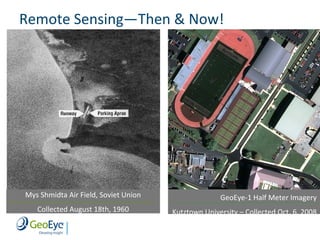
Remote Sensing—Then & Now!


Mys Shmidta Air Field, Soviet Union                 GeoEye-1 Half Meter Imagery
   Collected August 18th, 1960        Kutztown University – Collected Oct. 6, 2008
GeoEye-2 Technical Specs at a Glance
System           Specificatio      Performance
                 n                                                                                Power     Solar Array (5)
Satellite Bus    Size              2.3 m x 5.3 m                                                  Control
                                                                                                             Data Storage Unit (2)
                 Weight            2100 kg dry, 2500 kg wet                              Flight
                                                                                                  Unit

Payload          Aperture          1.1 meter aperture                                    Processor
                 Focal Length      16 meter focal length                   Battery (2)
                 Dynamic Range     11 bit dynamic range with TDI
                 GSD               34 cm Pan, 1.32m MSI
                 Swath             14.5 km
Attitude         Actuators         Honeywell M-95 CMGs                   Control
                                                                                                                  CMG Electronics (4)
                                                                         Moment Gyros
Control                                                                  (4)
System           Sensors           Goodrich GR-1004 Star Trackers        Star Tracker (2)
                                   SIRU Inertial Reference Units            Focal Plane
                                                                                                                      PL Electronics
                                   Monarch GPS Receiver                                                                Radiator (2)
                                                                            Radiator
                                                                                                                   Payload
                 Minimum Agility   Acceleration - 1.0 degree/sec2
                                                                           X-band High
                                                                                                                   Electronics (2)
                                   Max Slew Rate – 2.7 degree/sec
                                                                           Gain Antenna                             Narrowband
                                                                            Two Axis Gimbal                         Antenna (2)
Data             Data Recorder     3.2 Terabit High Speed Storage Unit
Handling &                                                                               Sun Sensor (2) GPS Antenna (2)
Communications   Wideband DL       800 Mbps Dual Pole, X band
                 Tlmy DL           128 Kbps, X band
                 Command UL        64 Kbps, S band


                                    See http://www.youtube.com/watch?v=lnv6cDiBF9o
                       5
Satellite Imagery
Satellite Orbits
8
GeoEye-1   IKONOS
    GeoEye-2

9
GeoEye Constellation                   GeoEye Constellation
                                         GeoEye Constellation
     High Resolution Images
     Move Beyond Mapping
› Frequent Access
   ‒ Mean Time to Access < 1 day
› Long Duration Accesses
   ‒ Average Access Time ~ 1 min/day
› High Resolution Access
   ‒ GeoEye-1: 41 cm Nadir GSD
   ‒ GeoEye-2: 34 cm Nadir GSD
   ‒ True 50 cm products
› Huge Collection Capacity
   ‒ IKONOS: 240,000 sqkm/day
   ‒ GeoEye-1: 350,000 sqkm/day
   ‒ GeoEye-2: 600,000 sqkm/day

                                                Ground Swaths
                                                 Ground Swaths
               10                      GE1 = Green IK = Yellow GE2 = Blue
                                       GE1 = Green IK = Yellow GE2 = Blue
Satellite Image Geometry
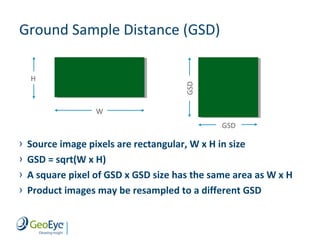
Ground Sample Distance (GSD)

    H


                                       GSD
                   W
                                               GSD

›   Source image pixels are rectangular, W x H in size
›   GSD = sqrt(W x H)
›   A square pixel of GSD x GSD size has the same area as W x H
›   Product images may be resampled to a different GSD
Satellite                      Satellite
Field of View                     imaging at
                                  nadir
                                                                 imaging
                                                                 off nadir


› Field of View (FOV) is angle from
  one edge of an image to the
  other.
› All rays of a high-resolution
  satellite image are at about the                      Satellite
                                                        Field of View
  same angle.

   Camera          FOV
   Aerial          90°
   IKONOS          0.95°
   GeoEye-1        1.28°
   GeoEye-2        1.22°              Aerial Camera    Aerial
                                       Field of View   camera


              13
14
Scan Azimuth
› Scan Azimuth
   ‒ Describes scan direction or motion of aim
                                                                    0° = North
     point on ground
   ‒ North-to-South
         Scan Azimuth = 180°
   ‒ South-to-North
         Scan Azimuth = 0°                      270° = West                      90° = East


                                                                   180° = South


                                                               West to East
                                                               Scan azimuth 90°
                                r o N o h uo S
                                h u mz A nac S


                                                                 East to West
                                       t t


                                                                 Scan azimuth 270°
                                 t i


                 15
Line of Sight (LOS)

› The Line of Sight (LOS) is the
  direction that the camera is
  imaging.

› A Line of Sight direction can be
  described by azimuth and
  elevation angles.


              16
Satellite Collection Geometry


       17
Azimuth
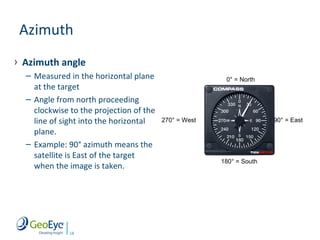
› Azimuth angle
  ‒ Measured in the horizontal plane                    0° = North
    at the target
  ‒ Angle from north proceeding
    clockwise to the projection of the
    line of sight into the horizontal    270° = West                  90° = East
    plane.
  ‒ Example: 90° azimuth means the
    satellite is East of the target
                                                       180° = South
    when the image is taken.


              18
Collection Azimuth
› North Up View


              19
Collection Azimuth
› View from sensor perspective


           GE1 Image acquired at 53.5° collection azimuth rotated
           180° - 53.5° CW on right to view from sensor perspective.
           20
Elevation
› Elevation angle
   ‒ Measured at target
   ‒ Angle from horizontal plane up to
     line of sight.


› Alternatives
                                         Elevation angle
   ‒ Incidence or Zenith angle
   ‒ Off-Nadir or Obliquity angle


              21
Computing height from shadows & layover


        DV                       DV

                                      DH

                DH


             DV = DH * tan(EL)
       22
Example: Republic Plaza (Singapore)
Image collected at 67°
  elevation angle
Layover measured at 116
  m
Height calculation
H = 116 m * tan(67°)
  = 273 m
Actual height
  280 m


            23
Elevation angle and terrain displacement
        Zenith           Sensor


                                               DH = DV / tan(EL)
                                  EL
                                       Earth
   DV
                                       DEM

                    DH

                 › EL = elevation angle
                 › DV = vertical distance
                 › DH = horizontal distance


            24
Incidence, Elevation, & Off-Nadir Angles


›   EL = Elevation = angle at target from horizontal to sensor.
›   IN = Incidence = angle at target from zenith to sensor.
›   OB = Obliquity = angle at sensor from nadir to target (off-nadir angle)
›   IN + EL = 90°
                                                                              R Cos( EL) 
›   Obliquity is related to elevation by trig formula:           OB = ArcSin  e
                                                                              (H + R )  
     ‒ Re radius of earth ~ 6371 km
          =
                                                                                 o    e  
     ‒ Ho = orbit height ~ 681 km


                          25
Incidence, Elevation, & Off-Nadir Angles


       26
Stereo Geometry                                          Orbit Track


       About one minute of orbit time
       between left and right image of
       a stereo pair.


                                                        Ground Track

                         Convergence
                            Angle


                                         EL2
                          EL1
                                           About two seconds of orbit time
                                   AOI     to scan a 15 km by 15 km stereo
                                           scene. Longer scans are possible.
                                           A 100 km long stereo pair takes
                                           about 20 seconds to scan.

      27
Field of Regard (FOR)

› Field of Regard: Angle Range that Camera can Image by
  rotating
› Satellite Field of Regard > 90°.
› Field of View can be anywhere within the Field of Regard


                                                             28
Field of Regard vs. Elevation Angle


        › Wider Field of Regard at lower elevation angle
        › Wider Field of Regard from higher orbits
       29
Field of Regard
                                           GSD vs. Cross-Track Distance
                 1


                0.9


                0.8


                0.7       60° Elevation
                           60° Elevation
                              Angle
       GSD, m


                               Angle
                0.6


                0.5


                0.4                                                             IKONOS
                                                                                GE1
                                                                                GE2
                0.3
                      0   100    200   300   400     500    600    700    800   900   1000
                                          Cross-Track Distance, km
  RunSatComparison


                  30
Revist Time (time between satellite accesses)


                                                     3-day revisit at 40° N
                                                     at 60° elevation angle


       › Shorter revisit time at lower elevation angle & higher latitude

            31
Revisit Time


                                                     › More frequent revisits at
                         15
                                                       high latitudes because the
                                                       orbits converge near the
       14        7
                                                5
                                                13
                                                       poles.
 13                                              6
                                                     › Ground stations are located
                                                       at high latitudes can contact
  12

       4
                                                       the satellite nerly every
            11
                         10        9
                                                       orbital revolution.
                     3                     15
                                       1
                               2


                          32
Pan-MSI Alignment
›   Each MSI pixel covers 4x4 Pan pixels
›   4 multispectral (MSI) bands
›   1 panchromatic (PAN) band
›   Simultaneous PAN/MSI collection
›   11-bit resolution


               33
CIR   RGB
4-meter RGB Multispectral                          1-meter RGB Pan-Sharpened


     Color
  enhances
interpretation
  for human
    visual
  perception

                                             1-meter Panchromatic


                 4-meter CIR Multispectral                          1-meter CIR Pan-Sharpened


                 35
Camera Models


      36
Rational Polynomial Coefficient (RPC) Camera Models
                                             › RPC Camera Models
                                               ‒ Generic mathematical model mapping
                                                 ground to image coordinates.
                                               ‒ Sensor software fits coefficients to
                                                 physical camera model of image.
                                               • Sensors
                                               ‒ GeoEye, Ikonos, QB, WV, Cartosat …
                                               • Application Software
                                               ‒ ERDAS, BAE, PCI, ZI, …
                                             › Applications
                                               ‒ Block adjust images with ground control
                                                 to improve accuracy.
                                               ‒ Orthorectification
                                               ‒ Stereo extraction
  The mathematics of satellite imagery is
   The mathematics of satellite imagery is     ‒ Photogrammetry
  complicated, but RPC models are simple
   complicated, but RPC models are simple
Satellite Image Product Geometry
Product Geometry
    Product         Rectification         Projection            Image Model
                                                              Physical (attitude,
    Basic          Synthetic Array    Satellite Scan Path    ephemeris & camera
                                                                calibrations)
    Geo        Constant height               Map                     RPC
    Ortho               DEM                  Map                    Ortho
    Stereo     Constant height Path, Map, or Epi-polar         RPC or Physical


                                                            Convergence
                                                               angle
                          Elevation
                             angle


              39
BASIC
                                           › Photogrammetric
                                             Applications
                                           › Satellite Projected
                                           › Physical Camera Model
                                             ‒ High Accuracy
                                           › RPC Camera Model
                                             ‒ Rapid Positioning

IKONOS image of the moon (BASIC product)
GEO                                   Tsangpo River Basin, Tibet


› Visual Interpretation
  ‒ Situational awareness
  ‒ Intelligence
  ‒ Media
› Photogrammetry
  ‒ Block adjust with other imagery
    or GCP to improve accuracy.
  ‒ Orthorectify with DEM to
    correct for terrain
    displacement
› Map Projected
› RPC Camera Model
  ‒ High Accuracy
E         BASIC and GEO Products
                                                   N


                        W                                         E


                              Geo                  S
                  S           East to West Scan
N
                              North up Map Projected


                                                BASIC       GEO
                            RPC Model                      
                            Physical Model
                                                            
                            Projection
                                                Satellite   Map
BASIC W
East to West Scan
Satellite Projected
Ortho
› Applications
  ‒ Feature Extraction
  ‒ GIS Map Base
› Terrain Corrected
› Map Projected
› Mosaics Available


                         Frankfurt Airport, Germany
Georectified or Orthorectified?
› Georectified
                         Constant Height   Line of Sight   Topographic
   ‒ Terrain displace-                                     Surface
     ment errors
   ‒ Quick,
     Low cost


› Orthorectified                                                Topo-
                                                                graphic

  ‒ DEM corrects for
                                                                Surface


    terrain
                                                                Ortho-
    displacement                                                rectified
                                                                Image
  ‒ Accuracy for
    mapping


               44
Geospatial eXploitation Products™


What is an Orthophoto?
•   An orthophoto is an image that                                                 Camera
    has had all distortion due to                              Original Image
    camera obliquity, terrain relief,
    and features removed.
•   The SOCET GXP Ortho Manager
    converts one or more original
    images into an orthophoto by
    transforming the pixels to their         Orthophoto
    proper position according to the
    given sensor, terrain, and feature
    information.
•   In the final product all points in
    the image appear as if the                                       DTM
    observer were looking down from
    nadir position.

                                                                                March, 2009
Orthorectified
Georectified
Stereo
› Attributes
  ‒ High resolution
  ‒ Color
  ‒ 3-dimensional
› Applications
  ‒ DEM extraction
  ‒ 3D feature extraction
  ‒ Geomorphic
    visualization

 Stereo       RPC       Physical
 Projection   Model     Model
 Satellite                
 Map                      
 Epi-Polar                
                   48
Stereo Image Of Downtown Denver, Colorado
Thank You!


             Big Bear Glacier, Alaska

2012 ASPRS Track, Satellite Image Geometry, Gene Dial

  • 1.
    Satellite Image Geometry Gene Dial GIS in the Rockies 2012-09-21 1
  • 2.
    Topics › Background › Satellite Orbits › Satellite Image Geometry › Stereo Image Geometry › Satellite Image Products Niagara Falls 2
  • 3.
  • 4.
    Remote Sensing—Then &Now! Mys Shmidta Air Field, Soviet Union GeoEye-1 Half Meter Imagery Collected August 18th, 1960 Kutztown University – Collected Oct. 6, 2008
  • 5.
    GeoEye-2 Technical Specsat a Glance System Specificatio Performance n Power Solar Array (5) Satellite Bus Size 2.3 m x 5.3 m Control Data Storage Unit (2) Weight 2100 kg dry, 2500 kg wet Flight Unit Payload Aperture 1.1 meter aperture Processor Focal Length 16 meter focal length Battery (2) Dynamic Range 11 bit dynamic range with TDI GSD 34 cm Pan, 1.32m MSI Swath 14.5 km Attitude Actuators Honeywell M-95 CMGs Control CMG Electronics (4) Moment Gyros Control (4) System Sensors Goodrich GR-1004 Star Trackers Star Tracker (2) SIRU Inertial Reference Units Focal Plane PL Electronics Monarch GPS Receiver Radiator (2) Radiator Payload Minimum Agility Acceleration - 1.0 degree/sec2 X-band High Electronics (2) Max Slew Rate – 2.7 degree/sec Gain Antenna Narrowband Two Axis Gimbal Antenna (2) Data Data Recorder 3.2 Terabit High Speed Storage Unit Handling & Sun Sensor (2) GPS Antenna (2) Communications Wideband DL 800 Mbps Dual Pole, X band Tlmy DL 128 Kbps, X band Command UL 64 Kbps, S band See http://www.youtube.com/watch?v=lnv6cDiBF9o 5
  • 6.
  • 7.
  • 8.
  • 9.
    GeoEye-1 IKONOS GeoEye-2 9
  • 10.
    GeoEye Constellation GeoEye Constellation GeoEye Constellation High Resolution Images Move Beyond Mapping › Frequent Access ‒ Mean Time to Access < 1 day › Long Duration Accesses ‒ Average Access Time ~ 1 min/day › High Resolution Access ‒ GeoEye-1: 41 cm Nadir GSD ‒ GeoEye-2: 34 cm Nadir GSD ‒ True 50 cm products › Huge Collection Capacity ‒ IKONOS: 240,000 sqkm/day ‒ GeoEye-1: 350,000 sqkm/day ‒ GeoEye-2: 600,000 sqkm/day Ground Swaths Ground Swaths 10 GE1 = Green IK = Yellow GE2 = Blue GE1 = Green IK = Yellow GE2 = Blue
  • 11.
  • 12.
    Ground Sample Distance(GSD) H GSD W GSD › Source image pixels are rectangular, W x H in size › GSD = sqrt(W x H) › A square pixel of GSD x GSD size has the same area as W x H › Product images may be resampled to a different GSD
  • 13.
    Satellite Satellite Field of View imaging at nadir imaging off nadir › Field of View (FOV) is angle from one edge of an image to the other. › All rays of a high-resolution satellite image are at about the Satellite Field of View same angle. Camera FOV Aerial 90° IKONOS 0.95° GeoEye-1 1.28° GeoEye-2 1.22° Aerial Camera Aerial Field of View camera 13
  • 14.
  • 15.
    Scan Azimuth › ScanAzimuth ‒ Describes scan direction or motion of aim 0° = North point on ground ‒ North-to-South  Scan Azimuth = 180° ‒ South-to-North  Scan Azimuth = 0° 270° = West 90° = East 180° = South West to East Scan azimuth 90° r o N o h uo S h u mz A nac S East to West t t Scan azimuth 270° t i 15
  • 16.
    Line of Sight(LOS) › The Line of Sight (LOS) is the direction that the camera is imaging. › A Line of Sight direction can be described by azimuth and elevation angles. 16
  • 17.
  • 18.
    Azimuth › Azimuth angle ‒ Measured in the horizontal plane 0° = North at the target ‒ Angle from north proceeding clockwise to the projection of the line of sight into the horizontal 270° = West 90° = East plane. ‒ Example: 90° azimuth means the satellite is East of the target 180° = South when the image is taken. 18
  • 19.
  • 20.
    Collection Azimuth › Viewfrom sensor perspective GE1 Image acquired at 53.5° collection azimuth rotated 180° - 53.5° CW on right to view from sensor perspective. 20
  • 21.
    Elevation › Elevation angle ‒ Measured at target ‒ Angle from horizontal plane up to line of sight. › Alternatives Elevation angle ‒ Incidence or Zenith angle ‒ Off-Nadir or Obliquity angle 21
  • 22.
    Computing height fromshadows & layover DV DV DH DH DV = DH * tan(EL) 22
  • 23.
    Example: Republic Plaza(Singapore) Image collected at 67° elevation angle Layover measured at 116 m Height calculation H = 116 m * tan(67°) = 273 m Actual height 280 m 23
  • 24.
    Elevation angle andterrain displacement Zenith Sensor DH = DV / tan(EL) EL Earth DV DEM DH › EL = elevation angle › DV = vertical distance › DH = horizontal distance 24
  • 25.
    Incidence, Elevation, &Off-Nadir Angles › EL = Elevation = angle at target from horizontal to sensor. › IN = Incidence = angle at target from zenith to sensor. › OB = Obliquity = angle at sensor from nadir to target (off-nadir angle) › IN + EL = 90°  R Cos( EL)  › Obliquity is related to elevation by trig formula: OB = ArcSin  e  (H + R )   ‒ Re radius of earth ~ 6371 km =  o e  ‒ Ho = orbit height ~ 681 km 25
  • 26.
    Incidence, Elevation, &Off-Nadir Angles 26
  • 27.
    Stereo Geometry Orbit Track About one minute of orbit time between left and right image of a stereo pair. Ground Track Convergence Angle EL2 EL1 About two seconds of orbit time AOI to scan a 15 km by 15 km stereo scene. Longer scans are possible. A 100 km long stereo pair takes about 20 seconds to scan. 27
  • 28.
    Field of Regard(FOR) › Field of Regard: Angle Range that Camera can Image by rotating › Satellite Field of Regard > 90°. › Field of View can be anywhere within the Field of Regard 28
  • 29.
    Field of Regardvs. Elevation Angle › Wider Field of Regard at lower elevation angle › Wider Field of Regard from higher orbits 29
  • 30.
    Field of Regard GSD vs. Cross-Track Distance 1 0.9 0.8 0.7 60° Elevation 60° Elevation Angle GSD, m Angle 0.6 0.5 0.4 IKONOS GE1 GE2 0.3 0 100 200 300 400 500 600 700 800 900 1000 Cross-Track Distance, km RunSatComparison 30
  • 31.
    Revist Time (timebetween satellite accesses) 3-day revisit at 40° N at 60° elevation angle › Shorter revisit time at lower elevation angle & higher latitude 31
  • 32.
    Revisit Time › More frequent revisits at 15 high latitudes because the orbits converge near the 14 7 5 13 poles. 13 6 › Ground stations are located at high latitudes can contact 12 4 the satellite nerly every 11 10 9 orbital revolution. 3 15 1 2 32
  • 33.
    Pan-MSI Alignment › Each MSI pixel covers 4x4 Pan pixels › 4 multispectral (MSI) bands › 1 panchromatic (PAN) band › Simultaneous PAN/MSI collection › 11-bit resolution 33
  • 34.
    CIR RGB
  • 35.
    4-meter RGB Multispectral 1-meter RGB Pan-Sharpened Color enhances interpretation for human visual perception 1-meter Panchromatic 4-meter CIR Multispectral 1-meter CIR Pan-Sharpened 35
  • 36.
  • 37.
    Rational Polynomial Coefficient(RPC) Camera Models › RPC Camera Models ‒ Generic mathematical model mapping ground to image coordinates. ‒ Sensor software fits coefficients to physical camera model of image. • Sensors ‒ GeoEye, Ikonos, QB, WV, Cartosat … • Application Software ‒ ERDAS, BAE, PCI, ZI, … › Applications ‒ Block adjust images with ground control to improve accuracy. ‒ Orthorectification ‒ Stereo extraction The mathematics of satellite imagery is The mathematics of satellite imagery is ‒ Photogrammetry complicated, but RPC models are simple complicated, but RPC models are simple
  • 38.
  • 39.
    Product Geometry Product Rectification Projection Image Model Physical (attitude, Basic Synthetic Array Satellite Scan Path ephemeris & camera calibrations) Geo Constant height Map RPC Ortho DEM Map Ortho Stereo Constant height Path, Map, or Epi-polar RPC or Physical Convergence angle Elevation angle 39
  • 40.
    BASIC › Photogrammetric Applications › Satellite Projected › Physical Camera Model ‒ High Accuracy › RPC Camera Model ‒ Rapid Positioning IKONOS image of the moon (BASIC product)
  • 41.
    GEO Tsangpo River Basin, Tibet › Visual Interpretation ‒ Situational awareness ‒ Intelligence ‒ Media › Photogrammetry ‒ Block adjust with other imagery or GCP to improve accuracy. ‒ Orthorectify with DEM to correct for terrain displacement › Map Projected › RPC Camera Model ‒ High Accuracy
  • 42.
    E BASIC and GEO Products N W E Geo S S East to West Scan N North up Map Projected BASIC GEO RPC Model   Physical Model   Projection Satellite Map BASIC W East to West Scan Satellite Projected
  • 43.
    Ortho › Applications ‒ Feature Extraction ‒ GIS Map Base › Terrain Corrected › Map Projected › Mosaics Available Frankfurt Airport, Germany
  • 44.
    Georectified or Orthorectified? ›Georectified Constant Height Line of Sight Topographic ‒ Terrain displace- Surface ment errors ‒ Quick, Low cost › Orthorectified Topo- graphic ‒ DEM corrects for Surface terrain Ortho- displacement rectified Image ‒ Accuracy for mapping 44
  • 45.
    Geospatial eXploitation Products™ Whatis an Orthophoto? • An orthophoto is an image that Camera has had all distortion due to Original Image camera obliquity, terrain relief, and features removed. • The SOCET GXP Ortho Manager converts one or more original images into an orthophoto by transforming the pixels to their Orthophoto proper position according to the given sensor, terrain, and feature information. • In the final product all points in the image appear as if the DTM observer were looking down from nadir position. March, 2009
  • 46.
  • 47.
  • 48.
    Stereo › Attributes ‒ High resolution ‒ Color ‒ 3-dimensional › Applications ‒ DEM extraction ‒ 3D feature extraction ‒ Geomorphic visualization Stereo RPC Physical Projection Model Model Satellite   Map   Epi-Polar   48
  • 49.
    Stereo Image OfDowntown Denver, Colorado
  • 50.
    Thank You! Big Bear Glacier, Alaska

Editor's Notes

  • #5 GeoEye revenue About ½ from commercial customers About ½ from the US Government By contrast, the US Government pays 100% of cost for National Technical Means. So we&apos;re a very cost effective alternative. Congress, by supporting US commercial imagery satellite companies, is increasing American security and protecting American jobs, but only paying 50 cent dollars to do so.
  • #7 So it’s into this historic background that GeoEye was formed by the acquisition of Space Imaging by OrbImage early in 2006. Our headquarters is conveniently located in Dulles Virginia. We’ve grown to 410 employees at various locations around the country and even around the world. We collect imagery from a constellation of satellite and aerial platforms. The listing of GeoEye stock on the NASDAQ exchange and our inclusion in the Russell 3000 speak to the evolving maturity of our industry. When the first JACIE conference was held, we concentrated on narrow, technical aspects of remote sensing. Today, we are truly an industry, blending requirements for customer service and back-office production systems with consideration of resampling kernels, MTFC, and acquisition angles.
  • #11 GE1 = Green GE2 = Blue IL = Yellow