Change
Detection
Studies using RS
Presented by: Tilok Chetri
M.Sc. GIS and RS
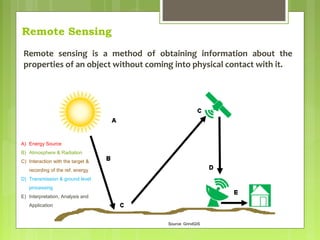
Remote sensing is a method of obtaining information about the
properties of an object without coming into physical contact with it.
A) Energy Source
B) Atmosphere & Radiation
C) Interaction with the target &
recording of the ref. energy
D) Transmission & ground level
processing
E) Interpretation, Analysis and
Application
Source: GrindGIS
Remote Sensing
 RS system capture radiation in different wavelength
reflected/emitted by the earth’s surface features and recorded
it either directly on the film as in case of aerial photography or
in digital medium used for generating the images
 It provides valuable data over vast area in a short time about
resources, meteorology and environment leading to better
resource management and accelerating national development
Remote Sensing
 Change detection in GIS is a method of understanding
how a given area has changed between two or more
time periods.
 It is helpful in many applications such as:
• Land use changes
• Rate of deforestation
• Coastal change
• Urban sprawl
 Change detection involves comparing changes
between aerial photographs taken over different time
periods that cover the exact same geographic area.
Change Detection
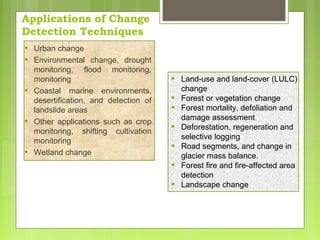
• Urban change
• Environmental change, drought
monitoring, flood monitoring,
monitoring
• Coastal marine environments,
desertification, and detection of
landslide areas
• Other applications such as crop
monitoring, shifting cultivation
monitoring
• Wetland change
Applications of Change
Detection Techniques
• Land-use and land-cover (LULC)
change
• Forest or vegetation change
• Forest mortality, defoliation and
damage assessment
• Deforestation, regeneration and
selective logging
• Road segments, and change in
glacier mass balance.
• Forest fire and fire-affected area
detection
• Landscape change
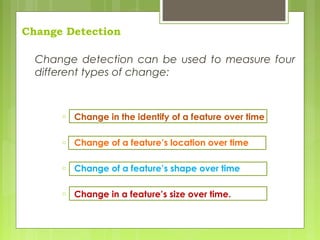
Change detection can be used to measure four
different types of change:
o Change in the identify of a feature over time
o Change of a feature’s location over time
o Change of a feature’s shape over time
o Change in a feature’s size over time.
Change Detection
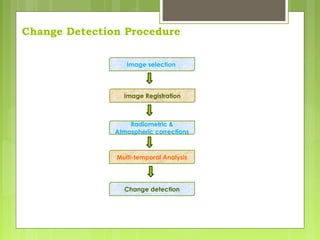
Change Detection Procedure
Image selection
Multi-temporal Analysis
Image Registration
Radiometric &
Atmospheric corrections
Change detection
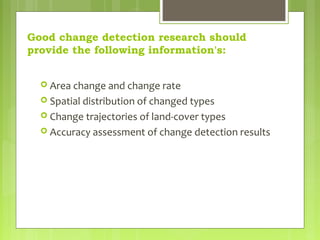
Good change detection research should
provide the following information's:
 Area change and change rate
 Spatial distribution of changed types
 Change trajectories of land-cover types
 Accuracy assessment of change detection results
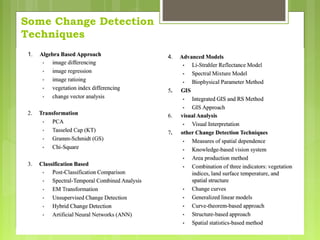
Some Change Detection
Techniques
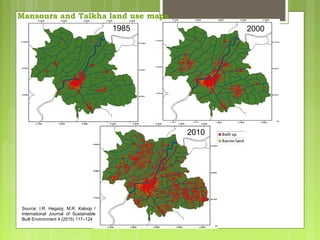
Source: I.R. Hegazy, M.R. Kaloop /
International Journal of Sustainable
Built Environment 4 (2015) 117–124
1985 2000
2010
Mansoura and Talkha land use maps
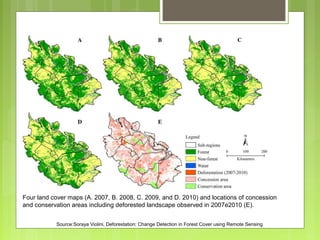
Four land cover maps (A. 2007, B. 2008, C. 2009, and D. 2010) and locations of concession
and conservation areas including deforested landscape observed in 2007e2010 (E).
Source:Soraya Violini, Deforestation: Change Detection in Forest Cover using Remote Sensing
o Monitoring urban growth and land use change detection with GIS
and remote sensing techniques in Daqahlia governorate Egypt-
Ibrahim Rizk Hegazy 2015
o PETIT, C. C., and LAMBIN, E. F., 2001, Integration of multi-source
remote sensing data for land cover change detection. International
Journal of Geographical Information Science, 15, 785–803
o Google Time-Lapse video(1984-2016)
References
Thank YOu…
Thank YOu…
Thank YOu…
Thank YOu…
Thank YOu…
Thank YOu…
Thank YOu…
Thank YOu…
Thank YOu…
Thank YOu…
Thank YOu…
Thank YOu…
Thank YOu…
Thank YOu…
Thank YOu…
Thank YOu…
Thank YOu…
Thank YOu…
Thank YOu…
Thank YOu…
Thank YOu…
Thank YOu…Thank YOu…
Thank YOu…
Thank YOu…
Notes:
Change detection can be used to measure four different types of change:
Change in the identify of a feature over time.    For example, the change in
type of retail store at a given location.  A local restaurant may go out of
business and be replaced by a toy store.  The actual physical building
hasn’t changed, the type of categorized land use hasn’t change
(commercial), but the specific identity of the store has change.
Change of a feature’s location over time.  Change detection can be used
to track the movement of a feature.
Change of a feature’s shape over time. Change detection can be used to
understand shrinkage in a specific specie’s habitat over time or the
changes in the shape of a river or lake.
Change in a feature’s size over time. Change detection can also measure
the extent of a feature.  Does the urban area grow or shrink between two
time points?

Change detection using remote sensing and GIS

  • 1.
    Change Detection Studies using RS Presentedby: Tilok Chetri M.Sc. GIS and RS
  • 2.
    Remote sensing isa method of obtaining information about the properties of an object without coming into physical contact with it. A) Energy Source B) Atmosphere & Radiation C) Interaction with the target & recording of the ref. energy D) Transmission & ground level processing E) Interpretation, Analysis and Application Source: GrindGIS Remote Sensing
  • 3.
     RS systemcapture radiation in different wavelength reflected/emitted by the earth’s surface features and recorded it either directly on the film as in case of aerial photography or in digital medium used for generating the images  It provides valuable data over vast area in a short time about resources, meteorology and environment leading to better resource management and accelerating national development Remote Sensing
  • 4.
     Change detectionin GIS is a method of understanding how a given area has changed between two or more time periods.  It is helpful in many applications such as: • Land use changes • Rate of deforestation • Coastal change • Urban sprawl  Change detection involves comparing changes between aerial photographs taken over different time periods that cover the exact same geographic area. Change Detection
  • 5.
    • Urban change •Environmental change, drought monitoring, flood monitoring, monitoring • Coastal marine environments, desertification, and detection of landslide areas • Other applications such as crop monitoring, shifting cultivation monitoring • Wetland change Applications of Change Detection Techniques • Land-use and land-cover (LULC) change • Forest or vegetation change • Forest mortality, defoliation and damage assessment • Deforestation, regeneration and selective logging • Road segments, and change in glacier mass balance. • Forest fire and fire-affected area detection • Landscape change
  • 6.
    Change detection canbe used to measure four different types of change: o Change in the identify of a feature over time o Change of a feature’s location over time o Change of a feature’s shape over time o Change in a feature’s size over time. Change Detection
  • 7.
    Change Detection Procedure Imageselection Multi-temporal Analysis Image Registration Radiometric & Atmospheric corrections Change detection
  • 8.
    Good change detectionresearch should provide the following information's:  Area change and change rate  Spatial distribution of changed types  Change trajectories of land-cover types  Accuracy assessment of change detection results
  • 9.
  • 10.
    Source: I.R. Hegazy,M.R. Kaloop / International Journal of Sustainable Built Environment 4 (2015) 117–124 1985 2000 2010 Mansoura and Talkha land use maps
  • 11.
    Four land covermaps (A. 2007, B. 2008, C. 2009, and D. 2010) and locations of concession and conservation areas including deforested landscape observed in 2007e2010 (E). Source:Soraya Violini, Deforestation: Change Detection in Forest Cover using Remote Sensing
  • 13.
    o Monitoring urbangrowth and land use change detection with GIS and remote sensing techniques in Daqahlia governorate Egypt- Ibrahim Rizk Hegazy 2015 o PETIT, C. C., and LAMBIN, E. F., 2001, Integration of multi-source remote sensing data for land cover change detection. International Journal of Geographical Information Science, 15, 785–803 o Google Time-Lapse video(1984-2016) References
  • 14.
    Thank YOu… Thank YOu… ThankYOu… Thank YOu… Thank YOu… Thank YOu… Thank YOu… Thank YOu… Thank YOu… Thank YOu… Thank YOu… Thank YOu… Thank YOu… Thank YOu… Thank YOu… Thank YOu… Thank YOu… Thank YOu… Thank YOu… Thank YOu… Thank YOu… Thank YOu…Thank YOu… Thank YOu… Thank YOu…
  • 15.
    Notes: Change detection canbe used to measure four different types of change: Change in the identify of a feature over time.    For example, the change in type of retail store at a given location.  A local restaurant may go out of business and be replaced by a toy store.  The actual physical building hasn’t changed, the type of categorized land use hasn’t change (commercial), but the specific identity of the store has change. Change of a feature’s location over time.  Change detection can be used to track the movement of a feature. Change of a feature’s shape over time. Change detection can be used to understand shrinkage in a specific specie’s habitat over time or the changes in the shape of a river or lake. Change in a feature’s size over time. Change detection can also measure the extent of a feature.  Does the urban area grow or shrink between two time points?