REMOTE SENSING & GIS APPLICATIONS IN 
WATERSHED MANAGEMENT 
Dr. Y. V. N. Krishna Murthy
RURAL POVERTY : GENESIS 
1.7 
1.2 
0.7 
0.2 
Productivity (t/ha) 
-Dry-land < 1 t/ha 
-Irrigated ~ 3t/ha 
Food 
grain 
Oil seed 
Pulses 
1950 1970 1990 1999 
Production Rainfed areas 
Food grain 
45 
Oilseeds 
75 
Pulses 
90 
Contribution (%) of Dry-land Areas 
Technology 
Mission 
Green 
Revolution 
Impact of Green Revolution 
covered 40 Mha and benefited 
mostly rich farmers 
100 Mha arable dry land of 
mostly to small & marginal 
farmers remained unaffected 
With enhanced cost of cultivation, 
reduced marketable surplus and 
increased vulnerability to natural 
disasters, small & marginal 
farmers - poverty trap..
WATER RESOURCES: SCARCITY & 
ABUNDANCE 
Season/Period M ha m % 
Winter (Jan-Feb) 12 3 
Pre-monsoon (Mar-May) 52 13 
SW monsoon (Jun- Sep) 296 74 
NE monsoon (Oct-Dec) 40 10 
Total for the year 400 100 
Rainfall 
zone 
(mm) 
Geogr. 
Area 
(M ha) 
Water avail. 
(M ha m) 
100-500 52.07 15.62 
500-750 40.26 25.16 
750-1000 65.86 57.63 
1000-2500 137.24 205.86 
>2500 32.57 95.86 
Total 328.00 400.00 
Need for : 
• Water Harvesting 
• Watershed Development 
• Command Area Development 
• Ground Water Targeting 
• River Basin Development 
• Inter-basin Linkages 
Spatial Variability 
Temporal Variability 
Total Usage 
51 Mham/ 
400 Mham 
Water 
Irrigation 
35 Mham 
Other Uses 
16 Mham
 One of the most densely populated nation. 
 Population : 16 % of world’s population. 
Present > billion (342 million in 1947). 
Future > 1.43 billion by 2030 
 Geographical area - 329 M ha (2.42 % of world’s geog. area). 
 Coast line - 7500 Km. 
 Forests – 19 % 
 Mangroves – 3 % of total forest area. 
 Per capita arable land – 0.15 ha (0.09 ha by 2075) 
 Rain-fed agriculture – 68 % 
 Agr. production – 205 M tons (required 325 M tons by 2050) 
 17 % of world’s cattle population.
 Increasing rate of degradation and depletion of resources. 
 Deforestation, desertification, soil erosion, salinization, falling water tables. 
 Degraded land – 175 M ha 
Soil erosion by wind & water – 150 M ha. Salt affected soils – 7.0 M ha 
Shifting cultivation – 4.36 M ha Water-logging – 6.0 M ha 
 Heavy demand for fodder resulting in over grazing of forest and grass lands. 
 Natural disasters: Drought (1/2 of the country is drought prone), Floods (40 M 
ha), landslides, cyclone, locust attack etc. 
Drastic reduction in Biomass 
Depleting Water Resources 
Loss of productive Soil 
Reduced carrying capacity of streams 
Extinction of fauna & flora
 Scientific & rational Land and Water Resources management 
 Striking balance between availability v/s needs 
 Adoption of eco-friendly sustainable development and 
Determining alternatives for development. 
 Peoples participation 
 Adopting natural boundaries defined by river basins/ sub-basins 
as a planning unit. 
 Integrated development approach. 
 Regular monitoring to assess the status of development
Watershed 
- is a natural hydrological unit 
- Topographically delineated area drained by a stream system, from 
which runoff resulting from precipitation flow past from a point into 
single stream. 
- Development is not confined just to agriculture lands but covers entire 
catchment's area. 
- Watershed approach is holistic, linking upstream and 
downstream areas. 
-Practical approach in planning, directed at preservation, 
conservation, development, management and exploitation of 
natural resources for the benefit of people.
Watershed Development Approach 
- Integrated and multi-disciplinary approach. 
- To suggest possible exploitation of resources within the limits of tolerance. 
- Approach is Preventive, Progressive, Corrective & Curative. 
• Objectives - 
• Conservation of Soil and Water 
• Improved ability of land to hold water 
• Maintaining adequate vegetative cover for controlling soil 
erosion 
• Rain water harvesting and ground water recharging. 
• Benefits - 
• Promotes economic and social development of community 
• Employment generation and other income generation 
• Ecological balance
Useful for generating environmental indicators that can be 
integrated with collateral data and social indicators. 
- Synoptic view, Multi-resolution, multi-spectral, repetitive 
offers appropriate method for quick, unbiased mapping and 
monitoring of natural resources both in space and time 
domain. 
- Timely and accurate information on spatial distribution – 
landuse, soil, vegetation density, forest, geology, water 
resources etc. 
- RS data in conjunction with collateral data helps in 
delineation of ridge line, characterization, prioritization, 
erosion prone areas, etc.
Capability of Remote Sensing for Watershed Attributes Information 
Attribute Attribute Parameter Relevance 
Size Area Available rainfall, run-off, 
sedimentation 
Shape Geometric form, shape index, form 
factor 
Run-off & 
sedimentation 
Physiography 
& slope 
Mean elevation, av. Slope, relief 
length 
Run-off & 
sedimentation 
Drainage Drainage pattern & density, stream 
order 
Run-off & 
sedimentation 
Geology Rock types Run-off & 
sedimentation 
Soil Texture, moisture, capability land degradation, 
production potential, 
Run-off & 
sedimentation 
Landuse Present LU, wasteland, surface water Run-off & 
sedimentation 
Groundwater Potential Recharge & irrigation
- Integration of natural resources information in 
conjunction with socio-economic data. 
- Generation of locale specific action plans for land 
and water resources. 
-Analysis of SE / demographic data to assess 
developmental needs of the region. 
- Assessment of the existing infrastructure to 
arrive at developmental schemes. 
- Generation of variety of derived maps.
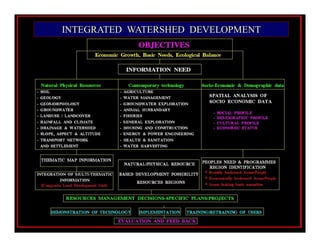
INTEGRATED WATERSHED DEVELOPMENT
WATERSHED DEMARCATION AND SELECTION 
Method: Separation of the major drainage area; principal drainage 
basin and sub-basin; watershed 
CATEGORIES DELINEATION SYSTEM 
Region (6) ………… 1.5-12 lakhs sq km 
Basins (50) ………… 0.3- 3.0 lakhs sq km 
Catchment …………. 0.1 - 0.5 lakhs sq km 
Subcatchment ……. 2000 - 10000 sq km 
Watershed …………. 500 - 2000 sq km 
Sub-watershed …….. 50 - 500 sq km 
Mini Wateshed ……. 10 - 50 sq km 
Micro watershed …… 5 - 10 sq km
WATERSHED 
COVERAGE 
Watershed codification 
REGION 4 E 5 A 6 C 2 a 
BASIN 
CATCHMENT 
SUB-CATCHMENT 
WATERSHED 
SUB-WATERSHED 
MINI WATERSHED 
AIS & LUS codes 
MICRO WATERSHED 
IMSD 
codes 
Watershed code items…WSNAME (8,8,C) 
WSCODE (8,8,C) 
WSLCODE (16,16,C)
River flowing to Bay of Bengal 
Mahanadi 
Hirakund to confluence with Seonath 
RB of Mahanadi - Hirakund to Jonk 
Upper Jonk/Silda 
4G2E7 XXX
Drainages superimposed on satellite data
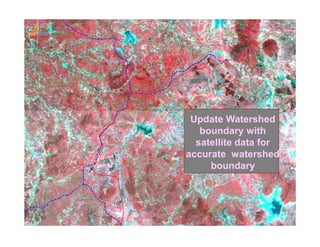
DRAINAGE UPDATION : Existing drains Existing drains Extracted from Image
Update Watershed 
boundary with 
satellite data for 
accurate watershed 
boundary
Update Watershed 
boundary with 
satellite data for 
accurate watershed 
boundary 
RRSSC-NAGPUR
WATERSHED CHARACTERIZATION 
Components of watershed : Drainage 
and its order, watershed boundary, area, 
perimeter, area under various drainage 
order, length of the stream, etc. 
Morphometric Analysis 
Various laws of drainage 
Calculation of various watershed 
characters
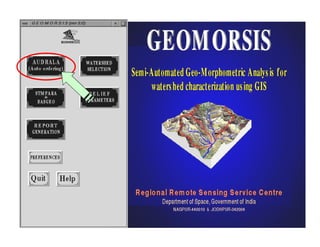
What is GEOMORSIS ? 
GEOMORSIS is a semi-automatic 
geo-morphometric analysis package for 
quantitative analysis of watershed for 
watershed characterization using GIS 
has SIX basic modules 
AUDRALA 
STMPARA 
BASGEO 
WATERSHED 
SELECTION 
RELIEF PARAMETER 
REPORT 
GENERATION
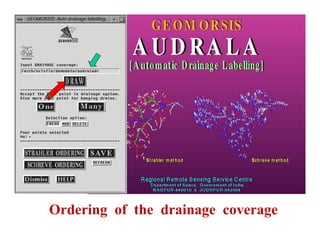
Ordering of the drainage coverage
DRAW displays the drainage coverage with nodes on 
which the pour points is to be selected
Select ‘ONE’ or ‘MANY’ pour points depending 
upon the number of drainage system.
1st order 
2nd order 
3rd order 
4th order 
5th order STRAHLER SCHREVE
Watershed 
Display
Watershed selection by-name
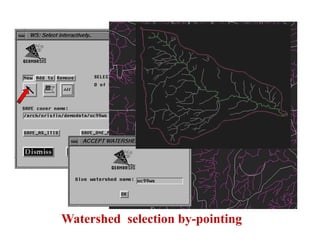
Watershed selection by-pointing
Watershed APPENDING
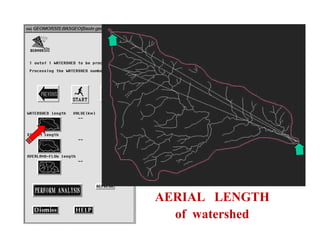
AERIAL LENGTH 
of watershed
STREAM LENGTH 
of watershed
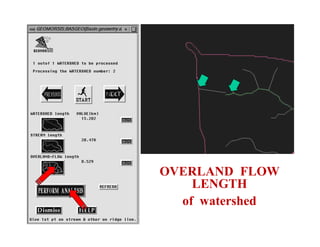
OVERLAND FLOW 
LENGTH 
of watershed
BASIN GEOMETRY 
PARAMETERS 
AREA and PERIMETER of watershed 
AERIAL, STREAM and OVERLAND - FLOW length 
of watershed 
ELONGATION RATIO 
BASIN CIRCULATORY RATIO 
FORM FACTOR 
COMPACTNESS COEFFICIENT 
RHODENTITY FACTOR 
DRAINAGE DENSITY 
STREAM FREQUENCY 
DRAINAGE TEXTURE 
TEXTURE RATIO 
LAMISCATE RATIO
MAXIMUM ELEVATION, MINIMUM ELEVATION 
RELIEF RATIO, RELATIVE RELIEF , 
RUGGEDNESS NUMBER
<output w/s name>.rlf 
<output w/s name>.stm <output w/s name>.bsg
WATERSHED PRIORITIZATION 
Erosion - Major problem and forms the bases of 
prioritization 
Factors - Rainfall, runoff, wind, soil, slope, plant cover and 
management practices. 
Why assessment of erosion becomes so important ? 
Identification of the eroded and erosion prone area 
through remote sensing (NDVI, SBI, PC) 
Assessment of the Erosion Hazards : 
Quantitative method - Universal soil loss equation; 
Qualitative method - Sediment Yield Index 
Runoff Rate 
Vegetation Status 
Socio-economic conditions
WATERSHED PRIORITIZATION - SYI Method 
Climatic Factors : Total precipitation, its frequency and 
intensity 
Geomorphic Factors : Landforms, Physiography, slope and 
drainage characteristics. 
Soil Factor : Soil profile characteristics (texture, structure, 
OM content, swell-shrink potential, porosity, 
hydraulic, soil depth & clay mineralogy 
Surface Cover Factor : Vegetation cover pattern governing 
flow hydraulics. 
Management Factors : Cultivation, bunding, multching, etc.
WATERSHED PRIORITIZATION - SYI Method 
Framework through systematic delineation & codification 
Mapping/Reconnaisance surveys for map indicating erosion-intensity mapping units 
Assignment of weightages values to various mapping units based on 
relative silt yield/run-off potential (0.35 to 0.95) 
Assignment of maximum delivery ratios to various erosion intensity and 
adjusted delivery ratios (measure of transportability) for different watersheds. 
Computation of Silt Yield Index (SYI)/ Potential Run-off Index (PRI) for 
individual watershed/subwatershed 
Ai = Area of the ith unit (EIMU) 
Wi = Weightages value of ith mapping unit 
Di = Adjusted delivery ratio assigned to ith mapping unit 
N = No. of mapping unit ; Aw = Total area of watershed 
CATEGORIZATION & GRADATION of Subwatershed 
SYI = 
( Ai * Wi * Di ) 
Aw * 100 , i = 1 to n RPI = 
( Ai * Wi) 
Aw 
* 100 , i = 1 to n 
Sediment 
Yield Index 
Run-off 
Potential Index
Fodder status < 0 Fodder status < 0 
(+) Wasteland > 50 
ha 
Fodder status < 0 (+) Wasteland > 50 
ha (+) Below Poverty level > 40 %
Run-off (Peak rate) 
OUTPUT
Run-off (Rainfall event) 
OUTPUT 
150
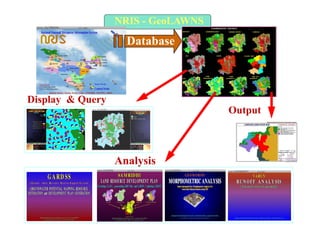
Database 
Display & Query 
Analysis 
Output 
NRIS - GeoLAWNS
INTEGRATED WATERSHED DEVELOPMENT
WATER HARVESTING 
Water harvesting is capturing and storing of runoff for 
later water requirements of drinking, irrigation, domestic 
and industrial use. 
OBJECTIVES 
Store excessive run off for future use 
Augment percolation /recharge to aquifers 
Checking of floods 
Checking of land erosion 
APPROPRIATE LOCATION 
Location of water harvesting structures at appropriate 
places is important for effectiveness of these structures.
Recharging is necessary in view of depleting GW table. 
Deteriorating water quality from the aquifers. 
Increasing demand for drinking water and irrigation. 
The excess runoff can be used for recharging the 
aquifers. 
Deep water table increases the cost per unit yield. 
To improve the GW supplies for longer durations. 
Checking of floods and land erosion. 
Right utilization of the excess water from cities and canals.
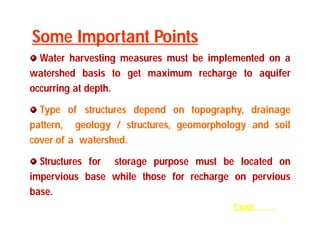
Water harvesting measures must be implemented on a 
watershed basis to get maximum recharge to aquifer 
occurring at depth. 
Type of structures depend on topography, drainage 
pattern, geology / structures, geomorphology and soil 
cover of a watershed. 
Structures for storage purpose must be located on 
impervious base while those for recharge on pervious 
base. 
Cont…… 
Some Important Points
Recharge structures need porous geological 
materials for percolation of water down to aquifers. 
Weak zones are preferred for recharging, viz., 
FRACTURED ZONES 
SHEAR ZONES 
ROCK CONTACTS 
LINEAMENT/ LINEAMENT INTERSECTIONS 
BRECCIATED AREAS 
WEATHERED ZONES 
TOPOGRAPHIC TROUGHS 
MAJOR VALLEYS
Obstruction Check dam, nalabund, 
gully plugs, khadin, contour 
bunds. 
Storing Percolation tanks, farm 
ponds, K.T. Weirs, recharge 
pits. 
Spreading Recharge basins, flooding. 
Injection Inverted / recharge wells.
Nature of subsurface soil, rock, extent of weathering and 
thickness of hydrogeological units. 
Water bearing capacity and hydraulic conductivity of 
aquifer materials. 
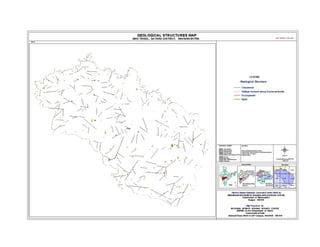
Geological structures (Lineaments). 
Topography, slope and drainage characteristics. 
Land use /land cover in the area. 
Quality of water and evaporation. 
Locations of recharge /discharge areas, water levels and water 
budget. 
Rainfall & runoff
Water Harvesting Structures 
Farm Ponds 
Made by either by constructing an embankment across a 
water course or by excavating a pit, usually provided within 
individual farms. 
To provide water storage for life saving irrigation. 
Provide drinking water for livestock and human beings in 
arid areas. 
Site conditions: Areas having flat topography and locations 
with rocks and soils of low permeability, free from structures 
such as faults, joints/fractures.
Water Harvesting Structures 
Minor Irrigation Tanks 
Created across streams for creating water reservoirs for 
providing irrigation to the crops at critical periods and to 
facilitate groundwater recharge. 
Site conditions: 
--Preferably narrow gorges/ valleys for making the dam in order 
to reduce the ratio of earth work to storage as minimum. 
--Availability of sufficient catchment area in the upstream side. 
--Geologically and structurally favourable sites to avoid loss of 
water.
Check Dams 
Proposed where water table fluctuation is very high and the 
stream is influent. Av. Catchment area of 25 ha. 
Main Objective: 
--To reduce runoff velocity thereby minimizing erosion. 
--Increasing recharge to the wells located down stream. 
Site conditions: 
--Areas having medium slope. 
--Constructed on lower order streams (generally up to third 
order). 
-- Favourable soils and lithology and structures for allowing 
percolation of water. 
-- Availability of irrigation wells downstream of proposed 
structures.
Masanary Bandhara / KT Weir 
Structures similar to minor irrigation tanks except that they do 
not have extensive canal system and their command area is 
limited to fields downstream. 
Main Objective: 
--to collect and impound surface runoff during during monsoon 
rains and facilitate infiltration to raise groundwater level. 
--to facilitate irrigation in the fields lying in the close proximity of 
the structure. 
Site conditions: 
--Located in moderately permeable strata and soils to facilitate 
recharge and also short term storage. 
--Availability of good cultivated land at the downstream of the 
structure to reap the benefits of the water stored. 
--Availability of good quality soil for bundhi construction.
Nala Bunds and Percolation Tanks 
Relatively structures of smaller dimension across nalas. 
Main Objective: 
--to impound surface runoff coming from the catchment and to 
facilitate percolation of stored water. 
--to hold the silt flow. 
Site conditions: 
-- Site should be in relatively flatter nala reaches, the slope of the 
nala should not be more than two percent. 
--The catchment area of the nala bund should not be less than 40 
ha. 
--the nala bed should have soils with adequate permeability and 
good fracture development to facilitate good groundwater 
recharge.
Sub-surface dykes 
Structures to arrest lateral groundwater flow (base flow in 
stream) in the alluvial area. 
Main Parameters to be considered: 
--thickness of sand/alluvium 
--degree and extent of weathering 
--depth to bedrock. 
Site conditions: 
--Thickness of weathered mantle should be about 2-5 m. 
--The structure should be constructed up to the bedrock, therefore 
depth to bedrock should not be very high.
Other Structures 
Inverted /Recharge/ Wells/Recharge Pits/ 
Trenches 
Where top layer is impervious. Dug perpendicular to 
fractures. Pits~10m, Trenches~3-4m. 
Contour Bunds/ Trenches 
In higher slope areas, for stopping soil erosion. 
Tankas 
Covered underground tanks for individual family use 
20-200 cu.m in arid zones.
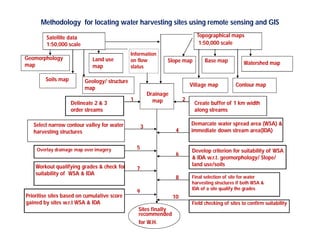
Methodology for locating water harvesting sites using remote sensing and GIS 
Satellite data 
1:50,000 scale 
Topographical maps 
1:50,000 scale 
Geomorphology 
map 
Land use 
map 
Geology/ structure 
map 
Soils map 
Slope map Base map Watershed map 
Drainage 
map 
Village map Contour map 
Information 
on flow 
status 
Delineate 2 & 3 
order streams 
Create buffer of 1 km width 
along streams 
Select narrow contour valley for water 
harvesting structures 
Demarcate water spread area (WSA) & 
immediate down stream area(IDA) 
1 2 
3 
Overlay drainage map over imagery Develop criterion for suitability of WSA 
& IDA w.r.t. geomorphology/ Slope/ 
Workout qualifying grades & check for land use/soils 
suitability of WSA & IDA 
Final selection of site for water 
harvesting structures if both WSA & 
IDA of a site qualify the grades 
Prioritise sites based on cumulative score 
gained by sites w.r.t WSA & IDA Field checking of sites to confirm suitability 
Sites finally 
recommended 
for W.H. 
4 
5 
6 
7 
8 
9 
10
Scales of data 
1:50,000 for delineation of water harvesting sites at 
block/taluk/watershed level 
1:25,000 for detailed study at watershed level 
1:12,500 for suitability study of individual sites 
Details of the satellite data 
1:50,000 scale study IRS LISS-III data 23.5 m 
Resolution 
1:25,000 Scale study IRS LISS-III & PAN 5.8 m Merged 
Data 
1:12,500 Scale study pan data (5.8m) Resolution and 
LISS-III+PAN merged FCC data products
Sample Criteria for Site Selection 
Drainage 
Order 
Buffer Dist. 
m 
HSG LU/LC SLP 
Check Dam 1 100 C, D WL, F 10-15% 
Nala Bund 1 200 C,D WL 5-10% 
Cement 
2 200 C,D WL 5-10% 
Nala Bund 
Percolation 
Tank 
>4 500 B,C,D WL 0-10 % 
KT Weir >4 300 C,D WL,F 0-5% 
UGB 2,3 100 A,B WL,F 0-5% 
Note : For all the structures, Nala Bed Slope should be used for further design 
(X-Section & L-Section) 
Geomorphology 
Pediplain 
/Pediments/VF 
Pediplain/VF 
Pediplain 
/Pediments/VF 
Pediplain /AP/VF 
Pediments 
Pediplain /VF
BASE MAP 
SLOPE GIS CONCEPT 
LANDUSE 
GEOLOGY & 
STRUCTURAL 
FEATURES 
GEOMORPHO-LOGICAL 
MAP 
HYDROLOGICAL 
MAP 
Water Harvesting Sites Map
GENEARATION OF KBF GENEARATION OF CLDU 
GENEARATION OF LRDP REFINE / UPDATE LRDP
CLDU GENERATION
KBF 
generation
LRDP GENERATION
LRDP 
REFINE & 
UPDATE
MULTI THEME 
SOCIO-ECONOMIC 
QUERY 
CLDU WITHOUT VILLAGE CLDU WITH VILLAGE
• LRDP = AGRO-HORTICULTURE
• LRDP =AGRO-HORTI along 2km BUFFER OF MAIN Rd.
LRDP MAP OUTPUT
VILLAGE MEETING TO DISCUSS PROBLEMS & SOLUTIONS 
Local elected bodies 
& 
Water users associations
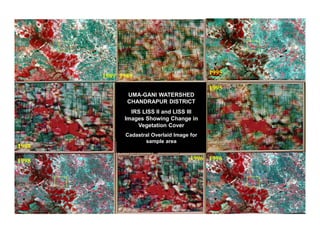
1995 
1998 
1996 
1989 1989 
1995 
UMA-GANI WATERSHED 
CHANDRAPUR DISTRICT 
IRS LISS II and LISS III 
Images Showing Change in 
Vegetation Cover 
Cadastral Overlaid Image for 
sample area 
1998 1996
BEFORE IMPLEMENTATION 
1989 
AFTER IMPLEMENTATION 
1995 
IMPACT ANALYSIS 
ACTIVITY : Farm pond (Rs 18,000/-) 
VILLAGE : Tirkhura 
Farmer’s name : Kishore Chandrasekar Ghadge 
Survey no. -138, Area -3.6 ha 
BEFORE IMPLEMENTATION AFTER IMPLEMENTATION 
S.bean.. 15q 15,000 /- S.bean .. 10 q 10,000 /- 
Urad dal. 5q 6,000 /- 
Wheat .. 40 q 28,000 /- 
Jowar… 3 q 2,000 /- 
--------------------------------------------------------------------------------------------------- 
INCOME …… Rs 15,000 /- 46,000 /- 
--------------------------------------------------------------------------------------------------- 
Where ground water prospects are poor, such area ‘traditional bodi’s’ 
have been converted to farm ponds with minimal cost due to impervious 
material, where lining of bunds is not required. 
13-11-1996 23-09-1997 
However while reaping the benefits, the same farmer increased the area under farm ponds. This will have negative impact in the adjoining fields 
in terms of land degradation by increase in salt concentration. Hence monitoring at micro level is imperative where high resolution satellite data 
will be useful.
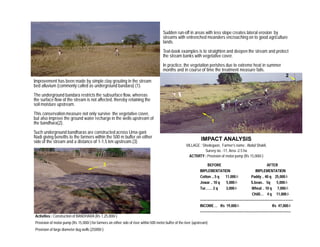
Improvement has been made by simple clay grouting in the stream 
bed alluvium (commonly called as underground bandara) (1). 
The underground bandara restricts the subsurface flow, whereas 
the surface flow of the stream is not affected, thereby retaining the 
soil moisture upstream. 
This conservation measure not only survive the vegetative cover, 
but also improve the ground water recharge in the wells upstream of 
the bandhara(2). 
Such underground bandharas are constructed across Uma-gani 
Nadi giving benefits to the farmers within the 500 m buffer on either 
side of the stream and a distance of 1-1.5 km upstream.(3) 
Sudden run-off in areas with less slope creates lateral erosion by 
streams with entrenched meanders encroaching on to good agriculture 
lands. 
Text-book examples is to straighten and deepen the stream and protect 
the stream banks with vegetative cover. 
In practice, the vegetation perishes due to extreme heat in summer 
months and in course of time the treatment measure fails. 
IMPACT ANALYSIS 
VILLAGE : Shedegaon, Farmer’s name : Abdul Shakil, 
Survey no. -17, Area -2.5 ha 
ACTIVITY : Provision of motor pump (Rs 15,000/-) 
BEFORE AFTER 
IMPLEMENTATION IMPLEMENTATION 
Cotton ...5 q 11,000 /- Paddy .. 40 q 25,000 /- 
Jowar .. 10 q 5,000 /- S.bean.. 5q 5,000 /- 
Tur…… 2 q 3,000 /- Wheat .. 10 q 7,000 /- 
Chilli… 4 q 11,000 /- 
------------------------------------------------------------------------------------ 
INCOME … Rs 19,000 /- Rs 47,000 /- 
---------------------------------------------------------------------------------- 
Activities : Construction of BANDHARA (Rs 1,25,000/-) 
Provision of motor pump (Rs 15,000/-) for farmers on either side of river within 500 meter buffer of the river (upstream) 
Provision of large diameter dug wells (25000/-) 
2 
1 
3
IMPACT ANALYSIS 
ACTIVITY : Large diameter Dug well 
upstream of Bandhara - (Rs 25,000/-) 
VILLAGE : Shedegaon 
Farmer’s name : 
Natthu Aadku Raut, 
Survey no. -4, Area -1.5 ha 
BEFORE IMPLEMENTATION AFTER IMPLEMENTATION 
Wheat ….. 2 q 1,500 /- Hort.(orange).. 50,000 /- 
Jowar …… 2 q 1,000 /- S.bean.. 2,000 /- 
Wheat .. 1,000 /- 
Chilli… 2,000 /- 
--------------------------------------------------------------------------------------------------- 
INCOME …… Rs 2,500 /- Rs 55,000 /- 
--------------------------------------------------------------------------------------------------- 
Unlined wells will recharge better.
IMPACT OF WATERSHED DEVELOPMENT – AN 
UMAGANI 
WATERSHED 
UMAGANI 
WATERSHED 
EXAMPLE 
Before … 
• Cropping Intensity - 
107% 
• Horticulture - 
5% 
• Rice Yield (t/ha) - 1.6 
• Cotton Yield (t/ha) - 1.0 
...After 
• Cropping Intensity - 
127% 
• Horticulture - 
6% 
• Rice Yield (t/ha) - 2.4 
• Cotton Yield (t/ha) - 2.1

REMOTE SENSING & GIS APPLICATIONS IN WATERSHED MANAGEMENT

  • 1.
    REMOTE SENSING &GIS APPLICATIONS IN WATERSHED MANAGEMENT Dr. Y. V. N. Krishna Murthy
  • 2.
    RURAL POVERTY :GENESIS 1.7 1.2 0.7 0.2 Productivity (t/ha) -Dry-land < 1 t/ha -Irrigated ~ 3t/ha Food grain Oil seed Pulses 1950 1970 1990 1999 Production Rainfed areas Food grain 45 Oilseeds 75 Pulses 90 Contribution (%) of Dry-land Areas Technology Mission Green Revolution Impact of Green Revolution covered 40 Mha and benefited mostly rich farmers 100 Mha arable dry land of mostly to small & marginal farmers remained unaffected With enhanced cost of cultivation, reduced marketable surplus and increased vulnerability to natural disasters, small & marginal farmers - poverty trap..
  • 3.
    WATER RESOURCES: SCARCITY& ABUNDANCE Season/Period M ha m % Winter (Jan-Feb) 12 3 Pre-monsoon (Mar-May) 52 13 SW monsoon (Jun- Sep) 296 74 NE monsoon (Oct-Dec) 40 10 Total for the year 400 100 Rainfall zone (mm) Geogr. Area (M ha) Water avail. (M ha m) 100-500 52.07 15.62 500-750 40.26 25.16 750-1000 65.86 57.63 1000-2500 137.24 205.86 >2500 32.57 95.86 Total 328.00 400.00 Need for : • Water Harvesting • Watershed Development • Command Area Development • Ground Water Targeting • River Basin Development • Inter-basin Linkages Spatial Variability Temporal Variability Total Usage 51 Mham/ 400 Mham Water Irrigation 35 Mham Other Uses 16 Mham
  • 7.
     One ofthe most densely populated nation.  Population : 16 % of world’s population. Present > billion (342 million in 1947). Future > 1.43 billion by 2030  Geographical area - 329 M ha (2.42 % of world’s geog. area).  Coast line - 7500 Km.  Forests – 19 %  Mangroves – 3 % of total forest area.  Per capita arable land – 0.15 ha (0.09 ha by 2075)  Rain-fed agriculture – 68 %  Agr. production – 205 M tons (required 325 M tons by 2050)  17 % of world’s cattle population.
  • 8.
     Increasing rateof degradation and depletion of resources.  Deforestation, desertification, soil erosion, salinization, falling water tables.  Degraded land – 175 M ha Soil erosion by wind & water – 150 M ha. Salt affected soils – 7.0 M ha Shifting cultivation – 4.36 M ha Water-logging – 6.0 M ha  Heavy demand for fodder resulting in over grazing of forest and grass lands.  Natural disasters: Drought (1/2 of the country is drought prone), Floods (40 M ha), landslides, cyclone, locust attack etc. Drastic reduction in Biomass Depleting Water Resources Loss of productive Soil Reduced carrying capacity of streams Extinction of fauna & flora
  • 9.
     Scientific &rational Land and Water Resources management  Striking balance between availability v/s needs  Adoption of eco-friendly sustainable development and Determining alternatives for development.  Peoples participation  Adopting natural boundaries defined by river basins/ sub-basins as a planning unit.  Integrated development approach.  Regular monitoring to assess the status of development
  • 10.
    Watershed - isa natural hydrological unit - Topographically delineated area drained by a stream system, from which runoff resulting from precipitation flow past from a point into single stream. - Development is not confined just to agriculture lands but covers entire catchment's area. - Watershed approach is holistic, linking upstream and downstream areas. -Practical approach in planning, directed at preservation, conservation, development, management and exploitation of natural resources for the benefit of people.
  • 11.
    Watershed Development Approach - Integrated and multi-disciplinary approach. - To suggest possible exploitation of resources within the limits of tolerance. - Approach is Preventive, Progressive, Corrective & Curative. • Objectives - • Conservation of Soil and Water • Improved ability of land to hold water • Maintaining adequate vegetative cover for controlling soil erosion • Rain water harvesting and ground water recharging. • Benefits - • Promotes economic and social development of community • Employment generation and other income generation • Ecological balance
  • 12.
    Useful for generatingenvironmental indicators that can be integrated with collateral data and social indicators. - Synoptic view, Multi-resolution, multi-spectral, repetitive offers appropriate method for quick, unbiased mapping and monitoring of natural resources both in space and time domain. - Timely and accurate information on spatial distribution – landuse, soil, vegetation density, forest, geology, water resources etc. - RS data in conjunction with collateral data helps in delineation of ridge line, characterization, prioritization, erosion prone areas, etc.
  • 13.
    Capability of RemoteSensing for Watershed Attributes Information Attribute Attribute Parameter Relevance Size Area Available rainfall, run-off, sedimentation Shape Geometric form, shape index, form factor Run-off & sedimentation Physiography & slope Mean elevation, av. Slope, relief length Run-off & sedimentation Drainage Drainage pattern & density, stream order Run-off & sedimentation Geology Rock types Run-off & sedimentation Soil Texture, moisture, capability land degradation, production potential, Run-off & sedimentation Landuse Present LU, wasteland, surface water Run-off & sedimentation Groundwater Potential Recharge & irrigation
  • 14.
    - Integration ofnatural resources information in conjunction with socio-economic data. - Generation of locale specific action plans for land and water resources. -Analysis of SE / demographic data to assess developmental needs of the region. - Assessment of the existing infrastructure to arrive at developmental schemes. - Generation of variety of derived maps.
  • 15.
  • 16.
    WATERSHED DEMARCATION ANDSELECTION Method: Separation of the major drainage area; principal drainage basin and sub-basin; watershed CATEGORIES DELINEATION SYSTEM Region (6) ………… 1.5-12 lakhs sq km Basins (50) ………… 0.3- 3.0 lakhs sq km Catchment …………. 0.1 - 0.5 lakhs sq km Subcatchment ……. 2000 - 10000 sq km Watershed …………. 500 - 2000 sq km Sub-watershed …….. 50 - 500 sq km Mini Wateshed ……. 10 - 50 sq km Micro watershed …… 5 - 10 sq km
  • 17.
    WATERSHED COVERAGE Watershedcodification REGION 4 E 5 A 6 C 2 a BASIN CATCHMENT SUB-CATCHMENT WATERSHED SUB-WATERSHED MINI WATERSHED AIS & LUS codes MICRO WATERSHED IMSD codes Watershed code items…WSNAME (8,8,C) WSCODE (8,8,C) WSLCODE (16,16,C)
  • 18.
    River flowing toBay of Bengal Mahanadi Hirakund to confluence with Seonath RB of Mahanadi - Hirakund to Jonk Upper Jonk/Silda 4G2E7 XXX
  • 19.
  • 20.
    DRAINAGE UPDATION :Existing drains Existing drains Extracted from Image
  • 21.
    Update Watershed boundarywith satellite data for accurate watershed boundary
  • 22.
    Update Watershed boundarywith satellite data for accurate watershed boundary RRSSC-NAGPUR
  • 23.
    WATERSHED CHARACTERIZATION Componentsof watershed : Drainage and its order, watershed boundary, area, perimeter, area under various drainage order, length of the stream, etc. Morphometric Analysis Various laws of drainage Calculation of various watershed characters
  • 24.
    What is GEOMORSIS? GEOMORSIS is a semi-automatic geo-morphometric analysis package for quantitative analysis of watershed for watershed characterization using GIS has SIX basic modules AUDRALA STMPARA BASGEO WATERSHED SELECTION RELIEF PARAMETER REPORT GENERATION
  • 26.
    Ordering of thedrainage coverage
  • 27.
    DRAW displays thedrainage coverage with nodes on which the pour points is to be selected
  • 28.
    Select ‘ONE’ or‘MANY’ pour points depending upon the number of drainage system.
  • 29.
    1st order 2ndorder 3rd order 4th order 5th order STRAHLER SCHREVE
  • 32.
  • 33.
  • 34.
  • 36.
  • 41.
  • 42.
  • 43.
    OVERLAND FLOW LENGTH of watershed
  • 44.
    BASIN GEOMETRY PARAMETERS AREA and PERIMETER of watershed AERIAL, STREAM and OVERLAND - FLOW length of watershed ELONGATION RATIO BASIN CIRCULATORY RATIO FORM FACTOR COMPACTNESS COEFFICIENT RHODENTITY FACTOR DRAINAGE DENSITY STREAM FREQUENCY DRAINAGE TEXTURE TEXTURE RATIO LAMISCATE RATIO
  • 45.
    MAXIMUM ELEVATION, MINIMUMELEVATION RELIEF RATIO, RELATIVE RELIEF , RUGGEDNESS NUMBER
  • 47.
    <output w/s name>.rlf <output w/s name>.stm <output w/s name>.bsg
  • 48.
    WATERSHED PRIORITIZATION Erosion- Major problem and forms the bases of prioritization Factors - Rainfall, runoff, wind, soil, slope, plant cover and management practices. Why assessment of erosion becomes so important ? Identification of the eroded and erosion prone area through remote sensing (NDVI, SBI, PC) Assessment of the Erosion Hazards : Quantitative method - Universal soil loss equation; Qualitative method - Sediment Yield Index Runoff Rate Vegetation Status Socio-economic conditions
  • 49.
    WATERSHED PRIORITIZATION -SYI Method Climatic Factors : Total precipitation, its frequency and intensity Geomorphic Factors : Landforms, Physiography, slope and drainage characteristics. Soil Factor : Soil profile characteristics (texture, structure, OM content, swell-shrink potential, porosity, hydraulic, soil depth & clay mineralogy Surface Cover Factor : Vegetation cover pattern governing flow hydraulics. Management Factors : Cultivation, bunding, multching, etc.
  • 50.
    WATERSHED PRIORITIZATION -SYI Method Framework through systematic delineation & codification Mapping/Reconnaisance surveys for map indicating erosion-intensity mapping units Assignment of weightages values to various mapping units based on relative silt yield/run-off potential (0.35 to 0.95) Assignment of maximum delivery ratios to various erosion intensity and adjusted delivery ratios (measure of transportability) for different watersheds. Computation of Silt Yield Index (SYI)/ Potential Run-off Index (PRI) for individual watershed/subwatershed Ai = Area of the ith unit (EIMU) Wi = Weightages value of ith mapping unit Di = Adjusted delivery ratio assigned to ith mapping unit N = No. of mapping unit ; Aw = Total area of watershed CATEGORIZATION & GRADATION of Subwatershed SYI = ( Ai * Wi * Di ) Aw * 100 , i = 1 to n RPI = ( Ai * Wi) Aw * 100 , i = 1 to n Sediment Yield Index Run-off Potential Index
  • 51.
    Fodder status <0 Fodder status < 0 (+) Wasteland > 50 ha Fodder status < 0 (+) Wasteland > 50 ha (+) Below Poverty level > 40 %
  • 52.
  • 53.
  • 54.
    Database Display &Query Analysis Output NRIS - GeoLAWNS
  • 55.
  • 58.
    WATER HARVESTING Waterharvesting is capturing and storing of runoff for later water requirements of drinking, irrigation, domestic and industrial use. OBJECTIVES Store excessive run off for future use Augment percolation /recharge to aquifers Checking of floods Checking of land erosion APPROPRIATE LOCATION Location of water harvesting structures at appropriate places is important for effectiveness of these structures.
  • 59.
    Recharging is necessaryin view of depleting GW table. Deteriorating water quality from the aquifers. Increasing demand for drinking water and irrigation. The excess runoff can be used for recharging the aquifers. Deep water table increases the cost per unit yield. To improve the GW supplies for longer durations. Checking of floods and land erosion. Right utilization of the excess water from cities and canals.
  • 60.
    Water harvesting measuresmust be implemented on a watershed basis to get maximum recharge to aquifer occurring at depth. Type of structures depend on topography, drainage pattern, geology / structures, geomorphology and soil cover of a watershed. Structures for storage purpose must be located on impervious base while those for recharge on pervious base. Cont…… Some Important Points
  • 61.
    Recharge structures needporous geological materials for percolation of water down to aquifers. Weak zones are preferred for recharging, viz., FRACTURED ZONES SHEAR ZONES ROCK CONTACTS LINEAMENT/ LINEAMENT INTERSECTIONS BRECCIATED AREAS WEATHERED ZONES TOPOGRAPHIC TROUGHS MAJOR VALLEYS
  • 62.
    Obstruction Check dam,nalabund, gully plugs, khadin, contour bunds. Storing Percolation tanks, farm ponds, K.T. Weirs, recharge pits. Spreading Recharge basins, flooding. Injection Inverted / recharge wells.
  • 63.
    Nature of subsurfacesoil, rock, extent of weathering and thickness of hydrogeological units. Water bearing capacity and hydraulic conductivity of aquifer materials. Geological structures (Lineaments). Topography, slope and drainage characteristics. Land use /land cover in the area. Quality of water and evaporation. Locations of recharge /discharge areas, water levels and water budget. Rainfall & runoff
  • 64.
    Water Harvesting Structures Farm Ponds Made by either by constructing an embankment across a water course or by excavating a pit, usually provided within individual farms. To provide water storage for life saving irrigation. Provide drinking water for livestock and human beings in arid areas. Site conditions: Areas having flat topography and locations with rocks and soils of low permeability, free from structures such as faults, joints/fractures.
  • 65.
    Water Harvesting Structures Minor Irrigation Tanks Created across streams for creating water reservoirs for providing irrigation to the crops at critical periods and to facilitate groundwater recharge. Site conditions: --Preferably narrow gorges/ valleys for making the dam in order to reduce the ratio of earth work to storage as minimum. --Availability of sufficient catchment area in the upstream side. --Geologically and structurally favourable sites to avoid loss of water.
  • 66.
    Check Dams Proposedwhere water table fluctuation is very high and the stream is influent. Av. Catchment area of 25 ha. Main Objective: --To reduce runoff velocity thereby minimizing erosion. --Increasing recharge to the wells located down stream. Site conditions: --Areas having medium slope. --Constructed on lower order streams (generally up to third order). -- Favourable soils and lithology and structures for allowing percolation of water. -- Availability of irrigation wells downstream of proposed structures.
  • 67.
    Masanary Bandhara /KT Weir Structures similar to minor irrigation tanks except that they do not have extensive canal system and their command area is limited to fields downstream. Main Objective: --to collect and impound surface runoff during during monsoon rains and facilitate infiltration to raise groundwater level. --to facilitate irrigation in the fields lying in the close proximity of the structure. Site conditions: --Located in moderately permeable strata and soils to facilitate recharge and also short term storage. --Availability of good cultivated land at the downstream of the structure to reap the benefits of the water stored. --Availability of good quality soil for bundhi construction.
  • 68.
    Nala Bunds andPercolation Tanks Relatively structures of smaller dimension across nalas. Main Objective: --to impound surface runoff coming from the catchment and to facilitate percolation of stored water. --to hold the silt flow. Site conditions: -- Site should be in relatively flatter nala reaches, the slope of the nala should not be more than two percent. --The catchment area of the nala bund should not be less than 40 ha. --the nala bed should have soils with adequate permeability and good fracture development to facilitate good groundwater recharge.
  • 69.
    Sub-surface dykes Structuresto arrest lateral groundwater flow (base flow in stream) in the alluvial area. Main Parameters to be considered: --thickness of sand/alluvium --degree and extent of weathering --depth to bedrock. Site conditions: --Thickness of weathered mantle should be about 2-5 m. --The structure should be constructed up to the bedrock, therefore depth to bedrock should not be very high.
  • 70.
    Other Structures Inverted/Recharge/ Wells/Recharge Pits/ Trenches Where top layer is impervious. Dug perpendicular to fractures. Pits~10m, Trenches~3-4m. Contour Bunds/ Trenches In higher slope areas, for stopping soil erosion. Tankas Covered underground tanks for individual family use 20-200 cu.m in arid zones.
  • 71.
    Methodology for locatingwater harvesting sites using remote sensing and GIS Satellite data 1:50,000 scale Topographical maps 1:50,000 scale Geomorphology map Land use map Geology/ structure map Soils map Slope map Base map Watershed map Drainage map Village map Contour map Information on flow status Delineate 2 & 3 order streams Create buffer of 1 km width along streams Select narrow contour valley for water harvesting structures Demarcate water spread area (WSA) & immediate down stream area(IDA) 1 2 3 Overlay drainage map over imagery Develop criterion for suitability of WSA & IDA w.r.t. geomorphology/ Slope/ Workout qualifying grades & check for land use/soils suitability of WSA & IDA Final selection of site for water harvesting structures if both WSA & IDA of a site qualify the grades Prioritise sites based on cumulative score gained by sites w.r.t WSA & IDA Field checking of sites to confirm suitability Sites finally recommended for W.H. 4 5 6 7 8 9 10
  • 72.
    Scales of data 1:50,000 for delineation of water harvesting sites at block/taluk/watershed level 1:25,000 for detailed study at watershed level 1:12,500 for suitability study of individual sites Details of the satellite data 1:50,000 scale study IRS LISS-III data 23.5 m Resolution 1:25,000 Scale study IRS LISS-III & PAN 5.8 m Merged Data 1:12,500 Scale study pan data (5.8m) Resolution and LISS-III+PAN merged FCC data products
  • 73.
    Sample Criteria forSite Selection Drainage Order Buffer Dist. m HSG LU/LC SLP Check Dam 1 100 C, D WL, F 10-15% Nala Bund 1 200 C,D WL 5-10% Cement 2 200 C,D WL 5-10% Nala Bund Percolation Tank >4 500 B,C,D WL 0-10 % KT Weir >4 300 C,D WL,F 0-5% UGB 2,3 100 A,B WL,F 0-5% Note : For all the structures, Nala Bed Slope should be used for further design (X-Section & L-Section) Geomorphology Pediplain /Pediments/VF Pediplain/VF Pediplain /Pediments/VF Pediplain /AP/VF Pediments Pediplain /VF
  • 74.
    BASE MAP SLOPEGIS CONCEPT LANDUSE GEOLOGY & STRUCTURAL FEATURES GEOMORPHO-LOGICAL MAP HYDROLOGICAL MAP Water Harvesting Sites Map
  • 76.
    GENEARATION OF KBFGENEARATION OF CLDU GENEARATION OF LRDP REFINE / UPDATE LRDP
  • 78.
  • 79.
  • 80.
  • 81.
  • 82.
    MULTI THEME SOCIO-ECONOMIC QUERY CLDU WITHOUT VILLAGE CLDU WITH VILLAGE
  • 83.
    • LRDP =AGRO-HORTICULTURE
  • 84.
    • LRDP =AGRO-HORTIalong 2km BUFFER OF MAIN Rd.
  • 85.
  • 102.
    VILLAGE MEETING TODISCUSS PROBLEMS & SOLUTIONS Local elected bodies & Water users associations
  • 103.
    1995 1998 1996 1989 1989 1995 UMA-GANI WATERSHED CHANDRAPUR DISTRICT IRS LISS II and LISS III Images Showing Change in Vegetation Cover Cadastral Overlaid Image for sample area 1998 1996
  • 104.
    BEFORE IMPLEMENTATION 1989 AFTER IMPLEMENTATION 1995 IMPACT ANALYSIS ACTIVITY : Farm pond (Rs 18,000/-) VILLAGE : Tirkhura Farmer’s name : Kishore Chandrasekar Ghadge Survey no. -138, Area -3.6 ha BEFORE IMPLEMENTATION AFTER IMPLEMENTATION S.bean.. 15q 15,000 /- S.bean .. 10 q 10,000 /- Urad dal. 5q 6,000 /- Wheat .. 40 q 28,000 /- Jowar… 3 q 2,000 /- --------------------------------------------------------------------------------------------------- INCOME …… Rs 15,000 /- 46,000 /- --------------------------------------------------------------------------------------------------- Where ground water prospects are poor, such area ‘traditional bodi’s’ have been converted to farm ponds with minimal cost due to impervious material, where lining of bunds is not required. 13-11-1996 23-09-1997 However while reaping the benefits, the same farmer increased the area under farm ponds. This will have negative impact in the adjoining fields in terms of land degradation by increase in salt concentration. Hence monitoring at micro level is imperative where high resolution satellite data will be useful.
  • 105.
    Improvement has beenmade by simple clay grouting in the stream bed alluvium (commonly called as underground bandara) (1). The underground bandara restricts the subsurface flow, whereas the surface flow of the stream is not affected, thereby retaining the soil moisture upstream. This conservation measure not only survive the vegetative cover, but also improve the ground water recharge in the wells upstream of the bandhara(2). Such underground bandharas are constructed across Uma-gani Nadi giving benefits to the farmers within the 500 m buffer on either side of the stream and a distance of 1-1.5 km upstream.(3) Sudden run-off in areas with less slope creates lateral erosion by streams with entrenched meanders encroaching on to good agriculture lands. Text-book examples is to straighten and deepen the stream and protect the stream banks with vegetative cover. In practice, the vegetation perishes due to extreme heat in summer months and in course of time the treatment measure fails. IMPACT ANALYSIS VILLAGE : Shedegaon, Farmer’s name : Abdul Shakil, Survey no. -17, Area -2.5 ha ACTIVITY : Provision of motor pump (Rs 15,000/-) BEFORE AFTER IMPLEMENTATION IMPLEMENTATION Cotton ...5 q 11,000 /- Paddy .. 40 q 25,000 /- Jowar .. 10 q 5,000 /- S.bean.. 5q 5,000 /- Tur…… 2 q 3,000 /- Wheat .. 10 q 7,000 /- Chilli… 4 q 11,000 /- ------------------------------------------------------------------------------------ INCOME … Rs 19,000 /- Rs 47,000 /- ---------------------------------------------------------------------------------- Activities : Construction of BANDHARA (Rs 1,25,000/-) Provision of motor pump (Rs 15,000/-) for farmers on either side of river within 500 meter buffer of the river (upstream) Provision of large diameter dug wells (25000/-) 2 1 3
  • 106.
    IMPACT ANALYSIS ACTIVITY: Large diameter Dug well upstream of Bandhara - (Rs 25,000/-) VILLAGE : Shedegaon Farmer’s name : Natthu Aadku Raut, Survey no. -4, Area -1.5 ha BEFORE IMPLEMENTATION AFTER IMPLEMENTATION Wheat ….. 2 q 1,500 /- Hort.(orange).. 50,000 /- Jowar …… 2 q 1,000 /- S.bean.. 2,000 /- Wheat .. 1,000 /- Chilli… 2,000 /- --------------------------------------------------------------------------------------------------- INCOME …… Rs 2,500 /- Rs 55,000 /- --------------------------------------------------------------------------------------------------- Unlined wells will recharge better.
  • 107.
    IMPACT OF WATERSHEDDEVELOPMENT – AN UMAGANI WATERSHED UMAGANI WATERSHED EXAMPLE Before … • Cropping Intensity - 107% • Horticulture - 5% • Rice Yield (t/ha) - 1.6 • Cotton Yield (t/ha) - 1.0 ...After • Cropping Intensity - 127% • Horticulture - 6% • Rice Yield (t/ha) - 2.4 • Cotton Yield (t/ha) - 2.1