Relation between Ground-based Soil Moisture 
and Satellite Image-based NDVI 
Presenter: Xianwei Wang 
April 15, 2005 
Instructor: Dr. Hongjie Xie 
Earth and Environmental Science Department 
University of Texas at San Antonio
Introduction 
• Soil moisture is very important parameters for vegetation 
growth and climatic and hydrological modeling. Surface 
soil moisture (<10cm) can be easily acquired, like 
remotely sensing by microwave, or estimating with 
satellite surface vegetation index. However, there was few 
ways to obtain the deeper zone soil moisture. Ground-based 
measurement of soil moisture is very expensive 
and can’t satisfy the need of climatic and hydrological 
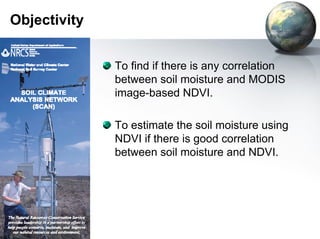
modeling. The Soil Climate Analysis Network (SCAN) 
provides the hourly profile soil moisture, which provides 
us chance to estimate soil moisture using MODIS NDVI.
Objectivity 
To find if there is any correlation 
between soil moisture and MODIS 
image-based NDVI. 
To estimate the soil moisture using 
NDVI if there is good correlation 
between soil moisture and NDVI.
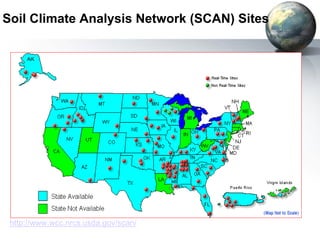
Soil Climate Analysis Network (SCAN) Sites 
http://www.wcc.nrcs.usda.gov/scan/
Research Areas and Period 
Three sites with different climate and vegetation. 
Adams Ranch (2015) in New Mexico, semi-arid region, 
grassland. 
Walnut Gulch (2026) in Arizona, semi-arid region, 
shrubland; 
Prairie View (2016) in Texas, moderate humid region, 
grassland, to be completed. 
Period is from Feb 26, 2000 to Apr 31, 2004.
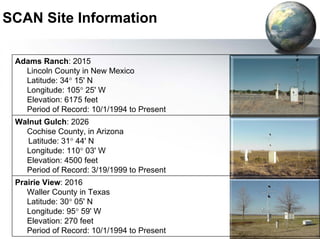
SCAN Site Information 
Adams Ranch: 2015 
Lincoln County in New Mexico 
Latitude: 34° 15' N 
Longitude: 105° 25' W 
Elevation: 6175 feet 
Period of Record: 10/1/1994 to Present 
Walnut Gulch: 2026 
Cochise County, in Arizona 
Latitude: 31° 44' N 
Longitude: 110° 03' W 
Elevation: 4500 feet 
Period of Record: 3/19/1999 to Present 
Prairie View: 2016 
Waller County in Texas 
Latitude: 30° 05' N 
Longitude: 95° 59' W 
Elevation: 270 feet 
Period of Record: 10/1/1994 to Present
Data Sources 
Soil moisture 
Soil Moisture data was downloaded from three SCAN 
Sites. 
Measured with neutron probe; 
Including 5cm, 10cm, 20cm, 50cm, and 100cm depth. 
Frequency: hourly 
Period is from Feb, 2000 through Apr, 2004
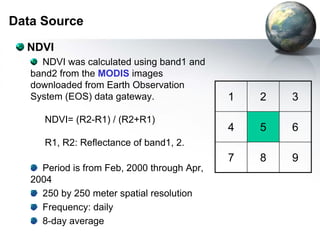
1 2 3 
4 5 6 
7 8 9 
Data Source 
NDVI 
NDVI was calculated using band1 and 
band2 from the MODIS images 
downloaded from Earth Observation 
System (EOS) data gateway. 
NDVI= (R2-R1) / (R2+R1) 
R1, R2: Reflectance of band1, 2. 
Period is from Feb, 2000 through Apr, 
2004 
250 by 250 meter spatial resolution 
Frequency: daily 
8-day average
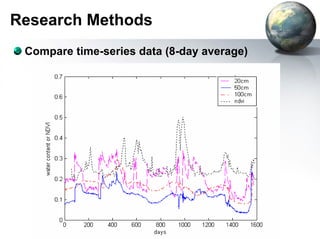
Research Methods 
Compare time-series data (8-day average)
Methods 
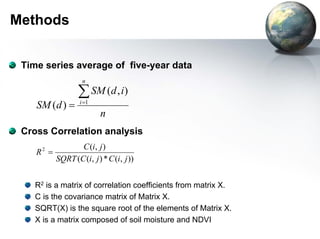
Time series average of five-year data 
SM d i 
n 
SM d 
n 
i Σ= 
= 1 
( , ) 
( ) 
Cross Correlation analysis 
R = C i j 
2 ( , ) 
SQRT C i j C i j 
( ( , ) * ( , )) 
R2 is a matrix of correlation coefficients from matrix X. 
C is the covariance matrix of Matrix X. 
SQRT(X) is the square root of the elements of Matrix X. 
X is a matrix composed of soil moisture and NDVI
Methods 
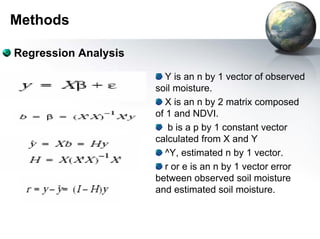
Regression Analysis 
Y is an n by 1 vector of observed 
soil moisture. 
X is an n by 2 matrix composed 
of 1 and NDVI. 
b is a p by 1 constant vector 
calculated from X and Y 
^Y, estimated n by 1 vector. 
r or e is an n by 1 vector error 
between observed soil moisture 
and estimated soil moisture.
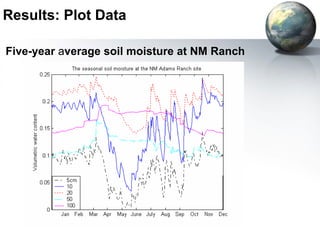
Results: Plot Data 
Five-year average soil moisture at NM Ranch
Correlation between NDVI and soil moisture 
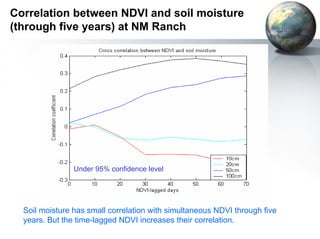
(through five years) at NM Ranch 
Under 95% confidence level 
Soil moisture has small correlation with simultaneous NDVI through five 
years. But the time-lagged NDVI increases their correlation.
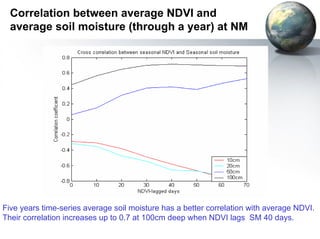
Correlation between average NDVI and 
average soil moisture (through a year) at NM 
Five years time-series average soil moisture has a better correlation with average NDVI. 
Their correlation increases up to 0.7 at 100cm deep when NDVI lags SM 40 days.
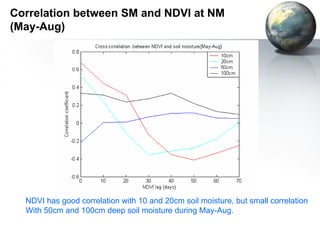
Correlation between SM and NDVI at NM 
(May-Aug) 
NDVI has good correlation with 10 and 20cm soil moisture, but small correlation 
With 50cm and 100cm deep soil moisture during May-Aug.
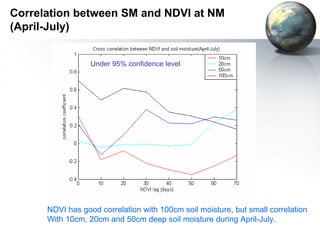
Correlation between SM and NDVI at NM 
(April-July) 
Under 95% confidence level 
NDVI has good correlation with 100cm soil moisture, but small correlation 
With 10cm, 20cm and 50cm deep soil moisture during April-July.
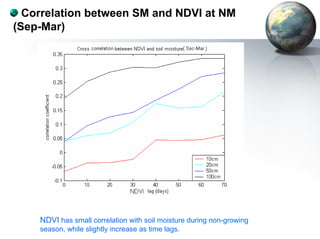
Correlation between SM and NDVI at NM 
(Sep-Mar) 
NDVI has small correlation with soil moisture during non-growing 
season, while slightly increase as time lags.
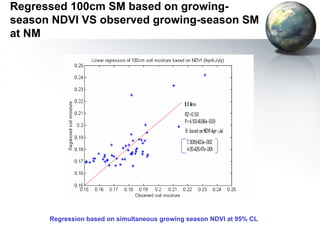
Regressed 100cm SM based on growing-season 
NDVI VS observed growing-season SM 
at NM 
Regression based on simultaneous growing season NDVI at 95% CL
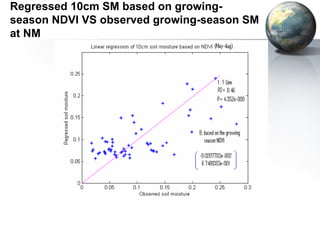
Regressed 10cm SM based on growing-season 
NDVI VS observed growing-season SM 
at NM
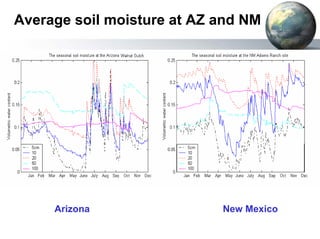
Average soil moisture at AZ and NM 
Arizona New Mexico
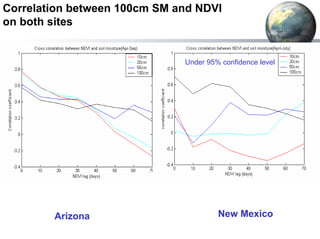
Correlation between 100cm SM and NDVI 
on both sites 
Under 95% confidence level 
Arizona New Mexico
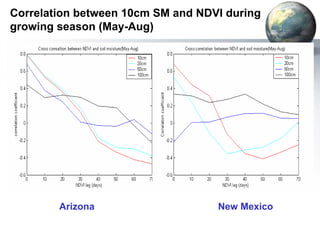
Correlation between 10cm SM and NDVI during 
growing season (May-Aug) 
Arizona New Mexico
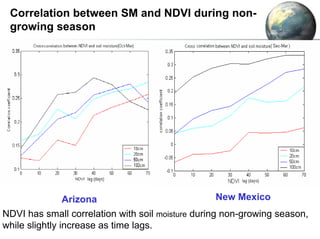
Correlation between SM and NDVI during non-growing 
season 
Arizona New Mexico 
NDVI has small correlation with soil moisture during non-growing season, 
while slightly increase as time lags.
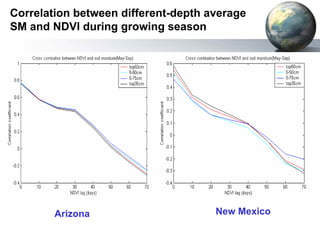
Correlation between different-depth average 
SM and NDVI during growing season 
Arizona New Mexico
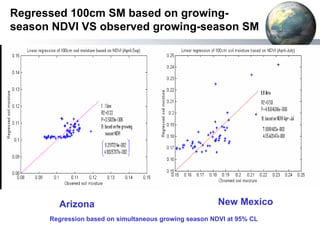
Regressed 100cm SM based on growing-season 
NDVI VS observed growing-season SM 
Arizona New Mexico 
Regression based on simultaneous growing season NDVI at 95% CL
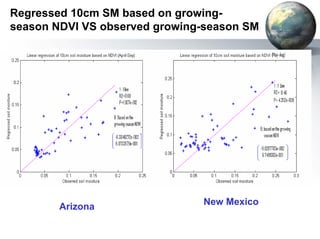
Regressed 10cm SM based on growing-season 
NDVI VS observed growing-season SM 
Arizona New Mexico
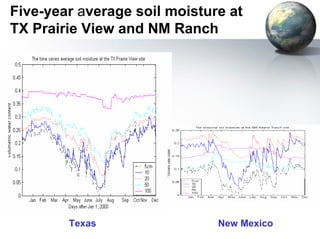
Five-year average soil moisture at 
TX Prairie View and NM Ranch 
Texas New Mexico
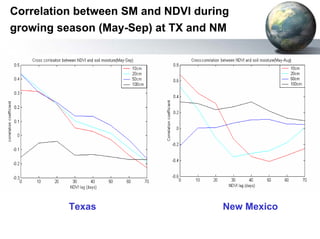
Correlation between SM and NDVI during 
growing season (May-Sep) at TX and NM 
Texas New Mexico
Conclusion 
The root and below-root zone soil moisture in semi-arid 
climate has good correlation with simultaneous NDVI and 
can be estimated using NDVI during growing season. 
The root zone soil moisture in humid climate also has 
moderate correlation with simultaneous NDVI and can be 
estimated using NDVI during growing season. 
The below-root soil moisture in humid climate has small 
correlation with NDVI and can’t be effectively estimated 
using NDVI. 
Soil moisture has small correlation with NDVI and can’t be 
effectively estimated using NDVI during non-growing 
season (Oct-March).

Relation between Ground-based Soil Moisture and Satellite Image-based NDVI

  • 1.
    Relation between Ground-basedSoil Moisture and Satellite Image-based NDVI Presenter: Xianwei Wang April 15, 2005 Instructor: Dr. Hongjie Xie Earth and Environmental Science Department University of Texas at San Antonio
  • 2.
    Introduction • Soilmoisture is very important parameters for vegetation growth and climatic and hydrological modeling. Surface soil moisture (<10cm) can be easily acquired, like remotely sensing by microwave, or estimating with satellite surface vegetation index. However, there was few ways to obtain the deeper zone soil moisture. Ground-based measurement of soil moisture is very expensive and can’t satisfy the need of climatic and hydrological modeling. The Soil Climate Analysis Network (SCAN) provides the hourly profile soil moisture, which provides us chance to estimate soil moisture using MODIS NDVI.
  • 3.
    Objectivity To findif there is any correlation between soil moisture and MODIS image-based NDVI. To estimate the soil moisture using NDVI if there is good correlation between soil moisture and NDVI.
  • 4.
    Soil Climate AnalysisNetwork (SCAN) Sites http://www.wcc.nrcs.usda.gov/scan/
  • 5.
    Research Areas andPeriod Three sites with different climate and vegetation. Adams Ranch (2015) in New Mexico, semi-arid region, grassland. Walnut Gulch (2026) in Arizona, semi-arid region, shrubland; Prairie View (2016) in Texas, moderate humid region, grassland, to be completed. Period is from Feb 26, 2000 to Apr 31, 2004.
  • 6.
    SCAN Site Information Adams Ranch: 2015 Lincoln County in New Mexico Latitude: 34° 15' N Longitude: 105° 25' W Elevation: 6175 feet Period of Record: 10/1/1994 to Present Walnut Gulch: 2026 Cochise County, in Arizona Latitude: 31° 44' N Longitude: 110° 03' W Elevation: 4500 feet Period of Record: 3/19/1999 to Present Prairie View: 2016 Waller County in Texas Latitude: 30° 05' N Longitude: 95° 59' W Elevation: 270 feet Period of Record: 10/1/1994 to Present
  • 7.
    Data Sources Soilmoisture Soil Moisture data was downloaded from three SCAN Sites. Measured with neutron probe; Including 5cm, 10cm, 20cm, 50cm, and 100cm depth. Frequency: hourly Period is from Feb, 2000 through Apr, 2004
  • 8.
    1 2 3 4 5 6 7 8 9 Data Source NDVI NDVI was calculated using band1 and band2 from the MODIS images downloaded from Earth Observation System (EOS) data gateway. NDVI= (R2-R1) / (R2+R1) R1, R2: Reflectance of band1, 2. Period is from Feb, 2000 through Apr, 2004 250 by 250 meter spatial resolution Frequency: daily 8-day average
  • 9.
    Research Methods Comparetime-series data (8-day average)
  • 10.
    Methods Time seriesaverage of five-year data SM d i n SM d n i Σ= = 1 ( , ) ( ) Cross Correlation analysis R = C i j 2 ( , ) SQRT C i j C i j ( ( , ) * ( , )) R2 is a matrix of correlation coefficients from matrix X. C is the covariance matrix of Matrix X. SQRT(X) is the square root of the elements of Matrix X. X is a matrix composed of soil moisture and NDVI
  • 11.
    Methods Regression Analysis Y is an n by 1 vector of observed soil moisture. X is an n by 2 matrix composed of 1 and NDVI. b is a p by 1 constant vector calculated from X and Y ^Y, estimated n by 1 vector. r or e is an n by 1 vector error between observed soil moisture and estimated soil moisture.
  • 12.
    Results: Plot Data Five-year average soil moisture at NM Ranch
  • 13.
    Correlation between NDVIand soil moisture (through five years) at NM Ranch Under 95% confidence level Soil moisture has small correlation with simultaneous NDVI through five years. But the time-lagged NDVI increases their correlation.
  • 14.
    Correlation between averageNDVI and average soil moisture (through a year) at NM Five years time-series average soil moisture has a better correlation with average NDVI. Their correlation increases up to 0.7 at 100cm deep when NDVI lags SM 40 days.
  • 15.
    Correlation between SMand NDVI at NM (May-Aug) NDVI has good correlation with 10 and 20cm soil moisture, but small correlation With 50cm and 100cm deep soil moisture during May-Aug.
  • 16.
    Correlation between SMand NDVI at NM (April-July) Under 95% confidence level NDVI has good correlation with 100cm soil moisture, but small correlation With 10cm, 20cm and 50cm deep soil moisture during April-July.
  • 17.
    Correlation between SMand NDVI at NM (Sep-Mar) NDVI has small correlation with soil moisture during non-growing season, while slightly increase as time lags.
  • 18.
    Regressed 100cm SMbased on growing-season NDVI VS observed growing-season SM at NM Regression based on simultaneous growing season NDVI at 95% CL
  • 19.
    Regressed 10cm SMbased on growing-season NDVI VS observed growing-season SM at NM
  • 20.
    Average soil moistureat AZ and NM Arizona New Mexico
  • 21.
    Correlation between 100cmSM and NDVI on both sites Under 95% confidence level Arizona New Mexico
  • 22.
    Correlation between 10cmSM and NDVI during growing season (May-Aug) Arizona New Mexico
  • 23.
    Correlation between SMand NDVI during non-growing season Arizona New Mexico NDVI has small correlation with soil moisture during non-growing season, while slightly increase as time lags.
  • 24.
    Correlation between different-depthaverage SM and NDVI during growing season Arizona New Mexico
  • 25.
    Regressed 100cm SMbased on growing-season NDVI VS observed growing-season SM Arizona New Mexico Regression based on simultaneous growing season NDVI at 95% CL
  • 26.
    Regressed 10cm SMbased on growing-season NDVI VS observed growing-season SM Arizona New Mexico
  • 27.
    Five-year average soilmoisture at TX Prairie View and NM Ranch Texas New Mexico
  • 28.
    Correlation between SMand NDVI during growing season (May-Sep) at TX and NM Texas New Mexico
  • 29.
    Conclusion The rootand below-root zone soil moisture in semi-arid climate has good correlation with simultaneous NDVI and can be estimated using NDVI during growing season. The root zone soil moisture in humid climate also has moderate correlation with simultaneous NDVI and can be estimated using NDVI during growing season. The below-root soil moisture in humid climate has small correlation with NDVI and can’t be effectively estimated using NDVI. Soil moisture has small correlation with NDVI and can’t be effectively estimated using NDVI during non-growing season (Oct-March).