Handbook Of Reflector Antennas And Feed Systems
Volume 3 Applications Of Reflectors 1st Edition
Sudhakar Rao download
https://ebookbell.com/product/handbook-of-reflector-antennas-and-
feed-systems-volume-3-applications-of-reflectors-1st-edition-
sudhakar-rao-4963992
Explore and download more ebooks at ebookbell.com
Here are some recommended products that we believe you will be
interested in. You can click the link to download.
Handbook Of Reflector Antennas And Feed Systems Volume 2 Feed Systems
Lotfollah Shafai
https://ebookbell.com/product/handbook-of-reflector-antennas-and-feed-
systems-volume-2-feed-systems-lotfollah-shafai-5039780
Handbook Of Reflector Antennas And Feed Systems Vol 1 Theory And
Design Of Reflectors 1st Edition Satish K Sharma
https://ebookbell.com/product/handbook-of-reflector-antennas-and-feed-
systems-vol-1-theory-and-design-of-reflectors-1st-edition-satish-k-
sharma-5766136
Handbook Of Reflection And Reflective Inquiry Mapping A Way Of Knowing
For Professional Reflective Inquiry 1st Edition Nona Lyons Auth
https://ebookbell.com/product/handbook-of-reflection-and-reflective-
inquiry-mapping-a-way-of-knowing-for-professional-reflective-
inquiry-1st-edition-nona-lyons-auth-4389896
Seismic Amplitude Inversion In Reflection Tomography Handbook Of
Geophysical Exploration Seismic Exploration Vol 33 Y Wang
https://ebookbell.com/product/seismic-amplitude-inversion-in-
reflection-tomography-handbook-of-geophysical-exploration-seismic-
exploration-vol-33-y-wang-2503306
Handbook Of Psychology Developmental Psychology Richard M Lerner M A
Easterbrooks Jayanthi Mistry
https://ebookbell.com/product/handbook-of-psychology-developmental-
psychology-richard-m-lerner-m-a-easterbrooks-jayanthi-mistry-44869188
Handbook Of Home Language Maintenance And Development Andrea C
Schalley
https://ebookbell.com/product/handbook-of-home-language-maintenance-
and-development-andrea-c-schalley-44875220
Handbook Of What Works With Sexual Offenders Contemporary Perspectives
In Theory Assessment Treatment And Prevention 1st Edition Jean Proulx
https://ebookbell.com/product/handbook-of-what-works-with-sexual-
offenders-contemporary-perspectives-in-theory-assessment-treatment-
and-prevention-1st-edition-jean-proulx-44880746
Handbook Of Dialysis Therapy 6th Edition Allen R Nissenson Richard N
Fine Rajnish Mehrotra Joshua Zaritsky
https://ebookbell.com/product/handbook-of-dialysis-therapy-6th-
edition-allen-r-nissenson-richard-n-fine-rajnish-mehrotra-joshua-
zaritsky-44887338
Handbook Of Revolutions In The 21st Century The New Waves Of
Revolutions And The Causes And Effects Of Disruptive Political Change
1st Edition Jack A Goldstone Editor
https://ebookbell.com/product/handbook-of-revolutions-in-the-21st-
century-the-new-waves-of-revolutions-and-the-causes-and-effects-of-
disruptive-political-change-1st-edition-jack-a-goldstone-
editor-44887720
Handbook of Reflector Antennas
and Feed Systems
Volume III
Applications of Reflectors
For a listing of recent titles in the
Artech House Antennas and Propagation Series,
turn to the back of this book.
Handbook of Reflector Antennas
and Feed Systems
Volume III
Applications of Reflectors
Sudhakar Rao
Lotfollah Shafai
Satish Sharma
Editors
‑Library of Congress Cataloging-in-Publication Data
A catalog record for this book is available from the U.S. Library of Congress.
British Library Cataloguing in Publication Data
A catalog record for this book is available from the British Library.
ISBN-13: 978-1-60807-519-5
Cover design by Vicki Kane
Cover photos:
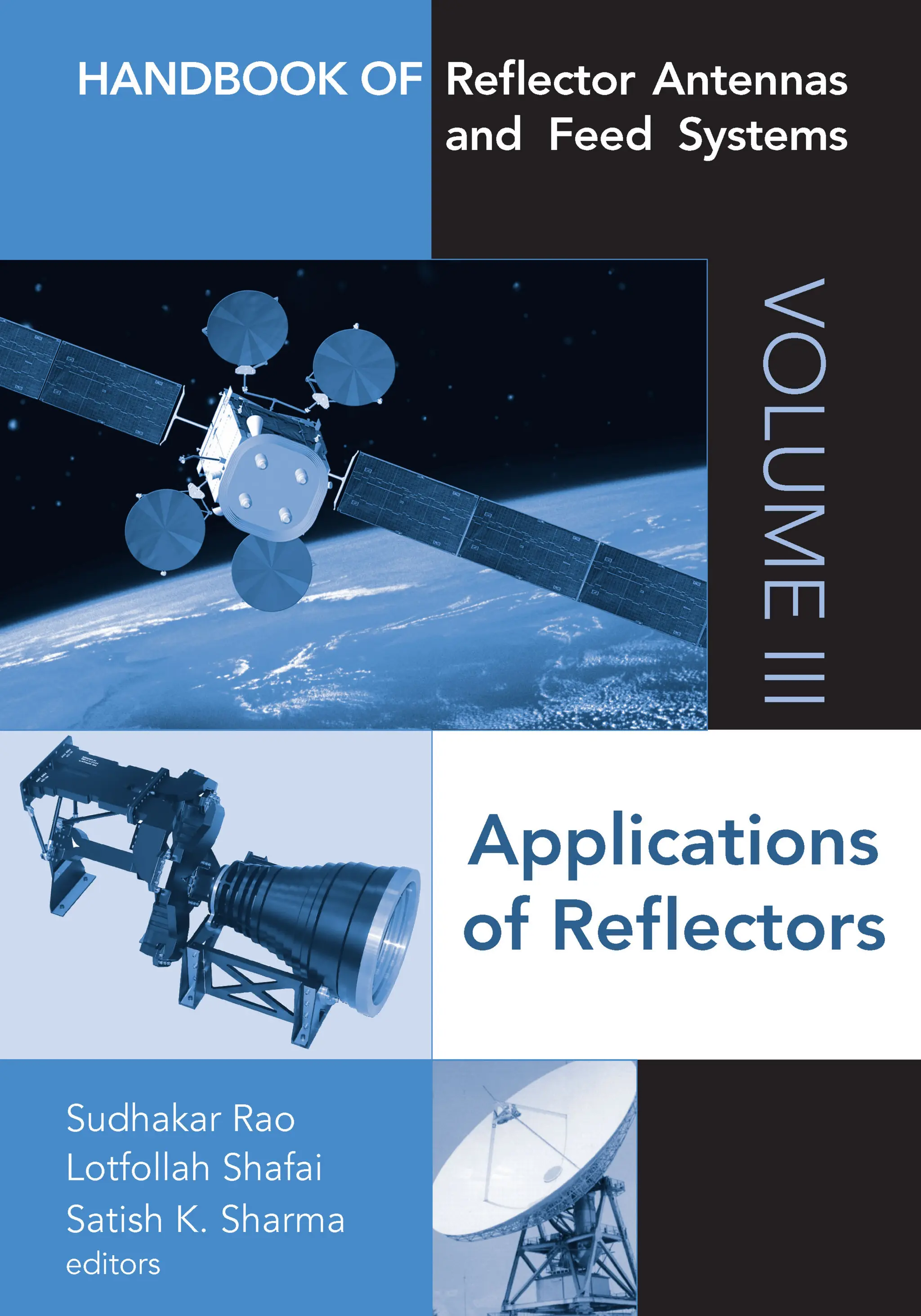
Top picture: An Intelsat satellite that employs multiple reflector antennas to provide
shaped beams over a wide area of landmass (courtesy of Intelsat Corporation).
Middle picture: C-band integrated compact feed assembly with dual-polarization,
high-power, and low-PIM capability used for uplink and downlink communications
links for fixed satellite services (courtesy of Custom Microwave, Inc.).
Bottom picture: Ibaraki No. 3 Earth Station Antenna (29.6m) (courtesy of MELCO,
Japan).
© 2013 Artech House
All rights reserved. Printed and bound in the United States of America. No part
of this book may be reproduced or utilized in any form or by any means, elec-
tronic or mechanical, including photocopying, recording, or by any information
storage and retrieval system, without permission in writing from the publisher.
All terms mentioned in this book that are known to be trademarks or service
marks have been appropriately capitalized. Artech House cannot attest to the
accuracy of this information. Use of a term in this book should not be regarded
as affecting the validity of any trademark or service mark.
10 9 8 7 6 5 4 3 2 1
v
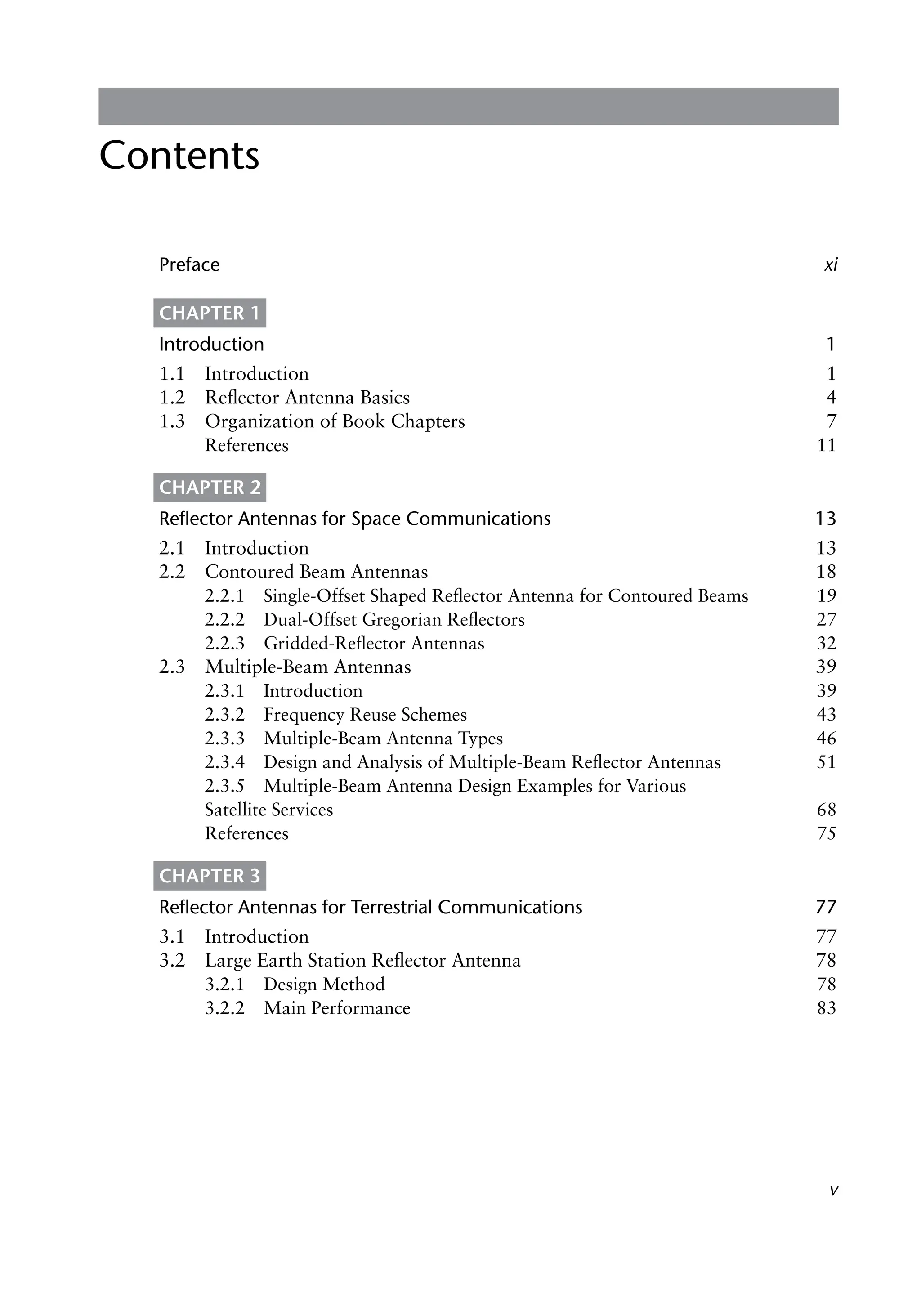
Contents
Preface xi
CHAPTER 1
Introduction 1
1.1 Introduction 1
1.2 Reflector Antenna Basics 4
1.3 Organization of Book Chapters 7
References 11
CHAPTER 2
Reflector Antennas for Space Communications 13
2.1 Introduction 13
2.2 Contoured Beam Antennas 18
2.2.1 Single-Offset Shaped Reflector Antenna for Contoured Beams 19
2.2.2 Dual-Offset Gregorian Reflectors 27
2.2.3 Gridded-Reflector Antennas 32
2.3 Multiple-Beam Antennas 39
2.3.1 Introduction 39
2.3.2 Frequency Reuse Schemes 43
2.3.3 Multiple-Beam Antenna Types 46
2.3.4 Design and Analysis of Multiple-Beam Reflector Antennas 51
2.3.5 Multiple-Beam Antenna Design Examples for Various
Satellite Services 68
References 75
CHAPTER 3
Reflector Antennas for Terrestrial Communications 77
3.1 Introduction 77
3.2 Large Earth Station Reflector Antenna 78
3.2.1 Design Method 78
3.2.2 Main Performance 83
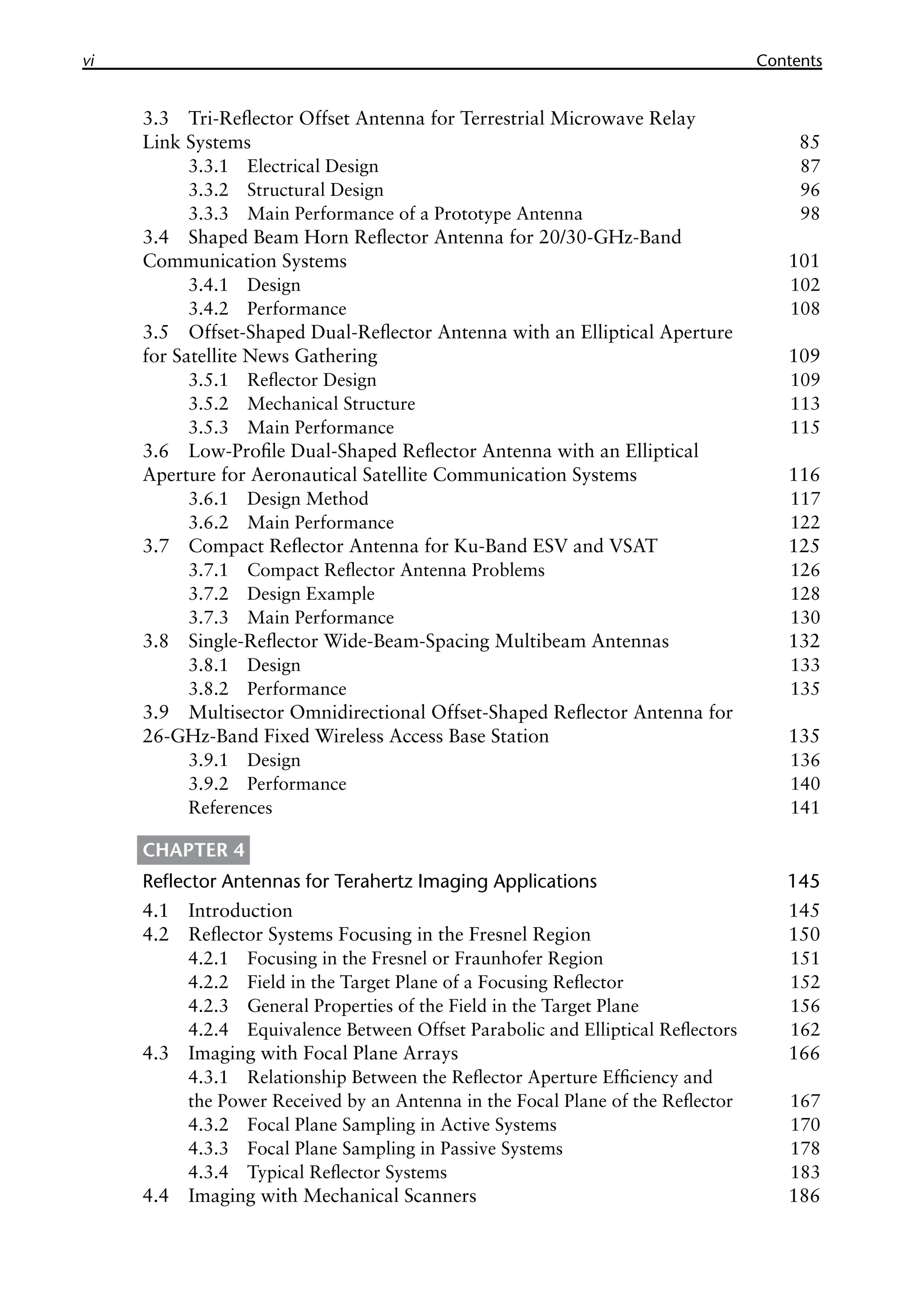
vi Contents
3.3 Tri-Reflector Offset Antenna for Terrestrial Microwave Relay
Link Systems 85
3.3.1 Electrical Design 87
3.3.2 Structural Design 96
3.3.3 Main Performance of a Prototype Antenna 98
3.4 Shaped Beam Horn Reflector Antenna for 20/30-GHz-Band
Communication Systems 101
3.4.1 Design 102
3.4.2 Performance 108
3.5 Offset-Shaped Dual-Reflector Antenna with an Elliptical Aperture
for Satellite News Gathering 109
3.5.1 Reflector Design 109
3.5.2 Mechanical Structure 113
3.5.3 Main Performance 115
3.6 Low-Profile Dual-Shaped Reflector Antenna with an Elliptical
Aperture for Aeronautical Satellite Communication Systems 116
3.6.1 Design Method 117
3.6.2 Main Performance 122
3.7 Compact Reflector Antenna for Ku-Band ESV and VSAT 125
3.7.1 Compact Reflector Antenna Problems 126
3.7.2 Design Example 128
3.7.3 Main Performance 130
3.8 Single-Reflector Wide-Beam-Spacing Multibeam Antennas 132
3.8.1 Design 133
3.8.2 Performance 135
3.9 Multisector Omnidirectional Offset-Shaped Reflector Antenna for
26-GHz-Band Fixed Wireless Access Base Station 135
3.9.1 Design 136
3.9.2 Performance 140
References 141
CHAPTER 4
Reflector Antennas for Terahertz Imaging Applications 145
4.1 Introduction 145
4.2 Reflector Systems Focusing in the Fresnel Region 150
4.2.1 Focusing in the Fresnel or Fraunhofer Region 151
4.2.2 Field in the Target Plane of a Focusing Reflector 152
4.2.3 General Properties of the Field in the Target Plane 156
4.2.4 Equivalence Between Offset Parabolic and Elliptical Reflectors 162
4.3 Imaging with Focal Plane Arrays 166
4.3.1 Relationship Between the Reflector Aperture Efficiency and
the Power Received by an Antenna in the Focal Plane of the Reflector 167
4.3.2 Focal Plane Sampling in Active Systems 170
4.3.3 Focal Plane Sampling in Passive Systems 178
4.3.4 Typical Reflector Systems 183
4.4 Imaging with Mechanical Scanners 186
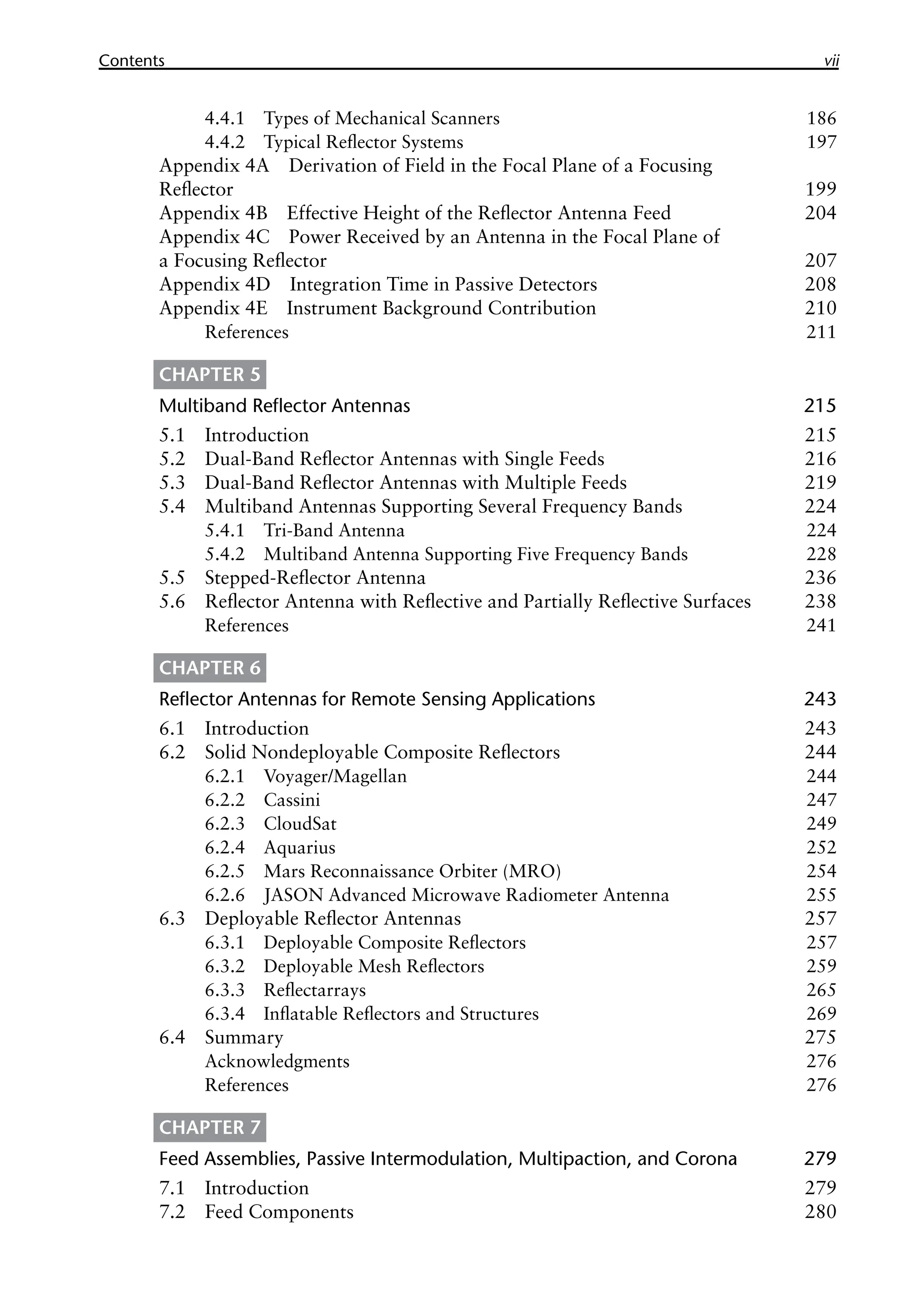
Contents vii
4.4.1 Types of Mechanical Scanners 186
4.4.2 Typical Reflector Systems 197
Appendix 4A Derivation of Field in the Focal Plane of a Focusing
Reflector 199
Appendix 4B Effective Height of the Reflector Antenna Feed 204
Appendix 4C Power Received by an Antenna in the Focal Plane of
a Focusing Reflector 207
Appendix 4D Integration Time in Passive Detectors 208
Appendix 4E Instrument Background Contribution 210
References 211
CHAPTER 5
Multiband Reflector Antennas 215
5.1 Introduction 215
5.2 Dual-Band Reflector Antennas with Single Feeds 216
5.3 Dual-Band Reflector Antennas with Multiple Feeds 219
5.4 Multiband Antennas Supporting Several Frequency Bands 224
5.4.1 Tri-Band Antenna 224
5.4.2 Multiband Antenna Supporting Five Frequency Bands 228
5.5 Stepped-Reflector Antenna 236
5.6 Reflector Antenna with Reflective and Partially Reflective Surfaces 238
References 241
CHAPTER 6
Reflector Antennas for Remote Sensing Applications 243
6.1 Introduction 243
6.2 Solid Nondeployable Composite Reflectors 244
6.2.1 Voyager/Magellan 244
6.2.2 Cassini 247
6.2.3 CloudSat 249
6.2.4 Aquarius 252
6.2.5 Mars Reconnaissance Orbiter (MRO) 254
6.2.6 JASON Advanced Microwave Radiometer Antenna 255
6.3 Deployable Reflector Antennas 257
6.3.1 Deployable Composite Reflectors 257
6.3.2 Deployable Mesh Reflectors 259
6.3.3 Reflectarrays 265
6.3.4 Inflatable Reflectors and Structures 269
6.4 Summary 275
Acknowledgments 276
References 276
CHAPTER 7
Feed Assemblies, Passive Intermodulation, Multipaction, and Corona 279
7.1 Introduction 279
7.2 Feed Components 280
viii Contents
7.2.1 Bends 280
7.2.2 Transitions 281
7.2.3 Filters 282
7.2.4 E-Plane, H-Plane, and Magic Tees 283
7.2.5 Orthomode Transducers 284
7.2.6 Polarizers 287
7.2.7 Horns 289
7.3 Feed Design 289
7.3.1 Integrated Design Approach 290
7.3.2 Other Key RF Design Considerations 290
7.3.3 Precision RF CAD Tools 291
7.3.4 Mechanical and Thermal Design 292
7.3.5 Manufacturing Methods 293
7.4 Feed Examples 295
7.4.1 Standard C-Band Feed 295
7.4.2 Standard Ku-Band Feeds 296
7.4.3 K-Ka-Band Feed 299
7.4.4 Low Profile K-Ka-Band Network for Feed Array 299
7.4.5 K-Ka-Q-Band Network 300
7.4.6 Ku-Band Tracking Feed 301
7.5 Qualification and Protoflight Testing 302
7.6 Feed Assembly Deleterious High-Power RF Effects: Passive
Intermodulation, Gas Ionization/Corona, and Multipactor 304
7.7 Passive Intermodulation 305
7.7.1 The PIM Problem 305
7.7.2 PIM Defined 306
7.7.3 Causes of PIM 307
7.7.4 Mathematical Definition [18, 19] 309
7.7.5 PIM as a Function of Incident Power 311
7.7.6 PIM Mitigation 312
7.7.7 Susceptible Systems 313
7.7.8 Hardware PIM Requirements 313
7.7.9 PIM Test and Verification Methods 314
7.8 Multipactor, Corona, and Ionization Breakdown 320
7.8.1 Multipactor 321
7.8.2 Corona and Ionization Breakdown 324
7.8.3 Hardware Test Requirements 325
Appendix 7A 331
7A.1 Generic PIM Test Setup Equations Related to Far-Field Tx
Flux Density 331
Appendix 7B 332
7B.1 Generic PIM Test Setup Equations Related to Far-Field Rx
Coupling 332
Appendix 7C 333
7C.1 Example Test Procedure 333
References 338
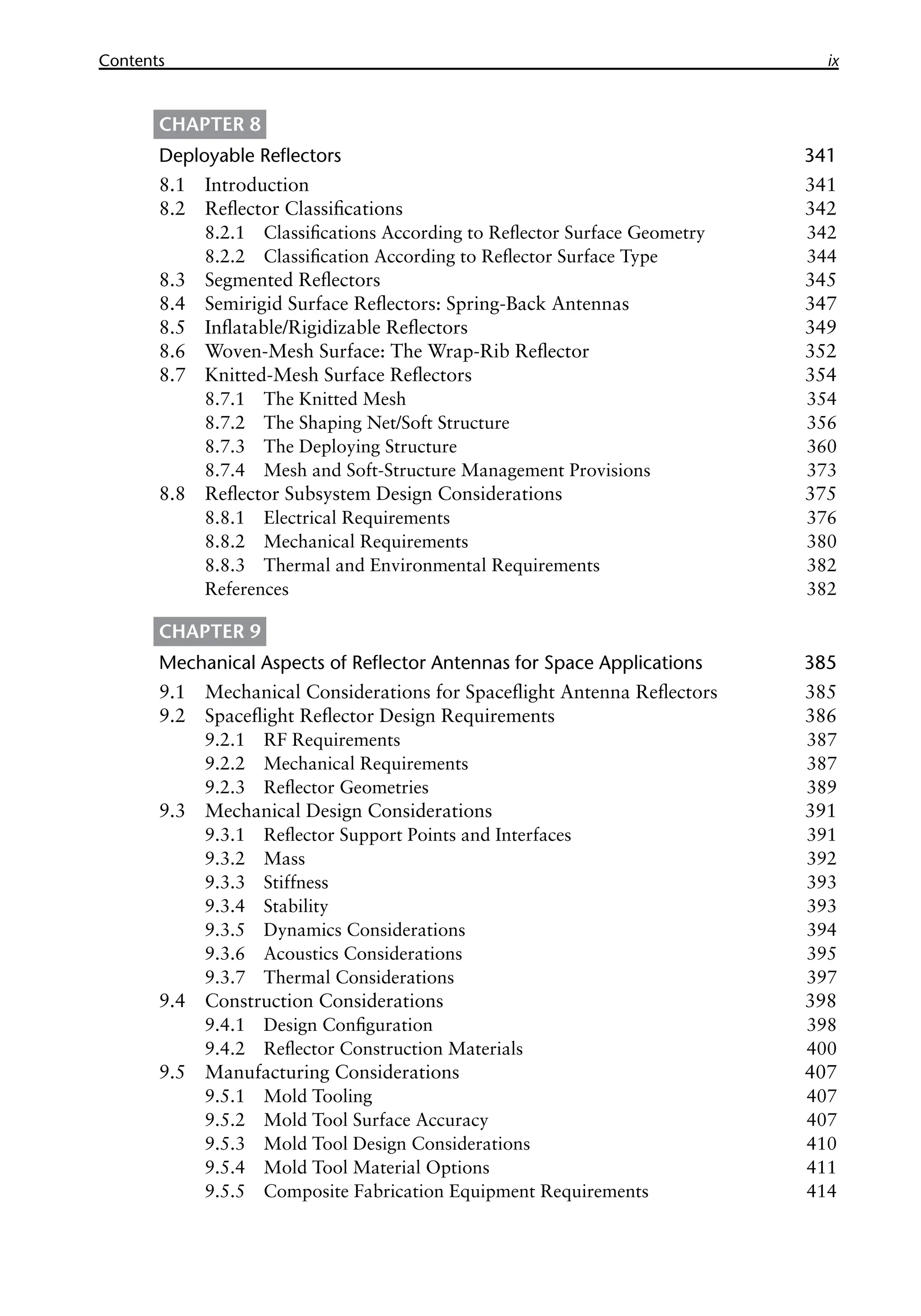
Contents ix
CHAPTER 8
Deployable Reflectors 341
8.1 Introduction 341
8.2 Reflector Classifications 342
8.2.1 Classifications According to Reflector Surface Geometry 342
8.2.2 Classification According to Reflector Surface Type 344
8.3 Segmented Reflectors 345
8.4 Semirigid Surface Reflectors: Spring-Back Antennas 347
8.5 Inflatable/Rigidizable Reflectors 349
8.6 Woven-Mesh Surface: The Wrap-Rib Reflector 352
8.7 Knitted-Mesh Surface Reflectors 354
8.7.1 The Knitted Mesh 354
8.7.2 The Shaping Net/Soft Structure 356
8.7.3 The Deploying Structure 360
8.7.4 Mesh and Soft-Structure Management Provisions 373
8.8 Reflector Subsystem Design Considerations 375
8.8.1 Electrical Requirements 376
8.8.2 Mechanical Requirements 380
8.8.3 Thermal and Environmental Requirements 382
References 382
CHAPTER 9
Mechanical Aspects of Reflector Antennas for Space Applications 385
9.1 Mechanical Considerations for Spaceflight Antenna Reflectors 385
9.2 Spaceflight Reflector Design Requirements 386
9.2.1 RF Requirements 387
9.2.2 Mechanical Requirements 387
9.2.3 Reflector Geometries 389
9.3 Mechanical Design Considerations 391
9.3.1 Reflector Support Points and Interfaces 391
9.3.2 Mass 392
9.3.3 Stiffness 393
9.3.4 Stability 393
9.3.5 Dynamics Considerations 394
9.3.6 Acoustics Considerations 395
9.3.7 Thermal Considerations 397
9.4 Construction Considerations 398
9.4.1 Design Configuration 398
9.4.2 Reflector Construction Materials 400
9.5 Manufacturing Considerations 407
9.5.1 Mold Tooling 407
9.5.2 Mold Tool Surface Accuracy 407
9.5.3 Mold Tool Design Considerations 410
9.5.4 Mold Tool Material Options 411
9.5.5 Composite Fabrication Equipment Requirements 414
x Contents
9.6 Mechanical and Environmental Testing 418
9.6.1 Fabrication In-Process Testing 419
9.6.2 Reflector Assembly Acceptance and Environmental Testing 420
9.7 Concluding Remarks 424
About the Editors 427
List of Contributors 430
Index 431
xi
Preface
Several books on reflector antennas have been written and the majority of them
have given excellent treatment to the theory and analysis of reflector antennas. The
intent of this book is to provide practical applications and design information of
reflector antennas used for several communications systems. I have been encour-
aged by my industry colleagues to write such a book documenting the application
aspects of reflector antennas for spacecraft and terrestrial communications. With
this in mind, I have invited mostly practicing engineers from the antenna industry
to write these book chapters. Experts from Northrop Grumman, MELCO, NASA/
JPL, Intelsat, Boeing, CMI, AASC, and DUT have largely contributed to this book.
Reflector antenna technology has been evolving continuously over the last two
decades to cater to new applications. These include large deployable reflectors for
mobile satellites, multiple beam reflector antennas for high-capacity satellites, mul-
tiband reflector antennas covering multiple frequency bands, terahertz reflectors for
radar applications, high-power antenna payloads with low passive intermodulation
products, low loss reflector antennas for wide scan applications, reflector antennas
for new terrestrial applications, and reflector antennas for remote sensing. This
book covers recent developments of reflector antennas used for satellite communi-
cations, terrestrial communications, and remote sensing applications. New subjects
are introduced for the first time here in a book format dealing with satellite anten-
nas, terahertz antennas, PIM, multipaction, corona, deployable mesh reflector an-
tennas, and mechanical aspects of reflector antennas. A separate topic on integrated
feed assembly for reflector antennas covering analysis, design, fabrication, and test
has been included in this book.
The organization of this book is as follows. A brief introduction beginning with
the history of reflector antennas and its basics is given in Chapter 1. Different types
of reflector antennas used for satellite communications, including introduction to
payload systems and antenna farm, are addressed in Chapter 2. Contoured beam
or shaped beam antennas are described along with analysis results for C-band and
Ku-band antennas for fixed satellite services. Gain performance as a function of re-
flector size is discussed. Dual-reflector Gregorian antenna configuration for shaped
beam applications is described. Gridded-reflector antennas with overlapping aper-
tures providing polarization reuse for linear polarization applications are discussed
along with design formulae for the grid geometry. The subject of multiple beam
antennas is relatively new and is covered in detail in Chapter 2. Design of MBAs,
analysis of MBA performance, and several applications of MBAs are discussed.
xii �������
Preface
Advanced feed technologies as well as reflector technologies that improve MBA
performance are given with examples. Multiple beam antennas for direct-to-home
local channel broadcast and personal communications satellites are addressed.
Chapter 3 provides past and recent developments on reflector antennas for ter-
restrial communications applications. There are seven sections that cover reflector
antennas for different applications. Beam-waveguide fed reflector systems for large
earth-station reflector antennas are presented. The shaped Cassegrain antenna fed
by a four-reflector beam waveguide feed is described and is a standard for large
earth stations all over the world. A trireflector offset antenna for terrestrial mi-
crowave relay link systems with very low cross-polar levels is addressed. Reflector
antennas used for Japanese communication satellite 2 (CS-2) and an elliptical aper-
ture reflector for satellite news-gathering applications with reduced interference to
adjacent satellites are discussed. This latter antenna is an offset Gregorian antenna
with elliptical main reflector. Compact dual-reflector elliptical aperture antennas
for aeronautical satellite communication systems are presented, including shaping
methods. The dual-shaped reflector antenna is realized by using a physical optics
shaping technique and achieves excellent electric performance. Reflector antennas
used as vessels for mobile communications and terminals for simultaneous com-
munication with broadcast and communication satellites are also discussed.
Use of focusing and nonfocusing reflector systems for terahertz imaging ap-
plications is described in Chapter 4. These systems need to steer the beam over
the intended field of view with specific spatial resolution. Focal plane arrays that
would acquire information from several image pixels simultaneously and reflector
antenna systems integrated with mechanical scanners in order to generate the im-
age at terahertz frequencies are addressed here. Relevant analyses for focal-plane
and image plane designs are given. Recent developments in the area of multiband
reflector antennas and associated feed horns are described in Chapter 5. These
antennas are capable of supporting multiple frequency bands that are separated
in frequency and covering several octave bandwidths. They have the advantage of
using a single antenna instead of several antennas with reduced cost and reduced
mass. Advanced reflector technologies—such as stepped-reflector, reflectors with
partially reflective surfaces, and shaped reflectors—are presented. Feed advance-
ments in terms of multimode horns with several “slope-discontinuities” and feed
assembly developments to isolate the frequency bands are discussed.
Chapter 6 presents reflector antennas used for remote sensing of the Earth
and other bodies in the solar system, and relevant sensor technologies to detect
and classify objects by means of propagated electromagnetic radiation. Sensors de-
ployed on aircraft or satellites make it possible to collect data on a global scale that
would not otherwise be practical to obtain. Remote sensing is used for a wide range
of science applications, ranging from global measurement of ocean topography and
deforestation to the study of Jupiter’s atmosphere. The military employs remote
sensing techniques to collect data about opposing forces, weather conditions, and
other information relevant to their mission. Chapter 6 also presents technologies
related to active and passive remote sensing. For spaceborne remote sensing ap-
plications, reflector antennas have historically been the most widely used antenna
design. This chapter presents an overview of the various types of reflector antenna
designs used for remote sensing applications. Antennas flown on historically signif-
icant missions are used to illustrate the practical implementation of each antenna
Preface xiii
type. In addition, the chapter presents notable antenna research developments that
are regarded as enabling technologies for new types of sensors.
Chapter 7 presents two key sections related to the feed assemblies used for
reflector antennas in space and, to a certain extent, in ground applications. It
provides the component designs, manufacture, and test results of various types
of feed assemblies employed at C-band, Ku-band, and Ka-band. The feed compo-
nents include horns, orthomode transducers (OMTs), polarizers, filters, diplexers,
combiners/dividers, and transitions. Manufacturing approaches that yield precise
tolerances required for high-performance feeds are discussed. Advantages of ad-
vanced design, analyses, manufacture, and test of integrated feed assembly instead
of conventional piece-part design are discussed. The second part of this chapter
deals with three important aspects of spacecraft antennas and feeds; namely, pas-
sive intermodulation (PIM), multipaction, and corona. These aspects are critical in
high-power payloads and multichannel repeaters and significantly impact the feed
and reflector design.
Space reflectors having sizes larger than the fairing of the booster need to be
“folded up” in some manner for launch, and then “unfurled” on orbit to their full
size. These are typically referred to as deployable reflectors, and are the subject
of Chapter 8. This chapter is organized into three main sections. The first sec-
tion deals with reflector classifications either according to the surface geometry
or according to the surface type (such as rigid/segmented, semirigid, inflatable/
rigidizable, woven-mesh, and knitted-mesh surfaces). The second section deals in
more detail with the major constituents/components of the knitted-mesh type re-
flector, which of all deployable reflectors, is most commonly flown in space. The
last section addresses the major design requirements/considerations for a typical
deployable reflector subsystem, including electrical, mechanical, thermal, and en-
vironmental drivers.
Chapter 9 is intended to provide the reader with a framework and top-level
understanding of the elements and requirements that must be considered in the suc-
cessful design, fabrication, and test of a spaceflight antenna reflector. It is a guide
based on over 30 years of professional experience of the authors in engineering,
fabricating, and testing spaceflight antenna reflectors and systems. As the state-of-
the-art in antenna reflector design continually advances, this chapter is purposely
written to provide general recommendations for configuration, design approach
materials, and testing. There is a wealth of information available from compos-
ite materials suppliers, technical papers, and organizations, such as SAMPE, so
it is left to the reader to perform the detailed analyses, engineering, and materials
research to establish the best possible specific choices relative to the set of require-
ments for the particular reflector being considered. A successful antenna reflector
design is always a carefully balanced combination of many specific and interdepen-
dent choices that must all work together to achieve the best possible results. The
mechanical design of the reflector antennas have to satisfy electrical, spacecraft,
launch load, vibration, extreme thermal, deployment in space, stowage, low mass,
pointing, and structural requirements simultaneously. These are all discussed in
Chapter 9.
A professional antenna engineer in the current industrial environment must
be skillful in several areas, including theory, analysis methods, design, mechani-
cal consideration, manufacture, test methods, antenna ranges, error analysis, and
xiv �������
Preface
related system aspects. More important, he or she should know what types of
antennas need to be used for a given application. I have been fortunate to work
with excellent mentors Chuck Mok and James Huang at Spar Aerospace Limited,
Montreal, Canada (now called MDA). During the 14 years of my early career, I had
the opportunity to acquire knowledge about antenna components, reflector anten-
nas for space and ground applications, test range developments, and spacecraft
antenna testing. I also had the benefit of leading a group of excellent engineers on
IRAD, new business proposals, and space programs. My best learning experience
was at Spar and I thank the management for encouraging me with progressively
more responsible and challenging jobs during the period 1983–1996. The knowl-
edge and experience I gained at Spar was useful later during my professional career
with Hughes/Boeing, Lockheed Martin, and now with Northrop Grumman. I must
thank my colleagues Dr. Chih-Chien Hsu, Jim Wang, Minh Tang, Duy Nguyen,
Sylvain Richard, Raj Sudarsanam, Joseph Kopal, Dr. Philip Law, Dr. Sebong Chun,
Dr. Jon Gulick, and several others with whom I have worked closely and learned
much during my association with them. My special thanks to Dr. Kwok-Kee Chan,
whom I consider the best antenna consultant in the industry; I had the opportu-
nity to work with him on several difficult antenna projects over the past 30 years.
Thanks also are due to Dr. Clency Lee-Yow, President of Custom Microwave Inc.,
with whom I had worked on advanced feed systems for several flight programs and
jointly developed a novel high-power spacecraft thermal vacuum test method using
pick-up horns.
I am thankful to my coeditors Prof. Lot Shafai and Prof. Satish Sharma for all
the planning, coordination, and motivation during the long and stressful two-year
period when the book contents were being finalized. My personal thanks to all the
chapter authors who took time in spite of their demanding schedules at work and
spending numerous weekends shaping the technical contents of this book. All the
authors have shown extreme dedication, professionalism, and cooperation during
this project and I am grateful to them for their contributions. I thank Northrop
Grumman management of Jon Gulick, Michelle Bailey, and Verne Nagayama for
granting me permission to write this book. Special thanks to my best friend Dr. C.
S. Rao and his wife Mrs. Chandra for their encouragement. I also want to thank
my family friends in Los Angeles for their interest in my work and keeping me
relaxed during weekends. Thanks are due to Artech House for guiding me through-
out the book development process and special thanks to Samantha Ronan, Lindsay
Moore, Jack Stone, Alexis Merry, and Mark Walsh.
Most important, I am grateful to my family for their love and support during
this endeavor. Without the help and encouragement of my wife Rajani and daugh-
ter Neha, it would not have been possible for me to complete this work.
This book is dedicated to my parents, my wife, and my daughter.
Sudhakar Rao
May 2013
1
C H A P T E R 1
Introduction
Sudhakar Rao, Northrop Grumman Aerospace Systems
Lot Shafai, University of Manitoba
1.1 Introduction
Reflector antennas are widely used for Earth station, satellite, radar, radio astron-
omy, and deep space communications. The main advantage of reflector antennas
is that they provide high gain values using a large passive aperture that reflects the
RF signal from the feed without the need for active amplification. It also has the
advantages of lower cost, lower mass, lower power, and grating-lobe free radiation
when compared to array antennas and lens antennas.
Isaac Newton is the father of modern reflector antennas, having invented the
optical reflective telescope in 1672. This type of telescope comprises a concave
mirror that reflects light rays to a smaller plane mirror, which in turn focuses into
an eyepiece, as illustrated in Figure 1.1. Later developments in reflector antennas
occurred during the 17th century through the efforts of Cassegrain and Gregory.
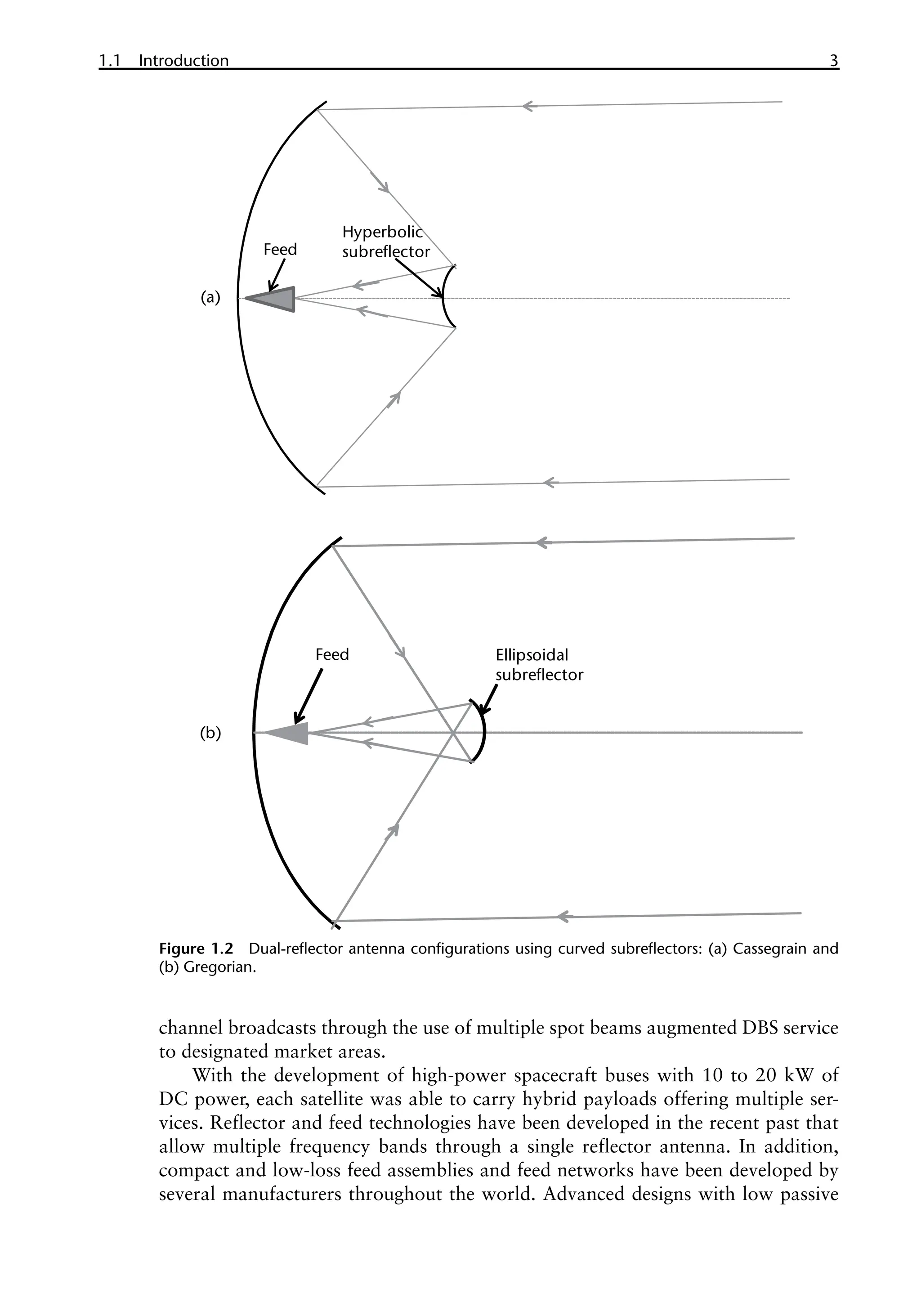
Their work resulted in the dual-reflector Cassegrainian and Gregorian reflector
configurations that are widely used even today. These two classic reflector configu-
rations are illustrated in Figure 1.2.
During the 1950s and 1960s, reflector antennas found new applications in ter-
restrial communication systems, radio telescopes, Earth stations, radar antennas,
and satellite communications. The use of reflector antennas for satellite communi-
cations started in 1960 with the launch of Echo 1, which employed a 30m reflec-
tor to test its propagation and transmission techniques. The launch of the Telstar
satellite at the C-band (6-GHz uplink and 4-GHz downlink) paved the way to
bent-pipe satellites for communication applications. Syncom III, launched in 1964,
was a true geostationary satellite. “Early Bird,” launched in 1965 by Intelsat, was
the first commercial trans-Atlantic satellite with 240 telephone circuits and live TV
transmission. In 1965, Russia also launched its first communication satellite in the
Molniya orbit.
2 ������������
Introduction
In the 1970s and 1980s, significant developments occurred in both satellite
communication antennas and Earth station antennas. Large Earth stations have
been constructed in the United States, Japan, and Europe that employ shaped dual-
reflector antennas and fixed-feed beam-waveguide technology with a focus on im-
proving the efficiency of antennas. Gridded reflector technology was developed in
Canada and the United States for spacecraft reflector antennas. This technology
allowed for reuse of the aperture space for two orthogonally polarized antenna
surfaces that are placed one behind the other and fed with two separate feed ar-
rays. This in turn allowed for polarization reuse, which enabled the bandwidth to
be increased twofold.
Large-mesh reflector technology was developed in late 1980s and early 1990s
by Harris and Astro-Mesh (now Northrop Grumman) for mobile applications.
This technology allowed for the use of large reflectors (5 to 12m) that could be
folded in a small volume for stowage and deployed in space. More recently, large
reflectors of 22m and more have been built and flown by the space industry for
both commercial and military applications.
During the late 1980s, another important development occurred in the form
of shaped reflector technology [1]. Shaped reflector technology allowed contoured
beam shapes to be created by changing the reflector surface shape and using a sin-
gle-feed instead of large-feed array with a beam-forming network feeding the array.
This technology has significant benefits in terms of reducing the overall mass and
cost of the payloads. Shaped dual-reflector Gregorian systems have been developed
for both linear and circular polarization applications.
Multiple-beam antennas have been developed for mobile and personal commu-
nication applications starting in the 1990s. Several satellite systems, such as M-Sat,
Anik-E, Globalstar, Inmarsat, ACeS, and Thuraya, have employed multiple beams
with frequency reuse schemes to increase the effective bandwidths by factors of 4
to 30. Direct broadcast satellites were developed during the 1990s that resulted in
high-power downlink beams providing regional coverage that allowed users to re-
ceive signals directly from a satellite using pizza-sized dishes at their homes. Local-
Figure 1.1 Newtonian reflector telescope with planar subreflector.
1.1 Introduction 3
channel broadcasts through the use of multiple spot beams augmented DBS service
to designated market areas.
With the development of high-power spacecraft buses with 10 to 20 kW of
DC power, each satellite was able to carry hybrid payloads offering multiple ser-
vices. Reflector and feed technologies have been developed in the recent past that
allow multiple frequency bands through a single reflector antenna. In addition,
compact and low-loss feed assemblies and feed networks have been developed by
several manufacturers throughout the world. Advanced designs with low passive
Figure 1.2 Dual-reflector antenna configurations using curved subreflectors: (a) Cassegrain and
(b) Gregorian.
Hyperbolic
subreflector
Feed
Ellipsoidal
subreflector
Feed
(a)
(b)
4 ������������
Introduction
intermodulation (PIM) products and high-power handling technologies have been
developed during the past 30 years, thus improving the reliability and extending
the capability of the high-power payloads. Reconfigurable reflector antenna tech-
nology has been developed for DABS (digital audio broadcast satellites) and has
been successfully flown on Sirius-1 and Sirius-2 satellites that operate in highly
inclined elliptical orbits. Flat reflector technologies have been developed for radar
and remote sensing technologies.
Several excellent books have covered conventional reflector antennas in the
past [2–6]. However, developments during the past two decades have not been
documented properly. The intent of this volume of the handbook is to address the
latest developments in reflector antennas for space, ground, remote sensing, and
terahertz applications. This volume will be useful for practicing engineers as well as
academic researchers. All of the chapters have been written by experts in the indus-
try and in academia who bring their valuable experience in dealing with practical
antennas, hardware design, and related issues. Some of the topics addressed are
new and documented here for the first time in textbook form.
The key developments in reflector antennas that have occurred during the past
few decades are addressed in this book and include the following topics:
•
• Contoured or shaped beam antennas;
•
• Multiple beam antennas;
•
• Multiband antennas;
•
• Feed assemblies for reflector antennas: design, fabrication, and test;
•
• Passive intermodulation products;
•
• Multipaction and corona;
•
• Reconfigurable antennas;
•
• Reflector antennas for terahertz applications;
•
• Large deployable mesh reflector antennas;
•
• Remote sensing antennas;
•
• Large reflector antennas for Earth stations and gateway applications on the
ground;
•
• Beam-waveguide dual-reflector antennas.
1.2 Reflector Antenna Basics
Reflector antennas are used for transmission and reception of RF signals provid-
ing high gain. They are preferred over other directive antenna types such as array
antennas and lens antennas due to their low cost and low mass and because they
do not require active components, they avoid the use of complex beam-forming
networks, and they provide large bandwidths. Gain and directivity definitions of
reflector antennas are sometimes not correctly used. The directivity of the reflector
antenna is defined as:
1.2 Reflector Antenna Basics 5
( )
( )
( )
p p
p q f
q f
q f q q f
=
∫ ∫
2
0 0
0 0 2 2
0
0 0
4 ,
,
,
E
D
E sin d d (1.1)
The denominator in (1.1) is the total radiated power and ( )
q f
2
0 0
,
E is the
power radiated per unit solid angle in the angular direction (q0, f0). Directivity can
be obtained by integrating the ideal computed copolar and cross-polar patterns of
the reflector antennas. However, gain of the reflector antenna, G(q0, f0), is lower
than the directivity and includes feed system and reflector losses. It is given as:
( ) ( )
q f q f
= - -
0 0 0 0
, D , L L
G F R (1.2)
The feed loss FL includes insertion loss due to all components of the feed assem-
bly (horn, polarizer, orthomode transducers, filters/diplexers, waveguide bends),
mismatch losses, and thermal losses as applicable. The reflector loss includes con-
ductive loss, loss due to surface errors, and thermal loss (if applicable) and is given
by:
= + +
L C S T
R R R R (1.3)
Conductive loss depends on the material properties of the reflector (graphite,
aluminum, etc.) and the surface loss in decibels can be calculated using Ruze’s for-
mulation [7] as:
( )
pδ l
-
 
=
 
2
4 /
10
10log
S
R e (1.4)
The thermal loss is accounted for by computing the directivity with reflector
surfaces at various temperatures and subtracting the directivity value with ambi-
ent surface. This is typically computed since gain measurements with thermal loss
are not feasible in practice. Thermal losses include mispointing losses and surface
distortion losses.
It is important to optimize the directivity of the reflector antenna by design
and minimize the feed and reflector losses through hardware design, manufacture,
and implementation. The key system parameters impacted by the reflector antenna
design are the effective isotropic radiated power (EIRP) and the gain-to-noise tem-
perature ratio (G/T) and are given as:
( ) ( )
= + -
10
10log i r
EIRP dBW P G L (1.5)
where Pi is the input power in watts, G is the antenna gain including losses, and Lr
is the losses between the amplifier and the antenna interface point.
=
Receive antenna gain
G T
System noise temperature
(1.6)
6 ������������
Introduction
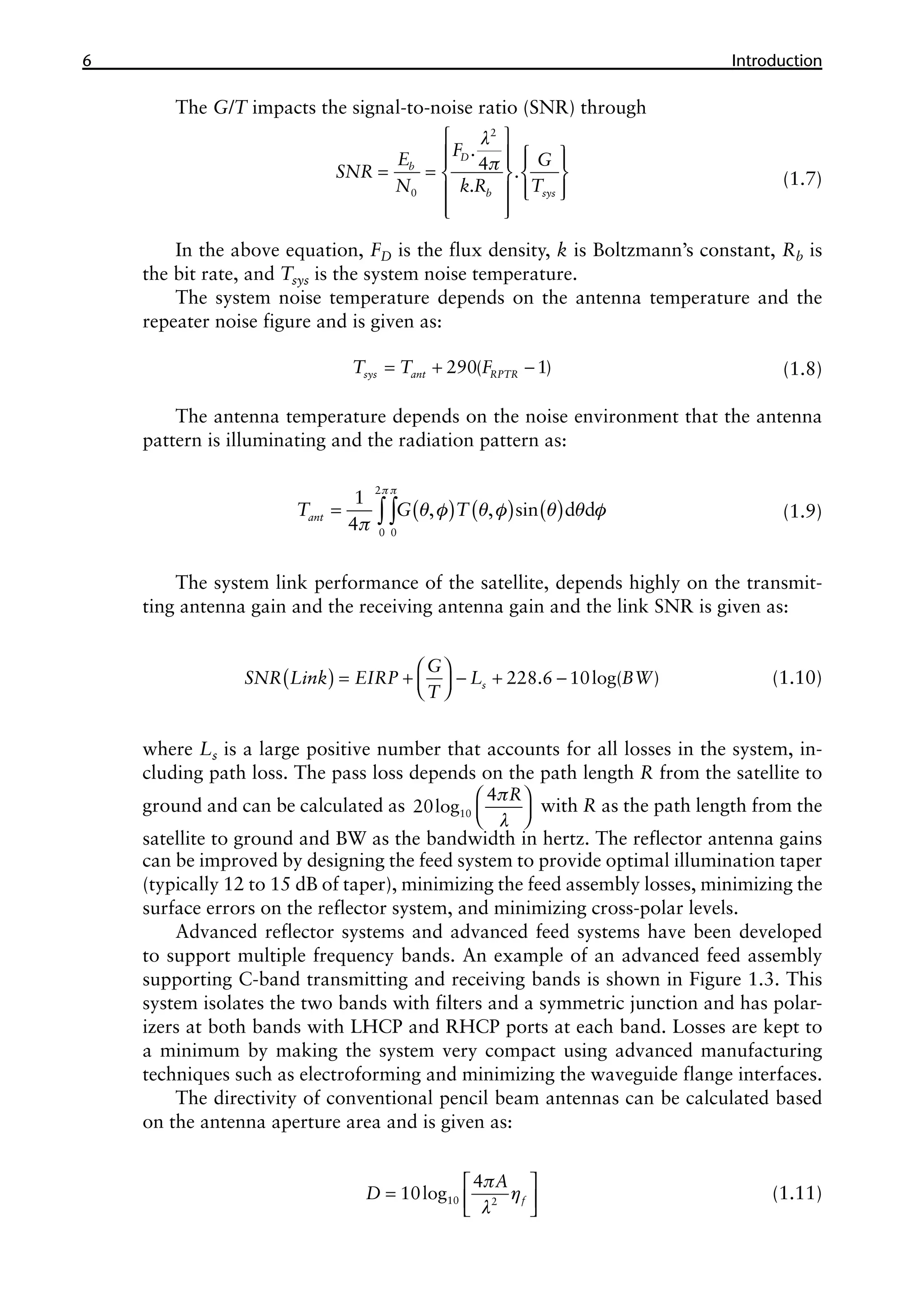
The G/T impacts the signal-to-noise ratio (SNR) through
l
p
 
   
   
= =    
 
   
 
 
2
0
.
4 .
.
D
b
b sys
F
E G
SNR
N k R T (1.7)
In the above equation, FD is the flux density, k is Boltzmann’s constant, Rb is
the bit rate, and Tsys is the system noise temperature.
The system noise temperature depends on the antenna temperature and the
repeater noise figure and is given as:
= + -
290( 1)
sys ant RPTR
T T F (1.8)
The antenna temperature depends on the noise environment that the antenna
pattern is illuminating and the radiation pattern as:
( ) ( ) ( )
p p
q f q f q q f
p
= ∫∫
2
0 0
1
, , sin d d
4
ant
T G T (1.9)
The system link performance of the satellite, depends highly on the transmit-
ting antenna gain and the receiving antenna gain and the link SNR is given as:
( )  
= + - + -
 
 
228.6 10log( )
s
G
SNR Link EIRP L BW
T
(1.10)
where Ls is a large positive number that accounts for all losses in the system, in-
cluding path loss. The pass loss depends on the path length R from the satellite to
ground and can be calculated as 10
4
20log
R
p
l
 
 
 
with R as the path length from the
satellite to ground and BW as the bandwidth in hertz. The reflector antenna gains
can be improved by designing the feed system to provide optimal illumination taper
(typically 12 to 15 dB of taper), minimizing the feed assembly losses, minimizing the
surface errors on the reflector system, and minimizing cross-polar levels.
Advanced reflector systems and advanced feed systems have been developed
to support multiple frequency bands. An example of an advanced feed assembly
supporting C-band transmitting and receiving bands is shown in Figure 1.3. This
system isolates the two bands with filters and a symmetric junction and has polar-
izers at both bands with LHCP and RHCP ports at each band. Losses are kept to
a minimum by making the system very compact using advanced manufacturing
techniques such as electroforming and minimizing the waveguide flange interfaces.
The directivity of conventional pencil beam antennas can be calculated based
on the antenna aperture area and is given as:
p
η
l
 
=  
 
10 2
4
10log f
A
D (1.11)
1.3 Organization of Book Chapters 7
where A is the aperture area, l is the wavelength, and ηf is the overall antenna ef-
ficiency and is given by [8, 9]
( )
q q
η
+
 
   
= -
   
 
   
 
2
2 1 1
2
1
4 cot 1 cos
2 2
n
f
n
n
(1.12)
Equation (1.12) includes spillover efficiency, aperture efficiency, phase effi-
ciency, and polarization efficiency, and can easily be factored into these four subef-
ficiencies. The feed pattern is assumed to be of the form cos
2
n q
 
 
 
in (1.12). The
variable n is related to the feed illumination taper T and is given by
q
-
=
 
 
 
 
 
 
1
10
0.05
cos
2
log
T
n
(1.13)
The maximum value of feed efficiency ηf is about 0.81 and occurs when the
feed illumination taper T is about 10 to 12 dB. In (1.13), θ1 is the half-subtended
angle from the focus to the reflector edges.
1.3 Organization of Book Chapters
This volume has been organized into the following nine individual chapters:
Chapter 1: Introduction
Chapter 2: Reflector Antennas for Space Communications
Chapter 3: Reflector Antennas for Terrestrial Communications
Figure 1.3 A C-band feed assembly with corrugated horn providing dual circular polarization at
both the 4- and 6-GHz bands for fixed satellite services. (Courtesy of Custom Microwave Inc.)
8 ������������
Introduction
Chapter 4: Reflector Antennas for Terahertz Imaging Applications
Chapter 5: Multiband Reflector Antennas
Chapter 6: Reflector Antennas for Remote Sensing Applications
Chapter 7: Feed Assemblies, Passive Intermodulation, Multipaction, and Co-
rona Considerations
Chapter 8: Deployable Reflectors
Chapter 9: Mechanical Aspects of Reflector Antennas for Space Applications
Chapter 2 describes the various types of reflector antennas used for satellite
communications. An introduction to payload systems and the antenna farms typi-
cally used for satellites is given. Different types of reflector antennas used for space
are described briefly. Contoured beam or shaped beam antennas are described later
along with analysis results for C-band and Ku-band antennas for fixed satellite ser-
vices. The gain performance as function of reflector size is discussed along with the
gain area product, which is sometimes used as the figure of merit of shaped beam
antennas. A dual-reflector Gregorian antenna configuration for shaped beam ap-
plications is described. Gridded-reflector antennas with overlapping apertures pro-
viding polarization reuse for linear polarization applications are discussed along
with design formulas for the grid geometry.
The subject of multiple-beam antennas (MBAs) is relatively new and is covered
in detail in Chapter 2. Design of MBAs, analysis of MBA performance, and several
applications of MBAs are discussed. Advanced feed technologies as well as reflec-
tor technologies that improve MBA performance are given with examples. MBAs
for direct-to-home local-channel broadcast and personal communications satellites
are also discussed.
Chapter 3 provides past and recent developments on reflector antennas for ter-
restrial communications applications. This chapter describes reflector antennas in
practical use, mainly focusing on terrestrial communications. Each of its sections
describes reflector antennas for a specific application. Section 3.1 presents design
technologies for beam-waveguide feed systems and practical examples in conjunc-
tion with large Earth station reflector antennas. The shaped Cassegrain antenna
fed by a four-reflector beam-waveguide feed is described. This type of antenna is a
standard for large Earth stations all over the world. Section 3.2 introduces a tri-re-
flector offset antenna for terrestrial microwave relay link systems. The reflector an-
tenna is shown to achieve very low cross-polar levels. Reflector antennas used for
Japanese communication satellite 2 (CS-2) are described in Section 3.3. The shape
of the wavefront, which corresponds to the desired beam cross section in the sense
of geometrical optics, is analyzed, and the method used to synthesize the wavefront
is discussed. The reflector shape is determined from the shape of the wavefront by
the geometrical optics approach, which is adequate for this application.
Section 3.4 presents the elliptical aperture antenna for satellite news gather-
ing. The antenna is an offset Gregorian antenna with an elliptical main reflector.
The elliptical aperture is used to reduce the interference from or to adjacent satel-
lites. Section 3.5 also describes a reflector antenna with an elliptical aperture for
aeronautical satellite communication systems. The elliptical aperture allows for
the realization of a very low profile antenna under severe envelope constraints
1.3 Organization of Book Chapters 9
on the airplane. The dual-shaped reflector antenna is realized by using a physical
optics shaping technique and achieves excellent electric performance. Section 3.6
introduces the compact reflector antenna for use on vessels for mobile satellite
communications. For such a system, the antenna needs to be designed to achieve
low sidelobe and low cross-polar characteristics while keeping the antennas effi-
ciency high. Section 3.7 presents a reflector antenna that is used for simultaneous
reception from broadcast satellites (BS) and communication satellites (CS). The
optimum reflector for a single-reflector wide beam-spacing multibeam antenna is
presented on the basis of wave aberration analysis of defocus-fed reflectors.
Terahertz imaging applications rely on the use of focusing and nonfocusing re-
flector systems. Chapter 4 describes the recent developments in the area of terahertz
reflector antennas. These systems need to steer the beam over the intended field of
view with specific spatial resolution. One possible solution is to use focal plane
arrays (i.e., a camera-like staring imager) that would acquire information from sev-
eral image pixels simultaneously. In the terahertz regime, this is a feasible solution
for passive detectors, such as bolometers or superconducting detectors, commonly
used for space applications. However, terahertz heterodyne detector array technol-
ogy is still under development. In such cases most of the current state-of-the-art im-
aging systems, especially for terrestrial applications, make use of antenna reflector
systems integrated with mechanical scanners in order to generate the image. The
properties and typical configurations of focusing reflector systems for both types
of image acquisition are addressed in Chapter 4. An analytical expression of the
vectorial field in the focal plane of a general focusing system is derived. This deri-
vation is very useful to study the properties of this field and establish equivalence
between reflector systems focusing in the near and far regions. Moreover, once
this focal plane field is known, it is shown that the power received by an array of
antennas in the focal plane can be calculated by using its effective length. With this
calculation of the received power, the trade-offs between focal plane sampling and
image acquisition velocity for passive detectors and different types of sources (i.e.,
isolated sources� and distributed incoherent sources) can be established.
Recent developments in the area of multiband reflector antennas and associ-
ated feed horns are described in Chapter 5. These antennas are capable of support-
ing multiple frequency bands that are separated in frequency and covering several
octave bandwidths. They have the advantage of using a single antenna instead of
several antennas, resulting in reduced costs and reduced mass. Advanced reflector
technologies such as stepped-reflectors, reflectors with partially reflective surfaces,
and shaped reflectors are presented. Feed advancements in terms of multimode
horns with several “slope discontinuities” and feed assembly developments to iso-
late the frequency bands are discussed in Chapter 5.
Chapter 6 presents reflector antennas used for remote sensing of the Earth and
other bodies in the solar system and relevant sensor technologies to detect and clas-
sify objects by means of propagated electromagnetic radiation. Sensors deployed
on aircraft or satellites make it possible to collect data on a global scale that would
not otherwise be practical to obtain. Remote sensing is used for a wide variety of
science applications ranging from global measurement of ocean topography and
deforestation to the study of Jupiter’s atmosphere. The military employs remote
sensing techniques to collect data about opposing forces, weather conditions and
other information relevant to its mission. The chapter presents technologies related
10 ������������
Introduction
to active and passive remote sensing. Remote sensing system design is driven by the
science requirements that define the mission. Consequently, both the system and an-
tenna designs need to be tailored to meet the unique mission science requirements.
For spaceborne remote sensing applications, reflector antennas have historically
been the most widely used antennas. Characteristics of the antenna such as beam
shape, sidelobe levels, cross-polar isolation, efficiency, and scanning capability are
driven by specific system design requirements. Chapter 6 also presents an overview
of the various types of reflector antenna designs used for remote sensing applica-
tions. Antennas flown on historically significant missions are used to illustrate the
practical implementation of each antenna type. In addition, the chapter presents
notable antenna research developments that are regarded as enabling technologies
for new types of sensors.
Chapter 7 presents two key sections related to the feed assemblies used for
reflector antennas in space and to a certain extent in ground applications. It pro-
vides the component designs, manufacture, and test results for various types of
feed assemblies employed in the C-band, Ku-band, and Ka-band. The feed compo-
nents include horns, orthomode transducers (OMTs), polarizers, filters, diplexers,
combiners/dividers, and transitions. Manufacturing approaches that yield precise
tolerances required for high-performance feeds are discussed. The advantages of
advanced design, analyses, manufacture, and test of integrated feed assembly in-
stead of conventional piece-part design are discussed. The satellite industry has
recently recognized the benefits of integrated feed assembly design relative to the
conventional discrete component approach and started using this approach for the
feed designs. The second part of Chapter 7 deals with three important aspects of
spacecraft antennas and feeds: passive intermodulation (PIM), multipaction, and
corona. These aspects are critical in high-power payloads and multichannel repeat-
ers and significantly impact the feed and reflector design. Design guidelines and
methods to mitigate potential risks due to PIM and multiplication to satellites are
discussed.
Space reflectors, whose size is larger than the fairing of the booster that carries
them, need to be “folded up” in some manner for launch, and then “unfurled” on
orbit to their full size. These are typically referred to as “deployable” reflectors,
and are the subject of Chapter 8. This chapter is organized into three main sections.
The first section deals with reflector classifications either according to the surface
geometry (such as parabolic vs. shaped, circular vs. elliptical, and center-fed vs. off-
set-fed reflectors) or according to the surface type (such as rigid/segmented, semi-
rigid, inflatable/rigidizable, woven-mesh and knitted-mesh surfaces). The second
section deals in more detail with the major constituents/components of the knitted-
mesh type reflector, which is the most commonly flown reflector in space of all of
the various types of deployable reflectors. The third and final section addresses the
major design requirements/considerations for a typical deployable reflector subsys-
tem including electrical, mechanical, thermal, and environmental drivers.
Finally, Chapter 9 is intended to provide the reader with a framework and top-
level understanding of the elements and requirements that must be considered in
the successful design, fabrication, and testing of a spaceflight antenna reflector. It is
a guide based on the more than 30 years of professional experience of the authors
in engineering, fabricating, and testing spaceflight antenna reflectors and systems.
Because the state of the art in antenna reflector design continually advances, this
1.3 Organization of Book Chapters 11
chapter is purposely written to provide general recommendations for configura-
tion, design approach, materials, and testing. A wealth of information is available
from composite materials suppliers, technical papers, and organizations, so it is left
to the reader to perform the detailed analyses, engineering, and materials research
to establish the best possible specific choices relative to the set of requirements for
the particular reflector being considered.
A successful antenna reflector design is always a carefully balanced combina-
tion of many specific and interdependent choices that must all work together to
achieve the best possible results. The mechanical design of reflector antennas has to
satisfy electrical, spacecraft, launch load, vibration, extreme thermal, deployment
in space, stowage, low mass, pointing, and structural requirements simultaneously.
This volume provides all aspects of reflector antennas for space and ground
applications. As the antenna technology moves towards the terahertz regime, new
types of reflector antenna designs and novel manufacturing methods will evolve in
the future.
References
[1] B. S. Westcott, Shaped Reflector Antenna Design, Research Studies Press, UK, 1983.
[2] R. C. Johnson and H. Jasik, Antenna Engineering Handbook, McGraw-Hill, New York,
1984.
[3] W. V. T. Rusch and P. D. Potter, Analysis of Reflector Antennas, Academic Press, San Diego,
1970.
[4] A. W. Rudge et al., The Handbook of Antenna Design, Peter Peregrinus, London, 1982.
[5] P. J. Wood, Reflector Antenna Analysis and Design, Peter Peregrinus, London, 1980.
[6] A. W. Love, “Some highlights in reflector antenna development,” Radio Science, Vol. 11,
pp. 671–684, 1976.
[7] J. Ruze, “Antenna tolerance theory—a review,” Proc. IEEE, Vol. 54, pp. 633–640, 1966.
[8] P. S. Kildal, “Factorization of the feed efficiency of paraboloids and Cassegrain antennas,”
IEEE Trans. Antennas & Propagation, Vol. 33, pp. 903–908, August 1995.
[9] S. Rao and P. S. Kildal, “A study of the diffraction and blockage effects on the efficiency of
the Cassegrain antenna,” Canadian Elec. Eng. Journal, Vol. 9, pp. 10–15, January 1984.
13
C H A P T E R 2
Reflector Antennas for Space
Communications
Sudhakar Rao, Northrop Grumman Aerospace Systems
C. Babu Ravipati, Intelsat Corporation1
2.1 Introduction
Reflector antennas are widely used in space applications for communication satel-
lites, military satellites, deep space exploration missions, cross-link communica-
tion among satellites, space stations, and remote sensing satellites [1, 2]. The main
reasons for the use of reflector antennas as opposed to other types, such as array
antennas and lens antennas, are mature technology, low cost, high performance,
low losses, low cross-polar levels, light weight, thermal stability, simpler feeds, and
wide bandwidths. A good review of conventional reflector antennas has been pro-
vided by Rudge [3] and Johnson and Jasik [4]. Although parabolic reflectors were
widely used in earlier applications, the design and implementation of advanced
reflector antennas has evolved mostly due to the stringent performance require-
ments and additional capabilities dictated by the space industry operators. Com-
munication satellites have multiple reflector antennas on each spacecraft that cater
to various services. Typical satellite services that employ reflector antennas include
the following:
•
• Fixed satellite services (FSS) that provide shaped or contoured beams for
domestic or regional satellite services. These antennas operate in the C-band,
Ku-band, or Ka-band providing both uplink (satellite receives from ground)
and downlink (satellite transmits to ground) beams from the same antenna
or using two antennas.
•
• Broadcast satellite services (BSS) that provide mostly downlink beams over a
coverage region such as the continental United States. This type of antenna
1. This work does not reflect the views of the authors’ companies (i.e., Northrop Grumman and Intelsat),
which assume no responsibility for the material presented.
14 �������������������������������������������
Reflector Antennas for Space Communications
operates over a narrow transmit (Tx) band (typically the Ku-band or K-
band) and provides a highly contoured beam to compensate for the rain
attenuation. With the recent approval of local-channel broadcast through
satellites, multiple reflector antennas are typically used for providing several
spot beams on the ground. Both DirecTV and EchoStar operators have suc-
cessfully used local-channel broadcast satellites for continental U.S. (CO-
NUS) services and extended CONUS services.
•
• Personal communication services (PCS) at the K/Ka-band. These systems em-
ploy multiple reflector antennas where each reflector uses a large number
of feeds for personal communication and data transfer from user-to-user
via satellite. Such a system typically employs a forward link from ground-
to-satellite-to-user and a return link from user-to-satellite-to-ground. These
systems employ a number of overlapping spot beams for both forward and
return links. The capacity of the satellite depends on number of factors such
as number of beams, frequency reuse scheme, gain of the spot beams, EIRP,
G/T, copolar isolation among reuse beams, cross-polar isolation, pointing
error of the satellite, and the DC power capability of the satellite.
•
• Mobile satellite services (MSS) that provide communication to mobile users
via satellite. These mobile satellites operate at lower frequencies (the UHF, L-
band, or S-band) and, therefore, need to use large deployable reflectors in the
range of 5 to 22m that take advantage of mesh reflector technology. The feed
array employs a large number of feeds to generate a large number of over-
lapping beams on the ground. Low-level beam-forming networks combined
with matrix power amplifiers (MPAs) for distributed power amplification
on the Tx link and low noise amplifiers (LNA) redundancy on the receiving
(Rx) end are typically used.
•
• Intersatellite services (ISS) that provide communication links and data trans-
fers from satellite-to-satellite. This includes, for example, a satellite constel-
lation used for global communications. Such systems typically employ large
gimbaled reflectors with autotrack capability. Center-fed dual-reflector sys-
tems with tracking feeds are employed while the antenna is mounted on a
gimbal mechanism to scan the beam. These are also called cross-link com-
munications antennas.
Communications links are established between satellite and ground, satellite to
aircraft, satellite to user, or satellite to satellite. The satellite links for FSS and DBS
satellites are illustrated in Figure 2.1. The FSS has both an uplink and a downlink
covering the domestic region with contoured beams, whereas the BSS has mainly
a downlink contoured beam covering the domestic region; its uplink is provided
through spot beams from ground sites.
Typical satellites have a number of reflector antennas and associated repeaters
to support hybrid payloads serving, for example, FSS, PCS, and MSS services. The
spacecraft bus needs to accommodate several large reflectors stowed in a small vol-
ume so that they can fit in the launch fairing envelope, which is about 4 to 5m in
diameter. This critical requirement demands that several reflectors be deployed in
space from the stowed launch configuration of the spacecraft. The deployed reflec-
tors are mostly accommodated on the east and west sides of the spacecraft and in
2.1 Introduction 15
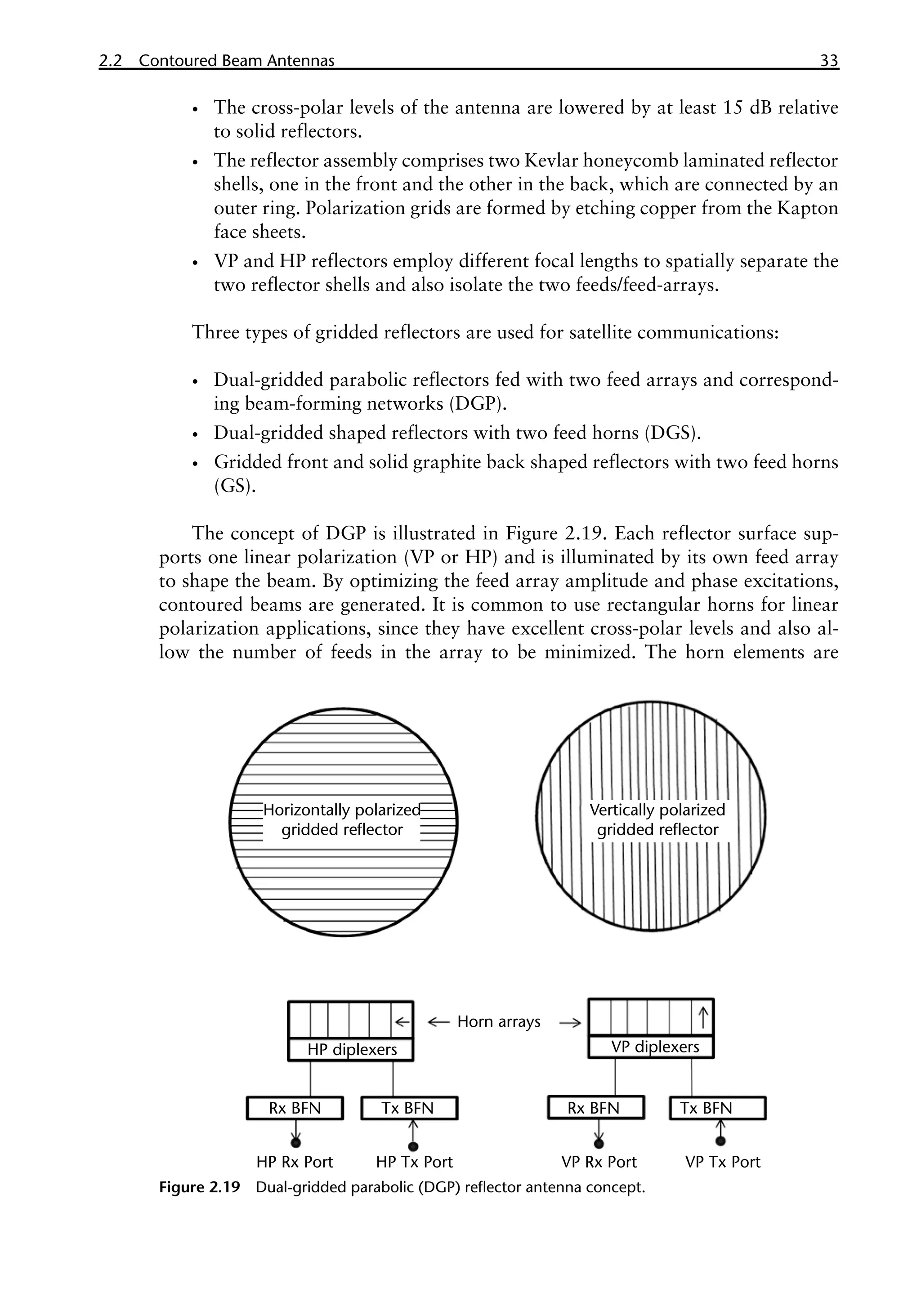
some cases on the nadir deck as well. Fixed smaller reflectors without deployment
are placed on the nadir deck of the spacecraft along with tracking, telemetry, and
command antennas and global horns. The majority of the reflectors employ an off-
set configuration to avoid blockage by the feed(s) and/or subreflectors. The feeds
for all of the reflectors are fixed on the east-west corners of the spacecraft and on
the nadir deck. This is due to the fact that the feed assemblies carry high power and
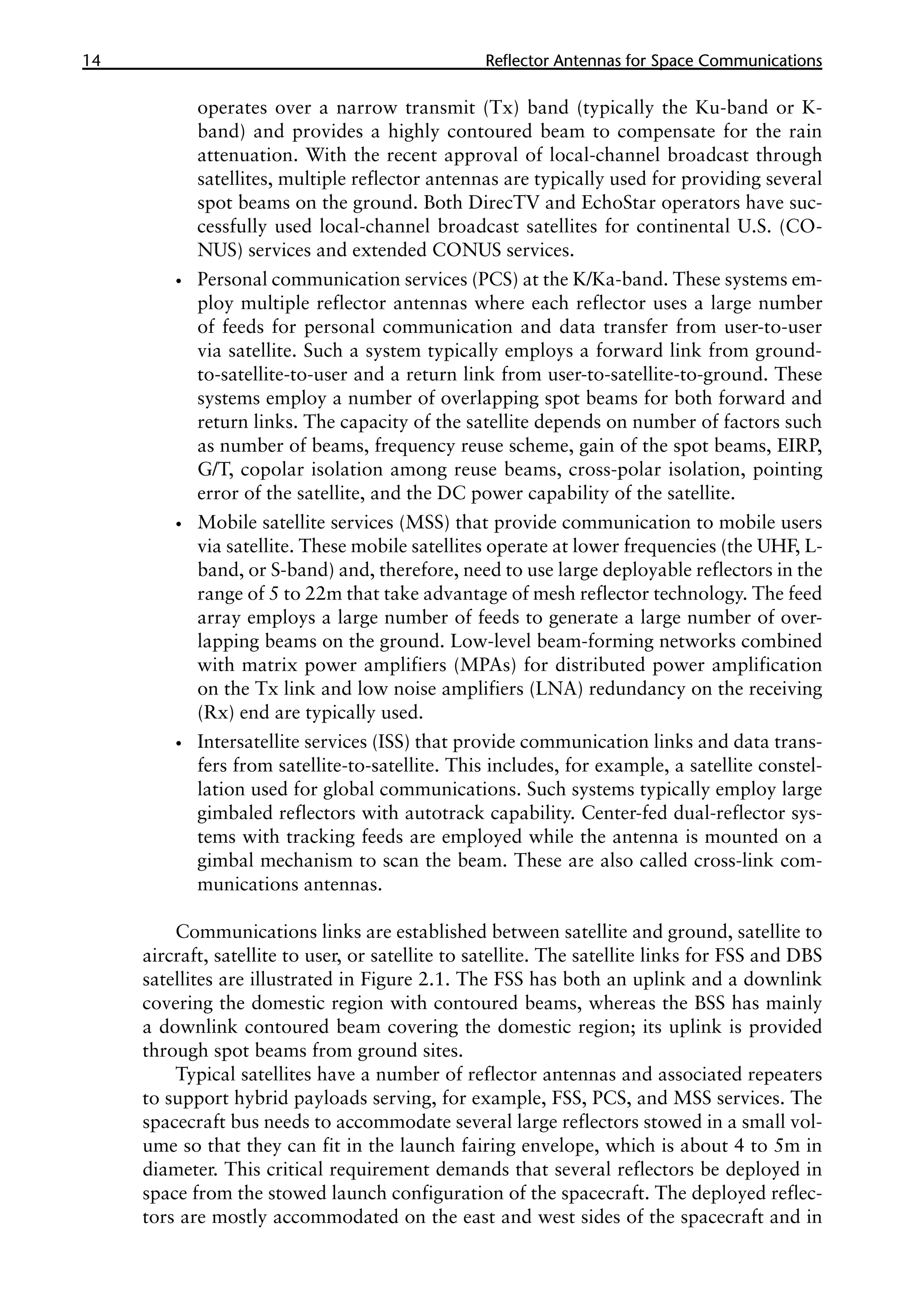
are sensitive to passive intermodulation (PIM). Figure 2.2 shows a typical satellite
in the deployed configuration. Solar panels are deployed along the north-south
directions to track the sun.
The payload for any satellite service includes the antenna subsystem and the
repeater subsystem. The antenna provides the desired radiation characteristics in
terms of beam shape tailored to the coverage region, required gain to close the
communication links, desired polarization (either single or dual), diplexing func-
tion between the Tx and Rx bands, high cross-polar isolation for polarization reuse
systems, copolar isolation outside the coverage, and sidelobe shaping as desired by
the customer needs.
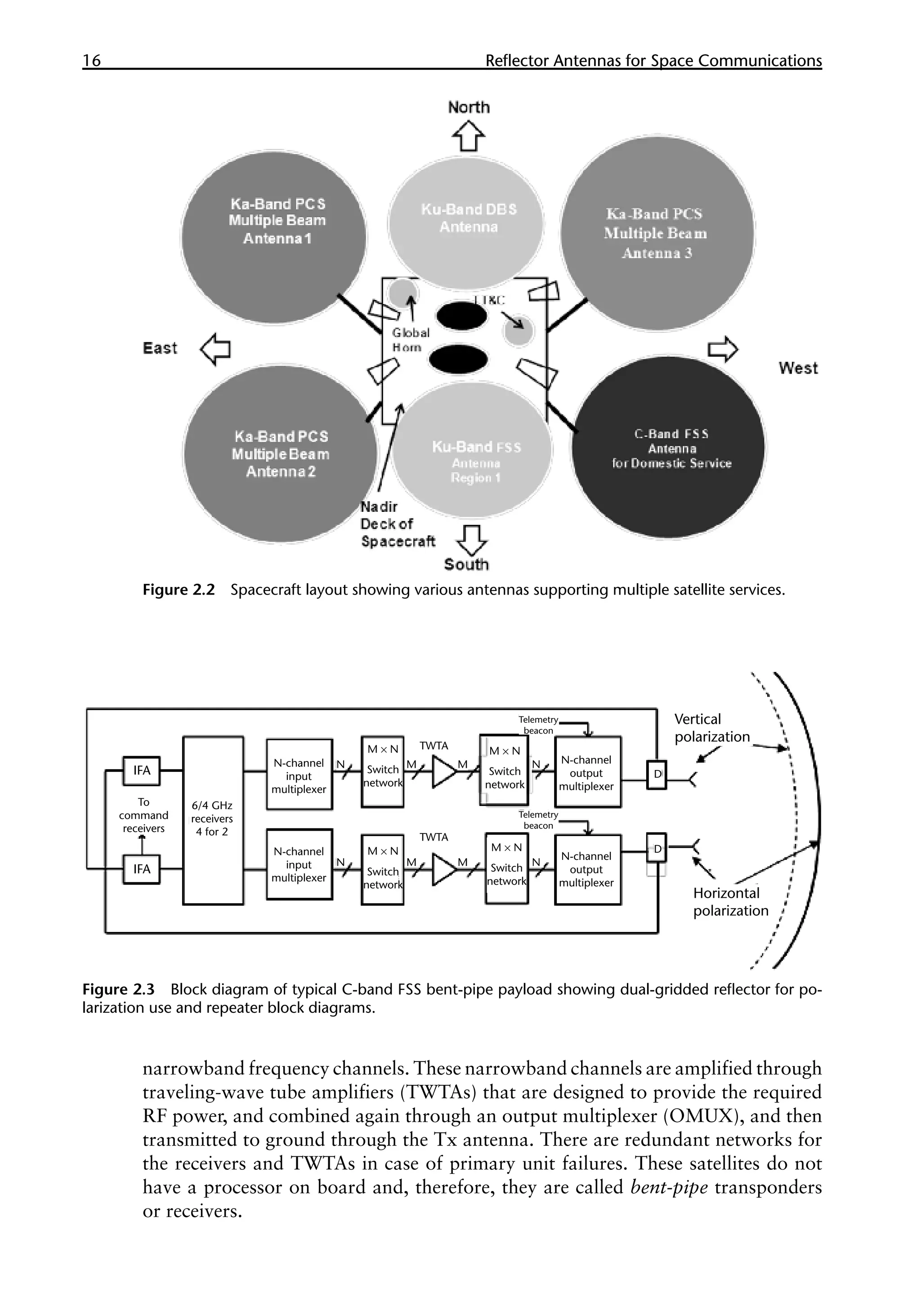
Figure 2.3 shows the block diagram for a bent-pipe satellite payload providing
FSS service. The reflector antenna in this example employs a gridded reflector with
two overlapping surfaces where the front reflector provides vertical polarization
and the back surface provides horizontal polarization. Each reflector is shaped to
provide a contoured beam over the coverage region and is fed with its own horn
with either vertical or horizontal polarization. Each feed is diplexed to isolate the
Tx and the Rx frequency bands. On the receiving side, the antenna receives the
RF signals from ground. The uplink signals go through the input filter assembly
(IFA), receivers that downconvert the 6-GHz signals to 4-GHz signals, and then
through input multiplexers (IMUX) that separate the wideband signal into various
Figure 2.1 Illustration of the various communication links for satellite communications. (© 1985
IEEE. From [13].)
Direct broadcast satellite
Uplink
Downlink
TT&C
link
Communication link
(uplink and downlink)
Domestic satellite (FSS)
16 �������������������������������������������
Reflector Antennas for Space Communications
narrowband frequency channels. These narrowband channels are amplified through
traveling-wave tube amplifiers (TWTAs) that are designed to provide the required
RF power, and combined again through an output multiplexer (OMUX), and then
transmitted to ground through the Tx antenna. There are redundant networks for
the receivers and TWTAs in case of primary unit failures. These satellites do not
have a processor on board and, therefore, they are called bent-pipe transponders
or receivers.
Figure 2.2 Spacecraft layout showing various antennas supporting multiple satellite services.
Figure 2.3 Block diagram of typical C-band FSS bent-pipe payload showing dual-gridded reflector for po-
larization use and repeater block diagrams.
N-channel
output
multiplexer
IFA
6/4 GHz
receivers
4 for 2
N-channel
input
multiplexer
IFA
N-channel
input
multiplexer
To
command
receivers
M × N
Switch
network
M × N
Switch
network
N
N
N
N
TWTA M × N
Switch
network
M × N
Switch
network
M
M
M
M
N-channel
output
multiplexer
D
D
Telemetry
beacon
Telemetry
beacon
TWTA
Vertical
polarization
Horizontal
polarization
2.1 Introduction 17
Key system parameters for the satellites are G/T (gain-to-noise temperature
ratio) and EIRP (effective isotropic radiated power). Both of these parameters are
the figures of merit for the satellite design and depend on the antenna gain at both
the Tx and Rx bands. The communication link quality is determined by the signal-
to-noise power ratio, which is defined in decibels as:
( )
 
=  
 
= + + + -
10
10
10log
228.6 10log
L w
Signal Power
SNR
NoisePower
EIRP G T S B
(2.1)
where SL is the system loss in decibels and Bw is the signal bandwidth in hertz.
The EIRP depends on the transmit power, losses from the amplifier output to the
antenna, and the antenna gain. The G/T depends on the Rx antenna gain, antenna
noise temperature, front-end losses, and noise figure of the LNA. The system losses
include free-space path loss from satellite to ground, atmospheric losses, polar-
ization losses, and loss due to satellite pointing errors. The free-space path loss
depends on the distance R between the satellite and ground terminal and the wave-
length. It is given in decibels as:
p
l
 
=  
 
10
4
20log
L
R
P (2.2)
The loss due to pointing error is generally taken care of in the design by ex-
panding the coverage region with the radial pointing error and synthesizing the
shaped beam with the expanded coverage region and computing the minimum
coverage area gain. For a spot beam payload, the gain loss (in decibels) due to
pointing error is given as:
q
 
 
 
= -
2
.
3
3
.
P E
h
P E
L (2.3)
where P.E is the satellite worst-case pointing error, and θ3h is the half beamwidth
at the –3 dB level of the spot beam. For shaped beams the loss is smaller due to
beam spreading. Antenna gain is very important for satellite designers because it
has a significant impact on both the uplink G/T and downlink EIRP. Many design-
ers spend a lot of time optimizing the antenna gain values to the last fraction of a
decibel. Other challenges include minimizing the front-end antenna losses, design-
ing the feed components to meet the high-power handling requirements, meeting
the low PIM requirements, and improving the copolar and cross-polar isolations
of the antenna.
Many types of reflector antennas are used for satellite communications. The
type of reflector antenna depends on the satellite payload requirements and the
accommodation on the spacecraft. Commonly used reflector antennas for com-
munication satellites are:
18 �������������������������������������������
Reflector Antennas for Space Communications
•
• Single-offset reflector (shaped or unshaped).
•
• Dual-reflector Gregorian in both offset and symmetric configurations
(shaped or unshaped).
•
• Gridded reflector for linear polarization reuse (typically shaped surfaces).
•
• Center-fed Cassegrain reflector for intersatellite links and offset-fed Casseg-
rain reflector.
•
• Large deployable mesh reflectors for mobile services.
•
• Single reflector imaging antennas.
•
• Dual-reflector antennas for large scan applications [side-fed offset Casseg-
rain (SFOC) and front-fed offset cassegrain (FFOC) antennas].
•
• Confocal reflector antenna.
Some of these reflector antennas are discussed in this chapter; others are presented
in other chapters of this three-volume handbook.
2.2 Contoured Beam Antennas
The contoured beam antennas are the most widely used type in satellite communi-
cations. They are also called shaped beam antennas. These antennas provide down-
link and/or uplink beams that are tailored to fit the geographic coverage region as
seen from a geostationary satellite from a given orbital slot. Contoured beams can
be generated using phased arrays or reflectors. Phased arrays have these limita-
tions: narrow bandwidth, lower efficiency of SSPAs, higher DC power dissipation,
increased delivery schedule, and increased cost and mass. Reflector antennas are
most commonly used for contoured beam applications and other satellite applica-
tions. Offset-fed reflector configurations (single or dual) are suitable for eliminating
the geometrical blockage caused by feeds/subreflectors and are simpler to accom-
modate on spacecraft. Two methods are used to generate a contoured beam on the
ground from a satellite using reflector antennas: (1) a parabolic reflector that is fed
with a feed array and (2) a shaped reflector with a single feed.
Satellite payloads prior to 1990 employed parabolic reflectors with a large
number of feed horns [5, 6]. The RF signals to the feed array are combined through
a beam-forming network (BFN) with appropriate amplitude and phase weight-
ings that are designed to shape the beam. The BFN is realized using a waveguide
medium at the Ku-band and higher bands and using a TEM-line medium (also
referred as square-ax medium) at the C-band and lower bands to reduce mass. It
is designed using a number of couplers with different coupling values, line lengths
for phase optimization, phase-slope equalizers for maintaining the phase distribu-
tion over the frequency band, and filters to reject frequencies outside the band.
Because of the bandwidth limitation of the BFN, the parabolic reflector with feed
array requires two such antennas: one for transmitting and another for receiving,
which makes it expensive and heavy. The shaped reflector with a single feed avoids
the need for a BFN and typically requires a single wideband antenna supporting
both Tx and Rx beams. The Tx and the Rx frequency bands are separated through
2.2 Contoured Beam Antennas 19
a diplexer. The two methods of generating the contoured beams are illustrated in
Figure 2.4.
2.2.1 Single-Offset Shaped Reflector Antenna for Contoured Beams
This section describes the single-offset solid reflector used for contoured beam
applications. The reflectors are typically made of graphite material for thermal
stability and lower mass. The primary objective of the design is to maximize the
Figure 2.4 (a) Schematic of parabolic reflector with multiple feeds and BFN for contoured beam
applications. The Rx antenna is similar to the Tx antenna except for the frequency difference. (b)
Schematic of shaped reflector antenna with single feed for contoured beam applications. OMT =
ortho-mode transducer, DIPL = diplexer, Tx = transmitting function, Rx = receiving function, VP =
vertical polarization, HP = horizontal polarization. (© 1999 IEEE. From [18].)
F F F
Transmit BFN
Receive reject filters
Offset parabolic reflector
(a)
(b)
OMT
DIPL DIPL
Tx
VP
Tx
HP
R x
VP
R x
HP
Shaped Reflector
20 �������������������������������������������
Reflector Antennas for Space Communications
minimum gain over the coverage region. The coverage region is irregularly shaped
to fit a domestic country as seen by the satellite or a region comprising several coun-
tries. Other secondary objectives include:
•
• Maximize the cross-polar isolation over the coverage.
•
• Maximize the copolar isolation among countries/regions that could poten-
tially use the same frequencies.
•
• Minimize the antenna losses, including those from the feed assembly, reflec-
tor manufacture (surface errors), and thermal distortion.
•
• Maximize the power handling capability of the feed components.
•
• Minimize the interference due to PIM products.
The advantages of a shaped reflector relative to a conventional parabolic re-
flector with a feed array are better antenna directivity due to lower spillover losses,
lower insertion loss due to elimination of the BFN, better gain and cross-polar
performance due to avoidance of mutual coupling effects among the feed elements,
and amplitude and phase variations of the BFN over the frequency and thermal
ranges.
The reflector geometry needs to be selected first based on the overall satellite
system requirements and the spacecraft constraints. Typical satellites carry hybrid
payloads on the spacecraft that cater to multiple services from a single satellite.
Several reflector antennas may need to be accommodated on the spacecraft that
must fit the limited launch fairing of mostly 4m (in some cases 5m) in the stowed
configuration. The reflectors are generally deployed with the feed assembly fixed-
mounted on the spacecraft.
The key design parameters for the shaped reflector are reflector diameter (D),
focal length (F), offset clearance (h), feed illumination taper or size, and the fre-
quency bandwidth covering both the Tx and Rx bands. The reflector size is dic-
tated by the system and spacecraft requirements. The focal length is dictated by
the cross-polar requirements and the beam squint for circular polarizations. The
F/D ratio needs to be in the range of 0.8 to 1.4, which is a compromise in terms
of achieving good cross-polar isolation and minimizing the beam squint for CP
versus mechanical constraints to minimize the deployment boom and mass. The
offset clearance h is selected such that there is no blockage from the feed assembly
over the coverage region. Good design practices impose a blockage-free condition
where the coverage region is expanded by about 3 deg. Figure 2.5 illustrates the
geometrical parameters of the reflector antenna. The angular parameters of the
starting offset parabolic reflector prior to shaping are given as:
( )
q - -
 
   
 
 
 
+
 
 
= ±  
 
+
 
 
-
-
 
   
 
 
 
1 1
2,1 2 2
1
ta
t n
2
4
a
4
n
D h h
h
D h F
F
F
F
(2.4)
q q q
= -
0 2 1
( ) 2 (2.5)
2.2 Contoured Beam Antennas 21
q q q
= +
*
1 0 (2.6)
The angle θ0 determines the feed illumination taper on the reflector and is designed
with a minimum taper of 15 dB at the lowest frequency of the band(s). It is impor-
tant when selecting the offset clearance h that consideration be given to maintaining
a blockage-free condition for all coverage angles of the contoured beam from the
antenna boresight. The maximum angle for blockage-free condition θsm depends
on the offset clearance, focal length, and the diameter d of the feed and is given as:
( )
q
q
q
- -
 
   
  -
 
= -
   
 
-  
-
 
   
 
*
1 1
2 2
*
0.5 cos
tan tan
0.5 cos
4 4
sm
h h d
h d
F F
F F
(2.7)
For linear polarization applications, the cross-polar isolation is intrinsically
poor because of the offset configuration of the reflector. Cross-polar suppression
in addition to the copolar gain contours needs to be incorporated as part of the
synthesis for reflector shaping. However, for circular polarization applications, the
reflector does not induce any cross-polar components and the feed assembly cross-
polar levels due to the feed horn and polarizer dominate the antenna level cross-
polar isolation. The offset geometry causes beam squint in the offset plane and is
given approximately as [7, 8]:
l q
q
p
-  
=  
 
*
1 sin
sin
4
L
BS
F
(2.8)
The beam squint occurs in the plane of symmetry and the direction depends on
the sense of polarization (LHCP or RHCP). The feed location needs to be displaced
Figure 2.5 Geometrical parameters of the shaped reflector antenna. (© 2003 IEEE. From [19].)
h
D
F
θ₂
θ₁
θ₀
θ *
Non-linear phase distribution
of shaped reflector antenna in
the aperture plane of the reflector
22 �������������������������������������������
Reflector Antennas for Space Communications
slightly from the reflector focus in order to compensate for the beam squint for
single sense of circular polarization application or can be accounted for in the shap-
ing process.
Reflector synthesis can be carried out by two methods. An indirect method
involves designing the surface of the reflector such that it produces a given aperture
field, which is known to generate a desired far field. The synthesis of the desired
aperture field most often involves the iterative solution of partial differential equa-
tions that describe the relationship between feed and aperture power distributions,
and is based on geometrical optics (GO).
The second method is a direct method and is the method most oftenly used.
In this method, the reflector system is designed such that it produces a prescribed
far field. The reflector is initially defined in terms of a base surface, for example, a
paraboloid, and a perturbed surface is then superimposed on the base surface [9].
The perturbed surface is defined in terms of a series expansion function such as
Zernike polynomials or cubic spline functions. At each iterative stage the far field
is calculated at a number of sample points and compared to the objective func-
tion. This is used to change the coefficients of the expansion until a better match
is achieved. Physical optics is used to obtain the far field in each calculation. Typi-
cally the expansion functions used are cubic splines because they provide the best
fit for rapidly varying surfaces due to their local nature. Zernike polynomials are
also used to define the surface. TICRA’s POS and GRASP commercial software
programs [10] are used as industry standards for synthesis and analysis of shaped
reflector contoured beam antennas. A flowchart for the contoured beam design is
illustrated in Figure 2.6.
The performance of the contoured beam is sometimes defined in terms of gain
area product (GAP). An ideal GAP for a uniformly illuminated coverage area with
no radiation outside the coverage is 41,253 [4p steradians = 4*π*(180/π)*(180/π)].
This is not practical because it requires an infinite size reflector with no spillover
and other losses. The GAP for contour beams is generally in the range of 6,000 to
25,000 and is highly dependent on the reflector size relative to wavelength (D/λ),
bandwidth of operation, the coverage shape, cross-polar isolation, and sidelobe
isolation outside the coverage region. The gain in GAP is the minimum gain over
the coverage region, which usually occurs near the edge of the coverage. The gain
variation over the coverage region designed with uniform weighting depends on
the reflector size and the coverage area and varies in the range of 1.0 to 4.0 dB. A
larger reflector tends to have more uniformly shaped contoured beams with less
gain variation over the coverage region and hence provides better edge-of-coverage
gain.
Ku-Band Contoured Beam Design
Examples of the contoured beam design for Ku-band FSS and BSS payloads are
discussed in this section. Two coverage regions, the continental United States (CO-
NUS) and South America (SA), are considered from a geostationary satellite at a
101° W orbital slot. The coverage areas on ground as seen from a geostationary
satellite are 13 square degrees for CONUS and 26.45 square degrees for SA. The
reflector is illuminated with a corrugated feed having a minimum illumination of
14 dB at Tx frequencies and 19 dB at Rx frequencies. Such high illumination tapers
2.2 Contoured Beam Antennas 23
(exceeding 14 dB) are required in order to minimize the spillover losses. Various
reflector sizes are considered in this parametric design and results are summarized
here for the following FSS and BSS design cases:
Case 1: FSS antenna with Tx band of 10.95 to 12.2 GHz and Rx band of 14.00
to 14.50 GHz.
Case 2: BSS antenna with Tx band of 12.20 to 12.70 GHz.
Synthesized gain contours of Case 1 over CONUS coverage are shown for
transmitting and receiving in Figures 2.7 and 2.8, respectively. Minimum coverage
gain is 31.7 dBi while the peak gain is 33.1 dBi. There is a 1.4 dB gain variation
over the coverage region. Larger variation can be expected if copolar isolation of
more than 27 dB needs to be achieved over another spatially isolated region outside
CONUS (for example, Brazil). The minimum coverage gain will also be reduced by
about 0.5 to 1.0 dB if stringent copolar isolation requirements need to be met. Gain
contours over South America for Case 1 are shown in Figures 2.9 and 2.10 for the
transmitting and receiving bands, respectively. Minimum gain over the coverage is
29.25 dBi. This gain is 2.45 dB lower than the CONUS gain due to the larger cover
region (the SA coverage area is about 2.03 times larger than the CONUS coverage
area). Gain variation is about 1.25 dB for this case with no sidelobe constraints.
Case 2 BSS transmit-only design results with weighted coverage gain require-
ments over the CONUS and SA regions are shown in Figures 2.11 and 2.12, respec-
tively. The weighted coverage requirements are needed to compensate for the larger
Figure 2.6 Flowchart describing an exemplary iterative procedure for designing multiband contoured
beams.
Start Design Opt.
Start Feed Optimization
(Profile, Corrugation,
geometry, Matching Selection
Define Coverage Reqts. &
Freq., Gain, Polarization
Define Reflector
Geomtry (Size,
Offset, Focal Length)
Define Feed Reqts.
(Taper, X-pol, P.C) Complete Feed
Opt
NO Have the Feed
Reqts. Met?
YES
Start Reflector
Surface Optimization
Evalutate Antenna
Perf. at Ku Tx, Ku Rx,
Ka Tx & Ka Rx
Contoured Beam Ant
Design Finished END
NO
YES Have the Coverage
Reqts. Met at 4
Freq. Band?
24 �������������������������������������������
Reflector Antennas for Space Communications
Figure 2.7 Computed gain contours of contoured beam for CONUS coverage at Tx band. (Case 1: 2.3m
shaped reflector antenna is designed over FSS Tx and Rx bands.)
30.50
31
31
31.80
32.40
32.40
-4.00 -2.00 0.00 2.00 4.00
Theta*cos(phi) in Degrees
2.00
3.00
4.00
5.00
6.00
7.00
8.00
Theta*sin(phi)
in
Degrees
Figure 2.8 Computed gain contours of contoured beam for CONUS coverage at Rx band. (Case 1: 2.3m
shaped reflector antenna is designed over FSS Tx and Rx bands.)
2.2 Contoured Beam Antennas 25
atmospheric attenuation in the rain regions of the coverage with higher antenna
gain requirements. Peak to edge variations are larger in the weighted coverage cases
(>4 dB) as seen from the plots. Typical cross-polar isolation contours of the FSS
antenna with LP are shown in Figure 2.13, which illustrates worst-case cross-polar
discrimination (XPD) values of better than 23 dB. The XPD is defined as the worst-
case ratio of the copolar signal to the cross-polar signal evaluated at each point
within the coverage region. Higher XPD values can be achieved by using longer a
F/D of the reflector and shaping the surface for XPD suppression.
The GAP depends primarily on the reflector diameter (D/λ) and the coverage
area and to a certain extent on the shape of the coverage. Tables 2.1 and 2.2 sum-
marize results for several designs carried out for the CONUS and SA areas at the
C-band and Ku-band using the reflector diameter as a variable. The GAP varies
from 6,222 to 15,575 for C-band designs and varies from 13,303 to 23,037 for
Ku-band designs. The following conclusions are drawn from the results shown in
the table and the industry experience:
•
• The GAP or minimum coverage gain is proportional to the reflector diameter
D/λ. Larger reflectors have better shaping capability with lower peak to edge
gain variation.
Figure 2.9 Computed gain contours of contoured beam for SA coverage at Tx band. (Case 1: 2.3m
shaped reflector antenna is designed over FSS Tx and Rx bands.)
26 �������������������������������������������
Reflector Antennas for Space Communications
•
• Larger coverage areas have increased GAP due to better shaping potential
with more uniform directivity contours over the coverage and with less peak
to edge variation in directivity.
•
• The GAP also depends on the amount of cross-polar suppression within
the coverage region. Note that a single-offset reflector produces significant
cross-polar levels for linear polarization (about 20 dB XPD) and needs to be
suppressed by about 15 dB in order to meet the cross-polar isolation require-
ments of better than 30 dB. This suppression can be achieved through shap-
ing of the reflector surface at the expense of lowering the minimum coverage
area directivity by about 0.5 dB.
•
• The GAP also depends on the copolar isolation requirements outside the
coverage region. It depends on the spatial distance of other service regions
from the designed coverage and the area that needs to be suppressed. The
EOC gain impact could be anywhere from 0.0 to 1.0 dB.
Results of the minimum edge of coverage gain as a function of the reflector size
are shown in Figure 2.14. Practicing engineers are often interested in how much
gain improvement can be made for contoured beam designs if a different reflector
Figure 2.10 Computed gain contours of contoured beam for SA coverage at Rx band. (Case 1:
2.3m shaped reflector antenna is designed over FSS Tx and Rx bands.)
2.2 Contoured Beam Antennas 27
size is shown. Figure 2.15 shows the EOC gain delta as a function of the reflector
size. The gain values with a 1.0m reflector size are used as a reference in the plot
shown in Figure 2.15.
2.2.2 Dual-Offset Gregorian Reflectors
The dual-reflector shaped Gregorian is widely used for both FSS and BSS applica-
tions. It gives better cross-polar performance relative to a single shaped reflector
for linear polarizations. Also, it has two reflector surfaces that provide better shap-
ing potential of the contoured beams. It is well known that an offset dual-reflector
antenna can be designed to eliminate geometrical optics cross-polarization in the
main reflector aperture [11, 12]. The feed horn is typically larger since it illuminates
the smaller subreflector with an illumination taper of better than 15 dB. The sub-
reflector is generally in the near-field region of the feed horn and near-field analysis
of the feed horn is required through the use of spherical harmonics. Diffraction ef-
fects may increase the cross-polarization in a practical offset dual-reflector system,
especially one with small subreflectors. To avoid this, an enlarged subreflector size
is often used, particularly at C-band frequencies. Typical sizes of Gregorian reflec-
tors are:
•
• Deployable reflectors: 2m and higher main and 0.7m sub (at Ku-band).
•
• Earth deck: 0.8 to 1.5m main and 0.45m sub (Ku-band).
•
• Steerable beam applications: 0.8 to 1.0m main and 0.4m sub.
Figure 2.11 Computed gain contours of weighted contoured beam for CONUS coverage at Tx band. (Case
2: 2.3m shaped reflector antenna is designed over BSS Tx bands.)
28 �������������������������������������������
Reflector Antennas for Space Communications
The geometry of the dual-offset Gregorian antenna that satisfies the low cross-
polar Mizuguchi condition [11] is illustrated in Figure 2.16. The geometry of the
system can be specified by the following six parameters:
•
• Diameter of the main reflector, D.
•
• Focal length of the main reflector, F.
•
• Half distance between the focal points of the subreflector, C.
•
• Eccentricity of the sub reflector, e.
•
• Angle between the main reflector and subreflector axis, α.
•
• Angle between the subreflector and feed axis, β.
The Mizuguchi condition, for unshaped reflectors, is given by:
( ) ( )
α β
=
tan 2 tan 2
M (2.9)
where M is the magnification and is related to the eccentricity as follows:
Figure 2.12 Computed gain contours of weighted contoured beam for SA coverage at Tx band.
(Case 2: 2.3m shaped reflector antenna is designed over BSS Tx bands.)
2.2 Contoured Beam Antennas 29
( ) ( )
= + -
1 1
M e e (2.10)
For ellipsoidal subreflectors, e is less than 1.
Any reflector shaping will typically degrade the cross-polar performance, even
when the starting geometry satisfies the Mizuguchi condition.
The cross-polar discrimination (XPD) contours computed at the Ku-band with
a 2.3m main reflector size over the CONUS and SA are plotted in Figures 2.17 and
Figure 2.13 Cross-polar isolation contours of FSS Ku-band antenna over the CONUS area. XPD is better than
23 dB and could be improved to 25 dB by shaping the surface with XPD constraints.
Table 2.1 Contoured Beam Design Results at C-Band (EOC
Directivity as a Function of Reflector Diameter)
Reflector
Diameter
(m) D/λ
CONUS
(13 sq. degrees)
C-Band
South America
(26.45 sq. degrees)
C-Band
EOC
Directivity
(dBi) GAP
EOC
Directivity
(dBi) GAP
1.0 12.33 26.8 6,222 25.2 8,758
1.3 16.03 27.8 7,833 26.0 10,530
1.5 18.50 28.4 8,994 26.3 11,283
1.8 22.20 28.8 9,862 26.9 12,955
2.0 24.67 29.0 10,326 27.3 14,205
2.3 28.37 29.4 11,323 27.5 14,874
2.6 32.07 29.6 11,856 27.7 15,575
30 �������������������������������������������
Reflector Antennas for Space Communications
Table 2.2 Contoured Beam Design Results at Ku-Band
(EOC Directivity as a Function of Reflector Diameter)
Reflector
Diameter
(m) D/λ
CONUS
(13 sq. degrees)
Ku-Band
South America
(26.45 sq. degrees)
Ku-Band
EOC
Directivity
(dBi) GAP
EOC
Directivity
(dBi) GAP
1.0 36.50 30.1 13,303 27.9 16,309
1.3 47.45 30.7 15,274 28.4 18,299
1.5 54.75 31.0 16,366 28.7 19,608
1.8 65.70 31.2 17,137 28.9 20,532
2.0 73.00 31.4 17,945 29.1 21,499
2.3 83.95 31.7 19,228 29.25 22,255
2.6 94.90 31.9 20,135 29.4 23,037
Figure 2.14 EOC directivity variation with the reflector size for different contoured beam designs.
Figure 2.15 EOC directivity improvement with increased reflector size for different contoured
beam designs.
2.2 Contoured Beam Antennas 31
2.18, respectively. The XPD levels are better than 33 dB for both coverage regions.
The copolar patterns are similar to the single shaped reflector patterns shown in
Figures 2.7 and 2.9. The XPD with Gregorian is about 10 dB better than the single-
offset reflector for linear polarizations.
Figure 2.16 Geometry of the dual-offset shaped Gregorian antenna for FSS and BSS applications.
The subreflector is typically oversized to minimize diffraction effects.
Figure 2.17 Cross-polar discrimination contours of a dual-offset shaped Gregorian antenna over the CONUS
area at the Ku-band Tx using a 2.3m main reflector. The XPD is better than 33 dB over the CONUS area.
32 �������������������������������������������
Reflector Antennas for Space Communications
2.2.3 Gridded-Reflector Antennas
Gridded reflectors are used for dual-linear polarization FSS applications at C-band
and Ku-band. The first dual-gridded reflector antenna was developed by SPAR
Aerospace Limited and was successfully flown on an RCA Satcom satellite in 1975
and later by Hughes Aircraft Company. It employs two different reflectors with
overlapped apertures where the front reflector surface is gridded and the grids are
laid in such a fashion that they are parallel to either vertical or horizontal polar-
izations and the back reflector is either gridded (orthogonal to the front-reflector
grids) or solid graphite supporting the opposite sense of linear polarization relative
to the front reflector. Each of the two reflectors is illuminated by its own feed horn
or horn arrays. The main features and advantages of the gridded reflectors over
solid reflectors are as follows:
•
• Provides twofold frequency reuse through orthogonally polarized (VP and
HP) beams.
•
• The antenna assembly consists of two reflectors with orthogonal grids shar-
ing a common aperture.
Figure 2.18 Cross-polar discrimination contours of a dual-offset shaped Gregorian antenna over
the SA area at the Ku-band Tx using a 2.3m main reflector. The XPD is better than 33 dB over SA.
2.2 Contoured Beam Antennas 33
•
• The cross-polar levels of the antenna are lowered by at least 15 dB relative
to solid reflectors.
•
• The reflector assembly comprises two Kevlar honeycomb laminated reflector
shells, one in the front and the other in the back, which are connected by an
outer ring. Polarization grids are formed by etching copper from the Kapton
face sheets.
•
• VP and HP reflectors employ different focal lengths to spatially separate the
two reflector shells and also isolate the two feeds/feed-arrays.
Three types of gridded reflectors are used for satellite communications:
•
• Dual-gridded parabolic reflectors fed with two feed arrays and correspond-
ing beam-forming networks (DGP).
•
• Dual-gridded shaped reflectors with two feed horns (DGS).
•
• Gridded front and solid graphite back shaped reflectors with two feed horns
(GS).
The concept of DGP is illustrated in Figure 2.19. Each reflector surface sup-
ports one linear polarization (VP or HP) and is illuminated by its own feed array
to shape the beam. By optimizing the feed array amplitude and phase excitations,
contoured beams are generated. It is common to use rectangular horns for linear
polarization applications, since they have excellent cross-polar levels and also al-
low the number of feeds in the array to be minimized. The horn elements are
Figure 2.19 Dual-gridded parabolic (DGP) reflector antenna concept.
34 �������������������������������������������
Reflector Antennas for Space Communications
attached to diplexers in order to separate the Tx and Rx frequency bands. The two
outputs of the diplexers for each array element are combined through two sepa-
rate beam-forming networks, one for transmitting and the other for receiving. The
BFNs are implemented in waveguide (Ku-band) or TEM-line media (C-band) using
hybrid couplers, loads, and line lengths in order to achieve the desired excitations.
Key aspects of the BFN are high power handling, low insertion loss, and minimal
variation of excitations over frequency and over temperature range.
The DGS antenna configuration is similar to the one shown in Figure 2.19 with
the exception that the reflectors are shaped surfaces instead of parabolic and each
feed array is replaced with a feed horn. Advantage of the DGS relative to DGP is
that it eliminates the need for BFNs, which results in a significant mass, cost, and
schedule savings, lower losses, and better RF performance. The GS configuration
is similar to DGS, but the rear surface is solid graphite surface instead of gridded
surface. The GS gridded reflectors are most widely used nowadays for fixed satel-
lite services at C-band and Ku-band.
The gridded reflector antennas have two major types: laterally displaced re-
flectors and a rotated reflector system, as illustrated in Figure 2.20. The laterally
displaced system has partially overlapped reflectors and the rotated reflector sys-
tem has completely overlapped reflectors that are more compact. The feeds of the
rotated reflector system are also rotated, providing more spacing between the two
horns/horn arrays. The rotated reflector system is most commonly used in space-
crafts due to compact size. The RF analysis of the gridded reflectors needs to take
into account the various contributions from the two reflectors, two feeds, and two
polarizations for detailed copolar and cross-polar analyses. This is illustrated in
Figure 2.21 and the various contributions are explained here:
Figure 2.20 Illustration of gridded reflector antenna types. Laterally displaced antenna has partial
overlap of the two apertures while the rotated system has complete overlap.
Laterally Displaced
Gridded Reflector
Rotated Gridded
Antenna System
2.2 Contoured Beam Antennas 35
CA,1: copolar signal from feed A reflected from reflector surface S1.
XA,1: cross-polar signal from feed A reflected from surface S1 with grid suppres-
sion of >12 dB.
CB,2: copolar signal from feed B reflected from rear reflector surface S2.
XB,1: cross-polar signal from feed B reflected from surface S1 without any sup-
pression. This signal has the same polarization of CA,1 and typically scans
outside the coverage due to feed separation. It is important to keep this contri-
bution far outside the coverage so that it does not impact the copolar contours
from feed A. Increased feed separation keeps this signal within the coverage
region low.
XA,2: cross-polar signal from feed A reflected from rear surface S2 without any
suppression. This signal has the same polarization as CB,2, but scans outside the
coverage region due to spatial separation of the two feeds. It is important to
keep this contribution far outside the coverage region with sufficient separation
between the two feeds.
XB,2: cross-polar signal of feed B leaking through the front shell and reflected
back from the front shell out to the rear reflector. This contribution is very low
and negligible.
The geometry of the gridded reflector to determine the minimum thickness
between the two surfaces is shown in Figure 2.22. The spacing between the shells’
“T” is determined based on satisfying the following conditions:
( ) ( )
- - - + >
1 3 1 2 0
Z Z F F T (2.11)
( ) ( )
- - - + >
2 4 1 2 0
Z Z F F T (2.12)
The Z variables in the above equations can be obtained using:
Figure 2.21 Copolar and cross-polar ray mapping of a gridded reflector antenna system.
S1
S2
CA,1
CB,2
XB,1
XA,2
XB,2
XA,1
Random documents with unrelated
content Scribd suggests to you:
Mr. Eisenberg. Now for the record, in the future I will refer
collectively to 774–783 as the standards.
The Chairman. They were all written by the same person?
Mr. Cole. Yes, Your Honor.
Mr. Eisenberg. Mr. Cole, were these the only standards or
potential standards from which you had to draw, or were a larger
group of potential standards furnished to you?
Mr. Cole. I saw a larger group of papers of potential standards.
Mr. Eisenberg. Can you state the circumstances under which this
larger group was given to you?
Mr. Cole. I came to your office and reviewed a very large group
of papers, and I pointed out what I would regard as a cross section
or representative sample from that larger group of papers.
Mr. Eisenberg. And can you explain the basis on which you took
the actual standards 774–783, that is, on which you selected those
documents from the larger possible group of documents which might
have served as standards?
Mr. Cole. Well, two bases: One, that the writing is fairly clear and
legible; most of these documents are not stained or mutilated in any
way; all the writing can be seen clearly. And, two, I think that this
group of papers gives a complete, reasonably complete record of the
writing habits of the author.
Mr. Eisenberg. Mr. Cole, continuing on these standards for a
moment, have you examined other questioned documents besides
Commission 773 at my request?
Mr. Cole. I have.
Mr. Eisenberg. Do the standards which you selected, that is, items
774 through 783, in your opinion provide a sufficient basis for
comparison of the other questioned documents which you also
examined?
Mr. Cole. They do provide a satisfactory basis for comparison.
Mr. Eisenberg. Are they sufficiently close in time, both to 773 and
to the other questioned documents which you have examined?
Mr. Cole. Yes, sir.
Mr. Eisenberg. Does handwriting change over the course of time,
Mr. Cole?
Mr. Cole. Handwriting does change over the course of time, but
usually fairly large periods are involved, 5 or 10 years or such.
Mr. Eisenberg. Is there any variation in the writing instruments
which were used to produce the various standards?
Mr. Cole. Yes; I think a variety of instruments were used.
Mr. Eisenberg. Does this affect your ability to use the standards as
against the questioned documents or as against those questioned
documents produced with other writing instruments?
Mr. Cole. It does not adversely affect my ability to make a
comparison.
Mr. Eisenberg. That is, you are able to compare a document
produced by a ballpoint pen with a document produced by a
fountain pen and vice versa?
Mr. Cole. Yes, sir.
Mr. Eisenberg. Do the standards show both cursive writing and
handprinting?
Mr. Cole. Yes.
Mr. Eisenberg. Can you explain meaning of the term "cursive
writing"?
Mr. Cole. Cursive means connected writing, as the term is used,
with a running connected hand, whereas handprinting refers to the
separate writing of letters without the connection of letters and
usually involves a somewhat different style for the formation of
letters, that is Roman capital letters or the lower case letters.
Mr. Eisenberg. Cursive writing then is the type of writing which we
normally use, which connects—in which the letters are connected,
the type which is taught in schools?
Mr. Cole. Yes, sir.
Mr. Eisenberg. Mr. Cole, some of the standards which are in the
group 774 to 783 are photographs rather than originals.
Mr. Cole. That is correct.
Mr. Eisenberg. Does a photograph in your opinion provide a
sufficient standard on which to base a conclusion as to a questioned
document?
Mr. Cole. Well, I believe these particular photographs are
satisfactory for that purpose.
Mr. Eisenberg. Would you draw a conclusion as to the origin of a
questioned document if your only standard was a photograph?
Mr. Cole. If the photographs were comparable to the
photographs we have in this case; yes.
Mr. Eisenberg. Mr. Cole, you examined the standards in their
entirety, did you?
Mr. Cole. I did.
Mr. Eisenberg. And you have stated in answer to an earlier
question they were all prepared by the same person, as I
understood it?
Mr. Cole. Yes, sir.
Representative Ford. What is unique about these photographs
that gives you this certainty or——
Mr. Cole. Well, I did not mean to indicate they are of a specially
good quality, but I had in mind the possible existence of other
photographs which would be much poorer and would not provide a
satisfactory basis. I think that on these photographs I can see
everything that is necessary to see to appreciate writing habit.
Mr. Eisenberg. Now, when you say the standards were all written
by one person, that is with the exception of initials put on by law
enforcement officers and the like?
Mr. Cole. That is correct.
Mr. Eisenberg. Now, Mr. Cole, returning to 773, the questioned
document, can you tell the Commission how you formed the
conclusion that it was prepared by the author of the standards, that
is, what steps you followed in your examination and comparison,
what things you considered, what instruments or equipment you
used, and so forth?
Mr. Cole. I made first a careful study of the writing on
Commission Exhibit 773 without reference to the standard writing, in
an effort to determine whether or not this writing contained what I
would regard as a basis for identification, contained a record of
writing habit, and as that—as a result of that part of my
examination, I concluded that this is a natural handwriting. By that I
mean that it was made at a fair speed, that it doesn't show any
evidence of an unnatural movement, poor line quality, tremor, waver,
retouching, or the like. I regard it as being made in a fluent and
fairly rapid manner which would record the normal writing habits of
the person who made it.
I then made a separate examination of the standards, of all of
the standard writings, to determine whether that record gave a
record of writing habit which could be used for identification
purposes, and I concluded that it, too, was a natural handwriting
and gave a good record of writing habit.
I then brought the standard writings together with the
questioned writing for a detailed and orderly comparison,
considering details of letter forms, proportion, pen pressure, letter
connections, and other details of handwriting habit, and as a part of
my examination I made photographs of the standard writings and
brought certain parts of them together on a chart for greater
convenience in comparing the standards with the questioned writing.
The Chairman. Gentlemen, I think it will be necessary for me to
leave now, Congressman Ford, you will preside, will you, please? I
appreciate it.
(Discussion off the record.)
(At this point, the Chief Justice left the hearing room.)
Representative Ford. Proceed.
Mr. Eisenberg. Mr. Cole, you mentioned that the writing in both
the questioned document, 773, and the standard seem to be
produced at a natural speed.
Mr. Cole. Yes.
Mr. Eisenberg. How do you determine that any document is
produced at a natural speed?
Mr. Cole. Because that conforms to a large number of other
specimens that I have examined over a period of years which I knew
to be normal writing. Specifically, it agrees with respect to the
quality of the line, which is reasonably good in this handwriting and
which I would expect to be quite poor in an unnatural specimen, one
that had been made at an abnormally reduced writing speed.
Mr. Eisenberg. Can you expand further on what you mean by
"quality of the line"?
Mr. Cole. Well, quality of line is—refers to the sharpness of the
edges of lines, to the absence of tremor, waver, patching,
retouching, and similar defects.
Mr. Eisenberg. Mr. Cole, could you explain the basis on which you
were able to make an identification of a questioned writing as being
authored by the person who wrote a standard writing?
Mr. Cole. This is based upon the principle that every handwriting
is distinctive, that since the mental and physical equipment for
producing handwriting is different in every individual, each person
produces his own distinctive writing habits. Of course, everyone
learns to write in the beginning by an endeavor to repeat ideal letter
forms, but practically no one is able to reproduce these forms
exactly. Even though a person might have some initial success
during the active period of instruction, he soon departs from these
and develops his own habits. It may be said that habit in
handwriting is that which makes handwriting possible. Habit is that
which makes handwriting efficient. If it were not for the
development of habit, one would he obliged to draw or sketch.
Some habit would be included even in those efforts. But the
production of handwriting rapidly and fluently always involves a
recording of personal writing habit. This has been confirmed by
observation of a very large number of specimens over a long period
of time, and it has further been demonstrated by, on my part, having
a formal responsibility for rendering decisions about the identification
of handwriting based upon an agreement of handwriting habit in
situations where there would be a rigorous testing of the correctness
of these decisions by field investigators, for example, of the law-
enforcement agencies, and a demonstration that these results were
confirmed by other evidence.
This is the basis for identification of handwriting.
Mr. Eisenberg. As I understand it, you mean you would make a
preliminary identification of a suspect on the basis of handwriting
and it has been your experience that field investigation confirms that
determination with additional evidence?
Mr. Cole. This is not what I would call "a preliminary
identification." This would be a formal presentation and formal
report to other persons who are interested in the problem, and the
investigation would be continued from that point.
Mr. Eisenberg. Mr. Cole, is handprinting as well as cursive writing
unique to every individual?
Mr. Cole. Well, I would say much of it is. Not all of it.
Handprinting doesn't always give the same amount of information
about writing habit as does cursive writing.
Mr. Eisenberg. Are you always able to identify the author of a
writing if you have a questioned document and a standard
document?
Mr. Cole. No, sir; not always.
Mr. Eisenberg. And can you expand on that?
Mr. Cole. Well, some handwriting doesn't include enough
distinctive features, or in some cases there may not be enough of it
to give a complete enough record of handwriting habits to be certain
that you have a basis for identification.
Mr. Eisenberg. Do you need a sufficient basis in both the
questioned and the standard?
Mr. Cole. Yes.
Mr. Eisenberg. Do the standards that you have selected provide a
sufficient basis for making identification?
Mr. Cole. They do.
Mr. Eisenberg. Without going into every questioned document
separately, do the questioned documents which you have reviewed
at my request each individually provide a sufficient basis for
comparison?
Mr. Cole. Yes, sir.
Representative Ford. Is there a difference of opinion in your
profession as to how much or how little you need for this purpose?
Mr. Cole. Yes; I think it would vary from one worker to another,
depending upon his experience in the work.
It sometimes happens that a person with limited experience may
go to either one extreme or to the other. He may sometimes be
rather reckless. Other times he may be extremely cautious.
Representative Ford. But the decision you have made in this case
would be what other experts, in your opinion, would agree to?
Mr. Cole. I would say others with whom I am familiar, with whom
I have worked and talked to, corresponded with over the years.
Mr. Eisenberg. Mr. Cole, can you characterize the skill of the
author of the standards and Exhibit 773?
Mr. Cole. I would say it is an average skill.
Mr. Eisenberg. Are some of the standards prepared more skillfully
than others?
Mr. Cole. Yes.
Mr. Eisenberg. Can you account for that at all?
Mr. Cole. I think there is a natural range of the use of skill in
handwriting, possibly depending upon the purpose or the physical
surroundings for producing handwriting or the writing instruments.
When the conditions for producing handwriting are the best, and
one's purpose is a perfectly free expression of his handwriting habit,
then he may produce a better handwriting than when conditions are
poor, such as an awkward writing position or poor writing tools.
Mr. Eisenberg. Mr. Cole, you mentioned earlier that you had
prepared some photographs or charts——
Mr. Cole. Yes.
Mr. Eisenberg. Showing the standards or portions thereof?
Mr. Cole. Yes.
Mr. Eisenberg. Could you produce those charts?
Mr. Cole. Yes, sir.
Mr. Eisenberg. Now, Mr. Cole, you have produced here three large
charts, each entitled "Standard Writing" and bearing the
designations "A," "B," and "C" in the upper left-hand corners. Can
you tell us precisely what is reflected on these charts A, B, and C?
Mr. Cole. These charts show excerpts from the standard writings,
sometimes showing a portion of a line, other times showing a single
word or a block of writing from the standard exhibits.
Mr. Eisenberg. Were these charts, which are in the form of
photographic reproductions, prepared by you or under your
supervision, Mr. Cole?
Mr. Cole. They were.
Mr. Eisenberg. Are they true and accurate reproductions of the
portions of the standard writings they purport to reproduce?
Mr. Cole. They are.
Mr. Eisenberg. Mr. Chairman, may these be admitted as 784A, B,
and C?
Representative Ford. They may be admitted.
(Commission Exhibits Nos. 784A, B, and C were marked and
received in evidence.)
Mr. Eisenberg. Mr. Cole, have you prepared a photograph of
Exhibit 773?
Mr. Cole. I have.
Mr. Eisenberg. Will you produce that photograph, please? Was
that photograph 773 made by you or under your supervision?
Mr. Cole. Yes, sir.
Mr. Eisenberg. And is it a true and accurate reproduction of 773?
Mr. Cole. Yes, it is.
Mr. Eisenberg. May this be admitted as 785, Mr. Chairman?
Representative Ford. It may be.
(Commission Exhibit No. 785 was marked and received in
evidence.)
Mr. Eisenberg. Now, the quality of 785, the reproduction, seems
to be somewhat brighter or whiter than 773. Can you explain that?
The contrast seems sharper.
Mr. Cole. Yes, that was purposely done in an effort to improve
the legibility of the handwriting shown on 773. It simply involves the
technique of developing the negative and making the print. It
doesn't add to or take anything away from 773.
Representative Ford. It doesn't change the quality of the
handwriting?
Mr. Cole. No, sir.
Mr. Eisenberg. Mr. Cole, could you please explain by reference to
785 and 784A, and B, and C, why you concluded that the author of
the standards reproduced in part on 784A, B, and C was also the
author of 785?
Mr. Cole. There is an agreement in details of the formation of
letters which I think are distinctive to this writer.
In other words, it involves unusual departures from the
conventional or copybook method of forming letters. One example is
the capital letter "A" on 785 in the name "A. Hidell." The stroke on
the left side of that capital is first a down stroke, which is almost
exactly retracted by an upstroke.
In other words, this is more than necessary to give the bare
outline of the letter, and this extra stroke is a characteristic of the
standard writing, and it may be observed in a number of places on
the charts A, B, and C. One place where it may be observed is on
chart "C," item 8 in the capital "A" in "Orleans." We have a
downstroke on the left side of the letter which is almost exactly
retracted by the upstroke.
Mr. Eisenberg. This downstroke starts just above the left side of
the bar across the "A," is that the downstroke you are referring to?
Mr. Cole. Yes, that is correct.
Representative Ford. Would that also be true in chart C, item 4,
in the "A" in "Harvey"?
Mr. Cole. Yes. As a matter of fact, virtually every "A," capital "A"
produced in the standard writing has that feature. There are some
few that lack it, but it occurs often enough to show that it is a habit
of this writer, and it corresponds with the "A" shown on 785.
Now, not all features of this writing are regarded as being useful
for identification. Some of the more simplified forms naturally have
less individuality. That would be true of the capital letter "H" in
"Hidell." While I don't see any significant difference, neither does the
letter have any identifying feature.
When we pass over to the letter "i" though, in "Hidell," we see a
feature which is distinctive, and that is the emphasis on the first
stroke of the letter, the elongation of the approach stroke. Here
again is something which the writer does as a matter of habit, it is
not an essential feature for producing a legible "i." And we also have
the circumstance that most small letter "i's" show an increase in
forehand slant. Both of these features, the emphasis of an approach
stroke and the increase in forehand slant, are found in the standard
writing.
Representative Ford. Would you explain in lay terms what you
mean by "an increase in forehand slant"?
Mr. Cole. A slant to the right.
One place where that may be observed in the letter "i" is on
chart A, item 8, in the word "it." Another place where rather an
exaggerated effect of the elongation of the approach stroke may be
observed is on chart A, item 3, in the "t" of the "the." Of course, this
requires a similar movement as that used in producing the letter "i,"
and this elongation of the approach stroke agrees with the effect
found on 785.
Mr. Eisenberg. Mr. Cole, in chart A, item 8, the word "in" appears.
Do you see the same elongated approach stroke in that word?
Mr. Cole. It is not elongated, but it is made somewhat with extra
pressure. We also have an instance of extra pressure on "i"—there is
a very small bulb of ink which indicates an extra pressure on the
beginning stroke. I might point that out as being a feature of the
approach stroke shown in the letter "t" on chart A, item 3.
Mr. Eisenberg. Proceed.
Mr. Cole. Now, I won't mention each and every letter in this
writing. When I pass over a letter, the meaning is that at that
particular point I don't find anything distinctive with respect to
writing habit, although at the same time I do not find any significant
difference.
I now move to the combination of "l," the double "l's" in "Hidell"
in 785. Here we observe that the second "l" is somewhat larger than
the first, and we find from time to time in the standard writing
where there are a pair of "l's" that the second is larger than the first,
one example is chart A, item 5, the word "filled."
In the capital letter "B" of the word "Box" on 785, still in the
upper left corner, we observe that the upper lobe of the "B," that is,
the closed circular form near the top of the letter, is somewhat
smaller than the lower lobe. These proportions I observed in the
standard writing, one item is found on chart A, item 9, "B" of
"Board."
In the capital "D" of "Dallas" on 785, the relationship of the
capital loop, I mean the looped form at the top of that capital letter,
is similar to that relationship which we found in "D's" of the standard
writing, one item being on chart B, item 2, in the abbreviation
"Dept.," and in that same item 2 the capital "D" of "D.C." along the
bottom line.
Mr. Eisenberg. Mr. Cole, on chart A-6 there is another initial "D."
Would you say that bears the same conformation?
Mr. Cole. Yes; it is similar, although the loop is not complete. The
aspect of the cap loop, I would say, would be the same if the loop
had been completed. It is not as complete there as it is in other
examples.
In the word "Dallas," the terminal "s," still referring to 785, is
modified from the conventional or copybook method of making that
letter by being flattened out, forced far over on its side. In other
words, it has an extreme forehand slant rather than standing up in a
more vertical position which we would find in a copybook. The same
is true of the terminal "s" in the word "Texas" in that area. Now this,
too, is a habit found in the standard writings, one good example
being chart B at the end of item 3, the "s" of the word "this."
In the word "Texas" a very distinctive method of forming the
letter "x" is observed. Now, this involves first the production, passing
directly from the letter "e" first the production of a point or cusp,
and then an underhand movement similar to that which would be
required for the letter "u," then with the pencil on the paper another
point or cusp is produced. The word is finished with the letters "as,"
and then the cross bar is made in such a manner that it runs along
the side of the second cusp. In other words, the basic part of the "x"
form, that is, the part which is connected to the other writings, is
somewhat in the shape of a shallow "u." May I demonstrate that on
a pad here?
Mr. Eisenberg. Please, Mr. Cole.
Mr. Cole. I have just drawn here an "x" diagraming the form
observed on 785 which shows its production of a shallow "u" shape,
with the cross bar striking across the second point of that "u"
shaped form. This, I say, is highly distinctive, and it is found in the
standard writing in several places.
Mr. Eisenberg. Pardon me. Mr. Chairman, may I introduce that
diagram as 786?
Representative Ford. It may be admitted.
(Commission Exhibit No. 786 was marked and received in
evidence.)
Mr. Cole. This distinctive formation of the "x" is observed on
chart B, item 4, in the word "Texas," also in the same chart B, item
13, in the word "Texas," and also item 12 on the same chart.
Mr. Eisenberg. Mr. Cole, did you say there was no pen lift after
finishing the second cusp, until the letters "as" are added?
Mr. Cole. That is correct.
Mr. Eisenberg. So that the "x" is not crossed, so to speak, until
the entire word is correct.
Mr. Cole. That is correct.
Mr. Eisenberg. How distinctive would you regard this form as
being?
Mr. Cole. Well, I regard it as highly unusual and carrying a good
deal of weight for identification purposes, because it is a wide
departure from the copybook method or conventional method of
making the letter, and it involves the addition of a part rather than
an omission which might come from carelessness.
Still considering Exhibit 785 and inspecting the word "Air" of "Air
mail," just under the stamp, I find a correspondence in the letter
forms with the standard writing. Chart B, item 5, where the same
word is reproduced, "Air." One distinctive feature there is the
simplified method of making the shoulder of the letter "r." Where the
copybook or conventional form would show first a point at the top of
the "r" and then the production of a rounded shoulder, this omits the
point, form and develops immediately into a rapidly sloping or
curving down slope.
Mr. Eisenberg. Will you illustrate the copybook form on your chart
paper, Mr. Cole?
Mr. Cole. The conventional or copybook form of this "r" would be
approximately in this manner: Cusp at the top, broad shoulder on
the right side.
Mr. Eisenberg. May I have that admitted as 787, Mr. Chairman, the
copybook form of the "r"?
Representative Ford. It may be admitted.
(Commission Exhibit No. 787 was marked and received in
evidence.)
Mr. Cole. The letter "m" in "mail" in 785, with respect to the
unusually broad spread of the arches of that letter, corresponds with
the letter "m" on chart B, item 6, top line, in the word "me," where
we have a similar spreading of the width of the arches of the "m."
The capital "K" in the word "Klein's" on 785 compares favorably
with "K's" in the standard writing, chart A, items 13 and 14.
Again, this word "Klein's" demonstrates a habit on 785 of a
somewhat greater forehand slant for the letter "i," that is, as
contrasted with the slant observed for the letter "e," and it also
shows this tendency to flatten out or run the letter "s" along the
writing lines, rather than giving it a more vertical position, and this
has already been observed in the standard writing. The entire word
"Dept." that is, the abbreviation "Dept," on 785, compares favorably
with that word as shown on chart B, item 2, that is the same
abbreviation, "Dept."
I will mention specifically two details of the letter "p." One is that
it lacks an upper extension, which is a part shown in most copybook
forms. In other words, there is no part of the staff—which, of
course, is connected to the lower extension—which extends above
the body of that letter, and that is true both as between the
questioned "p" on 785 and that shown on chart B, item 2, in the
abbreviation of "Dept." Another feature is the failure to bring the
body in to a point where it touches the staff, and this is a frequent
feature in the "p's" in the standard writing. Now, on chart B, not only
in the abbreviation of the word "Dept." in item 2, but moving down
to consideration of item 3 and the word "receipt," we observe a
similar effect in the letter "p."
In the letter "t," a distinctive feature is the abruptness of ending
that letter just before it reaches the writing line, which would differ
from other letters, which touch the writing line, and many of which
have a rising terminal stroke. In the questioned writing on 785 in "t"
of "Dept," and also in the "t" in the abbreviation of "street" in the
line below, we have just such a thing in the letter "t" which is shown
from time to time in the standard writing—one example being chart
A, item 13 in the abbreviation of "street." We have the same effect
on chart A, item 8, in the word "it."
In the word "Washington" on 785, one distinctive feature is the
curved staff of the letter "g." In other words, there is a continuous
curve from the apex of the "g" down to the bottom of the lower
extension, and this method of treating a "g" is repeated in the
standard writing, one example being chart A, item 2, in the word
"obligations."
Mr. Eisenberg. Would that also be true in chart B, item 10, in the
word "Washington"?
Mr. Cole. Yes, sir; a very good example of it.
Mr. Eisenberg. Mr. Cole, that item B-10 is spelled differently from
the standard, from the questioned document, rather. Does that—
what is your opinion as to that variation in spelling?
Mr. Cole. There are a number of misspellings in the standard
writings, and sometimes in the standard you will find words repeated
in a correct spelling and at other times with an incorrect spelling. In
other words, there is a variation in that respect. I think it comes
partly from carelessness, not essentially from lack of knowledge of
how to spell the word.
Representative Ford. These variations would be in the same
letter or the same document?
Mr. Cole. Yes; sometimes.
Mr. Eisenberg. Actually there is an example of that in B-2, where
Washington is spelled incorrectly?
Mr. Cole. That is correct. Now, in the combination of letters
"cago" just below the word "Washington" on 785, we also have a
repetition of this curved right side of the letter "g" found also in the
standard writing, and another feature worth noticing there is the
closing of the letter "o" rather far back on the upper left side of the
letter. This is distinctive because many writers are reluctant to make
leftward strokes, since the normal movement of handwriting is from
left to right, and this I would say represents a writing habit in the
questioned writing which is also repeated in the standard in a
number of places. Chart B, in the abbreviation "no," of item 10, that
is, the second segment of item 10, and also in the zero, item 11, you
see a similar method of closing that circular form far back on the left
side of the letter.
Representative Ford. That would appear also in B-13 in the word
"to"?
Mr. Cole. Yes, sir.
Representative Ford. Is there a difference in B-15 "you"?
Mr. Cole. Yes, sir; there is, but we are dealing with a terminal
form in the questioned writing. In other words, the opportunities for
expressing this particular habit is present in terminal forms and not
medial forms, the forms inside a word.
Mr. Eisenberg. Do you find generally or often that a writer's
terminal forms or beginning forms will differ from the forms inside of
the—the letters inside of the word?
Mr. Cole. Yes; in that it gives a different opportunity for
expression of writing habit.
Mr. Eisenberg. So is this an unusual—is this unusual, then that the
terminal form should be different?
Mr. Cole. No; not at all.
I invite attention to the exaggerated length of the comma
following the figure "6" on 785. This is repeated in the standard
writing on chart B, item 2, the comma following the word "chief."
Also on chart B the commas in items 1 and 9, following the word
"Dallas." The double "l's" of the abbreviation "Ill" on 785, again
show the habit of making the second "l" somewhat larger than the
first, which was previously pointed out as corresponding to the
standard writing on chart A, item 5 in the word "filled."
The form of the capital letter "I" of "Ill" on 785 compares
favorably with that form as on on chart B, items 3 and 4 where we
have the personal pronoun "I." Now, moving now to the writing
which is a part of the order form bearing the name "Klein's" on this
same Exhibit 785, I will draw attention to the method of making the
dollar sign before the amount "19.95." In the copybook or
conventional method of making this particular sign the "S" shape is
usually fairly prominent. In other words, the crossbars are usually
subordinated to the "S" shape. Here we observe a very heavy
pressure and exaggerated length and wide spacing of those
crossbars, which almost obliterate the "S" shaped part of the dollar
sign. This is shown in the standard writing chart B, item 6, second
line, the dollar sign preceding "$2."
On this order form the figure "5" of the amount "$19.95" shows
an exaggerated length of the final stroke of the "5," I mean the
approximately horizontal stroke across the top of the letter. That
same habit was previously observed in the "5" of the combination
"2915" at the upper left of 785. Now, this method of—excuse me, let
me mention one more example of that letter "5" on 785. On the
order form, the figure "5" of the post office box number "2915"
shows the same feature. Moving now to the standard writing, we
find that treatment of the letter "5," of the figure "5," on chart B,
item 7, in the combination of figures "6225." It is also shown on
chart B, item 1, in the combination of figures "2915," and again in
the same position, item 9 of chart B.
In the name "A. Hidell," I observe that we have a capital "H" and
we have capital forms of the "l's" but the remainder of the name
uses lower case letters, "ide" as lower case letters.
Mr. Eisenberg. This is in the order blank again?
Mr. Cole. Yes, sir. This habit of using a combination of capital and
small letters is a habit in the standard writing. One example would
be chart C, item 6, where various words show a similar mixture. For
example, in the name "Oswald" we have capital forms for "O," "S,"
"W," and "A," but a lower case letter for the "l" and "d." Dropping
down to the word "Mercedes," we have capital forms for "M," "R,"
"C," and "S," but in that same word the letters "e" and "d" have
lower case forms. And this mixture of capitals and small letters, as I
say is found frequently in the standard writing.
Mr. Eisenberg. Well, is a mixture like that infrequent—apart from
the particular letters which you use as small or large letters?
Mr. Cole. Well, I would say it is a part of this man's handwriting
habit to make such mixtures. Another person who might mix capital
and lower case forms might perhaps select different letters for that
purpose. In other words, I think in this writing we find that very
frequently as to the letter "i" and the letter "e."
Mr. Eisenberg. Is the fact of mixture itself significant?
Mr. Cole. Yes; it is a part of his writing habit.
Mr. Eisenberg. How highly individualistic is the fact of mixture to
this person's writing?
Mr. Cole. I regard it as having a fair weight. I wouldn't classify it
with the very considerable weight we give to that distorted form of
the "x" but I think it is just one more point for consideration with all
of the other similarities.
A similar mixture is found in the word "Texas." Again referring to
the order form of 785, we have all capital letters except the letter
"e," and then moving over to the standard writing, see the word
"Texas" on chart C, item 1, the use of capital letters except as to the
"e" form.
Representative Ford. The same would be true, I gather, on C-7 in
the use of "e" in the word "Texas"?
Mr. Cole. Yes, sir. This combination of agreement in the details of
forms of letters, proportions, and other features between the writing
on Commission Exhibit 785 and various parts of the standard writing
constitute the basis for my opinion that the writings are in the hand
of the same person.
Mr. Eisenberg. Mr. Cole, in many cases you have either pointed to,
or it can be noted, that there are differences or variations within the
writing of the standards or in the writing of the questioned
documents. Is this unusual?
Mr. Cole. No; as a matter of fact, it is usual to find variations in
handwriting, and, of course, that is demonstrated by the various
standard writing that we have here, where you find the same
combination of letters they are not identical with a photographic
sameness, but they have a range of variation. I would say that no
part of the questioned writing that we have considered on 785
would go outside of that normal range of variation which is true in
the standards.
Mr. Eisenberg. Did you find any differences between 785—or 773,
of which 785 is a reproduction—and the standards?
Mr. Cole. I don't find anything that I would regard as a significant
difference, but, of course, there are points where there is not a
perfect identity. For example, in the combination of letters "Ill." an
abbreviation for Illinois, while we don't have that same abbreviation
in the standards, we have got the full name written out on chart B,
item 5, and item 14. We have a smooth curved connection between
the "I" and the following "l" in those particular parts of the standard,
but there is an angular connection on 785 between the same letters.
That is a difference or variation, but I don't regard it as necessarily
being a significant one. It could be merely an accidental feature, a
momentary hesitation on 785 before proceeding into the making of
the "l."
Mr. Eisenberg. Why don't you conclude on the basis of that
difference that the questioned document was written by a different
author than the standard documents?
Mr. Cole. Because it is not nearly enough to raise such a
question. There would be required for an opinion that this was made
by some other person, a similar body of differences corresponding to
the similarities that I have talked about. In other words, if in fact this
was in the handwriting of some other person, I would expect to be
able to make about the same demonstration with respect to
differences as I have already made with regard to similarity.
Mr. Eisenberg. Would you need to find as many differences as
similarities in order to say there was a different author involved in
the questioned and standard?
Mr. Cole. No; depending upon the character of the differences. A
fairly small number would prevent a conclusion of identity or show
the hand of some other person, if they were really distinctive
differences.
Mr. Eisenberg. Mr. Cole, did you find any evidence in 773 that the
author attempted to disguise his handwriting?
Mr. Cole. Were you referring to 785?
Mr. Eisenberg. 785 is a reproduction of 773. You can use 785 to
answer the question, yes.
Mr. Cole. There is one faint suggestion of that possibility. It
doesn't permit a conclusion that that was the purpose. But I refer to
the use of a lower case "t" in the word "texas" in the return address
in the upper left corner. Since this writer demonstrates a good
knowledge about the formation of capital letters, it is possible that
the choice to make a lower case "t" was a deliberate one, and it
could have been at that particular point for the purpose of disguise.
But I say if that was his purpose, it certainly was not maintained,
and would be a very faint effort toward disguise.
Mr. Eisenberg. Mr. Cole, do you consider it unusual for a person to
use an alias without attempting to disguise his handwriting?
Mr. Cole. No; I would not.
Mr. Eisenberg. Have you had any experience along those lines?
Mr. Cole. Yes; I have observed a number of aliases where there
is no particular effort to disguise.
Mr. Eisenberg. In your capacity as questioned document examiner
of the Treasury Department, do you receive for examination checks,
the endorsements on which have been forged?
Mr. Cole. Yes.
Mr. Eisenberg. And on any occasion does the endorsement, the
forged endorsement, does the forged endorsement indicate that no
effort, no attempt has been made to disguise the endorsements?
Mr. Cole. That is a rather frequent condition, that the spurious
endorsement is made without an attempt to conceal or disguise
writing habit or to imitate the writing of any other person.
Mr. Eisenberg. Mr. Cole, do you know on the basis of your
experience whether individuals ever resort to handprinting as an
attempt at disguise?
Mr. Cole. Yes; it is a rather frequent method of disguise.
Mr. Eisenberg. Now, you testified earlier that handprinting can be
identified as to author?
Mr. Cole. Yes.
Mr. Eisenberg. Is this common knowledge, that is to say——
Mr. Cole. It is common knowledge among document examiners. I
don't think it is common knowledge among others.
Mr. Eisenberg. Might a layman attempt to disguise his handwriting
simply by resorting to undisguised handprinting?
Mr. Cole. Yes; he might.
Mr. Eisenberg. What are the usual evidences of disguise, by the
way, Mr. Cole?
Mr. Cole. Well, in cursive handwriting the usual evidences of
disguise involve some unnaturalness, such as a reduction of writing
speed, and other distortions such as writing very large, with an
exaggerated freedom, where parts of letters of various words are
run together; such as an exaggerated length of lower extensions
and upward extensions which tends to intermingle forms and make
it difficult to see the details of them; or writing very small, in almost
microscopic size where, again, the width of a pen stroke itself tends
to conceal details of handwriting; alterations of slant, such as a
person who normally writes a forehand slant or slanting to the right,
changing to a vertical or a backhand slant. Most efforts at disguise
are not well planned. They usually involve a determination to alter
the writing along one particular line such as writing very large, very
small, or a change in the slant. Other features are the simplification
of letter forms. For example, a person attempting to conceal a
writing habit may feel that his writing habit is revealed mostly by
capital letters so you might have him using printed forms for
capitals, but cursive forms for most other letters.
Representative Ford. Can you tell the difference between a right-
handed and a left-handed person by either cursive or capital letters?
Mr. Cole. No, sir; not definitely. Left-handed writers tend to write
more vertically, and for that particular left-hand writer who holds his
hand above the writing line, this gives a reversal of the pressure on
what would ordinarily be regarded as upstrokes and downstrokes,
and when you see that reversal this is an indication of left-hand
writing. But it is only when you have that special circumstance that
you get that signal about it.
Representative Ford. Is there anything in any of the writings that
you have analyzed of Lee Harvey Oswald of an indication that he
was left-handed?
Mr. Cole. Well, I wouldn't say that I could make a determination
of whether he was left-handed or right-handed.
Mr. Eisenberg. Mr. Cole, in your expert work do you draw a
distinction between a spurious and a forged document?
Mr. Cole. Well, I think of the word "forgery" as having that legal
connotation of malice or intent. The production of a false writing
with an intention to deceive or defraud somebody else. Spurious
writing means a false writing.
Mr. Eisenberg. That is, a writing produced by one hand calculated
to look as if it had been produced by another?
Mr. Cole. Well, not necessarily, that situation that you just
discussed would involve simulation of the person's, another person's
writing. But the word "spurious" could refer to a false writing, the
writing of the name of one person by another who had no particular
right to do it. But, of course, if the element of an intent to defraud is
not there, I suppose in a legal sense it is not forgery.
Mr. Eisenberg. Now, what are the elements which you look for to
see whether a person, A, has attempted to reproduce the
handwriting of another person, B, with intent to deceive or
otherwise?
Mr. Cole. Two categories of differences. One, defects of line
quality, by which is meant tremor, waver, patching, retouching, and
noncontinuous lines, pen lifts in awkward and unusual places. And
the other class of differences is details of the forms of letters, by
which I mean that when the person attempting to simulate another
writing concentrates upon the reproduction of one detail, he is likely
not to see other details. He may, for example, be able to imitate the
gross form of a letter but he may get proportions wrong or letter
connections wrong.
Mr. Eisenberg. What is the probability that person A could imitate
the handwriting of person B without leaving a telltale trace in one of
these two categories?
Mr. Cole. I think it is only a very remote possibility. But I would
add to that the need for having a fairly extensive specimen of
writing. Of course the possibility of a successful simulation is better
with smaller specimens of writing.
Mr. Eisenberg. Now, did you find any evidence in either category
that a person had attempted to simulate the writing of the author of
the standards in this case in producing either 773 or any of the other
questioned documents which you examined?
Mr. Cole. No; I did not find such indications.
Mr. Eisenberg. And you feel, did you say, there would be only a
remote probability that in the absence of such indication such a
simulation could exist?
Mr. Cole. Yes, sir.
Mr. Eisenberg. When you say remote, could you put this in terms
of figures?
Mr. Cole. I would say there is no reasonable possibility of it, and
I will put it this way: That from my study of these documents, there
is no particular element or elements of the handwriting that I can
point to and say this could be evidence of simulation.
Mr. Eisenberg. You mentioned before that you need to have a
sufficient amount of writing to make that type of determination. Do
you feel that the questioned documents provided a sufficient amount
of writing for that?
Mr. Cole. They do.
Mr. Eisenberg. Is that individually or collectively?
Mr. Cole. Individually.
Representative Ford. All of the illustrations on 784 A, B, and C
are taken from Commission exhibits——
Mr. Eisenberg. 774–783.
Representative Ford. Collectively?
Mr. Cole. Yes, sir.
Mr. Eisenberg. Carrying that question forward, on what basis did
you select excerpts from 774 to 783 to reproduce 784 A, B, and C?
Mr. Cole. The chief effort was to collect together in a fairly small
space items that were appropriate for comparison through repetition
of the same material, and in doing that there was kept in mind the
general purpose of giving a good representative cross section of all
of the writing habit illustrated in the standard writings.
Mr. Eisenberg. Well, that anticipates my next question, which is,
whether this is a representative cross section or was selected in
order to reproduce those particular characteristics you find in the
questioned documents.
Mr. Cole. I think it is a representative cross section, and I say a
part of the effort was to bring here some letters and combinations
for convenience of comparison. It was in no way an effort to
substitute these charts for the originals.
Mr. Eisenberg. Your actual examination was made on the basis of
the originals or the charts, Mr. Cole?
Mr. Cole. Yes; all of the—the chief examination was made upon
the basis of the originals and all parts of the originals, not limited to
the parts shown in the charts.
Mr. Eisenberg. These charts are only for demonstrative purposes,
making your testimony easier to follow, is that correct?
Mr. Cole. Yes, sir.
Mr. Eisenberg. You discussed briefly, Mr. Cole, or perhaps more
than briefly, the use of a photograph as a standard. Now, in the case
of 773, a photograph is used as a questioned document, or rather a
questioned document consists of a photograph. Are the comments
you made on the use of a photograph as a standard applicable to
the use of a photograph as a questioned document, that is, can you
make a determination on the handwriting in a photograph?
Mr. Cole. With these photographs I think a satisfactory
determination can be made. I would not necessarily include all
photographs.
Mr. Eisenberg. Yes?
Mr. Cole. Because there is a widely varying quality in
photographs.
Mr. Eisenberg. When you say these photographs, do you include
the other photographs included among the questioned documents
you have examined at my request?
Mr. Cole. Yes, sir.
Mr. Eisenberg. Mr. Cole, I now hand you an item consisting of a
U.S. postal money order in the amount of $21.45, payable to Klein's
Sporting Goods, from "A. Hidell, P.O. Box 2915, Dallas, Texas." For
the record I will state that this money order was included with the
purchase order in Exhibit 773 which has just been identified, and
was intended and used as payment for the weapon shipped in
response to the purchase order, 773. I ask you, Mr. Cole, whether
you have examined this money order for the purpose of determining
whether it was prepared by the author of the standards?
Mr. Cole. Yes, sir.
Mr. Eisenberg. What was your conclusion, Mr. Cole?
Mr. Cole. It is my conclusion that the handwriting on this money
order is in the hand of the person who executed the standard
writing.
Mr. Eisenberg. Mr. Chairman, may I have this money order
admitted as 788?
Representative Ford. It may be admitted.
(The document was marked as Commission Exhibit No. 788, and
was received in evidence.)
Mr. Eisenberg. Have you prepared a photograph of that Exhibit
788, the money order?
Mr. Cole. Yes; I have.
Mr. Eisenberg. And you have produced that photograph for me
just now, Mr. Cole?
Mr. Cole. Yes.
Mr. Eisenberg. Was this prepared by you or under your
supervision?
Mr. Cole. Yes, sir.
Mr. Eisenberg. Is it an accurate photograph of 788?
Mr. Cole. It is.
Mr. Eisenberg. May this be admitted as 789, Mr. Chairman?
Representative Ford. It may be admitted.
(The document referred to was marked Commission Exhibit No.
789, and received in evidence.)
Mr. Eisenberg. Mr. Cole, before you discuss your conclusion, the
handwriting on 788 seems to have a slight blur in some parts. Could
you explain that in any way?
Mr. Cole. Yes; it is my view that this document has been in
contact with moisture which affected the ink of the handwriting.
Such contact might have been through an effort to develop
fingerprints.
Mr. Eisenberg. Was it or is it discolored at this point at all, do you
think?
Mr. Cole. There are only two small areas of discoloration on this
document, one of them being along the upper edge just above the
figure "9," and the other along the right edge just opposite the
figure "5." This indicates to me that at one time this document was
more deeply stained but has been cleared up by some chemical
bleach.
Mr. Eisenberg. Was it in the same condition when you examined it
as it is now?
Mr. Cole. It was.
Mr. Eisenberg. Mr. Cole, would you explain by use of charts 784 A,
B, and C, and the photograph 789, why you conclude 788 was
prepared by the author of the standards in this case?
Mr. Cole. On the photograph, 789, I invite attention to the capital
"K" of "Klein's," which compares favorably in form to the "K's" of
exhibit—of chart A, items 13 and 14, with the exception of a larger
circle at the center of that "K" on the right side of 789, which is not
reproduced in the standards, but it is my belief that this writer might
well produce such a circular form when a letter is somewhat larger
and more freely made.
Mr. Eisenberg. On what do you base that belief, Mr. Cole?
Mr. Cole. That that would be a normal result of greater freedom
and a larger writing, it would produce a circular form rather than an
angle.
Mr. Eisenberg. Is this based upon your experience with
questioned documents and making analyses?
Mr. Cole. Yes, sir; now, in that——
Mr. Eisenberg. Excuse me 1 second. Just to elaborate on that. Do
I take it that your experience is such that you have found you can
predict forms of letters based upon the samples you have before
you, predict forms which may be used in other samples by the same
author?
Mr. Cole. Well, within certain narrow limits. That is, having
information about the range of variation in the body of standard
writing, it is reasonable to make a small allowance for the production
of forms not actually illustrated there, as long as they are consistent
with the forms that are actually available for examination. In other
words, I would regard it as a consistent thing in this writing to
occasionally produce a circle at the center portion of a letter "K"; it
does not, in my opinion, represent a difference of writing habit.
Now, in that same word we observe a habit heretofore
mentioned of increasing the amount of forehand slant, in the letter
"i"—that is in "Klein's" of the photograph 789—which has previously
been observed in the standard writing. Several examples have been
pointed out. For the present, I will mention the one on chart A, item
1 in the word "obligations," the second letter "i" there shows an
increased forehand slant. The same is true of the "i" of the word
"firm" on the same line.
The combination of letters in the word "sporting," that is, the
combination "port," are illustrated in the standard writing, chart A,
item 2 in the word "support," item 3 in the word "port," in item 4 in
the word "transportation," and here we find very close agreement in
all details of those letter forms. With respect to the letter "p," the
absence of an under extension, that is, the absence of any part
rising above the arched part of the letter on the writing line, and the
circumstance that the body of the letter or arch, as it is shown here
on the photograph 789, is not brought all the way into the staff, it is
made almost as a pure arch form with no movement in here towards
the staff, which is the same movement we have here on chart A,
item 3 in the word "port," repeated also on item 4, and in the two
Welcome to our website – the perfect destination for book lovers and
knowledge seekers. We believe that every book holds a new world,
offering opportunities for learning, discovery, and personal growth.
That’s why we are dedicated to bringing you a diverse collection of
books, ranging from classic literature and specialized publications to
self-development guides and children's books.
More than just a book-buying platform, we strive to be a bridge
connecting you with timeless cultural and intellectual values. With an
elegant, user-friendly interface and a smart search system, you can
quickly find the books that best suit your interests. Additionally,
our special promotions and home delivery services help you save time
and fully enjoy the joy of reading.
Join us on a journey of knowledge exploration, passion nurturing, and
personal growth every day!
ebookbell.com

Handbook Of Reflector Antennas And Feed Systems Volume 3 Applications Of Reflectors 1st Edition Sudhakar Rao


  • 1.
    Handbook Of ReflectorAntennas And Feed Systems Volume 3 Applications Of Reflectors 1st Edition Sudhakar Rao download https://ebookbell.com/product/handbook-of-reflector-antennas-and- feed-systems-volume-3-applications-of-reflectors-1st-edition- sudhakar-rao-4963992 Explore and download more ebooks at ebookbell.com

  • 2.
    Here are somerecommended products that we believe you will be interested in. You can click the link to download. Handbook Of Reflector Antennas And Feed Systems Volume 2 Feed Systems Lotfollah Shafai https://ebookbell.com/product/handbook-of-reflector-antennas-and-feed- systems-volume-2-feed-systems-lotfollah-shafai-5039780 Handbook Of Reflector Antennas And Feed Systems Vol 1 Theory And Design Of Reflectors 1st Edition Satish K Sharma https://ebookbell.com/product/handbook-of-reflector-antennas-and-feed- systems-vol-1-theory-and-design-of-reflectors-1st-edition-satish-k- sharma-5766136 Handbook Of Reflection And Reflective Inquiry Mapping A Way Of Knowing For Professional Reflective Inquiry 1st Edition Nona Lyons Auth https://ebookbell.com/product/handbook-of-reflection-and-reflective- inquiry-mapping-a-way-of-knowing-for-professional-reflective- inquiry-1st-edition-nona-lyons-auth-4389896 Seismic Amplitude Inversion In Reflection Tomography Handbook Of Geophysical Exploration Seismic Exploration Vol 33 Y Wang https://ebookbell.com/product/seismic-amplitude-inversion-in- reflection-tomography-handbook-of-geophysical-exploration-seismic- exploration-vol-33-y-wang-2503306
  • 3.
    Handbook Of PsychologyDevelopmental Psychology Richard M Lerner M A Easterbrooks Jayanthi Mistry https://ebookbell.com/product/handbook-of-psychology-developmental- psychology-richard-m-lerner-m-a-easterbrooks-jayanthi-mistry-44869188 Handbook Of Home Language Maintenance And Development Andrea C Schalley https://ebookbell.com/product/handbook-of-home-language-maintenance- and-development-andrea-c-schalley-44875220 Handbook Of What Works With Sexual Offenders Contemporary Perspectives In Theory Assessment Treatment And Prevention 1st Edition Jean Proulx https://ebookbell.com/product/handbook-of-what-works-with-sexual- offenders-contemporary-perspectives-in-theory-assessment-treatment- and-prevention-1st-edition-jean-proulx-44880746 Handbook Of Dialysis Therapy 6th Edition Allen R Nissenson Richard N Fine Rajnish Mehrotra Joshua Zaritsky https://ebookbell.com/product/handbook-of-dialysis-therapy-6th- edition-allen-r-nissenson-richard-n-fine-rajnish-mehrotra-joshua- zaritsky-44887338 Handbook Of Revolutions In The 21st Century The New Waves Of Revolutions And The Causes And Effects Of Disruptive Political Change 1st Edition Jack A Goldstone Editor https://ebookbell.com/product/handbook-of-revolutions-in-the-21st- century-the-new-waves-of-revolutions-and-the-causes-and-effects-of- disruptive-political-change-1st-edition-jack-a-goldstone- editor-44887720
  • 6.
    Handbook of ReflectorAntennas and Feed Systems Volume III Applications of Reflectors
  • 7.
    For a listingof recent titles in the Artech House Antennas and Propagation Series, turn to the back of this book.
  • 8.
    Handbook of ReflectorAntennas and Feed Systems Volume III Applications of Reflectors Sudhakar Rao Lotfollah Shafai Satish Sharma Editors
  • 9.
    ‑Library of CongressCataloging-in-Publication Data A catalog record for this book is available from the U.S. Library of Congress. British Library Cataloguing in Publication Data A catalog record for this book is available from the British Library. ISBN-13: 978-1-60807-519-5 Cover design by Vicki Kane Cover photos: Top picture: An Intelsat satellite that employs multiple reflector antennas to provide shaped beams over a wide area of landmass (courtesy of Intelsat Corporation). Middle picture: C-band integrated compact feed assembly with dual-polarization, high-power, and low-PIM capability used for uplink and downlink communications links for fixed satellite services (courtesy of Custom Microwave, Inc.). Bottom picture: Ibaraki No. 3 Earth Station Antenna (29.6m) (courtesy of MELCO, Japan). © 2013 Artech House All rights reserved. Printed and bound in the United States of America. No part of this book may be reproduced or utilized in any form or by any means, elec- tronic or mechanical, including photocopying, recording, or by any information storage and retrieval system, without permission in writing from the publisher. All terms mentioned in this book that are known to be trademarks or service marks have been appropriately capitalized. Artech House cannot attest to the accuracy of this information. Use of a term in this book should not be regarded as affecting the validity of any trademark or service mark. 10 9 8 7 6 5 4 3 2 1

  • 10.
    v Contents Preface xi CHAPTER 1 Introduction1 1.1 Introduction 1 1.2 Reflector Antenna Basics 4 1.3 Organization of Book Chapters 7 References 11 CHAPTER 2 Reflector Antennas for Space Communications 13 2.1 Introduction 13 2.2 Contoured Beam Antennas 18 2.2.1 Single-Offset Shaped Reflector Antenna for Contoured Beams 19 2.2.2 Dual-Offset Gregorian Reflectors 27 2.2.3 Gridded-Reflector Antennas 32 2.3 Multiple-Beam Antennas 39 2.3.1 Introduction 39 2.3.2 Frequency Reuse Schemes 43 2.3.3 Multiple-Beam Antenna Types 46 2.3.4 Design and Analysis of Multiple-Beam Reflector Antennas 51 2.3.5 Multiple-Beam Antenna Design Examples for Various Satellite Services 68 References 75 CHAPTER 3 Reflector Antennas for Terrestrial Communications 77 3.1 Introduction 77 3.2 Large Earth Station Reflector Antenna 78 3.2.1 Design Method 78 3.2.2 Main Performance 83
  • 11.
    vi Contents 3.3 Tri-ReflectorOffset Antenna for Terrestrial Microwave Relay Link Systems 85 3.3.1 Electrical Design 87 3.3.2 Structural Design 96 3.3.3 Main Performance of a Prototype Antenna 98 3.4 Shaped Beam Horn Reflector Antenna for 20/30-GHz-Band Communication Systems 101 3.4.1 Design 102 3.4.2 Performance 108 3.5 Offset-Shaped Dual-Reflector Antenna with an Elliptical Aperture for Satellite News Gathering 109 3.5.1 Reflector Design 109 3.5.2 Mechanical Structure 113 3.5.3 Main Performance 115 3.6 Low-Profile Dual-Shaped Reflector Antenna with an Elliptical Aperture for Aeronautical Satellite Communication Systems 116 3.6.1 Design Method 117 3.6.2 Main Performance 122 3.7 Compact Reflector Antenna for Ku-Band ESV and VSAT 125 3.7.1 Compact Reflector Antenna Problems 126 3.7.2 Design Example 128 3.7.3 Main Performance 130 3.8 Single-Reflector Wide-Beam-Spacing Multibeam Antennas 132 3.8.1 Design 133 3.8.2 Performance 135 3.9 Multisector Omnidirectional Offset-Shaped Reflector Antenna for 26-GHz-Band Fixed Wireless Access Base Station 135 3.9.1 Design 136 3.9.2 Performance 140 References 141 CHAPTER 4 Reflector Antennas for Terahertz Imaging Applications 145 4.1 Introduction 145 4.2 Reflector Systems Focusing in the Fresnel Region 150 4.2.1 Focusing in the Fresnel or Fraunhofer Region 151 4.2.2 Field in the Target Plane of a Focusing Reflector 152 4.2.3 General Properties of the Field in the Target Plane 156 4.2.4 Equivalence Between Offset Parabolic and Elliptical Reflectors 162 4.3 Imaging with Focal Plane Arrays 166 4.3.1 Relationship Between the Reflector Aperture Efficiency and the Power Received by an Antenna in the Focal Plane of the Reflector 167 4.3.2 Focal Plane Sampling in Active Systems 170 4.3.3 Focal Plane Sampling in Passive Systems 178 4.3.4 Typical Reflector Systems 183 4.4 Imaging with Mechanical Scanners 186
  • 12.
    Contents vii 4.4.1 Typesof Mechanical Scanners 186 4.4.2 Typical Reflector Systems 197 Appendix 4A Derivation of Field in the Focal Plane of a Focusing Reflector 199 Appendix 4B Effective Height of the Reflector Antenna Feed 204 Appendix 4C Power Received by an Antenna in the Focal Plane of a Focusing Reflector 207 Appendix 4D Integration Time in Passive Detectors 208 Appendix 4E Instrument Background Contribution 210 References 211 CHAPTER 5 Multiband Reflector Antennas 215 5.1 Introduction 215 5.2 Dual-Band Reflector Antennas with Single Feeds 216 5.3 Dual-Band Reflector Antennas with Multiple Feeds 219 5.4 Multiband Antennas Supporting Several Frequency Bands 224 5.4.1 Tri-Band Antenna 224 5.4.2 Multiband Antenna Supporting Five Frequency Bands 228 5.5 Stepped-Reflector Antenna 236 5.6 Reflector Antenna with Reflective and Partially Reflective Surfaces 238 References 241 CHAPTER 6 Reflector Antennas for Remote Sensing Applications 243 6.1 Introduction 243 6.2 Solid Nondeployable Composite Reflectors 244 6.2.1 Voyager/Magellan 244 6.2.2 Cassini 247 6.2.3 CloudSat 249 6.2.4 Aquarius 252 6.2.5 Mars Reconnaissance Orbiter (MRO) 254 6.2.6 JASON Advanced Microwave Radiometer Antenna 255 6.3 Deployable Reflector Antennas 257 6.3.1 Deployable Composite Reflectors 257 6.3.2 Deployable Mesh Reflectors 259 6.3.3 Reflectarrays 265 6.3.4 Inflatable Reflectors and Structures 269 6.4 Summary 275 Acknowledgments 276 References 276 CHAPTER 7 Feed Assemblies, Passive Intermodulation, Multipaction, and Corona 279 7.1 Introduction 279 7.2 Feed Components 280
  • 13.
    viii Contents 7.2.1 Bends280 7.2.2 Transitions 281 7.2.3 Filters 282 7.2.4 E-Plane, H-Plane, and Magic Tees 283 7.2.5 Orthomode Transducers 284 7.2.6 Polarizers 287 7.2.7 Horns 289 7.3 Feed Design 289 7.3.1 Integrated Design Approach 290 7.3.2 Other Key RF Design Considerations 290 7.3.3 Precision RF CAD Tools 291 7.3.4 Mechanical and Thermal Design 292 7.3.5 Manufacturing Methods 293 7.4 Feed Examples 295 7.4.1 Standard C-Band Feed 295 7.4.2 Standard Ku-Band Feeds 296 7.4.3 K-Ka-Band Feed 299 7.4.4 Low Profile K-Ka-Band Network for Feed Array 299 7.4.5 K-Ka-Q-Band Network 300 7.4.6 Ku-Band Tracking Feed 301 7.5 Qualification and Protoflight Testing 302 7.6 Feed Assembly Deleterious High-Power RF Effects: Passive Intermodulation, Gas Ionization/Corona, and Multipactor 304 7.7 Passive Intermodulation 305 7.7.1 The PIM Problem 305 7.7.2 PIM Defined 306 7.7.3 Causes of PIM 307 7.7.4 Mathematical Definition [18, 19] 309 7.7.5 PIM as a Function of Incident Power 311 7.7.6 PIM Mitigation 312 7.7.7 Susceptible Systems 313 7.7.8 Hardware PIM Requirements 313 7.7.9 PIM Test and Verification Methods 314 7.8 Multipactor, Corona, and Ionization Breakdown 320 7.8.1 Multipactor 321 7.8.2 Corona and Ionization Breakdown 324 7.8.3 Hardware Test Requirements 325 Appendix 7A 331 7A.1 Generic PIM Test Setup Equations Related to Far-Field Tx Flux Density 331 Appendix 7B 332 7B.1 Generic PIM Test Setup Equations Related to Far-Field Rx Coupling 332 Appendix 7C 333 7C.1 Example Test Procedure 333 References 338
  • 14.
    Contents ix CHAPTER 8 DeployableReflectors 341 8.1 Introduction 341 8.2 Reflector Classifications 342 8.2.1 Classifications According to Reflector Surface Geometry 342 8.2.2 Classification According to Reflector Surface Type 344 8.3 Segmented Reflectors 345 8.4 Semirigid Surface Reflectors: Spring-Back Antennas 347 8.5 Inflatable/Rigidizable Reflectors 349 8.6 Woven-Mesh Surface: The Wrap-Rib Reflector 352 8.7 Knitted-Mesh Surface Reflectors 354 8.7.1 The Knitted Mesh 354 8.7.2 The Shaping Net/Soft Structure 356 8.7.3 The Deploying Structure 360 8.7.4 Mesh and Soft-Structure Management Provisions 373 8.8 Reflector Subsystem Design Considerations 375 8.8.1 Electrical Requirements 376 8.8.2 Mechanical Requirements 380 8.8.3 Thermal and Environmental Requirements 382 References 382 CHAPTER 9 Mechanical Aspects of Reflector Antennas for Space Applications 385 9.1 Mechanical Considerations for Spaceflight Antenna Reflectors 385 9.2 Spaceflight Reflector Design Requirements 386 9.2.1 RF Requirements 387 9.2.2 Mechanical Requirements 387 9.2.3 Reflector Geometries 389 9.3 Mechanical Design Considerations 391 9.3.1 Reflector Support Points and Interfaces 391 9.3.2 Mass 392 9.3.3 Stiffness 393 9.3.4 Stability 393 9.3.5 Dynamics Considerations 394 9.3.6 Acoustics Considerations 395 9.3.7 Thermal Considerations 397 9.4 Construction Considerations 398 9.4.1 Design Configuration 398 9.4.2 Reflector Construction Materials 400 9.5 Manufacturing Considerations 407 9.5.1 Mold Tooling 407 9.5.2 Mold Tool Surface Accuracy 407 9.5.3 Mold Tool Design Considerations 410 9.5.4 Mold Tool Material Options 411 9.5.5 Composite Fabrication Equipment Requirements 414
  • 15.
    x Contents 9.6 Mechanicaland Environmental Testing 418 9.6.1 Fabrication In-Process Testing 419 9.6.2 Reflector Assembly Acceptance and Environmental Testing 420 9.7 Concluding Remarks 424 About the Editors 427 List of Contributors 430 Index 431
  • 16.
    xi Preface Several books onreflector antennas have been written and the majority of them have given excellent treatment to the theory and analysis of reflector antennas. The intent of this book is to provide practical applications and design information of reflector antennas used for several communications systems. I have been encour- aged by my industry colleagues to write such a book documenting the application aspects of reflector antennas for spacecraft and terrestrial communications. With this in mind, I have invited mostly practicing engineers from the antenna industry to write these book chapters. Experts from Northrop Grumman, MELCO, NASA/ JPL, Intelsat, Boeing, CMI, AASC, and DUT have largely contributed to this book. Reflector antenna technology has been evolving continuously over the last two decades to cater to new applications. These include large deployable reflectors for mobile satellites, multiple beam reflector antennas for high-capacity satellites, mul- tiband reflector antennas covering multiple frequency bands, terahertz reflectors for radar applications, high-power antenna payloads with low passive intermodulation products, low loss reflector antennas for wide scan applications, reflector antennas for new terrestrial applications, and reflector antennas for remote sensing. This book covers recent developments of reflector antennas used for satellite communi- cations, terrestrial communications, and remote sensing applications. New subjects are introduced for the first time here in a book format dealing with satellite anten- nas, terahertz antennas, PIM, multipaction, corona, deployable mesh reflector an- tennas, and mechanical aspects of reflector antennas. A separate topic on integrated feed assembly for reflector antennas covering analysis, design, fabrication, and test has been included in this book. The organization of this book is as follows. A brief introduction beginning with the history of reflector antennas and its basics is given in Chapter 1. Different types of reflector antennas used for satellite communications, including introduction to payload systems and antenna farm, are addressed in Chapter 2. Contoured beam or shaped beam antennas are described along with analysis results for C-band and Ku-band antennas for fixed satellite services. Gain performance as a function of re- flector size is discussed. Dual-reflector Gregorian antenna configuration for shaped beam applications is described. Gridded-reflector antennas with overlapping aper- tures providing polarization reuse for linear polarization applications are discussed along with design formulae for the grid geometry. The subject of multiple beam antennas is relatively new and is covered in detail in Chapter 2. Design of MBAs, analysis of MBA performance, and several applications of MBAs are discussed.
  • 17.
    xii ������� Preface Advanced feedtechnologies as well as reflector technologies that improve MBA performance are given with examples. Multiple beam antennas for direct-to-home local channel broadcast and personal communications satellites are addressed. Chapter 3 provides past and recent developments on reflector antennas for ter- restrial communications applications. There are seven sections that cover reflector antennas for different applications. Beam-waveguide fed reflector systems for large earth-station reflector antennas are presented. The shaped Cassegrain antenna fed by a four-reflector beam waveguide feed is described and is a standard for large earth stations all over the world. A trireflector offset antenna for terrestrial mi- crowave relay link systems with very low cross-polar levels is addressed. Reflector antennas used for Japanese communication satellite 2 (CS-2) and an elliptical aper- ture reflector for satellite news-gathering applications with reduced interference to adjacent satellites are discussed. This latter antenna is an offset Gregorian antenna with elliptical main reflector. Compact dual-reflector elliptical aperture antennas for aeronautical satellite communication systems are presented, including shaping methods. The dual-shaped reflector antenna is realized by using a physical optics shaping technique and achieves excellent electric performance. Reflector antennas used as vessels for mobile communications and terminals for simultaneous com- munication with broadcast and communication satellites are also discussed. Use of focusing and nonfocusing reflector systems for terahertz imaging ap- plications is described in Chapter 4. These systems need to steer the beam over the intended field of view with specific spatial resolution. Focal plane arrays that would acquire information from several image pixels simultaneously and reflector antenna systems integrated with mechanical scanners in order to generate the im- age at terahertz frequencies are addressed here. Relevant analyses for focal-plane and image plane designs are given. Recent developments in the area of multiband reflector antennas and associated feed horns are described in Chapter 5. These antennas are capable of supporting multiple frequency bands that are separated in frequency and covering several octave bandwidths. They have the advantage of using a single antenna instead of several antennas with reduced cost and reduced mass. Advanced reflector technologies—such as stepped-reflector, reflectors with partially reflective surfaces, and shaped reflectors—are presented. Feed advance- ments in terms of multimode horns with several “slope-discontinuities” and feed assembly developments to isolate the frequency bands are discussed. Chapter 6 presents reflector antennas used for remote sensing of the Earth and other bodies in the solar system, and relevant sensor technologies to detect and classify objects by means of propagated electromagnetic radiation. Sensors de- ployed on aircraft or satellites make it possible to collect data on a global scale that would not otherwise be practical to obtain. Remote sensing is used for a wide range of science applications, ranging from global measurement of ocean topography and deforestation to the study of Jupiter’s atmosphere. The military employs remote sensing techniques to collect data about opposing forces, weather conditions, and other information relevant to their mission. Chapter 6 also presents technologies related to active and passive remote sensing. For spaceborne remote sensing ap- plications, reflector antennas have historically been the most widely used antenna design. This chapter presents an overview of the various types of reflector antenna designs used for remote sensing applications. Antennas flown on historically signif- icant missions are used to illustrate the practical implementation of each antenna
  • 18.
    Preface xiii type. Inaddition, the chapter presents notable antenna research developments that are regarded as enabling technologies for new types of sensors. Chapter 7 presents two key sections related to the feed assemblies used for reflector antennas in space and, to a certain extent, in ground applications. It provides the component designs, manufacture, and test results of various types of feed assemblies employed at C-band, Ku-band, and Ka-band. The feed compo- nents include horns, orthomode transducers (OMTs), polarizers, filters, diplexers, combiners/dividers, and transitions. Manufacturing approaches that yield precise tolerances required for high-performance feeds are discussed. Advantages of ad- vanced design, analyses, manufacture, and test of integrated feed assembly instead of conventional piece-part design are discussed. The second part of this chapter deals with three important aspects of spacecraft antennas and feeds; namely, pas- sive intermodulation (PIM), multipaction, and corona. These aspects are critical in high-power payloads and multichannel repeaters and significantly impact the feed and reflector design. Space reflectors having sizes larger than the fairing of the booster need to be “folded up” in some manner for launch, and then “unfurled” on orbit to their full size. These are typically referred to as deployable reflectors, and are the subject of Chapter 8. This chapter is organized into three main sections. The first sec- tion deals with reflector classifications either according to the surface geometry or according to the surface type (such as rigid/segmented, semirigid, inflatable/ rigidizable, woven-mesh, and knitted-mesh surfaces). The second section deals in more detail with the major constituents/components of the knitted-mesh type re- flector, which of all deployable reflectors, is most commonly flown in space. The last section addresses the major design requirements/considerations for a typical deployable reflector subsystem, including electrical, mechanical, thermal, and en- vironmental drivers. Chapter 9 is intended to provide the reader with a framework and top-level understanding of the elements and requirements that must be considered in the suc- cessful design, fabrication, and test of a spaceflight antenna reflector. It is a guide based on over 30 years of professional experience of the authors in engineering, fabricating, and testing spaceflight antenna reflectors and systems. As the state-of- the-art in antenna reflector design continually advances, this chapter is purposely written to provide general recommendations for configuration, design approach materials, and testing. There is a wealth of information available from compos- ite materials suppliers, technical papers, and organizations, such as SAMPE, so it is left to the reader to perform the detailed analyses, engineering, and materials research to establish the best possible specific choices relative to the set of require- ments for the particular reflector being considered. A successful antenna reflector design is always a carefully balanced combination of many specific and interdepen- dent choices that must all work together to achieve the best possible results. The mechanical design of the reflector antennas have to satisfy electrical, spacecraft, launch load, vibration, extreme thermal, deployment in space, stowage, low mass, pointing, and structural requirements simultaneously. These are all discussed in Chapter 9. A professional antenna engineer in the current industrial environment must be skillful in several areas, including theory, analysis methods, design, mechani- cal consideration, manufacture, test methods, antenna ranges, error analysis, and
  • 19.
    xiv ������� Preface related systemaspects. More important, he or she should know what types of antennas need to be used for a given application. I have been fortunate to work with excellent mentors Chuck Mok and James Huang at Spar Aerospace Limited, Montreal, Canada (now called MDA). During the 14 years of my early career, I had the opportunity to acquire knowledge about antenna components, reflector anten- nas for space and ground applications, test range developments, and spacecraft antenna testing. I also had the benefit of leading a group of excellent engineers on IRAD, new business proposals, and space programs. My best learning experience was at Spar and I thank the management for encouraging me with progressively more responsible and challenging jobs during the period 1983–1996. The knowl- edge and experience I gained at Spar was useful later during my professional career with Hughes/Boeing, Lockheed Martin, and now with Northrop Grumman. I must thank my colleagues Dr. Chih-Chien Hsu, Jim Wang, Minh Tang, Duy Nguyen, Sylvain Richard, Raj Sudarsanam, Joseph Kopal, Dr. Philip Law, Dr. Sebong Chun, Dr. Jon Gulick, and several others with whom I have worked closely and learned much during my association with them. My special thanks to Dr. Kwok-Kee Chan, whom I consider the best antenna consultant in the industry; I had the opportu- nity to work with him on several difficult antenna projects over the past 30 years. Thanks also are due to Dr. Clency Lee-Yow, President of Custom Microwave Inc., with whom I had worked on advanced feed systems for several flight programs and jointly developed a novel high-power spacecraft thermal vacuum test method using pick-up horns. I am thankful to my coeditors Prof. Lot Shafai and Prof. Satish Sharma for all the planning, coordination, and motivation during the long and stressful two-year period when the book contents were being finalized. My personal thanks to all the chapter authors who took time in spite of their demanding schedules at work and spending numerous weekends shaping the technical contents of this book. All the authors have shown extreme dedication, professionalism, and cooperation during this project and I am grateful to them for their contributions. I thank Northrop Grumman management of Jon Gulick, Michelle Bailey, and Verne Nagayama for granting me permission to write this book. Special thanks to my best friend Dr. C. S. Rao and his wife Mrs. Chandra for their encouragement. I also want to thank my family friends in Los Angeles for their interest in my work and keeping me relaxed during weekends. Thanks are due to Artech House for guiding me through- out the book development process and special thanks to Samantha Ronan, Lindsay Moore, Jack Stone, Alexis Merry, and Mark Walsh. Most important, I am grateful to my family for their love and support during this endeavor. Without the help and encouragement of my wife Rajani and daugh- ter Neha, it would not have been possible for me to complete this work. This book is dedicated to my parents, my wife, and my daughter. Sudhakar Rao May 2013
  • 20.
    1 C H AP T E R 1 Introduction Sudhakar Rao, Northrop Grumman Aerospace Systems Lot Shafai, University of Manitoba 1.1 Introduction Reflector antennas are widely used for Earth station, satellite, radar, radio astron- omy, and deep space communications. The main advantage of reflector antennas is that they provide high gain values using a large passive aperture that reflects the RF signal from the feed without the need for active amplification. It also has the advantages of lower cost, lower mass, lower power, and grating-lobe free radiation when compared to array antennas and lens antennas. Isaac Newton is the father of modern reflector antennas, having invented the optical reflective telescope in 1672. This type of telescope comprises a concave mirror that reflects light rays to a smaller plane mirror, which in turn focuses into an eyepiece, as illustrated in Figure 1.1. Later developments in reflector antennas occurred during the 17th century through the efforts of Cassegrain and Gregory. Their work resulted in the dual-reflector Cassegrainian and Gregorian reflector configurations that are widely used even today. These two classic reflector configu- rations are illustrated in Figure 1.2. During the 1950s and 1960s, reflector antennas found new applications in ter- restrial communication systems, radio telescopes, Earth stations, radar antennas, and satellite communications. The use of reflector antennas for satellite communi- cations started in 1960 with the launch of Echo 1, which employed a 30m reflec- tor to test its propagation and transmission techniques. The launch of the Telstar satellite at the C-band (6-GHz uplink and 4-GHz downlink) paved the way to bent-pipe satellites for communication applications. Syncom III, launched in 1964, was a true geostationary satellite. “Early Bird,” launched in 1965 by Intelsat, was the first commercial trans-Atlantic satellite with 240 telephone circuits and live TV transmission. In 1965, Russia also launched its first communication satellite in the Molniya orbit.
  • 21.
    2 ������������ Introduction In the1970s and 1980s, significant developments occurred in both satellite communication antennas and Earth station antennas. Large Earth stations have been constructed in the United States, Japan, and Europe that employ shaped dual- reflector antennas and fixed-feed beam-waveguide technology with a focus on im- proving the efficiency of antennas. Gridded reflector technology was developed in Canada and the United States for spacecraft reflector antennas. This technology allowed for reuse of the aperture space for two orthogonally polarized antenna surfaces that are placed one behind the other and fed with two separate feed ar- rays. This in turn allowed for polarization reuse, which enabled the bandwidth to be increased twofold. Large-mesh reflector technology was developed in late 1980s and early 1990s by Harris and Astro-Mesh (now Northrop Grumman) for mobile applications. This technology allowed for the use of large reflectors (5 to 12m) that could be folded in a small volume for stowage and deployed in space. More recently, large reflectors of 22m and more have been built and flown by the space industry for both commercial and military applications. During the late 1980s, another important development occurred in the form of shaped reflector technology [1]. Shaped reflector technology allowed contoured beam shapes to be created by changing the reflector surface shape and using a sin- gle-feed instead of large-feed array with a beam-forming network feeding the array. This technology has significant benefits in terms of reducing the overall mass and cost of the payloads. Shaped dual-reflector Gregorian systems have been developed for both linear and circular polarization applications. Multiple-beam antennas have been developed for mobile and personal commu- nication applications starting in the 1990s. Several satellite systems, such as M-Sat, Anik-E, Globalstar, Inmarsat, ACeS, and Thuraya, have employed multiple beams with frequency reuse schemes to increase the effective bandwidths by factors of 4 to 30. Direct broadcast satellites were developed during the 1990s that resulted in high-power downlink beams providing regional coverage that allowed users to re- ceive signals directly from a satellite using pizza-sized dishes at their homes. Local- Figure 1.1 Newtonian reflector telescope with planar subreflector.
  • 22.
    1.1 Introduction 3 channelbroadcasts through the use of multiple spot beams augmented DBS service to designated market areas. With the development of high-power spacecraft buses with 10 to 20 kW of DC power, each satellite was able to carry hybrid payloads offering multiple ser- vices. Reflector and feed technologies have been developed in the recent past that allow multiple frequency bands through a single reflector antenna. In addition, compact and low-loss feed assemblies and feed networks have been developed by several manufacturers throughout the world. Advanced designs with low passive Figure 1.2 Dual-reflector antenna configurations using curved subreflectors: (a) Cassegrain and (b) Gregorian. Hyperbolic subreflector Feed Ellipsoidal subreflector Feed (a) (b)
  • 23.
    4 ������������ Introduction intermodulation (PIM)products and high-power handling technologies have been developed during the past 30 years, thus improving the reliability and extending the capability of the high-power payloads. Reconfigurable reflector antenna tech- nology has been developed for DABS (digital audio broadcast satellites) and has been successfully flown on Sirius-1 and Sirius-2 satellites that operate in highly inclined elliptical orbits. Flat reflector technologies have been developed for radar and remote sensing technologies. Several excellent books have covered conventional reflector antennas in the past [2–6]. However, developments during the past two decades have not been documented properly. The intent of this volume of the handbook is to address the latest developments in reflector antennas for space, ground, remote sensing, and terahertz applications. This volume will be useful for practicing engineers as well as academic researchers. All of the chapters have been written by experts in the indus- try and in academia who bring their valuable experience in dealing with practical antennas, hardware design, and related issues. Some of the topics addressed are new and documented here for the first time in textbook form. The key developments in reflector antennas that have occurred during the past few decades are addressed in this book and include the following topics: • • Contoured or shaped beam antennas; • • Multiple beam antennas; • • Multiband antennas; • • Feed assemblies for reflector antennas: design, fabrication, and test; • • Passive intermodulation products; • • Multipaction and corona; • • Reconfigurable antennas; • • Reflector antennas for terahertz applications; • • Large deployable mesh reflector antennas; • • Remote sensing antennas; • • Large reflector antennas for Earth stations and gateway applications on the ground; • • Beam-waveguide dual-reflector antennas. 1.2 Reflector Antenna Basics Reflector antennas are used for transmission and reception of RF signals provid- ing high gain. They are preferred over other directive antenna types such as array antennas and lens antennas due to their low cost and low mass and because they do not require active components, they avoid the use of complex beam-forming networks, and they provide large bandwidths. Gain and directivity definitions of reflector antennas are sometimes not correctly used. The directivity of the reflector antenna is defined as:
  • 24.
    1.2 Reflector AntennaBasics 5 ( ) ( ) ( ) p p p q f q f q f q q f = ∫ ∫ 2 0 0 0 0 2 2 0 0 0 4 , , , E D E sin d d (1.1) The denominator in (1.1) is the total radiated power and ( ) q f 2 0 0 , E is the power radiated per unit solid angle in the angular direction (q0, f0). Directivity can be obtained by integrating the ideal computed copolar and cross-polar patterns of the reflector antennas. However, gain of the reflector antenna, G(q0, f0), is lower than the directivity and includes feed system and reflector losses. It is given as: ( ) ( ) q f q f = - - 0 0 0 0 , D , L L G F R (1.2) The feed loss FL includes insertion loss due to all components of the feed assem- bly (horn, polarizer, orthomode transducers, filters/diplexers, waveguide bends), mismatch losses, and thermal losses as applicable. The reflector loss includes con- ductive loss, loss due to surface errors, and thermal loss (if applicable) and is given by: = + + L C S T R R R R (1.3) Conductive loss depends on the material properties of the reflector (graphite, aluminum, etc.) and the surface loss in decibels can be calculated using Ruze’s for- mulation [7] as: ( ) pδ l -   =   2 4 / 10 10log S R e (1.4) The thermal loss is accounted for by computing the directivity with reflector surfaces at various temperatures and subtracting the directivity value with ambi- ent surface. This is typically computed since gain measurements with thermal loss are not feasible in practice. Thermal losses include mispointing losses and surface distortion losses. It is important to optimize the directivity of the reflector antenna by design and minimize the feed and reflector losses through hardware design, manufacture, and implementation. The key system parameters impacted by the reflector antenna design are the effective isotropic radiated power (EIRP) and the gain-to-noise tem- perature ratio (G/T) and are given as: ( ) ( ) = + - 10 10log i r EIRP dBW P G L (1.5) where Pi is the input power in watts, G is the antenna gain including losses, and Lr is the losses between the amplifier and the antenna interface point. = Receive antenna gain G T System noise temperature (1.6)
  • 25.
    6 ������������ Introduction The G/Timpacts the signal-to-noise ratio (SNR) through l p           = =               2 0 . 4 . . D b b sys F E G SNR N k R T (1.7) In the above equation, FD is the flux density, k is Boltzmann’s constant, Rb is the bit rate, and Tsys is the system noise temperature. The system noise temperature depends on the antenna temperature and the repeater noise figure and is given as: = + - 290( 1) sys ant RPTR T T F (1.8) The antenna temperature depends on the noise environment that the antenna pattern is illuminating and the radiation pattern as: ( ) ( ) ( ) p p q f q f q q f p = ∫∫ 2 0 0 1 , , sin d d 4 ant T G T (1.9) The system link performance of the satellite, depends highly on the transmit- ting antenna gain and the receiving antenna gain and the link SNR is given as: ( )   = + - + -     228.6 10log( ) s G SNR Link EIRP L BW T (1.10) where Ls is a large positive number that accounts for all losses in the system, in- cluding path loss. The pass loss depends on the path length R from the satellite to ground and can be calculated as 10 4 20log R p l       with R as the path length from the satellite to ground and BW as the bandwidth in hertz. The reflector antenna gains can be improved by designing the feed system to provide optimal illumination taper (typically 12 to 15 dB of taper), minimizing the feed assembly losses, minimizing the surface errors on the reflector system, and minimizing cross-polar levels. Advanced reflector systems and advanced feed systems have been developed to support multiple frequency bands. An example of an advanced feed assembly supporting C-band transmitting and receiving bands is shown in Figure 1.3. This system isolates the two bands with filters and a symmetric junction and has polar- izers at both bands with LHCP and RHCP ports at each band. Losses are kept to a minimum by making the system very compact using advanced manufacturing techniques such as electroforming and minimizing the waveguide flange interfaces. The directivity of conventional pencil beam antennas can be calculated based on the antenna aperture area and is given as: p η l   =     10 2 4 10log f A D (1.11)
  • 26.
    1.3 Organization ofBook Chapters 7 where A is the aperture area, l is the wavelength, and ηf is the overall antenna ef- ficiency and is given by [8, 9] ( ) q q η +       = -             2 2 1 1 2 1 4 cot 1 cos 2 2 n f n n (1.12) Equation (1.12) includes spillover efficiency, aperture efficiency, phase effi- ciency, and polarization efficiency, and can easily be factored into these four subef- ficiencies. The feed pattern is assumed to be of the form cos 2 n q       in (1.12). The variable n is related to the feed illumination taper T and is given by q - =             1 10 0.05 cos 2 log T n (1.13) The maximum value of feed efficiency ηf is about 0.81 and occurs when the feed illumination taper T is about 10 to 12 dB. In (1.13), θ1 is the half-subtended angle from the focus to the reflector edges. 1.3 Organization of Book Chapters This volume has been organized into the following nine individual chapters: Chapter 1: Introduction Chapter 2: Reflector Antennas for Space Communications Chapter 3: Reflector Antennas for Terrestrial Communications Figure 1.3 A C-band feed assembly with corrugated horn providing dual circular polarization at both the 4- and 6-GHz bands for fixed satellite services. (Courtesy of Custom Microwave Inc.)
  • 27.
    8 ������������ Introduction Chapter 4:Reflector Antennas for Terahertz Imaging Applications Chapter 5: Multiband Reflector Antennas Chapter 6: Reflector Antennas for Remote Sensing Applications Chapter 7: Feed Assemblies, Passive Intermodulation, Multipaction, and Co- rona Considerations Chapter 8: Deployable Reflectors Chapter 9: Mechanical Aspects of Reflector Antennas for Space Applications Chapter 2 describes the various types of reflector antennas used for satellite communications. An introduction to payload systems and the antenna farms typi- cally used for satellites is given. Different types of reflector antennas used for space are described briefly. Contoured beam or shaped beam antennas are described later along with analysis results for C-band and Ku-band antennas for fixed satellite ser- vices. The gain performance as function of reflector size is discussed along with the gain area product, which is sometimes used as the figure of merit of shaped beam antennas. A dual-reflector Gregorian antenna configuration for shaped beam ap- plications is described. Gridded-reflector antennas with overlapping apertures pro- viding polarization reuse for linear polarization applications are discussed along with design formulas for the grid geometry. The subject of multiple-beam antennas (MBAs) is relatively new and is covered in detail in Chapter 2. Design of MBAs, analysis of MBA performance, and several applications of MBAs are discussed. Advanced feed technologies as well as reflec- tor technologies that improve MBA performance are given with examples. MBAs for direct-to-home local-channel broadcast and personal communications satellites are also discussed. Chapter 3 provides past and recent developments on reflector antennas for ter- restrial communications applications. This chapter describes reflector antennas in practical use, mainly focusing on terrestrial communications. Each of its sections describes reflector antennas for a specific application. Section 3.1 presents design technologies for beam-waveguide feed systems and practical examples in conjunc- tion with large Earth station reflector antennas. The shaped Cassegrain antenna fed by a four-reflector beam-waveguide feed is described. This type of antenna is a standard for large Earth stations all over the world. Section 3.2 introduces a tri-re- flector offset antenna for terrestrial microwave relay link systems. The reflector an- tenna is shown to achieve very low cross-polar levels. Reflector antennas used for Japanese communication satellite 2 (CS-2) are described in Section 3.3. The shape of the wavefront, which corresponds to the desired beam cross section in the sense of geometrical optics, is analyzed, and the method used to synthesize the wavefront is discussed. The reflector shape is determined from the shape of the wavefront by the geometrical optics approach, which is adequate for this application. Section 3.4 presents the elliptical aperture antenna for satellite news gather- ing. The antenna is an offset Gregorian antenna with an elliptical main reflector. The elliptical aperture is used to reduce the interference from or to adjacent satel- lites. Section 3.5 also describes a reflector antenna with an elliptical aperture for aeronautical satellite communication systems. The elliptical aperture allows for the realization of a very low profile antenna under severe envelope constraints
  • 28.
    1.3 Organization ofBook Chapters 9 on the airplane. The dual-shaped reflector antenna is realized by using a physical optics shaping technique and achieves excellent electric performance. Section 3.6 introduces the compact reflector antenna for use on vessels for mobile satellite communications. For such a system, the antenna needs to be designed to achieve low sidelobe and low cross-polar characteristics while keeping the antennas effi- ciency high. Section 3.7 presents a reflector antenna that is used for simultaneous reception from broadcast satellites (BS) and communication satellites (CS). The optimum reflector for a single-reflector wide beam-spacing multibeam antenna is presented on the basis of wave aberration analysis of defocus-fed reflectors. Terahertz imaging applications rely on the use of focusing and nonfocusing re- flector systems. Chapter 4 describes the recent developments in the area of terahertz reflector antennas. These systems need to steer the beam over the intended field of view with specific spatial resolution. One possible solution is to use focal plane arrays (i.e., a camera-like staring imager) that would acquire information from sev- eral image pixels simultaneously. In the terahertz regime, this is a feasible solution for passive detectors, such as bolometers or superconducting detectors, commonly used for space applications. However, terahertz heterodyne detector array technol- ogy is still under development. In such cases most of the current state-of-the-art im- aging systems, especially for terrestrial applications, make use of antenna reflector systems integrated with mechanical scanners in order to generate the image. The properties and typical configurations of focusing reflector systems for both types of image acquisition are addressed in Chapter 4. An analytical expression of the vectorial field in the focal plane of a general focusing system is derived. This deri- vation is very useful to study the properties of this field and establish equivalence between reflector systems focusing in the near and far regions. Moreover, once this focal plane field is known, it is shown that the power received by an array of antennas in the focal plane can be calculated by using its effective length. With this calculation of the received power, the trade-offs between focal plane sampling and image acquisition velocity for passive detectors and different types of sources (i.e., isolated sources� and distributed incoherent sources) can be established. Recent developments in the area of multiband reflector antennas and associ- ated feed horns are described in Chapter 5. These antennas are capable of support- ing multiple frequency bands that are separated in frequency and covering several octave bandwidths. They have the advantage of using a single antenna instead of several antennas, resulting in reduced costs and reduced mass. Advanced reflector technologies such as stepped-reflectors, reflectors with partially reflective surfaces, and shaped reflectors are presented. Feed advancements in terms of multimode horns with several “slope discontinuities” and feed assembly developments to iso- late the frequency bands are discussed in Chapter 5. Chapter 6 presents reflector antennas used for remote sensing of the Earth and other bodies in the solar system and relevant sensor technologies to detect and clas- sify objects by means of propagated electromagnetic radiation. Sensors deployed on aircraft or satellites make it possible to collect data on a global scale that would not otherwise be practical to obtain. Remote sensing is used for a wide variety of science applications ranging from global measurement of ocean topography and deforestation to the study of Jupiter’s atmosphere. The military employs remote sensing techniques to collect data about opposing forces, weather conditions and other information relevant to its mission. The chapter presents technologies related
  • 29.
    10 ������������ Introduction to activeand passive remote sensing. Remote sensing system design is driven by the science requirements that define the mission. Consequently, both the system and an- tenna designs need to be tailored to meet the unique mission science requirements. For spaceborne remote sensing applications, reflector antennas have historically been the most widely used antennas. Characteristics of the antenna such as beam shape, sidelobe levels, cross-polar isolation, efficiency, and scanning capability are driven by specific system design requirements. Chapter 6 also presents an overview of the various types of reflector antenna designs used for remote sensing applica- tions. Antennas flown on historically significant missions are used to illustrate the practical implementation of each antenna type. In addition, the chapter presents notable antenna research developments that are regarded as enabling technologies for new types of sensors. Chapter 7 presents two key sections related to the feed assemblies used for reflector antennas in space and to a certain extent in ground applications. It pro- vides the component designs, manufacture, and test results for various types of feed assemblies employed in the C-band, Ku-band, and Ka-band. The feed compo- nents include horns, orthomode transducers (OMTs), polarizers, filters, diplexers, combiners/dividers, and transitions. Manufacturing approaches that yield precise tolerances required for high-performance feeds are discussed. The advantages of advanced design, analyses, manufacture, and test of integrated feed assembly in- stead of conventional piece-part design are discussed. The satellite industry has recently recognized the benefits of integrated feed assembly design relative to the conventional discrete component approach and started using this approach for the feed designs. The second part of Chapter 7 deals with three important aspects of spacecraft antennas and feeds: passive intermodulation (PIM), multipaction, and corona. These aspects are critical in high-power payloads and multichannel repeat- ers and significantly impact the feed and reflector design. Design guidelines and methods to mitigate potential risks due to PIM and multiplication to satellites are discussed. Space reflectors, whose size is larger than the fairing of the booster that carries them, need to be “folded up” in some manner for launch, and then “unfurled” on orbit to their full size. These are typically referred to as “deployable” reflectors, and are the subject of Chapter 8. This chapter is organized into three main sections. The first section deals with reflector classifications either according to the surface geometry (such as parabolic vs. shaped, circular vs. elliptical, and center-fed vs. off- set-fed reflectors) or according to the surface type (such as rigid/segmented, semi- rigid, inflatable/rigidizable, woven-mesh and knitted-mesh surfaces). The second section deals in more detail with the major constituents/components of the knitted- mesh type reflector, which is the most commonly flown reflector in space of all of the various types of deployable reflectors. The third and final section addresses the major design requirements/considerations for a typical deployable reflector subsys- tem including electrical, mechanical, thermal, and environmental drivers. Finally, Chapter 9 is intended to provide the reader with a framework and top- level understanding of the elements and requirements that must be considered in the successful design, fabrication, and testing of a spaceflight antenna reflector. It is a guide based on the more than 30 years of professional experience of the authors in engineering, fabricating, and testing spaceflight antenna reflectors and systems. Because the state of the art in antenna reflector design continually advances, this
  • 30.
    1.3 Organization ofBook Chapters 11 chapter is purposely written to provide general recommendations for configura- tion, design approach, materials, and testing. A wealth of information is available from composite materials suppliers, technical papers, and organizations, so it is left to the reader to perform the detailed analyses, engineering, and materials research to establish the best possible specific choices relative to the set of requirements for the particular reflector being considered. A successful antenna reflector design is always a carefully balanced combina- tion of many specific and interdependent choices that must all work together to achieve the best possible results. The mechanical design of reflector antennas has to satisfy electrical, spacecraft, launch load, vibration, extreme thermal, deployment in space, stowage, low mass, pointing, and structural requirements simultaneously. This volume provides all aspects of reflector antennas for space and ground applications. As the antenna technology moves towards the terahertz regime, new types of reflector antenna designs and novel manufacturing methods will evolve in the future. References [1] B. S. Westcott, Shaped Reflector Antenna Design, Research Studies Press, UK, 1983. [2] R. C. Johnson and H. Jasik, Antenna Engineering Handbook, McGraw-Hill, New York, 1984. [3] W. V. T. Rusch and P. D. Potter, Analysis of Reflector Antennas, Academic Press, San Diego, 1970. [4] A. W. Rudge et al., The Handbook of Antenna Design, Peter Peregrinus, London, 1982. [5] P. J. Wood, Reflector Antenna Analysis and Design, Peter Peregrinus, London, 1980. [6] A. W. Love, “Some highlights in reflector antenna development,” Radio Science, Vol. 11, pp. 671–684, 1976. [7] J. Ruze, “Antenna tolerance theory—a review,” Proc. IEEE, Vol. 54, pp. 633–640, 1966. [8] P. S. Kildal, “Factorization of the feed efficiency of paraboloids and Cassegrain antennas,” IEEE Trans. Antennas & Propagation, Vol. 33, pp. 903–908, August 1995. [9] S. Rao and P. S. Kildal, “A study of the diffraction and blockage effects on the efficiency of the Cassegrain antenna,” Canadian Elec. Eng. Journal, Vol. 9, pp. 10–15, January 1984.
  • 32.
    13 C H AP T E R 2 Reflector Antennas for Space Communications Sudhakar Rao, Northrop Grumman Aerospace Systems C. Babu Ravipati, Intelsat Corporation1 2.1 Introduction Reflector antennas are widely used in space applications for communication satel- lites, military satellites, deep space exploration missions, cross-link communica- tion among satellites, space stations, and remote sensing satellites [1, 2]. The main reasons for the use of reflector antennas as opposed to other types, such as array antennas and lens antennas, are mature technology, low cost, high performance, low losses, low cross-polar levels, light weight, thermal stability, simpler feeds, and wide bandwidths. A good review of conventional reflector antennas has been pro- vided by Rudge [3] and Johnson and Jasik [4]. Although parabolic reflectors were widely used in earlier applications, the design and implementation of advanced reflector antennas has evolved mostly due to the stringent performance require- ments and additional capabilities dictated by the space industry operators. Com- munication satellites have multiple reflector antennas on each spacecraft that cater to various services. Typical satellite services that employ reflector antennas include the following: • • Fixed satellite services (FSS) that provide shaped or contoured beams for domestic or regional satellite services. These antennas operate in the C-band, Ku-band, or Ka-band providing both uplink (satellite receives from ground) and downlink (satellite transmits to ground) beams from the same antenna or using two antennas. • • Broadcast satellite services (BSS) that provide mostly downlink beams over a coverage region such as the continental United States. This type of antenna 1. This work does not reflect the views of the authors’ companies (i.e., Northrop Grumman and Intelsat), which assume no responsibility for the material presented.
  • 33.
    14 ������������������������������������������� Reflector Antennasfor Space Communications operates over a narrow transmit (Tx) band (typically the Ku-band or K- band) and provides a highly contoured beam to compensate for the rain attenuation. With the recent approval of local-channel broadcast through satellites, multiple reflector antennas are typically used for providing several spot beams on the ground. Both DirecTV and EchoStar operators have suc- cessfully used local-channel broadcast satellites for continental U.S. (CO- NUS) services and extended CONUS services. • • Personal communication services (PCS) at the K/Ka-band. These systems em- ploy multiple reflector antennas where each reflector uses a large number of feeds for personal communication and data transfer from user-to-user via satellite. Such a system typically employs a forward link from ground- to-satellite-to-user and a return link from user-to-satellite-to-ground. These systems employ a number of overlapping spot beams for both forward and return links. The capacity of the satellite depends on number of factors such as number of beams, frequency reuse scheme, gain of the spot beams, EIRP, G/T, copolar isolation among reuse beams, cross-polar isolation, pointing error of the satellite, and the DC power capability of the satellite. • • Mobile satellite services (MSS) that provide communication to mobile users via satellite. These mobile satellites operate at lower frequencies (the UHF, L- band, or S-band) and, therefore, need to use large deployable reflectors in the range of 5 to 22m that take advantage of mesh reflector technology. The feed array employs a large number of feeds to generate a large number of over- lapping beams on the ground. Low-level beam-forming networks combined with matrix power amplifiers (MPAs) for distributed power amplification on the Tx link and low noise amplifiers (LNA) redundancy on the receiving (Rx) end are typically used. • • Intersatellite services (ISS) that provide communication links and data trans- fers from satellite-to-satellite. This includes, for example, a satellite constel- lation used for global communications. Such systems typically employ large gimbaled reflectors with autotrack capability. Center-fed dual-reflector sys- tems with tracking feeds are employed while the antenna is mounted on a gimbal mechanism to scan the beam. These are also called cross-link com- munications antennas. Communications links are established between satellite and ground, satellite to aircraft, satellite to user, or satellite to satellite. The satellite links for FSS and DBS satellites are illustrated in Figure 2.1. The FSS has both an uplink and a downlink covering the domestic region with contoured beams, whereas the BSS has mainly a downlink contoured beam covering the domestic region; its uplink is provided through spot beams from ground sites. Typical satellites have a number of reflector antennas and associated repeaters to support hybrid payloads serving, for example, FSS, PCS, and MSS services. The spacecraft bus needs to accommodate several large reflectors stowed in a small vol- ume so that they can fit in the launch fairing envelope, which is about 4 to 5m in diameter. This critical requirement demands that several reflectors be deployed in space from the stowed launch configuration of the spacecraft. The deployed reflec- tors are mostly accommodated on the east and west sides of the spacecraft and in
  • 34.
    2.1 Introduction 15 somecases on the nadir deck as well. Fixed smaller reflectors without deployment are placed on the nadir deck of the spacecraft along with tracking, telemetry, and command antennas and global horns. The majority of the reflectors employ an off- set configuration to avoid blockage by the feed(s) and/or subreflectors. The feeds for all of the reflectors are fixed on the east-west corners of the spacecraft and on the nadir deck. This is due to the fact that the feed assemblies carry high power and are sensitive to passive intermodulation (PIM). Figure 2.2 shows a typical satellite in the deployed configuration. Solar panels are deployed along the north-south directions to track the sun. The payload for any satellite service includes the antenna subsystem and the repeater subsystem. The antenna provides the desired radiation characteristics in terms of beam shape tailored to the coverage region, required gain to close the communication links, desired polarization (either single or dual), diplexing func- tion between the Tx and Rx bands, high cross-polar isolation for polarization reuse systems, copolar isolation outside the coverage, and sidelobe shaping as desired by the customer needs. Figure 2.3 shows the block diagram for a bent-pipe satellite payload providing FSS service. The reflector antenna in this example employs a gridded reflector with two overlapping surfaces where the front reflector provides vertical polarization and the back surface provides horizontal polarization. Each reflector is shaped to provide a contoured beam over the coverage region and is fed with its own horn with either vertical or horizontal polarization. Each feed is diplexed to isolate the Tx and the Rx frequency bands. On the receiving side, the antenna receives the RF signals from ground. The uplink signals go through the input filter assembly (IFA), receivers that downconvert the 6-GHz signals to 4-GHz signals, and then through input multiplexers (IMUX) that separate the wideband signal into various Figure 2.1 Illustration of the various communication links for satellite communications. (© 1985 IEEE. From [13].) Direct broadcast satellite Uplink Downlink TT&C link Communication link (uplink and downlink) Domestic satellite (FSS)
  • 35.
    16 ������������������������������������������� Reflector Antennasfor Space Communications narrowband frequency channels. These narrowband channels are amplified through traveling-wave tube amplifiers (TWTAs) that are designed to provide the required RF power, and combined again through an output multiplexer (OMUX), and then transmitted to ground through the Tx antenna. There are redundant networks for the receivers and TWTAs in case of primary unit failures. These satellites do not have a processor on board and, therefore, they are called bent-pipe transponders or receivers. Figure 2.2 Spacecraft layout showing various antennas supporting multiple satellite services. Figure 2.3 Block diagram of typical C-band FSS bent-pipe payload showing dual-gridded reflector for po- larization use and repeater block diagrams. N-channel output multiplexer IFA 6/4 GHz receivers 4 for 2 N-channel input multiplexer IFA N-channel input multiplexer To command receivers M × N Switch network M × N Switch network N N N N TWTA M × N Switch network M × N Switch network M M M M N-channel output multiplexer D D Telemetry beacon Telemetry beacon TWTA Vertical polarization Horizontal polarization
  • 36.
    2.1 Introduction 17 Keysystem parameters for the satellites are G/T (gain-to-noise temperature ratio) and EIRP (effective isotropic radiated power). Both of these parameters are the figures of merit for the satellite design and depend on the antenna gain at both the Tx and Rx bands. The communication link quality is determined by the signal- to-noise power ratio, which is defined in decibels as: ( )   =     = + + + - 10 10 10log 228.6 10log L w Signal Power SNR NoisePower EIRP G T S B (2.1) where SL is the system loss in decibels and Bw is the signal bandwidth in hertz. The EIRP depends on the transmit power, losses from the amplifier output to the antenna, and the antenna gain. The G/T depends on the Rx antenna gain, antenna noise temperature, front-end losses, and noise figure of the LNA. The system losses include free-space path loss from satellite to ground, atmospheric losses, polar- ization losses, and loss due to satellite pointing errors. The free-space path loss depends on the distance R between the satellite and ground terminal and the wave- length. It is given in decibels as: p l   =     10 4 20log L R P (2.2) The loss due to pointing error is generally taken care of in the design by ex- panding the coverage region with the radial pointing error and synthesizing the shaped beam with the expanded coverage region and computing the minimum coverage area gain. For a spot beam payload, the gain loss (in decibels) due to pointing error is given as: q       = - 2 . 3 3 . P E h P E L (2.3) where P.E is the satellite worst-case pointing error, and θ3h is the half beamwidth at the –3 dB level of the spot beam. For shaped beams the loss is smaller due to beam spreading. Antenna gain is very important for satellite designers because it has a significant impact on both the uplink G/T and downlink EIRP. Many design- ers spend a lot of time optimizing the antenna gain values to the last fraction of a decibel. Other challenges include minimizing the front-end antenna losses, design- ing the feed components to meet the high-power handling requirements, meeting the low PIM requirements, and improving the copolar and cross-polar isolations of the antenna. Many types of reflector antennas are used for satellite communications. The type of reflector antenna depends on the satellite payload requirements and the accommodation on the spacecraft. Commonly used reflector antennas for com- munication satellites are:
  • 37.
    18 ������������������������������������������� Reflector Antennasfor Space Communications • • Single-offset reflector (shaped or unshaped). • • Dual-reflector Gregorian in both offset and symmetric configurations (shaped or unshaped). • • Gridded reflector for linear polarization reuse (typically shaped surfaces). • • Center-fed Cassegrain reflector for intersatellite links and offset-fed Casseg- rain reflector. • • Large deployable mesh reflectors for mobile services. • • Single reflector imaging antennas. • • Dual-reflector antennas for large scan applications [side-fed offset Casseg- rain (SFOC) and front-fed offset cassegrain (FFOC) antennas]. • • Confocal reflector antenna. Some of these reflector antennas are discussed in this chapter; others are presented in other chapters of this three-volume handbook. 2.2 Contoured Beam Antennas The contoured beam antennas are the most widely used type in satellite communi- cations. They are also called shaped beam antennas. These antennas provide down- link and/or uplink beams that are tailored to fit the geographic coverage region as seen from a geostationary satellite from a given orbital slot. Contoured beams can be generated using phased arrays or reflectors. Phased arrays have these limita- tions: narrow bandwidth, lower efficiency of SSPAs, higher DC power dissipation, increased delivery schedule, and increased cost and mass. Reflector antennas are most commonly used for contoured beam applications and other satellite applica- tions. Offset-fed reflector configurations (single or dual) are suitable for eliminating the geometrical blockage caused by feeds/subreflectors and are simpler to accom- modate on spacecraft. Two methods are used to generate a contoured beam on the ground from a satellite using reflector antennas: (1) a parabolic reflector that is fed with a feed array and (2) a shaped reflector with a single feed. Satellite payloads prior to 1990 employed parabolic reflectors with a large number of feed horns [5, 6]. The RF signals to the feed array are combined through a beam-forming network (BFN) with appropriate amplitude and phase weight- ings that are designed to shape the beam. The BFN is realized using a waveguide medium at the Ku-band and higher bands and using a TEM-line medium (also referred as square-ax medium) at the C-band and lower bands to reduce mass. It is designed using a number of couplers with different coupling values, line lengths for phase optimization, phase-slope equalizers for maintaining the phase distribu- tion over the frequency band, and filters to reject frequencies outside the band. Because of the bandwidth limitation of the BFN, the parabolic reflector with feed array requires two such antennas: one for transmitting and another for receiving, which makes it expensive and heavy. The shaped reflector with a single feed avoids the need for a BFN and typically requires a single wideband antenna supporting both Tx and Rx beams. The Tx and the Rx frequency bands are separated through
  • 38.
    2.2 Contoured BeamAntennas 19 a diplexer. The two methods of generating the contoured beams are illustrated in Figure 2.4. 2.2.1 Single-Offset Shaped Reflector Antenna for Contoured Beams This section describes the single-offset solid reflector used for contoured beam applications. The reflectors are typically made of graphite material for thermal stability and lower mass. The primary objective of the design is to maximize the Figure 2.4 (a) Schematic of parabolic reflector with multiple feeds and BFN for contoured beam applications. The Rx antenna is similar to the Tx antenna except for the frequency difference. (b) Schematic of shaped reflector antenna with single feed for contoured beam applications. OMT = ortho-mode transducer, DIPL = diplexer, Tx = transmitting function, Rx = receiving function, VP = vertical polarization, HP = horizontal polarization. (© 1999 IEEE. From [18].) F F F Transmit BFN Receive reject filters Offset parabolic reflector (a) (b) OMT DIPL DIPL Tx VP Tx HP R x VP R x HP Shaped Reflector
  • 39.
    20 ������������������������������������������� Reflector Antennasfor Space Communications minimum gain over the coverage region. The coverage region is irregularly shaped to fit a domestic country as seen by the satellite or a region comprising several coun- tries. Other secondary objectives include: • • Maximize the cross-polar isolation over the coverage. • • Maximize the copolar isolation among countries/regions that could poten- tially use the same frequencies. • • Minimize the antenna losses, including those from the feed assembly, reflec- tor manufacture (surface errors), and thermal distortion. • • Maximize the power handling capability of the feed components. • • Minimize the interference due to PIM products. The advantages of a shaped reflector relative to a conventional parabolic re- flector with a feed array are better antenna directivity due to lower spillover losses, lower insertion loss due to elimination of the BFN, better gain and cross-polar performance due to avoidance of mutual coupling effects among the feed elements, and amplitude and phase variations of the BFN over the frequency and thermal ranges. The reflector geometry needs to be selected first based on the overall satellite system requirements and the spacecraft constraints. Typical satellites carry hybrid payloads on the spacecraft that cater to multiple services from a single satellite. Several reflector antennas may need to be accommodated on the spacecraft that must fit the limited launch fairing of mostly 4m (in some cases 5m) in the stowed configuration. The reflectors are generally deployed with the feed assembly fixed- mounted on the spacecraft. The key design parameters for the shaped reflector are reflector diameter (D), focal length (F), offset clearance (h), feed illumination taper or size, and the fre- quency bandwidth covering both the Tx and Rx bands. The reflector size is dic- tated by the system and spacecraft requirements. The focal length is dictated by the cross-polar requirements and the beam squint for circular polarizations. The F/D ratio needs to be in the range of 0.8 to 1.4, which is a compromise in terms of achieving good cross-polar isolation and minimizing the beam squint for CP versus mechanical constraints to minimize the deployment boom and mass. The offset clearance h is selected such that there is no blockage from the feed assembly over the coverage region. Good design practices impose a blockage-free condition where the coverage region is expanded by about 3 deg. Figure 2.5 illustrates the geometrical parameters of the reflector antenna. The angular parameters of the starting offset parabolic reflector prior to shaping are given as: ( ) q - -             +     = ±     +     - -             1 1 2,1 2 2 1 ta t n 2 4 a 4 n D h h h D h F F F F (2.4) q q q = - 0 2 1 ( ) 2 (2.5)
  • 40.
    2.2 Contoured BeamAntennas 21 q q q = + * 1 0 (2.6) The angle θ0 determines the feed illumination taper on the reflector and is designed with a minimum taper of 15 dB at the lowest frequency of the band(s). It is impor- tant when selecting the offset clearance h that consideration be given to maintaining a blockage-free condition for all coverage angles of the contoured beam from the antenna boresight. The maximum angle for blockage-free condition θsm depends on the offset clearance, focal length, and the diameter d of the feed and is given as: ( ) q q q - -         -   = -       -   -         * 1 1 2 2 * 0.5 cos tan tan 0.5 cos 4 4 sm h h d h d F F F F (2.7) For linear polarization applications, the cross-polar isolation is intrinsically poor because of the offset configuration of the reflector. Cross-polar suppression in addition to the copolar gain contours needs to be incorporated as part of the synthesis for reflector shaping. However, for circular polarization applications, the reflector does not induce any cross-polar components and the feed assembly cross- polar levels due to the feed horn and polarizer dominate the antenna level cross- polar isolation. The offset geometry causes beam squint in the offset plane and is given approximately as [7, 8]: l q q p -   =     * 1 sin sin 4 L BS F (2.8) The beam squint occurs in the plane of symmetry and the direction depends on the sense of polarization (LHCP or RHCP). The feed location needs to be displaced Figure 2.5 Geometrical parameters of the shaped reflector antenna. (© 2003 IEEE. From [19].) h D F θ₂ θ₁ θ₀ θ * Non-linear phase distribution of shaped reflector antenna in the aperture plane of the reflector
  • 41.
    22 ������������������������������������������� Reflector Antennasfor Space Communications slightly from the reflector focus in order to compensate for the beam squint for single sense of circular polarization application or can be accounted for in the shap- ing process. Reflector synthesis can be carried out by two methods. An indirect method involves designing the surface of the reflector such that it produces a given aperture field, which is known to generate a desired far field. The synthesis of the desired aperture field most often involves the iterative solution of partial differential equa- tions that describe the relationship between feed and aperture power distributions, and is based on geometrical optics (GO). The second method is a direct method and is the method most oftenly used. In this method, the reflector system is designed such that it produces a prescribed far field. The reflector is initially defined in terms of a base surface, for example, a paraboloid, and a perturbed surface is then superimposed on the base surface [9]. The perturbed surface is defined in terms of a series expansion function such as Zernike polynomials or cubic spline functions. At each iterative stage the far field is calculated at a number of sample points and compared to the objective func- tion. This is used to change the coefficients of the expansion until a better match is achieved. Physical optics is used to obtain the far field in each calculation. Typi- cally the expansion functions used are cubic splines because they provide the best fit for rapidly varying surfaces due to their local nature. Zernike polynomials are also used to define the surface. TICRA’s POS and GRASP commercial software programs [10] are used as industry standards for synthesis and analysis of shaped reflector contoured beam antennas. A flowchart for the contoured beam design is illustrated in Figure 2.6. The performance of the contoured beam is sometimes defined in terms of gain area product (GAP). An ideal GAP for a uniformly illuminated coverage area with no radiation outside the coverage is 41,253 [4p steradians = 4*π*(180/π)*(180/π)]. This is not practical because it requires an infinite size reflector with no spillover and other losses. The GAP for contour beams is generally in the range of 6,000 to 25,000 and is highly dependent on the reflector size relative to wavelength (D/λ), bandwidth of operation, the coverage shape, cross-polar isolation, and sidelobe isolation outside the coverage region. The gain in GAP is the minimum gain over the coverage region, which usually occurs near the edge of the coverage. The gain variation over the coverage region designed with uniform weighting depends on the reflector size and the coverage area and varies in the range of 1.0 to 4.0 dB. A larger reflector tends to have more uniformly shaped contoured beams with less gain variation over the coverage region and hence provides better edge-of-coverage gain. Ku-Band Contoured Beam Design Examples of the contoured beam design for Ku-band FSS and BSS payloads are discussed in this section. Two coverage regions, the continental United States (CO- NUS) and South America (SA), are considered from a geostationary satellite at a 101° W orbital slot. The coverage areas on ground as seen from a geostationary satellite are 13 square degrees for CONUS and 26.45 square degrees for SA. The reflector is illuminated with a corrugated feed having a minimum illumination of 14 dB at Tx frequencies and 19 dB at Rx frequencies. Such high illumination tapers
  • 42.
    2.2 Contoured BeamAntennas 23 (exceeding 14 dB) are required in order to minimize the spillover losses. Various reflector sizes are considered in this parametric design and results are summarized here for the following FSS and BSS design cases: Case 1: FSS antenna with Tx band of 10.95 to 12.2 GHz and Rx band of 14.00 to 14.50 GHz. Case 2: BSS antenna with Tx band of 12.20 to 12.70 GHz. Synthesized gain contours of Case 1 over CONUS coverage are shown for transmitting and receiving in Figures 2.7 and 2.8, respectively. Minimum coverage gain is 31.7 dBi while the peak gain is 33.1 dBi. There is a 1.4 dB gain variation over the coverage region. Larger variation can be expected if copolar isolation of more than 27 dB needs to be achieved over another spatially isolated region outside CONUS (for example, Brazil). The minimum coverage gain will also be reduced by about 0.5 to 1.0 dB if stringent copolar isolation requirements need to be met. Gain contours over South America for Case 1 are shown in Figures 2.9 and 2.10 for the transmitting and receiving bands, respectively. Minimum gain over the coverage is 29.25 dBi. This gain is 2.45 dB lower than the CONUS gain due to the larger cover region (the SA coverage area is about 2.03 times larger than the CONUS coverage area). Gain variation is about 1.25 dB for this case with no sidelobe constraints. Case 2 BSS transmit-only design results with weighted coverage gain require- ments over the CONUS and SA regions are shown in Figures 2.11 and 2.12, respec- tively. The weighted coverage requirements are needed to compensate for the larger Figure 2.6 Flowchart describing an exemplary iterative procedure for designing multiband contoured beams. Start Design Opt. Start Feed Optimization (Profile, Corrugation, geometry, Matching Selection Define Coverage Reqts. & Freq., Gain, Polarization Define Reflector Geomtry (Size, Offset, Focal Length) Define Feed Reqts. (Taper, X-pol, P.C) Complete Feed Opt NO Have the Feed Reqts. Met? YES Start Reflector Surface Optimization Evalutate Antenna Perf. at Ku Tx, Ku Rx, Ka Tx & Ka Rx Contoured Beam Ant Design Finished END NO YES Have the Coverage Reqts. Met at 4 Freq. Band?
  • 43.
    24 ������������������������������������������� Reflector Antennasfor Space Communications Figure 2.7 Computed gain contours of contoured beam for CONUS coverage at Tx band. (Case 1: 2.3m shaped reflector antenna is designed over FSS Tx and Rx bands.) 30.50 31 31 31.80 32.40 32.40 -4.00 -2.00 0.00 2.00 4.00 Theta*cos(phi) in Degrees 2.00 3.00 4.00 5.00 6.00 7.00 8.00 Theta*sin(phi) in Degrees Figure 2.8 Computed gain contours of contoured beam for CONUS coverage at Rx band. (Case 1: 2.3m shaped reflector antenna is designed over FSS Tx and Rx bands.)
  • 44.
    2.2 Contoured BeamAntennas 25 atmospheric attenuation in the rain regions of the coverage with higher antenna gain requirements. Peak to edge variations are larger in the weighted coverage cases (>4 dB) as seen from the plots. Typical cross-polar isolation contours of the FSS antenna with LP are shown in Figure 2.13, which illustrates worst-case cross-polar discrimination (XPD) values of better than 23 dB. The XPD is defined as the worst- case ratio of the copolar signal to the cross-polar signal evaluated at each point within the coverage region. Higher XPD values can be achieved by using longer a F/D of the reflector and shaping the surface for XPD suppression. The GAP depends primarily on the reflector diameter (D/λ) and the coverage area and to a certain extent on the shape of the coverage. Tables 2.1 and 2.2 sum- marize results for several designs carried out for the CONUS and SA areas at the C-band and Ku-band using the reflector diameter as a variable. The GAP varies from 6,222 to 15,575 for C-band designs and varies from 13,303 to 23,037 for Ku-band designs. The following conclusions are drawn from the results shown in the table and the industry experience: • • The GAP or minimum coverage gain is proportional to the reflector diameter D/λ. Larger reflectors have better shaping capability with lower peak to edge gain variation. Figure 2.9 Computed gain contours of contoured beam for SA coverage at Tx band. (Case 1: 2.3m shaped reflector antenna is designed over FSS Tx and Rx bands.)
  • 45.
    26 ������������������������������������������� Reflector Antennasfor Space Communications • • Larger coverage areas have increased GAP due to better shaping potential with more uniform directivity contours over the coverage and with less peak to edge variation in directivity. • • The GAP also depends on the amount of cross-polar suppression within the coverage region. Note that a single-offset reflector produces significant cross-polar levels for linear polarization (about 20 dB XPD) and needs to be suppressed by about 15 dB in order to meet the cross-polar isolation require- ments of better than 30 dB. This suppression can be achieved through shap- ing of the reflector surface at the expense of lowering the minimum coverage area directivity by about 0.5 dB. • • The GAP also depends on the copolar isolation requirements outside the coverage region. It depends on the spatial distance of other service regions from the designed coverage and the area that needs to be suppressed. The EOC gain impact could be anywhere from 0.0 to 1.0 dB. Results of the minimum edge of coverage gain as a function of the reflector size are shown in Figure 2.14. Practicing engineers are often interested in how much gain improvement can be made for contoured beam designs if a different reflector Figure 2.10 Computed gain contours of contoured beam for SA coverage at Rx band. (Case 1: 2.3m shaped reflector antenna is designed over FSS Tx and Rx bands.)
  • 46.
    2.2 Contoured BeamAntennas 27 size is shown. Figure 2.15 shows the EOC gain delta as a function of the reflector size. The gain values with a 1.0m reflector size are used as a reference in the plot shown in Figure 2.15. 2.2.2 Dual-Offset Gregorian Reflectors The dual-reflector shaped Gregorian is widely used for both FSS and BSS applica- tions. It gives better cross-polar performance relative to a single shaped reflector for linear polarizations. Also, it has two reflector surfaces that provide better shap- ing potential of the contoured beams. It is well known that an offset dual-reflector antenna can be designed to eliminate geometrical optics cross-polarization in the main reflector aperture [11, 12]. The feed horn is typically larger since it illuminates the smaller subreflector with an illumination taper of better than 15 dB. The sub- reflector is generally in the near-field region of the feed horn and near-field analysis of the feed horn is required through the use of spherical harmonics. Diffraction ef- fects may increase the cross-polarization in a practical offset dual-reflector system, especially one with small subreflectors. To avoid this, an enlarged subreflector size is often used, particularly at C-band frequencies. Typical sizes of Gregorian reflec- tors are: • • Deployable reflectors: 2m and higher main and 0.7m sub (at Ku-band). • • Earth deck: 0.8 to 1.5m main and 0.45m sub (Ku-band). • • Steerable beam applications: 0.8 to 1.0m main and 0.4m sub. Figure 2.11 Computed gain contours of weighted contoured beam for CONUS coverage at Tx band. (Case 2: 2.3m shaped reflector antenna is designed over BSS Tx bands.)
  • 47.
    28 ������������������������������������������� Reflector Antennasfor Space Communications The geometry of the dual-offset Gregorian antenna that satisfies the low cross- polar Mizuguchi condition [11] is illustrated in Figure 2.16. The geometry of the system can be specified by the following six parameters: • • Diameter of the main reflector, D. • • Focal length of the main reflector, F. • • Half distance between the focal points of the subreflector, C. • • Eccentricity of the sub reflector, e. • • Angle between the main reflector and subreflector axis, α. • • Angle between the subreflector and feed axis, β. The Mizuguchi condition, for unshaped reflectors, is given by: ( ) ( ) α β = tan 2 tan 2 M (2.9) where M is the magnification and is related to the eccentricity as follows: Figure 2.12 Computed gain contours of weighted contoured beam for SA coverage at Tx band. (Case 2: 2.3m shaped reflector antenna is designed over BSS Tx bands.)
  • 48.
    2.2 Contoured BeamAntennas 29 ( ) ( ) = + - 1 1 M e e (2.10) For ellipsoidal subreflectors, e is less than 1. Any reflector shaping will typically degrade the cross-polar performance, even when the starting geometry satisfies the Mizuguchi condition. The cross-polar discrimination (XPD) contours computed at the Ku-band with a 2.3m main reflector size over the CONUS and SA are plotted in Figures 2.17 and Figure 2.13 Cross-polar isolation contours of FSS Ku-band antenna over the CONUS area. XPD is better than 23 dB and could be improved to 25 dB by shaping the surface with XPD constraints. Table 2.1 Contoured Beam Design Results at C-Band (EOC Directivity as a Function of Reflector Diameter) Reflector Diameter (m) D/λ CONUS (13 sq. degrees) C-Band South America (26.45 sq. degrees) C-Band EOC Directivity (dBi) GAP EOC Directivity (dBi) GAP 1.0 12.33 26.8 6,222 25.2 8,758 1.3 16.03 27.8 7,833 26.0 10,530 1.5 18.50 28.4 8,994 26.3 11,283 1.8 22.20 28.8 9,862 26.9 12,955 2.0 24.67 29.0 10,326 27.3 14,205 2.3 28.37 29.4 11,323 27.5 14,874 2.6 32.07 29.6 11,856 27.7 15,575
  • 49.
    30 ������������������������������������������� Reflector Antennasfor Space Communications Table 2.2 Contoured Beam Design Results at Ku-Band (EOC Directivity as a Function of Reflector Diameter) Reflector Diameter (m) D/λ CONUS (13 sq. degrees) Ku-Band South America (26.45 sq. degrees) Ku-Band EOC Directivity (dBi) GAP EOC Directivity (dBi) GAP 1.0 36.50 30.1 13,303 27.9 16,309 1.3 47.45 30.7 15,274 28.4 18,299 1.5 54.75 31.0 16,366 28.7 19,608 1.8 65.70 31.2 17,137 28.9 20,532 2.0 73.00 31.4 17,945 29.1 21,499 2.3 83.95 31.7 19,228 29.25 22,255 2.6 94.90 31.9 20,135 29.4 23,037 Figure 2.14 EOC directivity variation with the reflector size for different contoured beam designs. Figure 2.15 EOC directivity improvement with increased reflector size for different contoured beam designs.
  • 50.
    2.2 Contoured BeamAntennas 31 2.18, respectively. The XPD levels are better than 33 dB for both coverage regions. The copolar patterns are similar to the single shaped reflector patterns shown in Figures 2.7 and 2.9. The XPD with Gregorian is about 10 dB better than the single- offset reflector for linear polarizations. Figure 2.16 Geometry of the dual-offset shaped Gregorian antenna for FSS and BSS applications. The subreflector is typically oversized to minimize diffraction effects. Figure 2.17 Cross-polar discrimination contours of a dual-offset shaped Gregorian antenna over the CONUS area at the Ku-band Tx using a 2.3m main reflector. The XPD is better than 33 dB over the CONUS area.
  • 51.
    32 ������������������������������������������� Reflector Antennasfor Space Communications 2.2.3 Gridded-Reflector Antennas Gridded reflectors are used for dual-linear polarization FSS applications at C-band and Ku-band. The first dual-gridded reflector antenna was developed by SPAR Aerospace Limited and was successfully flown on an RCA Satcom satellite in 1975 and later by Hughes Aircraft Company. It employs two different reflectors with overlapped apertures where the front reflector surface is gridded and the grids are laid in such a fashion that they are parallel to either vertical or horizontal polar- izations and the back reflector is either gridded (orthogonal to the front-reflector grids) or solid graphite supporting the opposite sense of linear polarization relative to the front reflector. Each of the two reflectors is illuminated by its own feed horn or horn arrays. The main features and advantages of the gridded reflectors over solid reflectors are as follows: • • Provides twofold frequency reuse through orthogonally polarized (VP and HP) beams. • • The antenna assembly consists of two reflectors with orthogonal grids shar- ing a common aperture. Figure 2.18 Cross-polar discrimination contours of a dual-offset shaped Gregorian antenna over the SA area at the Ku-band Tx using a 2.3m main reflector. The XPD is better than 33 dB over SA.
  • 52.
    2.2 Contoured BeamAntennas 33 • • The cross-polar levels of the antenna are lowered by at least 15 dB relative to solid reflectors. • • The reflector assembly comprises two Kevlar honeycomb laminated reflector shells, one in the front and the other in the back, which are connected by an outer ring. Polarization grids are formed by etching copper from the Kapton face sheets. • • VP and HP reflectors employ different focal lengths to spatially separate the two reflector shells and also isolate the two feeds/feed-arrays. Three types of gridded reflectors are used for satellite communications: • • Dual-gridded parabolic reflectors fed with two feed arrays and correspond- ing beam-forming networks (DGP). • • Dual-gridded shaped reflectors with two feed horns (DGS). • • Gridded front and solid graphite back shaped reflectors with two feed horns (GS). The concept of DGP is illustrated in Figure 2.19. Each reflector surface sup- ports one linear polarization (VP or HP) and is illuminated by its own feed array to shape the beam. By optimizing the feed array amplitude and phase excitations, contoured beams are generated. It is common to use rectangular horns for linear polarization applications, since they have excellent cross-polar levels and also al- low the number of feeds in the array to be minimized. The horn elements are Figure 2.19 Dual-gridded parabolic (DGP) reflector antenna concept.
  • 53.
    34 ������������������������������������������� Reflector Antennasfor Space Communications attached to diplexers in order to separate the Tx and Rx frequency bands. The two outputs of the diplexers for each array element are combined through two sepa- rate beam-forming networks, one for transmitting and the other for receiving. The BFNs are implemented in waveguide (Ku-band) or TEM-line media (C-band) using hybrid couplers, loads, and line lengths in order to achieve the desired excitations. Key aspects of the BFN are high power handling, low insertion loss, and minimal variation of excitations over frequency and over temperature range. The DGS antenna configuration is similar to the one shown in Figure 2.19 with the exception that the reflectors are shaped surfaces instead of parabolic and each feed array is replaced with a feed horn. Advantage of the DGS relative to DGP is that it eliminates the need for BFNs, which results in a significant mass, cost, and schedule savings, lower losses, and better RF performance. The GS configuration is similar to DGS, but the rear surface is solid graphite surface instead of gridded surface. The GS gridded reflectors are most widely used nowadays for fixed satel- lite services at C-band and Ku-band. The gridded reflector antennas have two major types: laterally displaced re- flectors and a rotated reflector system, as illustrated in Figure 2.20. The laterally displaced system has partially overlapped reflectors and the rotated reflector sys- tem has completely overlapped reflectors that are more compact. The feeds of the rotated reflector system are also rotated, providing more spacing between the two horns/horn arrays. The rotated reflector system is most commonly used in space- crafts due to compact size. The RF analysis of the gridded reflectors needs to take into account the various contributions from the two reflectors, two feeds, and two polarizations for detailed copolar and cross-polar analyses. This is illustrated in Figure 2.21 and the various contributions are explained here: Figure 2.20 Illustration of gridded reflector antenna types. Laterally displaced antenna has partial overlap of the two apertures while the rotated system has complete overlap. Laterally Displaced Gridded Reflector Rotated Gridded Antenna System
  • 54.
    2.2 Contoured BeamAntennas 35 CA,1: copolar signal from feed A reflected from reflector surface S1. XA,1: cross-polar signal from feed A reflected from surface S1 with grid suppres- sion of >12 dB. CB,2: copolar signal from feed B reflected from rear reflector surface S2. XB,1: cross-polar signal from feed B reflected from surface S1 without any sup- pression. This signal has the same polarization of CA,1 and typically scans outside the coverage due to feed separation. It is important to keep this contri- bution far outside the coverage so that it does not impact the copolar contours from feed A. Increased feed separation keeps this signal within the coverage region low. XA,2: cross-polar signal from feed A reflected from rear surface S2 without any suppression. This signal has the same polarization as CB,2, but scans outside the coverage region due to spatial separation of the two feeds. It is important to keep this contribution far outside the coverage region with sufficient separation between the two feeds. XB,2: cross-polar signal of feed B leaking through the front shell and reflected back from the front shell out to the rear reflector. This contribution is very low and negligible. The geometry of the gridded reflector to determine the minimum thickness between the two surfaces is shown in Figure 2.22. The spacing between the shells’ “T” is determined based on satisfying the following conditions: ( ) ( ) - - - + > 1 3 1 2 0 Z Z F F T (2.11) ( ) ( ) - - - + > 2 4 1 2 0 Z Z F F T (2.12) The Z variables in the above equations can be obtained using: Figure 2.21 Copolar and cross-polar ray mapping of a gridded reflector antenna system. S1 S2 CA,1 CB,2 XB,1 XA,2 XB,2 XA,1
  • 55.
    Random documents withunrelated content Scribd suggests to you:
  • 56.
    Mr. Eisenberg. Nowfor the record, in the future I will refer collectively to 774–783 as the standards. The Chairman. They were all written by the same person? Mr. Cole. Yes, Your Honor. Mr. Eisenberg. Mr. Cole, were these the only standards or potential standards from which you had to draw, or were a larger group of potential standards furnished to you? Mr. Cole. I saw a larger group of papers of potential standards. Mr. Eisenberg. Can you state the circumstances under which this larger group was given to you? Mr. Cole. I came to your office and reviewed a very large group of papers, and I pointed out what I would regard as a cross section or representative sample from that larger group of papers. Mr. Eisenberg. And can you explain the basis on which you took the actual standards 774–783, that is, on which you selected those documents from the larger possible group of documents which might have served as standards? Mr. Cole. Well, two bases: One, that the writing is fairly clear and legible; most of these documents are not stained or mutilated in any way; all the writing can be seen clearly. And, two, I think that this group of papers gives a complete, reasonably complete record of the writing habits of the author. Mr. Eisenberg. Mr. Cole, continuing on these standards for a moment, have you examined other questioned documents besides Commission 773 at my request? Mr. Cole. I have. Mr. Eisenberg. Do the standards which you selected, that is, items 774 through 783, in your opinion provide a sufficient basis for comparison of the other questioned documents which you also examined?
  • 57.
    Mr. Cole. Theydo provide a satisfactory basis for comparison. Mr. Eisenberg. Are they sufficiently close in time, both to 773 and to the other questioned documents which you have examined? Mr. Cole. Yes, sir. Mr. Eisenberg. Does handwriting change over the course of time, Mr. Cole? Mr. Cole. Handwriting does change over the course of time, but usually fairly large periods are involved, 5 or 10 years or such. Mr. Eisenberg. Is there any variation in the writing instruments which were used to produce the various standards? Mr. Cole. Yes; I think a variety of instruments were used. Mr. Eisenberg. Does this affect your ability to use the standards as against the questioned documents or as against those questioned documents produced with other writing instruments? Mr. Cole. It does not adversely affect my ability to make a comparison. Mr. Eisenberg. That is, you are able to compare a document produced by a ballpoint pen with a document produced by a fountain pen and vice versa? Mr. Cole. Yes, sir. Mr. Eisenberg. Do the standards show both cursive writing and handprinting? Mr. Cole. Yes. Mr. Eisenberg. Can you explain meaning of the term "cursive writing"? Mr. Cole. Cursive means connected writing, as the term is used, with a running connected hand, whereas handprinting refers to the separate writing of letters without the connection of letters and usually involves a somewhat different style for the formation of letters, that is Roman capital letters or the lower case letters.
  • 58.
    Mr. Eisenberg. Cursivewriting then is the type of writing which we normally use, which connects—in which the letters are connected, the type which is taught in schools? Mr. Cole. Yes, sir. Mr. Eisenberg. Mr. Cole, some of the standards which are in the group 774 to 783 are photographs rather than originals. Mr. Cole. That is correct. Mr. Eisenberg. Does a photograph in your opinion provide a sufficient standard on which to base a conclusion as to a questioned document? Mr. Cole. Well, I believe these particular photographs are satisfactory for that purpose. Mr. Eisenberg. Would you draw a conclusion as to the origin of a questioned document if your only standard was a photograph? Mr. Cole. If the photographs were comparable to the photographs we have in this case; yes. Mr. Eisenberg. Mr. Cole, you examined the standards in their entirety, did you? Mr. Cole. I did. Mr. Eisenberg. And you have stated in answer to an earlier question they were all prepared by the same person, as I understood it? Mr. Cole. Yes, sir. Representative Ford. What is unique about these photographs that gives you this certainty or—— Mr. Cole. Well, I did not mean to indicate they are of a specially good quality, but I had in mind the possible existence of other photographs which would be much poorer and would not provide a satisfactory basis. I think that on these photographs I can see everything that is necessary to see to appreciate writing habit.
  • 59.
    Mr. Eisenberg. Now,when you say the standards were all written by one person, that is with the exception of initials put on by law enforcement officers and the like? Mr. Cole. That is correct. Mr. Eisenberg. Now, Mr. Cole, returning to 773, the questioned document, can you tell the Commission how you formed the conclusion that it was prepared by the author of the standards, that is, what steps you followed in your examination and comparison, what things you considered, what instruments or equipment you used, and so forth? Mr. Cole. I made first a careful study of the writing on Commission Exhibit 773 without reference to the standard writing, in an effort to determine whether or not this writing contained what I would regard as a basis for identification, contained a record of writing habit, and as that—as a result of that part of my examination, I concluded that this is a natural handwriting. By that I mean that it was made at a fair speed, that it doesn't show any evidence of an unnatural movement, poor line quality, tremor, waver, retouching, or the like. I regard it as being made in a fluent and fairly rapid manner which would record the normal writing habits of the person who made it. I then made a separate examination of the standards, of all of the standard writings, to determine whether that record gave a record of writing habit which could be used for identification purposes, and I concluded that it, too, was a natural handwriting and gave a good record of writing habit. I then brought the standard writings together with the questioned writing for a detailed and orderly comparison, considering details of letter forms, proportion, pen pressure, letter connections, and other details of handwriting habit, and as a part of my examination I made photographs of the standard writings and brought certain parts of them together on a chart for greater convenience in comparing the standards with the questioned writing.
  • 60.
    The Chairman. Gentlemen,I think it will be necessary for me to leave now, Congressman Ford, you will preside, will you, please? I appreciate it. (Discussion off the record.) (At this point, the Chief Justice left the hearing room.) Representative Ford. Proceed. Mr. Eisenberg. Mr. Cole, you mentioned that the writing in both the questioned document, 773, and the standard seem to be produced at a natural speed. Mr. Cole. Yes. Mr. Eisenberg. How do you determine that any document is produced at a natural speed? Mr. Cole. Because that conforms to a large number of other specimens that I have examined over a period of years which I knew to be normal writing. Specifically, it agrees with respect to the quality of the line, which is reasonably good in this handwriting and which I would expect to be quite poor in an unnatural specimen, one that had been made at an abnormally reduced writing speed. Mr. Eisenberg. Can you expand further on what you mean by "quality of the line"? Mr. Cole. Well, quality of line is—refers to the sharpness of the edges of lines, to the absence of tremor, waver, patching, retouching, and similar defects. Mr. Eisenberg. Mr. Cole, could you explain the basis on which you were able to make an identification of a questioned writing as being authored by the person who wrote a standard writing? Mr. Cole. This is based upon the principle that every handwriting is distinctive, that since the mental and physical equipment for producing handwriting is different in every individual, each person produces his own distinctive writing habits. Of course, everyone learns to write in the beginning by an endeavor to repeat ideal letter
  • 61.
    forms, but practicallyno one is able to reproduce these forms exactly. Even though a person might have some initial success during the active period of instruction, he soon departs from these and develops his own habits. It may be said that habit in handwriting is that which makes handwriting possible. Habit is that which makes handwriting efficient. If it were not for the development of habit, one would he obliged to draw or sketch. Some habit would be included even in those efforts. But the production of handwriting rapidly and fluently always involves a recording of personal writing habit. This has been confirmed by observation of a very large number of specimens over a long period of time, and it has further been demonstrated by, on my part, having a formal responsibility for rendering decisions about the identification of handwriting based upon an agreement of handwriting habit in situations where there would be a rigorous testing of the correctness of these decisions by field investigators, for example, of the law- enforcement agencies, and a demonstration that these results were confirmed by other evidence. This is the basis for identification of handwriting. Mr. Eisenberg. As I understand it, you mean you would make a preliminary identification of a suspect on the basis of handwriting and it has been your experience that field investigation confirms that determination with additional evidence? Mr. Cole. This is not what I would call "a preliminary identification." This would be a formal presentation and formal report to other persons who are interested in the problem, and the investigation would be continued from that point. Mr. Eisenberg. Mr. Cole, is handprinting as well as cursive writing unique to every individual? Mr. Cole. Well, I would say much of it is. Not all of it. Handprinting doesn't always give the same amount of information about writing habit as does cursive writing.
  • 62.
    Mr. Eisenberg. Areyou always able to identify the author of a writing if you have a questioned document and a standard document? Mr. Cole. No, sir; not always. Mr. Eisenberg. And can you expand on that? Mr. Cole. Well, some handwriting doesn't include enough distinctive features, or in some cases there may not be enough of it to give a complete enough record of handwriting habits to be certain that you have a basis for identification. Mr. Eisenberg. Do you need a sufficient basis in both the questioned and the standard? Mr. Cole. Yes. Mr. Eisenberg. Do the standards that you have selected provide a sufficient basis for making identification? Mr. Cole. They do. Mr. Eisenberg. Without going into every questioned document separately, do the questioned documents which you have reviewed at my request each individually provide a sufficient basis for comparison? Mr. Cole. Yes, sir. Representative Ford. Is there a difference of opinion in your profession as to how much or how little you need for this purpose? Mr. Cole. Yes; I think it would vary from one worker to another, depending upon his experience in the work. It sometimes happens that a person with limited experience may go to either one extreme or to the other. He may sometimes be rather reckless. Other times he may be extremely cautious. Representative Ford. But the decision you have made in this case would be what other experts, in your opinion, would agree to?
  • 63.
    Mr. Cole. Iwould say others with whom I am familiar, with whom I have worked and talked to, corresponded with over the years. Mr. Eisenberg. Mr. Cole, can you characterize the skill of the author of the standards and Exhibit 773? Mr. Cole. I would say it is an average skill. Mr. Eisenberg. Are some of the standards prepared more skillfully than others? Mr. Cole. Yes. Mr. Eisenberg. Can you account for that at all? Mr. Cole. I think there is a natural range of the use of skill in handwriting, possibly depending upon the purpose or the physical surroundings for producing handwriting or the writing instruments. When the conditions for producing handwriting are the best, and one's purpose is a perfectly free expression of his handwriting habit, then he may produce a better handwriting than when conditions are poor, such as an awkward writing position or poor writing tools. Mr. Eisenberg. Mr. Cole, you mentioned earlier that you had prepared some photographs or charts—— Mr. Cole. Yes. Mr. Eisenberg. Showing the standards or portions thereof? Mr. Cole. Yes. Mr. Eisenberg. Could you produce those charts? Mr. Cole. Yes, sir. Mr. Eisenberg. Now, Mr. Cole, you have produced here three large charts, each entitled "Standard Writing" and bearing the designations "A," "B," and "C" in the upper left-hand corners. Can you tell us precisely what is reflected on these charts A, B, and C? Mr. Cole. These charts show excerpts from the standard writings, sometimes showing a portion of a line, other times showing a single word or a block of writing from the standard exhibits.
  • 64.
    Mr. Eisenberg. Werethese charts, which are in the form of photographic reproductions, prepared by you or under your supervision, Mr. Cole? Mr. Cole. They were. Mr. Eisenberg. Are they true and accurate reproductions of the portions of the standard writings they purport to reproduce? Mr. Cole. They are. Mr. Eisenberg. Mr. Chairman, may these be admitted as 784A, B, and C? Representative Ford. They may be admitted. (Commission Exhibits Nos. 784A, B, and C were marked and received in evidence.) Mr. Eisenberg. Mr. Cole, have you prepared a photograph of Exhibit 773? Mr. Cole. I have. Mr. Eisenberg. Will you produce that photograph, please? Was that photograph 773 made by you or under your supervision? Mr. Cole. Yes, sir. Mr. Eisenberg. And is it a true and accurate reproduction of 773? Mr. Cole. Yes, it is. Mr. Eisenberg. May this be admitted as 785, Mr. Chairman? Representative Ford. It may be. (Commission Exhibit No. 785 was marked and received in evidence.) Mr. Eisenberg. Now, the quality of 785, the reproduction, seems to be somewhat brighter or whiter than 773. Can you explain that? The contrast seems sharper.
  • 65.
    Mr. Cole. Yes,that was purposely done in an effort to improve the legibility of the handwriting shown on 773. It simply involves the technique of developing the negative and making the print. It doesn't add to or take anything away from 773. Representative Ford. It doesn't change the quality of the handwriting? Mr. Cole. No, sir. Mr. Eisenberg. Mr. Cole, could you please explain by reference to 785 and 784A, and B, and C, why you concluded that the author of the standards reproduced in part on 784A, B, and C was also the author of 785? Mr. Cole. There is an agreement in details of the formation of letters which I think are distinctive to this writer. In other words, it involves unusual departures from the conventional or copybook method of forming letters. One example is the capital letter "A" on 785 in the name "A. Hidell." The stroke on the left side of that capital is first a down stroke, which is almost exactly retracted by an upstroke. In other words, this is more than necessary to give the bare outline of the letter, and this extra stroke is a characteristic of the standard writing, and it may be observed in a number of places on the charts A, B, and C. One place where it may be observed is on chart "C," item 8 in the capital "A" in "Orleans." We have a downstroke on the left side of the letter which is almost exactly retracted by the upstroke. Mr. Eisenberg. This downstroke starts just above the left side of the bar across the "A," is that the downstroke you are referring to? Mr. Cole. Yes, that is correct. Representative Ford. Would that also be true in chart C, item 4, in the "A" in "Harvey"?
  • 66.
    Mr. Cole. Yes.As a matter of fact, virtually every "A," capital "A" produced in the standard writing has that feature. There are some few that lack it, but it occurs often enough to show that it is a habit of this writer, and it corresponds with the "A" shown on 785. Now, not all features of this writing are regarded as being useful for identification. Some of the more simplified forms naturally have less individuality. That would be true of the capital letter "H" in "Hidell." While I don't see any significant difference, neither does the letter have any identifying feature. When we pass over to the letter "i" though, in "Hidell," we see a feature which is distinctive, and that is the emphasis on the first stroke of the letter, the elongation of the approach stroke. Here again is something which the writer does as a matter of habit, it is not an essential feature for producing a legible "i." And we also have the circumstance that most small letter "i's" show an increase in forehand slant. Both of these features, the emphasis of an approach stroke and the increase in forehand slant, are found in the standard writing. Representative Ford. Would you explain in lay terms what you mean by "an increase in forehand slant"? Mr. Cole. A slant to the right. One place where that may be observed in the letter "i" is on chart A, item 8, in the word "it." Another place where rather an exaggerated effect of the elongation of the approach stroke may be observed is on chart A, item 3, in the "t" of the "the." Of course, this requires a similar movement as that used in producing the letter "i," and this elongation of the approach stroke agrees with the effect found on 785. Mr. Eisenberg. Mr. Cole, in chart A, item 8, the word "in" appears. Do you see the same elongated approach stroke in that word? Mr. Cole. It is not elongated, but it is made somewhat with extra pressure. We also have an instance of extra pressure on "i"—there is a very small bulb of ink which indicates an extra pressure on the
  • 67.
    beginning stroke. Imight point that out as being a feature of the approach stroke shown in the letter "t" on chart A, item 3. Mr. Eisenberg. Proceed. Mr. Cole. Now, I won't mention each and every letter in this writing. When I pass over a letter, the meaning is that at that particular point I don't find anything distinctive with respect to writing habit, although at the same time I do not find any significant difference. I now move to the combination of "l," the double "l's" in "Hidell" in 785. Here we observe that the second "l" is somewhat larger than the first, and we find from time to time in the standard writing where there are a pair of "l's" that the second is larger than the first, one example is chart A, item 5, the word "filled." In the capital letter "B" of the word "Box" on 785, still in the upper left corner, we observe that the upper lobe of the "B," that is, the closed circular form near the top of the letter, is somewhat smaller than the lower lobe. These proportions I observed in the standard writing, one item is found on chart A, item 9, "B" of "Board." In the capital "D" of "Dallas" on 785, the relationship of the capital loop, I mean the looped form at the top of that capital letter, is similar to that relationship which we found in "D's" of the standard writing, one item being on chart B, item 2, in the abbreviation "Dept.," and in that same item 2 the capital "D" of "D.C." along the bottom line. Mr. Eisenberg. Mr. Cole, on chart A-6 there is another initial "D." Would you say that bears the same conformation? Mr. Cole. Yes; it is similar, although the loop is not complete. The aspect of the cap loop, I would say, would be the same if the loop had been completed. It is not as complete there as it is in other examples.
  • 68.
    In the word"Dallas," the terminal "s," still referring to 785, is modified from the conventional or copybook method of making that letter by being flattened out, forced far over on its side. In other words, it has an extreme forehand slant rather than standing up in a more vertical position which we would find in a copybook. The same is true of the terminal "s" in the word "Texas" in that area. Now this, too, is a habit found in the standard writings, one good example being chart B at the end of item 3, the "s" of the word "this." In the word "Texas" a very distinctive method of forming the letter "x" is observed. Now, this involves first the production, passing directly from the letter "e" first the production of a point or cusp, and then an underhand movement similar to that which would be required for the letter "u," then with the pencil on the paper another point or cusp is produced. The word is finished with the letters "as," and then the cross bar is made in such a manner that it runs along the side of the second cusp. In other words, the basic part of the "x" form, that is, the part which is connected to the other writings, is somewhat in the shape of a shallow "u." May I demonstrate that on a pad here? Mr. Eisenberg. Please, Mr. Cole. Mr. Cole. I have just drawn here an "x" diagraming the form observed on 785 which shows its production of a shallow "u" shape, with the cross bar striking across the second point of that "u" shaped form. This, I say, is highly distinctive, and it is found in the standard writing in several places. Mr. Eisenberg. Pardon me. Mr. Chairman, may I introduce that diagram as 786? Representative Ford. It may be admitted. (Commission Exhibit No. 786 was marked and received in evidence.) Mr. Cole. This distinctive formation of the "x" is observed on chart B, item 4, in the word "Texas," also in the same chart B, item 13, in the word "Texas," and also item 12 on the same chart.
  • 69.
    Mr. Eisenberg. Mr.Cole, did you say there was no pen lift after finishing the second cusp, until the letters "as" are added? Mr. Cole. That is correct. Mr. Eisenberg. So that the "x" is not crossed, so to speak, until the entire word is correct. Mr. Cole. That is correct. Mr. Eisenberg. How distinctive would you regard this form as being? Mr. Cole. Well, I regard it as highly unusual and carrying a good deal of weight for identification purposes, because it is a wide departure from the copybook method or conventional method of making the letter, and it involves the addition of a part rather than an omission which might come from carelessness. Still considering Exhibit 785 and inspecting the word "Air" of "Air mail," just under the stamp, I find a correspondence in the letter forms with the standard writing. Chart B, item 5, where the same word is reproduced, "Air." One distinctive feature there is the simplified method of making the shoulder of the letter "r." Where the copybook or conventional form would show first a point at the top of the "r" and then the production of a rounded shoulder, this omits the point, form and develops immediately into a rapidly sloping or curving down slope. Mr. Eisenberg. Will you illustrate the copybook form on your chart paper, Mr. Cole? Mr. Cole. The conventional or copybook form of this "r" would be approximately in this manner: Cusp at the top, broad shoulder on the right side. Mr. Eisenberg. May I have that admitted as 787, Mr. Chairman, the copybook form of the "r"? Representative Ford. It may be admitted.
  • 70.
    (Commission Exhibit No.787 was marked and received in evidence.) Mr. Cole. The letter "m" in "mail" in 785, with respect to the unusually broad spread of the arches of that letter, corresponds with the letter "m" on chart B, item 6, top line, in the word "me," where we have a similar spreading of the width of the arches of the "m." The capital "K" in the word "Klein's" on 785 compares favorably with "K's" in the standard writing, chart A, items 13 and 14. Again, this word "Klein's" demonstrates a habit on 785 of a somewhat greater forehand slant for the letter "i," that is, as contrasted with the slant observed for the letter "e," and it also shows this tendency to flatten out or run the letter "s" along the writing lines, rather than giving it a more vertical position, and this has already been observed in the standard writing. The entire word "Dept." that is, the abbreviation "Dept," on 785, compares favorably with that word as shown on chart B, item 2, that is the same abbreviation, "Dept." I will mention specifically two details of the letter "p." One is that it lacks an upper extension, which is a part shown in most copybook forms. In other words, there is no part of the staff—which, of course, is connected to the lower extension—which extends above the body of that letter, and that is true both as between the questioned "p" on 785 and that shown on chart B, item 2, in the abbreviation of "Dept." Another feature is the failure to bring the body in to a point where it touches the staff, and this is a frequent feature in the "p's" in the standard writing. Now, on chart B, not only in the abbreviation of the word "Dept." in item 2, but moving down to consideration of item 3 and the word "receipt," we observe a similar effect in the letter "p." In the letter "t," a distinctive feature is the abruptness of ending that letter just before it reaches the writing line, which would differ from other letters, which touch the writing line, and many of which have a rising terminal stroke. In the questioned writing on 785 in "t"
  • 71.
    of "Dept," andalso in the "t" in the abbreviation of "street" in the line below, we have just such a thing in the letter "t" which is shown from time to time in the standard writing—one example being chart A, item 13 in the abbreviation of "street." We have the same effect on chart A, item 8, in the word "it." In the word "Washington" on 785, one distinctive feature is the curved staff of the letter "g." In other words, there is a continuous curve from the apex of the "g" down to the bottom of the lower extension, and this method of treating a "g" is repeated in the standard writing, one example being chart A, item 2, in the word "obligations." Mr. Eisenberg. Would that also be true in chart B, item 10, in the word "Washington"? Mr. Cole. Yes, sir; a very good example of it. Mr. Eisenberg. Mr. Cole, that item B-10 is spelled differently from the standard, from the questioned document, rather. Does that— what is your opinion as to that variation in spelling? Mr. Cole. There are a number of misspellings in the standard writings, and sometimes in the standard you will find words repeated in a correct spelling and at other times with an incorrect spelling. In other words, there is a variation in that respect. I think it comes partly from carelessness, not essentially from lack of knowledge of how to spell the word. Representative Ford. These variations would be in the same letter or the same document? Mr. Cole. Yes; sometimes. Mr. Eisenberg. Actually there is an example of that in B-2, where Washington is spelled incorrectly? Mr. Cole. That is correct. Now, in the combination of letters "cago" just below the word "Washington" on 785, we also have a repetition of this curved right side of the letter "g" found also in the standard writing, and another feature worth noticing there is the
  • 72.
    closing of theletter "o" rather far back on the upper left side of the letter. This is distinctive because many writers are reluctant to make leftward strokes, since the normal movement of handwriting is from left to right, and this I would say represents a writing habit in the questioned writing which is also repeated in the standard in a number of places. Chart B, in the abbreviation "no," of item 10, that is, the second segment of item 10, and also in the zero, item 11, you see a similar method of closing that circular form far back on the left side of the letter. Representative Ford. That would appear also in B-13 in the word "to"? Mr. Cole. Yes, sir. Representative Ford. Is there a difference in B-15 "you"? Mr. Cole. Yes, sir; there is, but we are dealing with a terminal form in the questioned writing. In other words, the opportunities for expressing this particular habit is present in terminal forms and not medial forms, the forms inside a word. Mr. Eisenberg. Do you find generally or often that a writer's terminal forms or beginning forms will differ from the forms inside of the—the letters inside of the word? Mr. Cole. Yes; in that it gives a different opportunity for expression of writing habit. Mr. Eisenberg. So is this an unusual—is this unusual, then that the terminal form should be different? Mr. Cole. No; not at all. I invite attention to the exaggerated length of the comma following the figure "6" on 785. This is repeated in the standard writing on chart B, item 2, the comma following the word "chief." Also on chart B the commas in items 1 and 9, following the word "Dallas." The double "l's" of the abbreviation "Ill" on 785, again show the habit of making the second "l" somewhat larger than the
  • 73.
    first, which waspreviously pointed out as corresponding to the standard writing on chart A, item 5 in the word "filled." The form of the capital letter "I" of "Ill" on 785 compares favorably with that form as on on chart B, items 3 and 4 where we have the personal pronoun "I." Now, moving now to the writing which is a part of the order form bearing the name "Klein's" on this same Exhibit 785, I will draw attention to the method of making the dollar sign before the amount "19.95." In the copybook or conventional method of making this particular sign the "S" shape is usually fairly prominent. In other words, the crossbars are usually subordinated to the "S" shape. Here we observe a very heavy pressure and exaggerated length and wide spacing of those crossbars, which almost obliterate the "S" shaped part of the dollar sign. This is shown in the standard writing chart B, item 6, second line, the dollar sign preceding "$2." On this order form the figure "5" of the amount "$19.95" shows an exaggerated length of the final stroke of the "5," I mean the approximately horizontal stroke across the top of the letter. That same habit was previously observed in the "5" of the combination "2915" at the upper left of 785. Now, this method of—excuse me, let me mention one more example of that letter "5" on 785. On the order form, the figure "5" of the post office box number "2915" shows the same feature. Moving now to the standard writing, we find that treatment of the letter "5," of the figure "5," on chart B, item 7, in the combination of figures "6225." It is also shown on chart B, item 1, in the combination of figures "2915," and again in the same position, item 9 of chart B. In the name "A. Hidell," I observe that we have a capital "H" and we have capital forms of the "l's" but the remainder of the name uses lower case letters, "ide" as lower case letters. Mr. Eisenberg. This is in the order blank again? Mr. Cole. Yes, sir. This habit of using a combination of capital and small letters is a habit in the standard writing. One example would
  • 74.
    be chart C,item 6, where various words show a similar mixture. For example, in the name "Oswald" we have capital forms for "O," "S," "W," and "A," but a lower case letter for the "l" and "d." Dropping down to the word "Mercedes," we have capital forms for "M," "R," "C," and "S," but in that same word the letters "e" and "d" have lower case forms. And this mixture of capitals and small letters, as I say is found frequently in the standard writing. Mr. Eisenberg. Well, is a mixture like that infrequent—apart from the particular letters which you use as small or large letters? Mr. Cole. Well, I would say it is a part of this man's handwriting habit to make such mixtures. Another person who might mix capital and lower case forms might perhaps select different letters for that purpose. In other words, I think in this writing we find that very frequently as to the letter "i" and the letter "e." Mr. Eisenberg. Is the fact of mixture itself significant? Mr. Cole. Yes; it is a part of his writing habit. Mr. Eisenberg. How highly individualistic is the fact of mixture to this person's writing? Mr. Cole. I regard it as having a fair weight. I wouldn't classify it with the very considerable weight we give to that distorted form of the "x" but I think it is just one more point for consideration with all of the other similarities. A similar mixture is found in the word "Texas." Again referring to the order form of 785, we have all capital letters except the letter "e," and then moving over to the standard writing, see the word "Texas" on chart C, item 1, the use of capital letters except as to the "e" form. Representative Ford. The same would be true, I gather, on C-7 in the use of "e" in the word "Texas"? Mr. Cole. Yes, sir. This combination of agreement in the details of forms of letters, proportions, and other features between the writing on Commission Exhibit 785 and various parts of the standard writing
  • 75.
    constitute the basisfor my opinion that the writings are in the hand of the same person. Mr. Eisenberg. Mr. Cole, in many cases you have either pointed to, or it can be noted, that there are differences or variations within the writing of the standards or in the writing of the questioned documents. Is this unusual? Mr. Cole. No; as a matter of fact, it is usual to find variations in handwriting, and, of course, that is demonstrated by the various standard writing that we have here, where you find the same combination of letters they are not identical with a photographic sameness, but they have a range of variation. I would say that no part of the questioned writing that we have considered on 785 would go outside of that normal range of variation which is true in the standards. Mr. Eisenberg. Did you find any differences between 785—or 773, of which 785 is a reproduction—and the standards? Mr. Cole. I don't find anything that I would regard as a significant difference, but, of course, there are points where there is not a perfect identity. For example, in the combination of letters "Ill." an abbreviation for Illinois, while we don't have that same abbreviation in the standards, we have got the full name written out on chart B, item 5, and item 14. We have a smooth curved connection between the "I" and the following "l" in those particular parts of the standard, but there is an angular connection on 785 between the same letters. That is a difference or variation, but I don't regard it as necessarily being a significant one. It could be merely an accidental feature, a momentary hesitation on 785 before proceeding into the making of the "l." Mr. Eisenberg. Why don't you conclude on the basis of that difference that the questioned document was written by a different author than the standard documents? Mr. Cole. Because it is not nearly enough to raise such a question. There would be required for an opinion that this was made
  • 76.
    by some otherperson, a similar body of differences corresponding to the similarities that I have talked about. In other words, if in fact this was in the handwriting of some other person, I would expect to be able to make about the same demonstration with respect to differences as I have already made with regard to similarity. Mr. Eisenberg. Would you need to find as many differences as similarities in order to say there was a different author involved in the questioned and standard? Mr. Cole. No; depending upon the character of the differences. A fairly small number would prevent a conclusion of identity or show the hand of some other person, if they were really distinctive differences. Mr. Eisenberg. Mr. Cole, did you find any evidence in 773 that the author attempted to disguise his handwriting? Mr. Cole. Were you referring to 785? Mr. Eisenberg. 785 is a reproduction of 773. You can use 785 to answer the question, yes. Mr. Cole. There is one faint suggestion of that possibility. It doesn't permit a conclusion that that was the purpose. But I refer to the use of a lower case "t" in the word "texas" in the return address in the upper left corner. Since this writer demonstrates a good knowledge about the formation of capital letters, it is possible that the choice to make a lower case "t" was a deliberate one, and it could have been at that particular point for the purpose of disguise. But I say if that was his purpose, it certainly was not maintained, and would be a very faint effort toward disguise. Mr. Eisenberg. Mr. Cole, do you consider it unusual for a person to use an alias without attempting to disguise his handwriting? Mr. Cole. No; I would not. Mr. Eisenberg. Have you had any experience along those lines?
  • 77.
    Mr. Cole. Yes;I have observed a number of aliases where there is no particular effort to disguise. Mr. Eisenberg. In your capacity as questioned document examiner of the Treasury Department, do you receive for examination checks, the endorsements on which have been forged? Mr. Cole. Yes. Mr. Eisenberg. And on any occasion does the endorsement, the forged endorsement, does the forged endorsement indicate that no effort, no attempt has been made to disguise the endorsements? Mr. Cole. That is a rather frequent condition, that the spurious endorsement is made without an attempt to conceal or disguise writing habit or to imitate the writing of any other person. Mr. Eisenberg. Mr. Cole, do you know on the basis of your experience whether individuals ever resort to handprinting as an attempt at disguise? Mr. Cole. Yes; it is a rather frequent method of disguise. Mr. Eisenberg. Now, you testified earlier that handprinting can be identified as to author? Mr. Cole. Yes. Mr. Eisenberg. Is this common knowledge, that is to say—— Mr. Cole. It is common knowledge among document examiners. I don't think it is common knowledge among others. Mr. Eisenberg. Might a layman attempt to disguise his handwriting simply by resorting to undisguised handprinting? Mr. Cole. Yes; he might. Mr. Eisenberg. What are the usual evidences of disguise, by the way, Mr. Cole? Mr. Cole. Well, in cursive handwriting the usual evidences of disguise involve some unnaturalness, such as a reduction of writing speed, and other distortions such as writing very large, with an
  • 78.
    exaggerated freedom, whereparts of letters of various words are run together; such as an exaggerated length of lower extensions and upward extensions which tends to intermingle forms and make it difficult to see the details of them; or writing very small, in almost microscopic size where, again, the width of a pen stroke itself tends to conceal details of handwriting; alterations of slant, such as a person who normally writes a forehand slant or slanting to the right, changing to a vertical or a backhand slant. Most efforts at disguise are not well planned. They usually involve a determination to alter the writing along one particular line such as writing very large, very small, or a change in the slant. Other features are the simplification of letter forms. For example, a person attempting to conceal a writing habit may feel that his writing habit is revealed mostly by capital letters so you might have him using printed forms for capitals, but cursive forms for most other letters.
  • 79.
    Representative Ford. Canyou tell the difference between a right- handed and a left-handed person by either cursive or capital letters? Mr. Cole. No, sir; not definitely. Left-handed writers tend to write more vertically, and for that particular left-hand writer who holds his hand above the writing line, this gives a reversal of the pressure on what would ordinarily be regarded as upstrokes and downstrokes, and when you see that reversal this is an indication of left-hand writing. But it is only when you have that special circumstance that you get that signal about it. Representative Ford. Is there anything in any of the writings that you have analyzed of Lee Harvey Oswald of an indication that he was left-handed? Mr. Cole. Well, I wouldn't say that I could make a determination of whether he was left-handed or right-handed. Mr. Eisenberg. Mr. Cole, in your expert work do you draw a distinction between a spurious and a forged document? Mr. Cole. Well, I think of the word "forgery" as having that legal connotation of malice or intent. The production of a false writing with an intention to deceive or defraud somebody else. Spurious writing means a false writing. Mr. Eisenberg. That is, a writing produced by one hand calculated to look as if it had been produced by another? Mr. Cole. Well, not necessarily, that situation that you just discussed would involve simulation of the person's, another person's writing. But the word "spurious" could refer to a false writing, the writing of the name of one person by another who had no particular right to do it. But, of course, if the element of an intent to defraud is not there, I suppose in a legal sense it is not forgery. Mr. Eisenberg. Now, what are the elements which you look for to see whether a person, A, has attempted to reproduce the handwriting of another person, B, with intent to deceive or otherwise?
  • 80.
    Mr. Cole. Twocategories of differences. One, defects of line quality, by which is meant tremor, waver, patching, retouching, and noncontinuous lines, pen lifts in awkward and unusual places. And the other class of differences is details of the forms of letters, by which I mean that when the person attempting to simulate another writing concentrates upon the reproduction of one detail, he is likely not to see other details. He may, for example, be able to imitate the gross form of a letter but he may get proportions wrong or letter connections wrong. Mr. Eisenberg. What is the probability that person A could imitate the handwriting of person B without leaving a telltale trace in one of these two categories? Mr. Cole. I think it is only a very remote possibility. But I would add to that the need for having a fairly extensive specimen of writing. Of course the possibility of a successful simulation is better with smaller specimens of writing. Mr. Eisenberg. Now, did you find any evidence in either category that a person had attempted to simulate the writing of the author of the standards in this case in producing either 773 or any of the other questioned documents which you examined? Mr. Cole. No; I did not find such indications. Mr. Eisenberg. And you feel, did you say, there would be only a remote probability that in the absence of such indication such a simulation could exist? Mr. Cole. Yes, sir. Mr. Eisenberg. When you say remote, could you put this in terms of figures? Mr. Cole. I would say there is no reasonable possibility of it, and I will put it this way: That from my study of these documents, there is no particular element or elements of the handwriting that I can point to and say this could be evidence of simulation.
  • 81.
    Mr. Eisenberg. Youmentioned before that you need to have a sufficient amount of writing to make that type of determination. Do you feel that the questioned documents provided a sufficient amount of writing for that? Mr. Cole. They do. Mr. Eisenberg. Is that individually or collectively? Mr. Cole. Individually. Representative Ford. All of the illustrations on 784 A, B, and C are taken from Commission exhibits—— Mr. Eisenberg. 774–783. Representative Ford. Collectively? Mr. Cole. Yes, sir. Mr. Eisenberg. Carrying that question forward, on what basis did you select excerpts from 774 to 783 to reproduce 784 A, B, and C? Mr. Cole. The chief effort was to collect together in a fairly small space items that were appropriate for comparison through repetition of the same material, and in doing that there was kept in mind the general purpose of giving a good representative cross section of all of the writing habit illustrated in the standard writings. Mr. Eisenberg. Well, that anticipates my next question, which is, whether this is a representative cross section or was selected in order to reproduce those particular characteristics you find in the questioned documents. Mr. Cole. I think it is a representative cross section, and I say a part of the effort was to bring here some letters and combinations for convenience of comparison. It was in no way an effort to substitute these charts for the originals. Mr. Eisenberg. Your actual examination was made on the basis of the originals or the charts, Mr. Cole?
  • 82.
    Mr. Cole. Yes;all of the—the chief examination was made upon the basis of the originals and all parts of the originals, not limited to the parts shown in the charts. Mr. Eisenberg. These charts are only for demonstrative purposes, making your testimony easier to follow, is that correct? Mr. Cole. Yes, sir. Mr. Eisenberg. You discussed briefly, Mr. Cole, or perhaps more than briefly, the use of a photograph as a standard. Now, in the case of 773, a photograph is used as a questioned document, or rather a questioned document consists of a photograph. Are the comments you made on the use of a photograph as a standard applicable to the use of a photograph as a questioned document, that is, can you make a determination on the handwriting in a photograph? Mr. Cole. With these photographs I think a satisfactory determination can be made. I would not necessarily include all photographs. Mr. Eisenberg. Yes? Mr. Cole. Because there is a widely varying quality in photographs. Mr. Eisenberg. When you say these photographs, do you include the other photographs included among the questioned documents you have examined at my request? Mr. Cole. Yes, sir. Mr. Eisenberg. Mr. Cole, I now hand you an item consisting of a U.S. postal money order in the amount of $21.45, payable to Klein's Sporting Goods, from "A. Hidell, P.O. Box 2915, Dallas, Texas." For the record I will state that this money order was included with the purchase order in Exhibit 773 which has just been identified, and was intended and used as payment for the weapon shipped in response to the purchase order, 773. I ask you, Mr. Cole, whether you have examined this money order for the purpose of determining whether it was prepared by the author of the standards?
  • 83.
    Mr. Cole. Yes,sir. Mr. Eisenberg. What was your conclusion, Mr. Cole? Mr. Cole. It is my conclusion that the handwriting on this money order is in the hand of the person who executed the standard writing. Mr. Eisenberg. Mr. Chairman, may I have this money order admitted as 788? Representative Ford. It may be admitted. (The document was marked as Commission Exhibit No. 788, and was received in evidence.) Mr. Eisenberg. Have you prepared a photograph of that Exhibit 788, the money order? Mr. Cole. Yes; I have. Mr. Eisenberg. And you have produced that photograph for me just now, Mr. Cole? Mr. Cole. Yes. Mr. Eisenberg. Was this prepared by you or under your supervision? Mr. Cole. Yes, sir. Mr. Eisenberg. Is it an accurate photograph of 788? Mr. Cole. It is. Mr. Eisenberg. May this be admitted as 789, Mr. Chairman? Representative Ford. It may be admitted. (The document referred to was marked Commission Exhibit No. 789, and received in evidence.) Mr. Eisenberg. Mr. Cole, before you discuss your conclusion, the handwriting on 788 seems to have a slight blur in some parts. Could you explain that in any way?
  • 84.
    Mr. Cole. Yes;it is my view that this document has been in contact with moisture which affected the ink of the handwriting. Such contact might have been through an effort to develop fingerprints. Mr. Eisenberg. Was it or is it discolored at this point at all, do you think? Mr. Cole. There are only two small areas of discoloration on this document, one of them being along the upper edge just above the figure "9," and the other along the right edge just opposite the figure "5." This indicates to me that at one time this document was more deeply stained but has been cleared up by some chemical bleach. Mr. Eisenberg. Was it in the same condition when you examined it as it is now? Mr. Cole. It was. Mr. Eisenberg. Mr. Cole, would you explain by use of charts 784 A, B, and C, and the photograph 789, why you conclude 788 was prepared by the author of the standards in this case? Mr. Cole. On the photograph, 789, I invite attention to the capital "K" of "Klein's," which compares favorably in form to the "K's" of exhibit—of chart A, items 13 and 14, with the exception of a larger circle at the center of that "K" on the right side of 789, which is not reproduced in the standards, but it is my belief that this writer might well produce such a circular form when a letter is somewhat larger and more freely made. Mr. Eisenberg. On what do you base that belief, Mr. Cole? Mr. Cole. That that would be a normal result of greater freedom and a larger writing, it would produce a circular form rather than an angle. Mr. Eisenberg. Is this based upon your experience with questioned documents and making analyses?
  • 85.
    Mr. Cole. Yes,sir; now, in that—— Mr. Eisenberg. Excuse me 1 second. Just to elaborate on that. Do I take it that your experience is such that you have found you can predict forms of letters based upon the samples you have before you, predict forms which may be used in other samples by the same author? Mr. Cole. Well, within certain narrow limits. That is, having information about the range of variation in the body of standard writing, it is reasonable to make a small allowance for the production of forms not actually illustrated there, as long as they are consistent with the forms that are actually available for examination. In other words, I would regard it as a consistent thing in this writing to occasionally produce a circle at the center portion of a letter "K"; it does not, in my opinion, represent a difference of writing habit. Now, in that same word we observe a habit heretofore mentioned of increasing the amount of forehand slant, in the letter "i"—that is in "Klein's" of the photograph 789—which has previously been observed in the standard writing. Several examples have been pointed out. For the present, I will mention the one on chart A, item 1 in the word "obligations," the second letter "i" there shows an increased forehand slant. The same is true of the "i" of the word "firm" on the same line. The combination of letters in the word "sporting," that is, the combination "port," are illustrated in the standard writing, chart A, item 2 in the word "support," item 3 in the word "port," in item 4 in the word "transportation," and here we find very close agreement in all details of those letter forms. With respect to the letter "p," the absence of an under extension, that is, the absence of any part rising above the arched part of the letter on the writing line, and the circumstance that the body of the letter or arch, as it is shown here on the photograph 789, is not brought all the way into the staff, it is made almost as a pure arch form with no movement in here towards the staff, which is the same movement we have here on chart A, item 3 in the word "port," repeated also on item 4, and in the two
  • 86.
    Welcome to ourwebsite – the perfect destination for book lovers and knowledge seekers. We believe that every book holds a new world, offering opportunities for learning, discovery, and personal growth. That’s why we are dedicated to bringing you a diverse collection of books, ranging from classic literature and specialized publications to self-development guides and children's books. More than just a book-buying platform, we strive to be a bridge connecting you with timeless cultural and intellectual values. With an elegant, user-friendly interface and a smart search system, you can quickly find the books that best suit your interests. Additionally, our special promotions and home delivery services help you save time and fully enjoy the joy of reading. Join us on a journey of knowledge exploration, passion nurturing, and personal growth every day! ebookbell.com