PRESENTED BY:
Mustahid ALI
WHAT IS RADAR?
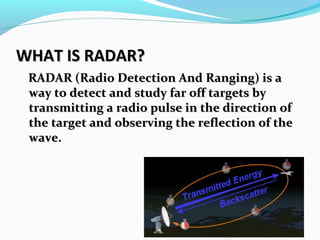
RADAR (Radio Detection And Ranging) is a
way to detect and study far off targets by
transmitting a radio pulse in the direction of
the target and observing the reflection of the
wave.
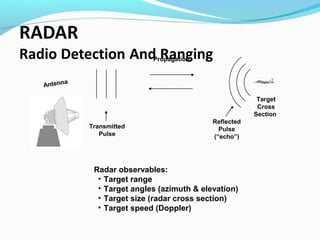
Propagation

a
Antenn

Target
Cross
Section
Transmitted
Pulse

Reflected
Pulse
(“echo”)

Radar observables:
• Target range
• Target angles (azimuth & elevation)
• Target size (radar cross section)
• Target speed (Doppler)
RADAR SIGNAL PROCESSING
a) Distance Measurement
1. transit time
2. frequency modulation
b) Speed measurement
c) Reduction of interference effects
d) Plot and track extraction
DISTANCE MEASUREMENT
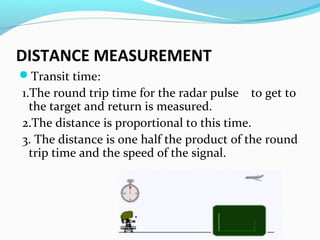
Transit time:

1.The round trip time for the radar pulse to get to
the target and return is measured.
2.The distance is proportional to this time.
3. The distance is one half the product of the round
trip time and the speed of the signal.
Radar Range Measurement
n
Ra

ge

Target
d
itte
sm
an lse
Tr Pu
ted
ec
fl
Re ulse
P

cτ
• Target range = 2
where c = speed of light
τ = round trip time
FREQUENCY MODULATION
Another form of distance measuring radar is based on

frequency modulation.
Frequency comparison between two signals is
considerably more accurate, even with older
electronics, than timing the signal.
By measuring the frequency of the returned signal
and comparing that with the original, the difference
can be easily measured.
2. Speed measurement
Speed is the change in distance to an object with

respect to time.
 Thus the existing system for measuring distance,
combined with a memory capacity to see where
the target last was, is enough to measure speed.
There is another effect that can be used to make
almost instant speed measurements known as the
Doppler effect.
REDUCTION OF INTERFERENCE
EFFECTS:
Signal processing is employed in radar systems to

reduce the radar interference effects.
Signal processing technique include MTI, pulse
Doppler, constant false alarm rate and digital terrain
model(DTM) are also used in clutter environments.
Doppler effect:
The Doppler effect is a frequency shift that results

from relative motion between a frequency source and
a listener.
The Doppler shift is directly proportional to speed
between source and listener, frequency of the source,
and the speed the wave travels.
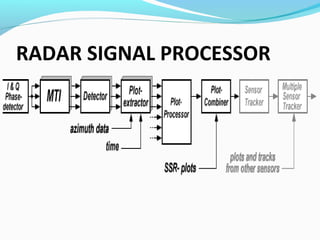
RADAR SIGNAL PROCESSOR
The signal processor is that part of the system which

separates targets from clutter on the basis of Doppler
content and amplitude characteristics.
In modern radar sets the conversion of radar signals
to digital form is typically accomplished after IF
amplification and phase sensitive detection.
Military application
Navigational radars
Radar altimeters
Air traffic control
Law enforcement and highway safety
Radar signal processing

Radar signal processing

  • 1.
  • 2.
    WHAT IS RADAR? RADAR(Radio Detection And Ranging) is a way to detect and study far off targets by transmitting a radio pulse in the direction of the target and observing the reflection of the wave.
  • 3.
    Propagation a Antenn Target Cross Section Transmitted Pulse Reflected Pulse (“echo”) Radar observables: • Targetrange • Target angles (azimuth & elevation) • Target size (radar cross section) • Target speed (Doppler)
  • 4.
    RADAR SIGNAL PROCESSING a)Distance Measurement 1. transit time 2. frequency modulation b) Speed measurement c) Reduction of interference effects d) Plot and track extraction
  • 5.
    DISTANCE MEASUREMENT Transit time: 1.Theround trip time for the radar pulse to get to the target and return is measured. 2.The distance is proportional to this time. 3. The distance is one half the product of the round trip time and the speed of the signal.
  • 6.
    Radar Range Measurement n Ra ge Target d itte sm anlse Tr Pu ted ec fl Re ulse P cτ • Target range = 2 where c = speed of light τ = round trip time
  • 7.
    FREQUENCY MODULATION Another formof distance measuring radar is based on frequency modulation. Frequency comparison between two signals is considerably more accurate, even with older electronics, than timing the signal. By measuring the frequency of the returned signal and comparing that with the original, the difference can be easily measured.
  • 8.
    2. Speed measurement Speedis the change in distance to an object with respect to time.  Thus the existing system for measuring distance, combined with a memory capacity to see where the target last was, is enough to measure speed. There is another effect that can be used to make almost instant speed measurements known as the Doppler effect.
  • 9.
    REDUCTION OF INTERFERENCE EFFECTS: Signalprocessing is employed in radar systems to reduce the radar interference effects. Signal processing technique include MTI, pulse Doppler, constant false alarm rate and digital terrain model(DTM) are also used in clutter environments.
  • 10.
    Doppler effect: The Dopplereffect is a frequency shift that results from relative motion between a frequency source and a listener. The Doppler shift is directly proportional to speed between source and listener, frequency of the source, and the speed the wave travels.
  • 11.
  • 12.
    The signal processoris that part of the system which separates targets from clutter on the basis of Doppler content and amplitude characteristics. In modern radar sets the conversion of radar signals to digital form is typically accomplished after IF amplification and phase sensitive detection.
  • 13.
    Military application Navigational radars Radaraltimeters Air traffic control Law enforcement and highway safety