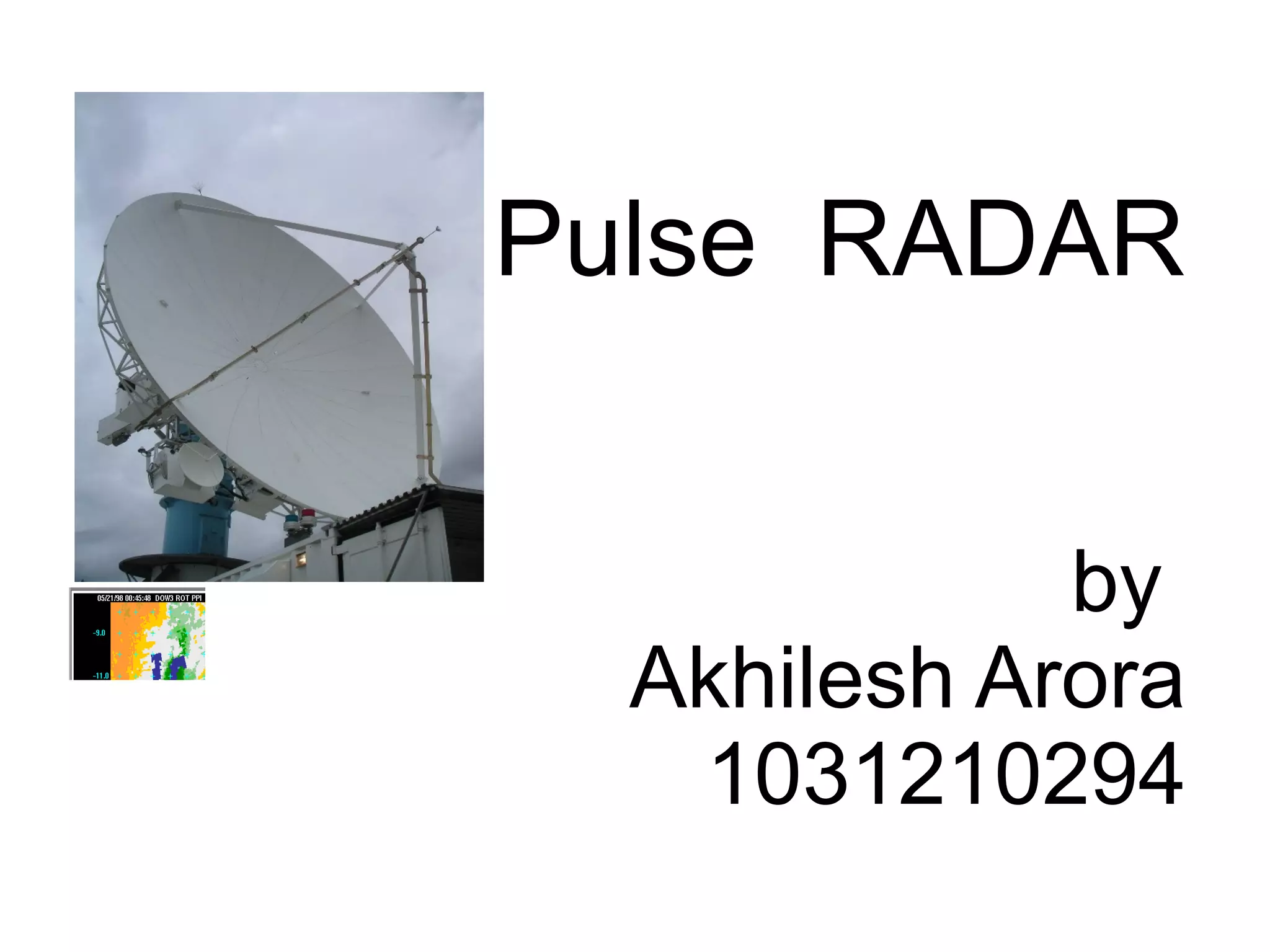
Pulse RADAR 
by 
Akhilesh Arora 
1031210294
Introduction 
● RADAR is acronym for Radio 
Detection and Ranging. 
● First successfully demonstrated in 
1936. 
● It uses electromagnetic waves. 
● It enjoys wide range of application.
Advantages 
● Uses low transmitting power, low power 
consumption. 
● simple circuitry, small in size. 
Disadvantages 
● several targets at a given bearing tend to cause 
confusion. 
● Range discrimination can be achieved only by 
introducing very costly complex circuitry. 
● It is not capable of indicating the range of 
target an can show only its velocity.
Types of Radar
Pulse Radar 
● Pulsed radar transmits high power, high-frequency 
pulses toward the target. 
● Choice of pulse repetition frequency decides 
the range and resolution of the radar. 
● Two broad categories of pulsed radar 
employing Doppler shifts are Moving Target 
Indicator Radar and Pulse Doppler Radar.
Doppler Shift: A frequency shift that occurs in 
electromagnetic 
waves due to the motion of scatterers toward or away from 
the observer. 
Analogy: The Doppler shift for sound waves is the frequency shift that occurs as 
race cars approach and then recede from a stationary observer 
Doppler radar: A radar that can determine the frequency shift 
through measurement of the phase change that occurs in 
electromagnetic waves during a series of pulses.
Note that Doppler radars are only sensitive to the radial motion of objects 
Air motion is a three dimensional vector: A Doppler radar can only measure one 
of these three components – the motion along the beam toward or away from the radar
Doppler Effect
● The Doppler effect (or Doppler shift) is the 
change in frequency of a wave (or other 
periodic event) for an observer moving relative 
to its source.
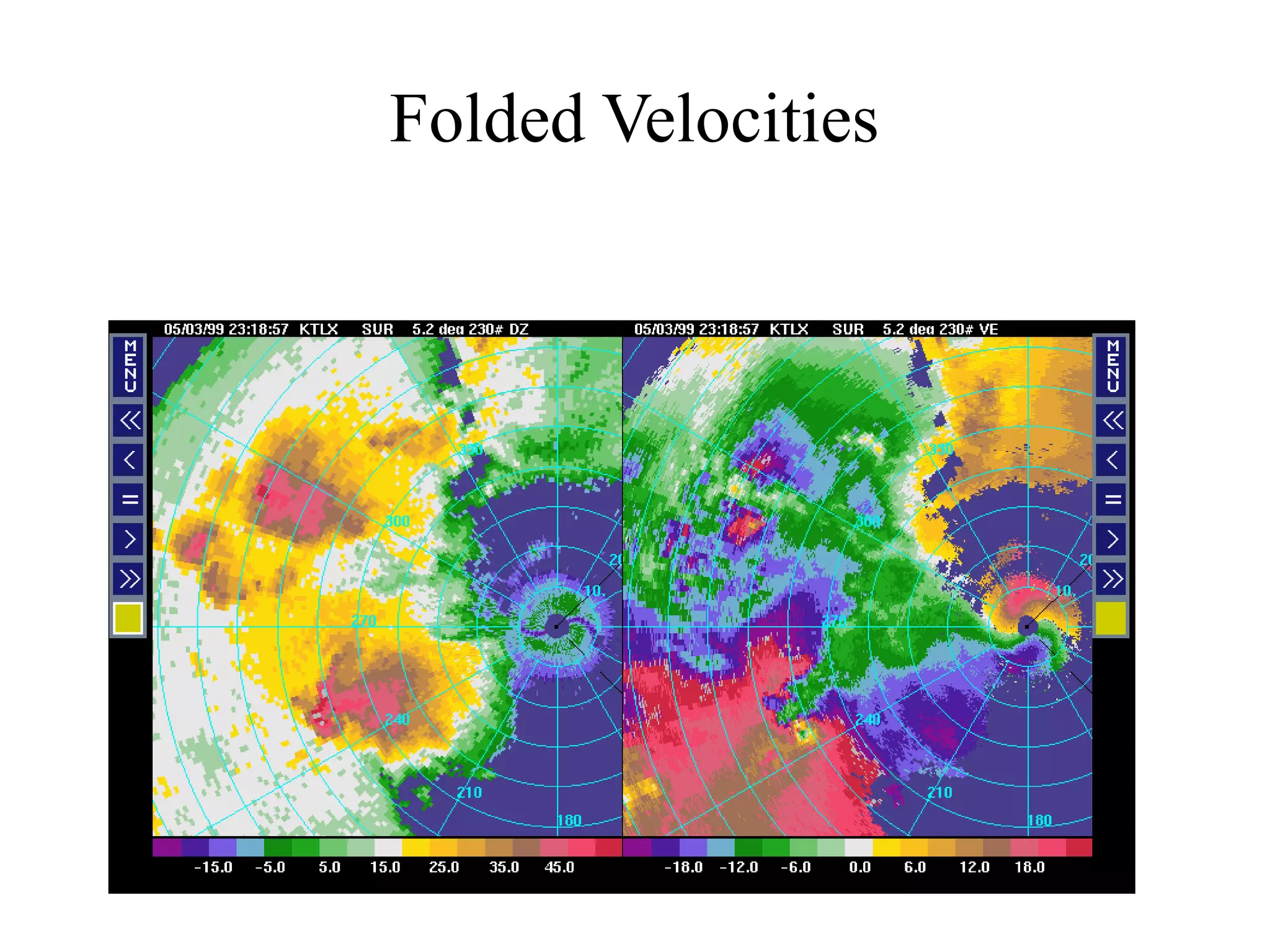
Folded Velocities
Moving Target Indicator Radar 
● This radar uses Doppler effect . 
● MTI radar distinguishes between moving 
targets and stationary targets. 
● The MTI Radar uses low pulse repetition 
frequency (PRF) to avoid range ambiguities. 
● MTI Radars can have Doppler ambiguities.
Principal of Working
MTI Application in UAVS 
● UAV Stands for Unmanned Aerial Vehicles 
● These aircraft are without pilot on board. 
● One specific area of interest that has been 
closely examined by the UAVB has been in the 
area of cross-cueing applications Moving Target 
Indicator (MTI). 
● JSTARS and TESARS are two type of UAVS 
used by US Air force.
Pulse Doppler Radar 
● Pulse Doppler Radar uses high PRF to avoid 
Doppler ambiguities, but it can have numerous 
range ambiguities. 
● In MTI radar the prf is chosen so that there are 
no range ambiguities, but there are usually 
many Doppler ambiguities, or blind speeds. 
● A radar that increases its prf high enough to 
avoid the problem of blind speeds is called a 
pulse Doppler radar.
Resolving Velocity Ambiguity 
● Earlier multiple prf was used. 
● Velocity ambiguity can be resolved by 
transmitting many carrier frequency. 
● fnd= nfr+f’nd 
Where f’nd is doppler frequency 
● fnd = 2Vt fn/c fr= 2vnfn/c 
● Therefore Vt = nVn+V’nt
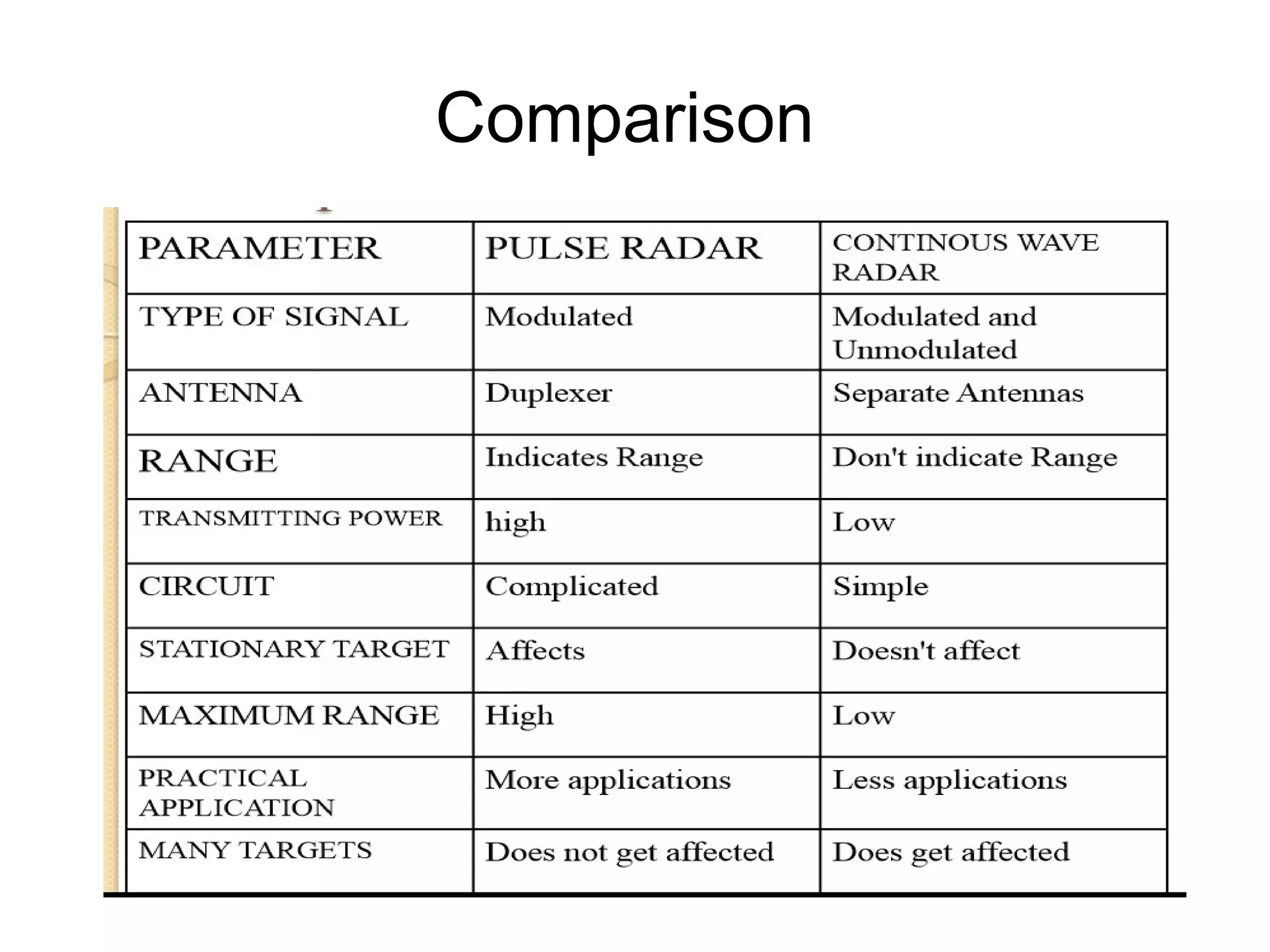
Comparison
Conclusion 
● RADAR is used to find velocity, range and 
position of the object. 
● Advantage of RADAR is that it provide superior 
penetration capability through any type of 
weather condition. 
● LIDAR is advanced type of radar which uses 
visible light from laser.
References 
● “Types of Radar”, Engineers Garage,2012[online]. 
Available: http://www.engineersgarage. 
com/articles/type-of-radars 
● “Types of Radar”, Cristian Wolff, June 10, 
2012[online]. Available:http://www.radartutorial. 
eu/02.basics/rp05.en.html 
● “Radar Basics”, Infoplease, September 22, 2012 
[online]. Available: http://www.infoplease. 
com/ce6/sci/A0860616.html 
● “Principles of communication”,Nptel,IITB(online)
Thank You

Pulse Doppler Radar

  • 1.
    Pulse RADAR by Akhilesh Arora 1031210294
  • 2.
    Introduction ● RADARis acronym for Radio Detection and Ranging. ● First successfully demonstrated in 1936. ● It uses electromagnetic waves. ● It enjoys wide range of application.
  • 3.
    Advantages ● Useslow transmitting power, low power consumption. ● simple circuitry, small in size. Disadvantages ● several targets at a given bearing tend to cause confusion. ● Range discrimination can be achieved only by introducing very costly complex circuitry. ● It is not capable of indicating the range of target an can show only its velocity.
  • 4.
  • 5.
    Pulse Radar ●Pulsed radar transmits high power, high-frequency pulses toward the target. ● Choice of pulse repetition frequency decides the range and resolution of the radar. ● Two broad categories of pulsed radar employing Doppler shifts are Moving Target Indicator Radar and Pulse Doppler Radar.
  • 7.
    Doppler Shift: Afrequency shift that occurs in electromagnetic waves due to the motion of scatterers toward or away from the observer. Analogy: The Doppler shift for sound waves is the frequency shift that occurs as race cars approach and then recede from a stationary observer Doppler radar: A radar that can determine the frequency shift through measurement of the phase change that occurs in electromagnetic waves during a series of pulses.
  • 8.
    Note that Dopplerradars are only sensitive to the radial motion of objects Air motion is a three dimensional vector: A Doppler radar can only measure one of these three components – the motion along the beam toward or away from the radar
  • 9.
  • 10.
    ● The Dopplereffect (or Doppler shift) is the change in frequency of a wave (or other periodic event) for an observer moving relative to its source.
  • 11.
  • 12.
    Moving Target IndicatorRadar ● This radar uses Doppler effect . ● MTI radar distinguishes between moving targets and stationary targets. ● The MTI Radar uses low pulse repetition frequency (PRF) to avoid range ambiguities. ● MTI Radars can have Doppler ambiguities.
  • 13.
  • 14.
    MTI Application inUAVS ● UAV Stands for Unmanned Aerial Vehicles ● These aircraft are without pilot on board. ● One specific area of interest that has been closely examined by the UAVB has been in the area of cross-cueing applications Moving Target Indicator (MTI). ● JSTARS and TESARS are two type of UAVS used by US Air force.
  • 15.
    Pulse Doppler Radar ● Pulse Doppler Radar uses high PRF to avoid Doppler ambiguities, but it can have numerous range ambiguities. ● In MTI radar the prf is chosen so that there are no range ambiguities, but there are usually many Doppler ambiguities, or blind speeds. ● A radar that increases its prf high enough to avoid the problem of blind speeds is called a pulse Doppler radar.
  • 17.
    Resolving Velocity Ambiguity ● Earlier multiple prf was used. ● Velocity ambiguity can be resolved by transmitting many carrier frequency. ● fnd= nfr+f’nd Where f’nd is doppler frequency ● fnd = 2Vt fn/c fr= 2vnfn/c ● Therefore Vt = nVn+V’nt
  • 20.
  • 21.
    Conclusion ● RADARis used to find velocity, range and position of the object. ● Advantage of RADAR is that it provide superior penetration capability through any type of weather condition. ● LIDAR is advanced type of radar which uses visible light from laser.
  • 22.
    References ● “Typesof Radar”, Engineers Garage,2012[online]. Available: http://www.engineersgarage. com/articles/type-of-radars ● “Types of Radar”, Cristian Wolff, June 10, 2012[online]. Available:http://www.radartutorial. eu/02.basics/rp05.en.html ● “Radar Basics”, Infoplease, September 22, 2012 [online]. Available: http://www.infoplease. com/ce6/sci/A0860616.html ● “Principles of communication”,Nptel,IITB(online)
  • 23.