Antennas & their Types
Presented By:
ZAHOOR AHMAD WANI
 An Antenna (aerial) is an electrical device which
converts electric energy into radio waves, and vice
versa. It is usually used with a radio transmitter or radio
receiver.
 An antenna is a device used for sending or receiving
Electromagnetic waves.
 An antenna Consists of a Transmitter and a Receiver.
A device that converts
sound, light, or electrical
signals into radio,
microwave, or other
electrical signals .
An antenna used to convert
electromagnetic waves into
electrical energy.
 BANDWIDTH
It specifies the range of frequencies over which its performance does
not suffer due to a poor impedance match.
 GAIN
Gain is a parameter which measures the degree of directivity of the
antenna's radiation pattern.
 EFFECTIVE AREA OR APERTURE
The effective area or effective aperture of a receiving antenna
expresses the portion of the power of a passing electromagnetic
wave .
 RADIATION PATTERN
It is typically represented by a three dimensional graph, or polar plots of the
horizontal and vertical cross sections.
 IMPEDANCE
As an electro-magnetic wave travels through the different parts of the
antenna system it may encounter differences in impedance.
 POLARIZATION
The polarization of an antenna is the orientation of the electric field (E-
plane) of the radio wave with respect to the Earth's surface and is
determined by the physical structure of the antenna and by its orientation.
 EFFICIENCY
Efficiency of a transmitting antenna is the ratio of power actually radiated
(in all directions) to the power absorbed by the antenna terminals.
PARAMETERS OFANTENNA
There are various types of Antennas and few of them are:
1. YAGI – UDA ANTENNA
2. HELIX ANTENNA
3. PARABOLIC ANTENNA
4. LOOP ANTENNA
5. HORN ANTENNA
 Yagi - Uda Antenna consists of:
 A Reflector
 Director and a
 Driven element.
 It is a Unidirectional antenna.
 Frequency range – 300MHz - 3GHz.
1. High gain and good front to back ratio.
2. It has narrow bandwidth.
3. It is fixed frequency device.
4. Greater directivity due to director and reflector.
 A conducting wire in the form of screw thread fed by
power source.
 The feed line is connected between the bottom of the
helix and the ground plane.
 Helix antenna is Omni-directional.
 Frequency range – VHF and UHF band.
where > VHF= Very High Frequency
UHF= Ultra High Frequency
1. Satellite Communication.
2. Space communication & space probes.
3. For Telemetry applications.
 This is used to convert Spherical wave into Plane wave
 The feed antenna is called primary antenna and reflector
is secondary antenna.
 Frequency range - 3GHz-30GHz
Applications
1. Radar communication.
2. Satellite communication.
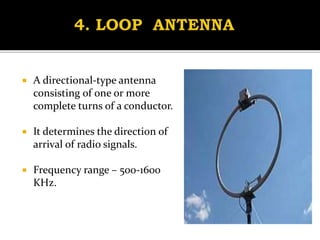
 A directional-type antenna
consisting of one or more
complete turns of a conductor.
 It determines the direction of
arrival of radio signals.
 Frequency range – 500-1600
KHz.
1. Direction finding of signal propagation.
2. Radio (AM/FM) reception.
3. Long distance point to point
Communication.
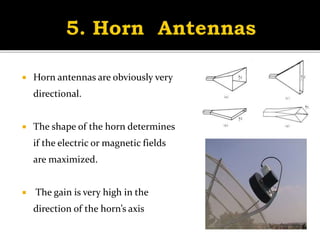
 Horn antennas are obviously very
directional.
 The shape of the horn determines
if the electric or magnetic fields
are maximized.
 The gain is very high in the
direction of the horn’s axis
Thank You…
20

Antennas in Wireless Communication

  • 1.
    Antennas & theirTypes Presented By: ZAHOOR AHMAD WANI
  • 3.
     An Antenna(aerial) is an electrical device which converts electric energy into radio waves, and vice versa. It is usually used with a radio transmitter or radio receiver.  An antenna is a device used for sending or receiving Electromagnetic waves.  An antenna Consists of a Transmitter and a Receiver.
  • 4.
    A device thatconverts sound, light, or electrical signals into radio, microwave, or other electrical signals .
  • 5.
    An antenna usedto convert electromagnetic waves into electrical energy.
  • 6.
     BANDWIDTH It specifiesthe range of frequencies over which its performance does not suffer due to a poor impedance match.  GAIN Gain is a parameter which measures the degree of directivity of the antenna's radiation pattern.  EFFECTIVE AREA OR APERTURE The effective area or effective aperture of a receiving antenna expresses the portion of the power of a passing electromagnetic wave .
  • 7.
     RADIATION PATTERN Itis typically represented by a three dimensional graph, or polar plots of the horizontal and vertical cross sections.  IMPEDANCE As an electro-magnetic wave travels through the different parts of the antenna system it may encounter differences in impedance.  POLARIZATION The polarization of an antenna is the orientation of the electric field (E- plane) of the radio wave with respect to the Earth's surface and is determined by the physical structure of the antenna and by its orientation.  EFFICIENCY Efficiency of a transmitting antenna is the ratio of power actually radiated (in all directions) to the power absorbed by the antenna terminals. PARAMETERS OFANTENNA
  • 8.
    There are varioustypes of Antennas and few of them are: 1. YAGI – UDA ANTENNA 2. HELIX ANTENNA 3. PARABOLIC ANTENNA 4. LOOP ANTENNA 5. HORN ANTENNA
  • 9.
     Yagi -Uda Antenna consists of:  A Reflector  Director and a  Driven element.  It is a Unidirectional antenna.  Frequency range – 300MHz - 3GHz.
  • 11.
    1. High gainand good front to back ratio. 2. It has narrow bandwidth. 3. It is fixed frequency device. 4. Greater directivity due to director and reflector.
  • 12.
     A conductingwire in the form of screw thread fed by power source.  The feed line is connected between the bottom of the helix and the ground plane.  Helix antenna is Omni-directional.  Frequency range – VHF and UHF band. where > VHF= Very High Frequency UHF= Ultra High Frequency
  • 14.
    1. Satellite Communication. 2.Space communication & space probes. 3. For Telemetry applications.
  • 15.
     This isused to convert Spherical wave into Plane wave  The feed antenna is called primary antenna and reflector is secondary antenna.  Frequency range - 3GHz-30GHz Applications 1. Radar communication. 2. Satellite communication.
  • 17.
     A directional-typeantenna consisting of one or more complete turns of a conductor.  It determines the direction of arrival of radio signals.  Frequency range – 500-1600 KHz.
  • 18.
    1. Direction findingof signal propagation. 2. Radio (AM/FM) reception. 3. Long distance point to point Communication.
  • 19.
     Horn antennasare obviously very directional.  The shape of the horn determines if the electric or magnetic fields are maximized.  The gain is very high in the direction of the horn’s axis
  • 20.