


Polarization Mode Dispersion(PMD)
Presented by:
Md. Abdur Rahman
ID:1402EEE00019
2nd batch
Dep't of EEE (MIU)
1
Content
Polarization Mode Dispersion.
Properties of PMD.
The origins of PMD.
Low PMD.
High PMD.
PMD test.
2
Polarization Mode Dispersion
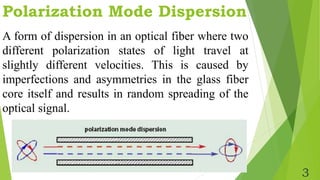
A form of dispersion in an optical fiber where two
different polarization states of light travel at
slightly different velocities. This is caused by
imperfections and asymmetries in the glass fiber
core itself and results in random spreading of the
optical signal.
3
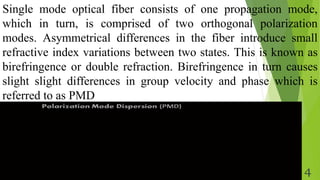
Single mode optical fiber consists of one propagation mode,
which in turn, is comprised of two orthogonal polarization
modes. Asymmetrical differences in the fiber introduce small
refractive index variations between two states. This is known as
birefringence or double refraction. Birefringence in turn causes
slight slight differences in group velocity and phase which is
referred to as PMD
4
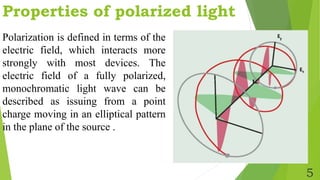
Properties of polarized light
Polarization is defined in terms of the
electric field, which interacts more
strongly with most devices. The
electric field of a fully polarized,
monochromatic light wave can be
described as issuing from a point
charge moving in an elliptical pattern
in the plane of the source .
5
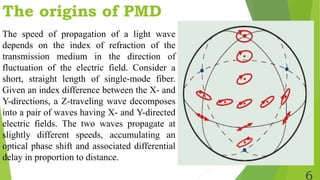
The origins of PMD
The speed of propagation of a light wave
depends on the index of refraction of the
transmission medium in the direction of
fluctuation of the electric field. Consider a
short, straight length of single-mode fiber.
Given an index difference between the X- and
Y-directions, a Z-traveling wave decomposes
into a pair of waves having X- and Y-directed
electric fields. The two waves propagate at
slightly different speeds, accumulating an
optical phase shift and associated differential
delay in proportion to distance.
6
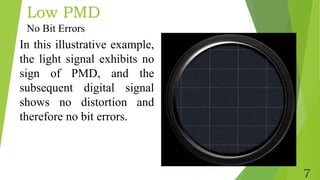
Low PMD
No Bit Errors
In this illustrative example,
the light signal exhibits no
sign of PMD, and the
subsequent digital signal
shows no distortion and
therefore no bit errors.
7
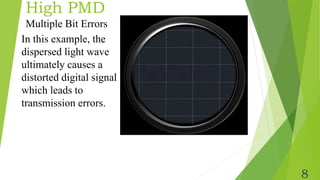
High PMD
Multiple Bit Errors
In this example, the
dispersed light wave
ultimately causes a
distorted digital signal
which leads to
transmission errors.
8
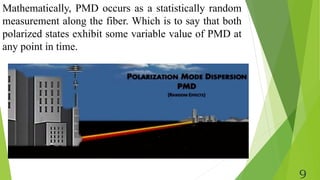
Mathematically, PMD occurs as a statistically random
measurement along the fiber. Which is to say that both
polarized states exhibit some variable value of PMD at
any point in time.
9
10
THANK YOU

Polarization mode dispersion(pmd)

  • 1.
    Polarization Mode Dispersion(PMD) Presentedby: Md. Abdur Rahman ID:1402EEE00019 2nd batch Dep't of EEE (MIU) 1
  • 2.
    Content Polarization Mode Dispersion. Propertiesof PMD. The origins of PMD. Low PMD. High PMD. PMD test. 2
  • 3.
    Polarization Mode Dispersion Aform of dispersion in an optical fiber where two different polarization states of light travel at slightly different velocities. This is caused by imperfections and asymmetries in the glass fiber core itself and results in random spreading of the optical signal. 3
  • 4.
    Single mode opticalfiber consists of one propagation mode, which in turn, is comprised of two orthogonal polarization modes. Asymmetrical differences in the fiber introduce small refractive index variations between two states. This is known as birefringence or double refraction. Birefringence in turn causes slight slight differences in group velocity and phase which is referred to as PMD 4
  • 5.
    Properties of polarizedlight Polarization is defined in terms of the electric field, which interacts more strongly with most devices. The electric field of a fully polarized, monochromatic light wave can be described as issuing from a point charge moving in an elliptical pattern in the plane of the source . 5
  • 6.
    The origins ofPMD The speed of propagation of a light wave depends on the index of refraction of the transmission medium in the direction of fluctuation of the electric field. Consider a short, straight length of single-mode fiber. Given an index difference between the X- and Y-directions, a Z-traveling wave decomposes into a pair of waves having X- and Y-directed electric fields. The two waves propagate at slightly different speeds, accumulating an optical phase shift and associated differential delay in proportion to distance. 6
  • 7.
    Low PMD No BitErrors In this illustrative example, the light signal exhibits no sign of PMD, and the subsequent digital signal shows no distortion and therefore no bit errors. 7
  • 8.
    High PMD Multiple BitErrors In this example, the dispersed light wave ultimately causes a distorted digital signal which leads to transmission errors. 8
  • 9.
    Mathematically, PMD occursas a statistically random measurement along the fiber. Which is to say that both polarized states exhibit some variable value of PMD at any point in time. 9
  • 10.
  • 11.