PROPAGATION MODELS INDOOR OUTDOOR  LOG-NORMAL LOG-DISTANCE
BASIC  DIVISION Different models have been developed, to meet the needs of realizing ,the propagation behavior in different conditions.  Types of models for radio propagation include: Models for indoor applications  Models for outdoor applications
Outdoor Propagation Models There are a number of mobile radio propagation models to predict path loss over irregular terrain. These methods generally aim to predict the  signal strength at a particular sector. But they vary widely in complexity and accuracy. These models are based on systematic interpretation of measurement data obtained in the service area.
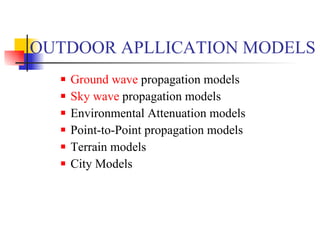
OUTDOOR APLLICATION MODELS Ground wave  propagation models  Sky wave  propagation models  Environmental Attenuation models  Point-to-Point propagation models  Terrain models  City Models
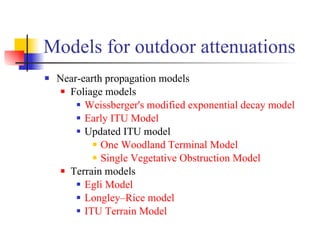
Models for outdoor attenuations Near-earth propagation models  Foliage models  Weissberger's  modified exponential decay model   Early ITU Model   Updated ITU model  One Woodland Terminal Model   Single Vegetative Obstruction Model   Terrain models  Egli  Model   Longley–Rice model   ITU Terrain Model
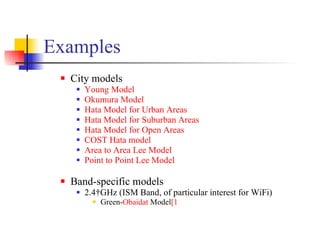
Examples City models  Young Model   Okumura Model   Hata  Model for Urban Areas   Hata  Model for Suburban Areas   Hata  Model for Open Areas   COST  Hata  model   Area to Area Lee Model   Point to Point Lee Model   Band-specific models  2.4 GHz (ISM Band, of particular interest for WiFi)  Green- Obaidat  Model [1
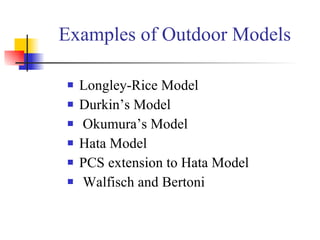
Examples of Outdoor Models Longley-Rice Model Durkin’s Model Okumura’s Model Hata Model PCS extension to Hata Model Walfisch and Bertoni
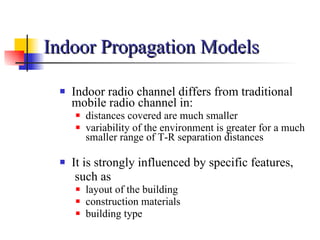
Indoor Propagation Models Indoor radio channel differs from traditional mobile radio channel in:  distances covered are much smaller variability of the environment is greater for a much smaller range of T-R separation distances It is strongly influenced by specific features,   such as  layout of the building construction materials building type
Models for indoor attenuations ITU Model for Indoor Attenuation   Log-distance path loss model
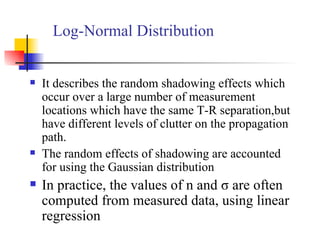
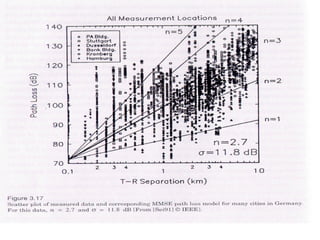
Log-Normal Distribution It describes the random shadowing effects which occur over a large number of measurement locations which have the same T-R separation,but have different levels of clutter on the propagation path. The random effects of shadowing are accounted for using the Gaussian distribution In practice, the values of n and σ are often computed from measured data, using linear regression
 
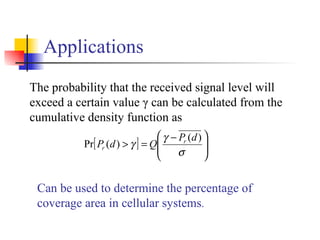
Applications The probability that the received signal level will exceed a certain value Îł can be calculated from the cumulative density function as Can be used to determine the percentage of coverage area in cellular systems .
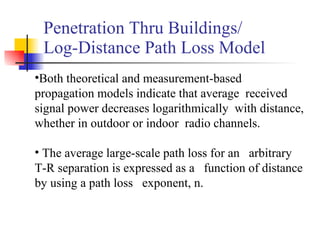
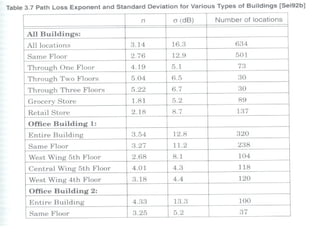
Penetration Thru Buildings/  Log-Distance Path Loss Model Both theoretical and measurement-based  propagation models indicate that average  received signal power decreases logarithmically  with distance, whether in outdoor or indoor  radio channels. The average large-scale path loss for an  arbitrary T-R separation is expressed as a  function of distance by using a path loss  exponent, n.
 
 
UNIT - 2 THE END

Outdoor indoor Propagation

  • 1.
    PROPAGATION MODELS INDOOROUTDOOR LOG-NORMAL LOG-DISTANCE
  • 2.
    BASIC DIVISIONDifferent models have been developed, to meet the needs of realizing ,the propagation behavior in different conditions. Types of models for radio propagation include: Models for indoor applications Models for outdoor applications
  • 3.
    Outdoor Propagation ModelsThere are a number of mobile radio propagation models to predict path loss over irregular terrain. These methods generally aim to predict the signal strength at a particular sector. But they vary widely in complexity and accuracy. These models are based on systematic interpretation of measurement data obtained in the service area.
  • 4.
    OUTDOOR APLLICATION MODELSGround wave propagation models Sky wave propagation models Environmental Attenuation models Point-to-Point propagation models Terrain models City Models
  • 5.
    Models for outdoorattenuations Near-earth propagation models Foliage models Weissberger's modified exponential decay model Early ITU Model Updated ITU model One Woodland Terminal Model Single Vegetative Obstruction Model Terrain models Egli Model Longley–Rice model ITU Terrain Model
  • 6.
    Examples City models Young Model Okumura Model Hata Model for Urban Areas Hata Model for Suburban Areas Hata Model for Open Areas COST Hata model Area to Area Lee Model Point to Point Lee Model Band-specific models 2.4 GHz (ISM Band, of particular interest for WiFi) Green- Obaidat Model [1
  • 7.
    Examples of OutdoorModels Longley-Rice Model Durkin’s Model Okumura’s Model Hata Model PCS extension to Hata Model Walfisch and Bertoni
  • 8.
    Indoor Propagation ModelsIndoor radio channel differs from traditional mobile radio channel in: distances covered are much smaller variability of the environment is greater for a much smaller range of T-R separation distances It is strongly influenced by specific features, such as layout of the building construction materials building type
  • 9.
    Models for indoorattenuations ITU Model for Indoor Attenuation Log-distance path loss model
  • 10.
    Log-Normal Distribution Itdescribes the random shadowing effects which occur over a large number of measurement locations which have the same T-R separation,but have different levels of clutter on the propagation path. The random effects of shadowing are accounted for using the Gaussian distribution In practice, the values of n and σ are often computed from measured data, using linear regression
  • 11.
  • 12.
    Applications The probabilitythat the received signal level will exceed a certain value Îł can be calculated from the cumulative density function as Can be used to determine the percentage of coverage area in cellular systems .
  • 13.
    Penetration Thru Buildings/ Log-Distance Path Loss Model Both theoretical and measurement-based propagation models indicate that average received signal power decreases logarithmically with distance, whether in outdoor or indoor radio channels. The average large-scale path loss for an arbitrary T-R separation is expressed as a function of distance by using a path loss exponent, n.
  • 14.
  • 15.
  • 16.
    UNIT - 2THE END