BASICS OF DIGITAL
FILTERS
Ismile Hossain
1403EEE00052
1
REFERENCE
Wikipedia
MikroElektronika
(learn.mikroe.com/ebooks/digitalfilterdesign/chapter/b
asic-concepts-of-digital-filtering/)
2
CONTENT
 What is a Digital Filter?
 Desired Features
 Example of Filtering Operations
 Types of Digital Filters
 FIR Filters
 IIR Filters
 Filter Specification
 Ideal Filters – Magnitude Response
 Designing Ideal Filters is Impossible
3
WHAT IS A DIGITAL FILTER?
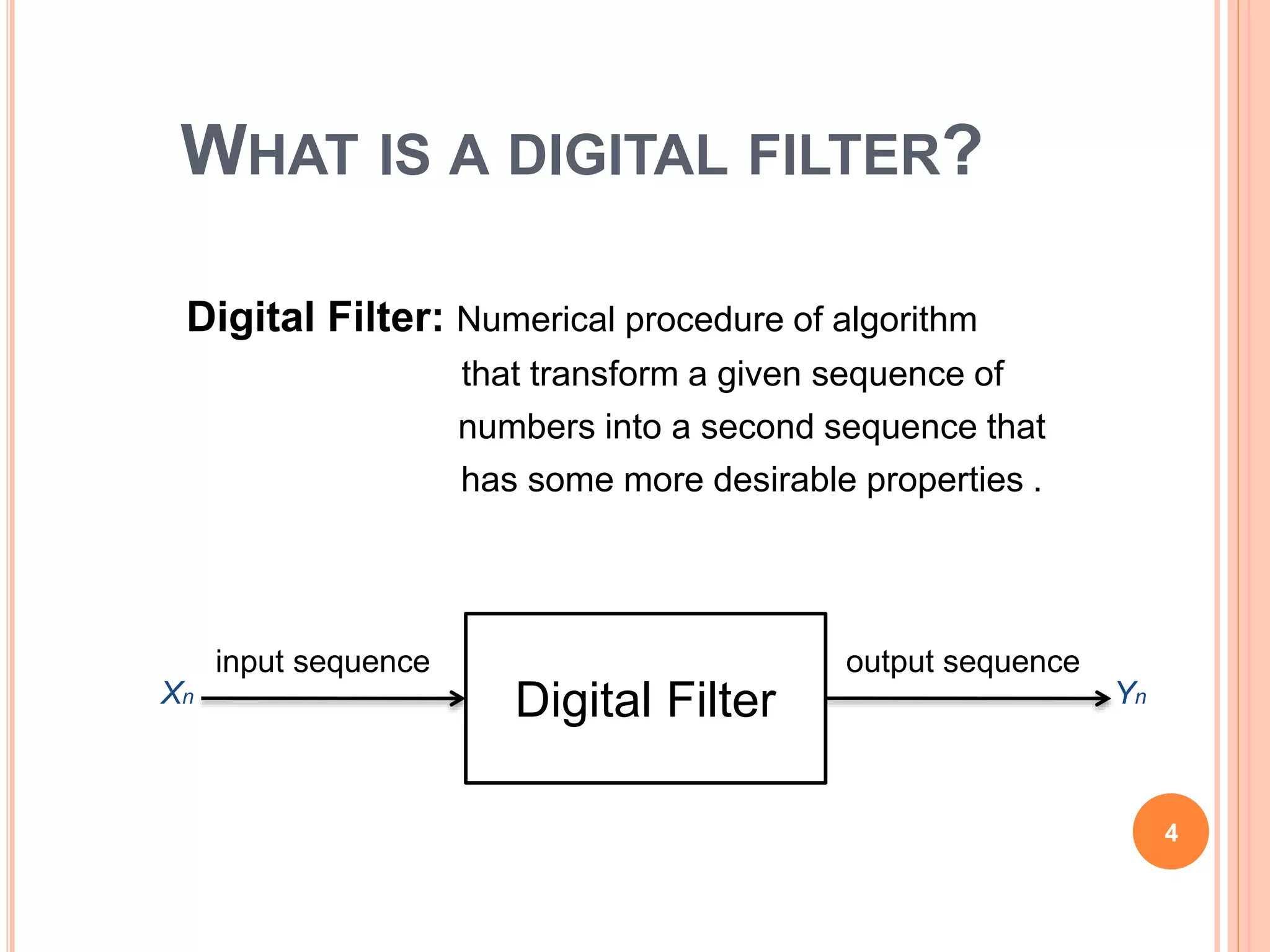
Digital Filter: Numerical procedure of algorithm
that transform a given sequence of
numbers into a second sequence that
has some more desirable properties .
Digital Filter
input sequence output sequence
4
Xn Yn
DESIRED FEATURES
Desired features depend on the application, for
example
Input Signal Output
5
generated by sensing
device (microphone)
having less noise or
interferences
speech with reduced
redundancy for more
efficient transmission
EXAMPLES OF FILTERING OPERATIONS
6
• received radio signals
• electrical signals measured from human
body (brain, heart, neurological signals)
Noise suppression
EXAMPLES OF FILTERING OPERATIONS
7
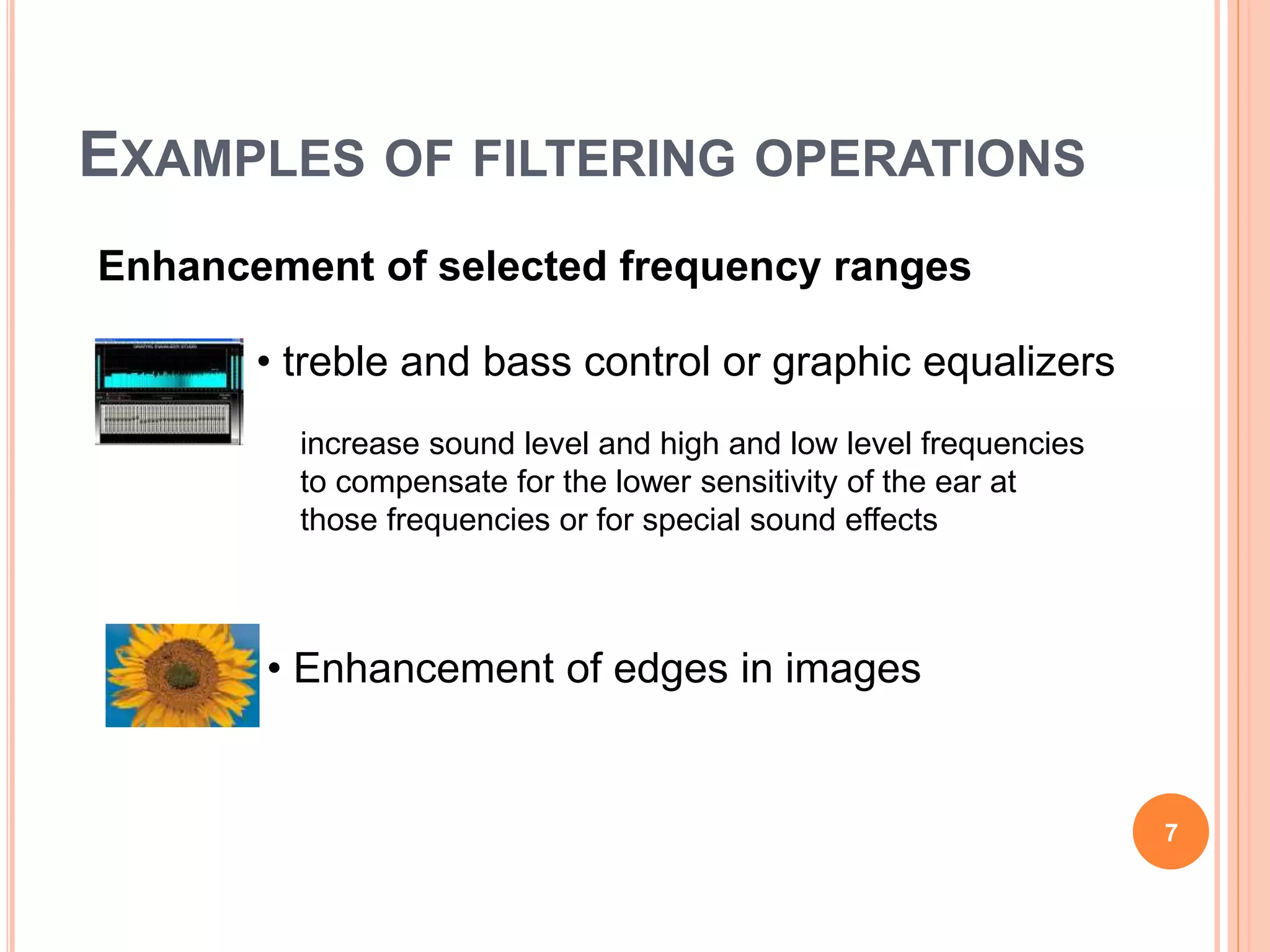
• treble and bass control or graphic equalizers
increase sound level and high and low level frequencies
to compensate for the lower sensitivity of the ear at
those frequencies or for special sound effects
Enhancement of selected frequency ranges
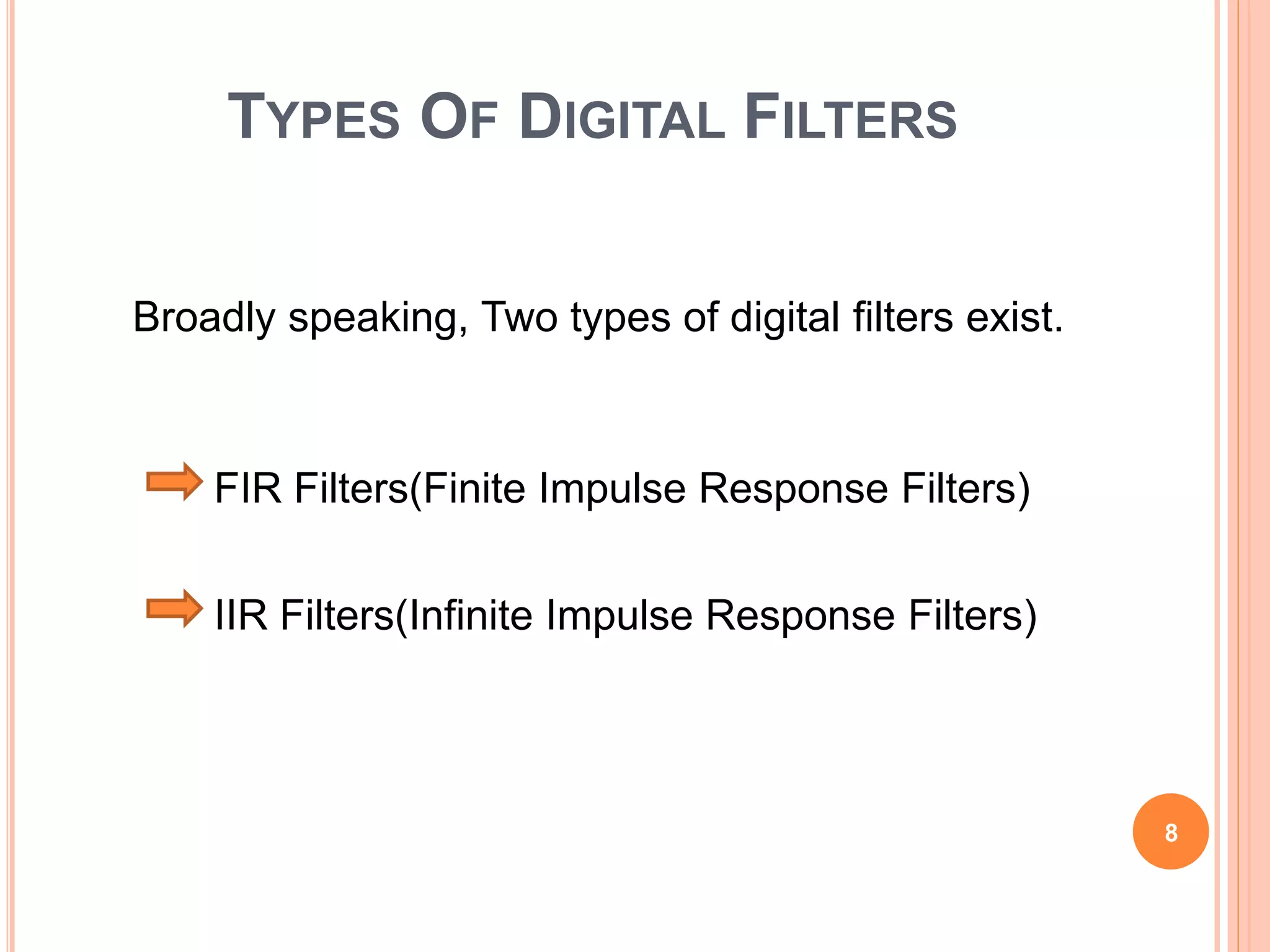
• Enhancement of edges in images
TYPES OF DIGITAL FILTERS
Broadly speaking, Two types of digital filters exist.
8
FIR Filters(Finite Impulse Response Filters)
IIR Filters(Infinite Impulse Response Filters)
FIR FILTERS
The digital filter whose impulse response is
of finite duration is known as FIR Filter &
the response of the FIR filter depends
only on the present and past input
samples.
These FIR filters are also called non recursive filters.
9
IIR FILTERS
The digital filter whose impulse response is of
infinite duration is known as IIR filter & the
response of an IIR filter is a function of current
and past input signal samples and past output
signal samples.
It is also called recursive filter.
10
FILTER SPECIFICATION
Before a filter is designed and implemented we need
to specify its performance requirements.
There are four basic filter types:
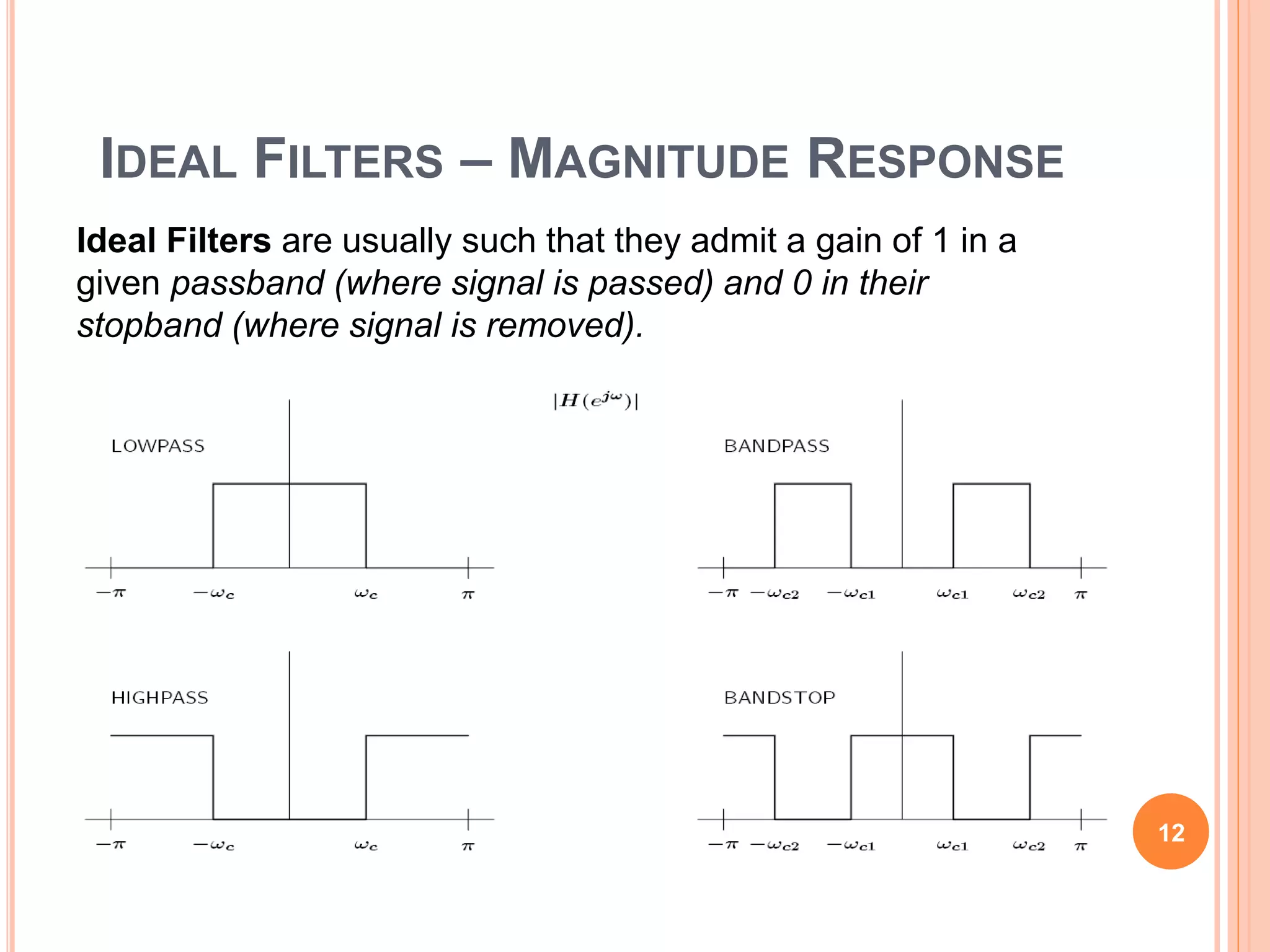
• Low-pass
• High-pass
• Band-pass
• Band-stop
Frequency band where signal is passed is passband
Frequency band where signal is removed is stopband 11
IDEAL FILTERS – MAGNITUDE RESPONSE
12
Ideal Filters are usually such that they admit a gain of 1 in a
given passband (where signal is passed) and 0 in their
stopband (where signal is removed).
DESIGNING IDEAL FILTERS IS IMPOSSIBLE
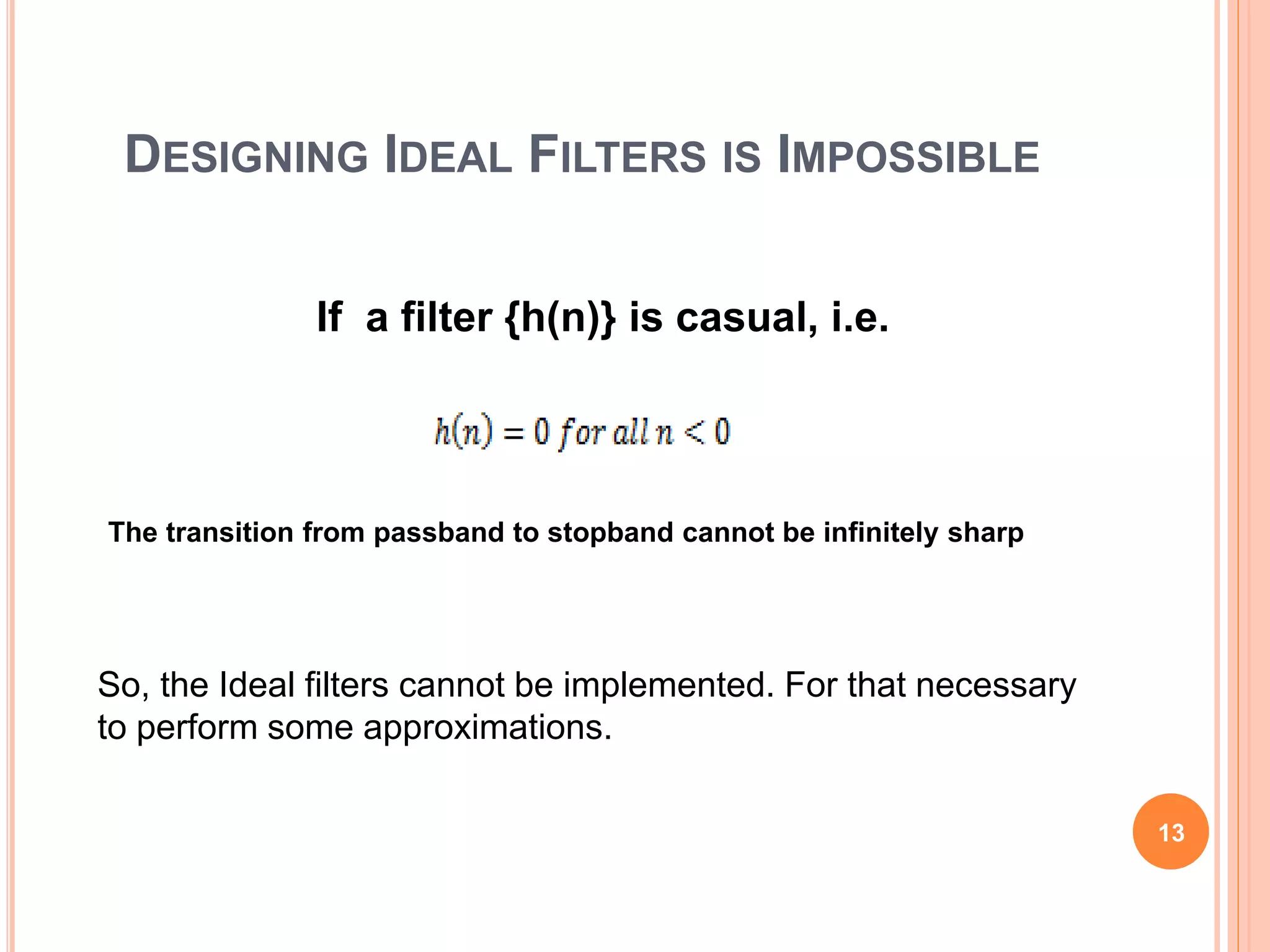
If a filter {h(n)} is casual, i.e.
13
The transition from passband to stopband cannot be infinitely sharp
So, the Ideal filters cannot be implemented. For that necessary
to perform some approximations.
Thank You
14

Basics of digital filters

  • 1.
    BASICS OF DIGITAL FILTERS IsmileHossain 1403EEE00052 1
  • 2.
  • 3.
    CONTENT  What isa Digital Filter?  Desired Features  Example of Filtering Operations  Types of Digital Filters  FIR Filters  IIR Filters  Filter Specification  Ideal Filters – Magnitude Response  Designing Ideal Filters is Impossible 3
  • 4.
    WHAT IS ADIGITAL FILTER? Digital Filter: Numerical procedure of algorithm that transform a given sequence of numbers into a second sequence that has some more desirable properties . Digital Filter input sequence output sequence 4 Xn Yn
  • 5.
    DESIRED FEATURES Desired featuresdepend on the application, for example Input Signal Output 5 generated by sensing device (microphone) having less noise or interferences speech with reduced redundancy for more efficient transmission
  • 6.
    EXAMPLES OF FILTERINGOPERATIONS 6 • received radio signals • electrical signals measured from human body (brain, heart, neurological signals) Noise suppression
  • 7.
    EXAMPLES OF FILTERINGOPERATIONS 7 • treble and bass control or graphic equalizers increase sound level and high and low level frequencies to compensate for the lower sensitivity of the ear at those frequencies or for special sound effects Enhancement of selected frequency ranges • Enhancement of edges in images
  • 8.
    TYPES OF DIGITALFILTERS Broadly speaking, Two types of digital filters exist. 8 FIR Filters(Finite Impulse Response Filters) IIR Filters(Infinite Impulse Response Filters)
  • 9.
    FIR FILTERS The digitalfilter whose impulse response is of finite duration is known as FIR Filter & the response of the FIR filter depends only on the present and past input samples. These FIR filters are also called non recursive filters. 9
  • 10.
    IIR FILTERS The digitalfilter whose impulse response is of infinite duration is known as IIR filter & the response of an IIR filter is a function of current and past input signal samples and past output signal samples. It is also called recursive filter. 10
  • 11.
    FILTER SPECIFICATION Before afilter is designed and implemented we need to specify its performance requirements. There are four basic filter types: • Low-pass • High-pass • Band-pass • Band-stop Frequency band where signal is passed is passband Frequency band where signal is removed is stopband 11
  • 12.
    IDEAL FILTERS –MAGNITUDE RESPONSE 12 Ideal Filters are usually such that they admit a gain of 1 in a given passband (where signal is passed) and 0 in their stopband (where signal is removed).
  • 13.
    DESIGNING IDEAL FILTERSIS IMPOSSIBLE If a filter {h(n)} is casual, i.e. 13 The transition from passband to stopband cannot be infinitely sharp So, the Ideal filters cannot be implemented. For that necessary to perform some approximations.
  • 14.