SEMESTER PROJECT
PRESENTATION
ON
ELECTRONICS BASED DEVICES
INDIAN INSTITUTE OF ENGINEERING SCIENCE
& TECHNOLOGY ,SHIBPUR
By’ Nitesh
kumar
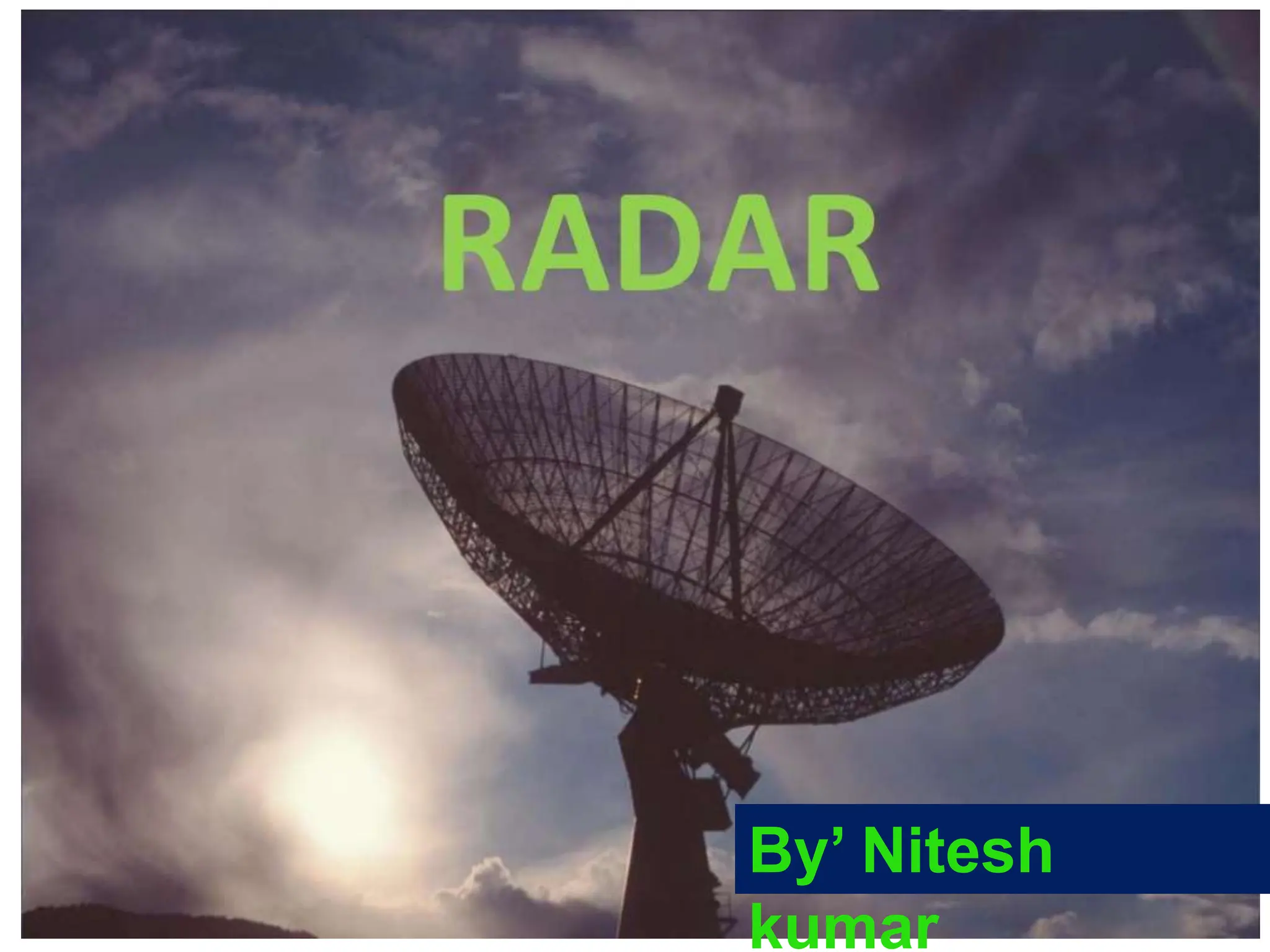
RADARSYSTEMS
Preparedby:
NITESH KUMAR
E&Tc Dept.-6th SEM
ID No.:110712009
IIEST,SHIBPUR
1.INTRODUCTION
2.BASIC PRINCIPLE
3.CLASSIFICATIONS
4.RADAR TECHNOLOGY
5.RADAR COMPONENTS
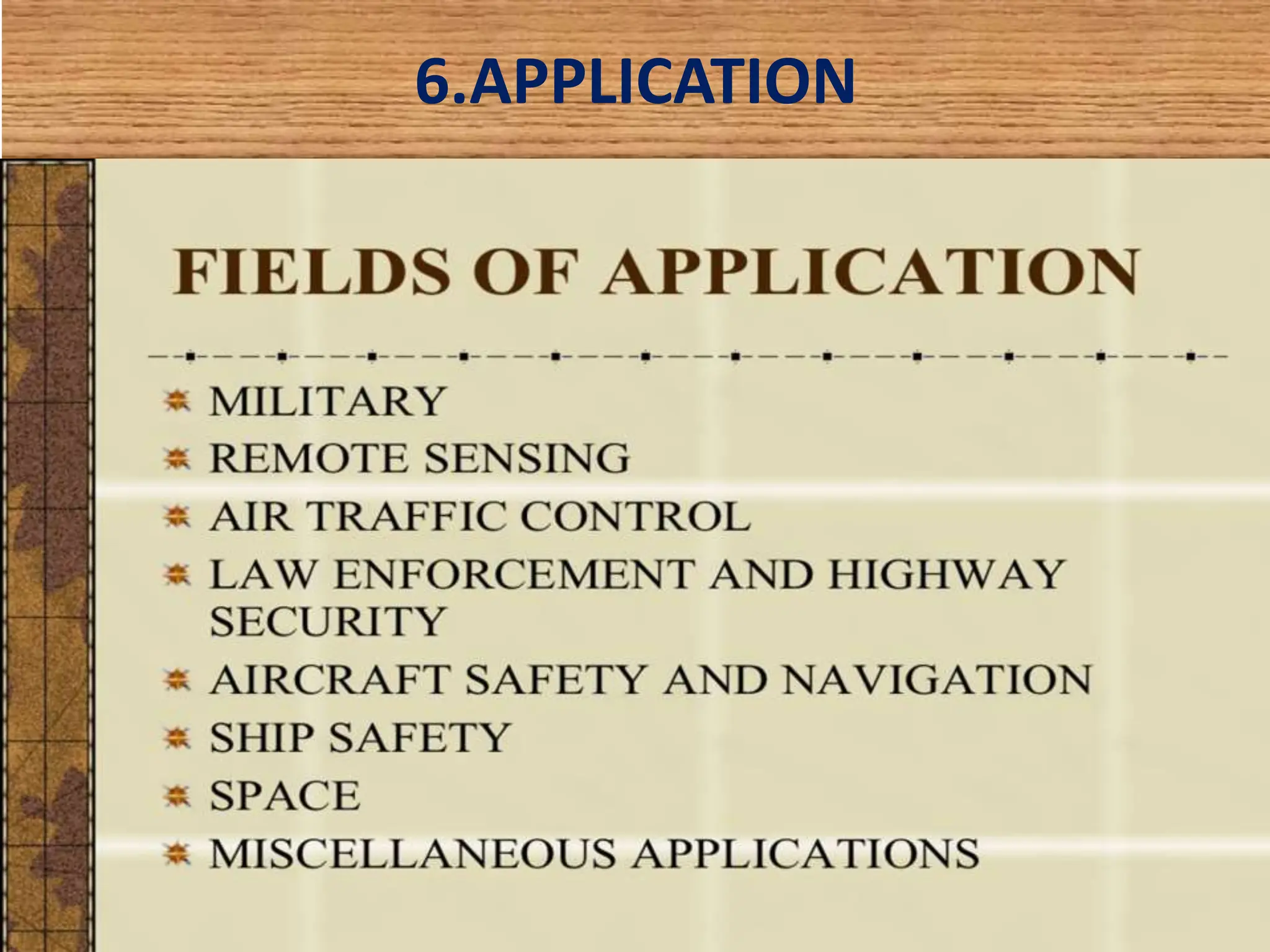
6.APPLICATIONS
1.Introduction
# defination: Radar is an object-detection system
that uses radio waves to determine the range,
altitude, direction, or speed of objects.
*RADAR stands for RADIO DETECTION AND RANGING
# historical review:
1886: H.R.Hertz Discovered Electromagnetic wave.
1897: G.Marconi (known as pioneer of radio
communication) firstly transmitted
electromagnetic wave for long distance.
1930: L.A.Hyland,Locates an aircraft for first time.
2.Basic principles And Design
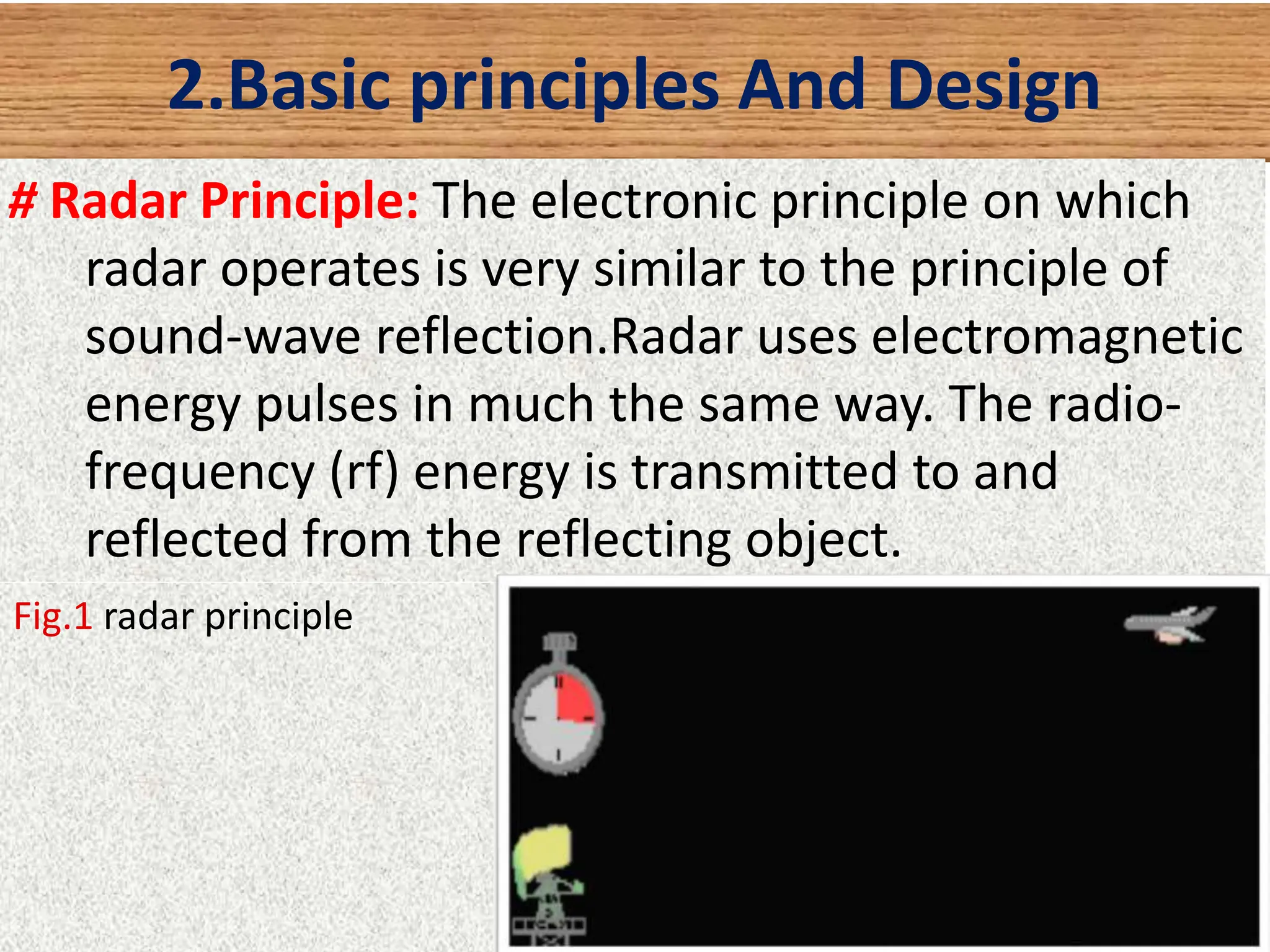
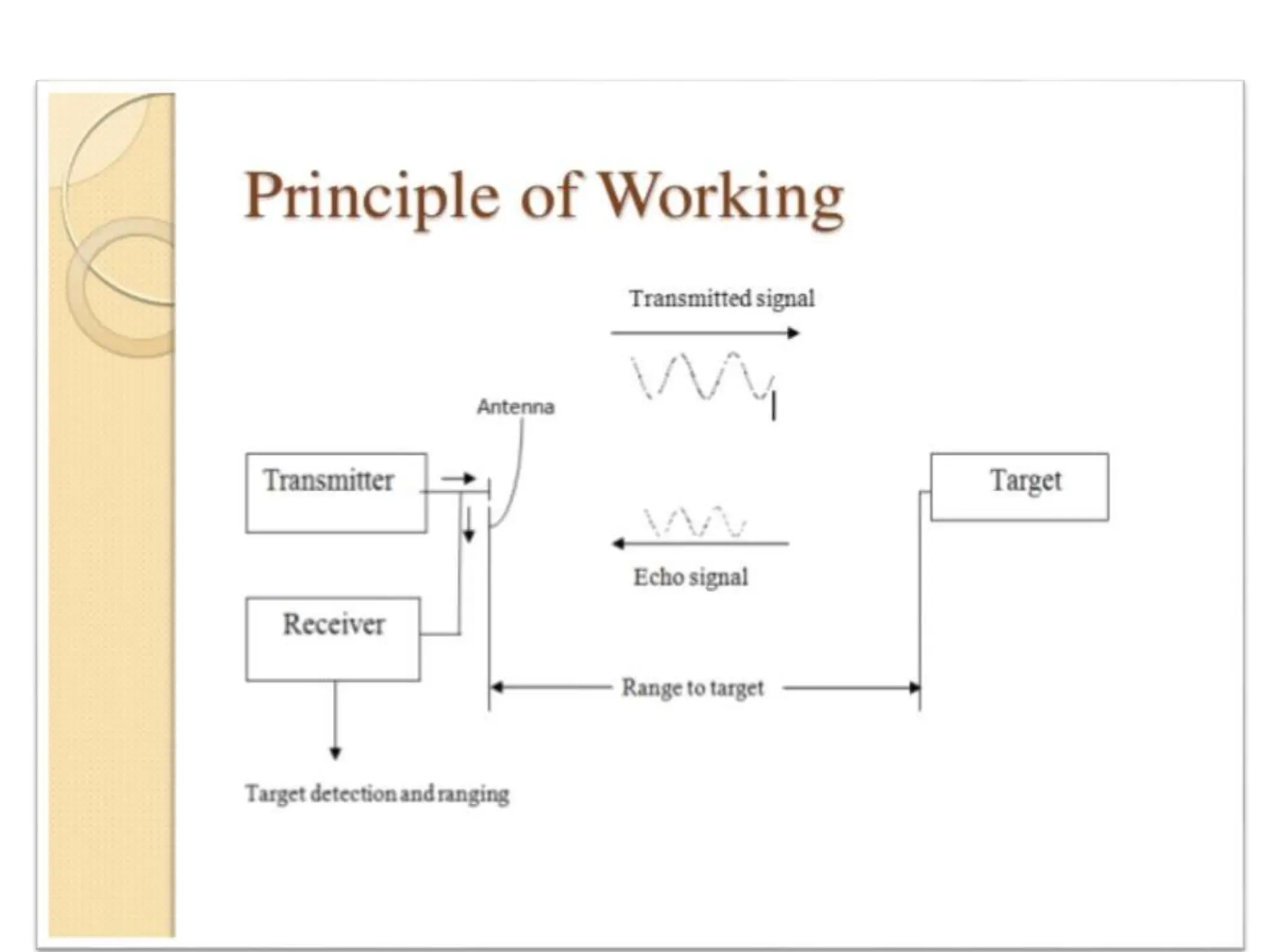
# Radar Principle: The electronic principle on which
radar operates is very similar to the principle of
sound-wave reflection.Radar uses electromagnetic
energy pulses in much the same way. The radio-
frequency (rf) energy is transmitted to and
reflected from the reflecting object.
Fig.1 radar principle
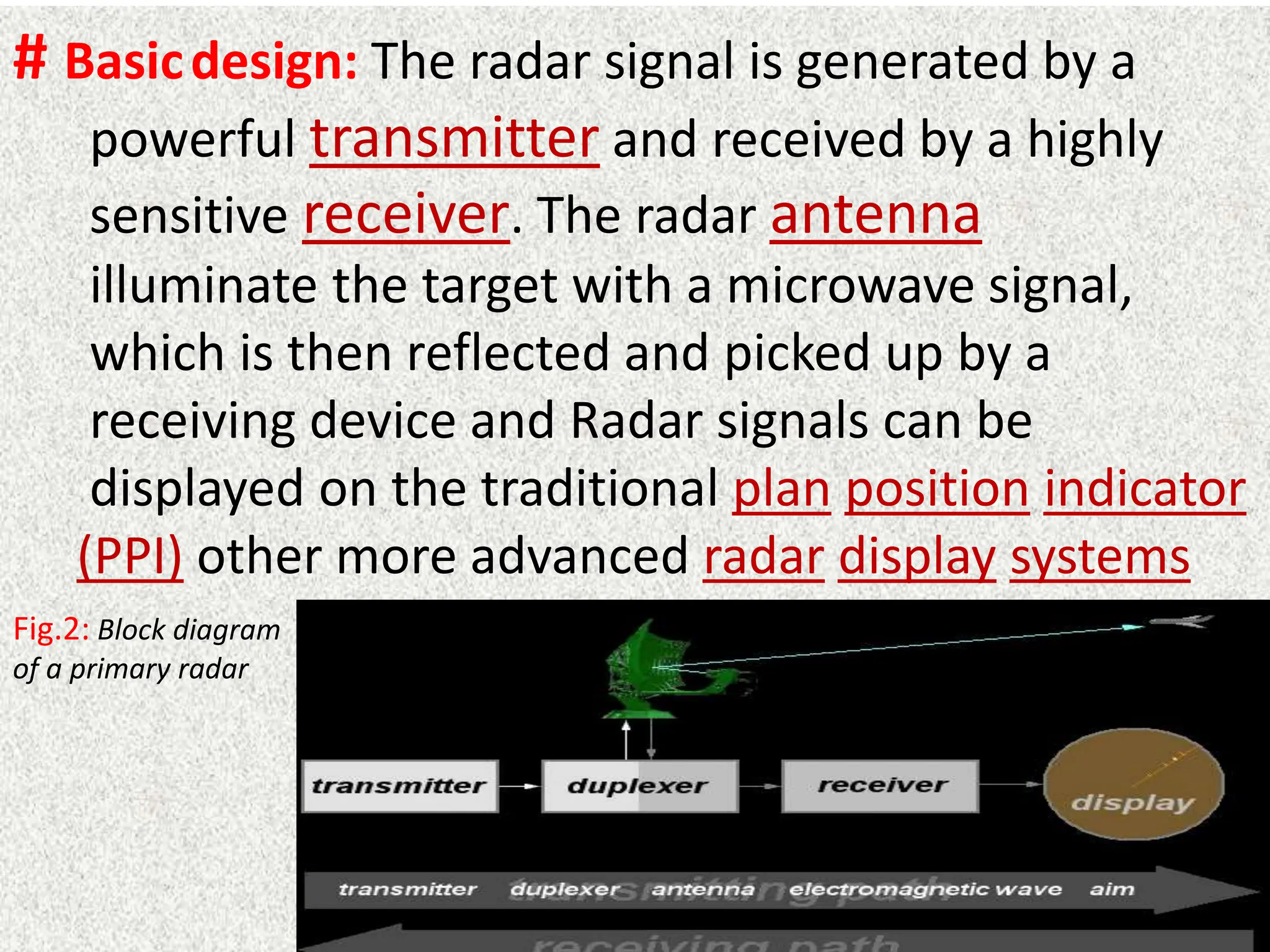
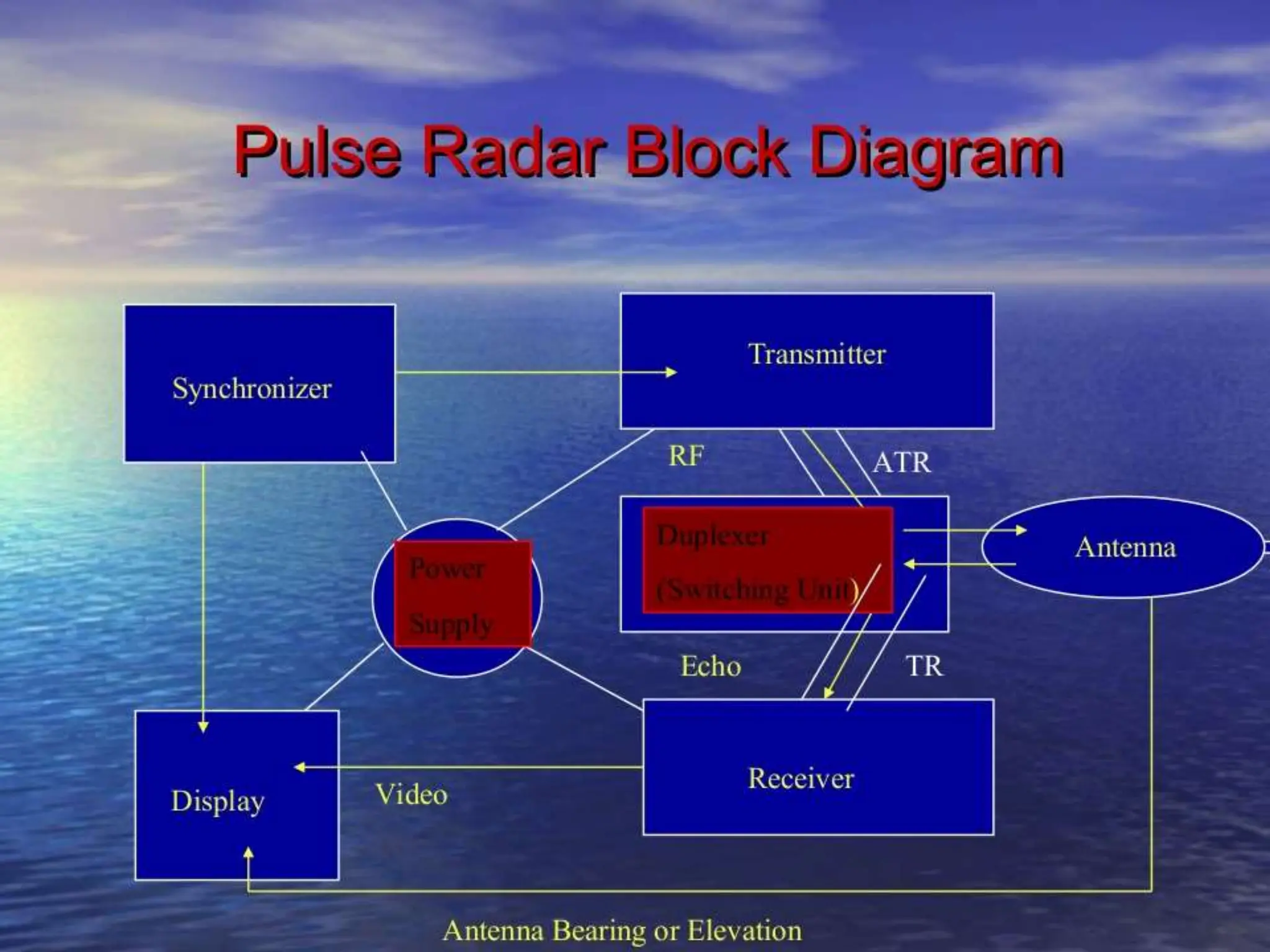
# Basicdesign: The radar signal is generated by a
powerful transmitter and received by a highly
sensitive receiver. The radar antenna
illuminate the target with a microwave signal,
which is then reflected and picked up by a
receiving device and Radar signals can be
displayed on the traditional plan position indicator
(PPI) other more advanced radar display systems
Fig.2: Block diagram
of a primary radar
# Important terms:
Some frequently used term are –
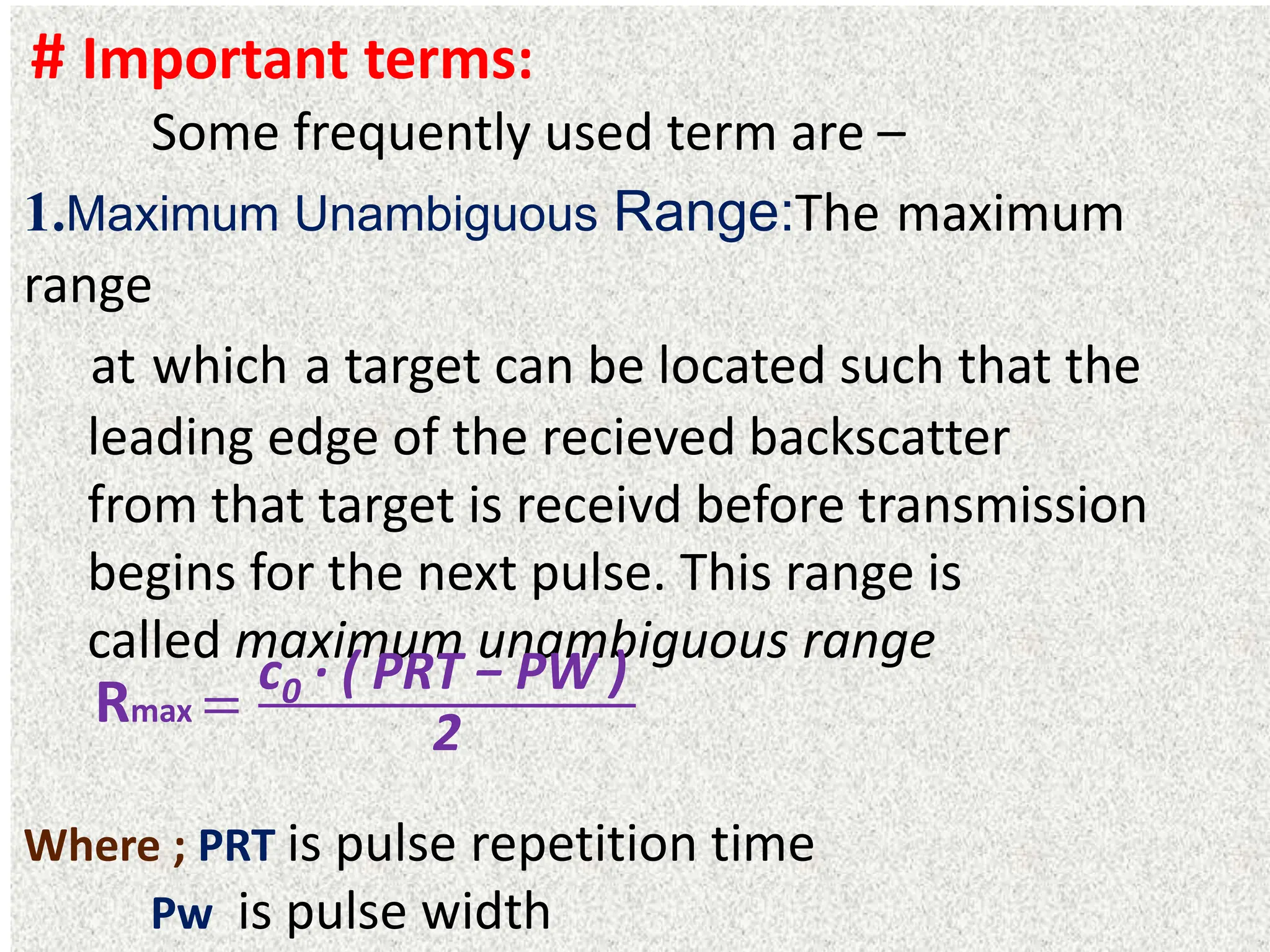
1.Maximum Unambiguous Range:The maximum
range
at which a target can be located such that the
leading edge of the recieved backscatter
from that target is receivd before transmission
begins for the next pulse. This range is
called maximum unambiguous range
Where ; PRT is pulse repetition time
Pw is pulse width
Rmax =
c0 · ( PRT − PW )
2
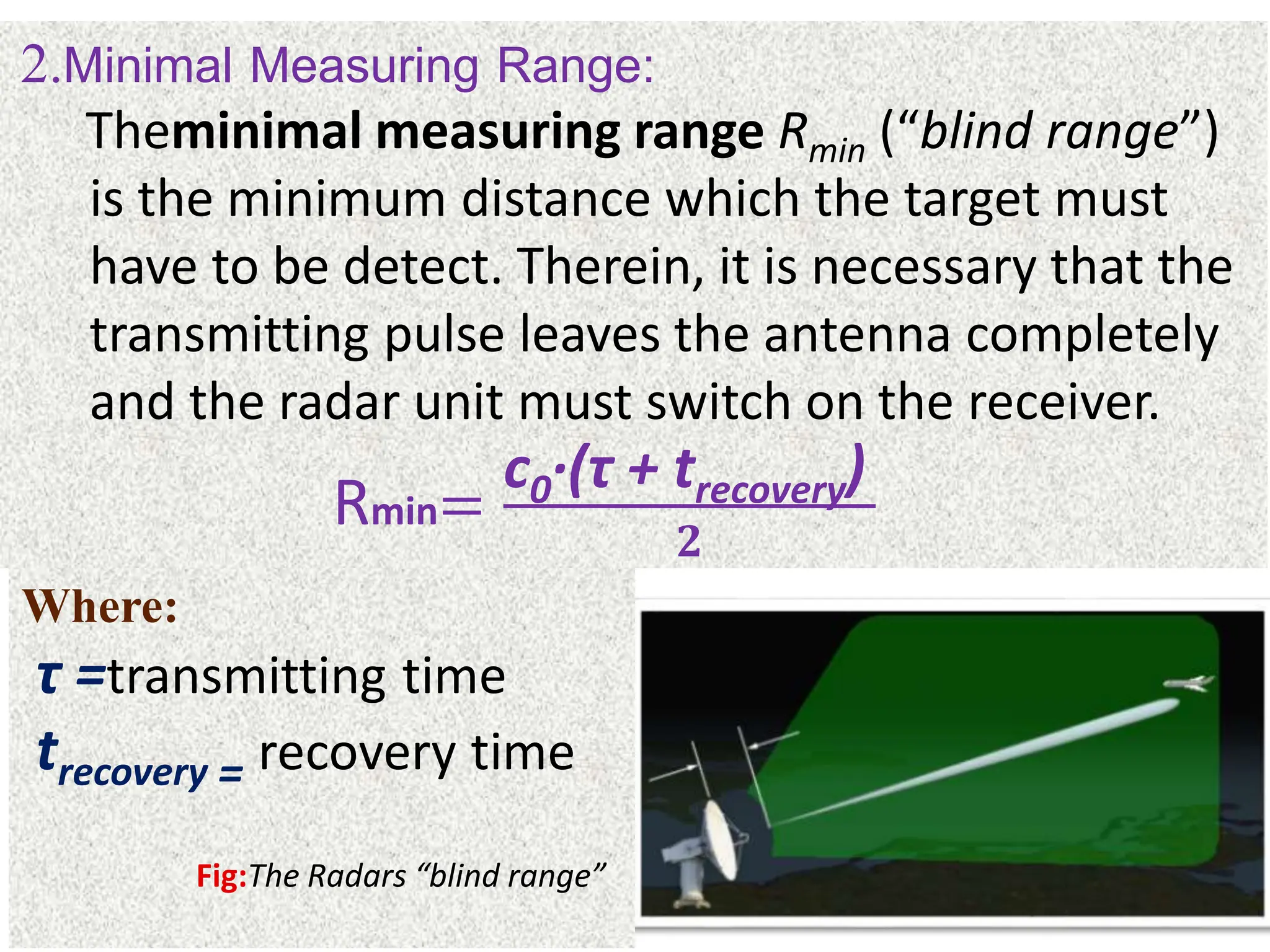
2.Minimal Measuring Range:
Theminimal measuring range Rmin (“blind range”)
is the minimum distance which the target must
have to be detect. Therein, it is necessary that the
transmitting pulse leaves the antenna completely
and the radar unit must switch on the receiver.
Rmin=
c0·(τ + trecovery)
𝟐
Where:
τ =transmitting time
trecovery = recovery time
Fig:The Radars “blind range”
# The Radar equation:
(Argumentation/Derivation)
Radar range equation represents the physical dependences of
the transmit power, one can assess the performance of the radar set
with the radar equation (or the radar range equation).
Non directional Power Density (su) :
Su =
Ps
4 · π · R1
2
Directional Power Density (sg) :
Sg = Su · G
The reflected power Pr :
Pr =
Ps· G · σ
4 · π · R1
2 [W/m2]
The received power PE :
PE =
Ps · G2· σ · λ2
(4 · π)3 · R4
The Antenna Gain (G):
G =
4 · π· A · Ka
λ2
The radar range equation:
R=
4 Ps · G2· σ · λ2
(4 · π)3.PE
Where: PS = transmitted power [W
σ = radar cross section [m2]
R1 = range, distance antenna - aim [m]
R2 = range aim - antenna [m]
Aw =Effective apparture antenna [𝑚2
]
=A · Ka
3.Classifications
*Brief Explanation:
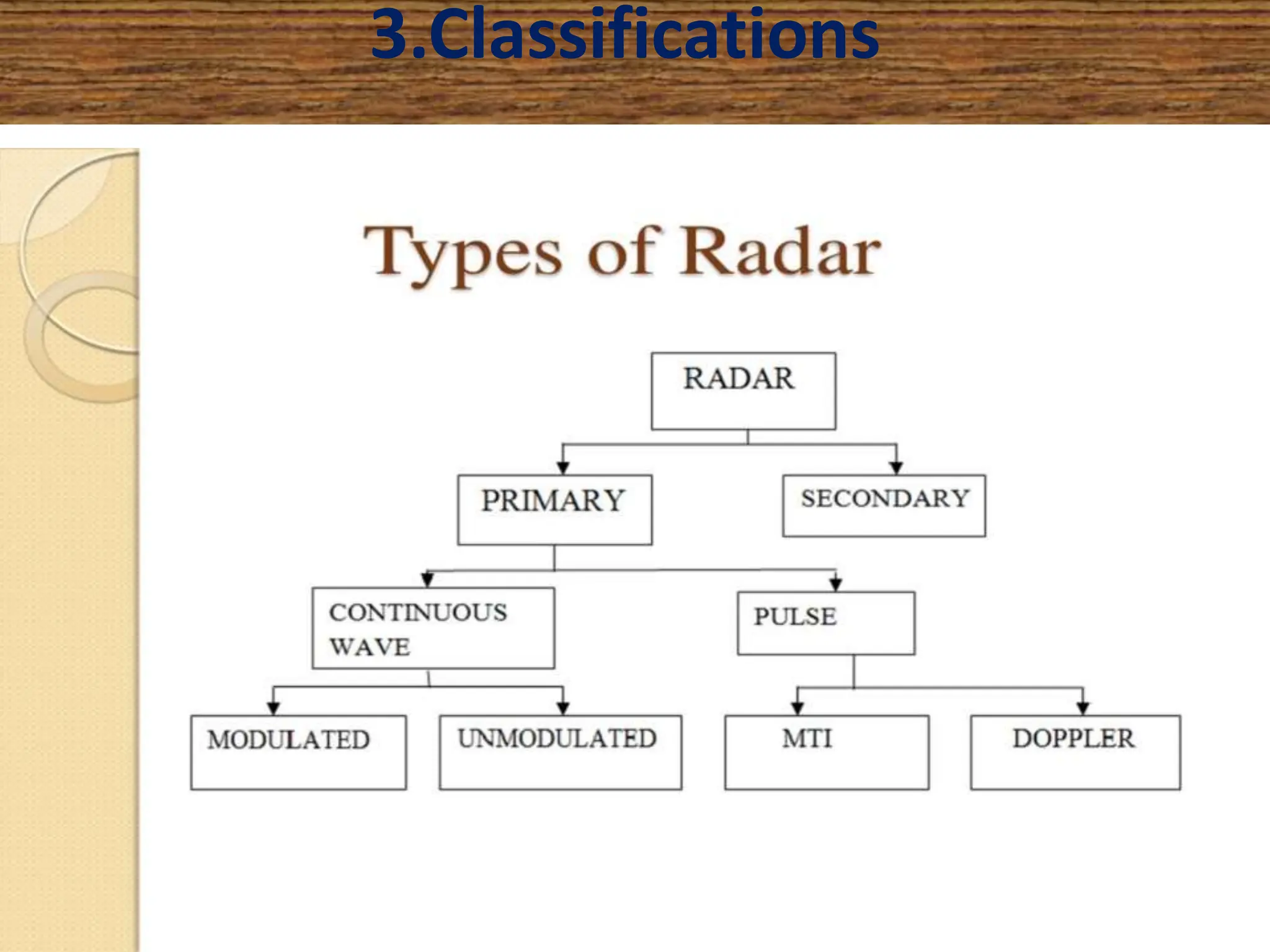
(A)Primary Radar
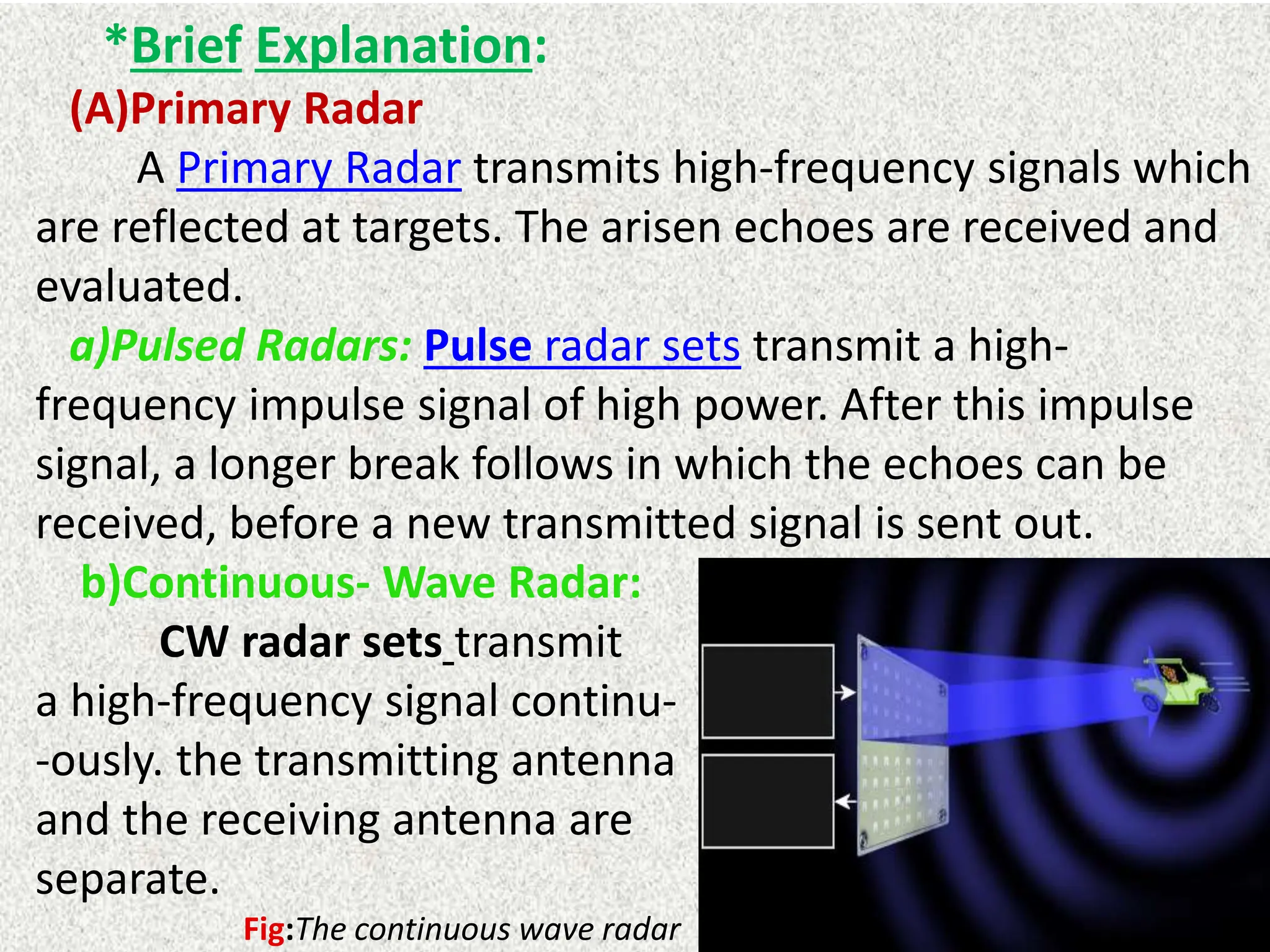
A Primary Radar transmits high-frequency signals which
are reflected at targets. The arisen echoes are received and
evaluated.
a)Pulsed Radars: Pulse radar sets transmit a high-
frequency impulse signal of high power. After this impulse
signal, a longer break follows in which the echoes can be
received, before a new transmitted signal is sent out.
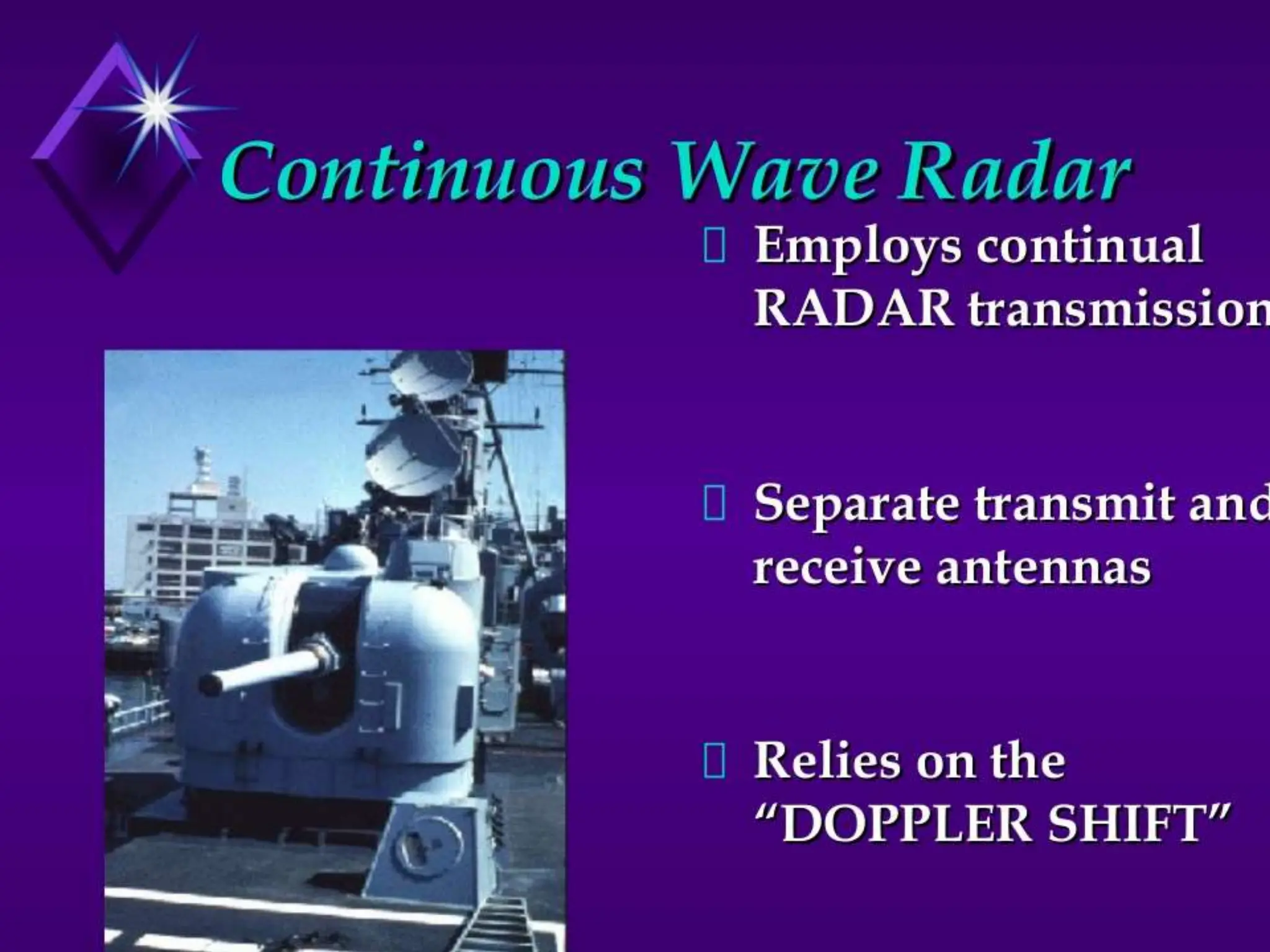
b)Continuous- Wave Radar:
CW radar sets transmit
a high-frequency signal continu-
-ously. the transmitting antenna
and the receiving antenna are
separate.
Fig:The continuous wave radar
(B) Secondary Radar:
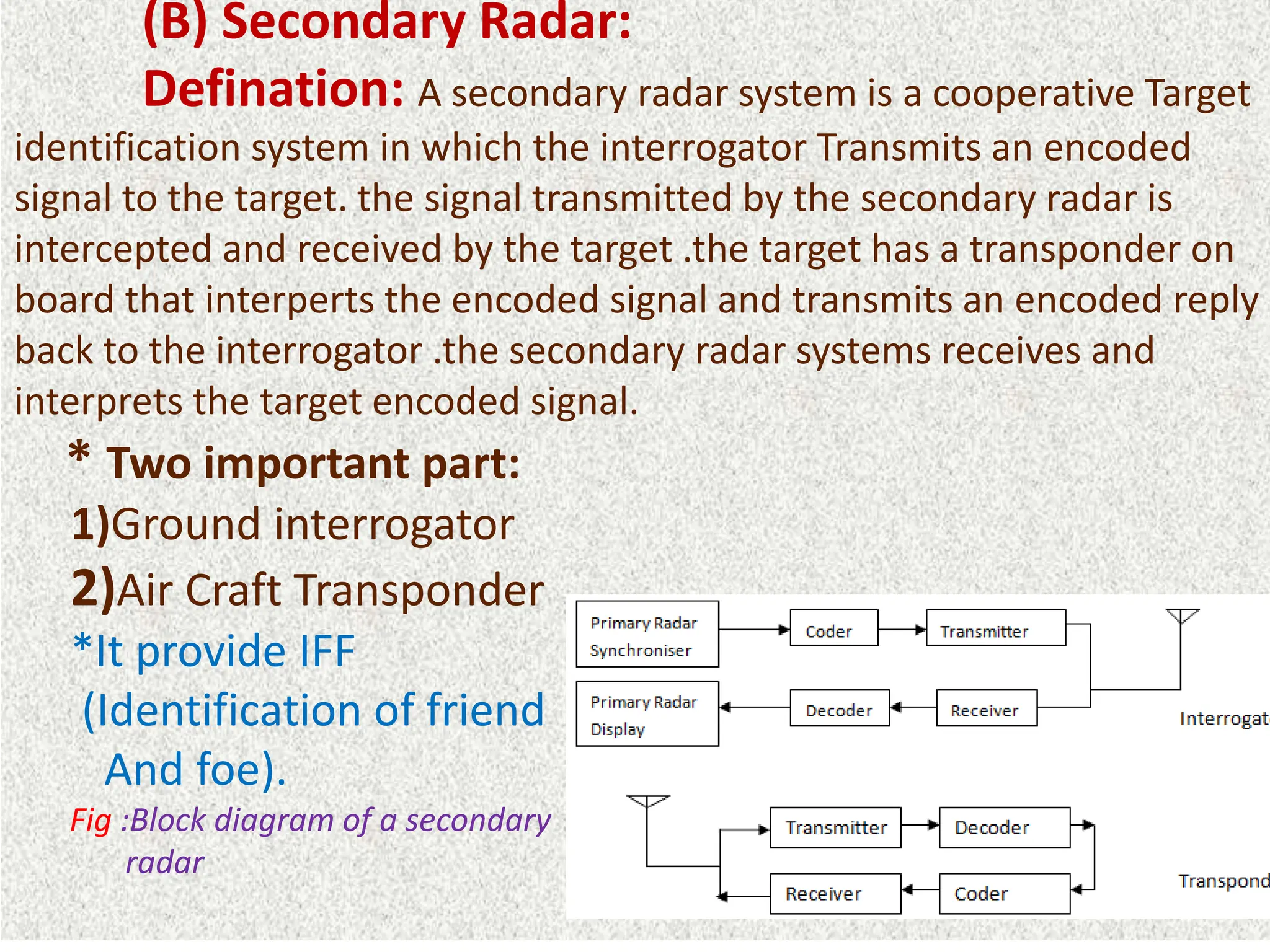
Defination: A secondary radar system is a cooperative Target
identification system in which the interrogator Transmits an encoded
signal to the target. the signal transmitted by the secondary radar is
intercepted and received by the target .the target has a transponder on
board that interperts the encoded signal and transmits an encoded reply
back to the interrogator .the secondary radar systems receives and
interprets the target encoded signal.
* Two important part:
1)Ground interrogator
2)Air Craft Transponder
*It provide IFF
(Identification of friend
And foe).
Fig :Block diagram of a secondary
radar
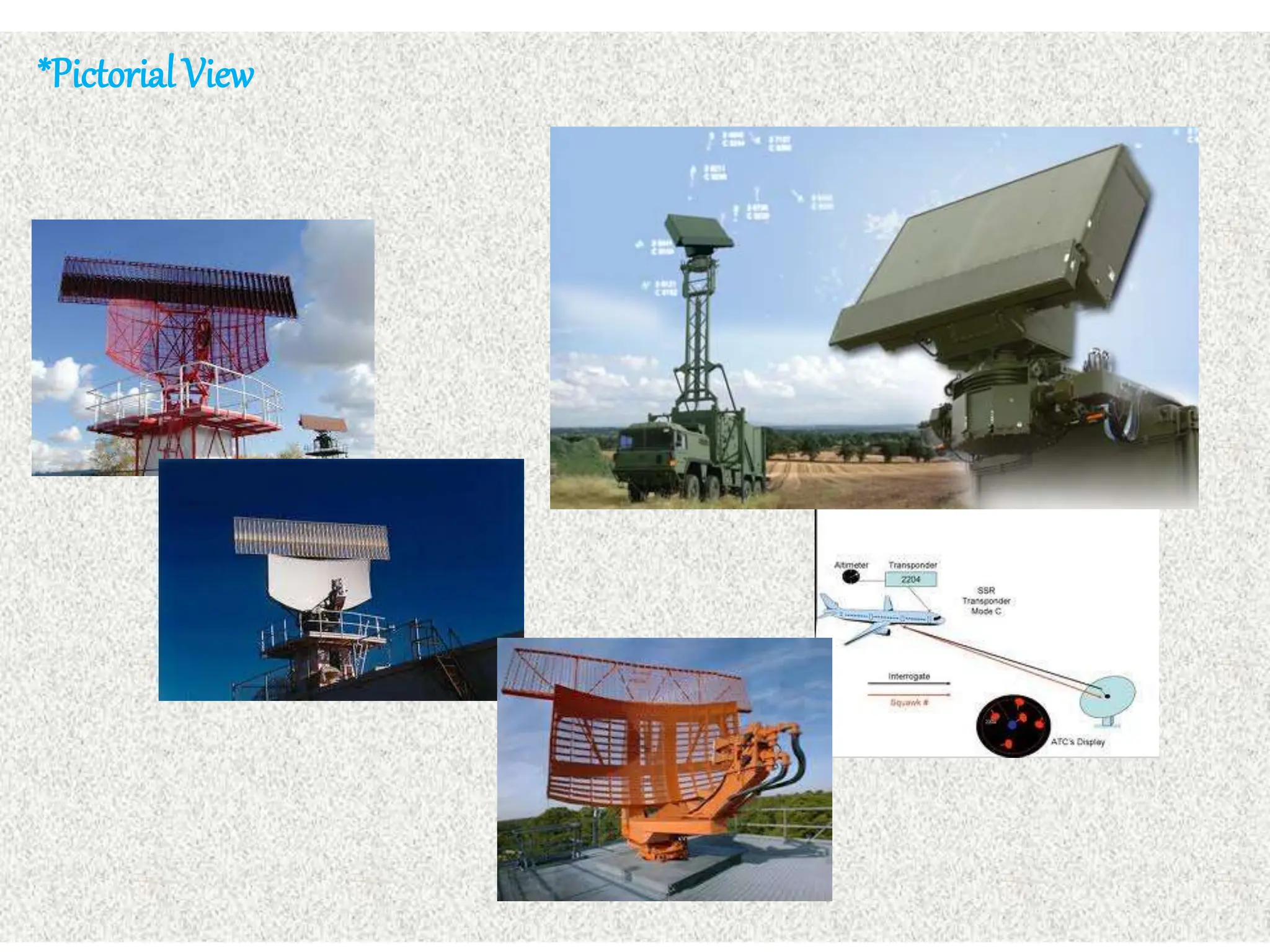
*Pictorial View
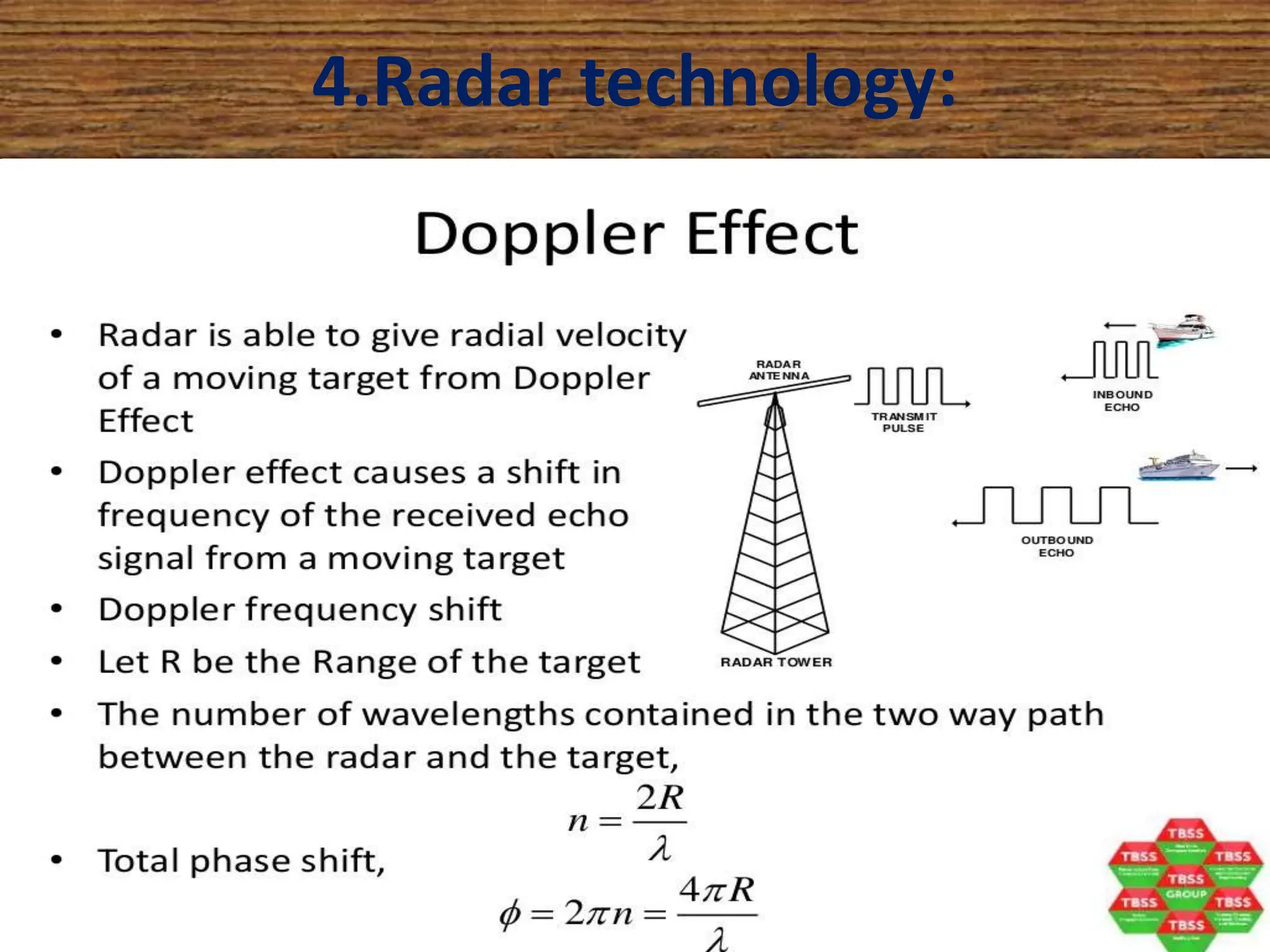
4.Radar technology:
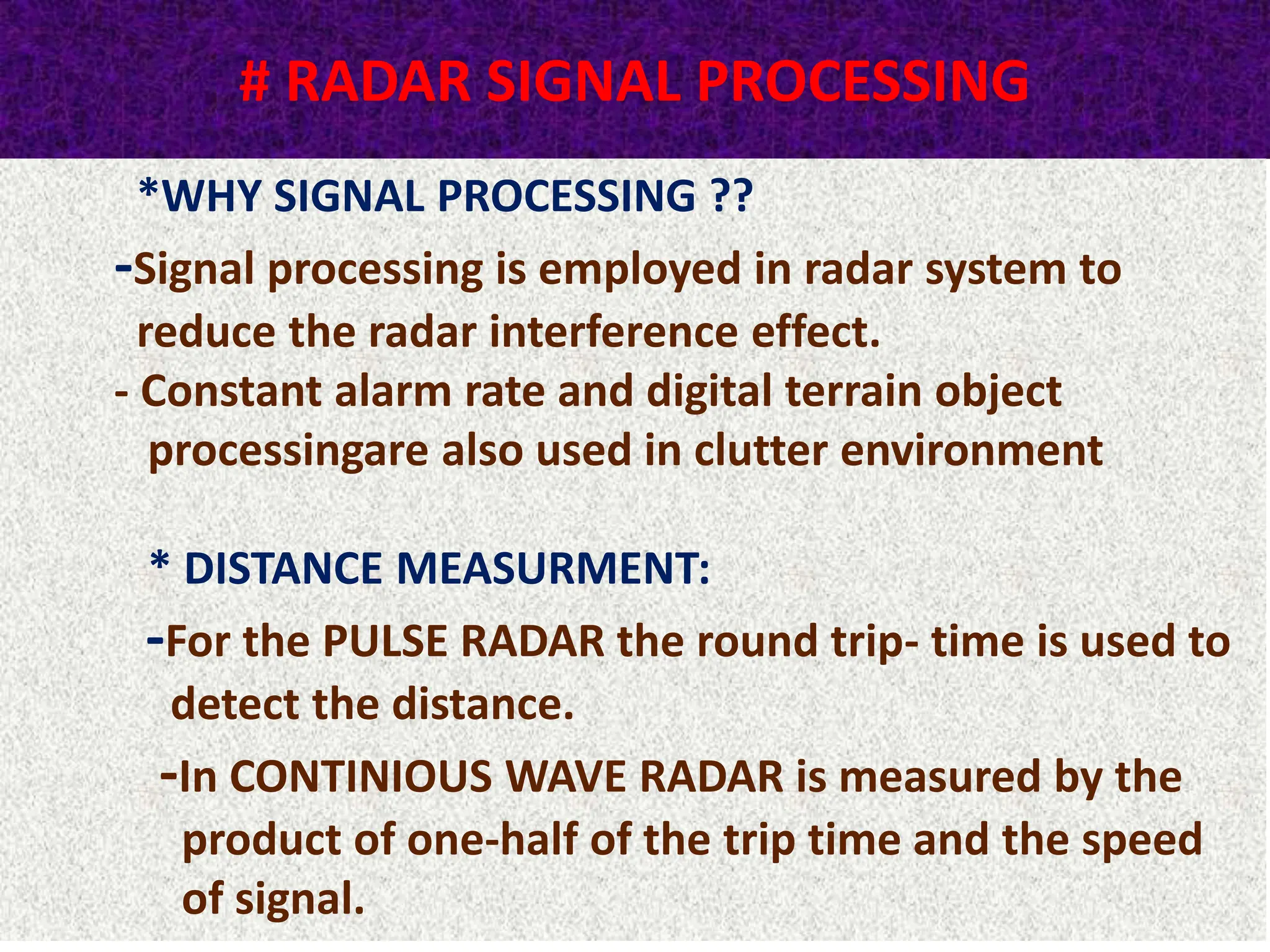
# RADAR SIGNAL PROCESSING
*WHY SIGNAL PROCESSING ??
-Signal processing is employed in radar system to
reduce the radar interference effect.
- Constant alarm rate and digital terrain object
processingare also used in clutter environment
* DISTANCE MEASURMENT:
-For the PULSE RADAR the round trip- time is used to
detect the distance.
-In CONTINIOUS WAVE RADAR is measured by the
product of one-half of the trip time and the speed
of signal.
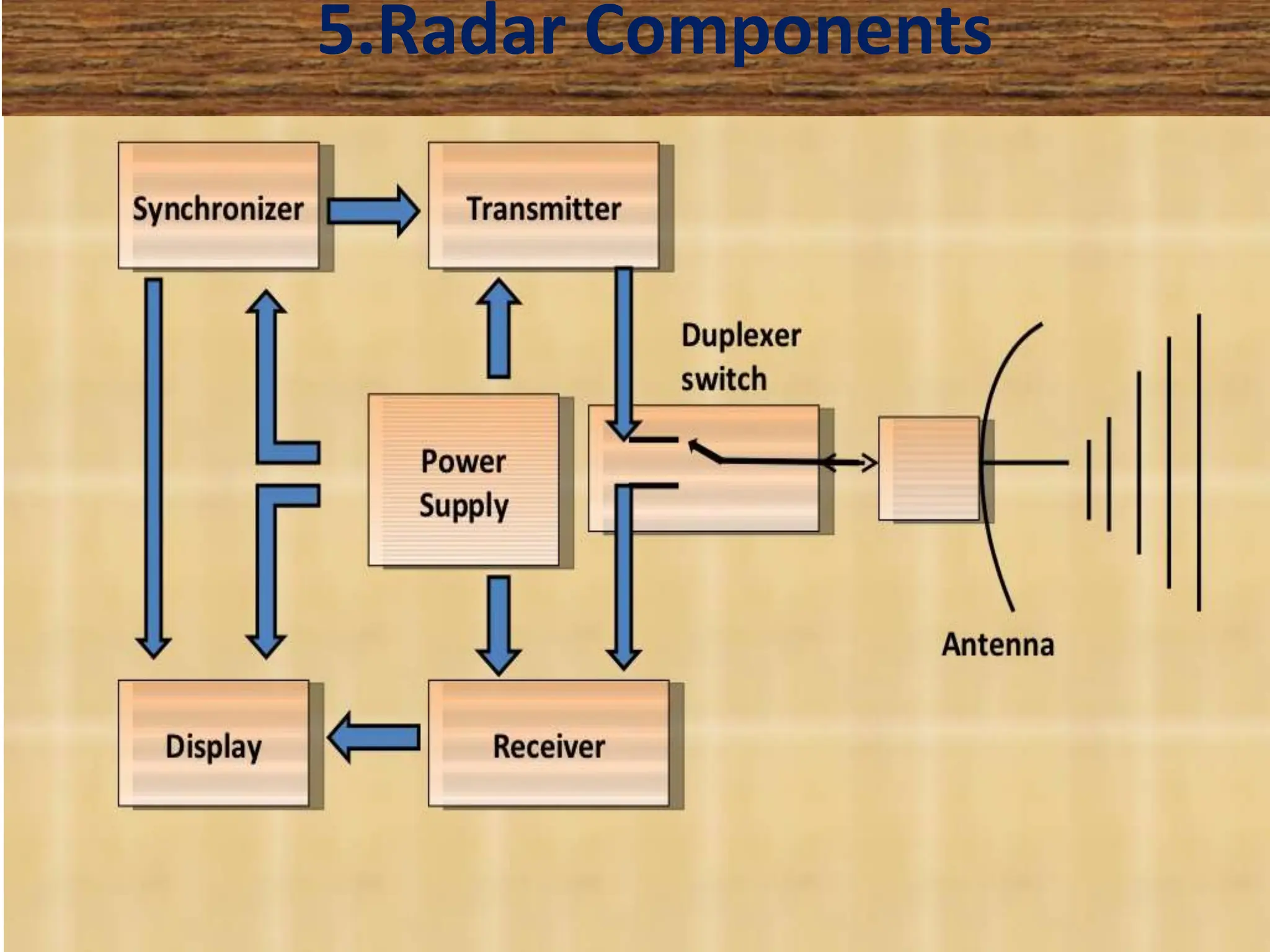
5.Radar Components
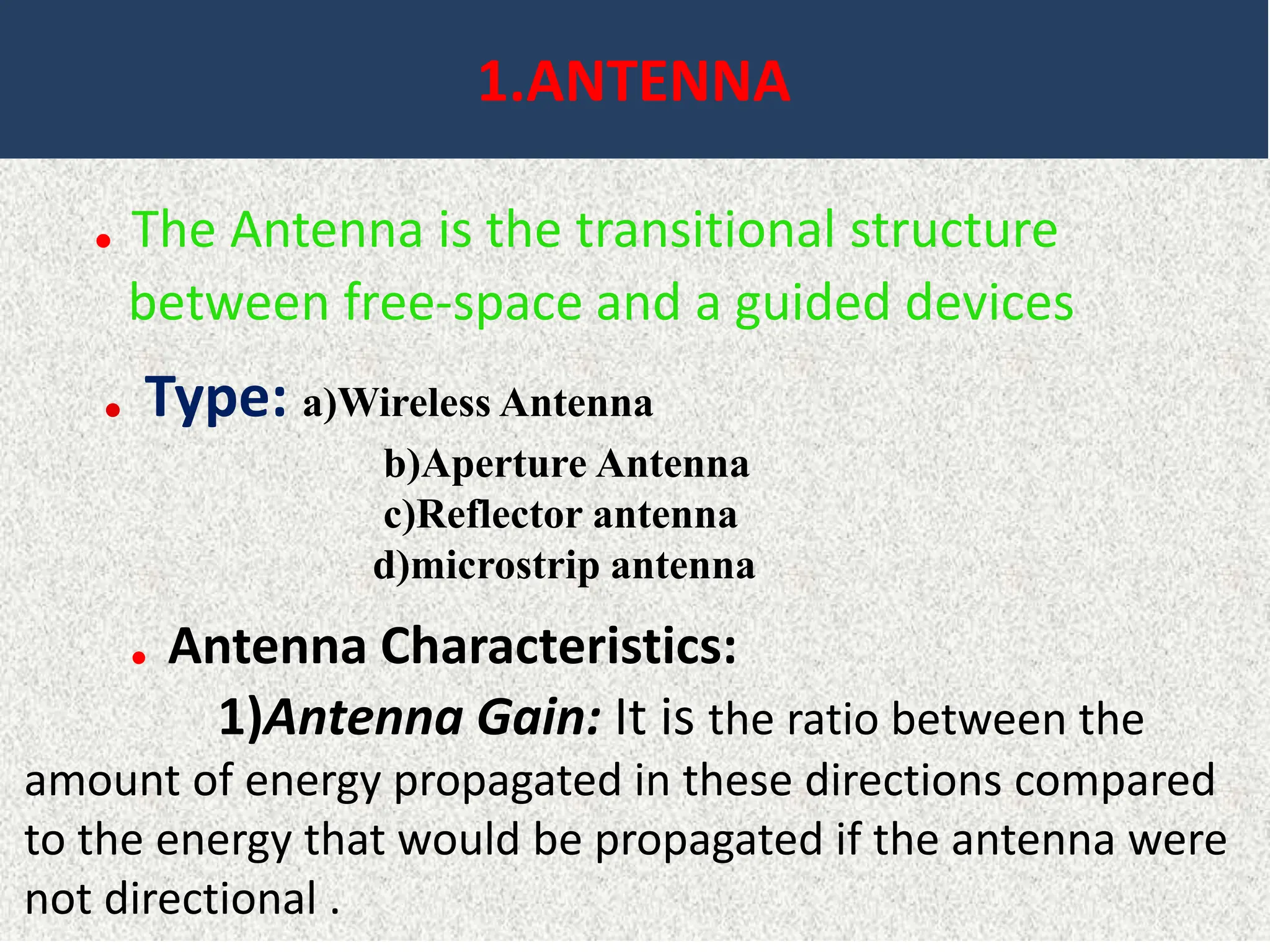
1.ANTENNA
. The Antenna is the transitional structure
between free-space and a guided devices
. Type: a)Wireless Antenna
b)Aperture Antenna
c)Reflector antenna
d)microstrip antenna
. Antenna Characteristics:
1)Antenna Gain: It is the ratio between the
amount of energy propagated in these directions compared
to the energy that would be propagated if the antenna were
not directional .
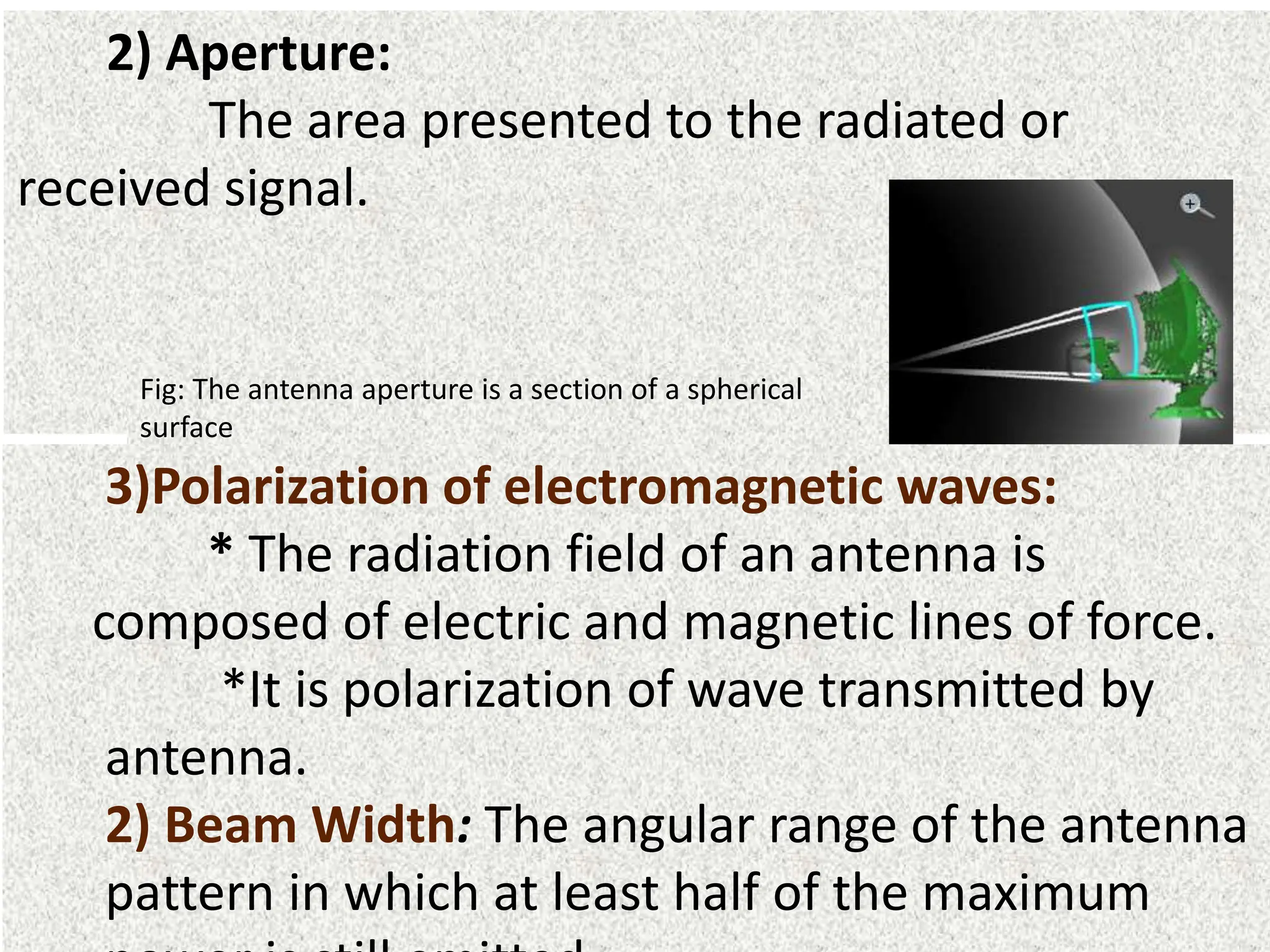
2) Aperture:
The area presented to the radiated or
received signal.
Fig: The antenna aperture is a section of a spherical
surface
3)Polarization of electromagnetic waves:
* The radiation field of an antenna is
composed of electric and magnetic lines of force.
*It is polarization of wave transmitted by
antenna.
2) Beam Width: The angular range of the antenna
pattern in which at least half of the maximum
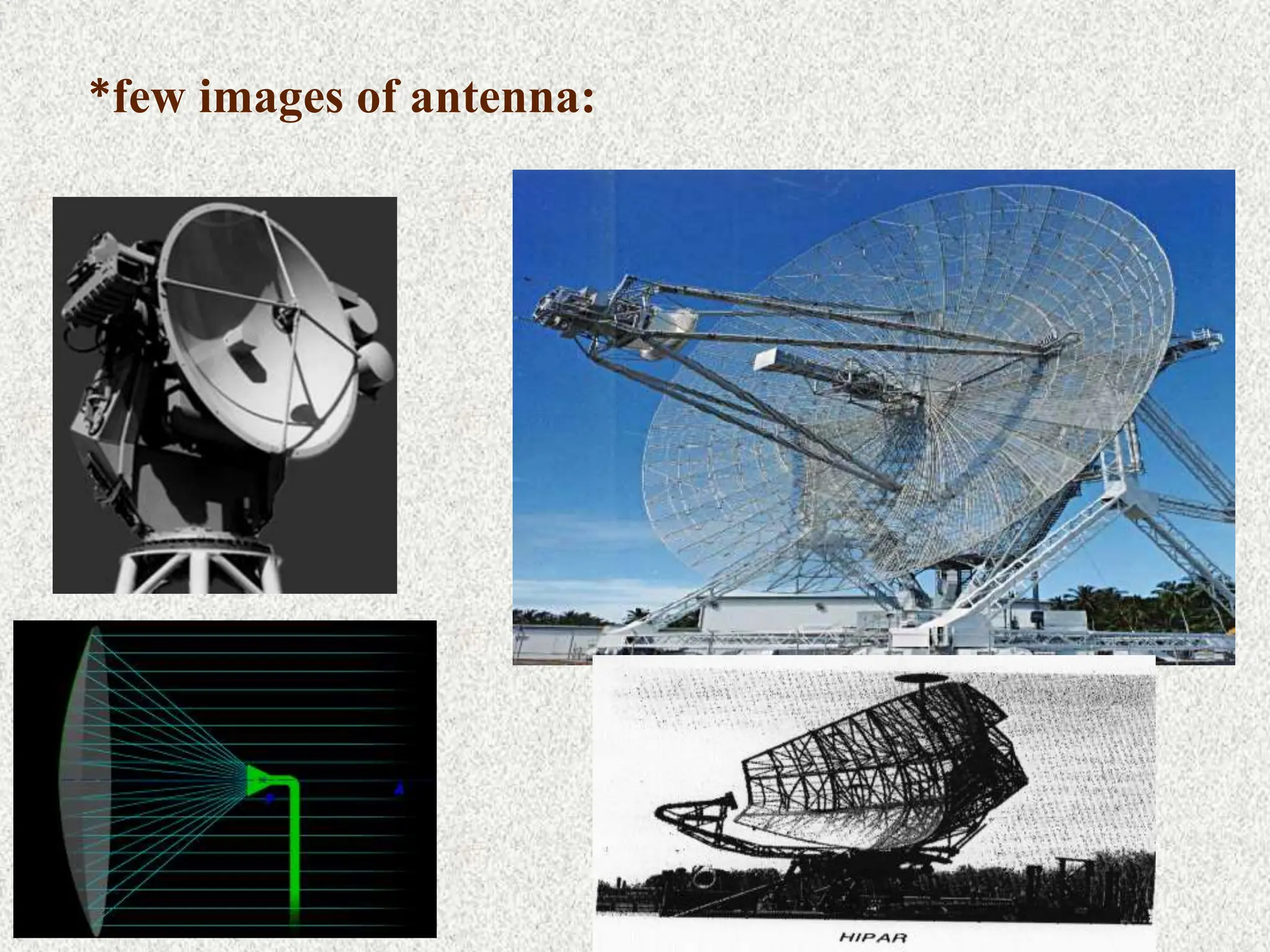
*few images of antenna:
2.RADAR TRANSMITTER
* A radar transmitter generates RF- energy, necessary
for scanning the free space.
*It should have the following operating
characteristics:
a)The transmitter must have a suitable RF bandwidth
b)The transmitter must be easily modulated to meet
waveform design requirements.
*Type:
1.Keyed-oscillator type
2.Power-Amplifier-Transmitters (PAT)
3.RADAR RECEIVER
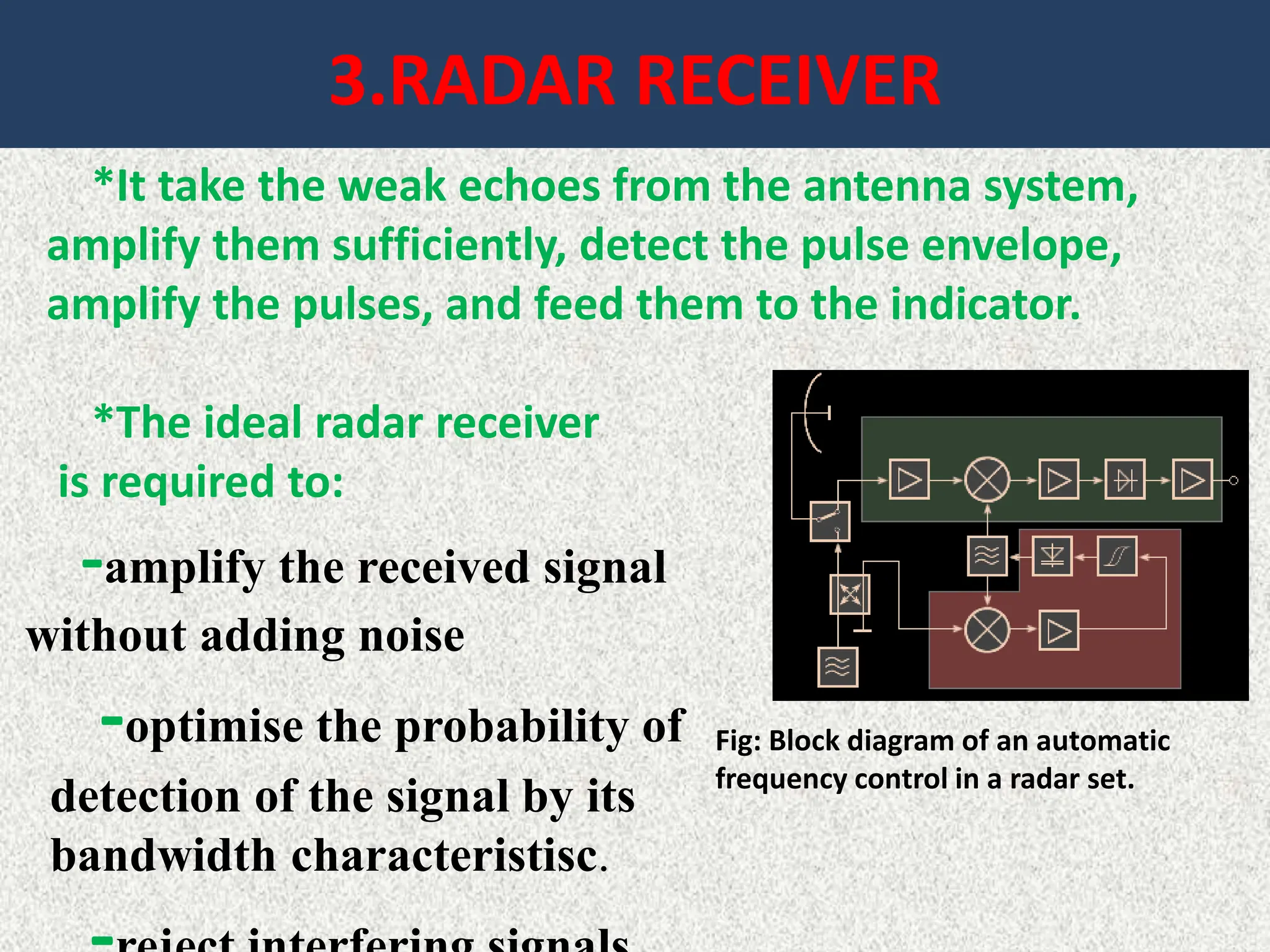
*It take the weak echoes from the antenna system,
amplify them sufficiently, detect the pulse envelope,
amplify the pulses, and feed them to the indicator.
*The ideal radar receiver
is required to:
-amplify the received signal
without adding noise
-optimise the probability of
detection of the signal by its
bandwidth characteristisc.
Fig: Block diagram of an automatic
frequency control in a radar set.
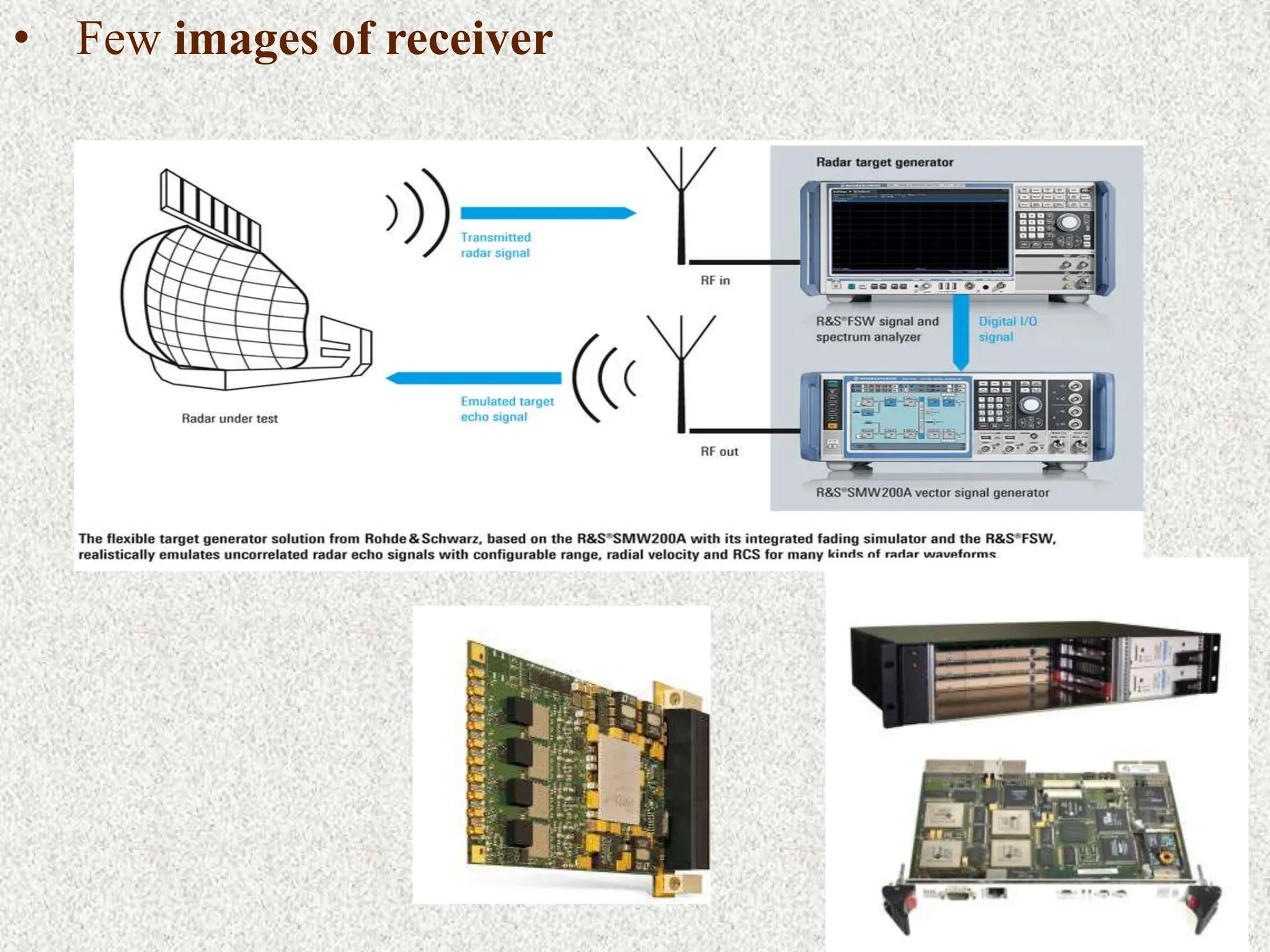
• Few images of receiver
4.DUPLEXER
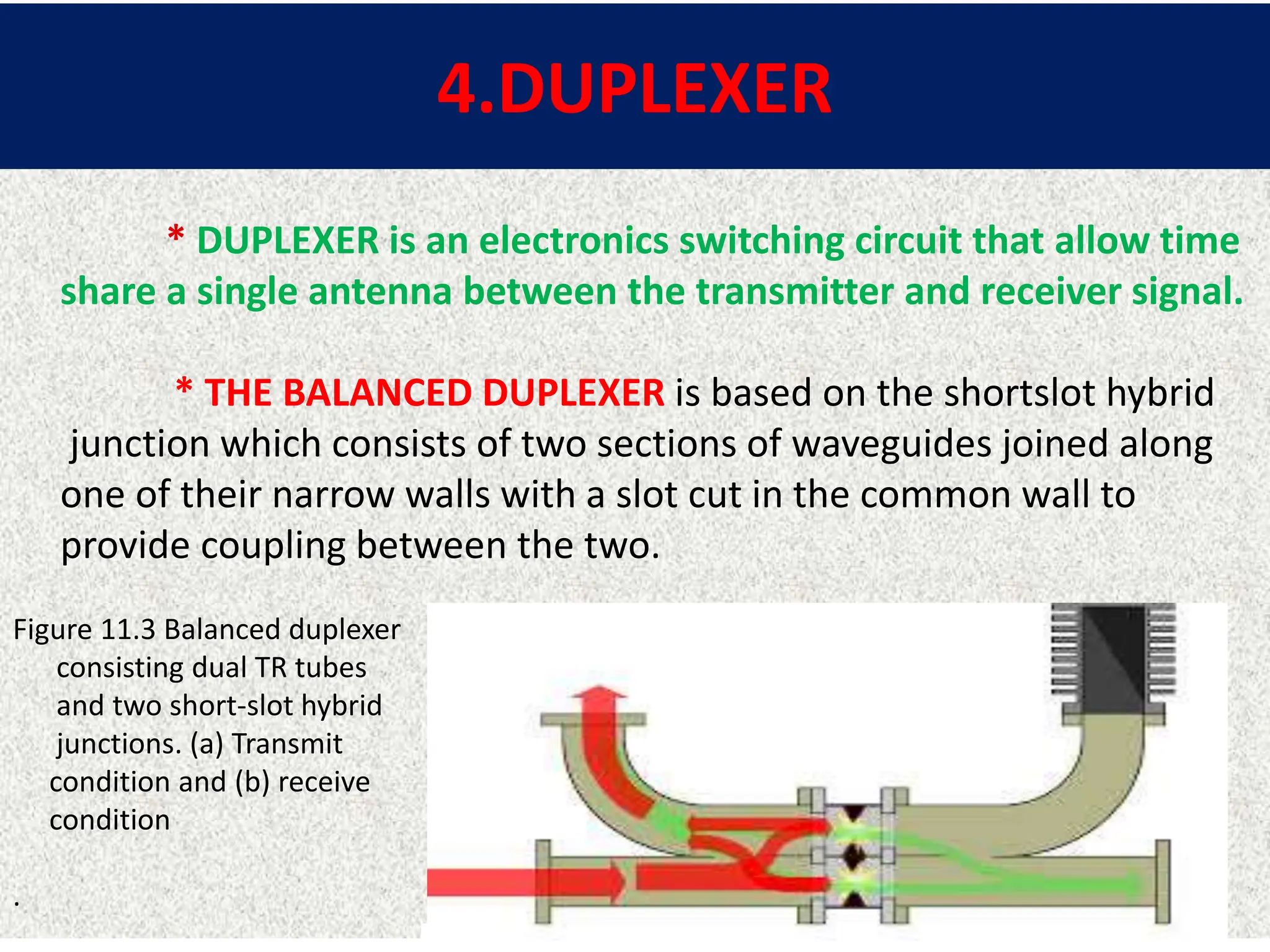
* DUPLEXER is an electronics switching circuit that allow time
share a single antenna between the transmitter and receiver signal.
* THE BALANCED DUPLEXER is based on the shortslot hybrid
junction which consists of two sections of waveguides joined along
one of their narrow walls with a slot cut in the common wall to
provide coupling between the two.
Figure 11.3 Balanced duplexer
consisting dual TR tubes
and two short-slot hybrid
junctions. (a) Transmit
condition and (b) receive
condition
.
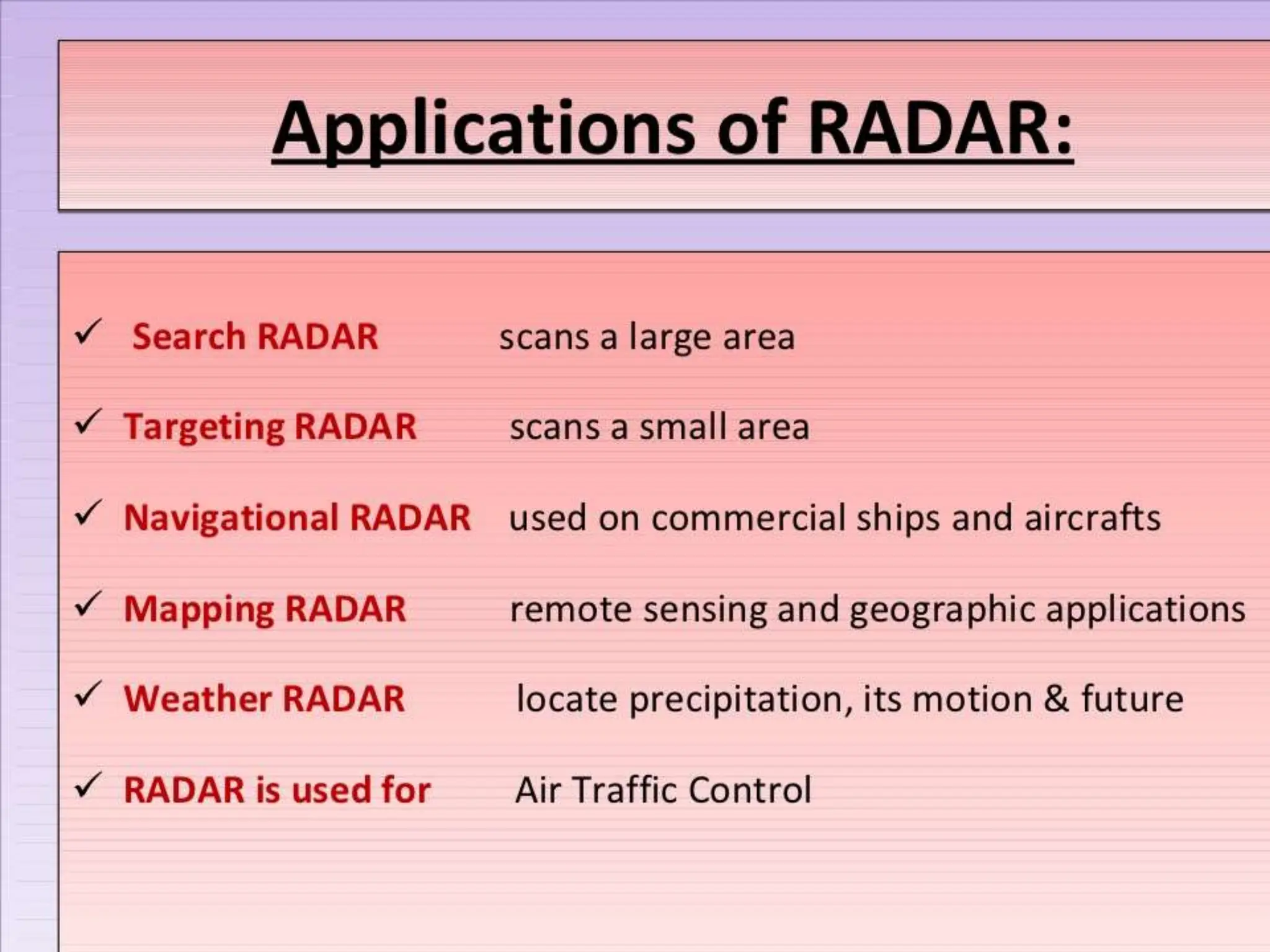
6.APPLICATION
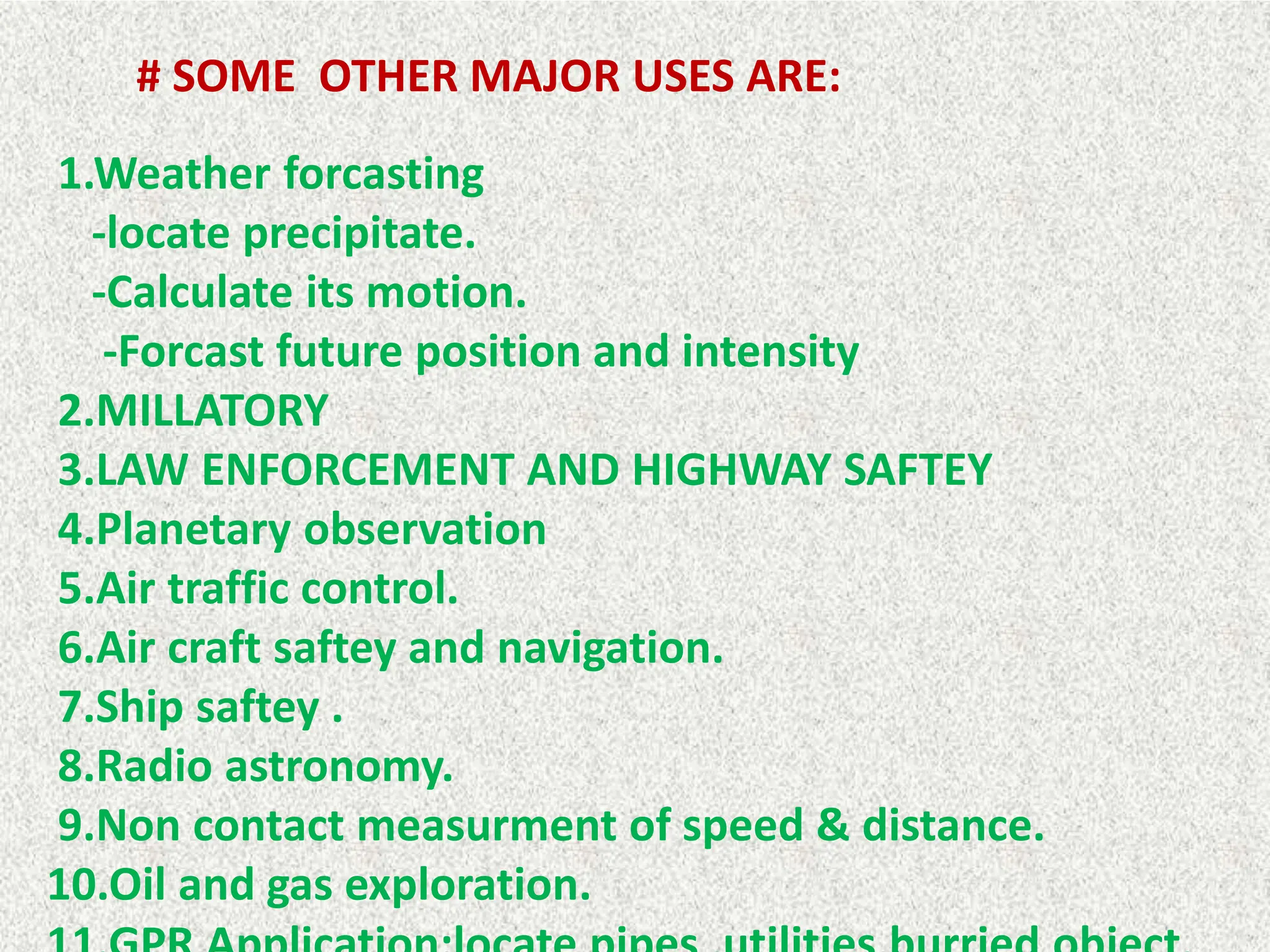
# SOME OTHER MAJOR USES ARE:
1.Weather forcasting
-locate precipitate.
-Calculate its motion.
-Forcast future position and intensity
2.MILLATORY
3.LAW ENFORCEMENT AND HIGHWAY SAFTEY
4.Planetary observation
5.Air traffic control.
6.Air craft saftey and navigation.
7.Ship saftey .
8.Radio astronomy.
9.Non contact measurment of speed & distance.
10.Oil and gas exploration.
introduction to radar system and devices.pdf

introduction to radar system and devices.pdf

  • 1.
    SEMESTER PROJECT PRESENTATION ON ELECTRONICS BASEDDEVICES INDIAN INSTITUTE OF ENGINEERING SCIENCE & TECHNOLOGY ,SHIBPUR
  • 2.
  • 3.
    RADARSYSTEMS Preparedby: NITESH KUMAR E&Tc Dept.-6thSEM ID No.:110712009 IIEST,SHIBPUR
  • 4.
  • 5.
    1.Introduction # defination: Radaris an object-detection system that uses radio waves to determine the range, altitude, direction, or speed of objects. *RADAR stands for RADIO DETECTION AND RANGING # historical review: 1886: H.R.Hertz Discovered Electromagnetic wave. 1897: G.Marconi (known as pioneer of radio communication) firstly transmitted electromagnetic wave for long distance. 1930: L.A.Hyland,Locates an aircraft for first time.
  • 6.
    2.Basic principles AndDesign # Radar Principle: The electronic principle on which radar operates is very similar to the principle of sound-wave reflection.Radar uses electromagnetic energy pulses in much the same way. The radio- frequency (rf) energy is transmitted to and reflected from the reflecting object. Fig.1 radar principle
  • 9.
    # Basicdesign: Theradar signal is generated by a powerful transmitter and received by a highly sensitive receiver. The radar antenna illuminate the target with a microwave signal, which is then reflected and picked up by a receiving device and Radar signals can be displayed on the traditional plan position indicator (PPI) other more advanced radar display systems Fig.2: Block diagram of a primary radar
  • 10.
    # Important terms: Somefrequently used term are – 1.Maximum Unambiguous Range:The maximum range at which a target can be located such that the leading edge of the recieved backscatter from that target is receivd before transmission begins for the next pulse. This range is called maximum unambiguous range Where ; PRT is pulse repetition time Pw is pulse width Rmax = c0 · ( PRT − PW ) 2
  • 11.
    2.Minimal Measuring Range: Theminimalmeasuring range Rmin (“blind range”) is the minimum distance which the target must have to be detect. Therein, it is necessary that the transmitting pulse leaves the antenna completely and the radar unit must switch on the receiver. Rmin= c0·(τ + trecovery) 𝟐 Where: τ =transmitting time trecovery = recovery time Fig:The Radars “blind range”
  • 12.
    # The Radarequation: (Argumentation/Derivation) Radar range equation represents the physical dependences of the transmit power, one can assess the performance of the radar set with the radar equation (or the radar range equation). Non directional Power Density (su) : Su = Ps 4 · π · R1 2 Directional Power Density (sg) : Sg = Su · G The reflected power Pr : Pr = Ps· G · σ 4 · π · R1 2 [W/m2] The received power PE :
  • 13.
    PE = Ps ·G2· σ · λ2 (4 · π)3 · R4 The Antenna Gain (G): G = 4 · π· A · Ka λ2 The radar range equation: R= 4 Ps · G2· σ · λ2 (4 · π)3.PE Where: PS = transmitted power [W σ = radar cross section [m2] R1 = range, distance antenna - aim [m] R2 = range aim - antenna [m] Aw =Effective apparture antenna [𝑚2 ] =A · Ka
  • 14.
  • 15.
    *Brief Explanation: (A)Primary Radar APrimary Radar transmits high-frequency signals which are reflected at targets. The arisen echoes are received and evaluated. a)Pulsed Radars: Pulse radar sets transmit a high- frequency impulse signal of high power. After this impulse signal, a longer break follows in which the echoes can be received, before a new transmitted signal is sent out. b)Continuous- Wave Radar: CW radar sets transmit a high-frequency signal continu- -ously. the transmitting antenna and the receiving antenna are separate. Fig:The continuous wave radar
  • 18.
    (B) Secondary Radar: Defination:A secondary radar system is a cooperative Target identification system in which the interrogator Transmits an encoded signal to the target. the signal transmitted by the secondary radar is intercepted and received by the target .the target has a transponder on board that interperts the encoded signal and transmits an encoded reply back to the interrogator .the secondary radar systems receives and interprets the target encoded signal. * Two important part: 1)Ground interrogator 2)Air Craft Transponder *It provide IFF (Identification of friend And foe). Fig :Block diagram of a secondary radar
  • 19.
  • 20.
  • 21.
    # RADAR SIGNALPROCESSING *WHY SIGNAL PROCESSING ?? -Signal processing is employed in radar system to reduce the radar interference effect. - Constant alarm rate and digital terrain object processingare also used in clutter environment * DISTANCE MEASURMENT: -For the PULSE RADAR the round trip- time is used to detect the distance. -In CONTINIOUS WAVE RADAR is measured by the product of one-half of the trip time and the speed of signal.
  • 22.
  • 23.
    1.ANTENNA . The Antennais the transitional structure between free-space and a guided devices . Type: a)Wireless Antenna b)Aperture Antenna c)Reflector antenna d)microstrip antenna . Antenna Characteristics: 1)Antenna Gain: It is the ratio between the amount of energy propagated in these directions compared to the energy that would be propagated if the antenna were not directional .
  • 24.
    2) Aperture: The areapresented to the radiated or received signal. Fig: The antenna aperture is a section of a spherical surface 3)Polarization of electromagnetic waves: * The radiation field of an antenna is composed of electric and magnetic lines of force. *It is polarization of wave transmitted by antenna. 2) Beam Width: The angular range of the antenna pattern in which at least half of the maximum
  • 25.
  • 26.
    2.RADAR TRANSMITTER * Aradar transmitter generates RF- energy, necessary for scanning the free space. *It should have the following operating characteristics: a)The transmitter must have a suitable RF bandwidth b)The transmitter must be easily modulated to meet waveform design requirements. *Type: 1.Keyed-oscillator type 2.Power-Amplifier-Transmitters (PAT)
  • 27.
    3.RADAR RECEIVER *It takethe weak echoes from the antenna system, amplify them sufficiently, detect the pulse envelope, amplify the pulses, and feed them to the indicator. *The ideal radar receiver is required to: -amplify the received signal without adding noise -optimise the probability of detection of the signal by its bandwidth characteristisc. Fig: Block diagram of an automatic frequency control in a radar set.
  • 28.
    • Few imagesof receiver
  • 29.
    4.DUPLEXER * DUPLEXER isan electronics switching circuit that allow time share a single antenna between the transmitter and receiver signal. * THE BALANCED DUPLEXER is based on the shortslot hybrid junction which consists of two sections of waveguides joined along one of their narrow walls with a slot cut in the common wall to provide coupling between the two. Figure 11.3 Balanced duplexer consisting dual TR tubes and two short-slot hybrid junctions. (a) Transmit condition and (b) receive condition .
  • 30.
  • 31.
    # SOME OTHERMAJOR USES ARE: 1.Weather forcasting -locate precipitate. -Calculate its motion. -Forcast future position and intensity 2.MILLATORY 3.LAW ENFORCEMENT AND HIGHWAY SAFTEY 4.Planetary observation 5.Air traffic control. 6.Air craft saftey and navigation. 7.Ship saftey . 8.Radio astronomy. 9.Non contact measurment of speed & distance. 10.Oil and gas exploration.