

RADAR COMMUNICATION
INTRODUCTION TO RADAR
By: Saurabh Kumar(0186ec131103)
CONTENT
• Introduction
• Working Principle of RADAR
• Types of RADAR
• Applications of RADAR
• Merits and Demerits of RADAR Technology
• What’s new in RADAR Technology?
INTRODUCTION
• Radar(RAdio Detection And Ranging) is a object detection system that uses radio
waves to determine the range, angle or velocity of object.
• A Radar system consist of a transmitter producing electromagnetic waves in the
radio or microwaves domain, a transmitting antenna, a receiving antenna and a
receiver and processor to determine properties of the objects.
• Radar was developed secretly for military use by several nation in the period before
and during World War II (1942).
WORKING PRINCIPLE
• The electronic principle on which radar operates is very similar to the
principle of sound waves reflection.
• RADAR uses electromagnetic energy pulses. Radio frequency energy is
transmitted to and reflected energy returns to the radar set. Radar set uses
these energy to determine the direction and distance of the reflecting object.
WORKING PRINCIPLE(Contd.)
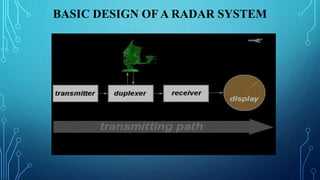
BASIC DESIGN OF A RADAR SYSTEM
CLASSIFICATION OF RADAR
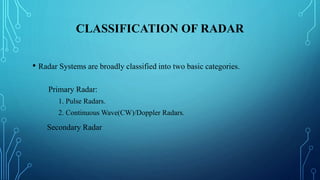
• Radar Systems are broadly classified into two basic categories.
Primary Radar:
1. Pulse Radars.
2. Continuous Wave(CW)/Doppler Radars.
Secondary Radar
CW/DOPPLER RADAR
• It transmits a continuous wave signal and is generally useful for Doppler
Radar which utilizes the Doppler Effect(i.e. change in the wavelength of
signal.)
• A radar using the Doppler effect principle is known as a Doppler Radar
which is useful in navigation over land and sea while navigation through
aircraft or ship.
CW/DOPPLER
RADAR(Contd.)
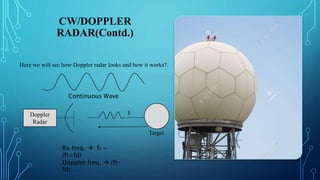
Here we will see how Doppler radar looks and how it works?.
ft
Continuous Wave
Doppler
Radar
Target
Rx freq.  fr =
(ft+fd)
Doppler freq.  (ft-
fd)
PULSE RADAR
• In context with CW radar, a pulse radar is more useful.
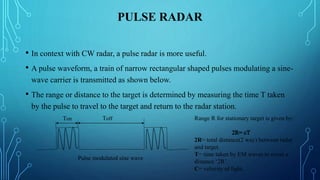
• A pulse waveform, a train of narrow rectangular shaped pulses modulating a sine-
wave carrier is transmitted as shown below.
• The range or distance to the target is determined by measuring the time T taken
by the pulse to travel to the target and return to the radar station.
ToffTon
Pulse modulated sine wave
Range R for stationary target is given by:
2R= total distance(2 way) between radar
and target.
T= time taken by EM waves to cover a
distance ‘2R’.
C= velocity of light.
PULSE RADAR(Contd.)
Transmitter Pulse
Echo signal
T
APPLICATIONS OF RADAR
• Continuous Wave Radar Application:
U.S. Army soldier using
a radar gun, an application of
Doppler radar, to catch
speeding violators.
Doppler Radar for navigation and
forecast
APPLICATIONS OF RADAR(Contd.)
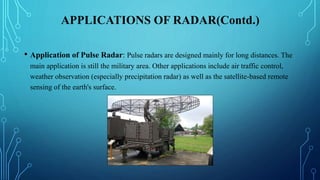
• Application of Pulse Radar: Pulse radars are designed mainly for long distances. The
main application is still the military area. Other applications include air traffic control,
weather observation (especially precipitation radar) as well as the satellite-based remote
sensing of the earth's surface.
MERITS AND DEMERITS OF RADAR
MERITS
• Radars can see through darkness, haze,
fog, rain, and snow.
• They can determine the range and
angle i.e., the location of the target very
accurately.
DEMERITS
• Radars cannot resolve in detail like the
human eye, especially at short
distances.
• They cannot recognize the color of the
target.
WHAT’S NEW IN RADAR TECHNOLOGY?
• In present scenario where war machines are made deliberately sleek. In fact
targets are made to have a very small area of cross section to evade radar detection
and are also painted in such a way that they cannot be detected as in stealth
aircraft.
• The United States has two aircrafts, the B-2 bomber and F-117 A fighter that
employs stealth technology to make aircraft “practically invisible” to radar. This
technology was under development for 20 years and in recent it was used during
attack on Osama-Bin-Laaden in Abbottabad(Pakistan).
Thank You!

Radar communication

  • 1.
    RADAR COMMUNICATION INTRODUCTION TORADAR By: Saurabh Kumar(0186ec131103)
  • 2.
    CONTENT • Introduction • WorkingPrinciple of RADAR • Types of RADAR • Applications of RADAR • Merits and Demerits of RADAR Technology • What’s new in RADAR Technology?
  • 3.
    INTRODUCTION • Radar(RAdio DetectionAnd Ranging) is a object detection system that uses radio waves to determine the range, angle or velocity of object. • A Radar system consist of a transmitter producing electromagnetic waves in the radio or microwaves domain, a transmitting antenna, a receiving antenna and a receiver and processor to determine properties of the objects. • Radar was developed secretly for military use by several nation in the period before and during World War II (1942).
  • 4.
    WORKING PRINCIPLE • Theelectronic principle on which radar operates is very similar to the principle of sound waves reflection. • RADAR uses electromagnetic energy pulses. Radio frequency energy is transmitted to and reflected energy returns to the radar set. Radar set uses these energy to determine the direction and distance of the reflecting object.
  • 5.
  • 6.
    BASIC DESIGN OFA RADAR SYSTEM
  • 7.
    CLASSIFICATION OF RADAR •Radar Systems are broadly classified into two basic categories. Primary Radar: 1. Pulse Radars. 2. Continuous Wave(CW)/Doppler Radars. Secondary Radar
  • 8.
    CW/DOPPLER RADAR • Ittransmits a continuous wave signal and is generally useful for Doppler Radar which utilizes the Doppler Effect(i.e. change in the wavelength of signal.) • A radar using the Doppler effect principle is known as a Doppler Radar which is useful in navigation over land and sea while navigation through aircraft or ship.
  • 9.
    CW/DOPPLER RADAR(Contd.) Here we willsee how Doppler radar looks and how it works?. ft Continuous Wave Doppler Radar Target Rx freq.  fr = (ft+fd) Doppler freq.  (ft- fd)
  • 10.
    PULSE RADAR • Incontext with CW radar, a pulse radar is more useful. • A pulse waveform, a train of narrow rectangular shaped pulses modulating a sine- wave carrier is transmitted as shown below. • The range or distance to the target is determined by measuring the time T taken by the pulse to travel to the target and return to the radar station. ToffTon Pulse modulated sine wave Range R for stationary target is given by: 2R= total distance(2 way) between radar and target. T= time taken by EM waves to cover a distance ‘2R’. C= velocity of light.
  • 11.
  • 12.
    APPLICATIONS OF RADAR •Continuous Wave Radar Application: U.S. Army soldier using a radar gun, an application of Doppler radar, to catch speeding violators. Doppler Radar for navigation and forecast
  • 13.
    APPLICATIONS OF RADAR(Contd.) •Application of Pulse Radar: Pulse radars are designed mainly for long distances. The main application is still the military area. Other applications include air traffic control, weather observation (especially precipitation radar) as well as the satellite-based remote sensing of the earth's surface.
  • 14.
    MERITS AND DEMERITSOF RADAR MERITS • Radars can see through darkness, haze, fog, rain, and snow. • They can determine the range and angle i.e., the location of the target very accurately. DEMERITS • Radars cannot resolve in detail like the human eye, especially at short distances. • They cannot recognize the color of the target.
  • 15.
    WHAT’S NEW INRADAR TECHNOLOGY? • In present scenario where war machines are made deliberately sleek. In fact targets are made to have a very small area of cross section to evade radar detection and are also painted in such a way that they cannot be detected as in stealth aircraft. • The United States has two aircrafts, the B-2 bomber and F-117 A fighter that employs stealth technology to make aircraft “practically invisible” to radar. This technology was under development for 20 years and in recent it was used during attack on Osama-Bin-Laaden in Abbottabad(Pakistan).
  • 16.

Editor's Notes

  • #4 Acronym by US navy Lieutenant Commander Samuel M. Tucker and F.R. Furth in November 1940